
EECE 340 Problems with Solutions, Spring 2011
American University of Beirut · Signals and Systems · 6 pages · Prof. Karim Kabalan · with solution

More EECE 340 files
- Problems Book · Spring 2020ProblemsView
- Problems with Solutions · Spring 2011Problems · with solutionView
- Exam 2 · Spring 2017ExamView
- Exam 1 Kabalan · Spring 2017ExamView
- Exam 2 · Spring 2016ExamView
- Homework 1 Solution · Spring 2016Homework · with solutionView
- Homework 2 · Spring 2016HomeworkView
- Homework 2 Solution · Spring 2016Homework · with solutionView
Show the text of this problems
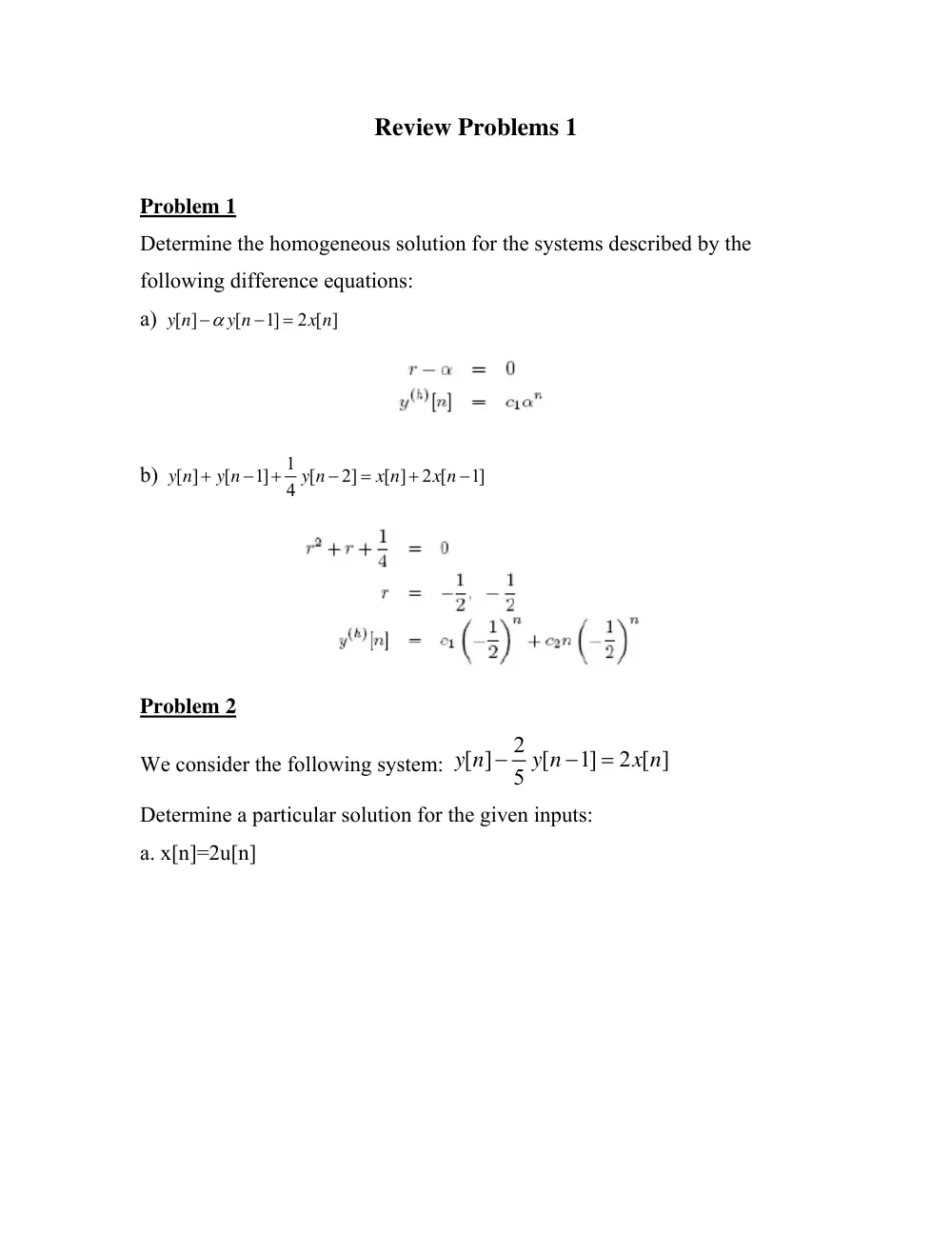
Review Problems 1
Problem 1
Determine the homogeneous solution for the systems described by the
following difference equations:
a) [ ]
[
1]
2 [ ]
y n
y n
x n
−α
−
=
b)
1
[ ]
[
1]
[
2]
[ ]
2 [
1]
4
y n
y n
y n
x n
x n
+
−
+
−
=
+
−
Problem 2
We consider the following system:
2
[ ]
[
1]
2 [ ]
5
y n
y n
x n
−
−
=
Determine a particular solution for the given inputs:
a. x[n]=2u[n]
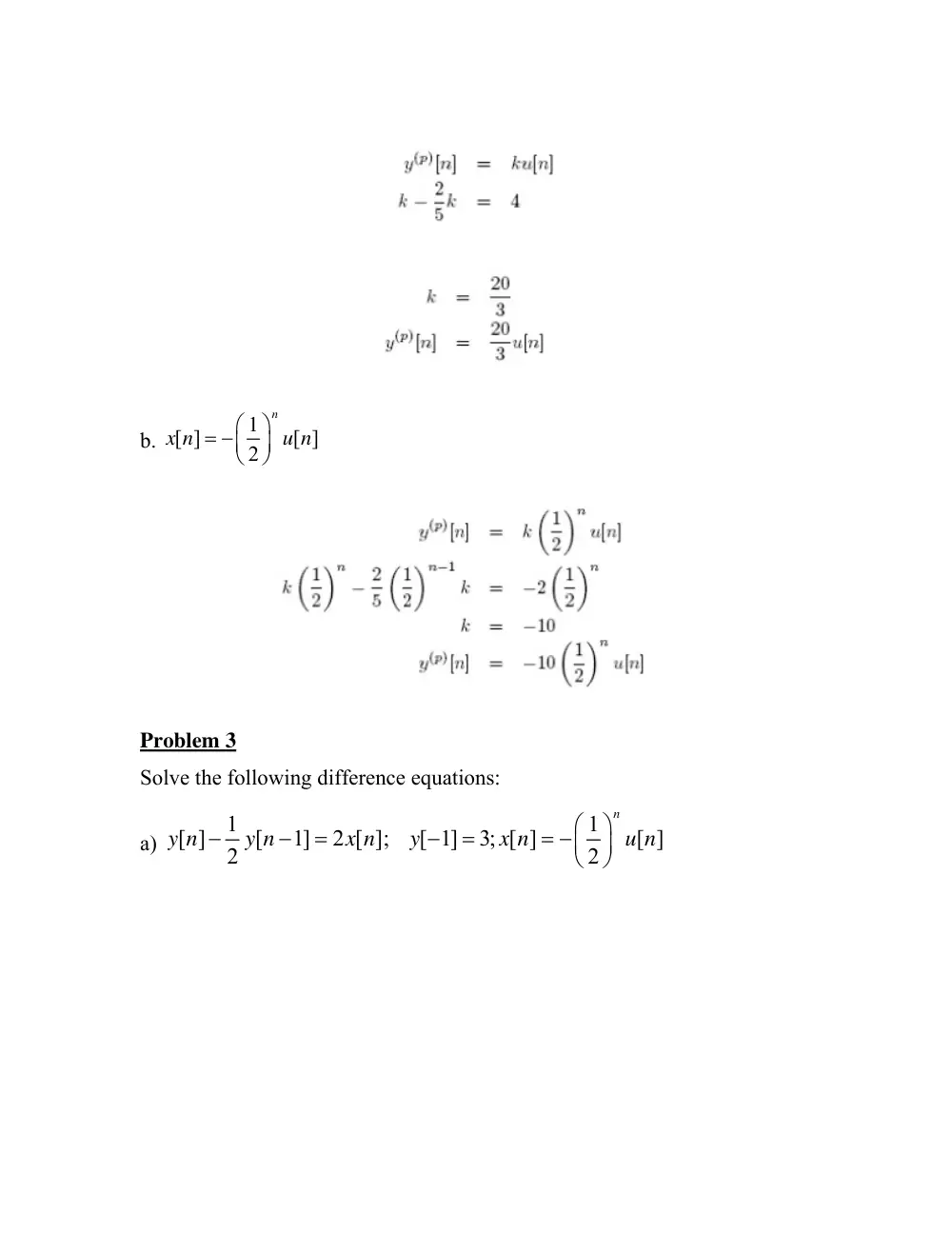
b.
1
[ ]
[ ]
2
n
x n
u n
⎛
⎞
= −⎜
⎟
⎝
⎠
Problem 3
Solve the following difference equations:
a)
1
1
[ ]
[
1]
2 [ ]; [ 1]
3; [ ]
[ ]
2
2
n
y n
y n
x n
y
x n
u n
⎛
⎞
−
−
=
−
=
= −⎜
⎟
⎝
⎠
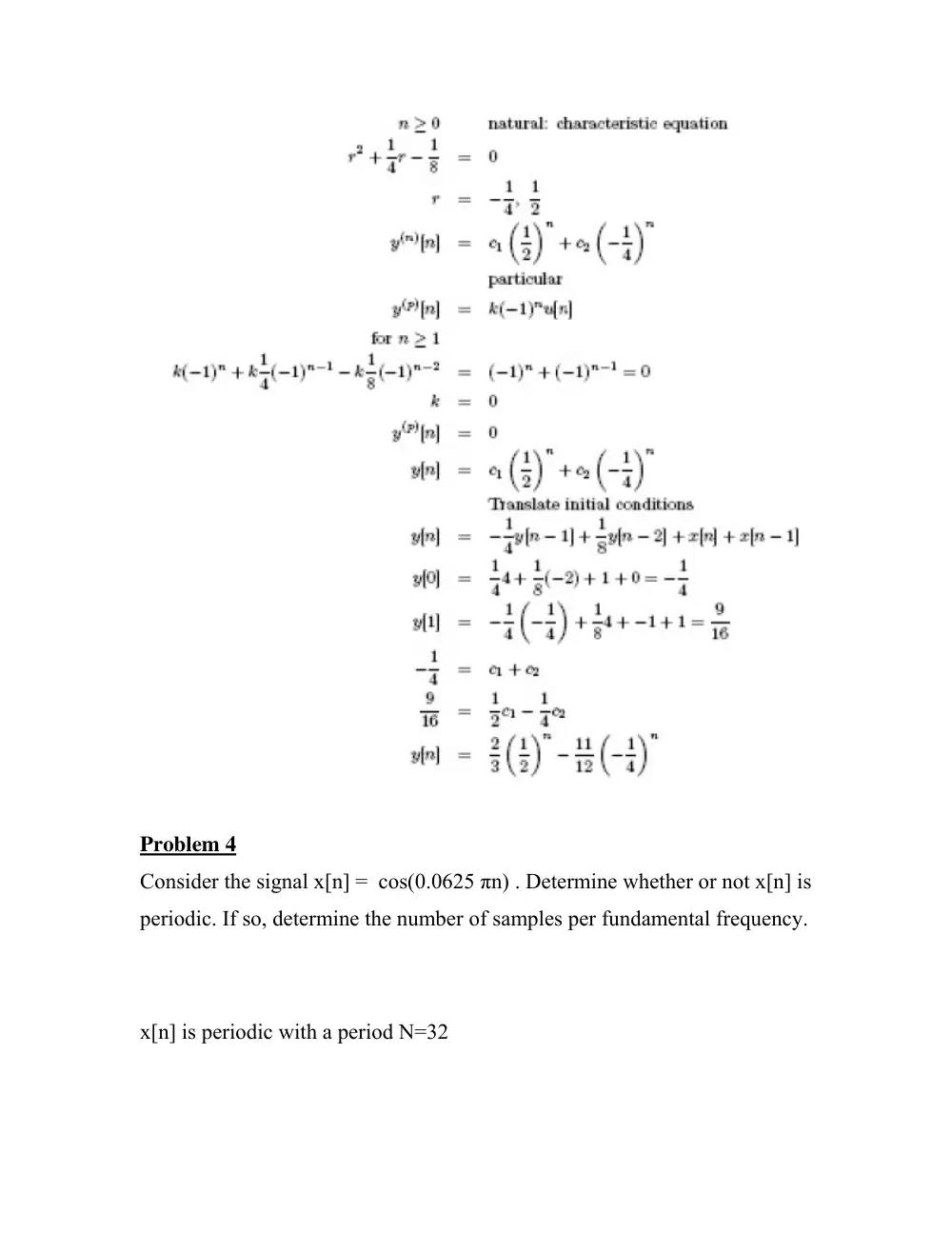
b)
( )
1
1
[ ]
[
1]
[
2]
[ ]
[
1]; [ 1]
4; [ 2]
2; [ ]
1
[ ]
4
8
n
y n
y n
y n
x n
x n
y
y
x n
u n
+
−
−
−
=
+
−
−
=
−
= −
= −
Problem 4
Consider the signal x[n] = cos(0.0625 πn) . Determine whether or not x[n] is
periodic. If so, determine the number of samples per fundamental frequency.
x[n] is periodic with a period N=32
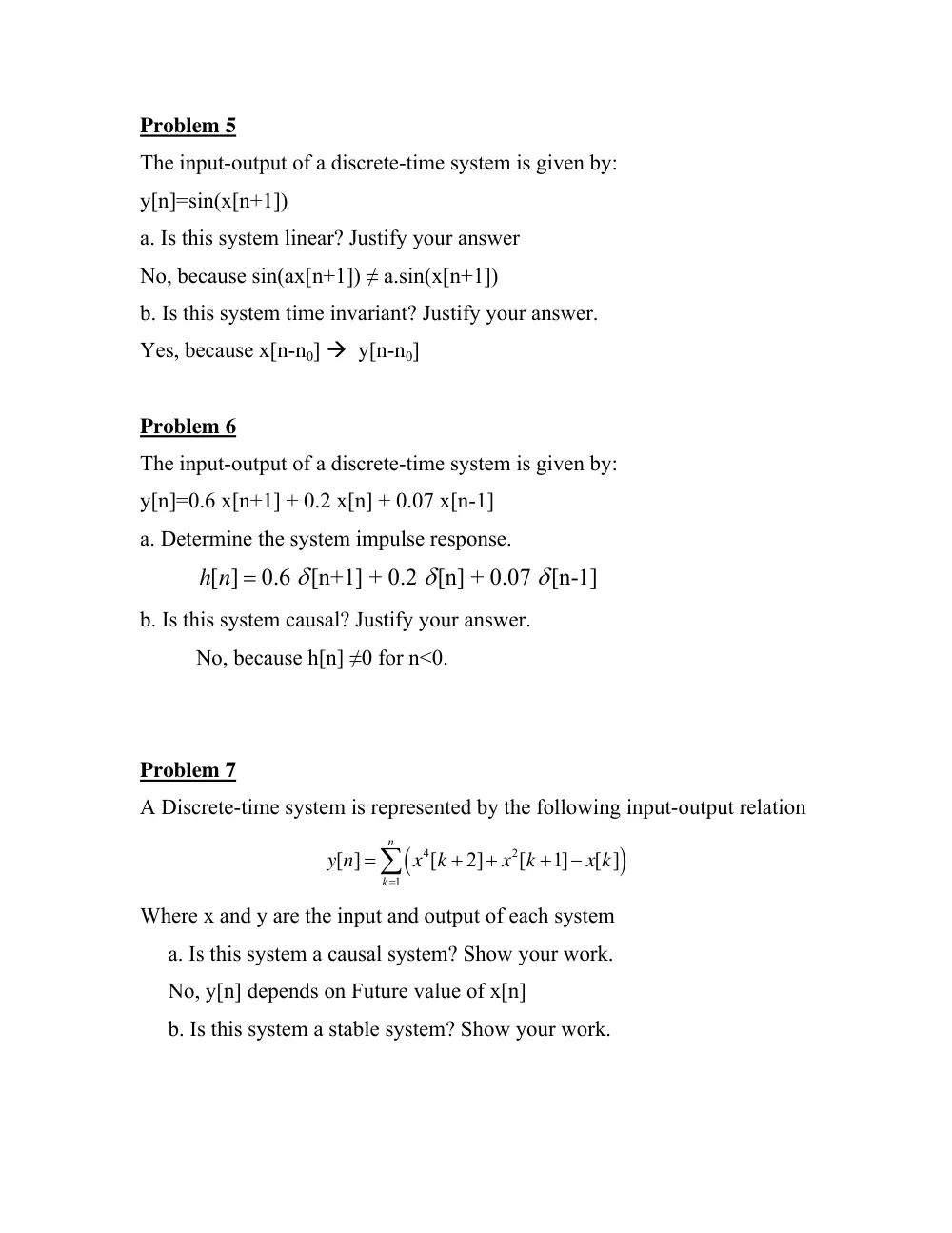
Problem 5
The input-output of a discrete-time system is given by:
y[n]=sin(x[n+1])
a. Is this system linear? Justify your answer
No, because sin(ax[n+1]) ≠ a.sin(x[n+1])
b. Is this system time invariant? Justify your answer.
Yes, because x[n-n0] � y[n-n0]
Problem 6
The input-output of a discrete-time system is given by:
y[n]=0.6 x[n+1] + 0.2 x[n] + 0.07 x[n-1]
a. Determine the system impulse response.
[ ]
0.6 [n+1] + 0.2 [n] + 0.07 [n-1]
h n
δ
δ
δ
=
b. Is this system causal? Justify your answer.
No, because h[n] ≠0 for n<0.
Problem 7
A Discrete-time system is represented by the following input-output relation
(
)
4
2
1
[ ]
[
2]
[
1]
[ ]
n
k
y n
x k
x k
x k
=
=
+
+
+
−
∑
Where x and y are the input and output of each system
a. Is this system a causal system? Show your work.
No, y[n] depends on Future value of x[n]
b. Is this system a stable system? Show your work.
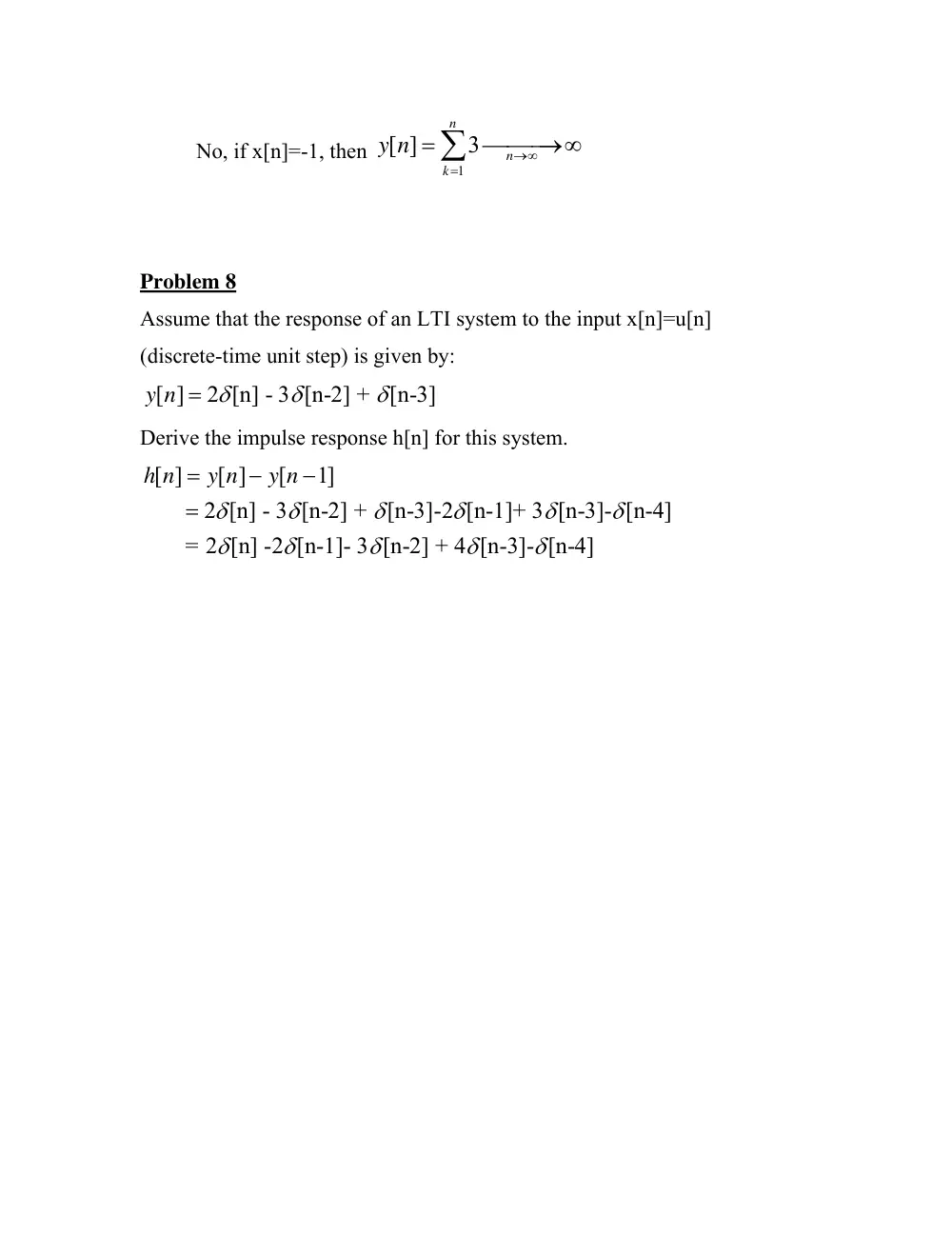
No, if x[n]=-1, then
1
[ ]
3
n
n
k
y n
→∞
=
=
⎯⎯⎯→∞
∑
Problem 8
Assume that the response of an LTI system to the input x[n]=u[n]
(discrete-time unit step) is given by:
[ ]
2 [n] - 3 [n-2] + [n-3]
y n
δ
δ
δ
=
Derive the impulse response h[n] for this system.
[ ]
[ ]
[
1]
2 [n] - 3 [n-2] + [n-3]-2 [n-1]+ 3 [n-3]- [n-4]
= 2 [n] -2 [n-1]- 3 [n-2] + 4 [n-3]- [n-4]
h n
y n
y n
δ
δ
δ
δ
δ
δ
δ
δ
δ
δ
δ
=
−
−
=