
EECE 433 Chapter 25, Spring 2012
American University of Beirut · Database Systems · 48 pages


Showing the first 10 of 48 pages. Download the PDF to see all of it.
More EECE 433 files
- Problems Chapter 3 · Spring 2012ChapterView
- Chapter 7 · Spring 2012ChapterView
- Chapter 8 · Spring 2012ChapterView
- Problems Chapter 1 & 2 · Spring 2012ChapterView
- Problems Chapter 5 · Spring 2012ChapterView
- Problems Chapter 6 Handout · Spring 2012ChapterView
- Chapter 19 · Spring 2012ChapterView
- Problems Chapter 4 · Spring 2012ChapterView
Show the text of this chapter
1
Overview of Data Warehouse
and OLAP Technology
Ch. 25
Hazem Hajj
Source: Data Mining Course Presentations
WHY DATA WAREHOUSE?
October 19, 2026
Data Mining: Concepts and
Techniques
2
October 19, 2026
Data Mining: Concepts and
Techniques
3
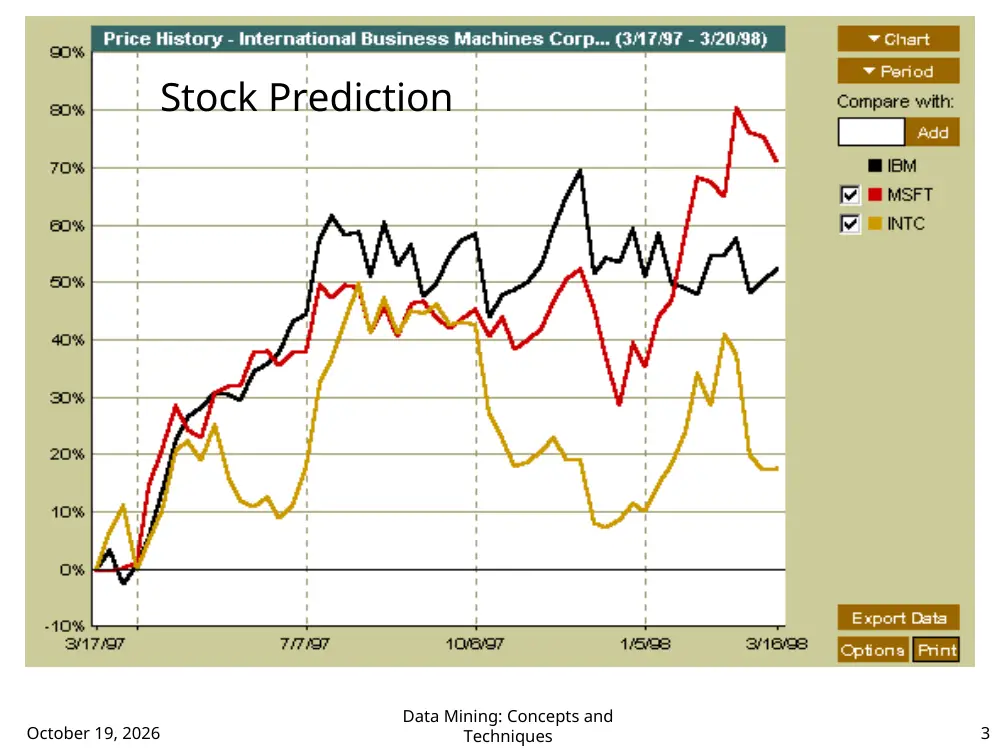
Stock Prediction
October 19, 2026
Mining and Searching Graphs in
Graph Databases
4
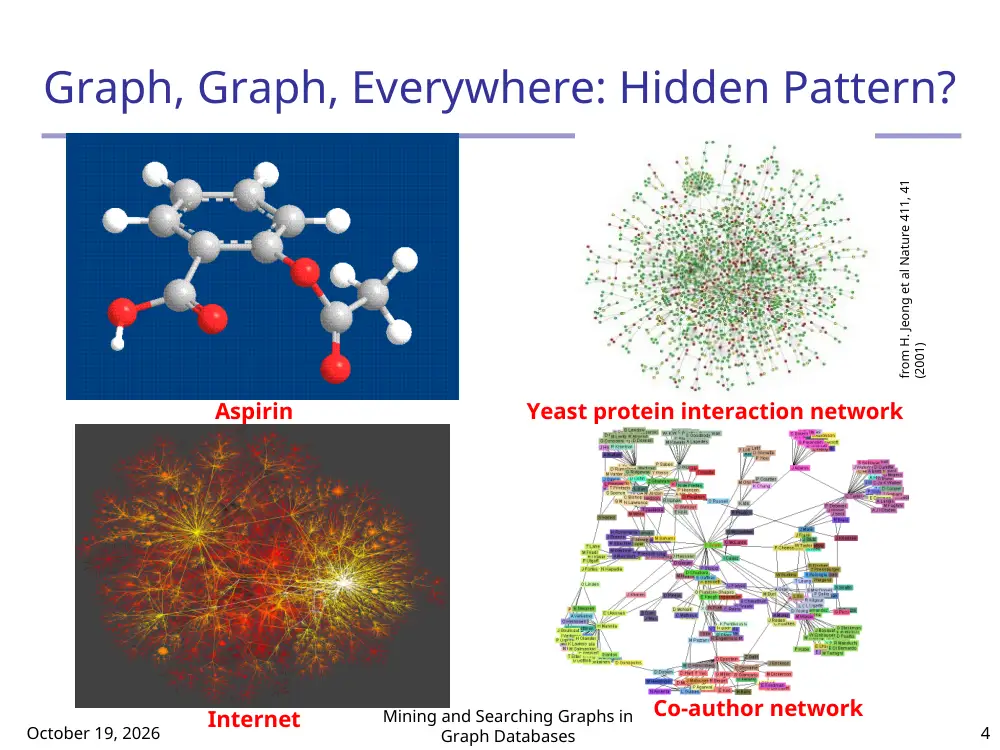
Graph, Graph, Everywhere: Hidden Pattern?
Aspirin
Yeast protein interaction network
from H. Jeong et al Nature 411, 41
(2001)
Internet
Co-author network
October 19, 2026
Data Mining: Concepts and Techniqu
es
5
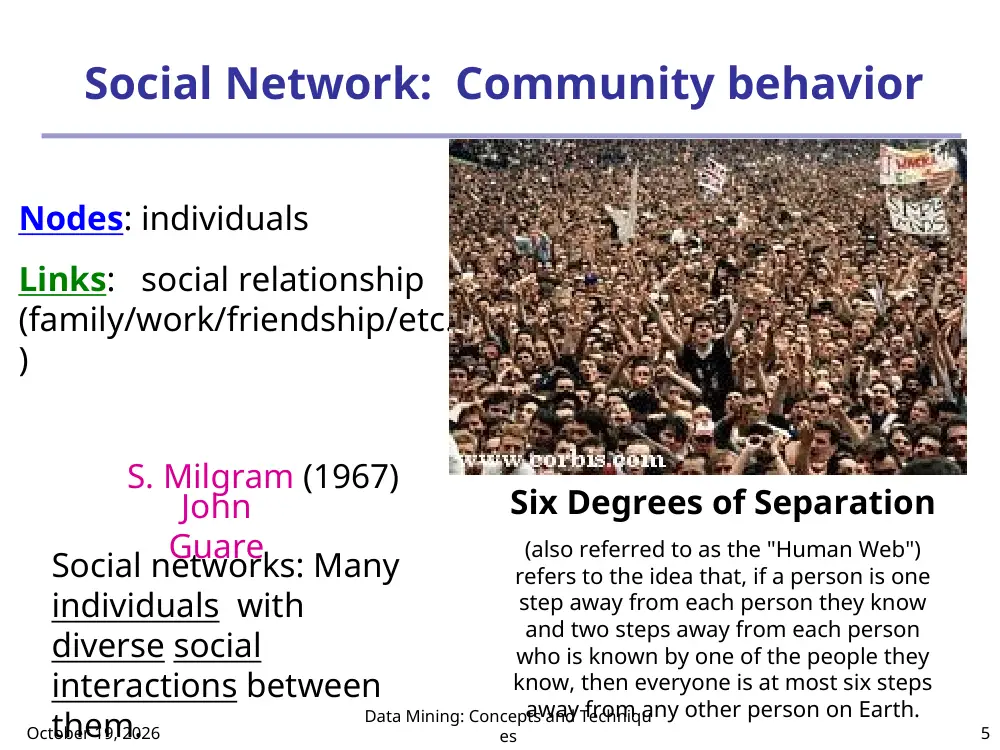
Social Network: Community behavior
Nodes: individuals
Links: social relationship
(family/work/friendship/etc.
)
S. Milgram (1967)
Social networks: Many
individuals with
diverse social
interactions between
them.
John
Guare
Six Degrees of Separation
(also referred to as the "Human Web")
refers to the idea that, if a person is one
step away from each person they know
and two steps away from each person
who is known by one of the people they
know, then everyone is at most six steps
away from any other person on Earth.
10/19/26
Data Mining: Principles and
Algorithms
6
WEB Search Engine – Two Rank
Functions
Web Pages
Meta Data
Forward
Index
Inverted
Index
Forward
Link
Backward Link
(Anchor Text)
Web Topology
Graph
Web Page Parser
Indexer
Anchor Text
Generator
Web Graph
Constructor
Importance Ranking
(Link Analysis)
Rank Functions
URL
Dictioanry
Term Dictionary
(Lexicon)
Search
Relevance Ranking
Ranking based on link
structure analysis
Similarity
based on
content or text
10/19/26
Data Mining: Principles and
Algorithms
7
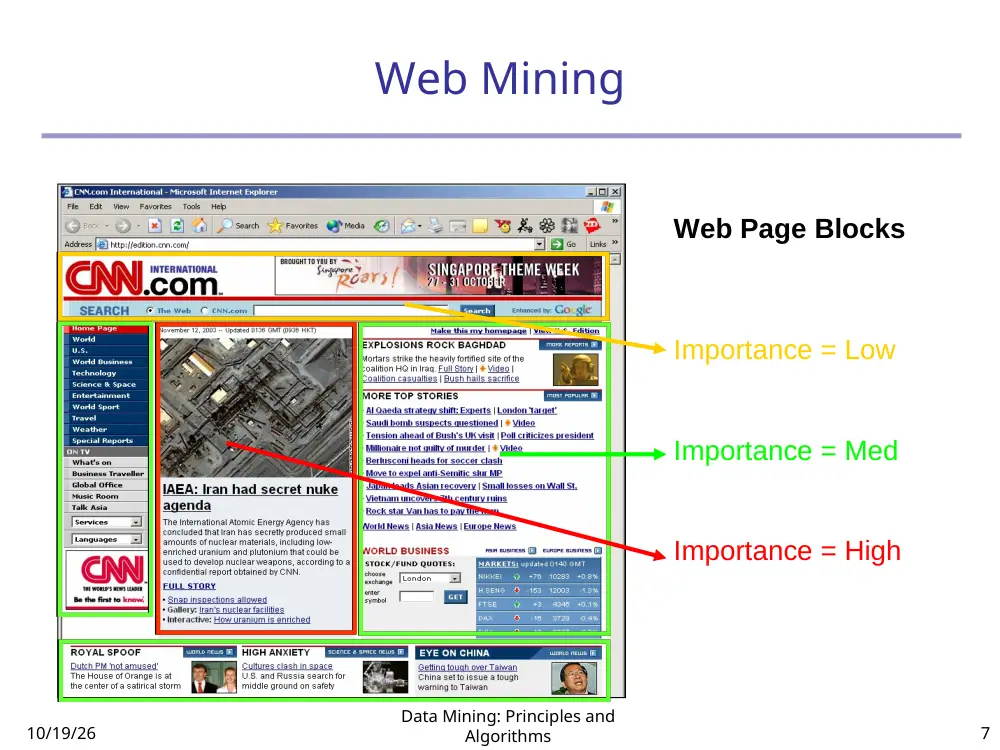
Web Mining
Importance = Med
Importance = Low
Importance = High
Web Page Blocks
October 19, 2026
Data Mining: Concepts and
Techniques
8
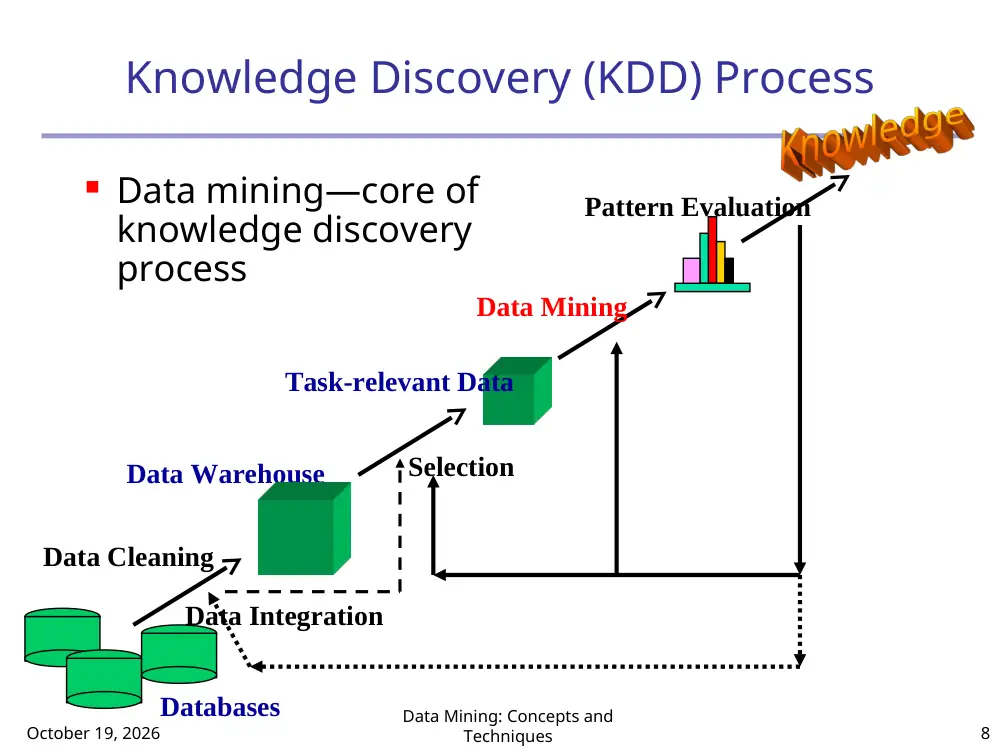
Knowledge Discovery (KDD) Process
Data mining—core of
knowledge discovery
process
Data Cleaning
Data Integration
Databases
Data Warehouse
Task-relevant Data
Selection
Data Mining
Pattern Evaluation
October 19, 2026
Data Mining: Concepts and
Techniques
9
Architecture: Typical Data Mining System
data cleaning, integration, and selection
Database or Data Warehouse Server
Data Mining Engine
Pattern Evaluation
Graphical User Interface
Know
ledge
-Base
Database
Data
Warehouse
World-Wide
Web
Other Info
Repositories
OLAP
October 19, 2026
Data Mining: Concepts and
Techniques
10
Data Warehousing and OLAP
Technology: An Overview
What is a data warehouse?: Definition, OLAP VS
OLTP,
A multi-dimensional data model
Data warehouse architecture
Data warehouse implementation
From data warehousing to data mining
October 19, 2026
Data Mining: Concepts and
Techniques
11
What is Data Warehouse?
“A data warehouse is a subject-oriented,
integrated, time-variant, and nonvolatile
collection of data in support of management’s
decision-making process.”—W. H. Inmon
October 19, 2026
Data Mining: Concepts and
Techniques
12
Data Warehouse—Subject-Oriented
Organized around major subjects, such as sales
(versus operational DB that may be storing every
single transaction that happened in a store: time,
teller, product items, barcode, price per item,
customer info,…)
Focusing on the modeling and analysis of data for
decision makers,
not on daily operations or transaction processing
(e.g.: sales/year, sales/branch,….)
October 19, 2026
Data Mining: Concepts and
Techniques
13
Data Warehouse—Integrated
Constructed by integrating multiple, heterogeneous
data sources
relational databases, flat files, on-line transaction
records
Data cleaning and data integration techniques are
applied.
Ensure consistency among different data sources
E.g., Hotel price: currency, tax, breakfast covered, etc.
When data is moved to the warehouse, it is
converted.
October 19, 2026
Data Mining: Concepts and
Techniques
14
Data Warehouse—Time Variant
The time horizon for the data warehouse is
significantly longer than that of operational systems
Data warehouse data: provide information from a
historical perspective (e.g., past 5-10 years)
Every key structure in the data warehouse Contains
an element of time, explicitly or implicitly
October 19, 2026
Data Mining: Concepts and
Techniques
15
Data Warehouse—Nonvolatile
A physically separate store of data transformed from
the operational environment
Requires two operations in data accessing:
loading of data and access of data
October 19, 2026
Data Mining: Concepts and
Techniques
16
Data Warehouse vs. Heterogeneous
DBMS
Traditional heterogeneous DB integration: A query driven
approach
When a query is posed to a client site, a meta-dictionary is
used to translate the query into queries appropriate for
individual heterogeneous sites involved, and the results are
integrated into a global answer set
Data warehouse: update-driven, high performance
Information from heterogeneous sources is integrated in
advance and stored in warehouses for direct query and
analysis
October 19, 2026
Data Mining: Concepts and
Techniques
17
Data Warehouse vs. Operational DBMS
OLTP (on-line transaction processing)
Major task of traditional relational DBMS
Day-to-day operations.
Example at Intel: OLTP stores equipment and wafer data. (Not overall
process health)
OLAP (on-line analytical processing)
Major task of data warehouse system
Data analysis and decision making
Example at Intel: WIPT (Wip Turns)
Distinct features (OLTP vs. OLAP):
Data contents: current, detailed vs. historical, consolidated
Database design: ER vs. star + subject
October 19, 2026
Data Mining: Concepts and
Techniques
18
OLTP vs. OLAP
OLTP
OLAP
users
clerk, IT professional
knowledge worker
function
day to day operations
decision support
DB design
application-oriented
subject-oriented
data
current, up-to-date
detailed, flat relational
isolated
historical,
summarized, multidimensional
integrated, consolidated
usage
repetitive
ad-hoc
access
read/write
index/hash on prim. key
lots of scans
unit of work
short, simple transaction
complex query
# records accessed
tens
millions
#users
thousands
hundreds
DB size
100MB-GB
100GB-TB
metric
transaction throughput
query throughput, response
October 19, 2026
Data Mining: Concepts and
Techniques
19
Data Warehousing and OLAP
Technology: An Overview
What is a data warehouse?
A multi-dimensional data model: Schema design,
Cubes, and typical OLAP
Data warehouse architecture
Data warehouse implementation
From data warehousing to data mining
October 19, 2026
Data Mining: Concepts and
Techniques
20
From Tables and Spreadsheets to Data
Cubes
A data warehouse is based on a multidimensional data model
which views data in the form of a data cube
A data cube, such as sales, allows data to be modeled and
viewed in multiple dimensions
Dimension tables, such as item (item_name, brand, type), or
time(day, week, month, quarter, year)
Fact table contains measures (such as dollars_sold) and
keys to each of the related dimension tables
In data warehousing literature, an n-D base cube is called a base
cuboid. The top most 0-D cuboid, which holds the highest-level
of summarization, is called the apex cuboid. The lattice of
cuboids forms a data cube.
October 19, 2026
Data Mining: Concepts and
Techniques
21
Cube: A Lattice of Cuboids
Aggregation with GROUP BY
time,item
time,item,location
time, item, location, supplier
all
time
item
location
supplier
time,location
time,supplier
item,location
item,supplier
location,supplier
time,item,supplier
time,location,supplier
item,location,supplier
0-D(apex) cuboid
1-D cuboids
2-D cuboids
3-D cuboids
4-D(base) cuboid
October 19, 2026
Data Mining: Concepts and
Techniques
22
Conceptual Modeling of Data Warehouses
Modeling data warehouses: dimensions & measures
Star schema: A fact table in the middle connected to
a set of dimension tables
Snowflake schema: A refinement of star schema
where some dimensional hierarchy is normalized
into a set of smaller dimension tables, forming a
shape similar to snowflake
Fact constellations: Multiple fact tables share
dimension tables, viewed as a collection of stars,
therefore called galaxy schema or fact constellation
October 19, 2026
Data Mining: Concepts and
Techniques
23
Example of Star Schema
time_key
day
day_of_the_week
month
quarter
year
time
location_key
street
city
state_or_province
country
location
Sales Fact Table
time_key
item_key
branch_key
location_key
units_sold
dollars_sold
avg_sales
Measures
item_key
item_name
brand
type
supplier_type
item
branch_key
branch_name
branch_type
branch
October 19, 2026
Data Mining: Concepts and
Techniques
24
Example of Snowflake Schema
time_key
day
day_of_the_week
month
quarter
year
time
location_key
street
city_key
location
Sales Fact Table
time_key
item_key
branch_key
location_key
units_sold
dollars_sold
avg_sales
Measures
item_key
item_name
brand
type
supplier_key
item
branch_key
branch_name
branch_type
branch
supplier_key
supplier_type
supplier
city_key
city
state_or_province
country
city
October 19, 2026
Data Mining: Concepts and
Techniques
25
Example of Fact Constellation
time_key
day
day_of_the_week
month
quarter
year
time
location_key
street
city
province_or_state
country
location
Sales Fact Table
time_key
item_key
branch_key
location_key
units_sold
dollars_sold
avg_sales
Measures
item_key
item_name
brand
type
supplier_type
item
branch_key
branch_name
branch_type
branch
Shipping Fact Table
time_key
item_key
shipper_key
from_location
to_location
dollars_cost
units_shipped
shipper_key
shipper_name
location_key
shipper_type
shipper
October 19, 2026
Data Mining: Concepts and
Techniques
26
Multidimensional Data
Sales volume as a function of product, month,
and region
Product
Region
Month
Dimensions: Product, Location, Time
Hierarchical summarization paths
Industry Region Year
Category Country Quarter
Product City Month Week
Office Day
October 19, 2026
Data Mining: Concepts and
Techniques
27
A Sample Data Cube
Total annual sales
of TV in U.S.A.
Date
Product
Country
sum
sum
TV
VCR
PC
1Qtr
2Qtr
3Qtr
4Qtr
U.S.A
Canada
Mexico
sum
October 19, 2026
Data Mining: Concepts and
Techniques
28
Cuboids Corresponding to the Cube
all
product
date
country
product,date
product,country
date, country
product, date, country
0-D(apex) cuboid
1-D cuboids
2-D cuboids
3-D(base) cuboid
October 19, 2026
Data Mining: Concepts and
Techniques
29
Browsing a Data Cube
Visualization
OLAP capabilities
Interactive
manipulation
October 19, 2026
Data Mining: Concepts and
Techniques
30
Typical OLAP Operations
Roll up (drill-up): summarize data
by climbing up hierarchy or by dimension reduction
Drill down (roll down): reverse of roll-up
from higher level summary to lower level summary or
detailed data, or introducing new dimensions
Slice and dice: slice: select on one dimension of the cube; dice:
select on two or more dimensions.
Pivot (rotate):
reorient the cube, visualization, 3D to series of 2D planes
Other operations
drill across: involving (across) more than one fact table
drill through: through the bottom level of the cube to its back-end
relational tables (using SQL)
October 19, 2026
Data Mining: Concepts and
Techniques
31
Fig. 3.10 Typical
OLAP Operations
October 19, 2026
Data Mining: Concepts and
Techniques
32
Data Warehousing and OLAP
Technology: An Overview
What is a data warehouse?
A multi-dimensional data model
Data warehouse System architecture, Development
approach and Back-end tools
Data warehouse implementation
From data warehousing to data mining
October 19, 2026
Data Mining: Concepts and
Techniques
33
Data Warehouse: A Multi-Tiered Architecture
Data Warehouse: A Multi-Tiered Architecture
Data
Warehouse
Extract
Transform
Load
Refresh
OLAP Engine
Analysis
Query
Reports
Data mining
Monitor
&
Integrator
Metadata
Data Sources
Front-End Tools
Serve
Data Marts
Operational
DBs
Other
sources
Data Storage
OLAP Server
October 19, 2026
Data Mining: Concepts and
Techniques
34
Three Data Warehouse Models
Enterprise warehouse
collects all of the information about subjects
spanning the entire organization
Data Mart
a subset of corporate-wide data that is of value to a
specific groups of users. Its scope is confined to
specific, selected groups, such as marketing data
mart
Virtual warehouse
A set of views over operational databases
Only some of the possible summary views may be
materialized
October 19, 2026
Data Mining: Concepts and
Techniques
35
Data Warehouse
Development: A
Recommended Approach
Define a high-level corporate data model
Data
Mart
Data
Mart
Distributed
Data Marts
Multi-Tier Data
Warehouse
Enterprise
Data
Warehouse
Model refinement
Model refinement
October 19, 2026
Data Mining: Concepts and
Techniques
36
Data Warehouse Back-End Tools and
Utilities
Data extraction
get data from multiple, heterogeneous, and external
sources
Data cleaning
detect errors in the data and rectify them when possible
Data transformation
convert data from legacy or host format to warehouse
format
Load
sort, summarize, consolidate, compute views, check
integrity, and build indicies and partitions
Refresh
propagate the updates from the data sources to the
warehouse
October 19, 2026
Data Mining: Concepts and
Techniques
37
Data Warehousing and OLAP
Technology: An Overview
What is a data warehouse?
A multi-dimensional data model
Data warehouse architecture
Data warehouse implementation: Efficient Cube
computations
From data warehousing to data mining
October 19, 2026
Data Mining: Concepts and
Techniques
38
Efficient Data Cube Computation
Data cube can be viewed as a lattice of cuboids
The bottom-most cuboid is the base cuboid
The top-most cuboid (apex) contains only one cell
How many cuboids in an n-dimensional cube with L
levels?
Materialization of data cube
Materialize every (cuboid) (full materialization), none
(no materialization), or some (partial materialization)
Selection of which cuboids to materialize
Based on size, sharing, access frequency, etc.
)
1
1
(
n
i
Li
T
October 19, 2026
Data Mining: Concepts and
Techniques
39
Cube Operation
Cube definition and computation in DMQL
define cube sales[item, city, year]: sum(sales_in_dollars)
compute cube sales
Transform it into a SQL-like language (with a new operator
cube by, introduced by Gray et al.’96)
SELECT item, city, year, SUM (amount)
FROM SALES
CUBE BY item, city, year
Need compute the following Group-Bys
(date, product, customer),
(date,product),(date, customer), (product, customer),
(date), (product), (customer)
()
(item)
(city)
()
(year)
(city, item)
(city, year)
(item, year)
(city, item, year)
October 19, 2026
Data Mining: Concepts and
Techniques
40
Iceberg Cube
Computing only the cuboid cells whose count
or other aggregates satisfying the condition
like
HAVING COUNT(*) >= minsup
Motivation
Only a small portion of cube cells may be “above the
water’’ in a sparse cube
Only calculate “interesting” cells—data above certain
threshold
Avoid explosive growth of the cube
Suppose 100 dimensions, only 1 base cell. How many
aggregate cells if count >= 1? What about count >= 2?
October 19, 2026
Data Mining: Concepts and
Techniques
41
Data Warehousing and OLAP
Technology: An Overview
What is a data warehouse?
A multi-dimensional data model
Data warehouse architecture
Data warehouse implementation
From data warehousing to data mining
October 19, 2026
Data Mining: Concepts and
Techniques
42
Data Warehouse Usage
Three kinds of data warehouse applications
Information processing
supports querying, basic statistical analysis, and reporting using
crosstabs, tables, charts and graphs
Analytical processing
multidimensional analysis of data warehouse data
supports basic OLAP operations, slice-dice, drilling, pivoting
Some Data mining
knowledge discovery from hidden patterns
supports associations, constructing analytical models, performing
classification and prediction, and presenting the mining results using
visualization tools
More DM may be needed for complex data or more automated
analysis.
October 19, 2026
Data Mining: Concepts and
Techniques
43
From On-Line Analytical Processing (OLAP)
to On Line Analytical Mining (OLAM)
Why online analytical mining?
High quality of data in data warehouses
DW contains integrated, consistent, cleaned data
Available information processing structure
surrounding data warehouses
ODBC, Web accessing, service facilities, reporting
and OLAP tools
OLAP-based exploratory data analysis
Mining with drilling, dicing, pivoting, etc.
On-line selection of data mining functions
Integration and swapping of multiple mining
functions, algorithms, and tasks
October 19, 2026
Data Mining: Concepts and
Techniques
44
An OLAM System Architecture
Data
Warehouse
Meta Data
MDDB
OLAM
Engine
OLAP
Engine
User GUI API
Data Cube API
Database API
Data cleaning
Data integration
Layer3
OLAP/OLAM
Layer2
MDDB
Layer1
Data
Repository
Layer4
User Interface
Filtering&Integration
Filtering
Databases
Mining query
Mining result
October 19, 2026
Data Mining: Concepts and
Techniques
45
Data Warehousing and OLAP
Technology: An Overview
What is a data warehouse?
A multi-dimensional data model
Data warehouse architecture
Data warehouse implementation
From data warehousing to data mining
Summary
October 19, 2026
Data Mining: Concepts and
Techniques
46
Key notes about Data Warehouse and OLAP
Technology
Why data warehousing?
A multi-dimensional model of a data warehouse
Star schema, snowflake schema, fact constellations
A data cube consists of dimensions & measures
OLAP operations: drilling, rolling, slicing, dicing and pivoting
Data warehouse architecture
OLAP servers: ROLAP, MOLAP, HOLAP
Efficient computation of data cubes
Partial vs. full vs. no materialization
Indexing OALP data: Bitmap index and join index
OLAP query processing
From OLAP to OLAM (on-line analytical mining)
October 19, 2026
Data Mining: Concepts and
Techniques
47
References (I)
S. Agarwal, R. Agrawal, P. M. Deshpande, A. Gupta, J. F. Naughton, R.
Ramakrishnan, and S. Sarawagi. On the computation of multidimensional
aggregates. VLDB’96
D. Agrawal, A. E. Abbadi, A. Singh, and T. Yurek. Efficient view maintenance in data
warehouses. SIGMOD’97
R. Agrawal, A. Gupta, and S. Sarawagi. Modeling multidimensional databases.
ICDE’97
S. Chaudhuri and U. Dayal. An overview of data warehousing and OLAP
technology. ACM SIGMOD Record, 26:65-74, 1997
E. F. Codd, S. B. Codd, and C. T. Salley. Beyond decision support. Computer World,
27, July 1993.
J. Gray, et al. Data cube: A relational aggregation operator generalizing group-by,
cross-tab and sub-totals. Data Mining and Knowledge Discovery, 1:29-54, 1997.
A. Gupta and I. S. Mumick. Materialized Views: Techniques, Implementations, and
Applications. MIT Press, 1999.
J. Han. Towards on-line analytical mining in large databases. ACM SIGMOD Record,
27:97-107, 1998.
V. Harinarayan, A. Rajaraman, and J. D. Ullman. Implementing data cubes
efficiently. SIGMOD’96
October 19, 2026
Data Mining: Concepts and
Techniques
48
References (II)
C. Imhoff, N. Galemmo, and J. G. Geiger. Mastering Data Warehouse Design:
Relational and Dimensional Techniques. John Wiley, 2003
W. H. Inmon. Building the Data Warehouse. John Wiley, 1996
R. Kimball and M. Ross. The Data Warehouse Toolkit: The Complete Guide to
Dimensional Modeling. 2ed. John Wiley, 2002
P. O'Neil and D. Quass. Improved query performance with variant indexes.
SIGMOD'97
Microsoft. OLEDB for OLAP programmer's reference version 1.0. In
http://www.microsoft.com/data/oledb/olap, 1998
A. Shoshani. OLAP and statistical databases: Similarities and differences. PODS’00.
S. Sarawagi and M. Stonebraker. Efficient organization of large multidimensional
arrays. ICDE'94
OLAP council. MDAPI specification version 2.0. In
http://www.olapcouncil.org/research/apily.htm, 1998
E. Thomsen. OLAP Solutions: Building Multidimensional Information Systems. John
Wiley, 1997
P. Valduriez. Join indices. ACM Trans. Database Systems, 12:218-246, 1987.
J. Widom. Research problems in data warehousing. CIKM’95.