
EECE 460 Homework, Spring 2007
American University of Beirut · Control Systems · 6 pages


More EECE 460 files
Show the text of this homework
F. Mrad EECE 460 Spring 2007
Homework # 1 Solution (Exercises 3.7, 8, 9, 11 & 14)
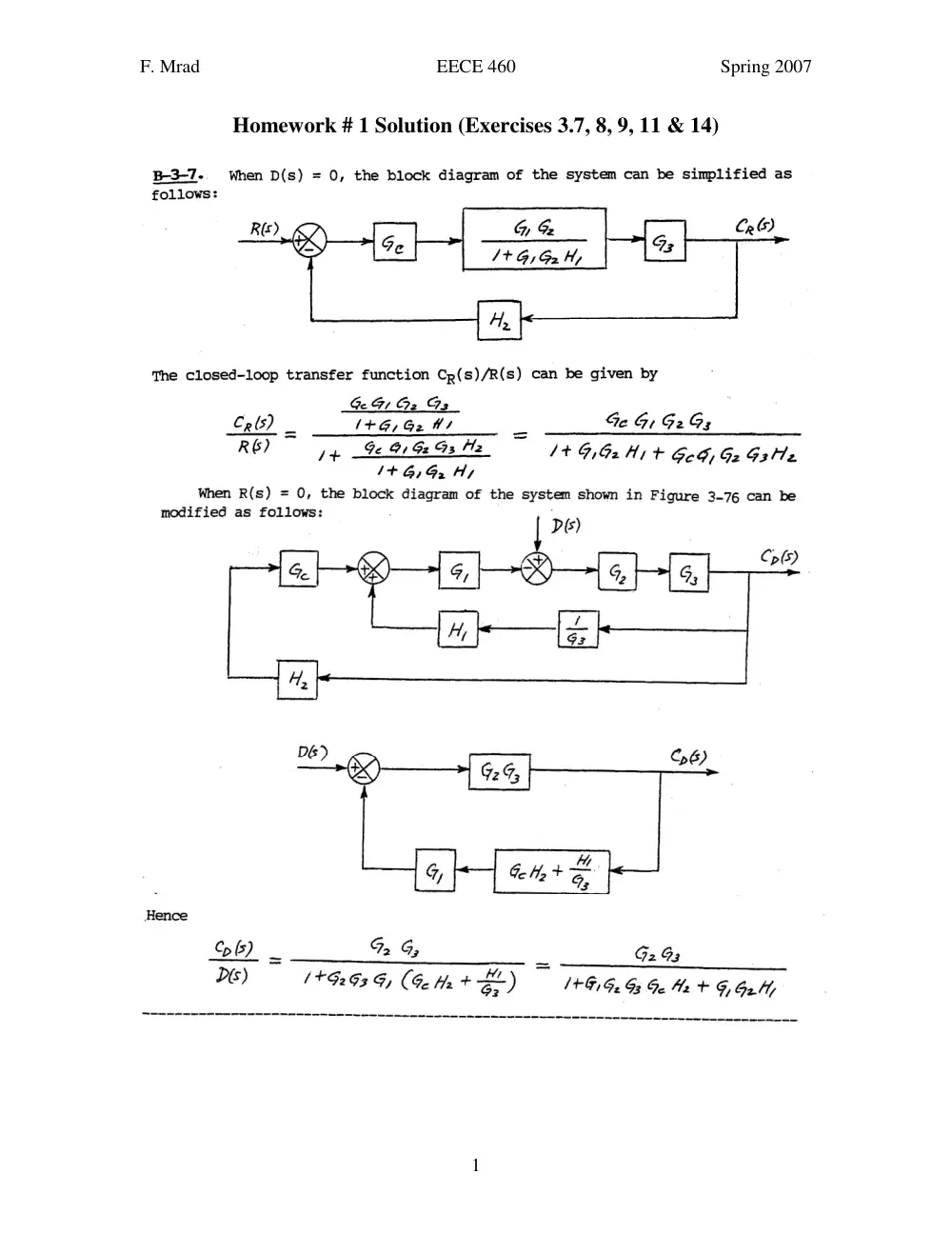
B-3-7-. When D(s) = 0, the block diagram of the system can be simplified as
follows:
The closed-loop transfer function Cp(s)/R(s) can be given by
Ge Gr Ge Ge
Crls) _ 1+G,G62 4 _ Ge Gi Ga Gs
R6) pe 92 Gt G2 Gs Ha /t GjG2H1+ Ge, G2 Gate
1+ GiGa Hy
When R(s) = 0, the block diagram of the system shown in Figure 3-76 can be
modified as follows: ; ;
| DG)
Ge +|4,| +L)
Ce)
Hence
Sb) _ Go G; Go Gs
I
DE) (+6293 Gy (Ge th + HE '+ GG. Gz Ge He + G, Gal
F. Mrad EECE 460 Spring 2007
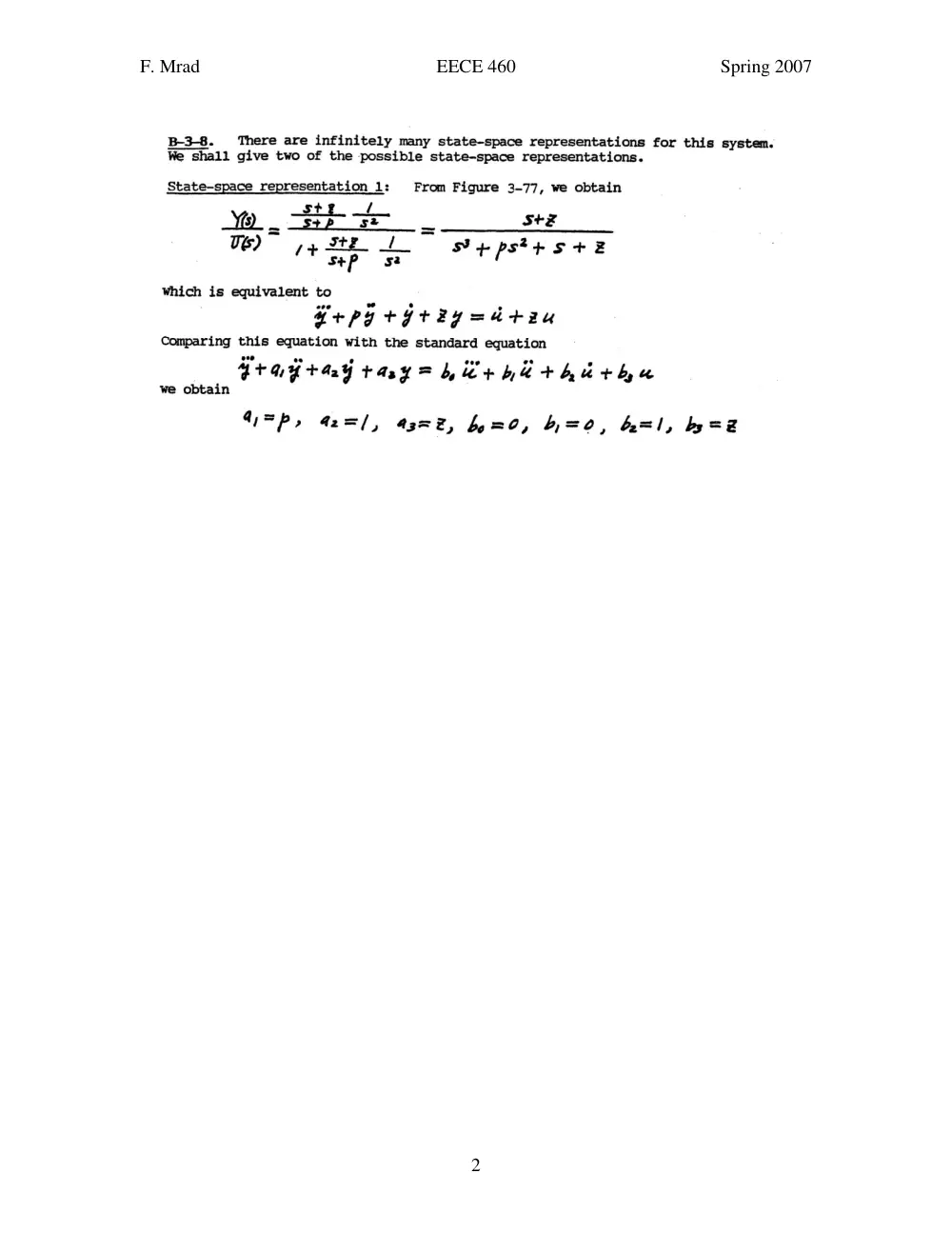
B3-8. There are infinitely many state-space representations for this system.
We shall give two of the possible state-space representations.
State-space tr 1: From Figure 3-77, we obtain
YO. a Stz
uN 2
6) +e £ Sp pstpsreZ
which is equivalent to
Yr pyr ytzysadrzu
Comparing this equation with the standard equation
Gt tay t4ay= dt hbathithn
we obtain
=p, 42=/, 43= 2, be =O, 4=0, b= 1, by =z
F. Mrad EECE 460 Spring 2007
Define
%) =9- fot
X= Y- fp ~fUu=%,-fa
% =, ~ far
where
fo = be =o
Aah ~4, fo =0
fz = b.- 4, fy -42 fo =/
fs = b3 — 4% fa 4a By 43 fe = F-p
Then, state-space equations can be given by
ep fe ¢ Oily) 14
4] =] 9 Qe / |e] +] Ba | ee
% -z -/ —p 3 Bs
%
yuls o Olle + faX
X3
or
4 J / oO x o
RIl=) oO. hhel + /
4%] |-? -/ -- Ile z~p
&
x
yall 0 Olle
%
State-space representation 2: Since
St+2 = StPt+z-p = /+ r-P
S+pP S+p S+p
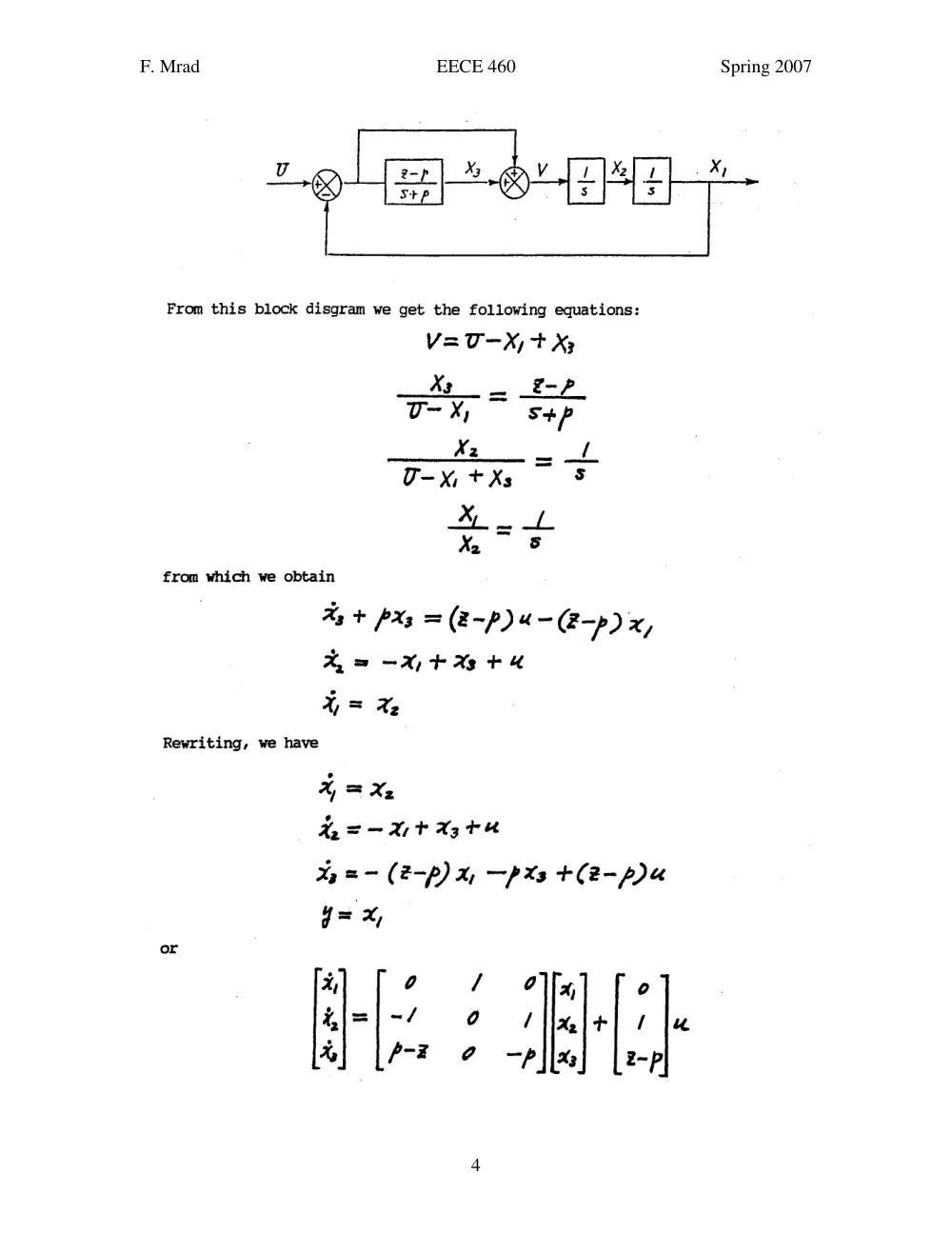
we can redraw the block diagram as shown below.
F. Mrad EECE 460 Spring 2007
U e-p | % VIL
“se O41
From this block disgram we get the following equations:
Va=0-X, + x3
X3 = 2-?
U- xX; S+P
—_ *~2 -
0-X, + Xs s
* a
Xo s
from which we obtain
4a + pXs = (2-P)4-@-p) x,
Xa MA +H
% = 22
Rewriting, we have
%, = 2%
= Ut AztH
Xy = — (2-p) X, —p%s +(2-p)a
= %,
4, Qo ff OTTx, 0
4 =} -/ 0 / ait] / [4
%| [P-? 9 —plixg| | 2- P
F. Mrad
EECE 460
%
= C7 Qo og] XR
%
Spring 2007
B39. eee oy .
a+sy+2gaX%
Define
%) = 4
%=%
%=Y
Then
%t3t3 + 2%=K
LHX
Xam
or
x o ft On a
“I=]° 0 Sfx tol”
4] fo -2 3G} [7
%
a=[/ © o]l%
a3
B-3-11
A=
we
[Fc]. a[2], ee a
The transfer function G(s) of the system is given by
a= cerarany al i) ]
-3
/ stl -/ 2
= [’ 2] SS
(S+5)(s4/) +3 3 sts | |S
_ / [v 2] 25-3 ] _ _ /254+59
~ St4+ 65th SS+3/ S*+6St+
A MATLAB solution to this problem is given below.
A=[5 -13 -1])
B= [2;5];
C=[l 2];
D=0;
(num, den] = ss2tf{A,B,C,D)
F. Mrad EECE 460 Spring 2007
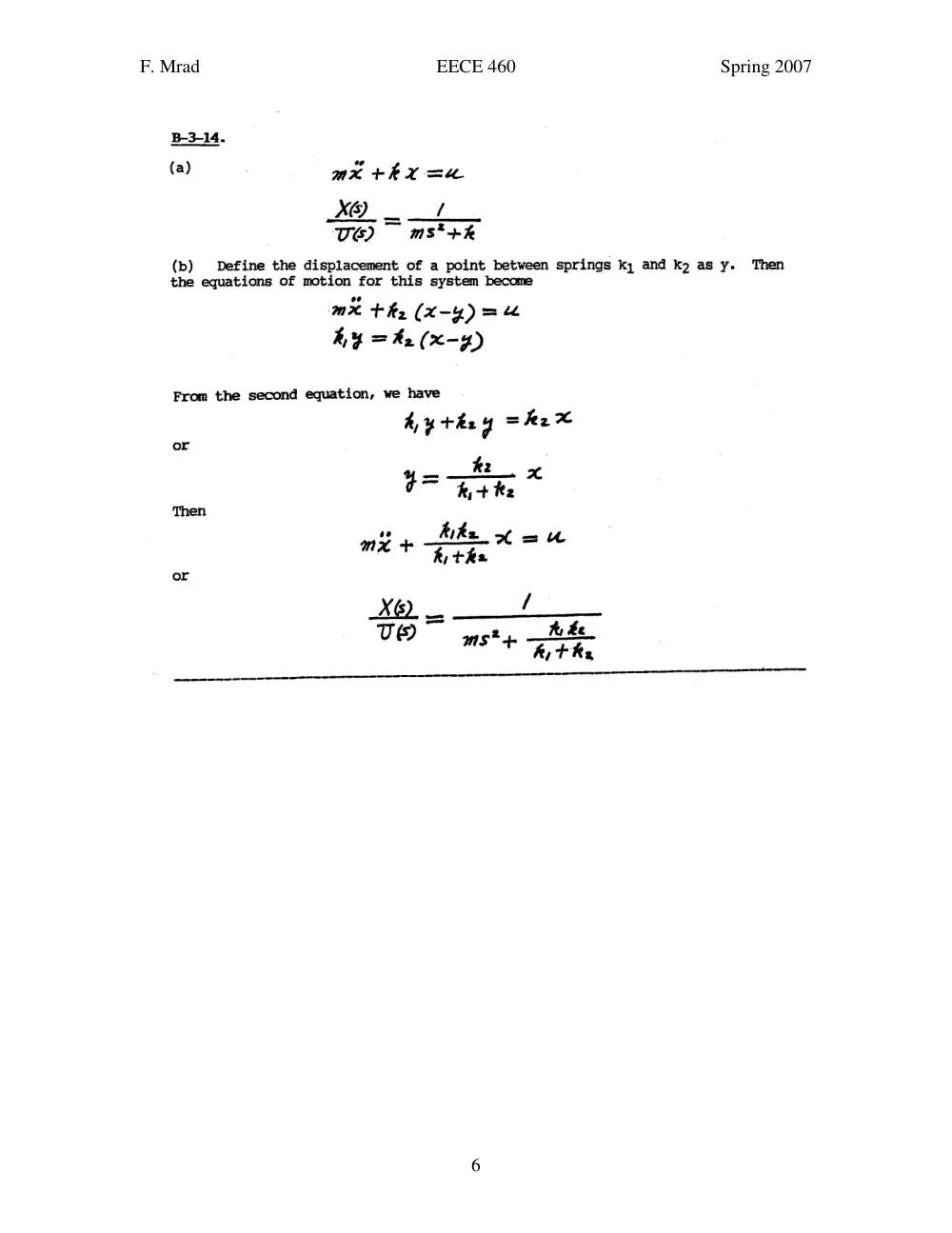
B-3-14.
(a) MK EAL RL
xX) __/
UG) ms*+k
(b) Define the displacement of a point between springs ky and k2 as y. Then
the equations of motion for this system become
mx +h, (X-y) mee
hy =A (*-g)
From the second equation, we have
Aythey =hkrx%
or
-—# x
+= kt ke
i hike Mat
or