
EECE 460 Homework, Spring 2008
American University of Beirut · Control Systems · 3 pages

More EECE 460 files
Show the text of this homework
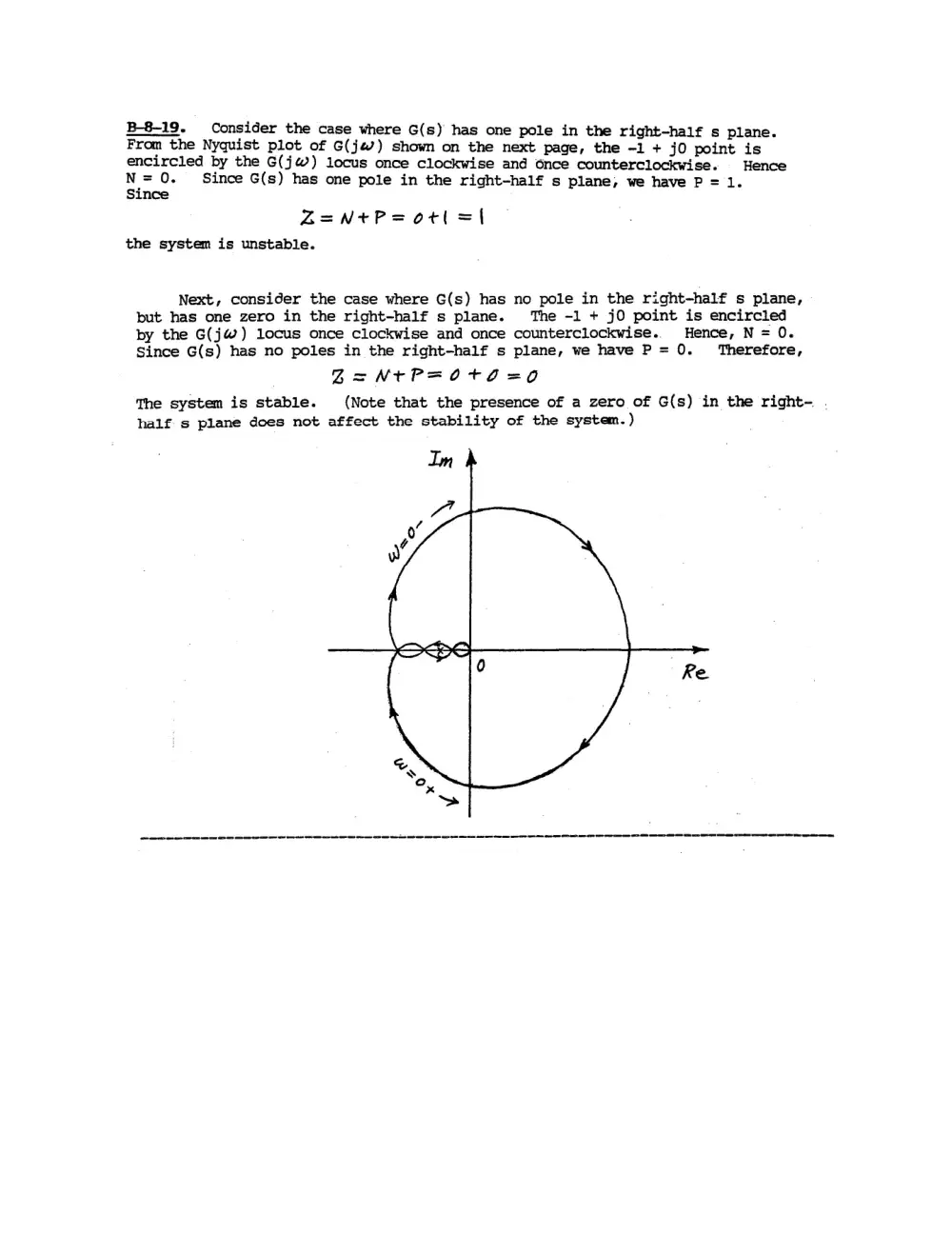
B-8-19. Consider the case where G(s) has one pole in the right-half s plane.
From the Nyquist plot of G(j#) shown on the next page, the -1 + jO point is
encircled by the G(j@) locus once clockwise and once counterclockwise. Hence
N= 0. Since G(s) has one pole in the right-half s plane; we have P = 1.
Since
Z=NtP=otl =|
the system is unstable.
Next, consider the case where G(s) has no pole in the right-half s plane,
but has one zero in the right-half s plane. The -1 + jO point is encircled
by the G(j@) locus once clockwise and once counterclockwise. Hence, N = 0.
Since G(s) has no poles in the right-half s plane, we have P= 0. Therefore,
Z=oNtP=0+d=0
The system is stable. (Note that the presence of a zero of G(s) in the right- .
half s plane does not affect the stability of the system.)
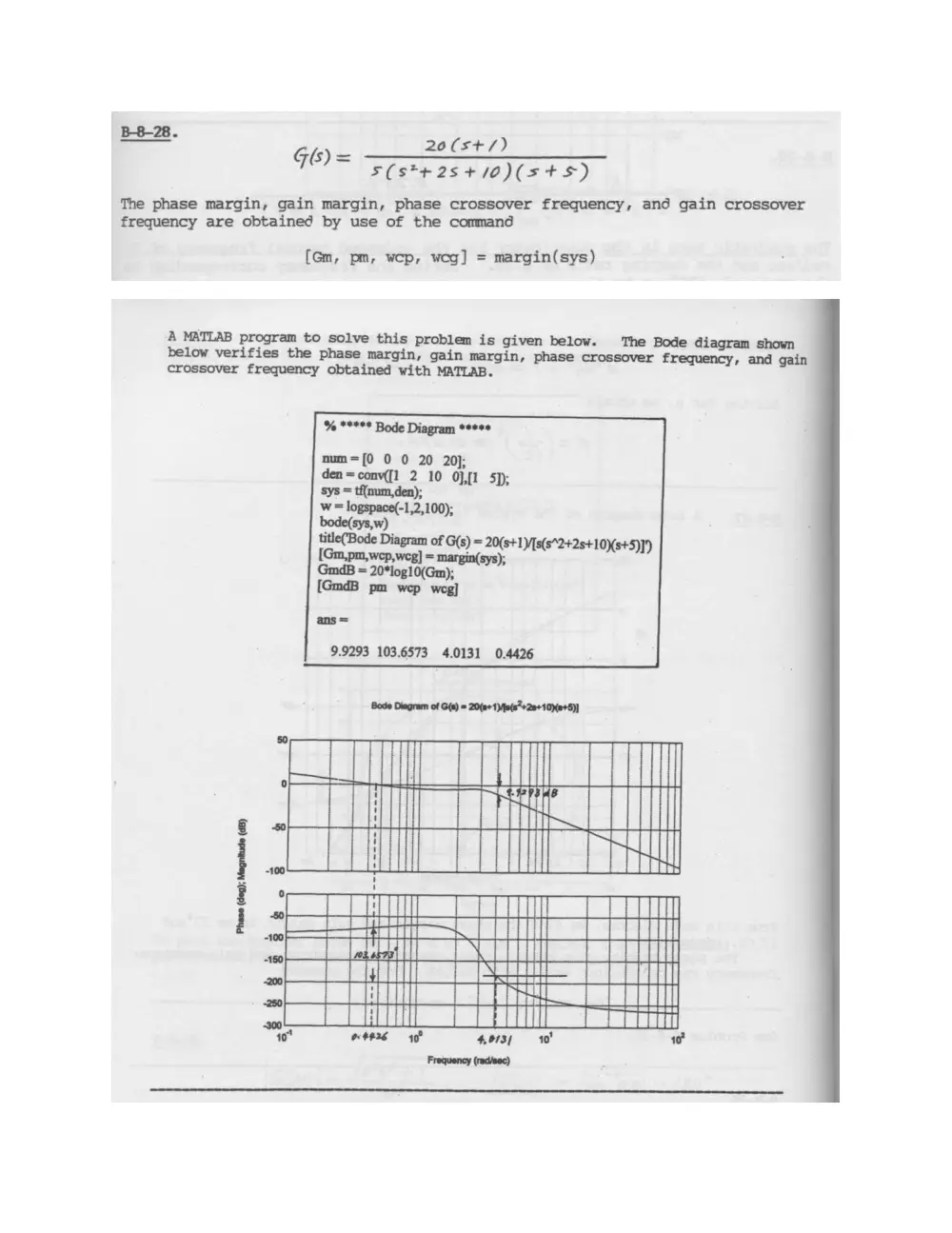
BS 28. Gis) = 20(s+/)
T= “S(s*+ 25+ 10)(s45)
The phase margin, gain margin, phase crossover frequency, and gain crossover
frequency are obtained by use of the command
{Gm, pm, wep, weg] = margin(sys)
A MATLAB program to solve this problem is given below. The Bode diagram shown
below verifies the phase margin, gain margin, phase crossover frequency, and gain
crossover frequency obtained with MATLAB.
% tees Bode Diagram sees
num=[0 0 0 20 20];
den=conv([1 2 10 O},1 5);
ae coy
we i :
bode(sys,w)
title(Bode Diagram of G(s) = 20(s+1)/[s(s*2+2s+10\s+:
[Gm,pm,wep,weg] = margin(sys); —
GmdB = 20*1og10(Gm);
[GmdB pm wep wog]
9.9293 103.6573 4.0131 0.4426
Bode Diagram of G(s) = 20(s+1)/js(s*+2s+10Xe+5))
i ==aull
es et
anit a
Can i
Ti rt
10" a #826 40° 40131 10" 0
Frequency (red/sec)
8-35:
G(s) = 10 / (s*(0.17 s + 1))