
GEOL 101 Final, Fall 1997
American University of Beirut · The Earth, Present and Past · 5 pages
More GEOL 101 files
Show the text of this final exam
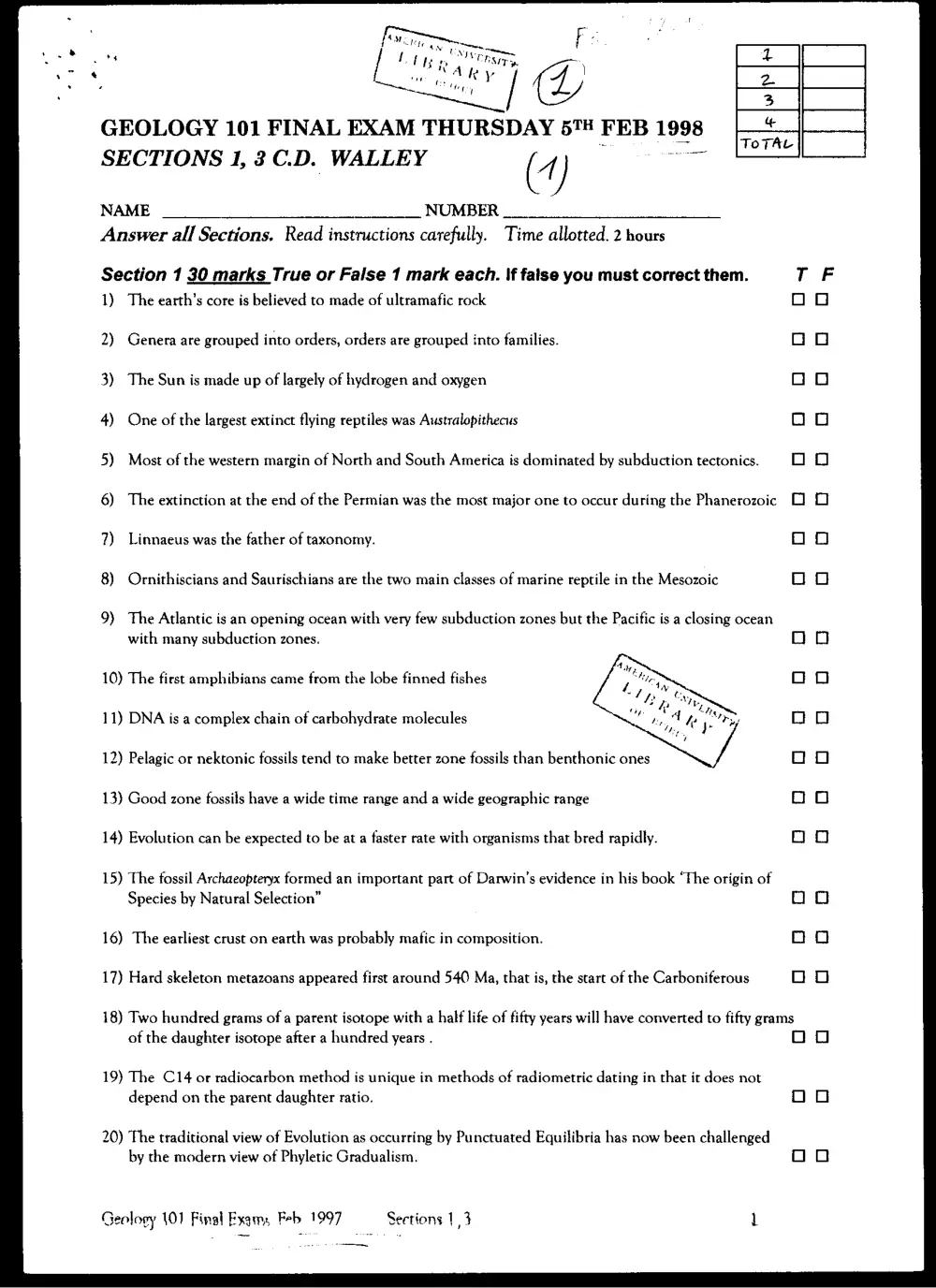
GEOLOGY 101 FINAL EXAM THURSDAY 57 FEB 1998
SECTIONS 1, 3 C.D. WALLEY (1)
NAME NUMBER
Answer all Sections. Read instructions carefully. Time allotted. 2 hours
Section 1 30 marks True or False 1 mark each. If faise you must correct them.
1) The earth’s core is believed to made of ultramafic rock
2) Genera are grouped into orders, orders are grouped into families.
3) The Sun is made up of largely of hydrogen and oxygen
4) One of the largest extinct flying reptiles was Australopithecus
5) Most of the western margin of North and South America is dominated by subduction tectonics.
6) The extinction at the end of the Permian was the most major one to occur during the Phanerozoic
7) Linnaeus was the father of taxonomy.
ooo og oo og oA
nonoooog oo OY
8) Ornithiscians and Saurischians are the two main classes of marine reptile in the Mesozoic
9) The Atlantic is an opening ocean with very few subduction zones but the Pacific is a closing ocean
with many subduction zones.
10) The first amphibians came from the lobe finned fishes
11) DNA is a complex chain of carbohydrate molecules
12) Pelagic or nektonic fossils tend to make better zone fossils than benthonic ones
13) Good zone fossils have a wide time range and a wide geographic range
oo
oo
oO
oo
oad
oo
14) Evolution can be expected to be at a faster rate with organisms that bred rapidly.
15) The fossil Archaeopteryx formed an important part of Darwin’s evidence in his book ‘The origin of
Species by Natural Selection”
o
16) The earliest crust on earth was probably mafic in composition. og
17) Hard skeleton metazoans appeared first around 540 Ma, that is, the start of the Carboniferous o0
18) Two hundred grams of a parent isotope with a half life of fifty years will have converted to fifty grams
of the daughter isotope after a hundred years . oO
19) The C14 of radiocarbon method is unique in methods of radiometric dating in that it does not
depend on the parent daughter ratio. ia]
20) The traditional view of Evolution as occurring by Punctuated Equilibria has now been challenged
by the modern view of Phyletic Gradualism. i]
Geology 101 Final Exams Feb 1997 Sections | 3
Les}
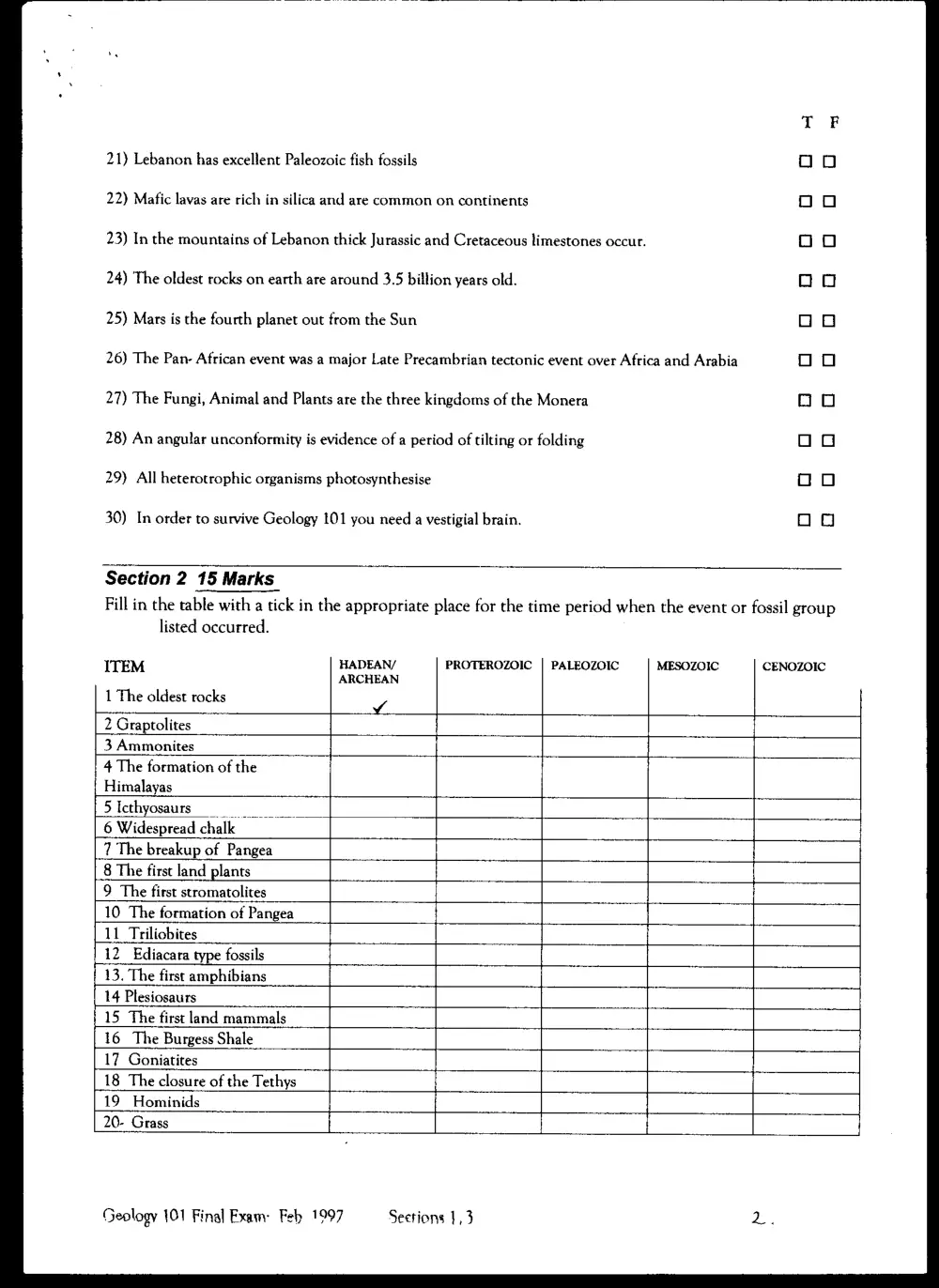
21) Lebanon has excellent Paleozoic fish fossils
22) Mafic lavas are rich in silica and are common on continents
23) In the mountains of Lebanon thick Jurassic and Cretaceous limestones occur.
24) The oldest rocks on earth are around 3.5 billion years old.
25) Mars is the fourth planet out from the Sun
26) The Pan- African event was a major Late Precambrian tectonic event over Africa and Arabia
27) The Fungi, Animal and Plants are the three kingdoms of the Monera
28) An angular unconformity is evidence of a period of tilting or folding
29) All heterotrophic organisms photosynthesise
000 O 00 000 0
Oo O O80 GO O OG OOo ODO
30) In order to survive Geology 101 you need a vestigial brain.
Section 2 15 Marks
Fill in the table with a tick in the appropriate place for the time period when the event or fossil group
listed occurred.
ITEM HADEAN/ PROTEROZOIC | PALEOZOIC MESOZOIC CENOZOIC
ARCHEAN
1 The oldest rocks Vv
2 Graptolites
3 Ammonites
4 The formation of the
Himalayas
5icthyosaurs
6 Widespread chalk
7 The breakup of Pangea
8 The first land plants
9 The first stromatolites
10_The formation of Pangea
11. Triliobites
12 Ediacara type fossils
13. The first amphibians
14 Plesiosaurs
15 The first land mammals
16 The Burgess Shale
17 Goniatites
18 The closure of the Tethys
19 Hominids
20- Grass
Geology 101 Final Exam: Feb 1997 Sections 1,3 2.
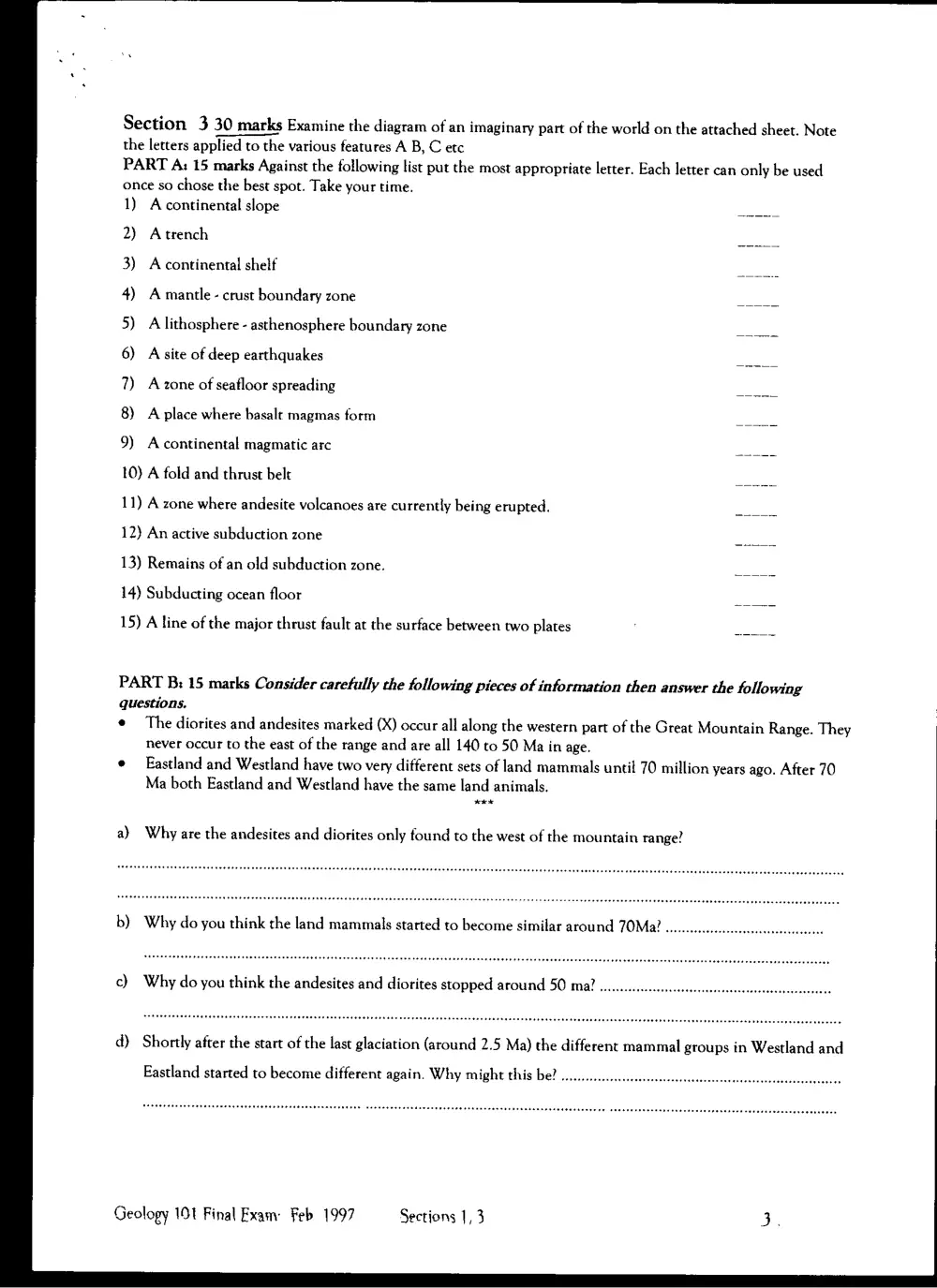
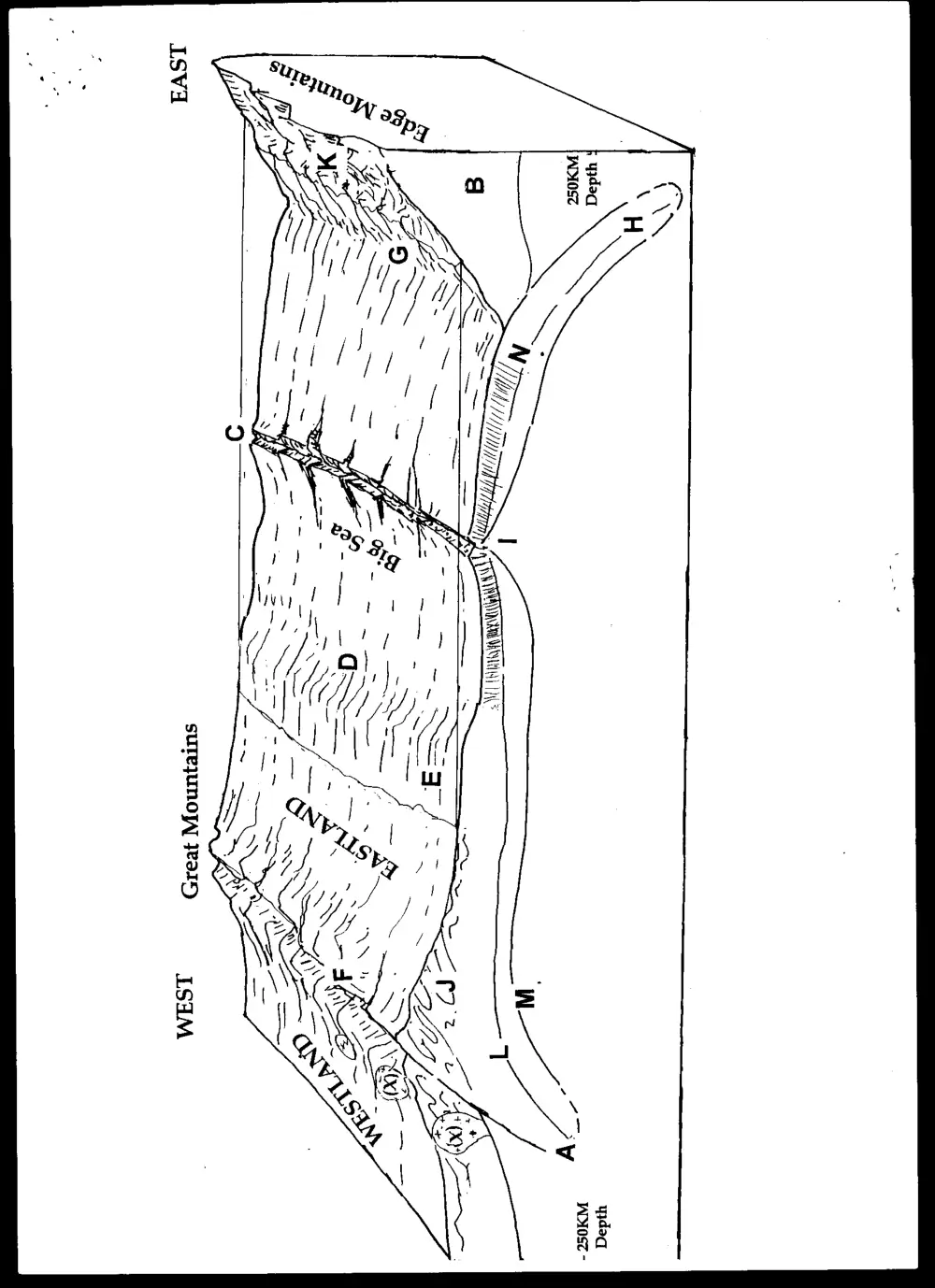
Section 3 30 marks Examine the diagram of an imaginary part of the world on the attached sheet. Note
the letters applied to the various features A B, C etc
PART A: 15 marks Against the following list put the most appropriate letter. Each letter can only be used
once so chose the best spot. Take your time.
1) Acontinental slope
2) Atrench
3) Acontinental shelf
4) A mantle - crust boundary zone
5) A lithosphere - asthenosphere boundary zone
6) A site of deep earthquakes
7) Azone of seafloor spreading
8) A place where basalt magmas form
9) Acontinental magmatic are
10) A fold and thrust belt
11) A zone where andesite volcanoes are currently being erupted.
12) An active subduction zone
13) Remains of an old subduction zone.
14) Subducting ocean floor
15) A line of the major thrust fault at the surface between two plates
PART B: 15 marks Consider carefully the following pieces of information then answer the following
questions.
¢ The diorites and andesites marked (X) occur all along the western part of the Great Mountain Range. They
never occur to the east of the range and are all 140 co 50 Ma in age.
e Eastland and Westland have two very different sets of land mammals until 70 million years ago. After 70
Ma both Eastland and Westland have the same land animals.
cera
a) Why are the andesites and diorites only found to the west of the mountain range?
d) Shortly after the start of the last glaciation (around 2.5 Ma) the different mammal groups in Westland and
Eastland started to become different again. Why might this be? .......cccssscccssssssssessssessescsssssssscsssssssosssssssvesceses
Geology 191 Final Examv Feb 1997 Sections 1,3 3.
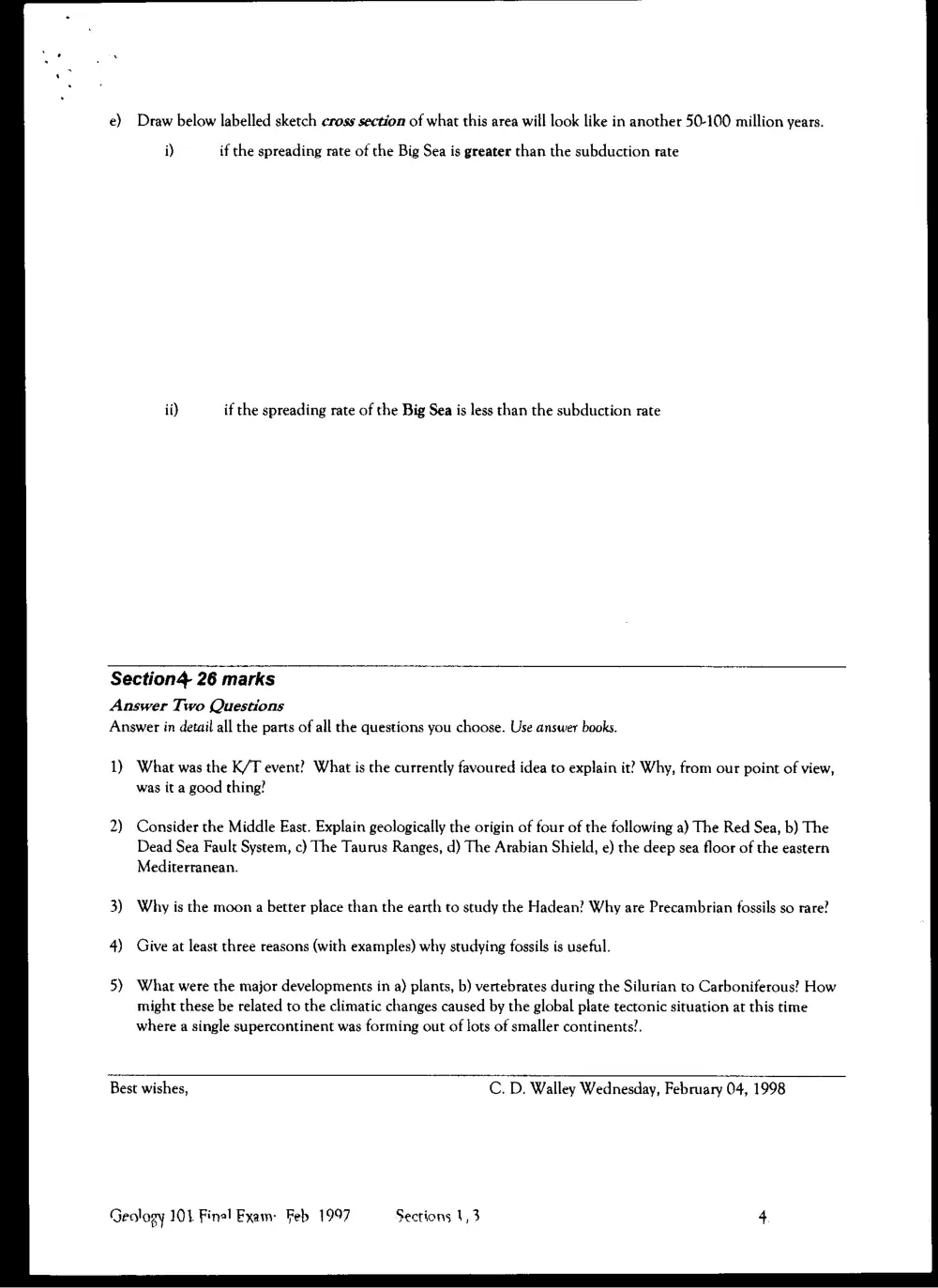
e) Draw below labelled sketch cross section of what this area will look like in another 50-100 million years.
i) if the spreading rate of the Big Sea is greater than the subduction rate
ii) if the spreading rate of the Big Sea is less than the subduction rate
Section4 26 marks
Answer Two Questions
Answer in detail all the parts of all the questions you choose. Use answer books.
1) What was the K/T event? What is the currently favoured idea to explain it? Why, from our point of view,
was it a good thing?
2) Consider the Middle East. Explain geologically the origin of four of the following a) The Red Sea, b) The
Dead Sea Fault System, c) The Taurus Ranges, d) The Arabian Shield, e) the deep sea floor of the eastern
Mediterranean.
Why is the moon a better place than the earth to study the Hadean? Why are Precambrian fossils so rare?
Give at least three reasons (with examples) why studying fossils is useful.
What were the major developments in a) plants, b) vertebrates during the Silurian to Carboniferous? How
might these be related to the climatic changes caused by the global plate tectonic situation at this time
where a single supercontinent was forming out of lots of smaller continents?.
Best wishes, C. D. Walley Wednesday, February 04, 1998
Geology 101 Final Exam: Feb 1997 Sections 1,3
By
Zz
el
Great Mountains
Vi
Qn
MM