
GEOL 101 Final, Fall 2005
American University of Beirut · The Earth, Present and Past · 10 pages



More GEOL 101 files
Show the text of this final exam
1
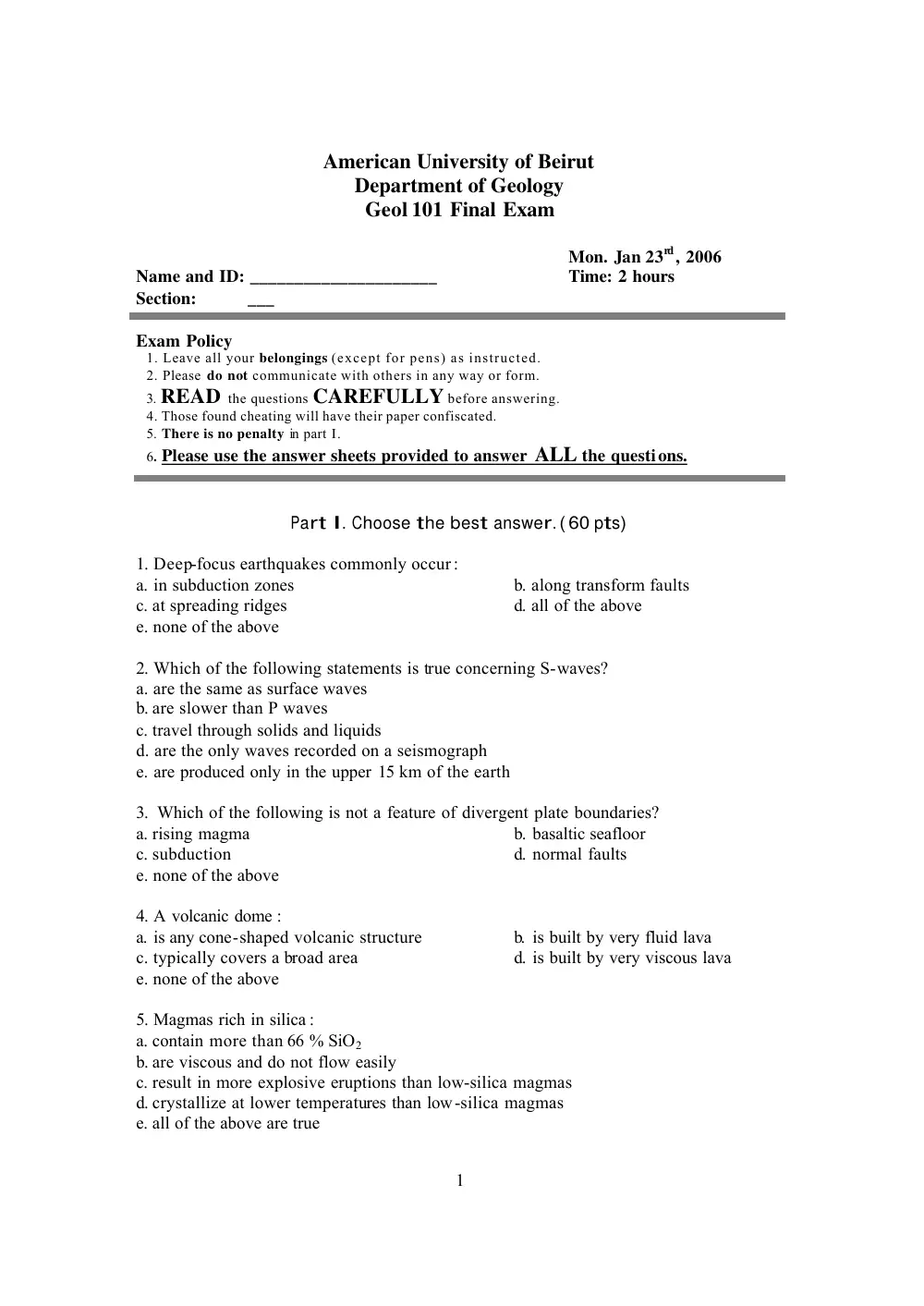
American University of Beirut
Department of Geology
Geol 101 Final Exam
Mon. Jan 23rd, 2006
Name and ID: _____________________
Time: 2 hours
Section:
___
Exam Policy
1. Leave all your belongings (except for pens) as instructed.
2. Please do not communicate with others in any way or form.
3. READ the questions CAREFULLY before answering.
4. Those found cheating will have their paper confiscated.
5. There is no penalty in part I.
6. Please use the answer sheets provided to answer ALL the questions.
Part I. Choose the best answer. ( 60 pts)
1. Deep-focus earthquakes commonly occur:
a. in subduction zones
b. along transform faults
c. at spreading ridges
d. all of the above
e. none of the above
2. Which of the following statements is true concerning S-waves?
a. are the same as surface waves
b. are slower than P waves
c. travel through solids and liquids
d. are the only waves recorded on a seismograph
e. are produced only in the upper 15 km of the earth
3. Which of the following is not a feature of divergent plate boundaries?
a. rising magma
b. basaltic seafloor
c. subduction
d. normal faults
e. none of the above
4. A volcanic dome :
a. is any cone-shaped volcanic structure
b. is built by very fluid lava
c. typically covers a broad area
d. is built by very viscous lava
e. none of the above
5. Magmas rich in silica :
a. contain more than 66 % SiO2
b. are viscous and do not flow easily
c. result in more explosive eruptions than low-silica magmas
d. crystallize at lower temperatures than low-silica magmas
e. all of the above are true
2
6. Compressional seismic body waves are referred to as:
a. P-waves
b. S-waves
c. seiches
d. surface waves
e. radio waves
7. The low-viscosity, fluid lava of hot-spot volcanoes is typically
a. intermediate
b. mafic
c. andesitic
d. volatile
e. granitic
8. Volcanic ash, cinders, and bombs are examples of ___________ material.
a. plutonic
b. phreatic
c. pyroclastic
d. depth
e. fissure eruption
9. The Richter scale rates earthquake magnitude by determining:
a. the maximum distance recorded on seismic instruments
b. the height of tsunami waves
c. the distance over which the earthquake was felt
d. the amount of energy released by the earthquake
e. none of the above
10. The asthenosphere is:
a. cold, plastic with pockets of molten material
b. mostly liquid Fe and Ni
c. composed mostly of sedimentary rocks
d. hard, strong solid rock
e. none of the above
11. Groundwater:
a. moves slowly through the pore spaces of Earth materials
b. is recharged through infiltration
c. can move upward against the force of gravity
d. moves from areas of high pressure toward areas of low pressure
e. all of the above
12. An ice age is caused by:
a. sudden decrease of the atmospheric wind activity
b. exceptionally cool climate s
c. reduction of CO2 in the ocean waters
d. reduction of CO2 in the atmosphere
e. none of the above
13. Which of the following is the process of formation of glacier ice from snow?
a. compacted snow� glacial ice� snow� ice
b. firn � compacted snow� snow� glacial ice
c. snow� compacted snow� firn� glacial ice
d. firn� snow� compacted snow � glacial ice
e. none of the above
3
14. The ease with which fluids pass through a rock is determined by the rock
a. porosity
b. permeability
c. grain size
d. age
e. all of the above
15. The unsaturated zone is also known as the:
a. vadose zone
b. saturated zone
c. confined zone
d. recharge zone
e. all of the above
16. In a typical dune profile:
a. the slip face is always steeper than the backslope
b. loess material is present only along the backslope
c. coarse grained sand is very abundant
d. a steep windward side is always facing upwind
e. varves occur at the base of the dune
17. The Milankovitch theory suggests that periods of glaciation are caused by:
a. variations in the nature of Earth's orbit around the Sun
b. fluctuations in the energy output from the Sun
c. changes in the relative positions of the continents
d. the uplift of continental blocks
e. changes in the intensity of the greenhouse effect
18. Which statement(s) best describe(s) dunes?
a. a dune is a desert landform most commonly associated with wind deposition
b. a dune is an accumulation of sand that is shaped by the wind action
c. dunes can be active (migrating) or inactive (fixed by the plants roots)
d. dunes are affected by the wind speed and direction
e. all of the above
19. An aquifer can be characterized as:
a. porous but not too permeable
b. permeable but not too porous
c. low in both porosity and permeability
d. a closed system
e. both porous and permeable
20. Artesian conditions require:
a. very pure water
b. hard water
c. karstic conditions
d. a confined aquifer
e. an unconfined aquifer
21. Which statement(s) is (are) true about karstic features?
a. karst and karstic features are not related to groundwater
b. caves and caverns are mainly formed by tectonic processes
c. terrestrial sediments can never be encountered inside caves and caverns
d. karstic features characterize terrains undergoing leaching
e. all of the above
4
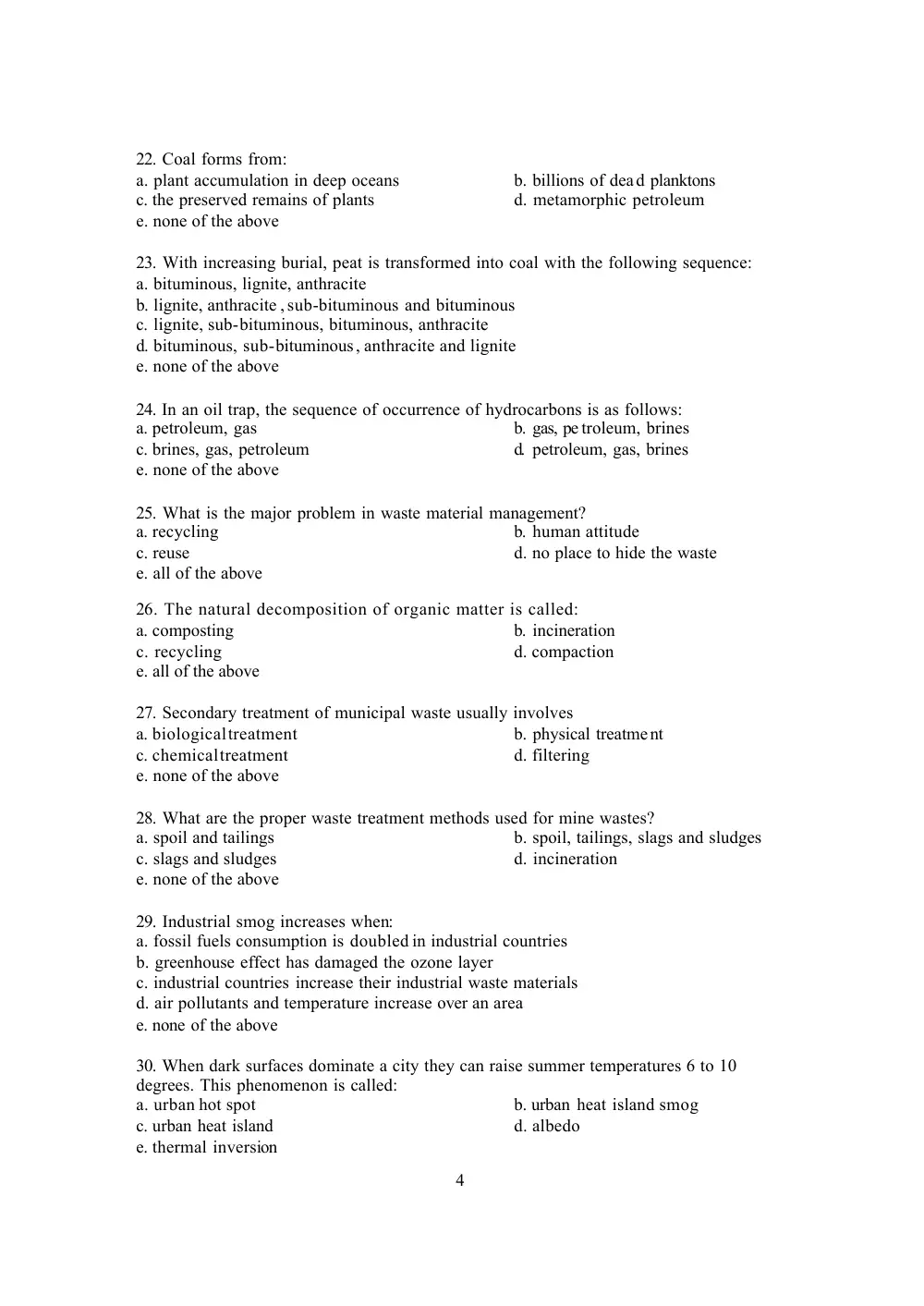
22. Coal forms from:
a. plant accumulation in deep oceans
b. billions of dead planktons
c. the preserved remains of plants
d. metamorphic petroleum
e. none of the above
23. With increasing burial, peat is transformed into coal with the following sequence:
a. bituminous, lignite, anthracite
b. lignite, anthracite , sub-bituminous and bituminous
c. lignite, sub-bituminous, bituminous, anthracite
d. bituminous, sub-bituminous, anthracite and lignite
e. none of the above
24. In an oil trap, the sequence of occurrence of hydrocarbons is as follows:
a. petroleum, gas
b. gas, pe troleum, brines
c. brines, gas, petroleum
d. petroleum, gas, brines
e. none of the above
25. What is the major problem in waste material management?
a. recycling
b. human attitude
c. reuse
d. no place to hide the waste
e. all of the above
26. The natural decomposition of organic matter is called:
a. composting
b. incineration
c. recycling
d. compaction
e. all of the above
27. Secondary treatment of municipal waste usually involves
a. biological treatment
b. physical treatment
c. chemical treatment
d. filtering
e. none of the above
28. What are the proper waste treatment methods used for mine wastes?
a. spoil and tailings
b. spoil, tailings, slags and sludges
c. slags and sludges
d. incineration
e. none of the above
29. Industrial smog increases when:
a. fossil fuels consumption is doubled in industrial countries
b. greenhouse effect has damaged the ozone layer
c. industrial countries increase their industrial waste materials
d. air pollutants and temperature increase over an area
e. none of the above
30. When dark surfaces dominate a city they can raise summer temperatures 6 to 10
degrees. This phenomenon is called:
a. urban hot spot
b. urban heat island smog
c. urban heat island
d. albedo
e. thermal inversion
5
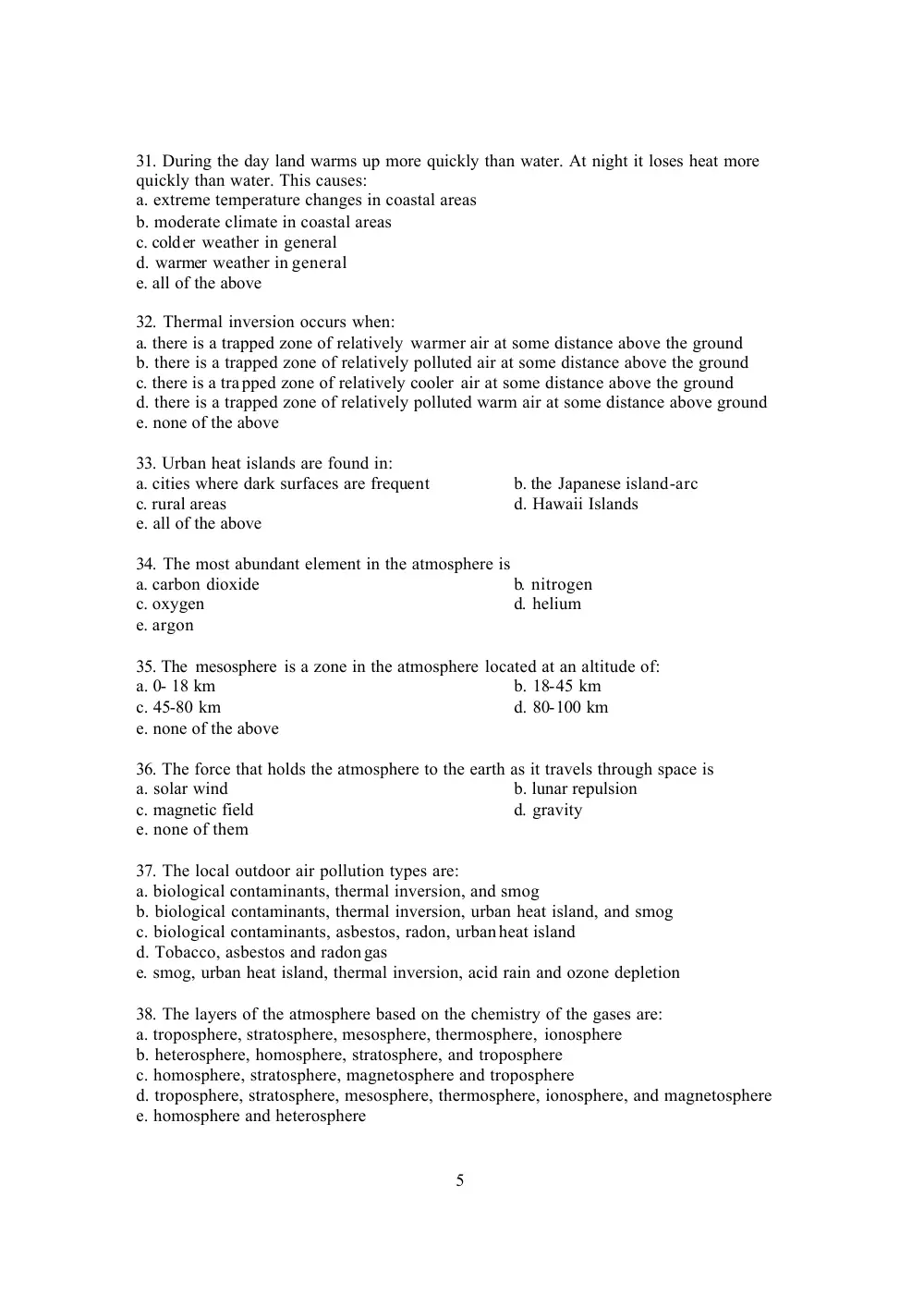
31. During the day land warms up more quickly than water. At night it loses heat more
quickly than water. This causes:
a. extreme temperature changes in coastal areas
b. moderate climate in coastal areas
c. colder weather in general
d. warmer weather in general
e. all of the above
32. Thermal inversion occurs when:
a. there is a trapped zone of relatively warmer air at some distance above the ground
b. there is a trapped zone of relatively polluted air at some distance above the ground
c. there is a trapped zone of relatively cooler air at some distance above the ground
d. there is a trapped zone of relatively polluted warm air at some distance above ground
e. none of the above
33. Urban heat islands are found in:
a. cities where dark surfaces are frequent
b. the Japanese island-arc
c. rural areas
d. Hawaii Islands
e. all of the above
34. The most abundant element in the atmosphere is
a. carbon dioxide
b. nitrogen
c. oxygen
d. helium
e. argon
35. The mesosphere is a zone in the atmosphere located at an altitude of:
a. 0- 18 km
b. 18-45 km
c. 45-80 km
d. 80-100 km
e. none of the above
36. The force that holds the atmosphere to the earth as it travels through space is
a. solar wind
b. lunar repulsion
c. magnetic field
d. gravity
e. none of them
37. The local outdoor air pollution types are:
a. biological contaminants, thermal inversion, and smog
b. biological contaminants, thermal inversion, urban heat island, and smog
c. biological contaminants, asbestos, radon, urban heat island
d. Tobacco, asbestos and radon gas
e. smog, urban heat island, thermal inversion, acid rain and ozone depletion
38. The layers of the atmosphere based on the chemistry of the gases are:
a. troposphere, stratosphere, mesosphere, thermosphere, ionosphere
b. heterosphere, homosphere, stratosphere, and troposphere
c. homosphere, stratosphere, magnetosphere and troposphere
d. troposphere, stratosphere, mesosphere, thermosphere, ionosphere, and magnetosphere
e. homosphere and heterosphere
6
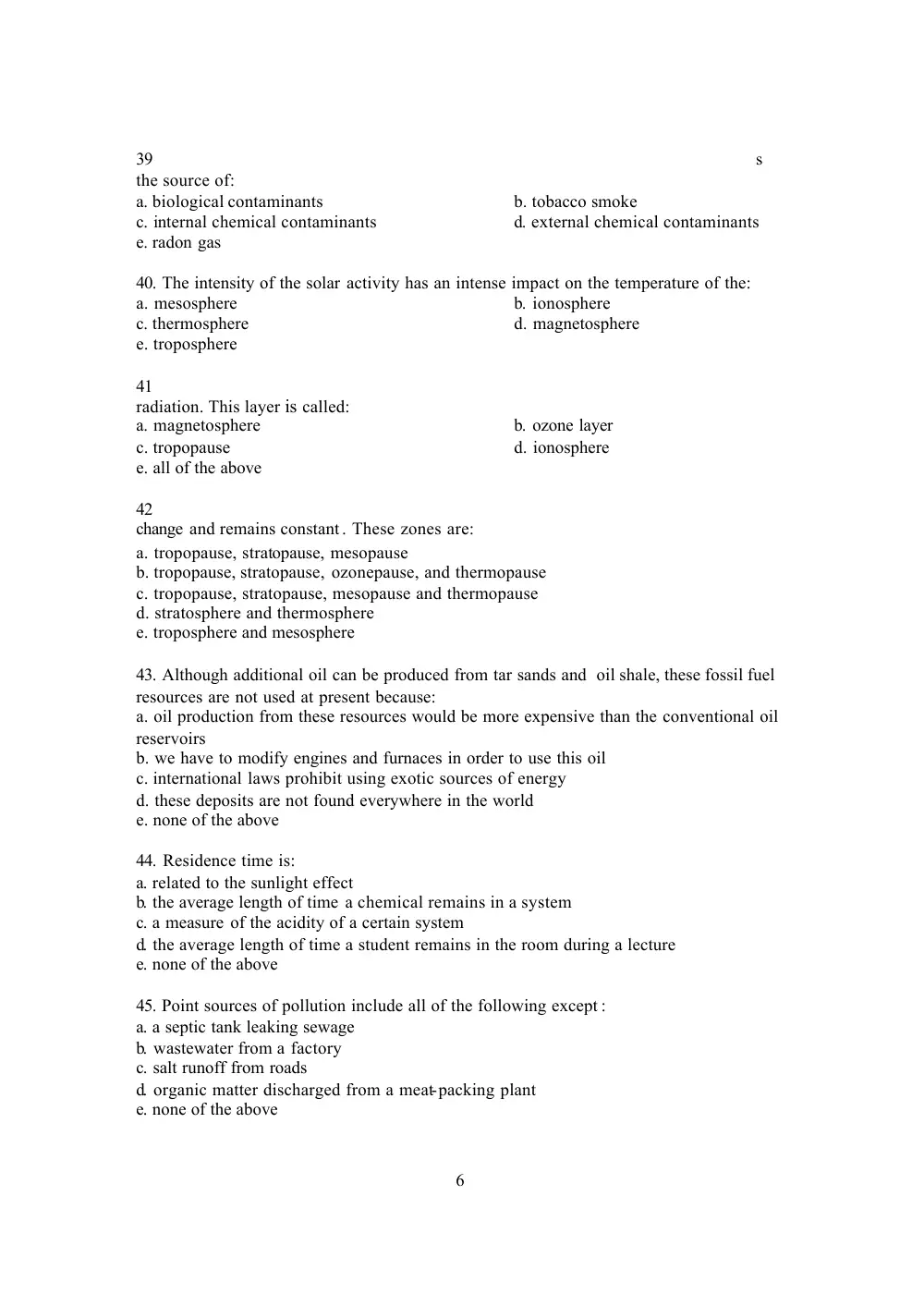
39
s
the source of:
a. biological contaminants
b. tobacco smoke
c. internal chemical contaminants
d. external chemical contaminants
e. radon gas
40. The intensity of the solar activity has an intense impact on the temperature of the:
a. mesosphere
b. ionosphere
c. thermosphere
d. magnetosphere
e. troposphere
41
radiation. This layer is called:
a. magnetosphere
b. ozone layer
c. tropopause
d. ionosphere
e. all of the above
42
change and remains constant. These zones are:
a. tropopause, stratopause, mesopause
b. tropopause, stratopause, ozonepause, and thermopause
c. tropopause, stratopause, mesopause and thermopause
d. stratosphere and thermosphere
e. troposphere and mesosphere
43. Although additional oil can be produced from tar sands and oil shale, these fossil fuel
resources are not used at present because:
a. oil production from these resources would be more expensive than the conventional oil
reservoirs
b. we have to modify engines and furnaces in order to use this oil
c. international laws prohibit using exotic sources of energy
d. these deposits are not found everywhere in the world
e. none of the above
44. Residence time is:
a. related to the sunlight effect
b. the average length of time a chemical remains in a system
c. a measure of the acidity of a certain system
d. the average length of time a student remains in the room during a lecture
e. none of the above
45. Point sources of pollution include all of the following except :
a. a septic tank leaking sewage
b. wastewater from a factory
c. salt runoff from roads
d. organic matter discharged from a meat-packing plant
e. none of the above
7
46. Groundwater pollution
a. comes only from nonpoint pollution sources, like fertilizer runoff from farmland
b. is readily detectable because the presence of pollutants is obvious from the water's
taste or smell
c. can easily be treated
d. is very difficult to clean up once it has occurred
e. can only be treated by chemicals
47
a. aerobic
b. anaerobic
c. brackish
d. saline
e. eutrophic
48. Biochemical oxygen demand is the amount of oxygen needed:
a. by humans to breathe
b. by all organisms in a system, both plants and animals
c. to destroy all chemical pollutants in a system
d. for the anaerobic breakdown of organic matter in a system
e. for the aerobic breakdown of organic matter in a system
49. Particulate air pollutants:
a. are only produced by anthropogenic processes
b. are small solid particles
c. are not harmful to the ma rine ecosystem
d. are unsightly but not unhealthy
e. all of the above
50. Which of the following statements is not true?
a. by the time studies of rain acidity were begun, all air was polluted to some extent
b. rainfall would not be acidic if burning of sulfur-rich coal were stopped
c. the problems caused by acid rain vary in severity with local soil and industry
d. rainfall is often more acidic downwind of coal-fired power plants
e. all of the above
51. Eutrophication of water is accelerated by:
a. discharge of raw sewage into the water
b. excess fertilizer runoff
c. phosphate detergent residue in wastewater
d. all of the above
e. none of the above
52. Lead, mercury, and plutonium are __________ that are characterized by a tendency to
accumulate in organisms:
a. radioactive metals
b. precious metals
c. native elements
d. heavy elements
e. none of the above
53. Significant components of indoor air pollution may include:
a. radon
b. tobacco
c. asbestos
d. volatile organic compounds
e. all of the above
8
54. The pollutant of principal concern in discussions of acid rain is
a. carbon monoxide
b. carbon dioxide
c. nitrogen oxide
e. particulate matter
e. sulfur dioxide
55. One possible consequence of eutrophication is:
a. reduction of nutrient levels in a body of water
b. an increase in the biodiversity of the body of water
c. confiscation of dissolved toxins in lake sediments
d. fish kills, because of the lowered dissolved oxygen in the water
e. none of the above
56. Groundwater pollution:
a. comes only from nonpoint pollution sources, like fertilizer runoff from farmland
b. is readily detectable because of the pollutants taste or smell
c. is very difficult to clean up once it has occurred
d. all of the above is correct
e. none of the above is correct
57. Oil shale :
a. is rich in a tarry, asphalt-like oil
b. contains a waxy solid called kerogen
c. can be developed by using warm water to extract the oil from the rocks without mining
d. is very abundant in the world
e. all of the above
58. An alternate fossil-fuel source that has lost its lighter hydrocarbons is known as:
a. tar sand
b. oil shale
c. lignite
d. crude oil
e. kerosene
59. Around an actively pumped well in an unconfined aquifer, a ________ may develop:
a. cone of depression
b. cone of ascension
c. perched water table
d. sinkhole
e. salt water intrusion
60. A very fine-grained, wind-deposited sediment that lacks layering is:
a. loess
b. silt
c. deflation
d. rock flour
e. sand dune
61b. A hot, glowing cloud of gas and ash is sometimes known as a
b. rhyolite
c. volcanic bombs
c. composite flow
e. tephra
9
62b. Surface waves:
a. are the most destructive seismic waves
b. travel on the surfaces of water bodies
c. are unaffected by earth material in which they travel
d. are faster than body waves
e. none of the above
63b. A brittle material is one that:
a. ruptures easily under stress
b. resists deformation under stress
c. conducts electricity well
d. undergoes plastic deformation
e. is also referred to as ductile
Part III. Examine the diagram of an imaginary part of the world on the
attached sheet. Note
Against the following list indicate the most appropriate letter. Each letter
can only be used once (10 pts; Answer this question on the ANSWER
SHEETS).
1) A trench
2) A mantle - crust boundary zone
3) A lithosphere - asthenosphere boundary zone
4) A site of deep earthquakes
5) A zone of seafloor spreading
6) A place where basalt magmas form
7) A continental magmatic arc
8) A fault and fold belt
9) An active subduction zone
10) Subducting ocean floor
Part IV. Briefly answer only 5 of the 9 following questions ( 30 pts total)
ANSWER SHEETS to answer ALL the questions.
1. Briefly explain the three ways of managing waste material.
2. Sketch a typical dune profile. List and sketch the different types of sand dunes.
3.
4. Draw and label a sketch showing the various layers of the atmosphere, showing the
different temperature trends.
5. List the different types of petroleum traps. Draw and label sketches.
6. The way magma erupts depends on its composition. Explain
tion
.
7. One of the disadvantages of a sanitary landfill has to do with the leachate of leachate
material (bathtub effect).
10
8. With the use of a diagram, explain the various atmospheric wind belts occurring at the
surface of the earth.
9. Compare and contrast between confined and unconfined aquifers. Draw sketches.
GOOD LUCK!!!