
GEOL 101 Final, Spring 1998
American University of Beirut · The Earth, Present and Past · 6 pages

More GEOL 101 files
Show the text of this final exam
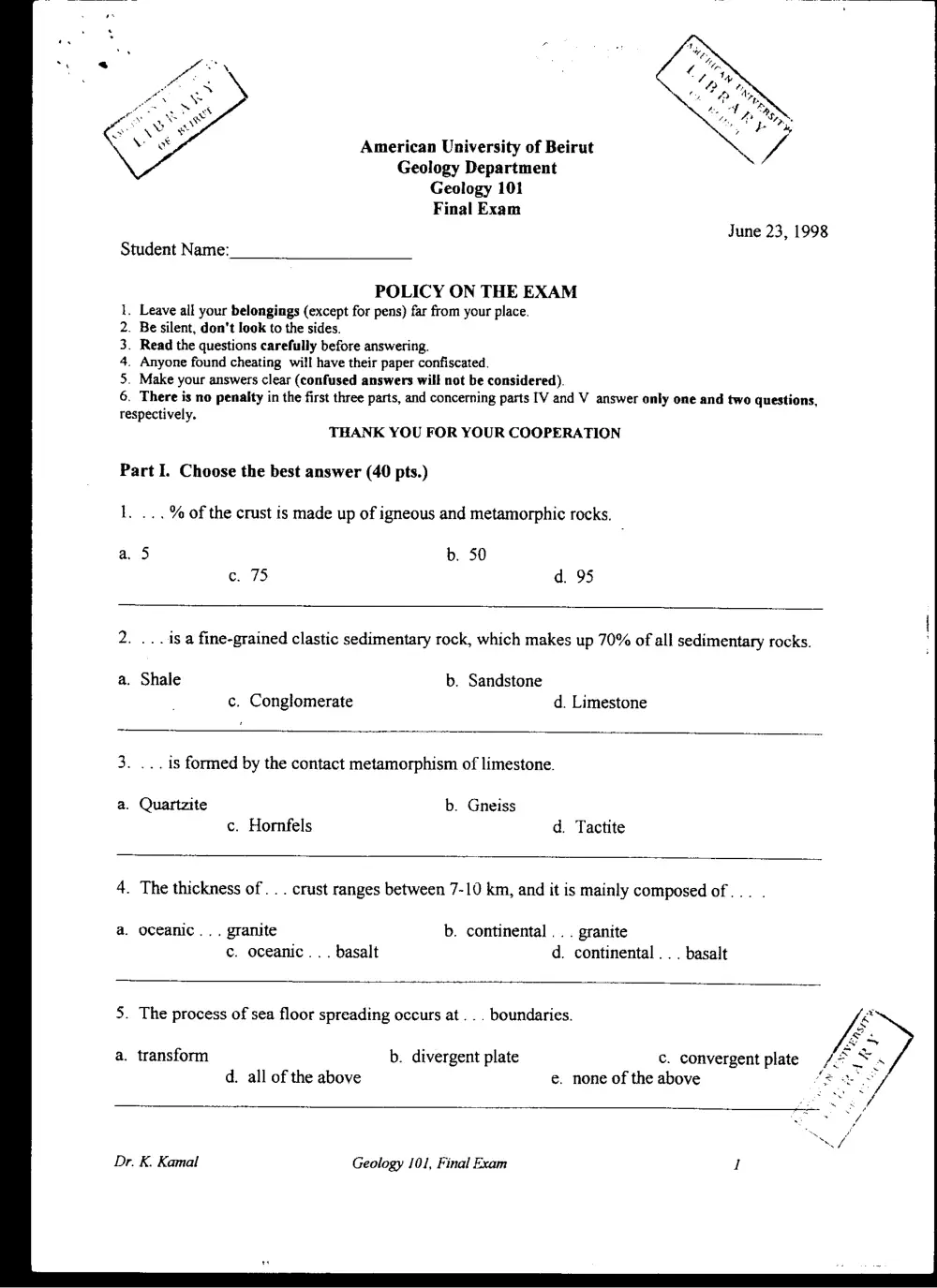
American University of Beirut
Geology Department
Geology 101
Final Exam
June 23, 1998
Student Name:
POLICY ON THE EXAM
. Leave all your belongings (except for pens) far from your place.
. Be silent, don't look to the sides.
. Read the questions carefully before answering.
. Anyone found cheating will have their paper confiscated.
. Make your answers clear (confused answers will not be considered).
. There is no penalty in the first three parts, and concerning parts IV and V answer only one and two questions,
respectively.
THANK YOU FOR YOUR COOPERATION
Part I. Choose the best answer (40 pts.)
1. ... % of the crust is made up of igneous and metamorphic rocks.
a. 5 b. 50
c. 75 d. 95
. ... 4s a fine-grained clastic sedimentary rock, which makes up 70% of all sedimentary rocks.
. Shale b. Sandstone
c. Conglomerate d. Limestone
. ... 18 formed by the contact metamorphism of limestone.
. Quartzite b. Gneiss
c. Hornfels d. Tactite
. The thickness of. . . crust ranges between 7-10 km, and it is mainly composed of... .
. oceanic... granite b. continental .. . granite
c. oceanic... basalt d. continental .. . basalt
. The process of sea floor spreading occurs at . .. boundaries.
. transform b. divergent plate c. convergent plate
d. all of the above e. none of the above
Geology 101, Final Exam
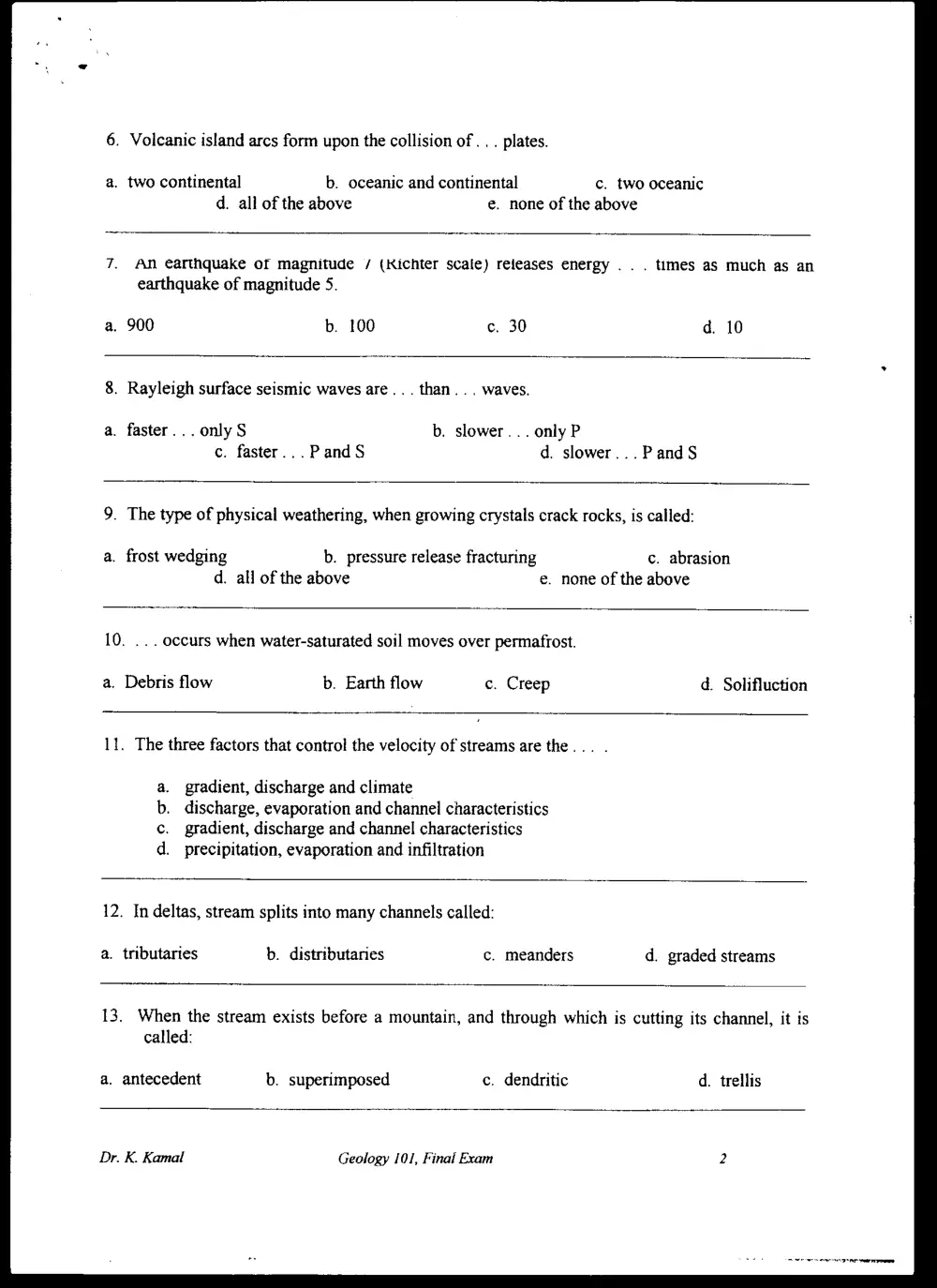
6. Volcanic island arcs form upon the collision of . . . plates.
a. two continental b. oceanic and continental c. two oceanic
d. all of the above e. none of the above
AN earthquake of magnitude / (Kichter scale) releases energy . . . times as much as an
earthquake of magnitude 5.
. 900 b. 100 c. 30 d. 10
. Rayleigh surface seismic waves are... than... waves.
. faster... onlyS b. slower... only P
c. faster... PandS d. slower...PandS
. The type of physical weathering, when growing crystals crack rocks, is called:
. frost wedging b. pressure release fracturing c. abrasion
d. all of the above e. none of the above
10. ... occurs when water-saturated soil moves over permafrost.
a. Debris flow b. Earth flow c. Creep d. Solifluction
11. The three factors that control the velocity of streams are the... .
gradient, discharge and climate
discharge, evaporation and channel characteristics
gradient, discharge and channel characteristics
precipitation, evaporation and infiltration
a
b.
c.
d
12. In deltas, stream splits into many channels called:
a. tributaries b. distributaries c. meanders d. graded streams
13. When the stream exists before a mountain, and through which is cutting its channel, it is
called:
a, antecedent b. superimposed c. dendritic d. trellis
Dr. K. Kamal Geology 101, Finai Exam
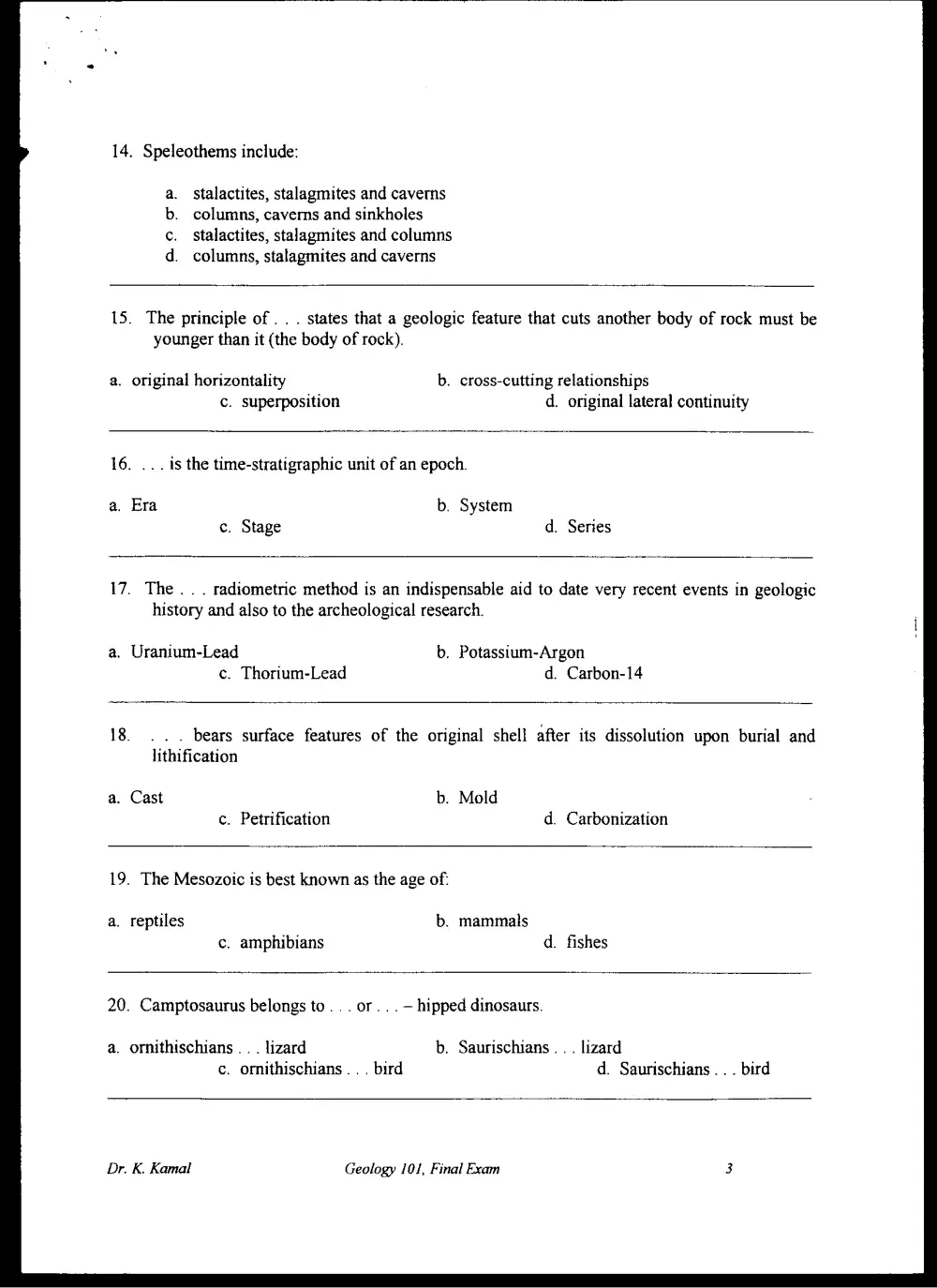
14. Speleothems include:
stalactites, stalagmites and caverns
columns, caverns and sinkholes
stalactites, stalagmites and columns
columns, stalagmites and caverns
ao of
15. The principle of . . . states that a geologic feature that cuts another body of rock must be
younger than it (the body of rock).
a. original horizontality b. cross-cutting relationships
¢. superposition d. original lateral continuity
16. ... is the time-stratigraphic unit of an epoch.
a. Era b. System
c. Stage d. Series
17. The... radiometric method is an indispensable aid to date very recent events in geologic
history and also to the archeological research.
a. Uranium-Lead b. Potassium-Argon
c. Thorium-Lead d. Carbon-14
18... . bears surface features of the original shell after its dissolution upon burial and
lithification
a. Cast b. Mold
c. Petrification d. Carbonization
19. The Mesozoic is best known as the age of:
a. reptiles b. mammals
c. amphibians d. fishes
20. Camptosaurus belongs to... or... — hipped dinosaurs.
a. ornithischians .. . lizard b. Saurischians . . . lizard
c. ornithischians .. . bird d. Saurischians . . . bird
Dr. K. Kamal Geology 101, Final Exam 3
Part II. Fill in the blanks (20 pts.)
1. The volcanic equivalent of granite is ; gabbro is ; and that of
diorite is andesite.
2. The supercontinent (all lands) was composed of two very large continents
and Laurasia. !
3. Along plate boundary the two plates move away from each other,
whereas along plate boundary the two plates slide horizontally
past one another.
4. The earthquake damage is resulted from: 1) ;
2) permanent alteration and landforms (fault slip); 3) ;
4) and 5)
5. The soil profiles consist (from the top downwards) of: : ; and
horizons.
6. The three forms of sediment transport are: 1) , 2) and
3) bed loads.
7. Alluvial fan forms when the stream
8. Porosity (definition) is the
9. The eons (largest divisions of the geologic time scale) are: 1) , 2) ;
3) and 4)
10. Half-life (definition) is the
Dr. K. Kamal Geology 101, Final Exam 4
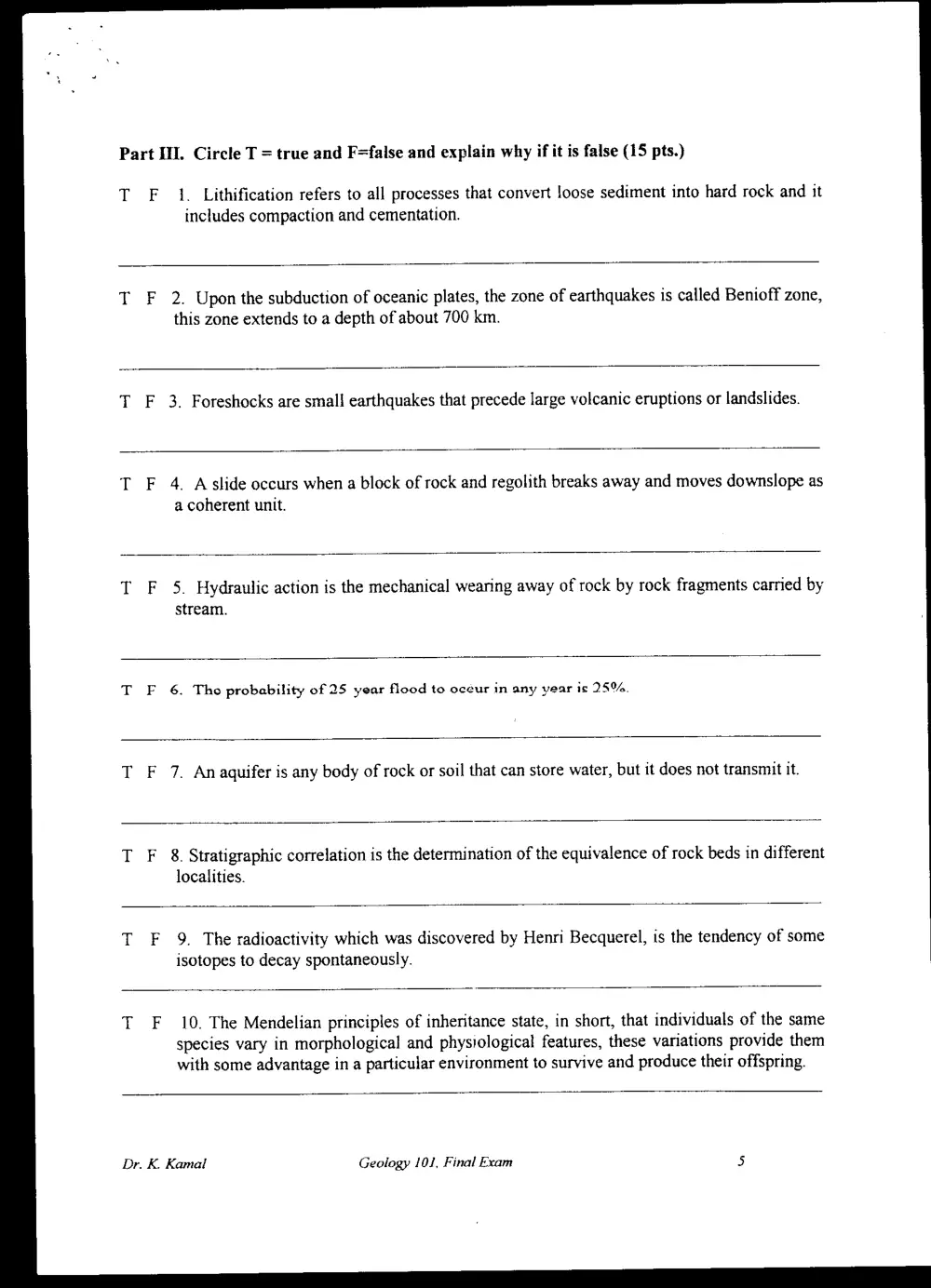
Part II. Circle T = true and F=false and explain why if it is false (15 pts.)
T F 1. Lithification refers to all processes that convert loose sediment into hard rock and it
includes compaction and cementation.
F 2. Upon the subduction of oceanic plates, the zone of earthquakes is called Benioff zone,
this zone extends to a depth of about 700 km.
3. Foreshocks are small earthquakes that precede large volcanic eruptions or landslides.
4. A slide occurs when a block of rock and regolith breaks away and moves downslope as
a coherent unit.
5. Hydraulic action is the mechanical wearing away of rock by rock fragments carried by
stream.
6. The probability of 25 year flood to oceur in any year is 25%
7. Anaquifer is any body of rock or soil that can store water, but it does not transmit it.
8. Stratigraphic correlation is the determination of the equivalence of rock beds in different
localities.
9. The radioactivity which was discovered by Henri Becquerel, is the tendency of some
isotopes to decay spontaneously.
10. The Mendelian principles of inheritance state, in short, that individuals of the same
species vary in morphological and physiological features, these variations provide them
with some advantage in a particular environment to survive and produce their offspring.
Dr. K. Kamal Geology 101, Final Exam
Part IV. Answer only one of the following two questions (5 pts.)
1. Match the relevant terminologies (one to one) in the following two columns (5 pts.)
1. intrusive igneous rock ___ marble
2. extrusive igneous rock __ artesian well
3. clastic sedimentary rock __ dolostone
4. nonclastic sedimentary rock __ ox-bow lake
5. foliated metamorphic rock ___ peridotite
6. nonfoliated metamorphic rock __ schist
7. chemical weathering __ andesite
8. physical weathering ___ thermal expansion and contraction
9. meanders __ conglomerate
10. confined aquifer __ oxidation
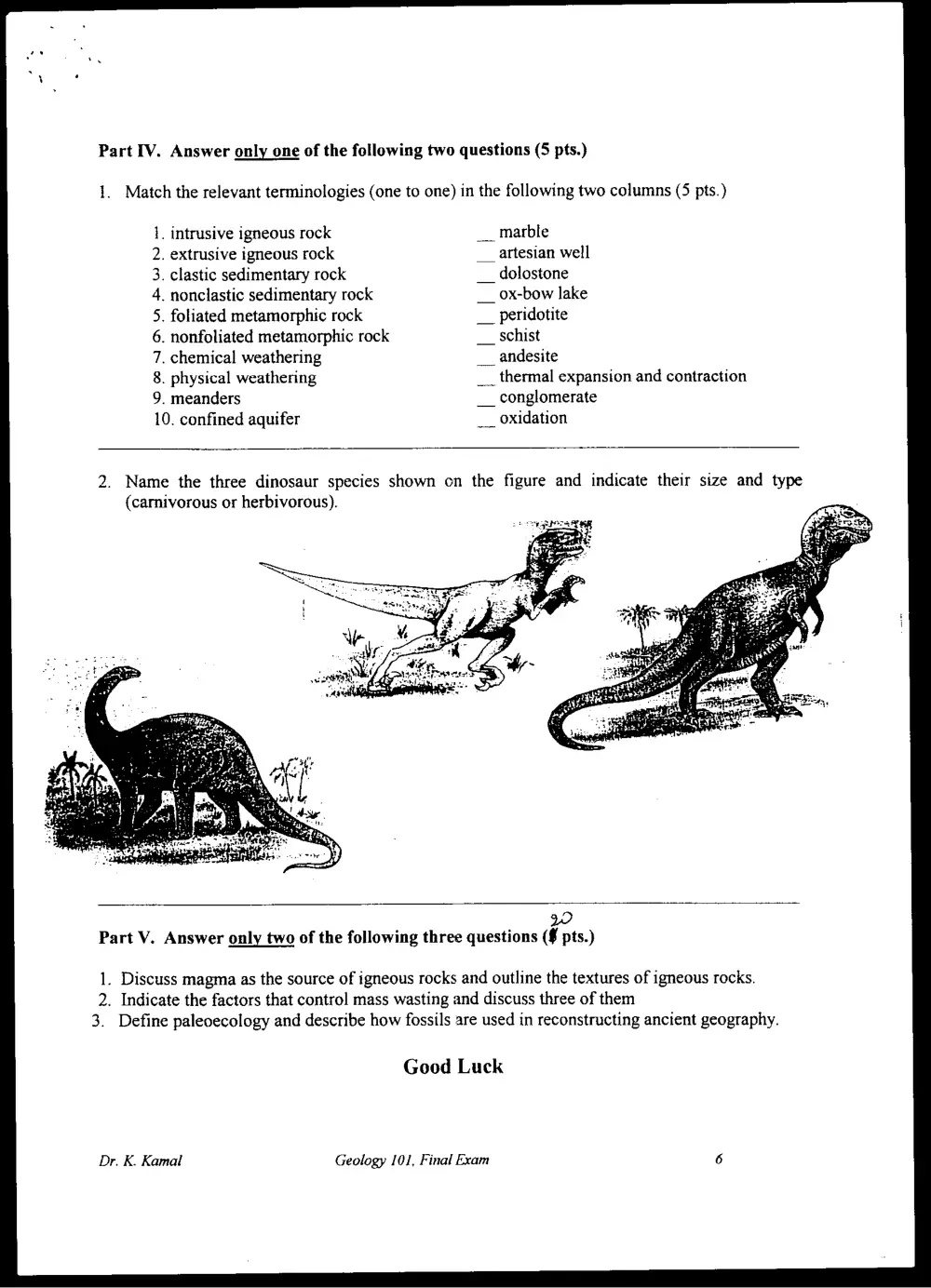
2. Name the three dinosaur species shown on the figure and indicate their size and type
(carnivorous or herbivorous).
20
Part V. Answer only two of the following three questions (§ pts.)
1. Discuss magma as the source of igneous rocks and outline the textures of igneous rocks.
2. Indicate the factors that control mass wasting and discuss three of them
3. Define paleoecology and describe how fossils are used in reconstructing ancient geography.
Good Luck
Dr. K. Kamal Geology 101, Final Exam