
GEOL 101 Final, Fall 1999
American University of Beirut · The Earth, Present and Past · 6 pages
More GEOL 101 files
Show the text of this final exam
\ (2
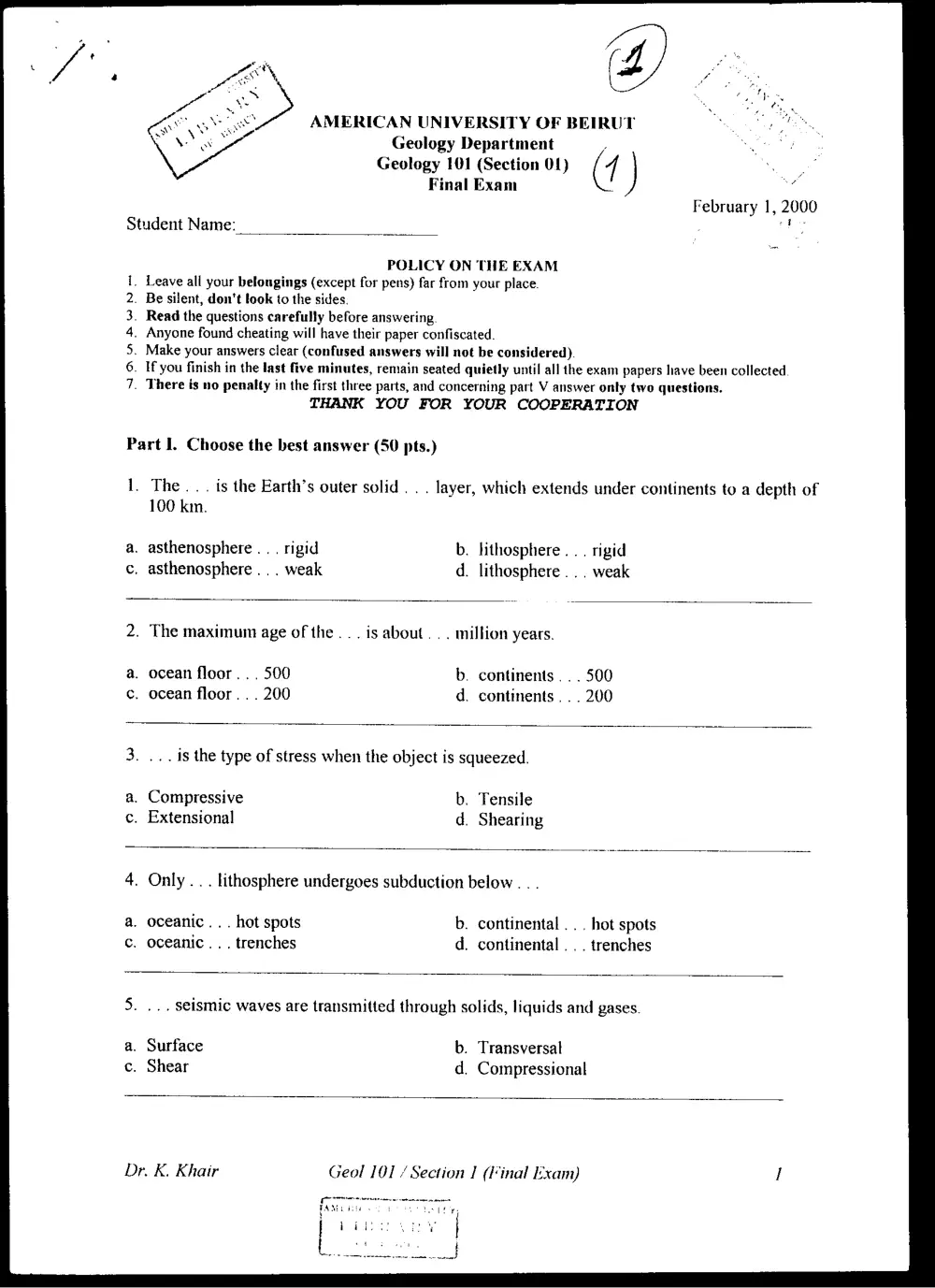
> AMERICAN UNIVERSITY OF BEIRUT
Geology Department ,
Geology 101 (Section O01) (1)
Final Exam
February 1, 2000
Student Name: ; ey
POLICY ON THE EXAM
. Leave all your belongings (except for pens) far from your place.
. Be silent, don't look to the sides.
. Read the questions carefully before answering.
. Anyone found cheating will have their paper confiscated.
. Make your answers clear (confused answers will not be considered)
. If you finish in the last five minutes, remain seated quietly until all the exam papers have been collected
. There is no penalty in the first three parts, and concerning part V answer only two questions.
THANK YOU FOR YOUR COOPERATION
Part J. Choose the best answer (50 pts.)
1. The... is the Earth’s outer solid . . . layer, which extends under continents to a depth of
100 km.
. asthenosphere . . . rigid b. lithosphere... rigid
. asthenosphere ... weak d. lithosphere... weak
. The maximum age of the... is about . . . million years.
. ocean floor... 500 b. continents...
. ocean floor... 200 d. continents , . .
. ... is the type of stress when the object is squeezed.
. Compressive b. Tensile
. Extensional d. Shearing
. Only. . . lithosphere undergoes subduction below . . .
. oceanic... hot spots b. continental . . . hot spots
. oceanic... trenches d. continental . . . trenches
. ... Seismic waves are transmitted through solids, liquids and gases.
. Surface b. Transversal
. Shear d. Compressional
Dr. K. Khair Geol 101 / Section ] (Final Exam)
AMG ni 4 Lally
pier |
a tenn pe nem os aneenel
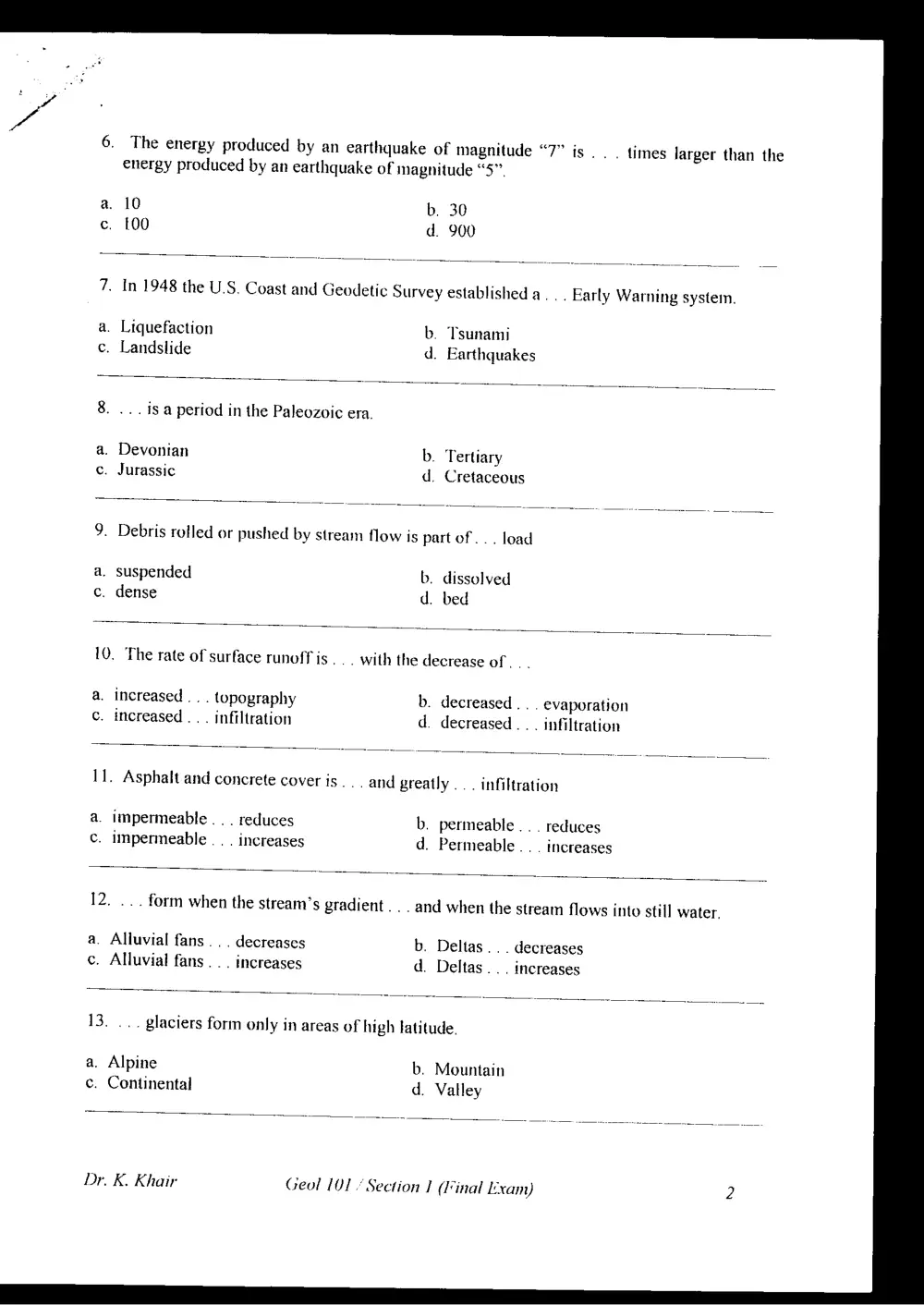
6. The energy produced by an earthquake of magnitude “7” is. . . times larger than the
energy produced by an earthquake of magnitude “5”.
a. 10 b. 30
c. 100 d. 900
7. In 1948 the U.S. Coast and Geodetic Survey established a... Early Warning system.
a. Liquefaction b. Tsunami
c. Landslide d. Earthquakes
8. .. . isa period in the Paleozoic era.
a. Devonian b. Tertiary
c. Jurassic d. Cretaceous
9. Debris rolled or pushed by stream flow is part of... load
a. suspended b. dissolved
c. dense d. bed
10. The rate of surface runoff is... with the decrease of...
a. increased . . . topography b. decreased... evaporation
c. increased . . . infiltration d. decreased . . . infiltration
11. Asphalt and concrete cover is... and greatly... infiltration
a. impermeable . . . reduces b. permeable .. . reduces
c. impermeable . . . increases d. Permeable .. . increases
12. ... form when the stream’s gradient . . . and when the stream flows into still water,
a. Alluvial fans... decreases b. Deltas... decreases
c. Alluvial fans... increases d. Deltas... increases
13. ... glaciers form only in areas of high latitude.
a. Alpine b. Mountain
c. Continental d. Valley
Dr. K. Khair Geol 101 “ Section 1 (Final Exam) 2
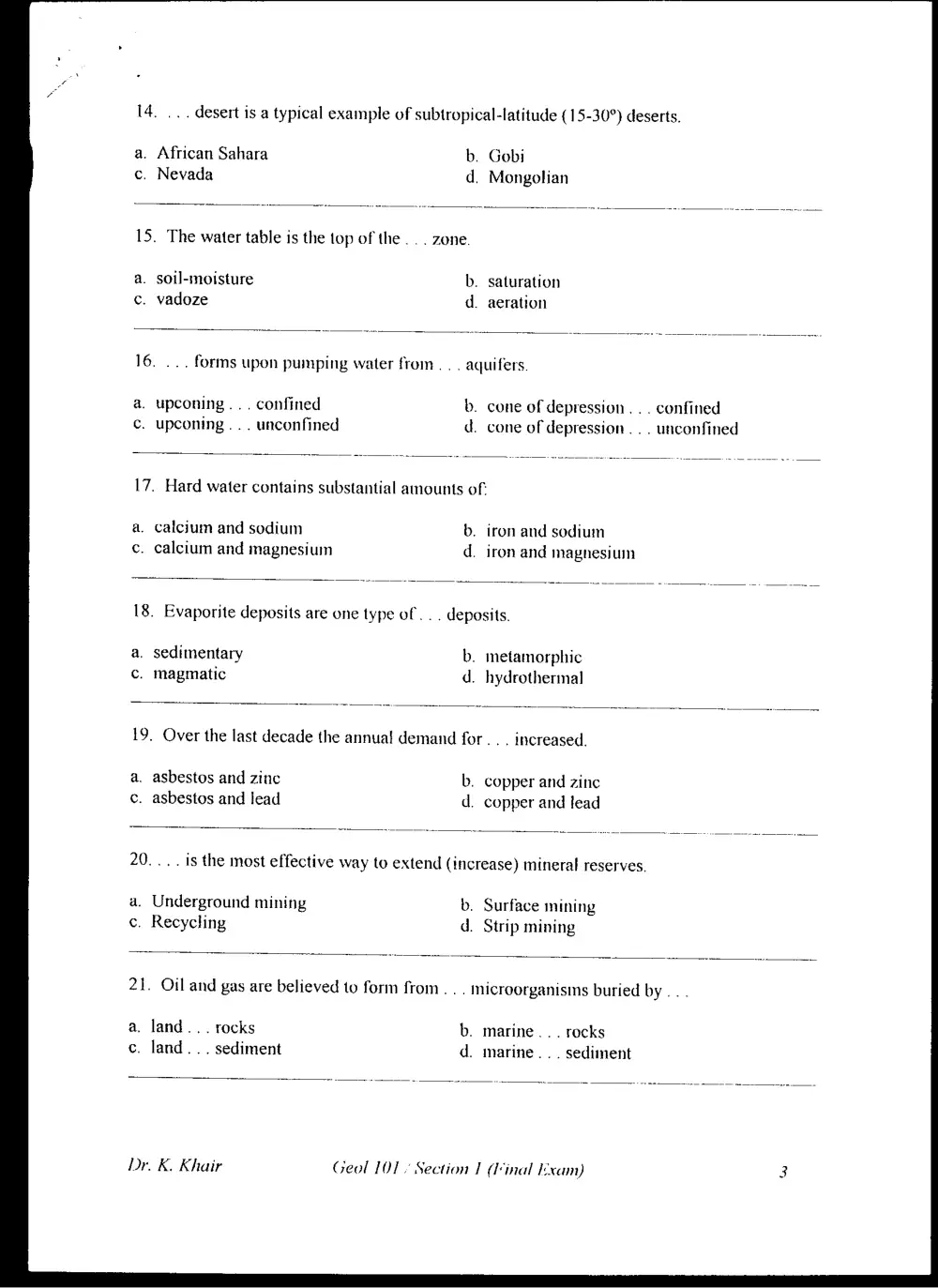
14. ... desert is a typical example of subtropical-latitude (15-30°) deserts.
a. African Sahara b. Gobi
c. Nevada d. Mongolian
15. The water table is the top of the . . . zone.
a. soil-moisture b. saturation
c. vadoze d. aeration
16. ... forms upon pumping water from . . . aquifers.
a. upconing ... confined b. cone of depression . . . confined
c. upconing ... unconfined d. cone of depression... unconfined
17. Hard water contains substantial amounts of:
a. calcium and sodium b. iron and sodium
c. calcium and magnesium d. iron and magnesium
18. Evaporite deposits are one type of . . . deposits.
a. sedimentary b. metamorphic
c. magmatic d. hydrothermal
19. Over the last decade the annual demand for . . . increased.
a. asbestos and zinc b. copper and zinc
c. asbestos and lead d. copper and lead
20... . is the most effective way to extend (increase) mineral reserves.
a. Underground mining b. Surface mining
c. Recycling d. Strip mining
21. Oil and gas are believed to form from . . . microorganisins buried by...
a. land... rocks b. marine... rocks
c. land... sediment d. marine... sediment
Dr. K. Khair Geol 101 / Section 1 (Vinal exam) 3
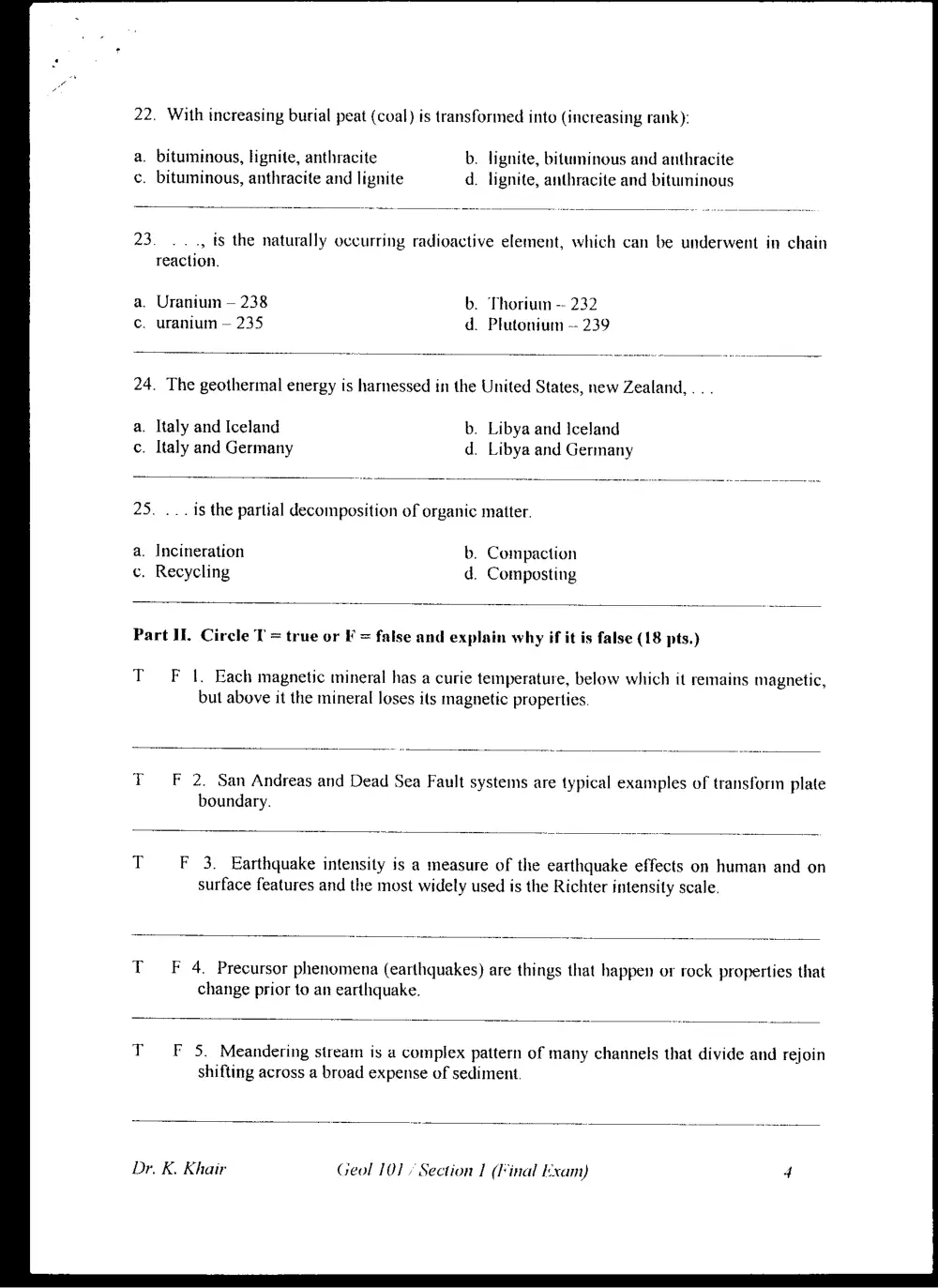
22. With increasing burial peat (coal) is transformed into (increasing rank):
a. bituminous, lignite, anthracite b. lignite, bituminous and anthracite
c. bituminous, anthracite and lignite d. lignite, anthracite and bituminous
23... ., is the naturally occurring radioactive element, which can be underwent in chain
reaction.
a. Uranium — 238 b. Thorium -- 232
c. uranium — 235 d. Plutonium — 239
24. The geothermal energy is harnessed in the United States, new Zealand, . . .
a. Italy and Iceland b. Libya and Iceland
c. Italy and Germany d. Libya and Germany
25. ... is the partial decomposition of organic matter.
a. Incineration b. Compaction
c. Recycling d. Composting
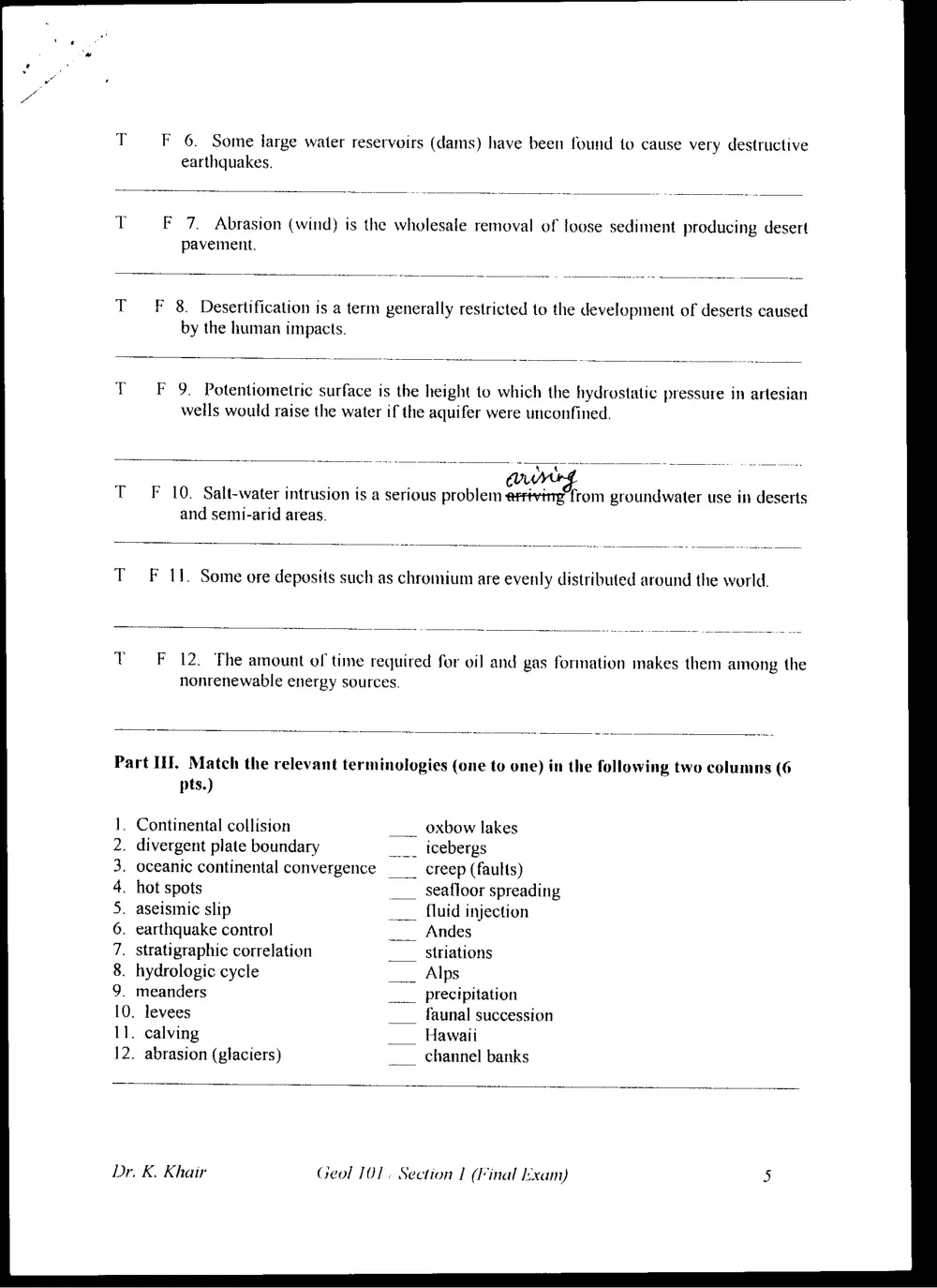
Part II. Circle T = true or F = false and explain why if it is false (18 pts.)
TF 1. Each magnetic mineral has a curie temperature, below which it remains magnetic
but above it the mineral loses its magnetic properties.
>
TF 2. San Andreas and Dead Sea Fault systems are typical examples of transform plate
boundary.
F 3. Earthquake intensity is a measure of the earthquake effects on human and on
surface features and the most widely used is the Richter intensity scale.
F 4. Precursor phenomena (earthquakes) are things that happen or rock properties that
change prior to an earthquake.
F 5. Meandering stream is a complex pattern of many channels that divide and rejoin
shifting across a broad expense of sediment.
Dr. K. Khair Geol 10] ¢ Section | (Final exam)
F 6. Some large water reservoirs (dams) have been found to cause very destructive
earthquakes.
F 7. Abrasion (wind) is the wholesale removal of loose sediment producing desert
pavement.
F 8. Desertification is a term generally restricted to the development of deserts caused
by the human impacts.
F 9. Potentiometric surface is the height to which the hydrostatic pressure in artesian
wells would raise the water if the aquifer were unconfined.
yo
F 10. Salt-water intrusion is a serious problem ert+ving from groundwater use in deserts
and semi-arid areas.
F 11. Some ore deposits such as chromium are evenly distributed around the world,
F 12. The amount of time required for oi] and gas formation makes them among the
nonrenewable energy sources.
Part IIT. Match the relevant terminologies (one to one) in the following two columns (6
pts.)
Continental collision oxbow lakes
divergent plate boundary __. tcebergs
oceanic continental convergence creep (faults)
hot spots ___ seafloor spreading
aseismic slip fluid injection
earthquake control Andes
stratigraphic correlation striations
hydrologic cycle Alps
. meanders ; precipitation
10. levees faunal succession
11. calving Hawaii
12. abrasion (glaciers) channel banks
SON AwRWN—
Dr. K. Khair Geol 10], Section 1 (Final Exam)
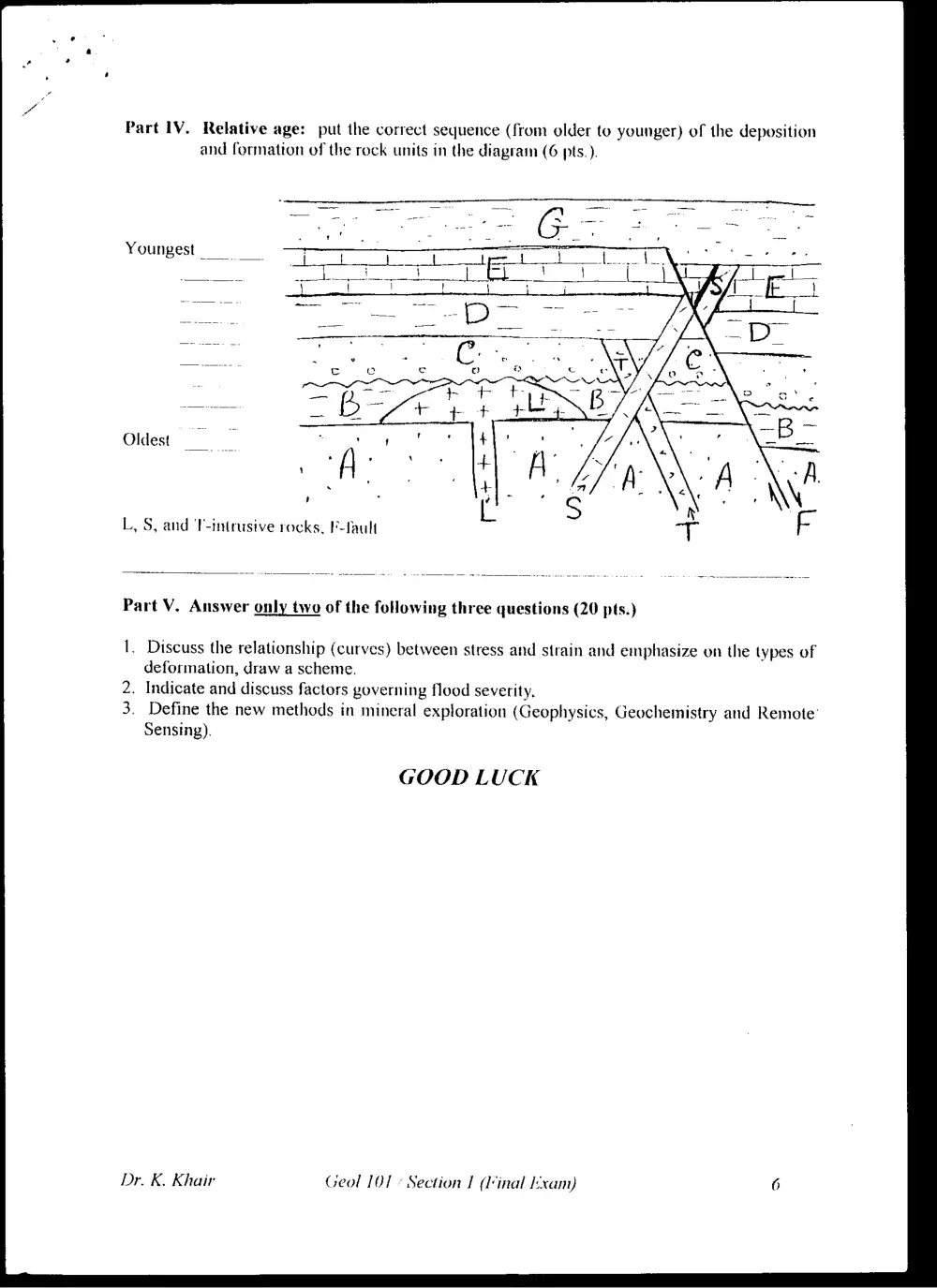
Part 1V. Relative age: put the correct sequence (from older to younger) of the deposition
and formation of the rock units in the diagram (6 pts. ).
Oldest
L, S, and ‘T-intrusive rocks, F-fault
Part V. Answer only two of the folowing three questions (20 pts.)
|. Discuss the relationship (curves) between stress and strain and emphasize on the types of
deformation, draw a scheme.
2. Indicate and discuss factors governing flood severity,
3. Define the new methods in mineral exploration (Geophysics, Geochemistry and Remote’
Sensing).
GOOD LUCK
Dr. K, Khair Geol 101 + Section I (Iinal Isxam)