
GEOL 101 Final, Fall 1997
American University of Beirut · The Earth, Present and Past · 6 pages
More GEOL 101 files
Show the text of this final exam
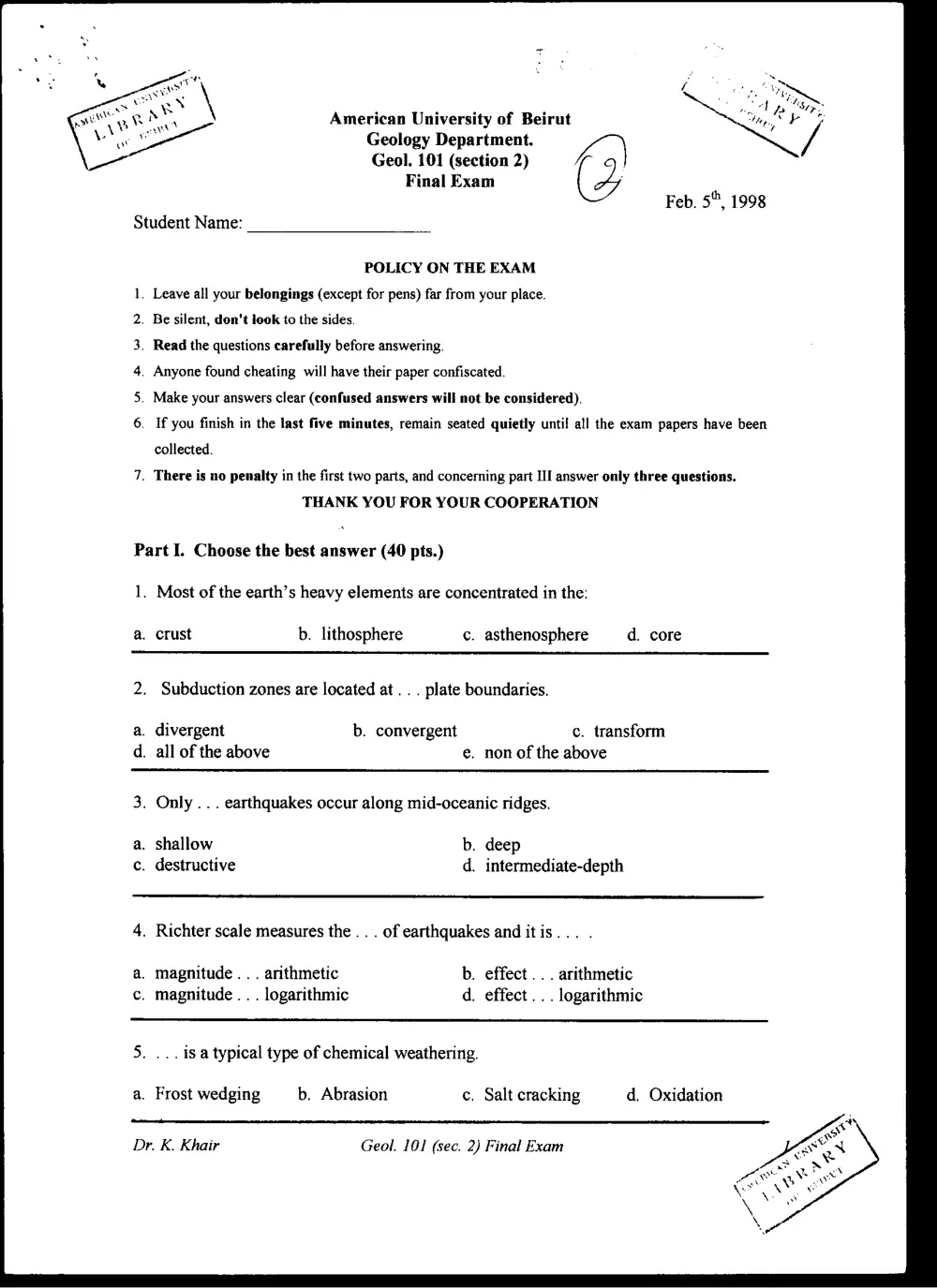
American University of Beirut
Final Exam
Geology Department.
Geol. 101 (section 2) ( yh
Feb. 5", 1998
Student Name:
POLICY ON THE EXAM
. Leave all your belongings (except for pens) far from your place.
. Be silent, don't look to the sides.
. Read the questions carefully before answering.
. Anyone found cheating will have their paper confiscated.
. Make your answers clear (confused answers will not be considered).
. If you finish in the last five minutes, remain seated quietly until all the exam papers have been
collected.
. There is no penalty in the first two parts, and concerning part III answer only three questions.
THANK YOU FOR YOUR COOPERATION
Part I. Choose the best answer (40 pts.)
1. Most of the earth’s heavy elements are concentrated in the:
a. crust b. lithosphere c. asthenosphere d. core
2. Subduction zones are located at . . . plate boundaries,
a. divergent b. convergent c. transform
d. all of the above e. non of the above
3. Only... earthquakes occur along mid-oceanic ridges.
a. shallow b. deep
c. destructive d. intermediate-depth
4. Richter scale measures the . . . of earthquakes anditis... .
a. magnitude. . . arithmetic b. effect... arithmetic
c. magnitude .. . logarithmic d. effect... logarithmic
5. ...is atypical type of chemical weathering.
a. Frost wedging b. Abrasion c. Salt cracking d. Oxidation
Dr. K. Khair Geol. 101 (sec. 2) Final Exam
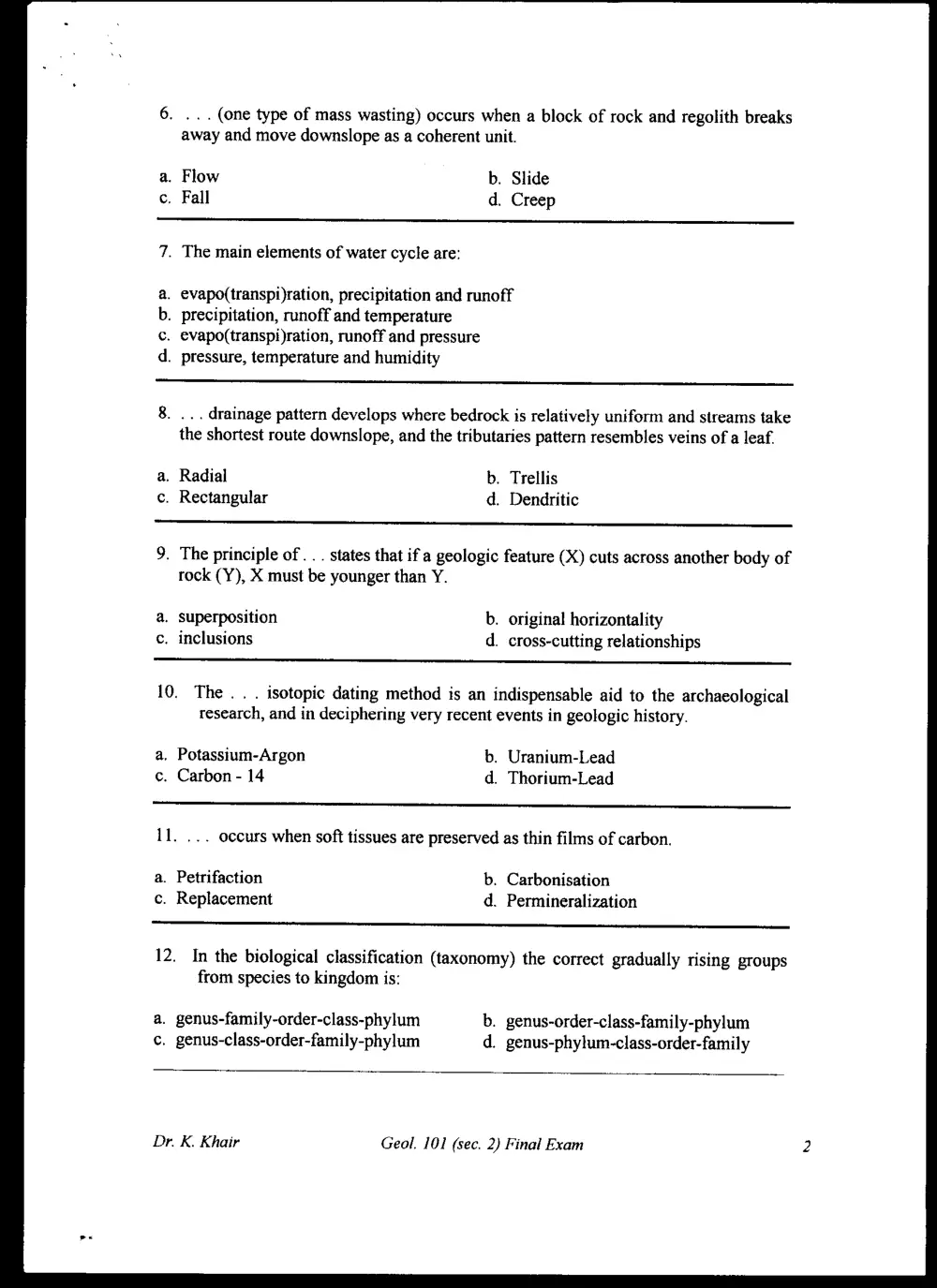
6. ... (one type of mass wasting) occurs when a block of rock and regolith breaks
away and move downslope as a coherent unit.
a. Flow b. Slide
c. Fall d. Creep
SSeS
7. The main elements of water cycle are:
. evapo(transpi)ration, precipitation and runoff
. precipitation, runoff and temperature
. evapo(transpi)ration, runoff and pressure
. pressure, temperature and humidity
8. ... drainage pattern develops where bedrock is relatively uniform and streams take
the shortest route downslope, and the tributaries pattern resembles veins of a leaf.
a. Radial b. Trellis
c. Rectangular d. Dendritic
. The principle of . . . states that if a geologic feature (X) cuts across another body of
rock (Y), X must be younger than Y.
. Superposition b. original horizontality
. inclusions d. cross-cutting relationships
10. The . . . isotopic dating method is an indispensable aid to the archaeological
research, and in deciphering very recent events in geologic history.
a. Potassium-Argon b. Uranium-Lead
c. Carbon - 14 d. Thorium-Lead
RS rrr
11. ... occurs when soft tissues are preserved as thin films of carbon.
a. Petrifaction b. Carbonisation
c. Replacement d. Permineralization
Spy sr
12. In the biological classification (taxonomy) the correct gradually rising groups
from species to kingdom is:
a. genus-family-order-class-phylum b. genus-order-class-family-phylum
c. genus-class-order-family-phylum d. genus-phylum-class-order-family
Dr. K. Khair Geol. 10] (sec. 2) Final Exam
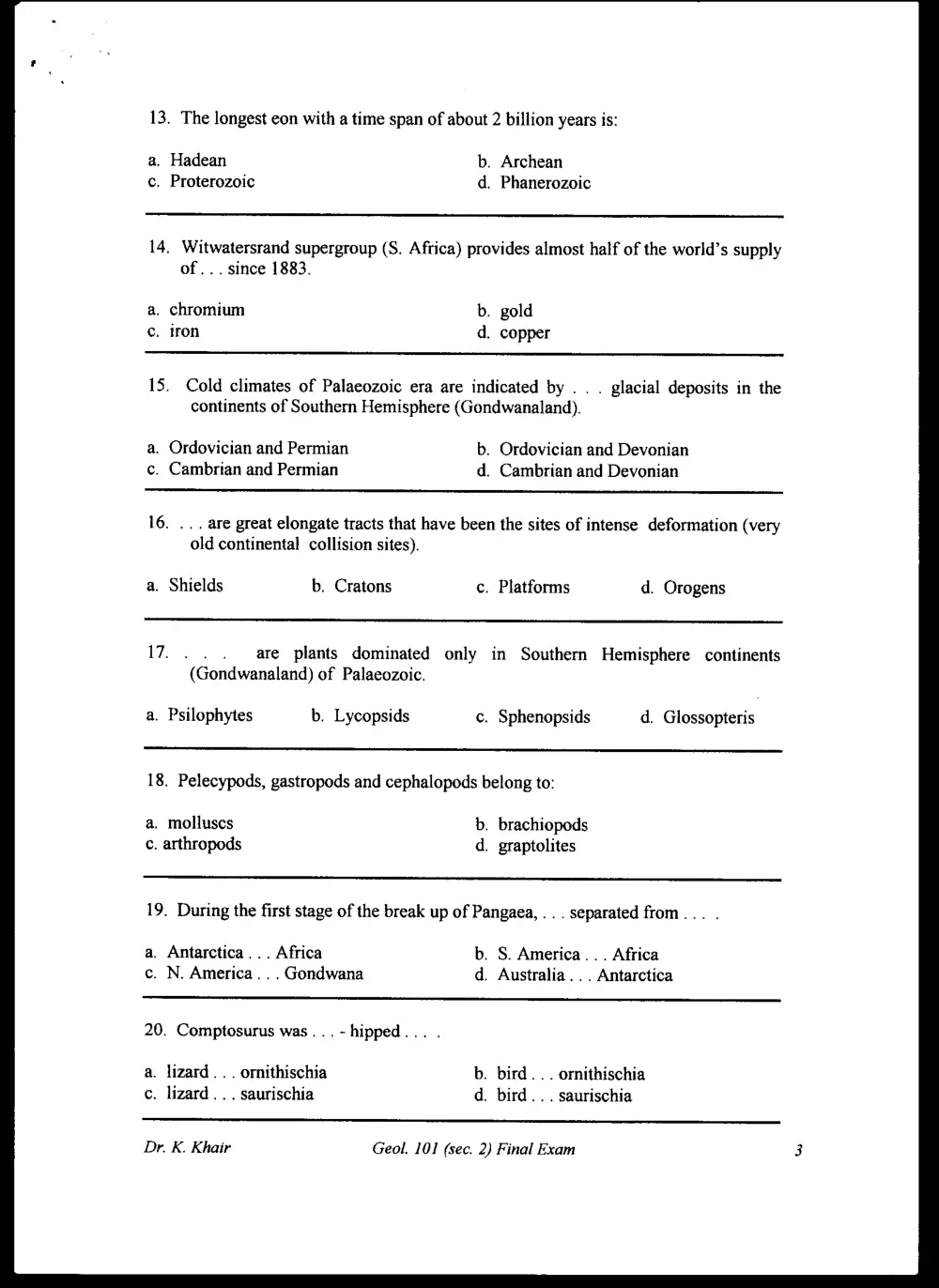
13. The longest eon with a time span of about 2 billion years is:
a. Hadean b. Archean
c. Proterozoic d. Phanerozoic
14, Witwatersrand supergroup (S. Africa) provides almost half of the world’s supply
of... since 1883.
a. chromium b. gold
c. iron d. copper
15. Cold climates of Palaeozoic era are indicated by . . . glacial deposits in the
continents of Southern Hemisphere (Gondwanaland).
a. Ordovician and Permian b. Ordovician and Devonian
c. Cambrian and Permian d. Cambrian and Devonian
16. ... are great elongate tracts that have been the sites of intense deformation (very
old continental collision sites).
a. Shields b. Cratons c. Platforms d. Orogens
17... . are plants dominated only in Southern Hemisphere continents
(Gondwanaland) of Palaeozoic.
a. Psilophytes b. Lycopsids c. Sphenopsids d. Glossopteris
18. Pelecypods, gastropods and cephalopods belong to:
a, molluscs b. brachiopods
c. arthropods d. graptolites
19. During the first stage of the break up of Pangaea, ... separated from... .
a. Antarctica... Africa b. S. America... Africa
c. N. America... Gondwana d. Australia... Antarctica
20. Comptosurus was...- hipped... .
a. lizard... ornithischia b. bird... ornithischia
c. lizard... saurischia d. bird... saurischia
Dr. K. Khair Geol. 10] (sec. 2) Final Exam
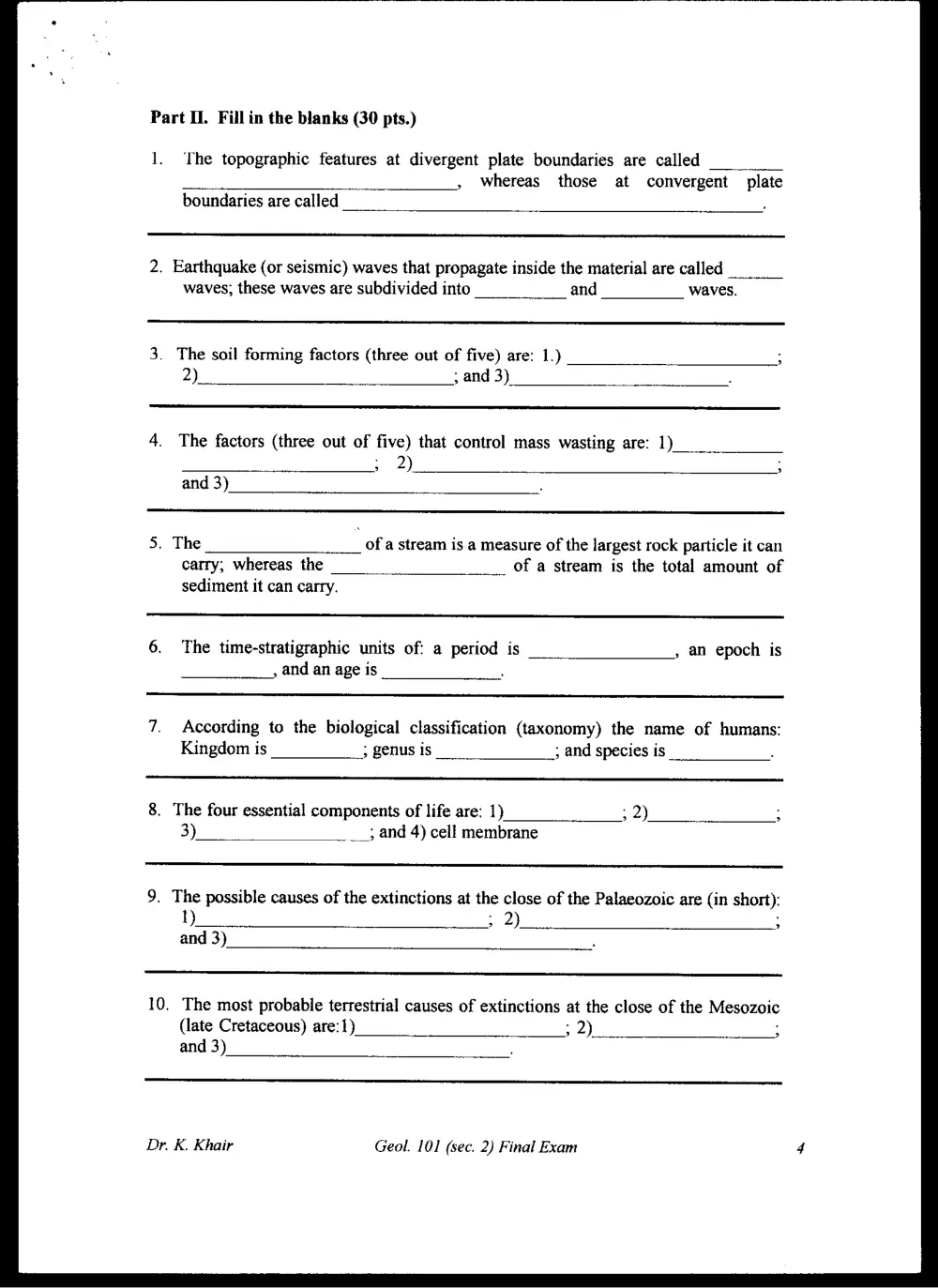
Part Il. Fill in the blanks (30 pts.)
1. The topographic features at divergent plate boundaries are called
, whereas those at convergent plate
boundaries are called
2. Earthquake (or seismic) waves that propagate inside the material are called
waves; these waves are subdivided into and waves.
3. The soil forming factors (three out of five) are: 1.)
2) ; and 3)
4. The factors (three out of five) that control mass wasting are: 1)
; 2) ;
and 3)
5. The of a stream is a measure of the largest rock particle it can
carry; whereas the of a stream is the total amount of
sediment it can carry.
6. The time-stratigraphic units of: a period is , an epoch is
and an age is
7. According to the biological classification (taxonomy) the name of humans:
Kingdom is 3 genus is ; and species is
8, The four essential components of life are: 1) ; 2) 5
3) ; and 4) cell membrane
9. The possible causes of the extinctions at the close of the Palaeozoic are (in short):
1) ; 2) 3
and 3)
10. The most probable terrestrial causes of extinctions at the close of the Mesozoic
(late Cretaceous) are:1) ; 2)
and 3)
>
Dr. K. Khair Geol. 10] (sec. 2) Final Exam
Part LIL. Answer only three of the following four questions (30 pts.)
1. Indicate and discuss the earth’s layers, draw schemes.
2. Discuss the sediment deposition including channel deposits, and alluvial fans and
deltas, draw schemes.
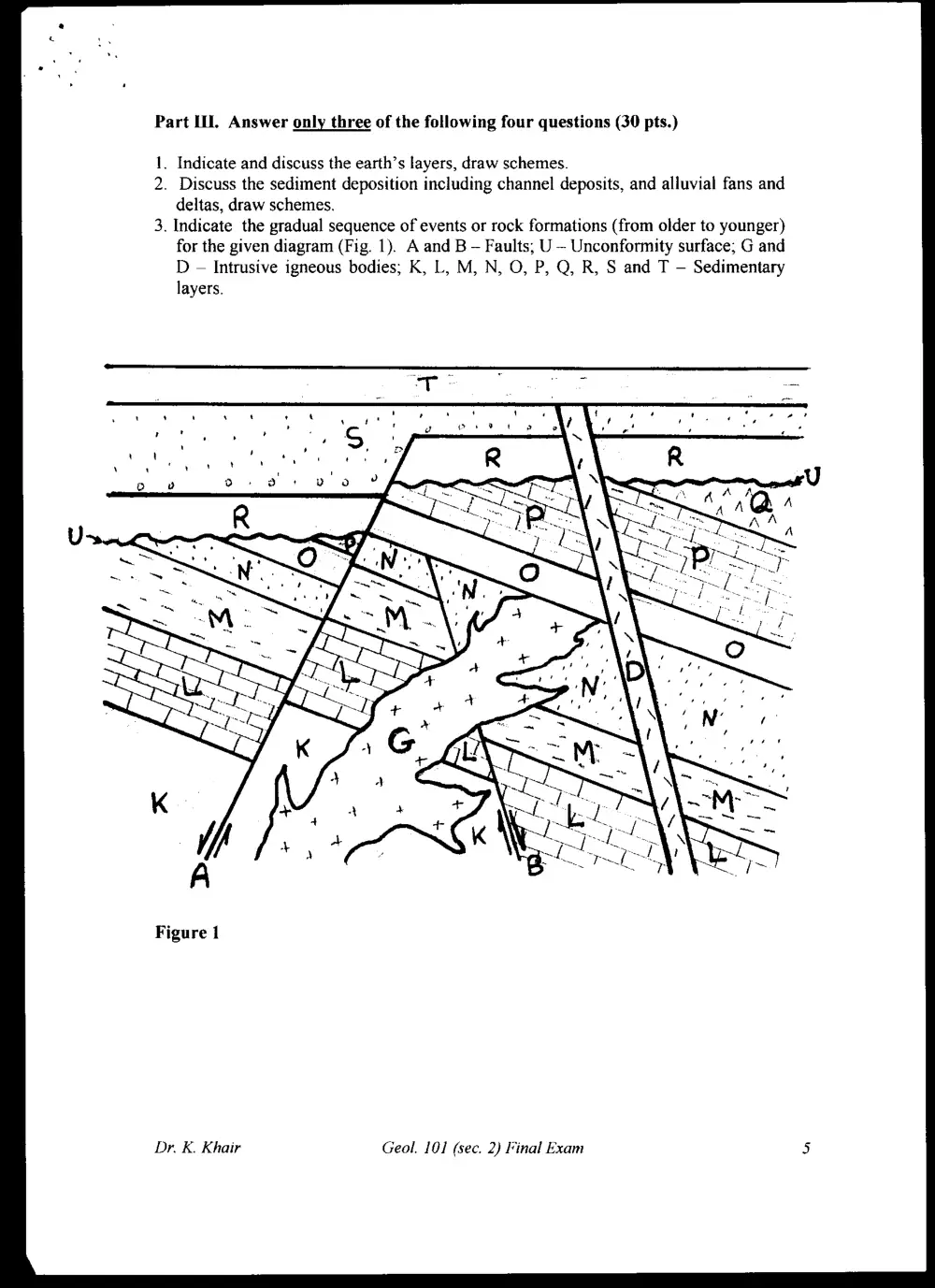
3. Indicate the gradual sequence of events or rock formations (from older to younger)
for the given diagram (Fig. 1). A and B — Faults; U — Unconformity surface; G and
D — Intrusive igneous bodies; K, L, M, N, O, P, Q, R, S and T — Sedimentary
layers.
Dr. K. Khair Geol. 101] (sec. 2) Final Exam
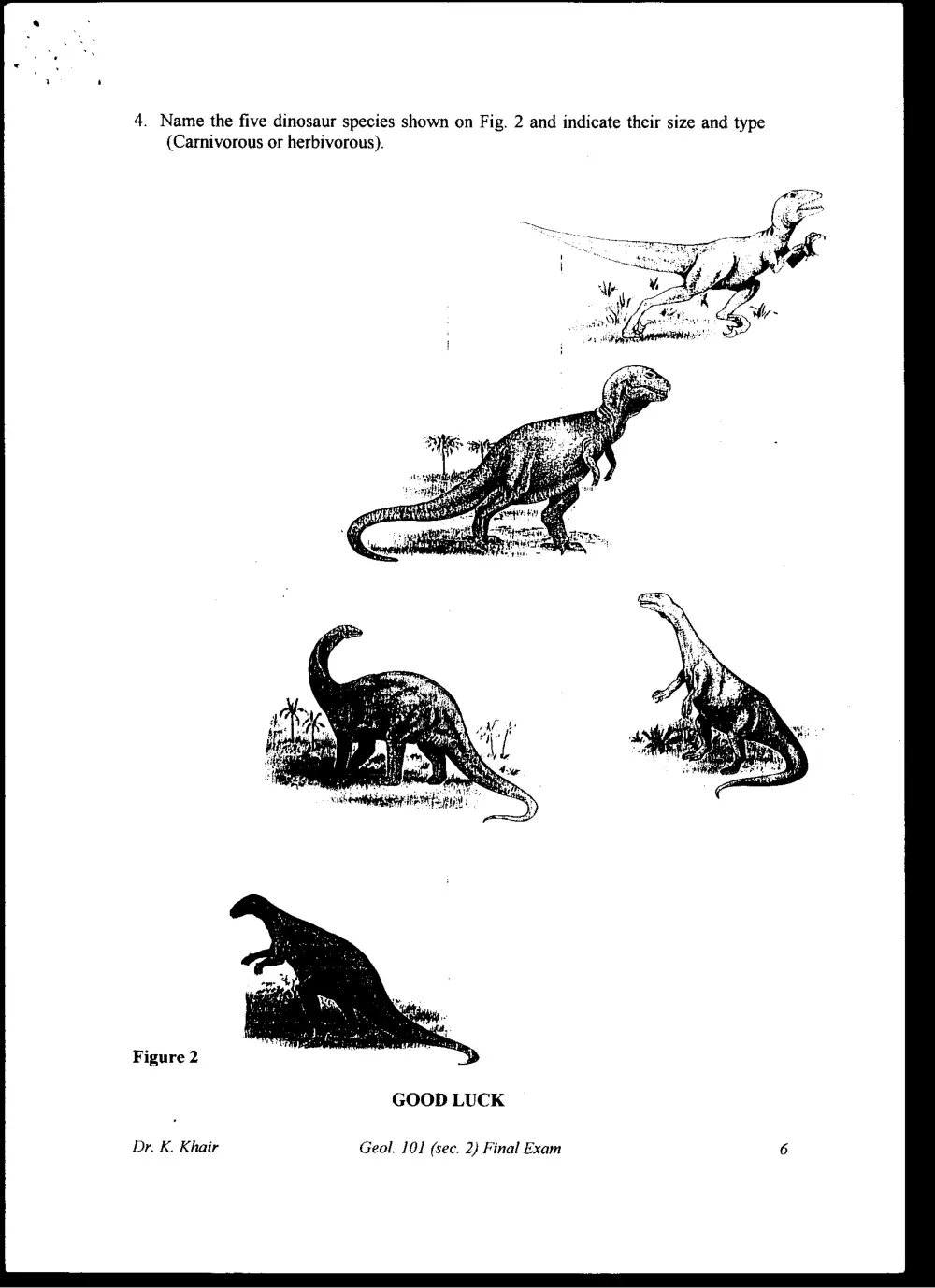
4. Name the five dinosaur species shown on Fig. 2 and indicate their size and type
(Carnivorous or herbivorous).
GOOD LUCK
Dr. K. Khair Geol. 101 (sec. 2) Final Exam