
MATH 261 Final, Fall 2001
American University of Beirut · Number Theory · 2 pages
More MATH 261 files
Show the text of this final exam
ERIGAN CUNIVERSIT?
LIBRARY
OF REIRUI
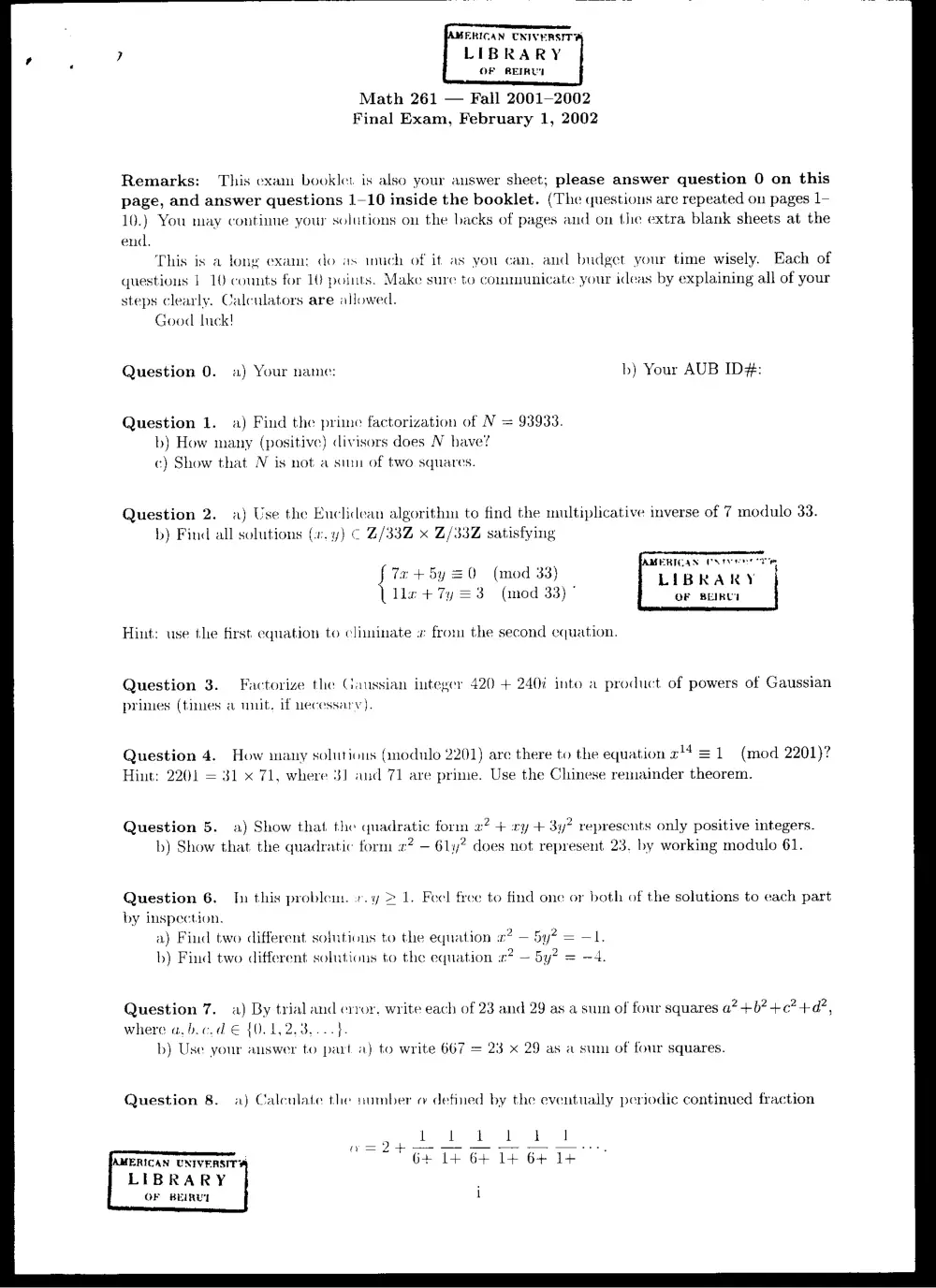
Math 261 — Fall 2001—2002
Final Exam, February 1, 2002
Remarks: This exam booklet is also your auswer sheet; please answer question 0 on this
page, and answer questions 1-10 inside the booklet. (The questions are repeated on pages 1-
10.) You may continue your solutions on the backs of pages and on the extra blank sheets at the
end.
This is a long exam: do as inuch of it as you can, and budget your time wisely. Each of
questions | 10 counts for 10 points. Make sure to communicate your ideas by explaining all of your
steps clearly. Calculators are allowed.
Good luck!
Question 0. a) Your name: b) Your AUB ID#:
Question 1. a) Find the prime factorization of N = 93933.
b) How many (positive) divisors does N have?
¢) Show that N is not a sim of two squares.
Question 2. a) Use the Euclidean algorithm to find the multiplicative inverse of 7 modulo 33.
b) Find all solutions (a. y) ¢ Z/33Z x Z/33Z satisfying
7a +5y =0 (mod 33) LIBRARY
AMERICAN CATeRe Tm
{ lla + 7y =3 (mod 33) ° OF BEIRUA
Hint: use the first equation to climinate « from the second equation.
Question 3. Factorize the Gaussian integer 420 + 240i into a product of powers of Gaussian
primes (times a unit, if necessary).
Question 4. How many solutions (modulo 2201) are there to the equation a!4=1 (mod 2201)?
Hint: 2201 = 31 x 71, where 31 and 71 are prime. Use the Chinese remainder theorem.
Question 5. a) Show that the quadratic form x? + xy + 3y° represents only positive integers.
b) Show that the quadratic form 2? — 61, does not represent 23, by working modulo 61.
Question 6. In this problem. +. > 1. Feel free to find one or both of the solutions to each part
by inspection.
a) Find two different solutions to the equation «?
— Sy? = -1.
b) Find two different solutions to the equation x? — Sy? = —4.
Question 7. a) By trial and error, write each of 23 and 29 as a sui of four squares a+b? +c+a?,
where a, bic, d € {0.1,2,3,...4.
b) Use your answer to part a) to write 667 = 23 x 29 as a sum of four squares.
Question 8. a) Calculate the number @ defined by the eventually periodic continued fraction
2+
AMERICAN UNIVERSITY G+ 1+ 6+ 1+ 6+ 1+
LIBRARY
OF BEIRUT
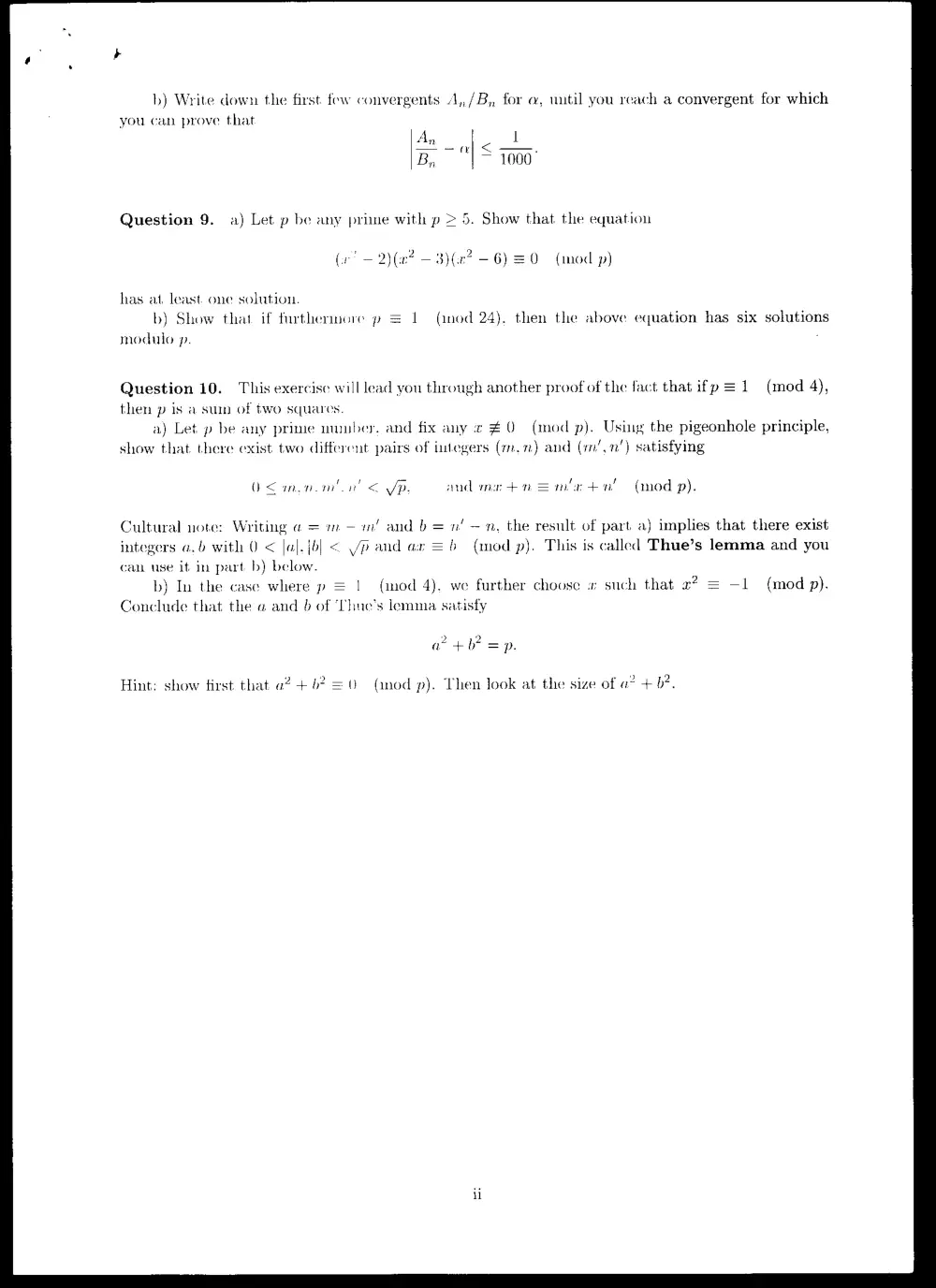
bh) Write down the first few convergents A,,/B,, for a, witil you reach a convergent for which
you can prove that
Question 9. a) Let p be any prime with p > 5. Show that the equation
=O0 (mod p)
has at least. one solution.
b) Show that if furthermore p = 1 (anod 24), then the above equation has six solutions
modulo p. :
Question 10. This exercise will lead you through another proof of the fact that ifp =1 (mod 4),
then p is a sum of two squares.
a) Let p be any prime nuuber, and fix any « #0 (mod p). Using the pigeonhole principle,
show that there exist two different pairs of integers (mn) and (m/,n’) satisfying
O<aineniim' an < Sp, and maton Same ten’ (mod p).
Cultural uote: Writing @ = a — mn! and b n’ ~ nm, the result of part a) implies that there exist
integers a,b with 0 < Jal. jb] < /p and ar = 6 (aod p). This is called Thue’s lemma and you
can use if in part b) below.
b) In the case where p = | (nod 4), we further choose « such that az’ = —1 (mod p).
Conclude that the @ and b of ‘Thuc’s lemma satisfy
w+? =p.
Hint: show first that a? +62 = (nod p). Then look at the size of a? + Bb.