
MATH 261 Final, Fall 2007
American University of Beirut · Number Theory · 1 page
Stuck on a question? A tutor can walk you through it.
More MATH 261 files
Show the text of this final exam
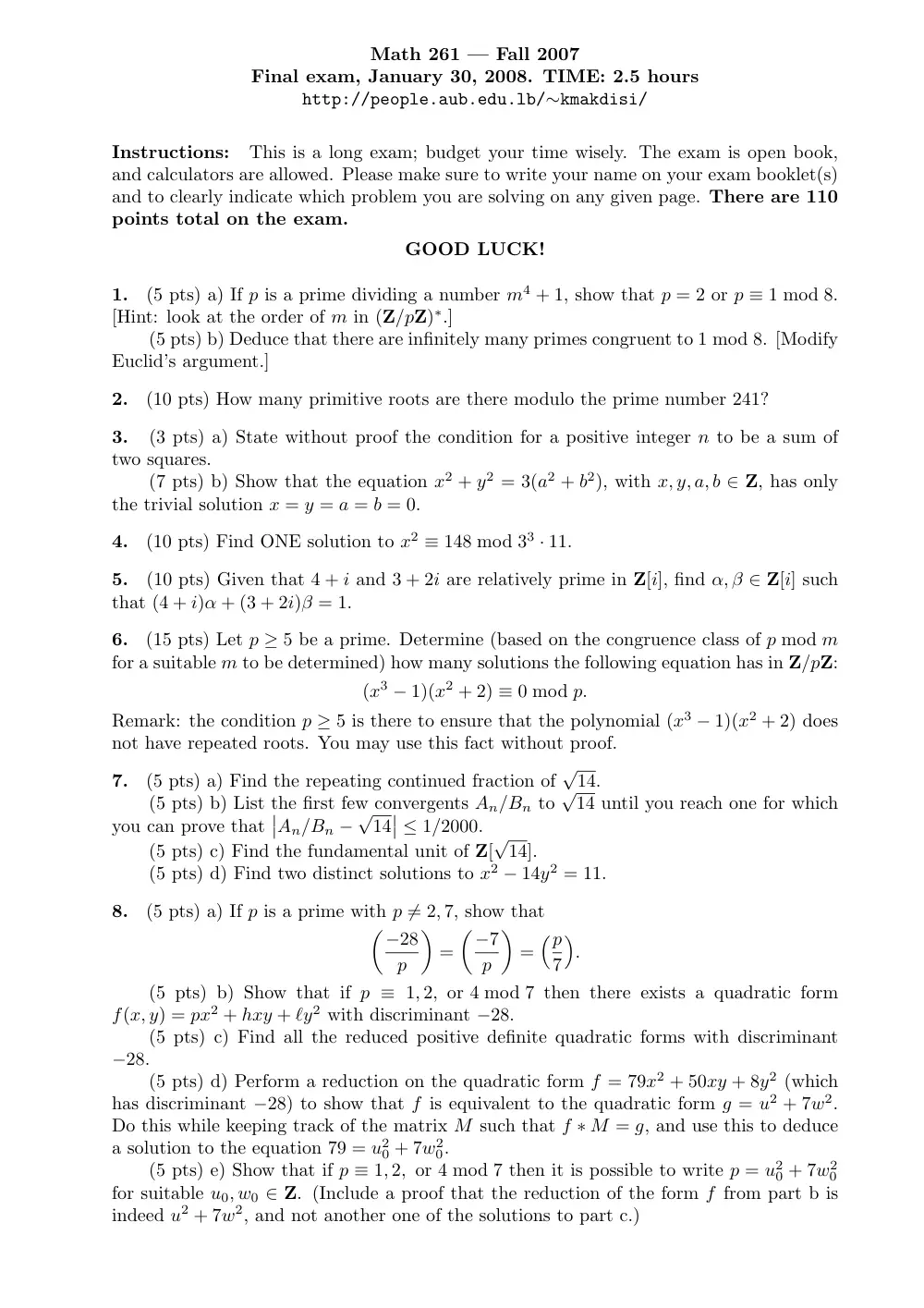
Math 261 — Fall 2007
Final exam, January 30, 2008. TIME: 2.5 hours
http://people.aub.edu.lb/∼kmakdisi/
Instructions:
This is a long exam; budget your time wisely. The exam is open book,
and calculators are allowed. Please make sure to write your name on your exam booklet(s)
and to clearly indicate which problem you are solving on any given page. There are 110
points total on the exam.
GOOD LUCK!
1.
(5 pts) a) If p is a prime dividing a number m4 + 1, show that p = 2 or p ≡ 1 mod 8.
[Hint: look at the order of m in (Z/pZ)∗.]
(5 pts) b) Deduce that there are infinitely many primes congruent to 1 mod 8. [Modify
Euclid’s argument.]
2.
(10 pts) How many primitive roots are there modulo the prime number 241?
3.
(3 pts) a) State without proof the condition for a positive integer n to be a sum of
two squares.
(7 pts) b) Show that the equation x2 + y2 = 3(a2 + b2), with x, y, a, b ∈ Z, has only
the trivial solution x = y = a = b = 0.
4.
(10 pts) Find ONE solution to x2 ≡ 148 mod 33 · 11.
5.
(10 pts) Given that 4 + i and 3 + 2i are relatively prime in Z[i], find α, β ∈ Z[i] such
that (4 + i)α + (3 + 2i)β = 1.
6.
(15 pts) Let p ≥ 5 be a prime. Determine (based on the congruence class of p mod m
for a suitable m to be determined) how many solutions the following equation has in Z/pZ:
(x3 − 1)(x2 + 2) ≡ 0 mod p.
Remark: the condition p ≥ 5 is there to ensure that the polynomial (x3 − 1)(x2 + 2) does
not have repeated roots. You may use this fact without proof.
7.
(5 pts) a) Find the repeating continued fraction of
√
14.
(5 pts) b) List the first few convergents An/Bn to
√
14 until you reach one for which
you can prove that
��An/Bn −
√
14
�� ≤ 1/2000.
(5 pts) c) Find the fundamental unit of Z[
√
14].
(5 pts) d) Find two distinct solutions to x2 − 14y2 = 11.
8.
(5 pts) a) If p is a prime with p ̸= 2, 7, show that
�−28
p
�
=
�−7
p
�
=
�p
7
�
.
(5 pts) b) Show that if p ≡ 1, 2, or 4 mod 7 then there exists a quadratic form
f(x, y) = px2 + hxy + ℓy2 with discriminant −28.
(5 pts) c) Find all the reduced positive definite quadratic forms with discriminant
−28.
(5 pts) d) Perform a reduction on the quadratic form f = 79x2 + 50xy + 8y2 (which
has discriminant −28) to show that f is equivalent to the quadratic form g = u2 + 7w2.
Do this while keeping track of the matrix M such that f ∗ M = g, and use this to deduce
a solution to the equation 79 = u2
0 + 7w2
0.
(5 pts) e) Show that if p ≡ 1, 2, or 4 mod 7 then it is possible to write p = u2
0 + 7w2
0
for suitable u0, w0 ∈ Z. (Include a proof that the reduction of the form f from part b is
indeed u2 + 7w2, and not another one of the solutions to part c.)