
MATH 261 Final, Fall 2017
American University of Beirut · Number Theory · 2 pages · Dr. Nicolas Mascot
More MATH 261 files
Show the text of this final exam
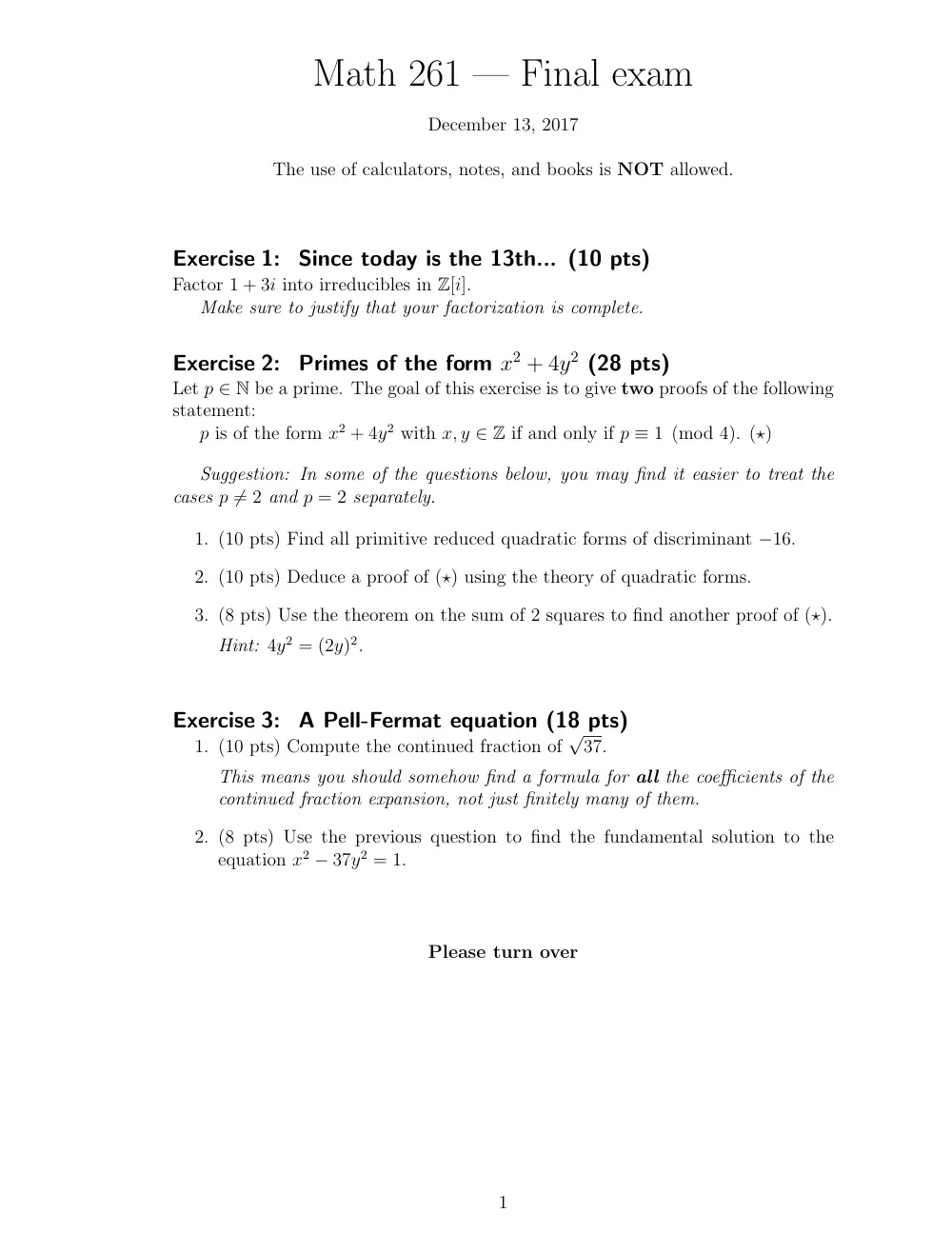
Math 261 — Final exam
December 13, 2017
The use of calculators, notes, and books is NOT allowed.
Exercise 1:
Since today is the 13th... (10 pts)
Factor 1 + 3i into irreducibles in Z[i].
Make sure to justify that your factorization is complete.
Exercise 2:
Primes of the form x2 + 4y2 (28 pts)
Let p ∈ N be a prime. The goal of this exercise is to give two proofs of the following
statement:
p is of the form x2 + 4y2 with x, y ∈ Z if and only if p ≡ 1 (mod 4). (⋆)
Suggestion: In some of the questions below, you may find it easier to treat the
cases p ̸= 2 and p = 2 separately.
1. (10 pts) Find all primitive reduced quadratic forms of discriminant −16.
2. (10 pts) Deduce a proof of (⋆) using the theory of quadratic forms.
3. (8 pts) Use the theorem on the sum of 2 squares to find another proof of (⋆).
Hint: 4y2 = (2y)2.
Exercise 3:
A Pell-Fermat equation (18 pts)
1. (10 pts) Compute the continued fraction of
√
37.
This means you should somehow find a formula for all the coefficients of the
continued fraction expansion, not just finitely many of them.
2. (8 pts) Use the previous question to find the fundamental solution to the
equation x2 − 37y2 = 1.
Please turn over
1
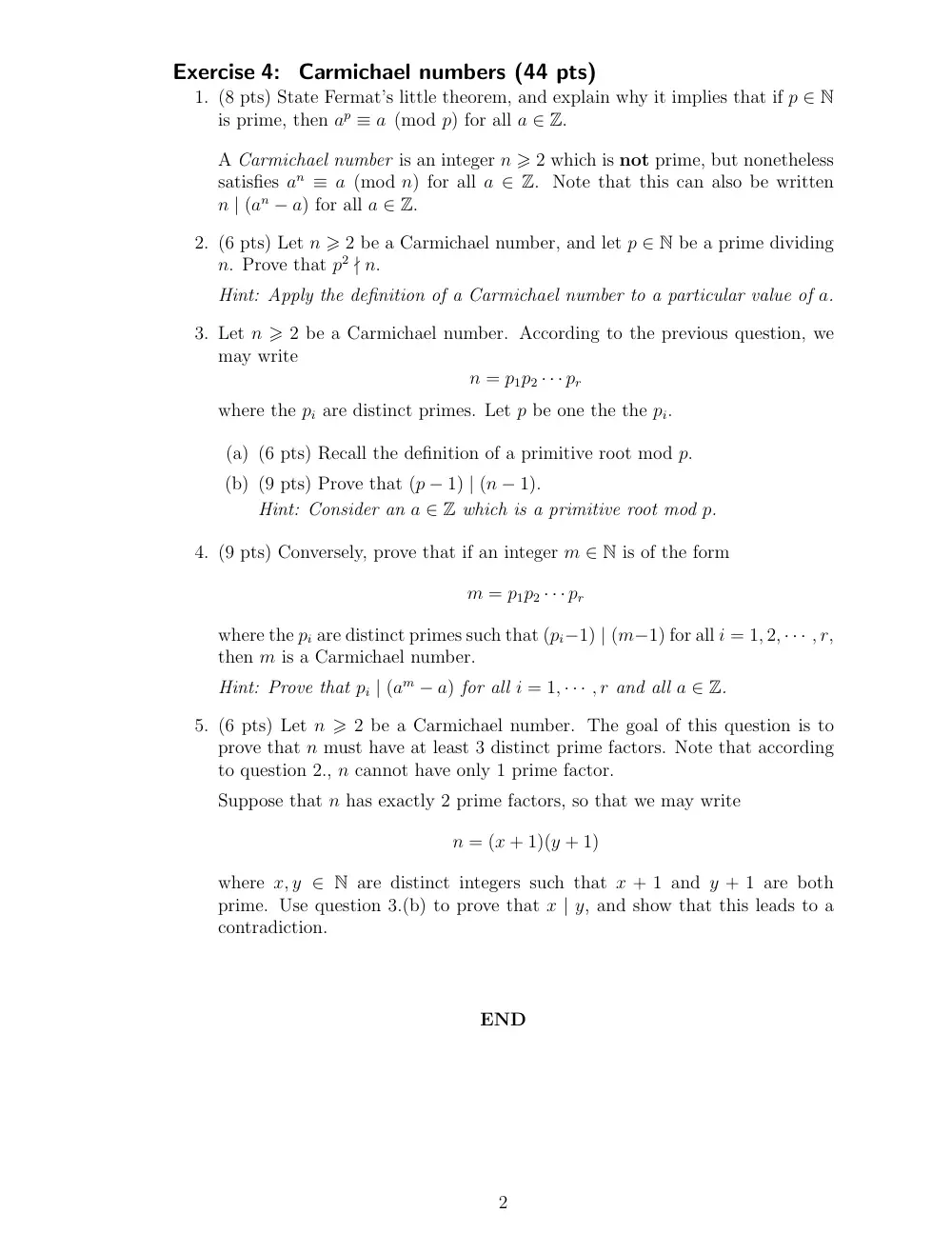
Exercise 4:
Carmichael numbers (44 pts)
1. (8 pts) State Fermat’s little theorem, and explain why it implies that if p ∈ N
is prime, then ap ≡ a (mod p) for all a ∈ Z.
A Carmichael number is an integer n ⩾ 2 which is not prime, but nonetheless
satisfies an ≡ a (mod n) for all a ∈ Z. Note that this can also be written
n | (an − a) for all a ∈ Z.
2. (6 pts) Let n ⩾ 2 be a Carmichael number, and let p ∈ N be a prime dividing
n. Prove that p2 ∤ n.
Hint: Apply the definition of a Carmichael number to a particular value of a.
3. Let n ⩾ 2 be a Carmichael number. According to the previous question, we
may write
n = p1p2 · · · pr
where the pi are distinct primes. Let p be one the the pi.
(a) (6 pts) Recall the definition of a primitive root mod p.
(b) (9 pts) Prove that (p − 1) | (n − 1).
Hint: Consider an a ∈ Z which is a primitive root mod p.
4. (9 pts) Conversely, prove that if an integer m ∈ N is of the form
m = p1p2 · · · pr
where the pi are distinct primes such that (pi−1) | (m−1) for all i = 1, 2, · · · , r,
then m is a Carmichael number.
Hint: Prove that pi | (am − a) for all i = 1, · · · , r and all a ∈ Z.
5. (6 pts) Let n ⩾ 2 be a Carmichael number. The goal of this question is to
prove that n must have at least 3 distinct prime factors. Note that according
to question 2., n cannot have only 1 prime factor.
Suppose that n has exactly 2 prime factors, so that we may write
n = (x + 1)(y + 1)
where x, y ∈ N are distinct integers such that x + 1 and y + 1 are both
prime. Use question 3.(b) to prove that x | y, and show that this leads to a
contradiction.
END
2