
MATH 261 Final, Fall 2018
American University of Beirut · Number Theory · 2 pages · Dr. Nicolas Mascot

More MATH 261 files
Show the text of this final exam
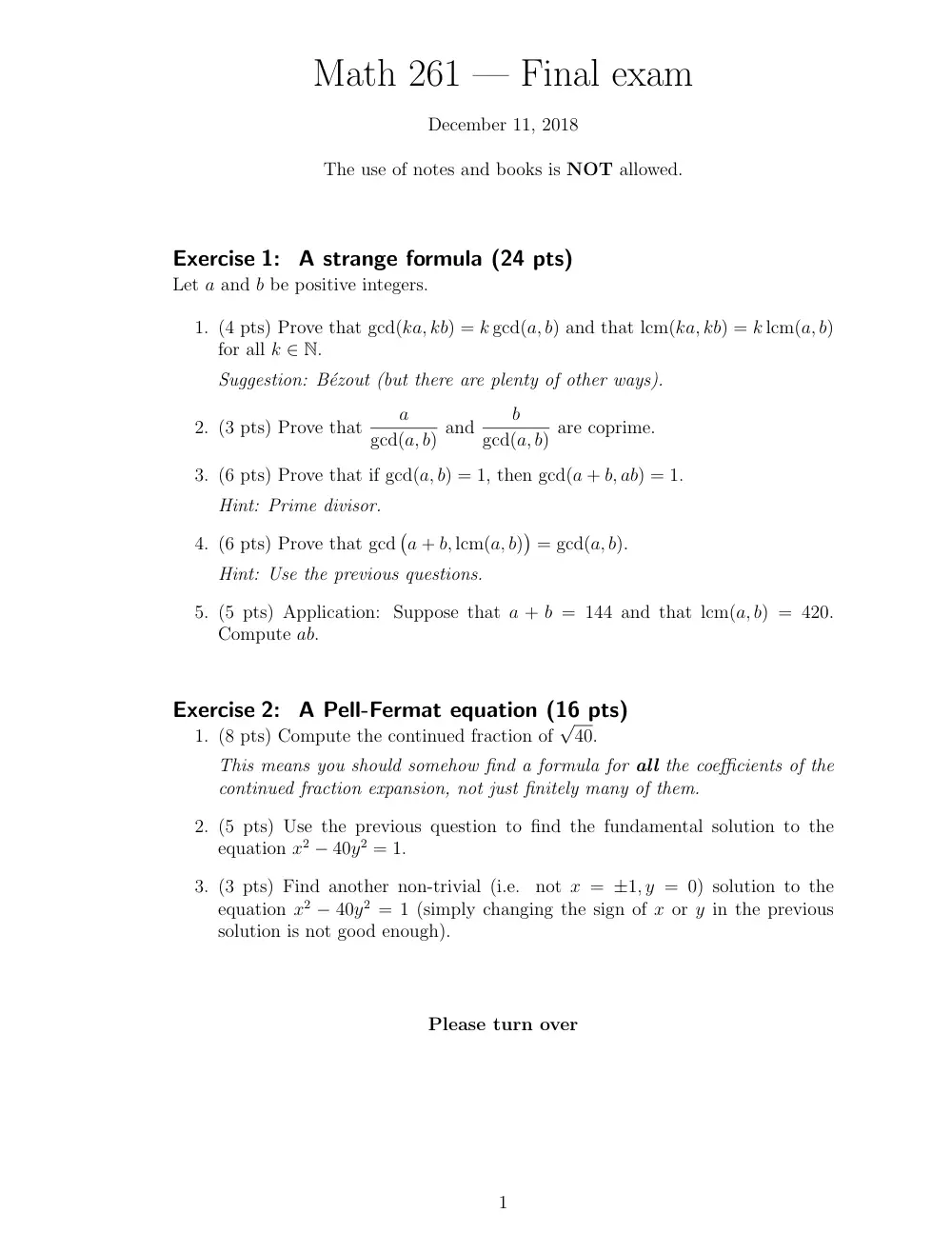
Math 261 — Final exam
December 11, 2018
The use of notes and books is NOT allowed.
Exercise 1:
A strange formula (24 pts)
Let a and b be positive integers.
1. (4 pts) Prove that gcd(ka, kb) = k gcd(a, b) and that lcm(ka, kb) = k lcm(a, b)
for all k ∈ N.
Suggestion: B´ezout (but there are plenty of other ways).
2. (3 pts) Prove that
a
gcd(a, b) and
b
gcd(a, b) are coprime.
3. (6 pts) Prove that if gcd(a, b) = 1, then gcd(a + b, ab) = 1.
Hint: Prime divisor.
4. (6 pts) Prove that gcd
�
a + b, lcm(a, b)
�
= gcd(a, b).
Hint: Use the previous questions.
5. (5 pts) Application: Suppose that a + b = 144 and that lcm(a, b) = 420.
Compute ab.
Exercise 2:
A Pell-Fermat equation (16 pts)
1. (8 pts) Compute the continued fraction of
√
40.
This means you should somehow find a formula for all the coefficients of the
continued fraction expansion, not just finitely many of them.
2. (5 pts) Use the previous question to find the fundamental solution to the
equation x2 − 40y2 = 1.
3. (3 pts) Find another non-trivial (i.e.
not x = ±1, y = 0) solution to the
equation x2 − 40y2 = 1 (simply changing the sign of x or y in the previous
solution is not good enough).
Please turn over
1
Exercise 3:
Multiples of sums of squares (27 pts)
The purpose of the exercise is to determine some conditions for the multiple of a
sum of k squares to be a sum of k squares. We will consider the case k = 2 in most
of the exercise, and k = 3 in the last question.
1. (1 pt) Briefly recall why n is a sum of two squares if and only if there exists
α ∈ Z[i] such that N(α) = n.
2. (4 pts) Let n ∈ N. Prove that if n is a sum of two squares, then so is 2n.
Hint: Multiply by 1 + i.
3. (4 pts) More precisely, suppose that we know a, b ∈ Z such that n = a2 + b2.
Find c, d ∈ Z (expressed in terms of a and b) such that 2n = c2 + d2.
4. We now suppose that n is a sum of two squares. Let k ∈ N. The purpose of
the next two questions is to prove that kn is a sum of two squares if and only
if k is a sum of two squares.
(a) (4 pts) Prove that if k is a sum of two squares, then so is kn.
(b) (7 pts) Prove that if k is not a sum of two squares, then neither is kn.
Hint: What is the condition on the prime factorization of k for k to be a
sum of two squares?
5. (7 pts) To conclude, we try again with three squares. Is it true that if m, n ∈ N
are sums of three squares, then so is mn? (Either prove it or give a counter-
example).
Exercise 4:
Sophie Germain and the automatic primitive root (33 pts)
In this exercise, we fix an odd prime p ∈ N such that q = p−1
2
is also prime and
q ⩾ 5.
1. (4 pts) Prove that p ≡ −1 (mod 3).
Hint: Express p in terms of q. What happens if p ≡ +1 (mod 3)?
2. (7 pts) Express the number of primitive roots in (Z/pZ)× in terms of q.
Hint: What are the prime divisors of p − 1?
3. (10 pts) Let x ∈ (Z/pZ)×. Prove that x is a primitive root if and only if
x ̸= ±1 and
�
x
p
�
= −1.
Hint: What are the prime divisors of p − 1? (bis)
4. (7 pts) Deduce that x = −3 ∈ (Z/pZ)× is a primitive root.
5. (5 pts) (More difficult) Prove that x = 6 ∈ (Z/pZ)× is a primitive root if and
only if q is a sum of two squares.
END
2