
MATH 261 Final, Fall 2001
American University of Beirut · Number Theory · 2 pages

More MATH 261 files
Show the text of this final exam
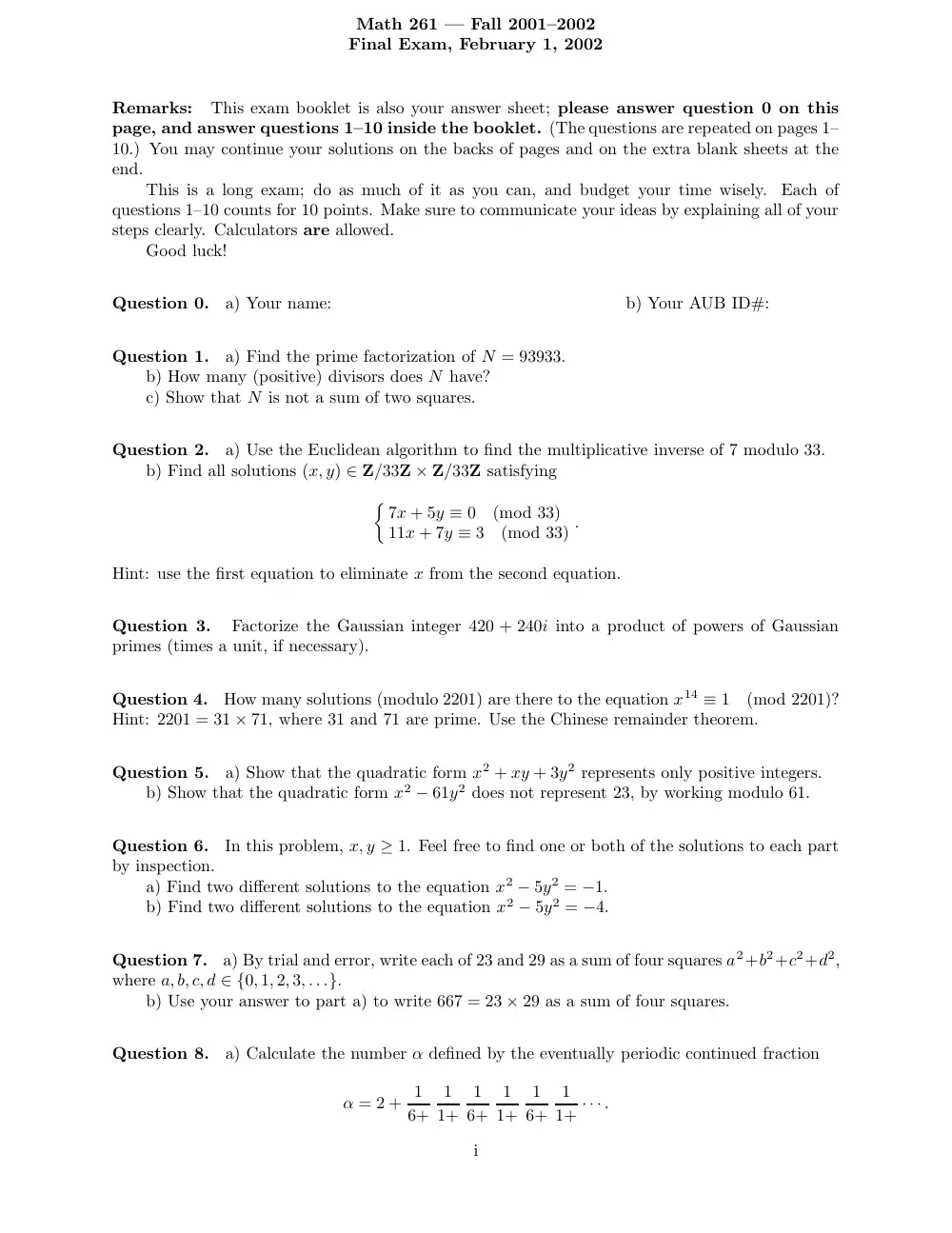
Math 261 — Fall 2001–2002
Final Exam, February 1, 2002
Remarks:
This exam booklet is also your answer sheet; please answer question 0 on this
page, and answer questions 1–10 inside the booklet. (The questions are repeated on pages 1–
10.) You may continue your solutions on the backs of pages and on the extra blank sheets at the
end.
This is a long exam; do as much of it as you can, and budget your time wisely.
Each of
questions 1–10 counts for 10 points. Make sure to communicate your ideas by explaining all of your
steps clearly. Calculators are allowed.
Good luck!
Question 0.
a) Your name:
b) Your AUB ID#:
Question 1.
a) Find the prime factorization of N = 93933.
b) How many (positive) divisors does N have?
c) Show that N is not a sum of two squares.
Question 2.
a) Use the Euclidean algorithm to find the multiplicative inverse of 7 modulo 33.
b) Find all solutions (x, y) ∈ Z/33Z × Z/33Z satisfying
�
7x + 5y ≡ 0
(mod 33)
11x + 7y ≡ 3
(mod 33) .
Hint: use the first equation to eliminate x from the second equation.
Question 3.
Factorize the Gaussian integer 420 + 240i into a product of powers of Gaussian
primes (times a unit, if necessary).
Question 4.
How many solutions (modulo 2201) are there to the equation x14 ≡ 1
(mod 2201)?
Hint: 2201 = 31 × 71, where 31 and 71 are prime. Use the Chinese remainder theorem.
Question 5.
a) Show that the quadratic form x2 + xy + 3y2 represents only positive integers.
b) Show that the quadratic form x2 − 61y2 does not represent 23, by working modulo 61.
Question 6.
In this problem, x, y ≥ 1. Feel free to find one or both of the solutions to each part
by inspection.
a) Find two different solutions to the equation x2 − 5y2 = −1.
b) Find two different solutions to the equation x2 − 5y2 = −4.
Question 7.
a) By trial and error, write each of 23 and 29 as a sum of four squares a2+b2+c2+d2,
where a, b, c, d ∈ {0, 1, 2, 3, . . .}.
b) Use your answer to part a) to write 667 = 23 × 29 as a sum of four squares.
Question 8.
a) Calculate the number α defined by the eventually periodic continued fraction
α = 2 + 1
6+
1
1+
1
6+
1
1+
1
6+
1
1+ · · · .
i
b) Write down the first few convergents An/Bn for α, until you reach a convergent for which
you can prove that
����
An
Bn
− α
���� ≤
1
1000.
Question 9.
a) Let p be any prime with p ≥ 5. Show that the equation
(x2 − 2)(x2 − 3)(x2 − 6) ≡ 0
(mod p)
has at least one solution.
b) Show that if furthermore p ≡ 1
(mod 24), then the above equation has six solutions
modulo p.
Question 10.
This exercise will lead you through another proof of the fact that if p ≡ 1
(mod 4),
then p is a sum of two squares.
a) Let p be any prime number, and fix any x ̸≡ 0
(mod p). Using the pigeonhole principle,
show that there exist two different pairs of integers (m, n) and (m′, n′) satisfying
0 ≤ m, n, m′, n′ < √p,
and mx + n ≡ m′x + n′
(mod p).
Cultural note: Writing a = m − m′ and b = n′ − n, the result of part a) implies that there exist
integers a, b with 0 < |a|, |b| < √p and ax ≡ b
(mod p). This is called Thue’s lemma and you
can use it in part b) below.
b) In the case where p ≡ 1
(mod 4), we further choose x such that x2 ≡ −1
(mod p).
Conclude that the a and b of Thue’s lemma satisfy
a2 + b2 = p.
Hint: show first that a2 + b2 ≡ 0
(mod p). Then look at the size of a2 + b2.
ii