
MECH 310 Problems Chapter 8 Solutions, Fall 2011
American University of Beirut · Thermodynamics I · 14 pages · with solution

Showing the first 10 of 14 pages. Download the PDF to see all of it.
More MECH 310 files
- Essay Chapter 3 · Fall 2017ChapterView
- Problems Solution Manual Chapter 9 · Fall 2011Chapter · with solutionView
- Problems Chapter 5 Solutions · Fall 2011Chapter · with solutionView
- Problems Chapter 9 Extra Problems · Fall 2011ChapterView
- Problems Solution Manual Chapter 2 · Fall 2011Chapter · with solutionView
- Problems Chapter 6 Solutions · Fall 2011Chapter · with solutionView
- Problems Chapter 3 Solutions · Fall 2011Chapter · with solutionView
- Problems Chapter 4 Solutions · Fall 2011Chapter · with solutionView
Show the text of this chapter
MECH 310 Thermodynamics I
American University of Beirut, Fall 2011
Januray 4, 2012
Handout # 7
Chapter 08 Solved Problems
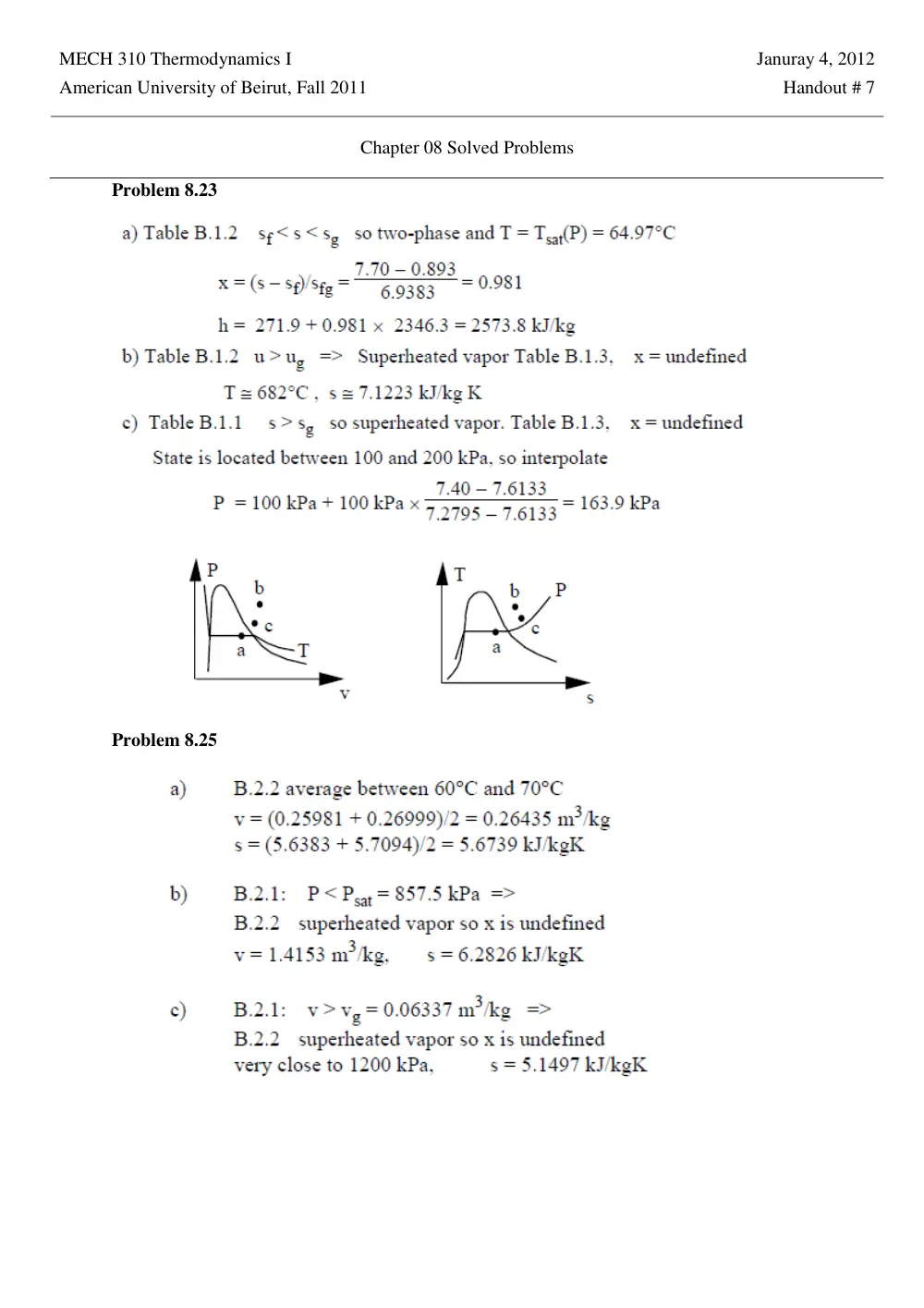
Problem 8.23
a) TableB.12 sp<s<s, so two-phase and T= T,,(P) = 64.97°C
7.70 — 0.893
=(s—sp)/st = 69393 = 0-981
h= 271.9+0.981 x 2346.3 = 2573.8 kI/kg
b) Table B.1.2 u>u, => Superheated vapor Table B.1.3, x =undefined
g
T=682°C, s=7.1223 kI/kgK
c) Table B.1.1 s>s, so superheated vapor. Table B.1.3, x =undetfined
g
State is located between 100 and 200 kPa, so interpolate
7.40 — 7.6133
P =100 kPa+ 100 kPa x SG50b a eqn = 163.9 kPa
Problem 8.25
a)
b)
7.2795 — 7.6133
B.2.2 average between 60°C and 70°C
v = (0.25981 + 0.26999)/2 = 0.26435 m/kg
s = (5.6383 + 5.7094)/2 = 5.6739 kI/kgK
2.1: P< Pi = 857.5 kPa =>
2.2 superheated vapor so x is undefined
v=14153m/kg, s =6.2826 kI/kgK
B.2.1:) V> Vg = 0.06337 no kg =>
B.2.2 superheated vapor so x is undefined
very close to 1200 kPa, s= 5.1497 kI/kgK
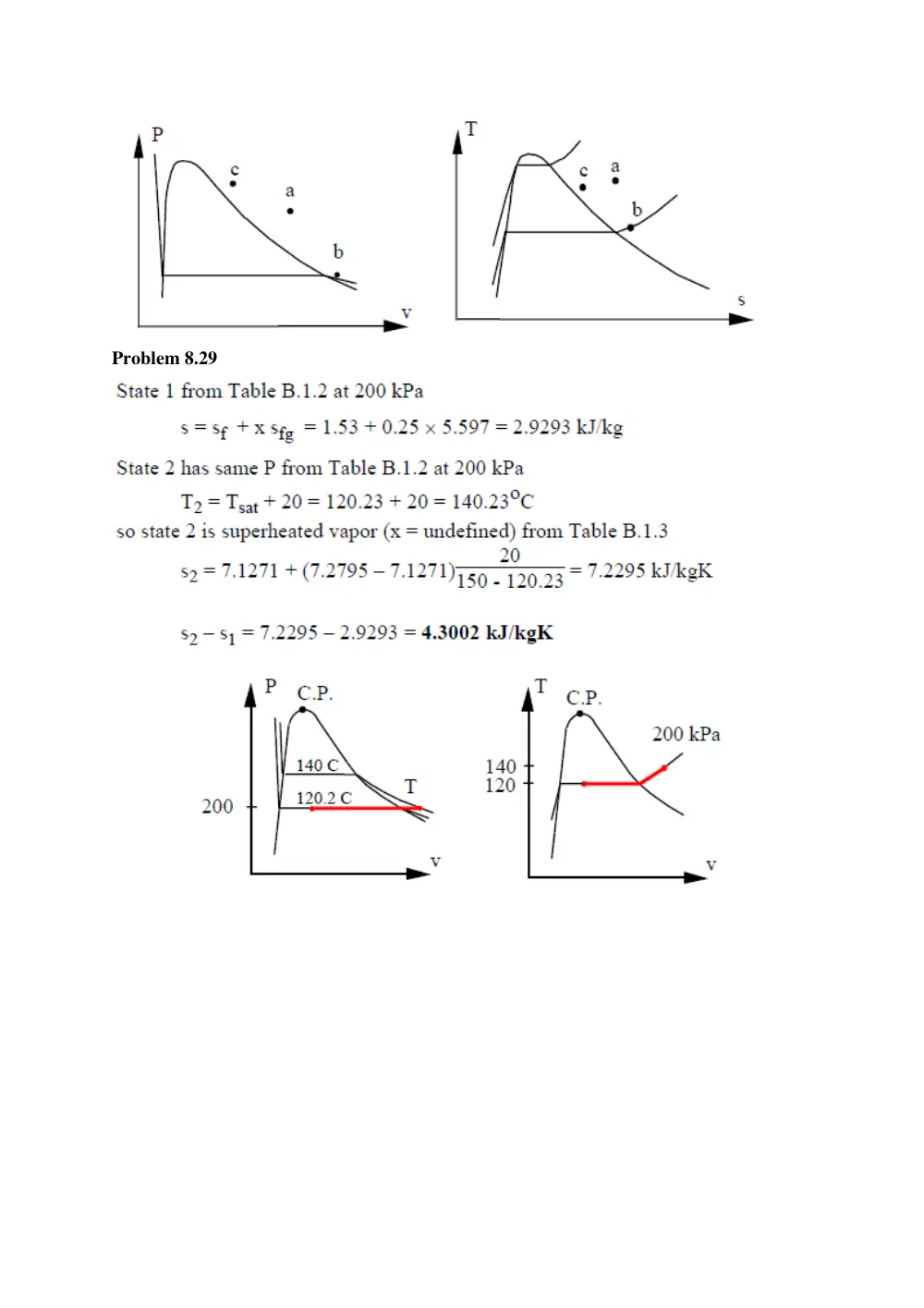
Problem 8.29
State 1 from Table B.1.2 at 200 kPa
S=sg +X Spg = 1.53 + 0.25 x 5.597 = 2.9293 kI/kg
State 2 has same P from Table B.1.2 at 200 kPa
T> = Teat + 20 = 120.23 + 20 = 140.23°C
so state 2 is superheated vapor (x = undefined) from Table B.1.3
20
$9 = 7.1271 + (7.2795 — T.1271)359 - 120.23
= 7.2295 kWkgK
s) — 81 = 7.2295 — 2.9293 = 4.3002 kJ/kgK
P cp. T CP.
140
120
200
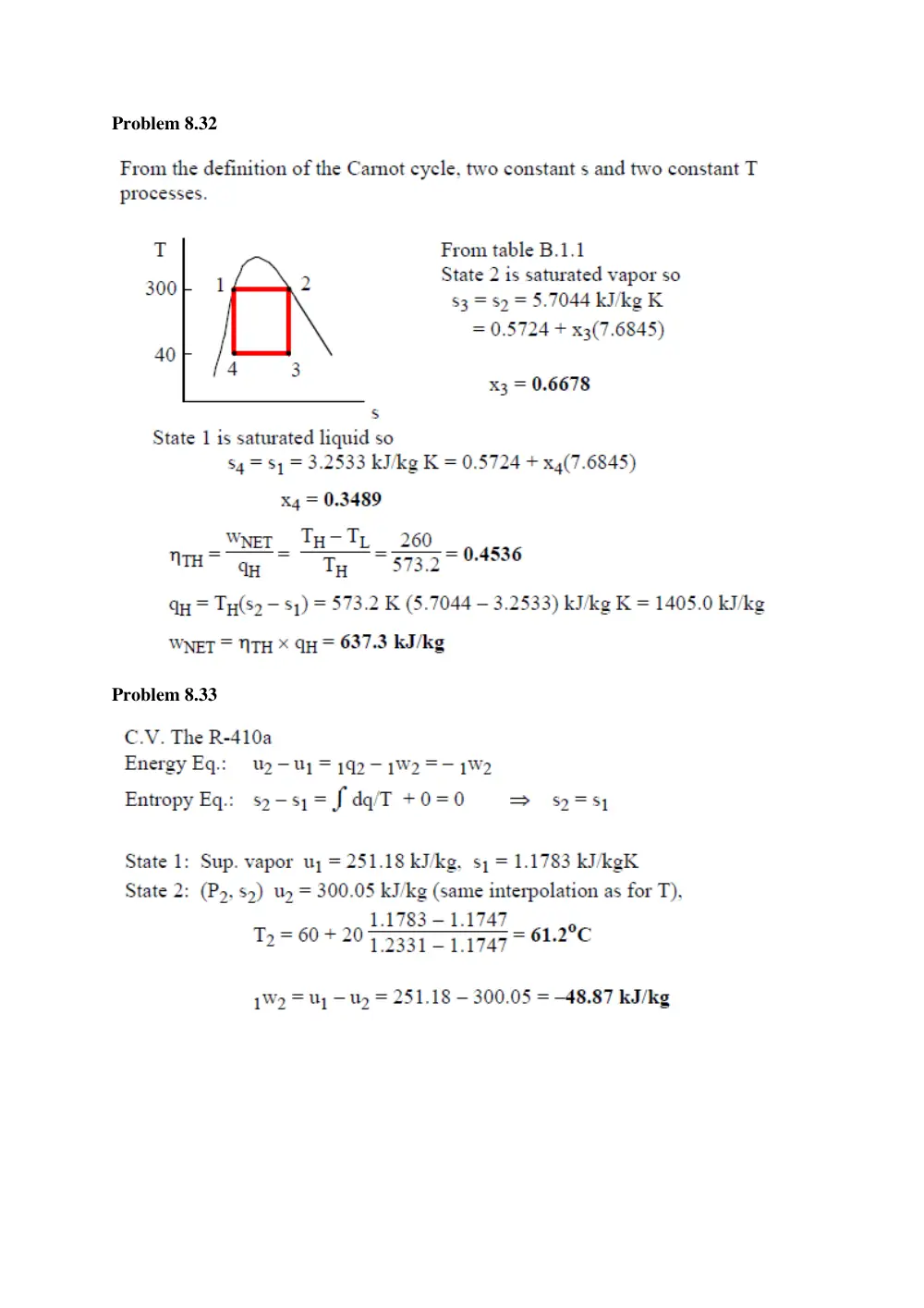
Problem 8.32
From the definition of the Carnot cycle, two constant s and two constant T
processes.
T From table B.1.1
State 2 is saturated vapor so
300 83 =s9 =5.7044 kJ/kg K
= 0.5724 + x3(7.6845)
40
x3 = 0.6678
5
State 1 is saturated liquid so
54 = 81 = 3.2533 kJ/kg K = 0.5724 + x,(7.6845)
x4 = 0.3489
_Wyet_ Ty-Th 260
“THT gy Tq )S(O5 73.2
= 0.4536
du = Ty(S2 — $y) = 573.2 K (5.7044 — 3.2533) kJ/kg K = 1405.0 kJ/kg
WNET = NTH ¥ dH = 637.3 kJ/kg
Problem 8.33
C.V. The R-410a
Energy Eq.: up —Uy = 192 —-1W2 =- Wo
Entropy Eq.: sy — 5, = f dq/T +0=0 => s=5]
State 1: Sup. vapor uy = 251.18 kJ/kg. s; = 1.1783 k/kgK
State 2: (Pp. $9) Uy = 300.05 kJ/kg (same interpolation as for T),
1.1783 — 1.1747
_ a o-
T2 = 60 + 207533] 1.1747 012 C
1W = Uy — Uy = 251.18 — 300.05 = 48.87 kJ/kg
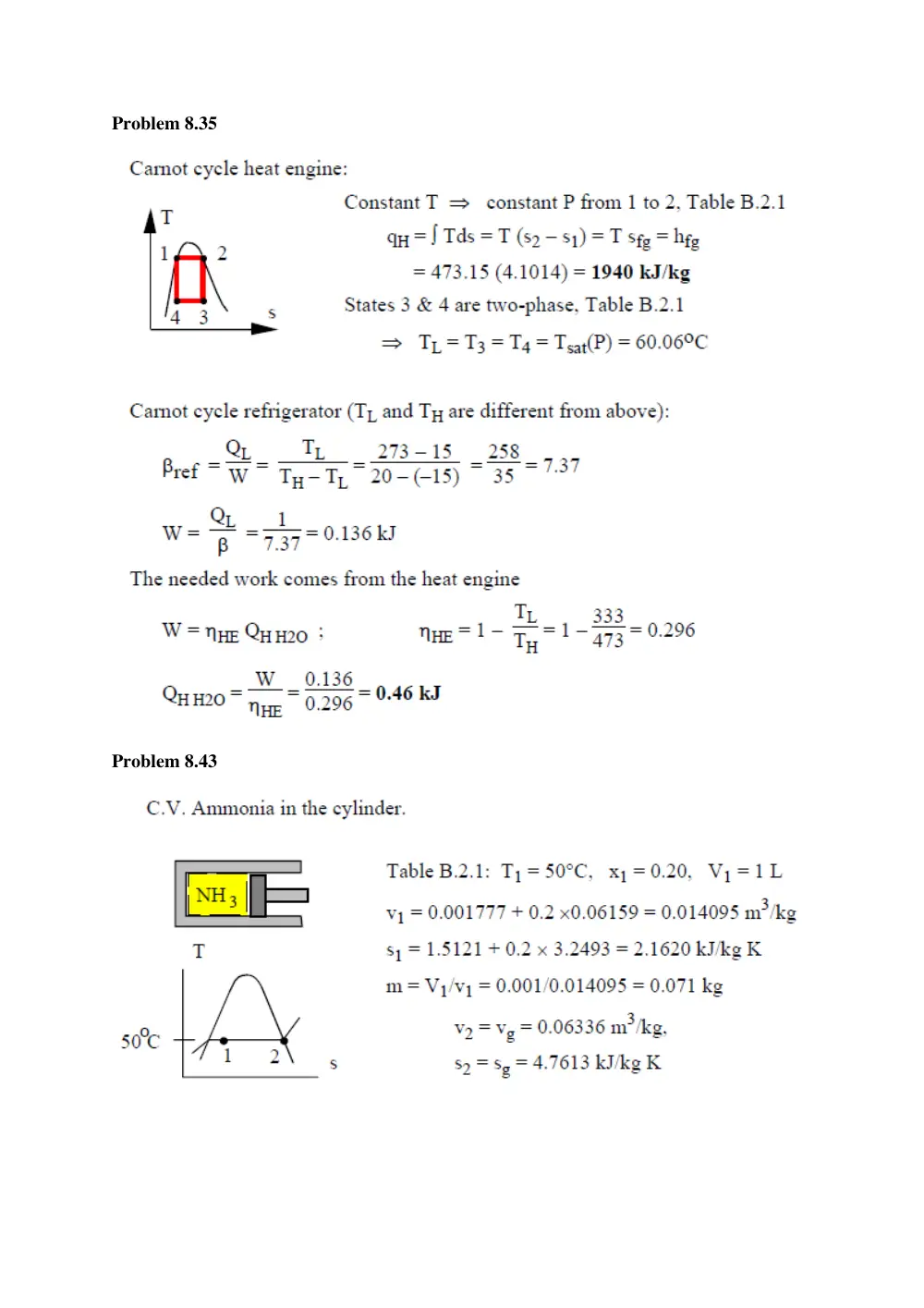
Problem 8.35
Carnot cycle heat engine:
Constant T = constant P from 1 to 2, Table B.2.1
qu = J Tds = T (s — 51) =T sg = hyp
= 473.15 (4.1014) = 1940 kJ/kg
States 3 & 4 are two-phase, Table B.2.1
=> TL =T3=T4=Te(P) = 60.06°C
Carmot cycle refrigerator (Ty, and Ty are different from above):
QT 273-15 258
Bref = W Ty-T, 20-C15) 35.97
W= 7 = se =0.136 kT
The needed work comes from the heat engine
W =n Quo : nie =1- Tea 1-35 = 0296
Ogino == BE 46s
Problem 8.43
C.V. Ammonia in the cylinder.
Table B.2.1: Ty = 50°C, x, =0.20, V}=1L
NH; | = y iriad 7 = sy.
vz, = 0.001777 + 0.2 x0.06159 = 0.014095 m°/kg
T sy = 1.5121 + 0.2 x 3.2493 = 2.1620 k/kg K
m = Vj/v; = 0.001/0.014095 = 0.071 kg
3
V> =V, = 0.06336 m/kg.
50°C — as .
sp = Sg = 4.7613 kJ/kg K
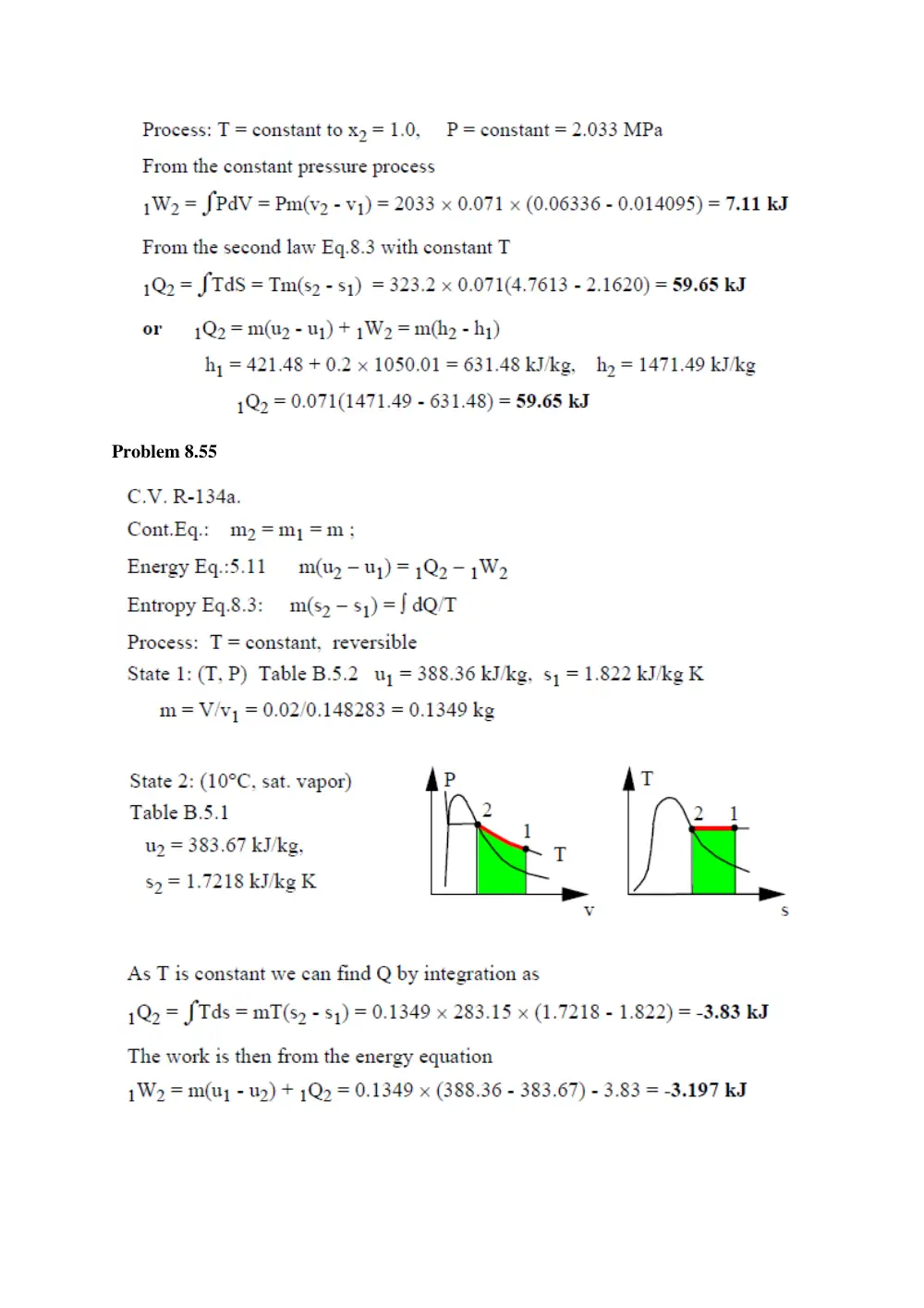
Process: T= constant tox,;=1.0. P=constant = 2.033 MPa
From the constant pressure process
1W> = fPdV = Pm(v9 - vy) = 2033 x 0.071 x (0.06336 - 0.014095) = 7.11 kJ
From the second law Eq.8.3 with constant T
1Q) = fTdS = Tmn(sp - 51) = 323.2 x 0.071(4.7613 - 2.1620) = 59.65 kJ
or = ~Qy=m(Uy - uy) + {Wo = m(hy - hy)
hy = 421.48 + 0.2 x 1050.01 = 631.48 kJ/kg. hy = 1471.49 kJ/kg
1Q9 = 0.071(1471.49 - 631.48) = 59.65 kJ
Problem 8.55
C.V. R-134a.
Cont.Eq.: m) =m; =m:
Energy Eq.:5.11 = m(uy— uy) = 1Q.—- 1 W>
Entropy Eq.8.3: m(s;—s,)=! dQ/T
Process: T= constant. reversible
State 1:(T.P) Table B.5.2 uy = 388.36 kI/kg. 5s; = 1.822 kI/kg EK
m= V/vy = 0.02/0.148283 = 0.1349 ke
State 2: (10°C, sat. vapor) AP T
Table B.5.1 2 ; 2 1
uy = 383.67 kI/kg, T
$7 = 1.7218 kJ/kg K
~ a a
Vv s
As T is constant we can find Q by integration as
1Qo = fTds = mT(sq - sy) = 0.1349 x 283.15 x (1.7218 - 1.822) = -3.83 kJ
The work is then from the energy equation
1W = m(uq - uy) + Qo = 0.1349 x (388.36 - 383.67) - 3.83 = -3.197 kJ
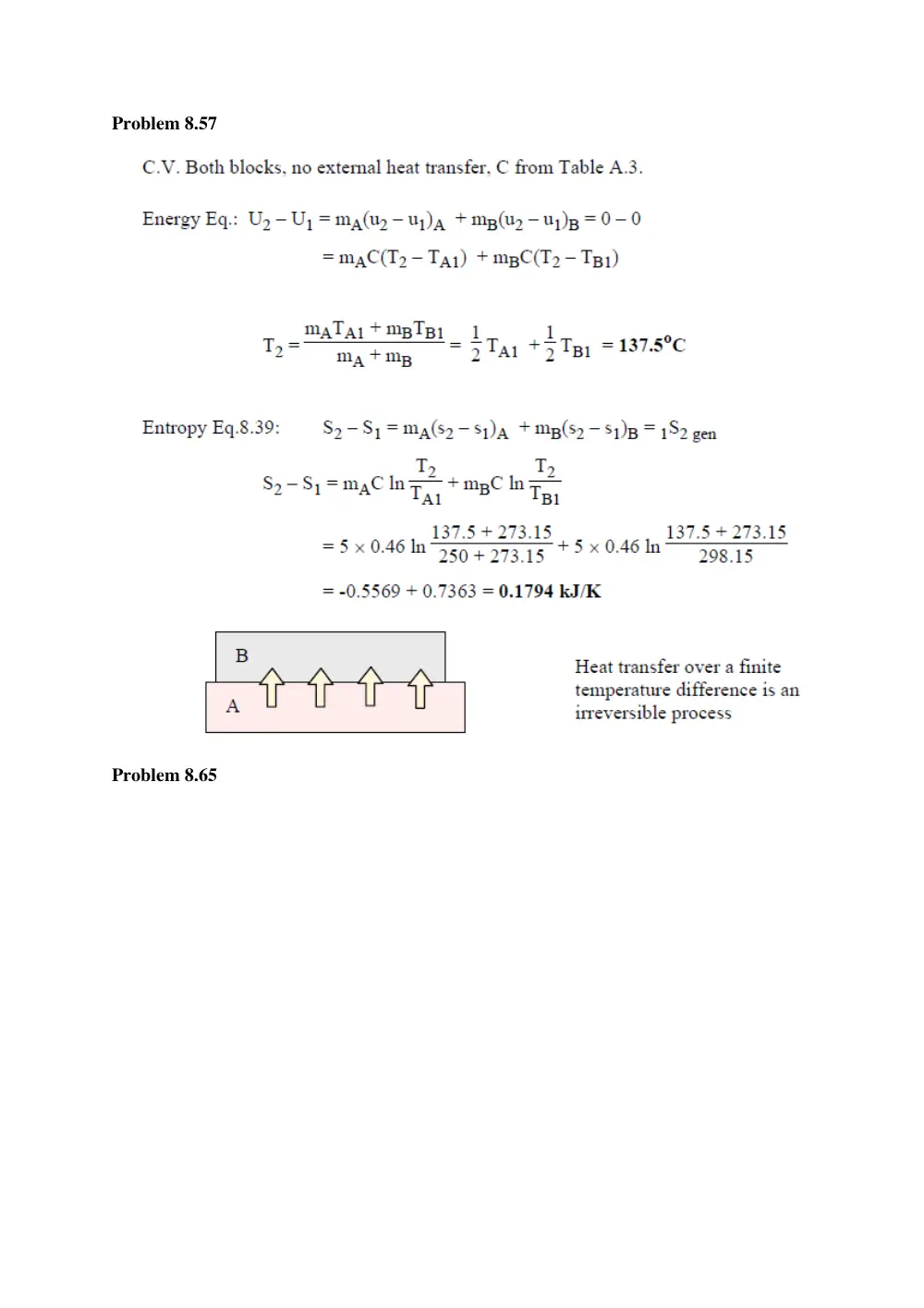
Problem 8.57
C.V. Both blocks. no external heat transfer. C from Table A.3.
Energy Eq.: U,—-U, =mag(u,—uy), + mp(u,—uy)p = 9-0
=maC(T;—Tai) + mpC(T2-Tg1)
mala;*+mplpi 1 1 o-.
T> = ma +mp = 2 Tal + 2 Ti =137.5 C
Entropy Eq.8.39: Sy — Sy =ma(so— $y), + mp(So —$y)B = 189 gen
S,—-$,=m,C ln=— + mpC ln -—
pst NAS "Tay BO Tay
137.5+273.15 _ 137.5 + 273.15
=5 x 0.46 In-550 4273.15 $273.15 +5 x 0.46 In 308.15
= -0.5569 + 0.7363 = 0.1794 kJ/K
B - -.
Heat transfer over a finite
A th itr 4p fe temperature difference is an
irreversible process
Problem 8.65
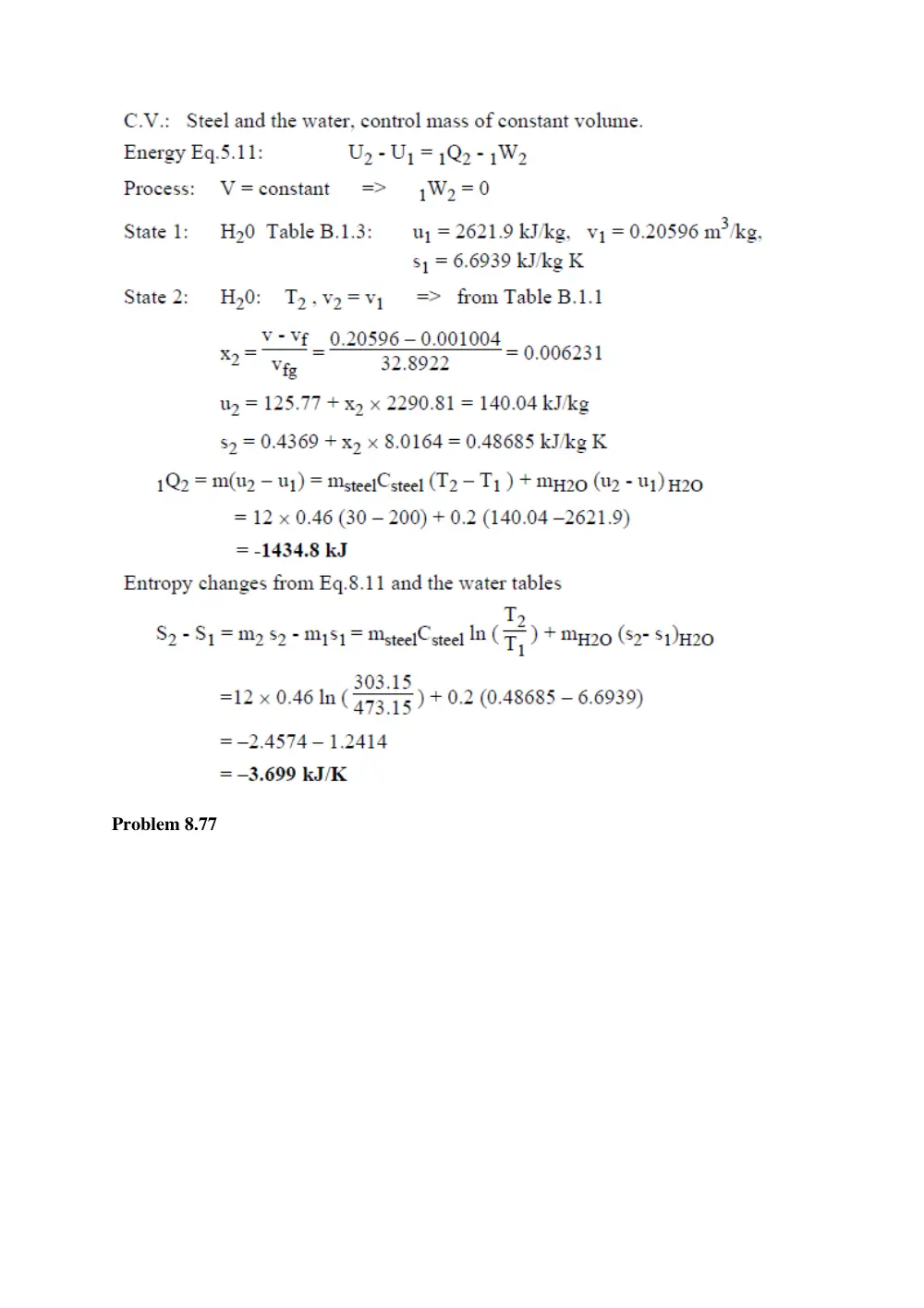
C.V.: Steel and the water. control mass of constant volume.
Energy Eq.5.11: Uy - Uy = 1Q9 - ; Wo
Process: V=constant => 1W,=0
State 1: H,0 Table B.1.3: uy = 2621.9 kI/kg, vy = 0.20596 mm kg.
81 = 6.6939 kI/ke K
State2: H,0: Ty.v.=vy => from Table B.1.1
V- YE 0.20596 —- 0.001004
Xo = Vfg = 32.8922 = 0.006231
uy = 125.77 + xq x 2290.81 = 140.04 kI/kg
8) = 0.4369 +x, x 8.0164 = 0.48685 kI/kg K
1Q2 = muy — Uy) = Metee!Csteel (T2 — Ti) + MEO (U2 - U1) HO
= 12 x 0.46 (30 — 200) + 0.2 (140.04 —2621.9)
= -1434.8 kJ
Entropy changes from Eq.8.11 and the water tables
T
Sq - Sy = my $2 - M451 = MeteetCsteet In CP, ) + MH20 (52° S1)H20
303.15
=12 x 0.46 In (=s-—=) + 0.2 (0.48685 — 6.6939)
473.15
= —2.4574 — 1.2414
=—3.699 kJ/K
Problem 8.77
C.V. Aw. Assume a reversible, adiabatic process.
Energy Eq.5.11: Ug -y =O- Wo :
Entropy Eq.8.37: $9-$,= J dq/T + 459 gen = 0
Process: Adiabatic 4q)=0 Reversible 139 geq = 0
With these two terms zero we have a zero for the entropy change. So this is a
constant ¢ (isentropic) expansion process. From Eq.8.19
P>
ST — st = Ring:
Properties: Table AS: 57, =6.4168. sq) = 7.2336 kJ/kg K
Po 7.2336 — 6.4168
o o f
Pi exp [(Sp> — $q,)/R] = exp(— 99509 ) = 23.1955
P> = 100 x 23.1955 = 2320 kPa
Ideal gas law: P,V,;=mRT, and P,V>=mRT,
Take the ratio of these so mR drops out to give
700. 100
Vo = Vy x (To / Ty) x (Py / Pa) = 0.1 x (390) x (5320) = 0.01 m3
P T
> 27%)
\ 1 Pi
1
_ _
Vv 8
Problem 8.81
C.V. CO , a control mass undergoing a reversible, adiabatic process.
Energy Eq.5.11: Ug -y =O- Ww :
Entropy Eq.8.37: 59-5, = J dq’T + 159 gen = 0
Process: Adiabatic jq)=0 Reversible 159 geg = 0
State 1: (300 K, 400 kPa) State 2: (3000 kPa, ?)
With two terms zero in the entropy equation we have a zero for the entropy
change. So this is a constant s (isentropic) expansion process, $7 = $1.
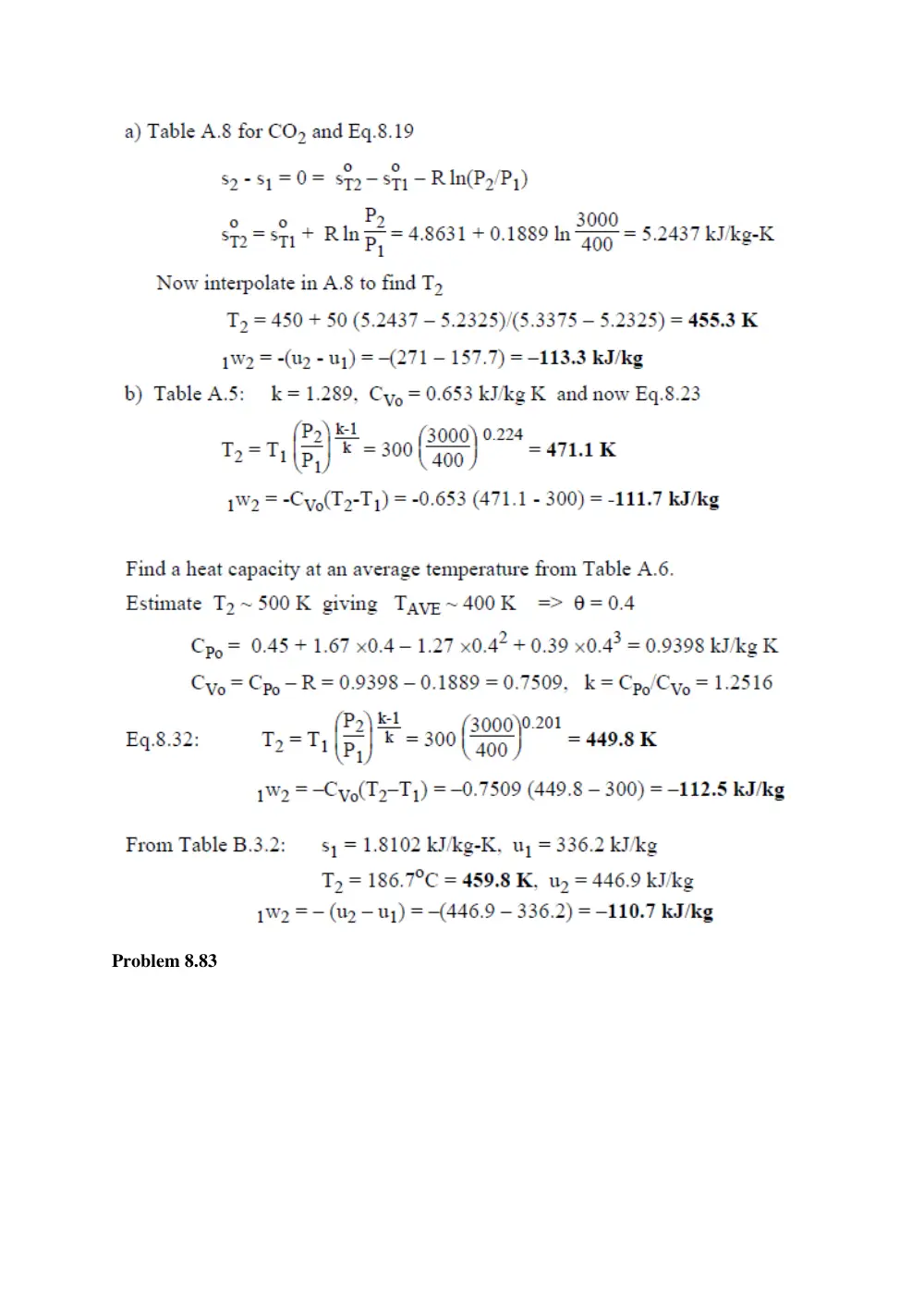
a) Table A.8 for CO, and Eq.8.19
$9 75,7 0= ST _ ST _ Rln(P5 P,)
Py 3000
oO oO
8p) = Sq, 7 Ring = 4.8631 + 0.1889 In 400
= 5.2437 kI/kg-K
Now interpolate in A.8 to find T,
Tz =450 + 50 (5.2437 — 5,.2325)/(5.3375 — 5.2325) = 455.3 k
1W = -(uy - uy) = (271 - 157.7) =-113.3 kJ/kg
b) Table AS: k=1.289, Cy, = 0.653 kJ/kg K and now Eq.8.23
Py) kl 3000) 0.224
T,=T, (2) k =300 (2e00) =471.1K
1W9 = -Cyo(T>-T}) = -0.653 (471.1 - 300) = -111.7 kJ/kg
Find a heat capacity at an average temperature from Table A.6.
Estimate T,~ 500K giving Tayg~400K => 8=0.4
Cpg= 0.45 + 1.67 x0.4— 1.27 x0.47 + 0.39 x0.4? = 0.9398 kJ. kg K
Cyp = Cpy —R = 0.9398 — 0.1889 = 0.7509, k= Cpy/Cyp = 1.2516
Py) k1 3000)0.201
. =T,|—l|k= =—— =
Eq.8.32: T)=T, (??| 300 (p00) 449.8 K
1W =—Cy(T2-T}) =-0.7509 (449.8 — 300) =-112.5 kJ/kg
From Table B.3.2: sy = 1.8102 kI/kg-K. uy = 336.2 kJ/kg
T> = 186.7°C = 459.8 K, uy = 446.9 kI/kg
iW =— (ug — uy) = 4446.9 — 336.2) =-110.7 kJ/kg
Problem 8.83
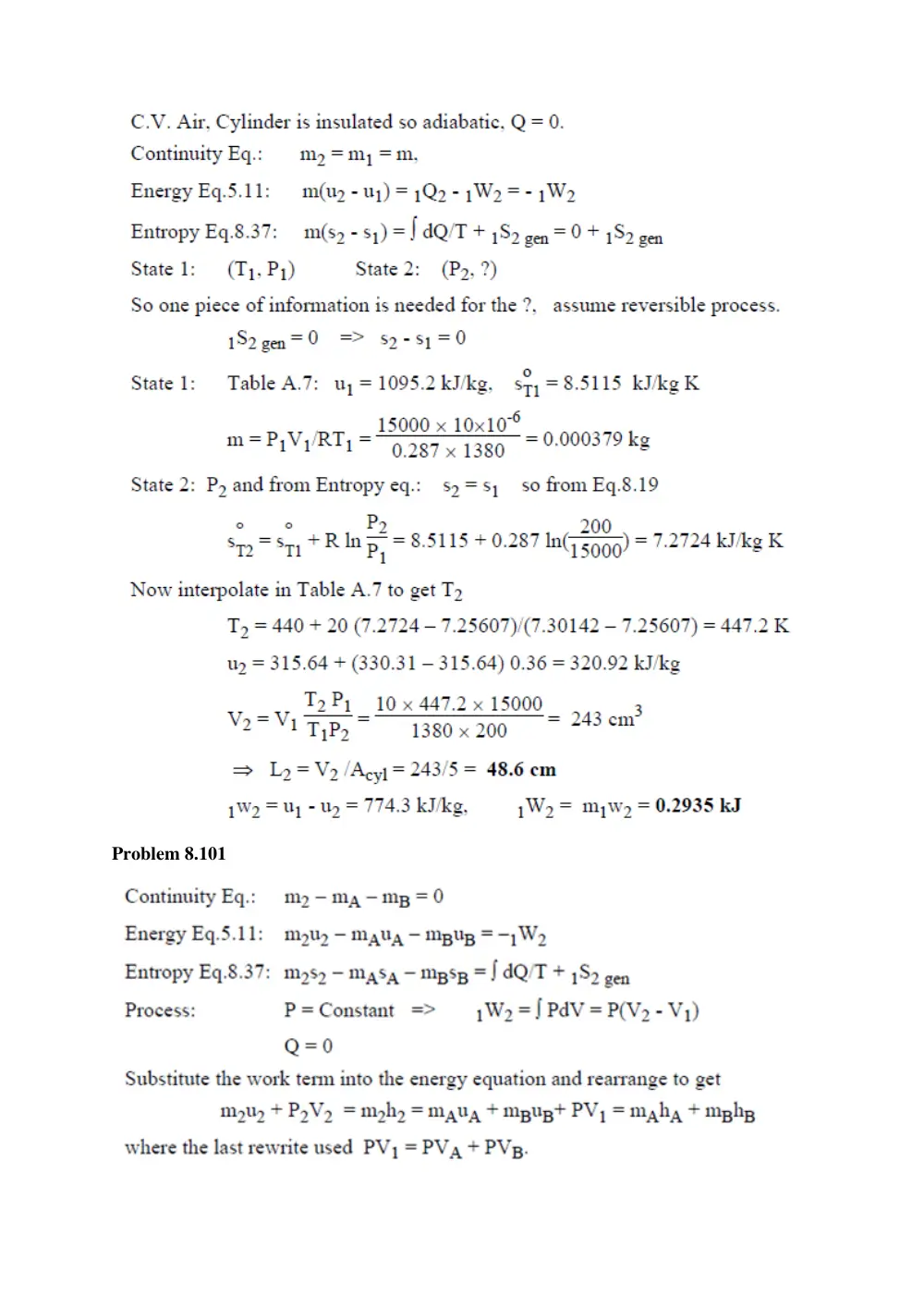
C.V. Air, Cylinder is insulated so adiabatic, Q = 0.
Continuity Eq.: my =m, =m.
Energy Eq.5.11: 9 m(up - 4) = 1Q2 - yWo =- 1 Wo
Entropy Eq.8.37: m(s)-s,)= [ dQvT + 152 gen = 9 + 182 gen
State 1: (Ty, Py) State 2: (Ps, 7)
So one piece of information is needed for the ?, assume reversible process.
152 gen = 0 => §9-5,> 0
Statel: Table A.7: uy = 1095.2 kI/kg. st =8.5115 kIkgK
15000 x 10x10
0.287 x 1380
State 2: Py and from Entropy eq.: s)=s, so from Eq.8.19
m=P,V,/RT, = = 0.000379 kg
oe 8 Py 200
DT +*Rinp = 8.5115 + 0.287 In(y 5000)
s =7.2724k)/ke Kk
Now interpolate in Table A.7 to get Tz
Ts = 440 + 20 (7.2724 — 7.25607)/(7.30142 — 7.25607) = 447.2 K
uy = 315.64 + (330.31 — 315.64) 0.36 = 320.92 k/kg
_y T2Py 10 x 447.2 x 15000
1T,P> 1380 x 200
=> L)=V>2/Agi=243/5 = 48.6 em
1Wo = Uy - Uy = 774.3 kikg, 1W> = mywo = 0.2935 kJ
= 243 cm?
Problem 8.101
Continuity Eq.: mo -m,—mp=9
Energy Eq.5.11: mouy — mguy — Mgug = —1; W>
Entropy Eq.8.37: mys7 — masa — Mpsp =! dQ/T + 1S) gen
Process: P=Constant => 1W2 =| PdV = P(V2 - V))
Q=0
Substitute the work term into the energy equation and rearrange to get
N1jUz + P>V> = myzh> = myuy + Mpgugt PV, = mah, + mghp
where the last rewrite used PV] = PV, + PVg.