
MECH 310 Problems Solution Manual Chapter 4, Fall 2011
American University of Beirut · Thermodynamics I · 144 pages · with solution


Showing the first 10 of 144 pages. Download the PDF to see all of it.
More MECH 310 files
- Essay Chapter 3 · Fall 2017ChapterView
- Problems Solution Manual Chapter 9 · Fall 2011Chapter · with solutionView
- Problems Chapter 5 Solutions · Fall 2011Chapter · with solutionView
- Problems Chapter 8 Solutions · Fall 2011Chapter · with solutionView
- Problems Chapter 9 Extra Problems · Fall 2011ChapterView
- Problems Chapter 6 Solutions · Fall 2011Chapter · with solutionView
- Problems Chapter 3 Solutions · Fall 2011Chapter · with solutionView
- Problems Chapter 4 Solutions · Fall 2011Chapter · with solutionView
Show the text of this chapter
SOLUTION MANUAL
CHAPTER 4
Borgnakke and Sonntag
CONTENT
SUBSECTION
PROB NO.
Concept problems
1-17
Force displacement work
18-27
Boundary work: simple one-step process
28-46
Polytropic process
47-60
Boundary work: multistep process
61-74
Other types of work and general concepts
75-86
Rates of work
87-101
Heat transfer rates
102-115
Review problems
116-130
Excerpts from this work may be reproduced by instructors for distribution on a not-for-profit basis for
testing or instructional purposes only to students enrolled in courses for which this textbook has been
adopted. Any other reproduction or translation of this work beyond that permitted by Sections 107 or 108
of the 1976 United States Copyright Act without the permission of the copyright owner is unlawful.
Borgnakke and Sonntag
In-Text Concept Questions
Excerpts from this work may be reproduced by instructors for distribution on a not-for-profit basis for
testing or instructional purposes only to students enrolled in courses for which this textbook has been
adopted. Any other reproduction or translation of this work beyond that permitted by Sections 107 or 108
of the 1976 United States Copyright Act without the permission of the copyright owner is unlawful.
Borgnakke and Sonntag
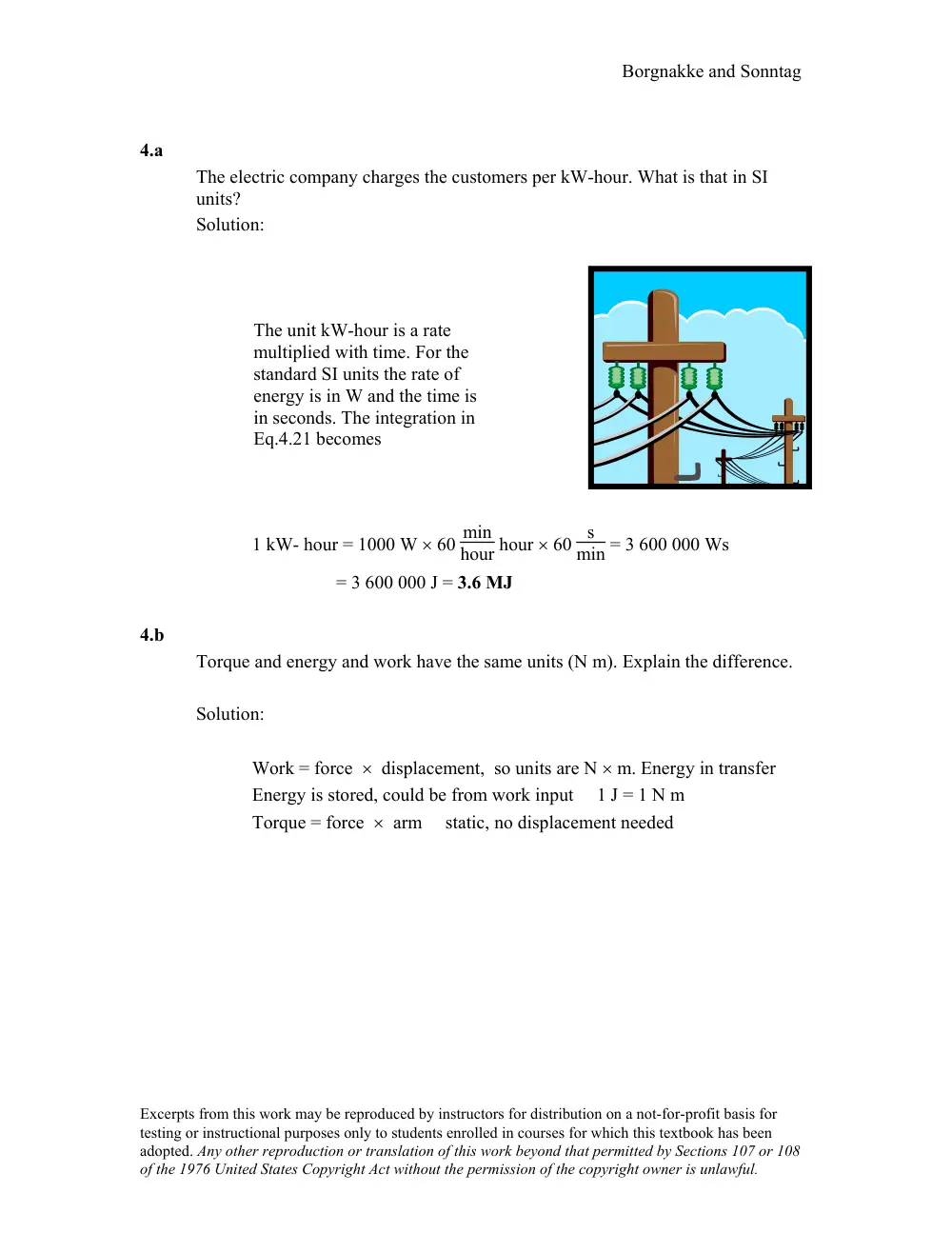
4.a
The electric company charges the customers per kW-hour. What is that in SI
units?
Solution:
The unit kW-hour is a rate
multiplied with time. For the
standard SI units the rate of
energy is in W and the time is
in seconds. The integration in
Eq.4.21 becomes
1 kW- hour = 1000 W × 60 min
hour hour × 60 s
min = 3 600 000 Ws
= 3 600 000 J = 3.6 MJ
4.b
Torque and energy and work have the same units (N m). Explain the difference.
Solution:
Work = force × displacement, so units are N × m. Energy in transfer
Energy is stored, could be from work input 1 J = 1 N m
Torque = force × arm static, no displacement needed
Excerpts from this work may be reproduced by instructors for distribution on a not-for-profit basis for
testing or instructional purposes only to students enrolled in courses for which this textbook has been
adopted. Any other reproduction or translation of this work beyond that permitted by Sections 107 or 108
of the 1976 United States Copyright Act without the permission of the copyright owner is unlawful.
Borgnakke and Sonntag
4.c
What is roughly the relative magnitude of the work in the process 1-2c versus the
process 1-2a shown in figure 4.8?
By visual inspection the area below the curve 1-2c is roughly 50% of the
rectangular area below the curve 1-2a. To see this better draw a straight line from
state 1 to point f on the axis. This curve has exactly 50% of the area below it.
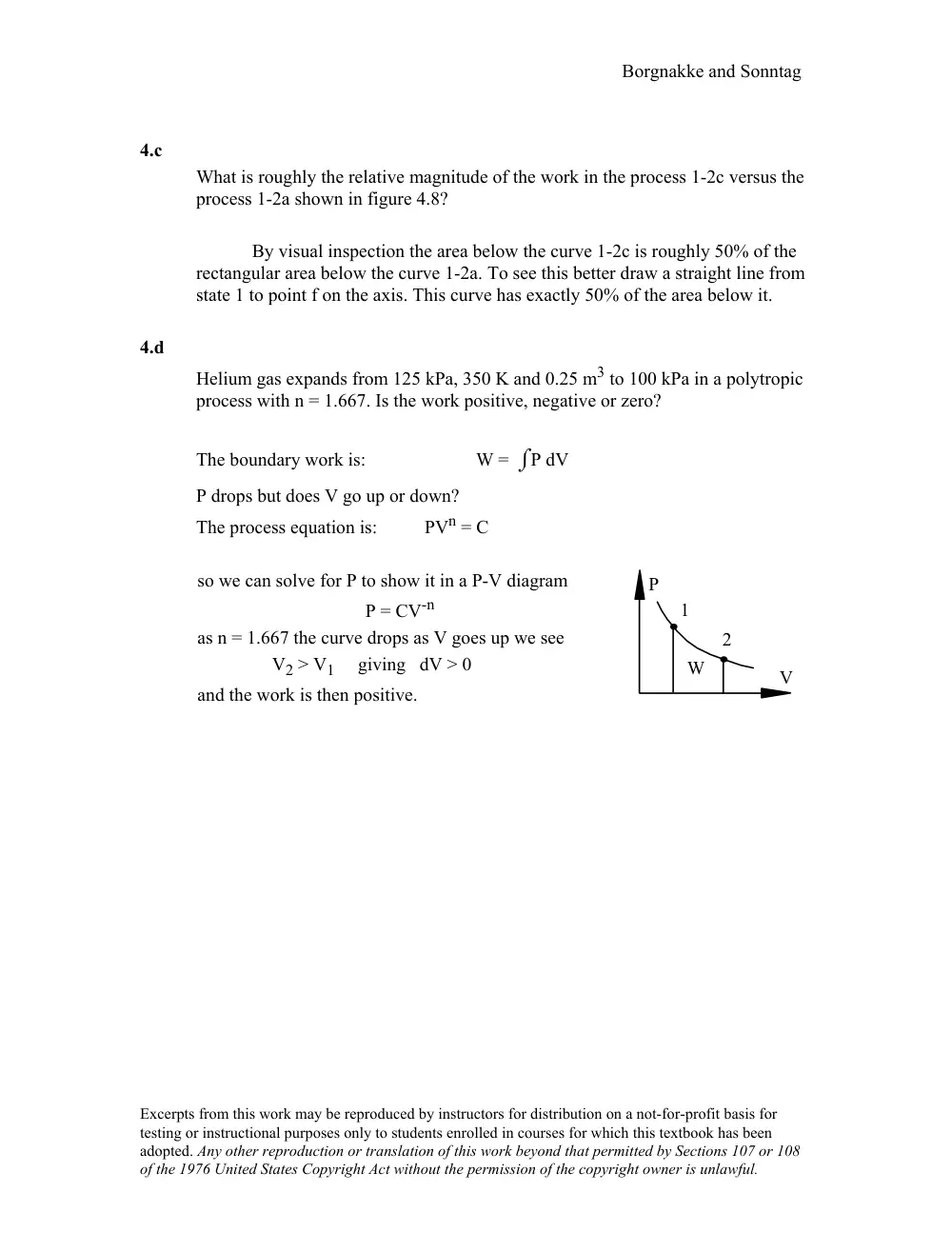
4.d
Helium gas expands from 125 kPa, 350 K and 0.25 m3 to 100 kPa in a polytropic
process with n = 1.667. Is the work positive, negative or zero?
The boundary work is:
W = ⌡⌠P dV
P drops but does V go up or down?
The process equation is:
PVn = C
so we can solve for P to show it in a P-V diagram
P = CV-n
as n = 1.667 the curve drops as V goes up we see
V2 > V1 giving dV > 0
and the work is then positive.
P
V
W
1
2
Excerpts from this work may be reproduced by instructors for distribution on a not-for-profit basis for
testing or instructional purposes only to students enrolled in courses for which this textbook has been
adopted. Any other reproduction or translation of this work beyond that permitted by Sections 107 or 108
of the 1976 United States Copyright Act without the permission of the copyright owner is unlawful.
Borgnakke and Sonntag
4.e
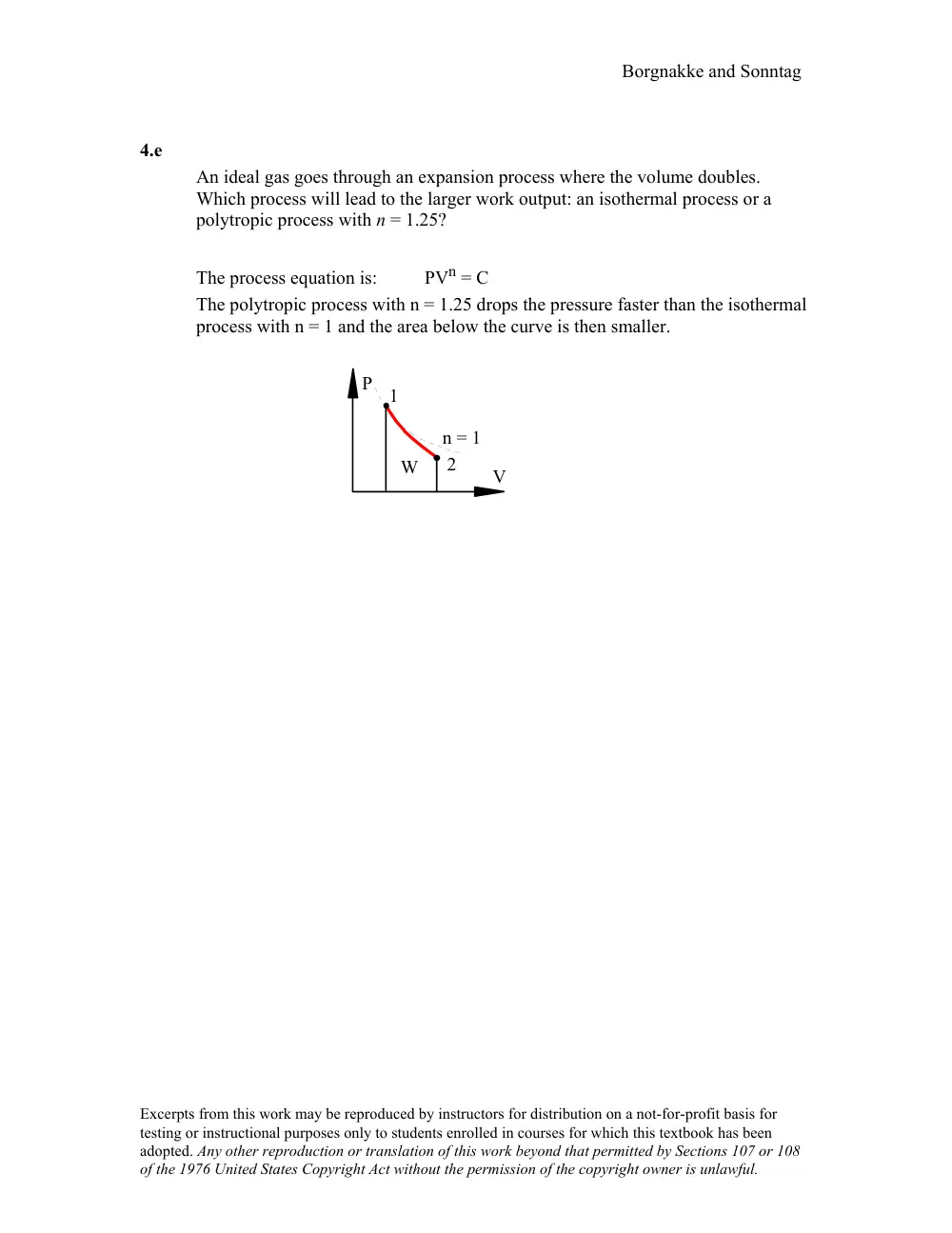
An ideal gas goes through an expansion process where the volume doubles.
Which process will lead to the larger work output: an isothermal process or a
polytropic process with n = 1.25?
The process equation is:
PVn = C
The polytropic process with n = 1.25 drops the pressure faster than the isothermal
process with n = 1 and the area below the curve is then smaller.
P
V
W
1
2
n = 1
Excerpts from this work may be reproduced by instructors for distribution on a not-for-profit basis for
testing or instructional purposes only to students enrolled in courses for which this textbook has been
adopted. Any other reproduction or translation of this work beyond that permitted by Sections 107 or 108
of the 1976 United States Copyright Act without the permission of the copyright owner is unlawful.
Borgnakke and Sonntag
Concept Problems
Excerpts from this work may be reproduced by instructors for distribution on a not-for-profit basis for
testing or instructional purposes only to students enrolled in courses for which this textbook has been
adopted. Any other reproduction or translation of this work beyond that permitted by Sections 107 or 108
of the 1976 United States Copyright Act without the permission of the copyright owner is unlawful.
Borgnakke and Sonntag
4.1
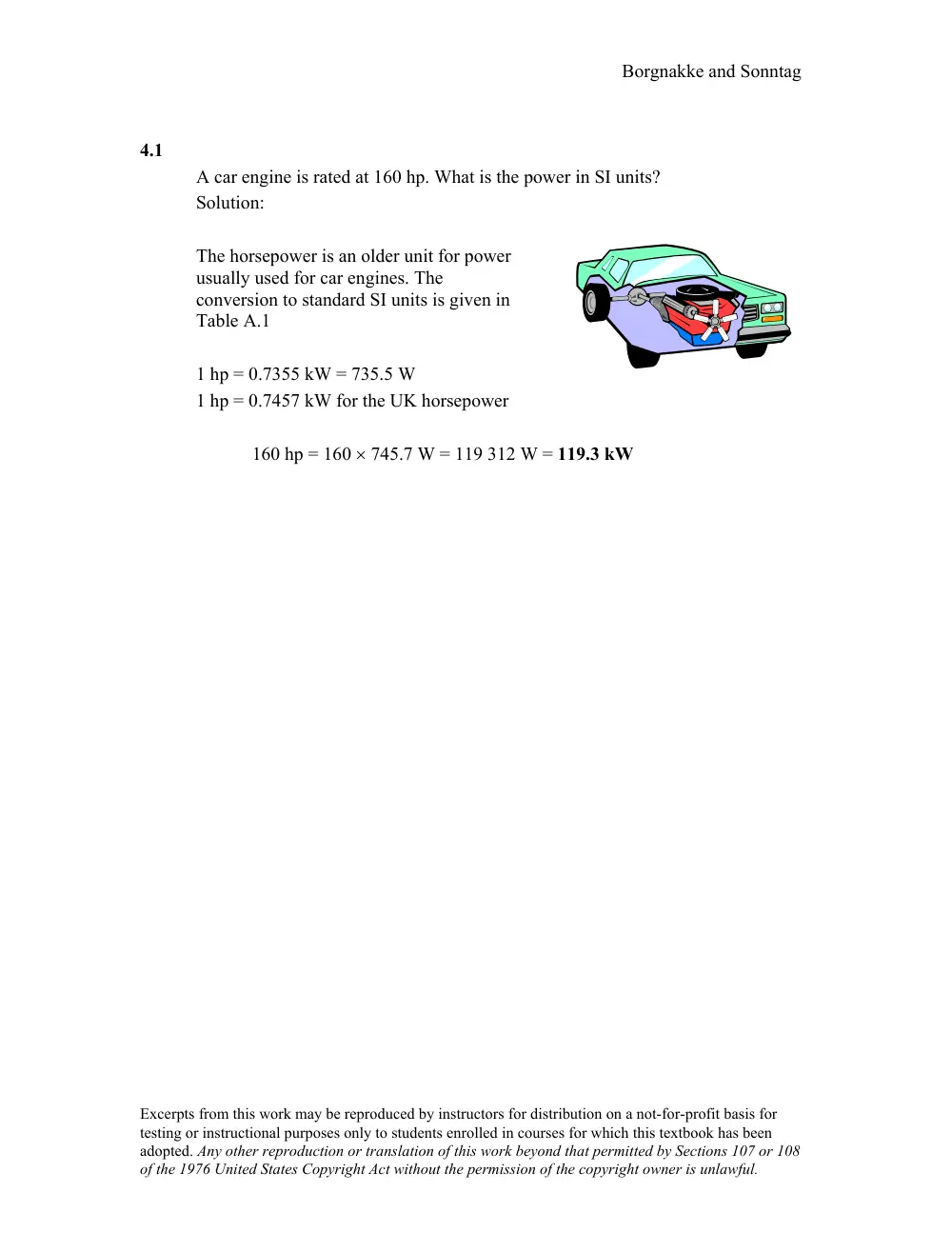
A car engine is rated at 160 hp. What is the power in SI units?
Solution:
The horsepower is an older unit for power
usually used for car engines. The
conversion to standard SI units is given in
Table A.1
1 hp = 0.7355 kW = 735.5 W
1 hp = 0.7457 kW for the UK horsepower
160 hp = 160 × 745.7 W = 119 312 W = 119.3 kW
Excerpts from this work may be reproduced by instructors for distribution on a not-for-profit basis for
testing or instructional purposes only to students enrolled in courses for which this textbook has been
adopted. Any other reproduction or translation of this work beyond that permitted by Sections 107 or 108
of the 1976 United States Copyright Act without the permission of the copyright owner is unlawful.
Borgnakke and Sonntag
4.2
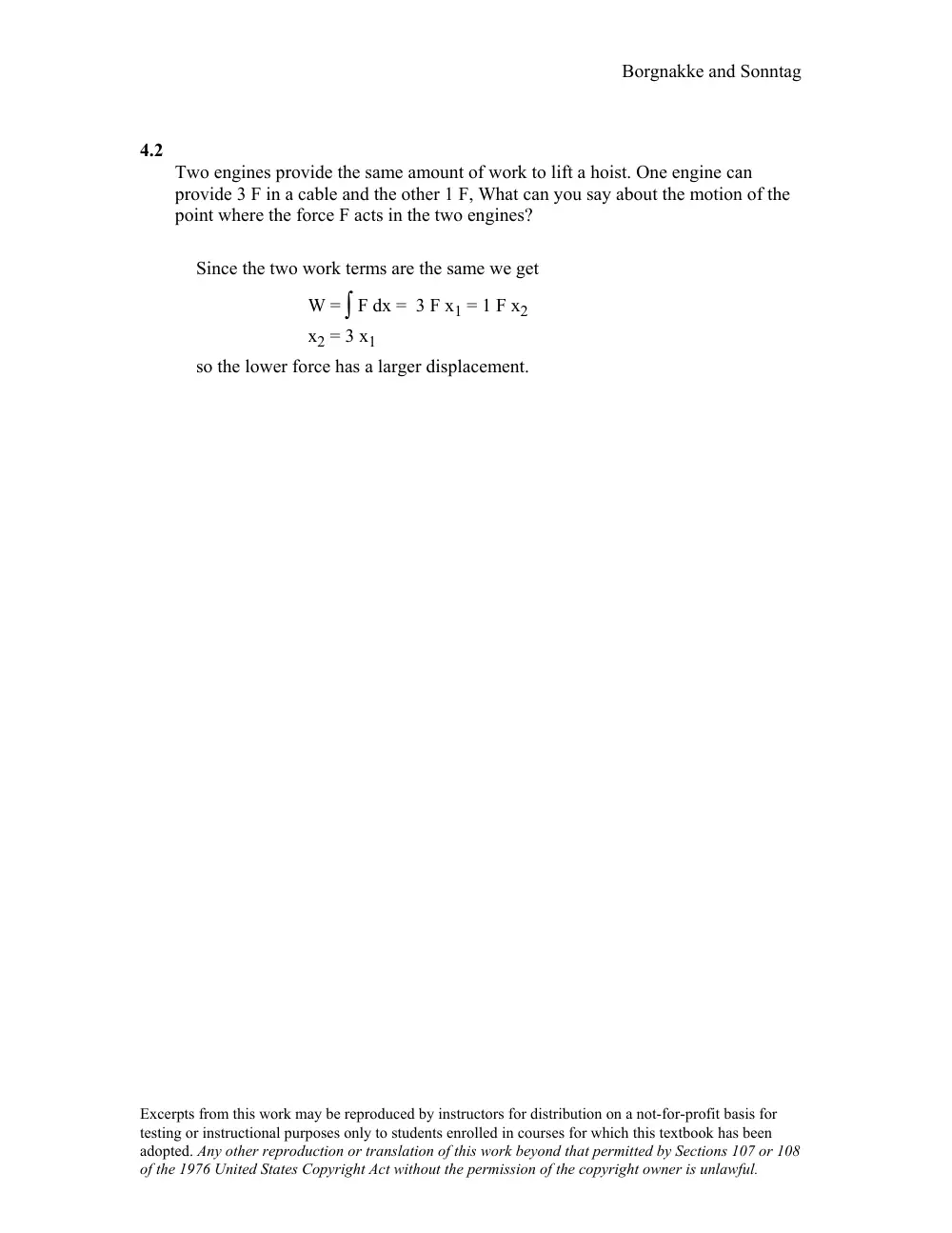
Two engines provide the same amount of work to lift a hoist. One engine can
provide 3 F in a cable and the other 1 F, What can you say about the motion of the
point where the force F acts in the two engines?
Since the two work terms are the same we get
W = ∫ F dx = 3 F x1 = 1 F x2
x2 = 3 x1
so the lower force has a larger displacement.
Excerpts from this work may be reproduced by instructors for distribution on a not-for-profit basis for
testing or instructional purposes only to students enrolled in courses for which this textbook has been
adopted. Any other reproduction or translation of this work beyond that permitted by Sections 107 or 108
of the 1976 United States Copyright Act without the permission of the copyright owner is unlawful.
Borgnakke and Sonntag
4.3
Two hydraulic piston/cylinders are connected through a hydraulic line so they
have roughly the same pressure. If they have diameters of D1 and D2 = 2D1
respectively, what can you say about the piston forces F1 and F2?
For each cylinder we have the total force as: F = PAcyl = P π D2/4
F1 = PAcyl 1 = P π D2
1/4
F2 = PAcyl 2 = P π D2
2/4 = P π 4 D2
1/4 = 4 F1
cb
1
2
F
2
F
1
The forces are the total force
acting up due to the cylinder
pressure. There must be other
forces on each piston to have a
force balance so the pistons do
not move.
Excerpts from this work may be reproduced by instructors for distribution on a not-for-profit basis for
testing or instructional purposes only to students enrolled in courses for which this textbook has been
adopted. Any other reproduction or translation of this work beyond that permitted by Sections 107 or 108
of the 1976 United States Copyright Act without the permission of the copyright owner is unlawful.
Borgnakke and Sonntag
4.4
Normally pistons have a flat head, but in diesel engines pistons can have bowls in
them and protruding ridges. Does this geometry influence the work term?
The shape of the surface does not influence the displacement
dV = An dx
where An is the area projected to the plane normal to the direction of motion.
An = Acyl = π D2/4
Work is
dW = F dx = P dV = P An dx = P Acyl dx
and thus unaffected by the surface shape.
Semi-spherical
head is made to
make room for
larger valves.
Piston
Bowl
Ridge
x
normal plane
Excerpts from this work may be reproduced by instructors for distribution on a not-for-profit basis for
testing or instructional purposes only to students enrolled in courses for which this textbook has been
adopted. Any other reproduction or translation of this work beyond that permitted by Sections 107 or 108
of the 1976 United States Copyright Act without the permission of the copyright owner is unlawful.
Borgnakke and Sonntag
4.5
CV A is the mass inside a piston-cylinder, CV B is that
plus the piston, outside which is the standard atmosphere.
Write the process equation and the work term for the two
CVs.
P o
m
g
p
A
m
Solution:
C.V. A: Process: P = Po + mpg/Acyl = C,
1W2 = ∫ P dV = P1 ∫ m dv = P1m(v2 – v1)
C.V. B: Process: P = Po = C,
1W2 = ∫ Po dV = Po ∫ m dv = Pom(v2 – v1)
Excerpts from this work may be reproduced by instructors for distribution on a not-for-profit basis for
testing or instructional purposes only to students enrolled in courses for which this textbook has been
adopted. Any other reproduction or translation of this work beyond that permitted by Sections 107 or 108
of the 1976 United States Copyright Act without the permission of the copyright owner is unlawful.
Borgnakke and Sonntag
4.6
Assume a physical set-up as in Fig. P4.5. We now heat the
cylinder. What happens to P, T and v (up, down or c
What transf
onstant)?
ers do we have for Q and W (pos., neg., or zero)?
P o
m p
Solution:
Process: P = Po + mpg/Acyl = C
Heat in so T increases, v increases and Q is positive.
As the volume increases the work is positive. 1W2 = ∫ P dV
Excerpts from this work may be reproduced by instructors for distribution on a not-for-profit basis for
testing or instructional purposes only to students enrolled in courses for which this textbook has been
adopted. Any other reproduction or translation of this work beyond that permitted by Sections 107 or 108
of the 1976 United States Copyright Act without the permission of the copyright owner is unlawful.
Borgnakke and Sonntag
4.7
For a buffer storage of natural gas (CH4) a large bell in a container can move up and
down keeping a pressure of 105 kPa inside. The sun then heats the container and the
gas from 280 K to 300 K during 4 hours. What happens to the volume and what is
the sign of the work term?
Solution
The process has constant pressure
Ideal gas: PV = mRT as T increases then V increases
1W2 = ∫ P dV > 0 so positive.
Excerpts from this work may be reproduced by instructors for distribution on a not-for-profit basis for
testing or instructional purposes only to students enrolled in courses for which this textbook has been
adopted. Any other reproduction or translation of this work beyond that permitted by Sections 107 or 108
of the 1976 United States Copyright Act without the permission of the copyright owner is unlawful.
Borgnakke and Sonntag
4.8
A drag force on an object moving through a medium (like a car through air or a
submarine through water) is Fd = 0.225 A ρV2. Verify the unit becomes Newton.
Solution:
Fd = 0.225 A ρV2
Units = m2 × ( kg/m3 ) × ( m2/ s2 ) = kg m / s2 = N
Excerpts from this work may be reproduced by instructors for distribution on a not-for-profit basis for
testing or instructional purposes only to students enrolled in courses for which this textbook has been
adopted. Any other reproduction or translation of this work beyond that permitted by Sections 107 or 108
of the 1976 United States Copyright Act without the permission of the copyright owner is unlawful.
Borgnakke and Sonntag
4.9
The sketch shows a physical situation, show the possible process in a P-v diagram.
a)
b)
c)
Po
mp
R-410a
V
P
1
P 1
V stop
V
P
1
P
1
V1
V
P
1
P1
V stop
V1
Excerpts from this work may be reproduced by instructors for distribution on a not-for-profit basis for
testing or instructional purposes only to students enrolled in courses for which this textbook has been
adopted. Any other reproduction or translation of this work beyond that permitted by Sections 107 or 108
of the 1976 United States Copyright Act without the permission of the copyright owner is unlawful.
Borgnakke and Sonntag
4.10
For the indicated physical set-up in a-b and c above write a process equation and the
expression for work.
a)
P = P1 and V ≥ Vstop
or V = Vstop and P ≤ P1
1W2 = P1(V2 – V1)
[ P1 = Pfloat ]
b) P = A + BV;
1W2 = 1
2 (P1 + P2)(V2 – V1)
c)
P = P1 and V ≤ Vstop
or V = Vstop and P ≥ P1
1W2 = P1(V2 – V1)
[ P1 = Pfloat ]
a)
b)
c)
Po
mp
R-410a
V
P
1
P 1
V stop
V
P
1
P
1
V1
V
P
1
P1
V stop
V1
Excerpts from this work may be reproduced by instructors for distribution on a not-for-profit basis for
testing or instructional purposes only to students enrolled in courses for which this textbook has been
adopted. Any other reproduction or translation of this work beyond that permitted by Sections 107 or 108
of the 1976 United States Copyright Act without the permission of the copyright owner is unlawful.
Borgnakke and Sonntag
4.11
Assume the physical situation as in Fig. P4.9b; what is the work term a, b, c or d?
a: 1w2 = P1(v2 – v1) b: 1w2 = v1(P2 – P1)
c: 1w2 = 1
2 (P1 + P2)(v2 – v1) d: 1w2 = 1
2 (P1 – P2)(v2 + v1)
Solution:
work term is formula c the area under the process curve in a
P-v diagram.
Excerpts from this work may be reproduced by instructors for distribution on a not-for-profit basis for
testing or instructional purposes only to students enrolled in courses for which this textbook has been
adopted. Any other reproduction or translation of this work beyond that permitted by Sections 107 or 108
of the 1976 United States Copyright Act without the permission of the copyright owner is unlawful.
Borgnakke and Sonntag
4.12
The sketch in Fig. P4.12 shows a physical situation; show the possible process in a
P-v diagram.
a)
b)
c)
Solution:
v
P
1
P 1
v stop
v
P
1
P
1
v 1
v
P
1
P1
v stop
Po
mp
R-410a
Excerpts from this work may be reproduced by instructors for distribution on a not-for-profit basis for
testing or instructional purposes only to students enrolled in courses for which this textbook has been
adopted. Any other reproduction or translation of this work beyond that permitted by Sections 107 or 108
of the 1976 United States Copyright Act without the permission of the copyright owner is unlawful.
Borgnakke and Sonntag
4.13
What can you say about the beginning state of the R-410a in Fig. P4.9 versus the
case in Fig. P4.12 for the same piston-cylinder?
For the case where the piston floats as in Fig. P4.9 the pressure of the R-410a
must equal the equilibrium pressure that floats (balance forces on) the piston.
The situation in Fig. P4.12 is possible if the R-410a pressure equals or exceeds
the float pressure.
Excerpts from this work may be reproduced by instructors for distribution on a not-for-profit basis for
testing or instructional purposes only to students enrolled in courses for which this textbook has been
adopted. Any other reproduction or translation of this work beyond that permitted by Sections 107 or 108
of the 1976 United States Copyright Act without the permission of the copyright owner is unlawful.
Borgnakke and Sonntag
4.14
Show how the polytropic exponent n can be evaluated if you know the end state
properties, (P1, V1) and (P2, V2).
Polytropic process: PVn = C
Both states must be on the process line: P2Vn
2 = C = P1Vn
1
Take the ratio to get:
P1
P2 =
V2
V1
n
and then take ln of the ratio
ln
P1
P2 = ln
V2
V1
n
= n ln
V2
V1
now solve for the exponent n
n = ln
P1
P2 / ln
V2
V1
Excerpts from this work may be reproduced by instructors for distribution on a not-for-profit basis for
testing or instructional purposes only to students enrolled in courses for which this textbook has been
adopted. Any other reproduction or translation of this work beyond that permitted by Sections 107 or 108
of the 1976 United States Copyright Act without the permission of the copyright owner is unlawful.
Borgnakke and Sonntag
4.15
A piece of steel has a conductivity of k = 15 W/mK and a brick has k = 1 W/mK.
How thick a steel wall will provide the same insulation as a 10 cm thick brick?
The heat transfer due to conduction is from Eq. 4.18
.
Q = − kA dT
dx ≈ kA ∆T
∆x
For the same area and temperature difference the heat transfers become
the same for equal values of (k / ∆x) so
( k
∆x )brick = ( k
∆x )steel =>
∆xsteel = ∆xbrick
ksteel
kbrick = 0.1 m × 15
1 = 1.5 m
Excerpts from this work may be reproduced by instructors for distribution on a not-for-profit basis for
testing or instructional purposes only to students enrolled in courses for which this textbook has been
adopted. Any other reproduction or translation of this work beyond that permitted by Sections 107 or 108
of the 1976 United States Copyright Act without the permission of the copyright owner is unlawful.
Borgnakke and Sonntag
4.16
A thermopane window, see Fig. 4.27, traps some gas between the two glass
panes. Why is this beneficial?
The gas has a very low conductivity relative to a liquid or solid so the heat
transfer for a given thickness becomes smaller. The gap is furthermore made so
small that possible natural convection motion is reduced to a minimum. It
becomes a trade off to minimize the overall heat transfer due to conduction and
convection. Typically these windows can be manufactured with an E-glaze to
reduce radiation loss (winter) or gain (summer).
Excerpts from this work may be reproduced by instructors for distribution on a not-for-profit basis for
testing or instructional purposes only to students enrolled in courses for which this textbook has been
adopted. Any other reproduction or translation of this work beyond that permitted by Sections 107 or 108
of the 1976 United States Copyright Act without the permission of the copyright owner is unlawful.
Borgnakke and Sonntag
4.17
On a chilly 10oC fall day a house, 20oC inside, loses 6 kW by heat transfer. What
transfer happens on a 30oC warm summer day assuming everything else is the
same?
The heat transfer is
.
Q = CA ∆T where the details of the heat transfer is in the
factor C. Assuming those details are the same then it is the temperature difference
that changes the heat transfer so
.
Q = CA ∆T = 6 kW = CA (20 – 10) => CA = 0.6 kW
K
Then
.
Q = CA ∆T = 0.6 kW
K × (20 – 30) K = – 6 kW (it goes in)
Excerpts from this work may be reproduced by instructors for distribution on a not-for-profit basis for
testing or instructional purposes only to students enrolled in courses for which this textbook has been
adopted. Any other reproduction or translation of this work beyond that permitted by Sections 107 or 108
of the 1976 United States Copyright Act without the permission of the copyright owner is unlawful.
Borgnakke and Sonntag
Force displacement work
Excerpts from this work may be reproduced by instructors for distribution on a not-for-profit basis for
testing or instructional purposes only to students enrolled in courses for which this textbook has been
adopted. Any other reproduction or translation of this work beyond that permitted by Sections 107 or 108
of the 1976 United States Copyright Act without the permission of the copyright owner is unlawful.
Borgnakke and Sonntag
4.18
A piston of mass 2 kg is lowered 0.5 m in the standard gravitational field. Find
the required force and work involved in the process.
Solution:
F = ma = 2 kg × 9.80665 m/s2 = 19.61 N
W = ∫ F dx = F ∫ dx = F ∆x = 19.61 N × 0.5 m = 9.805 J
Excerpts from this work may be reproduced by instructors for distribution on a not-for-profit basis for
testing or instructional purposes only to students enrolled in courses for which this textbook has been
adopted. Any other reproduction or translation of this work beyond that permitted by Sections 107 or 108
of the 1976 United States Copyright Act without the permission of the copyright owner is unlawful.
Borgnakke and Sonntag
4.19
A hydraulic cylinder of area 0.01 m2 must push a 1000 kg arm and shovel 0.5 m
straight up. What pressure is needed and how much work is done?
F = mg = 1000 kg × 9.81 m/s2
= 9810 N = PA
P = F/A = 9810 N/ 0.01 m2
= 981 000 Pa = 981 kPa
W = ⌡⌠F dx = F ∆x = 9810 N × 0.5 m = 4905 J
Excerpts from this work may be reproduced by instructors for distribution on a not-for-profit basis for
testing or instructional purposes only to students enrolled in courses for which this textbook has been
adopted. Any other reproduction or translation of this work beyond that permitted by Sections 107 or 108
of the 1976 United States Copyright Act without the permission of the copyright owner is unlawful.
Borgnakke and Sonntag
4.20
An escalator raises a 100 kg bucket of sand 10 m in 1 minute. Determine the total
amount of work done during the process.
Solution:
The work is a force with a displacement and force is constant: F = mg
W = ∫ F dx = F ∫ dx = F ∆x = 100 kg × 9.80665 m/s2 × 10 m = 9807 J
Excerpts from this work may be reproduced by instructors for distribution on a not-for-profit basis for
testing or instructional purposes only to students enrolled in courses for which this textbook has been
adopted. Any other reproduction or translation of this work beyond that permitted by Sections 107 or 108
of the 1976 United States Copyright Act without the permission of the copyright owner is unlawful.
Borgnakke and Sonntag
4.21
A bulldozer pushes 500 kg of dirt 100 m with a force of 1500 N. It then lifts the
dirt 3 m up to put it in a dump truck. How much work did it do in each situation?
Solution:
W = ∫ F dx = F ∆x
= 1500 N × 100 m
= 150 000 J = 150 kJ
W = ∫ F dz = ∫ mg dz = mg ∆Z
= 500 kg × 9.807 m/s2 × 3 m
= 14 710 J = 14.7 kJ
Excerpts from this work may be reproduced by instructors for distribution on a not-for-profit basis for
testing or instructional purposes only to students enrolled in courses for which this textbook has been
adopted. Any other reproduction or translation of this work beyond that permitted by Sections 107 or 108
of the 1976 United States Copyright Act without the permission of the copyright owner is unlawful.
Borgnakke and Sonntag
4.22
A hydraulic cylinder has a piston of cross sectional area 15 cm2 and a fluid
pressure of 2 MPa. If the piston is moved 0.25 m how much work is done?
Solution:
The work is a force with a displacement and force is constant: F = PA
W = ∫ F dx = ∫ PA dx = PA ∆x
= 2000 kPa × 15 × 10-4 m2 × 0.25 m = 0.75 kJ
Units:
kPa m2 m = kN m-2 m2 m = kN m = kJ
Excerpts from this work may be reproduced by instructors for distribution on a not-for-profit basis for
testing or instructional purposes only to students enrolled in courses for which this textbook has been
adopted. Any other reproduction or translation of this work beyond that permitted by Sections 107 or 108
of the 1976 United States Copyright Act without the permission of the copyright owner is unlawful.
Borgnakke and Sonntag
4.23
A linear spring, F = ks(x − x0), with spring constant ks = 500 N/m, is stretched
until it is 100 mm longer. Find the required force and work input.
Solution:
F = ks(x - x0) = 500 × 0.1 = 50 N
W = ∫ F dx = ⌡⌠ ks(x - x0)d(x - x0) = ks(x - x0)2/2
= 500 N
m × (0.12/2) m2 = 2.5 J
Excerpts from this work may be reproduced by instructors for distribution on a not-for-profit basis for
testing or instructional purposes only to students enrolled in courses for which this textbook has been
adopted. Any other reproduction or translation of this work beyond that permitted by Sections 107 or 108
of the 1976 United States Copyright Act without the permission of the copyright owner is unlawful.
Borgnakke and Sonntag
4.24
Two hydraulic cylinders maintain a pressure of 1200 kPa. One has a cross
sectional area of 0.01 m2 the other 0.03 m2. To deliver a work of 1 kJ to the
piston how large a displacement (V) and piston motion H is needed for each
cylinder? Neglect Patm.
Solution:
W = ∫ F dx = ∫ P dV = ∫ PA dx = PA* H = P∆V
∆V = W
P =
1 kJ
1200 kPa = 0.000 833 m3
Both cases the height is H = ∆V/A
H1 = 0.000833
0.01
= 0.0833 m
H2 = 0.000833
0.03
= 0.0278 m
cb
1
2
F
2
F
1
Excerpts from this work may be reproduced by instructors for distribution on a not-for-profit basis for
testing or instructional purposes only to students enrolled in courses for which this textbook has been
adopted. Any other reproduction or translation of this work beyond that permitted by Sections 107 or 108
of the 1976 United States Copyright Act without the permission of the copyright owner is unlawful.
Borgnakke and Sonntag
4.25
Two hydraulic piston/cylinders are connected with a line. The master cylinder has
an area of 5 cm2 creating a pressure of 1000 kPa. The slave cylinder has an area
of 3 cm2. If 25 J is the work input to the master cylinder what is the force and
displacement of each piston and the work out put of the slave cylinder piston?
Solution:
W = ∫ Fx dx = ∫ P dv = ∫ P A dx = P A ∆x
∆xmaster = W
PA =
25
1000×5×10-4 = 0.05 m
A∆x = ∆V = 5 ×10-4× 0.05 = 2.5 ×10⁻⁵ m = ∆Vslave = A ∆x �
∆xslave = ∆V/A = 2.5 × 10⁻⁵ / 3 ×10-4 = 0.0083 33 m
Fmaster = P A = 1000× 5 ×10-4 ×103 = 500 N
Fslave = P A = 1000 ×103× 3 ×10-4 = 300 N
Wslave = F ∆x = 300 × 0.08333 = 25 J
Master Slave
Excerpts from this work may be reproduced by instructors for distribution on a not-for-profit basis for
testing or instructional purposes only to students enrolled in courses for which this textbook has been
adopted. Any other reproduction or translation of this work beyond that permitted by Sections 107 or 108
of the 1976 United States Copyright Act without the permission of the copyright owner is unlawful.
Borgnakke and Sonntag
4.26
The rolling resistance of a car depends on its weight as: F = 0.006 m g. How long
will a car of 1400 kg drive for a work input of 25 kJ?
Solution:
Work is force times distance so assuming a constant force we get
W = ⌡⌠ F dx = F x = 0.006 mgx
Solve for x
x =
W
0.006 mg =
25 kJ
0.006 × 1400 kg × 9.807 m/s2 = 303.5 m
Excerpts from this work may be reproduced by instructors for distribution on a not-for-profit basis for
testing or instructional purposes only to students enrolled in courses for which this textbook has been
adopted. Any other reproduction or translation of this work beyond that permitted by Sections 107 or 108
of the 1976 United States Copyright Act without the permission of the copyright owner is unlawful.
Borgnakke and Sonntag
4.27
The air drag force on a car is 0.225 A ρV2. Assume air at 290 K, 100 kPa and a
car frontal area of 4 m2 driving at 90 km/h. How much energy is used to
overcome the air drag driving for 30 minutes?
The formula involves density and velocity and work involves distance so:
ρ = 1
v = P
RT =
100
0.287 ×290 = 1.2015 kg
m3
V = 90 km
h = 90 × 1000
3600 m
s = 25 m/s
∆x = V ∆t = 25 m/s × 30 min × 60 s/min = 45 000 m
Now
F = 0.225 A ρ V2 = 0.225 × 4 × 1.2015 × 252
= 675.8 m2 kg
m3 × m2
s2 = 676 N
W = F ∆x = 676 N × 45 000 m = 30 420 000 J = 30.42 MJ
Excerpts from this work may be reproduced by instructors for distribution on a not-for-profit basis for
testing or instructional purposes only to students enrolled in courses for which this textbook has been
adopted. Any other reproduction or translation of this work beyond that permitted by Sections 107 or 108
of the 1976 United States Copyright Act without the permission of the copyright owner is unlawful.
Borgnakke and Sonntag
Boundary work simple 1 step process
Excerpts from this work may be reproduced by instructors for distribution on a not-for-profit basis for
testing or instructional purposes only to students enrolled in courses for which this textbook has been
adopted. Any other reproduction or translation of this work beyond that permitted by Sections 107 or 108
of the 1976 United States Copyright Act without the permission of the copyright owner is unlawful.
Borgnakke and Sonntag
4.28
The R-410a in Problem 4.12 c is at 1000 kPa, 50oC with mass 0.1 kg. It is cooled
so the volume is reduced to half the initial volume . The piston mass and
gravitation is such that a pressure of 400 kPa will float the piston. Find the work
in the process.
If the volume is reduced the piston must drop and thus float with P = 400 kPa.
The process therefore follows a process curve shown in the P-V diagram.
Table B.4.2: v1 = 0.03320 m3/kg
1W2 = ⌡⌠PdV = area
= Pfloat (V2 – V1) = –Pfloat V1/2
= –400 kPa × 0.1 kg × 0.0332 m3/kg /2
= – 0.664 kJ
v
P
1
P1
v stop
400
2
Excerpts from this work may be reproduced by instructors for distribution on a not-for-profit basis for
testing or instructional purposes only to students enrolled in courses for which this textbook has been
adopted. Any other reproduction or translation of this work beyond that permitted by Sections 107 or 108
of the 1976 United States Copyright Act without the permission of the copyright owner is unlawful.
Borgnakke and Sonntag
4.29
A steam radiator in a room at 25°C has saturated water vapor at 110 kPa flowing
through it, when the inlet and exit valves are closed. What is the pressure and the
quality of the water, when it has cooled to 25oC? How much work is done?
Solution: Control volume radiator.
After the valve is closed no more flow, constant volume and mass.
1: x1 = 1, P1 = 110 kPa ⇒ v1 = vg = 1.566 m3/kg from Table B.1.2
2: T2 = 25oC, ?
Process: v2 = v1 = 1.566 m3/kg = [0.001003 + x2 × 43.359] m3/kg
x2 = 1.566 – 0.001003
43.359
= 0.0361
State 2 : T2 , x2 From Table B.1.1 P2 = Psat = 3.169 kPa
1W2 = ⌡⌠PdV = 0
Excerpts from this work may be reproduced by instructors for distribution on a not-for-profit basis for
testing or instructional purposes only to students enrolled in courses for which this textbook has been
adopted. Any other reproduction or translation of this work beyond that permitted by Sections 107 or 108
of the 1976 United States Copyright Act without the permission of the copyright owner is unlawful.
Borgnakke and Sonntag
4.30
A constant pressure piston cylinder contains 0.2 kg water as saturated vapor at
400 kPa. It is now cooled so the water occupies half the