
MECH 310 Problems Solution Manual Chapter 5, Fall 2011
American University of Beirut · Thermodynamics I · 190 pages · with solution


Showing the first 10 of 190 pages. Download the PDF to see all of it.
More MECH 310 files
- Essay Chapter 3 · Fall 2017ChapterView
- Problems Solution Manual Chapter 9 · Fall 2011Chapter · with solutionView
- Problems Chapter 5 Solutions · Fall 2011Chapter · with solutionView
- Problems Chapter 8 Solutions · Fall 2011Chapter · with solutionView
- Problems Chapter 9 Extra Problems · Fall 2011ChapterView
- Problems Chapter 6 Solutions · Fall 2011Chapter · with solutionView
- Problems Chapter 3 Solutions · Fall 2011Chapter · with solutionView
- Problems Chapter 4 Solutions · Fall 2011Chapter · with solutionView
Show the text of this chapter
SOLUTION MANUAL
CHAPTER 5
Borgnakke and Sonntag
CONTENT
SUBSECTION
PROB NO.
Concept Problems
1-14
Kinetic and potential energy
15-24
Properties (u,h) from general tables
25-34
Energy equation: simple process
35-67
Energy eqaution: multistep process
68-77
Energy equation: solids and liquids
78-89
Properties (u, h, Cv, Cp), ideal gas
90-101
Energy equation: ideal gas
102-120
Energy equation: polytropic process
121-135
Energy equation in rate form
136-156
Review Problems
157-172
Excerpts from this work may be reproduced by instructors for distribution on a not-for-profit basis for testing or
instructional purposes only to students enrolled in courses for which this textbook has been adopted. Any other
reproduction or translation of this work beyond that permitted by Sections 107 or 108 of the 1976 United States
Copyright Act without the permission of the copyright owner is unlawful.
Borgnakke and Sonntag
In-Text Concept Questions
Excerpts from this work may be reproduced by instructors for distribution on a not-for-profit basis for testing or
instructional purposes only to students enrolled in courses for which this textbook has been adopted. Any other
reproduction or translation of this work beyond that permitted by Sections 107 or 108 of the 1976 United States
Copyright Act without the permission of the copyright owner is unlawful.
Borgnakke and Sonntag
5.a
In a complete cycle what is the net change in energy and in volume?
For a complete cycle the substance has no change in energy and therefore no storage,
so the net change in energy is zero.
For a complete cycle the substance returns to its beginning state, so it has no change in
specific volume and therefore no change in total volume.
5.b
Explain in words what happens with the energy terms for the stone in Example 5.2. What
would happen if it were a bouncing ball falling to a hard surface?
In the beginning all the energy is potential energy associated with the gravitational
force. As the stone falls the potential energy is turned into kinetic energy and in the
impact the kinetic energy is turned into internal energy of the stone and the water. Finally
the higher temperature of the stone and water causes a heat transfer to the ambient until
ambient temperature is reached.
With a hard ball instead of the stone the impact would be close to elastic transforming
the kinetic energy into potential energy (the material acts as a spring) that is then turned
into kinetic energy again as the ball bounces back up. Then the ball rises up transforming
the kinetic energy into potential energy (mgZ) until zero velocity is reached and it starts
to fall down again. The collision with the floor is not perfectly elastic so the ball does not
rise exactly up to the original height losing a little energy into internal energy (higher
temperature due to internal friction) with every bounce and finally the motion will die
out. All the energy eventually is lost by heat transfer to the ambient or sits in lasting
deformation (internal energy) of the substance.
Excerpts from this work may be reproduced by instructors for distribution on a not-for-profit basis for testing or
instructional purposes only to students enrolled in courses for which this textbook has been adopted. Any other
reproduction or translation of this work beyond that permitted by Sections 107 or 108 of the 1976 United States
Copyright Act without the permission of the copyright owner is unlawful.
Borgnakke and Sonntag
5.c
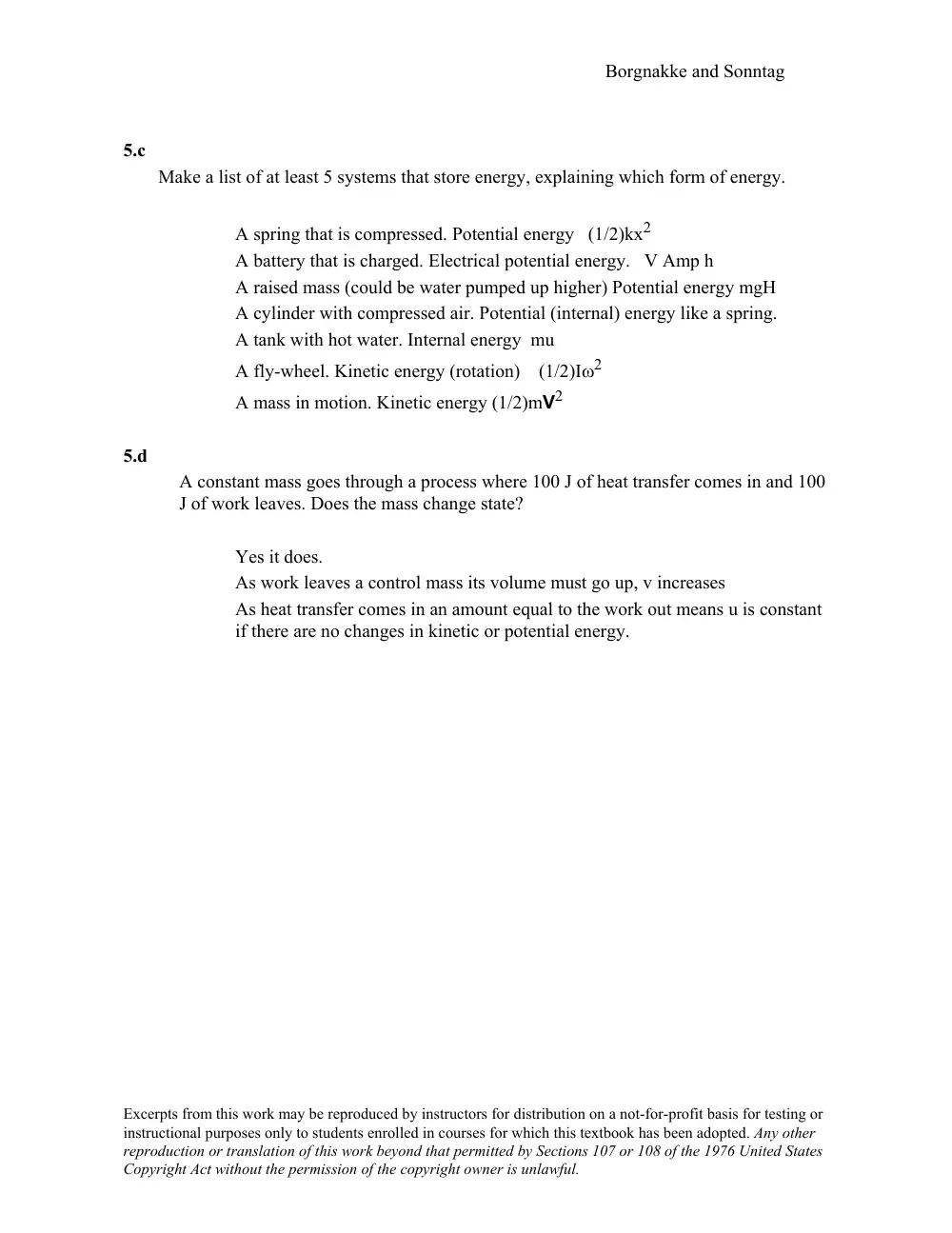
Make a list of at least 5 systems that store energy, explaining which form of energy.
A spring that is compressed. Potential energy (1/2)kx2
A battery that is charged. Electrical potential energy. V Amp h
A raised mass (could be water pumped up higher) Potential energy mgH
A cylinder with compressed air. Potential (internal) energy like a spring.
A tank with hot water. Internal energy mu
A fly-wheel. Kinetic energy (rotation) (1/2)Iω2
A mass in motion. Kinetic energy (1/2)mV2
5.d
A constant mass goes through a process where 100 J of heat transfer comes in and 100
J of work leaves. Does the mass change state?
Yes it does.
As work leaves a control mass its volume must go up, v increases
As heat transfer comes in an amount equal to the work out means u is constant
if there are no changes in kinetic or potential energy.
Excerpts from this work may be reproduced by instructors for distribution on a not-for-profit basis for testing or
instructional purposes only to students enrolled in courses for which this textbook has been adopted. Any other
reproduction or translation of this work beyond that permitted by Sections 107 or 108 of the 1976 United States
Copyright Act without the permission of the copyright owner is unlawful.
Borgnakke and Sonntag
5.e
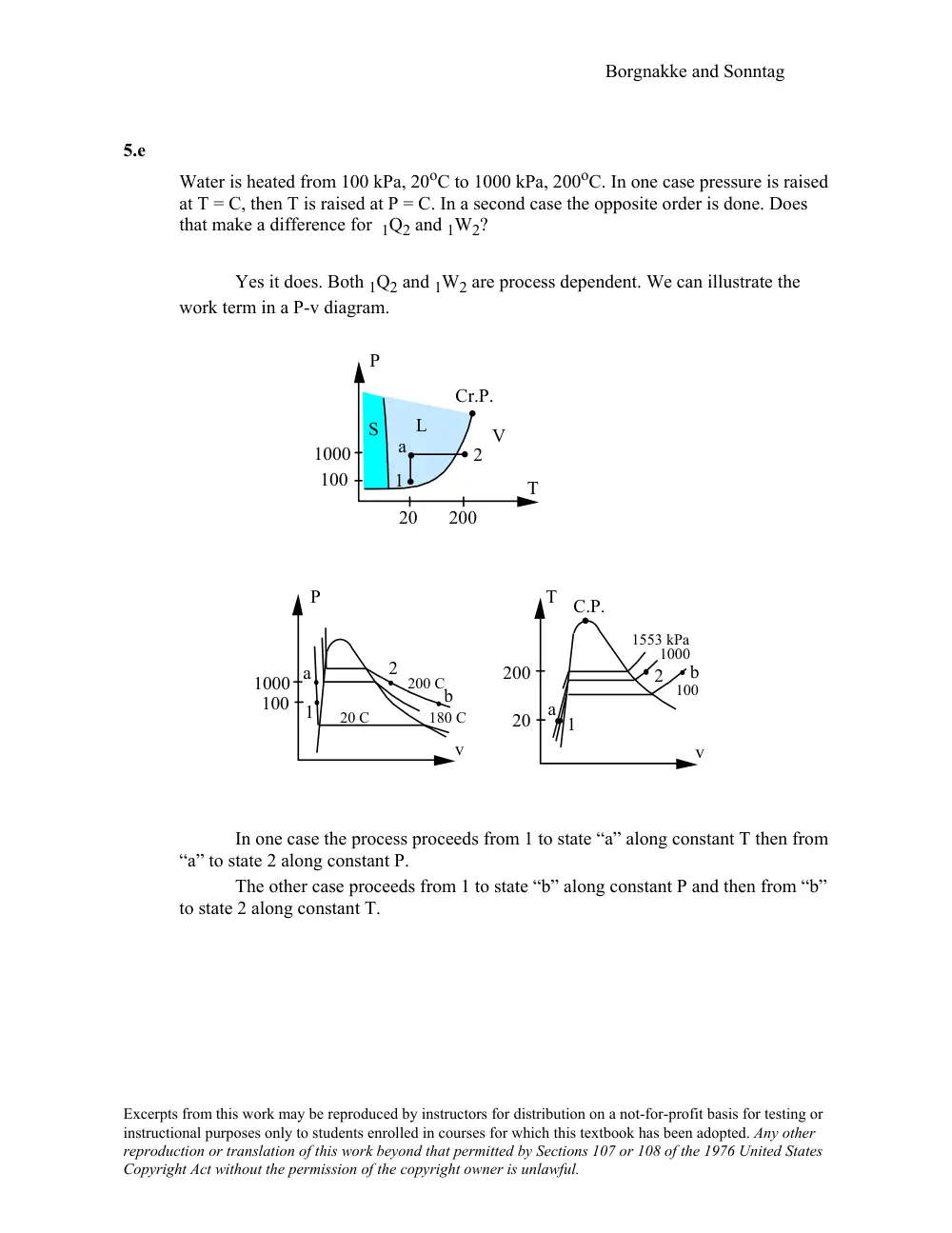
Water is heated from 100 kPa, 20oC to 1000 kPa, 200oC. In one case pressure is raised
at T = C, then T is raised at P = C. In a second case the opposite order is done. Does
that make a difference for 1Q2 and 1W2?
Yes it does. Both 1Q2 and 1W2 are process dependent. We can illustrate the
work term in a P-v diagram.
P
T
V
L
Cr.P.
S
1000
a
20
200
1
2
100
T
C.P.
v
a
P
v
a
180 C
2
2
20 C
20
200
1
100
1000
200 C
100
1553 kPa
1000
1
b
b
In one case the process proceeds from 1 to state “a” along constant T then from
“a” to state 2 along constant P.
The other case proceeds from 1 to state “b” along constant P and then from “b”
to state 2 along constant T.
Excerpts from this work may be reproduced by instructors for distribution on a not-for-profit basis for testing or
instructional purposes only to students enrolled in courses for which this textbook has been adopted. Any other
reproduction or translation of this work beyond that permitted by Sections 107 or 108 of the 1976 United States
Copyright Act without the permission of the copyright owner is unlawful.
Borgnakke and Sonntag
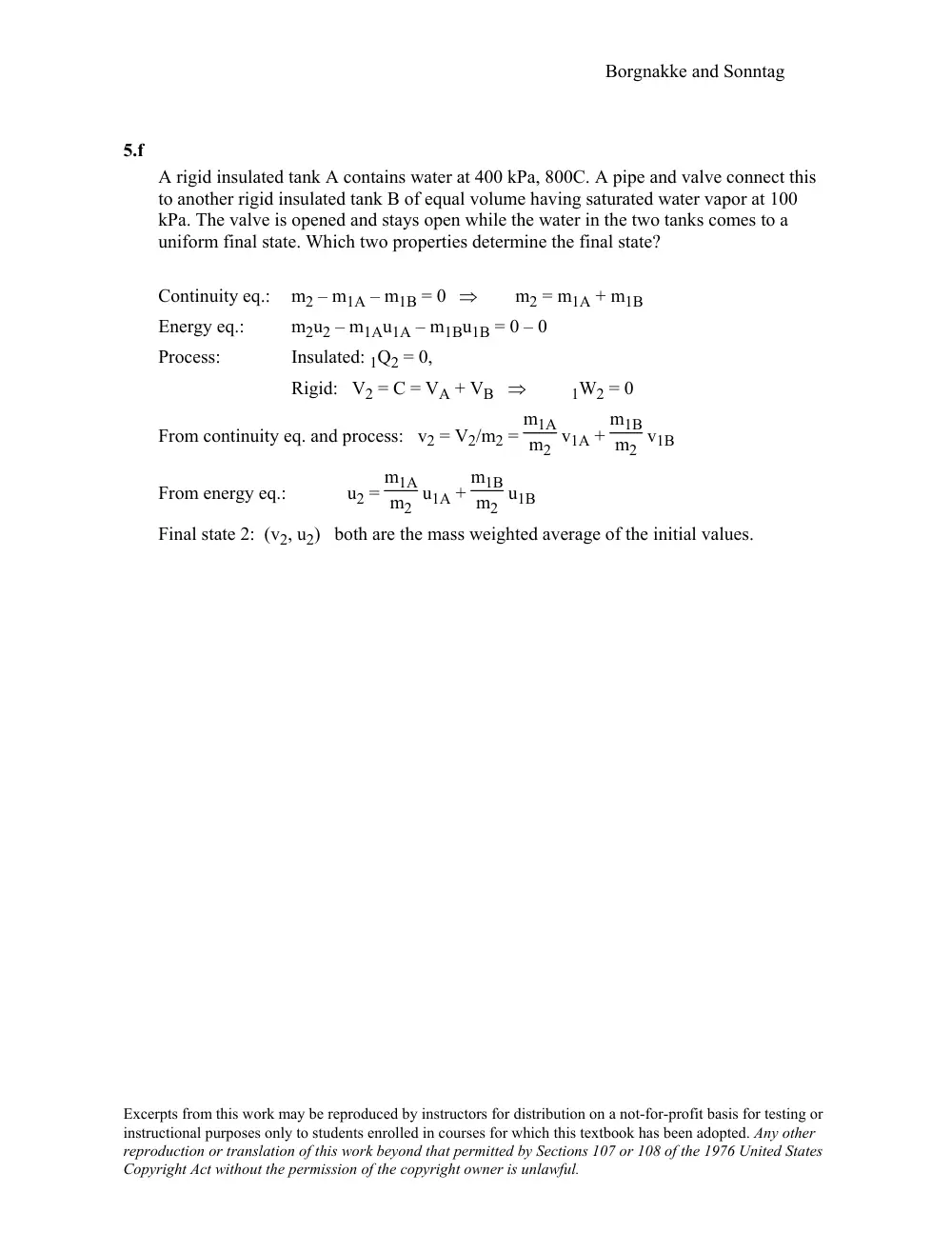
5.f
A rigid insulated tank A contains water at 400 kPa, 800C. A pipe and valve connect this
to another rigid insulated tank B of equal volume having saturated water vapor at 100
kPa. The valve is opened and stays open while the water in the two tanks comes to a
uniform final state. Which two properties determine the final state?
Continuity eq.:
m2 – m1A – m1B = 0 ⇒
m2 = m1A + m1B
Energy eq.:
m2u2 – m1Au1A – m1Bu1B = 0 – 0
Process:
Insulated: 1Q2 = 0,
Rigid: V2 = C = VA + VB ⇒
1W2 = 0
From continuity eq. and process: v2 = V2/m2 =
m1A
m2 v1A +
m1B
m2 v1B
From energy eq.:
u2 =
m1A
m2 u1A +
m1B
m2 u1B
Final state 2: (v2, u2) both are the mass weighted average of the initial values.
Excerpts from this work may be reproduced by instructors for distribution on a not-for-profit basis for testing or
instructional purposes only to students enrolled in courses for which this textbook has been adopted. Any other
reproduction or translation of this work beyond that permitted by Sections 107 or 108 of the 1976 United States
Copyright Act without the permission of the copyright owner is unlawful.
Borgnakke and Sonntag
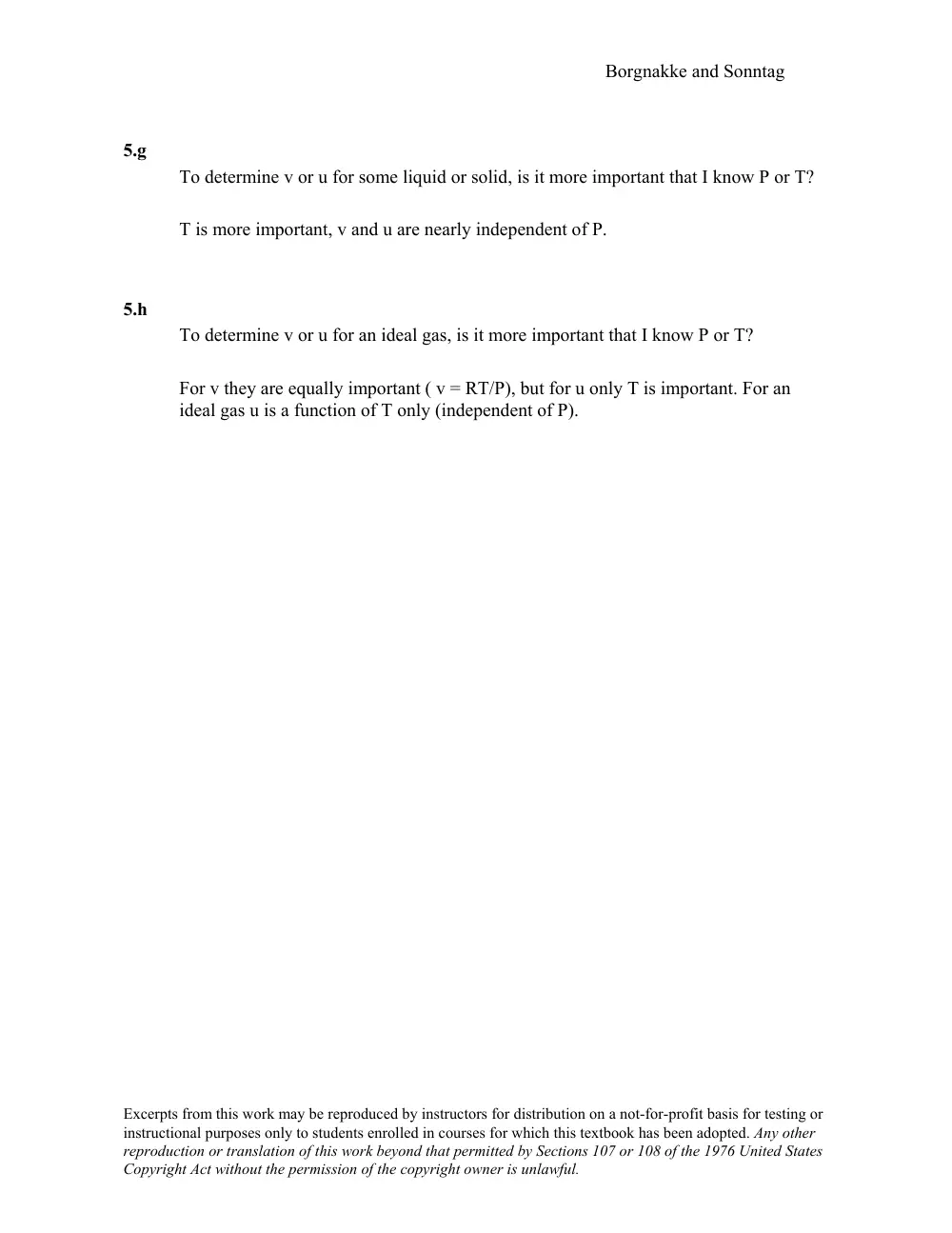
5.g
To determine v or u for some liquid or solid, is it more important that I know P or T?
T is more important, v and u are nearly independent of P.
5.h
To determine v or u for an ideal gas, is it more important that I know P or T?
For v they are equally important ( v = RT/P), but for u only T is important. For an
ideal gas u is a function of T only (independent of P).
Excerpts from this work may be reproduced by instructors for distribution on a not-for-profit basis for testing or
instructional purposes only to students enrolled in courses for which this textbook has been adopted. Any other
reproduction or translation of this work beyond that permitted by Sections 107 or 108 of the 1976 United States
Copyright Act without the permission of the copyright owner is unlawful.
Borgnakke and Sonntag
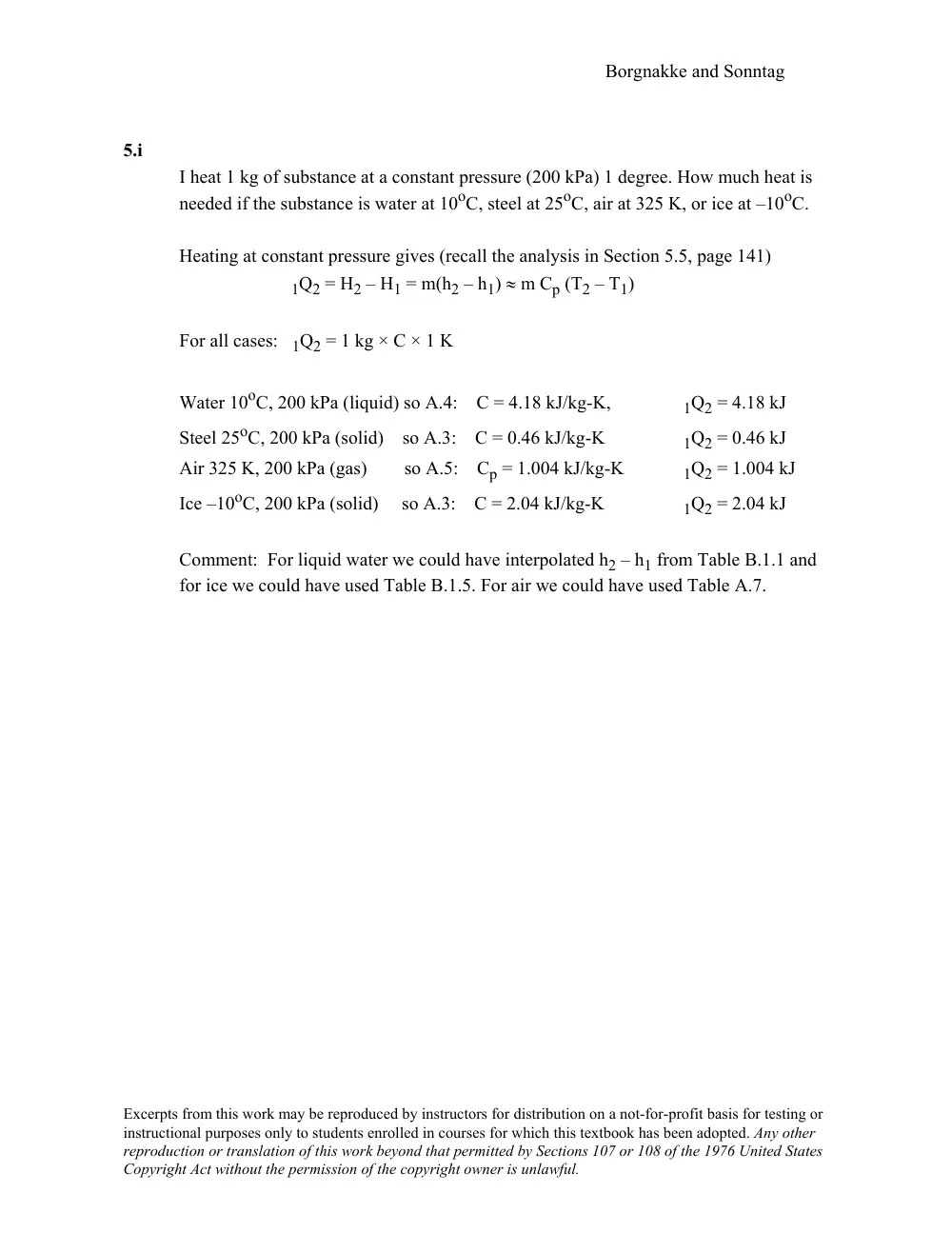
5.i
I heat 1 kg of substance at a constant pressure (200 kPa) 1 degree. How much heat is
needed if the substance is water at 10oC, steel at 25oC, air at 325 K, or ice at –10oC.
Heating at constant pressure gives (recall the analysis in Section 5.5, page 141)
1Q2 = H2 – H1 = m(h2 – h1) ≈ m Cp (T2 – T1)
For all cases: 1Q2 = 1 kg × C × 1 K
Water 10oC, 200 kPa (liquid) so A.4: C = 4.18 kJ/kg-K,
1Q2 = 4.18 kJ
Steel 25oC, 200 kPa (solid) so A.3: C = 0.46 kJ/kg-K
1Q2 = 0.46 kJ
Air 325 K, 200 kPa (gas) so A.5: Cp = 1.004 kJ/kg-K
1Q2 = 1.004 kJ
Ice –10oC, 200 kPa (solid) so A.3: C = 2.04 kJ/kg-K
1Q2 = 2.04 kJ
Comment: For liquid water we could have interpolated h2 – h1 from Table B.1.1 and
for ice we could have used Table B.1.5. For air we could have used Table A.7.
Excerpts from this work may be reproduced by instructors for distribution on a not-for-profit basis for testing or
instructional purposes only to students enrolled in courses for which this textbook has been adopted. Any other
reproduction or translation of this work beyond that permitted by Sections 107 or 108 of the 1976 United States
Copyright Act without the permission of the copyright owner is unlawful.
Borgnakke and Sonntag
Concept Problems
Excerpts from this work may be reproduced by instructors for distribution on a not-for-profit basis for testing or
instructional purposes only to students enrolled in courses for which this textbook has been adopted. Any other
reproduction or translation of this work beyond that permitted by Sections 107 or 108 of the 1976 United States
Copyright Act without the permission of the copyright owner is unlawful.
Borgnakke and Sonntag
5.1
What is 1 cal in SI units and what is the name given to 1 N-m?
Look in the conversion factor table A.1 under energy:
1 cal (Int.) = 4.1868 J = 4.1868 Nm = 4.1868 kg m2/s2
This was historically defined as the heat transfer needed to bring 1 g of liquid water
from 14.5oC to 15.5oC, notice the value of the heat capacity of water in Table A.4
1 N-m = 1 J or Force times displacement = energy = Joule
Excerpts from this work may be reproduced by instructors for distribution on a not-for-profit basis for testing or
instructional purposes only to students enrolled in courses for which this textbook has been adopted. Any other
reproduction or translation of this work beyond that permitted by Sections 107 or 108 of the 1976 United States
Copyright Act without the permission of the copyright owner is unlawful.
Borgnakke and Sonntag
5.2
Why do we write ∆E or E2 – E1 whereas we write 1Q2 and 1W2?
∆E or E2 – E1 is the change in the stored energy from state 1 to state 2 and
depends only on states 1 and 2 not upon the process between 1 and 2.
1Q2 and 1W2 are amounts of energy transferred during the process between
1 and 2 and depend on the process path. The quantities are associated with
the process and they are not state properties.
5.3
If a process in a control mass increases energy E2 – E1 > 0 can you say anything about
the sign for 1Q2 and 1W2?
No.
The net balance of the heat transfer and work terms from the energy equation is
E2 – E1 = 1Q2 – 1W2 > 0
but that does not separate the effect of the two terms.
Excerpts from this work may be reproduced by instructors for distribution on a not-for-profit basis for testing or
instructional purposes only to students enrolled in courses for which this textbook has been adopted. Any other
reproduction or translation of this work beyond that permitted by Sections 107 or 108 of the 1976 United States
Copyright Act without the permission of the copyright owner is unlawful.
Borgnakke and Sonntag
5.4
When you windup a spring in a toy or stretch a rubber band what happens in terms of
work, energy, and heat transfer? Later, when they are released, what happens then?
In both processes work is put into the device and the energy is stored as potential
energy. If the spring or rubber is inelastic some of the work input goes into internal
energy (it becomes warmer or permanently deformed) and not into its potential energy.
Being warmer than the ambient air it cools slowly to ambient temperature.
When the spring or rubber band is released the potential energy is transferred back
into work given to the system connected to the end of the spring or rubber band. If
nothing is connected the energy goes into kinetic energy and the motion is then
dampened as the energy is transformed into internal energy.
Excerpts from this work may be reproduced by instructors for distribution on a not-for-profit basis for testing or
instructional purposes only to students enrolled in courses for which this textbook has been adopted. Any other
reproduction or translation of this work beyond that permitted by Sections 107 or 108 of the 1976 United States
Copyright Act without the permission of the copyright owner is unlawful.
Borgnakke and Sonntag
Excerpts from this work may be reproduced by instructors for distribution on a not-for-profit basis for testing or
instructional purposes only to students enrolled in courses for which this textbook has been adopted. Any other
reproduction or translation of this work beyond that permitted by Sections 107 or 108 of the 1976 United States
Copyright Act without the permission of the copyright owner is unlawful.
5.5
CV A is the mass inside a piston-cylinder, CV B is that
plus the piston outside, which is the standard atmosphere.
Write the energy equation and work term for the two CVs
assuming we have a non-zero Q between state 1 and state
2.
Po
p
m
g
A
m
CV A:
E2 – E1 = mA(e2 – e1) = mA(u2 – u1) = 1Q2 – 1WA2
1WA2 = ∫ P dV = P(V2 – V1)
CV B:
E2 – E1 = mA(e2 – e1) + mpist(e2 – e1) = mA(u2 – u1) + mpist(gZ2 – gZ1)
= 1Q2 – 1WB2
1WB2 = ∫ Po dV = Po(V2 – V1)
Notice how the P inside CV A is P = Po + mpistg /Acyl i.e. the first work term is
larger than the second. The difference between the work terms is exactly equal to the potential
energy of the piston sitting on the left hand side in the CV B energy Eq. The two equations
are mathematically identical.
1WA2 = P(V2 – V1) = [Po + mpistg /Acyl ] (V2 – V1) = 1WB2 + mpistg(V2 – V1)/Acyl
= 1WB2 + mpistg(Z2 – Z1)
Borgnakke and Sonntag
5.6
Saturated water vapor has a maximum for u and h at around 235oC. Is it similar for other
substances?
Look at the various substances listed in appendix B. Everyone has a maximum u and h
somewhere along the saturated vapor line at different T for each substance. This means
the constant u and h curves are different from the constant T curves and some of them
cross over the saturated vapor line twice, see sketch below.
Constant h lines are
similar to the constant
u line shown.
P C.P.
v
T
C.P.
v
T
P = C
u = C
u = C
Notice the constant u (or h) line becomes parallel to the constant T lines in the
superheated vapor region for low P where it is an ideal gas. In the T-v diagram the
constant u (or h) line becomes horizontal in the ideal gas region.
Excerpts from this work may be reproduced by instructors for distribution on a not-for-profit basis for testing or
instructional purposes only to students enrolled in courses for which this textbook has been adopted. Any other
reproduction or translation of this work beyond that permitted by Sections 107 or 108 of the 1976 United States
Copyright Act without the permission of the copyright owner is unlawful.
Borgnakke and Sonntag
5.7
Some liquid water is heated so it becomes superheated vapor. Do I use u or h in the
energy equation? Explain.
The energy equation for a control mass is: m(u2 – u1) = 1Q2 – 1W2
The storage of energy is a change in u (when we neglect kinetic and potential energy
changes) and that is always so. To solve for the heat transfer we must know the work
in the process and it is for a certain process (P = C) that the work term combines with
the change in u to give a change in h. To avoid confusion you should always write the
energy equation as shown above and substitute the appropriate expression for the
work term when you know the process equation that allows you to evaluate work.
Excerpts from this work may be reproduced by instructors for distribution on a not-for-profit basis for testing or
instructional purposes only to students enrolled in courses for which this textbook has been adopted. Any other
reproduction or translation of this work beyond that permitted by Sections 107 or 108 of the 1976 United States
Copyright Act without the permission of the copyright owner is unlawful.
Borgnakke and Sonntag
5.8
Some liquid water is heated so it becomes superheated vapor. Can I use specific heat
to find the heat transfer? Explain.
NO.
The specific heat can not give any information about the energy required to do the
phase change. The specific heat is useful for single phase state changes only.
Excerpts from this work may be reproduced by instructors for distribution on a not-for-profit basis for testing or
instructional purposes only to students enrolled in courses for which this textbook has been adopted. Any other
reproduction or translation of this work beyond that permitted by Sections 107 or 108 of the 1976 United States
Copyright Act without the permission of the copyright owner is unlawful.
Borgnakke and Sonntag
5.9
Look at the R-410a value for uf at -50oC. Can the energy really be negative? Explain.
The absolute value of u and h are arbitrary. A constant can be added to all u and h
values and the table is still valid. It is customary to select the reference such that u for
saturated liquid water at the triple point is zero. The standard for refrigerants like R-
410a is that h is set to zero as saturated liquid at -40oC, other substances like
cryogenic substances like nitrogen, methane etc. may have different states at which h
is set to zero. The ideal gas tables use a zero point for h as 25oC or at absolute zero, 0
K.
Excerpts from this work may be reproduced by instructors for distribution on a not-for-profit basis for testing or
instructional purposes only to students enrolled in courses for which this textbook has been adopted. Any other
reproduction or translation of this work beyond that permitted by Sections 107 or 108 of the 1976 United States
Copyright Act without the permission of the copyright owner is unlawful.
Borgnakke and Sonntag
5.10
A rigid tank with pressurized air is used to a) increase the volume of a linear spring
loaded piston cylinder (cylindrical geometry) arrangement and b) to blow up a
spherical balloon. Assume that in both cases P = A + BV with the same A and B.
What is the expression for the work term in each situation?
The expression is exactly the same; the geometry does not matter as long as we have
the same relation between P and V then
1W2 = ∫ P dV = ∫ (A + BV) dV
= A(V2 – V1) + 0.5 B (V2
2 – V2
1)
= A(V2 – V1) + 0.5 B (V2 + V1) (V2 – V1)
= 0.5 [ A + B V2 + A + B V1] (V2 – V1)
= 0.5 (P1 + P2) (V2 – V1)
Notice the last expression directly gives the area below the curve in the P-V diagram.
Excerpts from this work may be reproduced by instructors for distribution on a not-for-profit basis for testing or
instructional purposes only to students enrolled in courses for which this textbook has been adopted. Any other
reproduction or translation of this work beyond that permitted by Sections 107 or 108 of the 1976 United States
Copyright Act without the permission of the copyright owner is unlawful.
Borgnakke and Sonntag
5.11
An ideal gas in a piston-cylinder is heated with 2 kJ during an isothermal process.
How much work is involved?
Energy Eq.:
u2 − u1 = 1q2 – 1w2 = 0 since u2 = u1 (isothermal)
Then
1W2 = m 1w2 = 1Q2 = m 1Q2 = 2 kJ
5.12
An ideal gas in a piston-cylinder is heated with 2 kJ during an isobaric process. Is the
work pos., neg., or zero?
As the gas is heated u and T increase and since PV = mRT it follows that the volume
increase and thus work goes out.
w > 0
Excerpts from this work may be reproduced by instructors for distribution on a not-for-profit basis for testing or
instructional purposes only to students enrolled in courses for which this textbook has been adopted. Any other
reproduction or translation of this work beyond that permitted by Sections 107 or 108 of the 1976 United States
Copyright Act without the permission of the copyright owner is unlawful.
Borgnakke and Sonntag
5.13
You heat a gas 10 K at P = C. Which one in Table A.5 requires most energy? Why?
A constant pressure process in a control mass gives (recall Eq.5.29)
1q2 = u2 − u1 + 1w2 = h2 − h1 ≈ Cp ∆T
The one with the highest specific heat is hydrogen, H2. The hydrogen has the
smallest mass, but the same kinetic energy per mol as other molecules and thus the
most energy per unit mass is needed to increase the temperature.
Excerpts from this work may be reproduced by instructors for distribution on a not-for-profit basis for testing or
instructional purposes only to students enrolled in courses for which this textbook has been adopted. Any other
reproduction or translation of this work beyond that permitted by Sections 107 or 108 of the 1976 United States
Copyright Act without the permission of the copyright owner is unlawful.
Borgnakke and Sonntag
5.14
A 500 W electric space heater with a small fan inside heats air by blowing it over a
hot electrical wire. For each control volume: a) wire only b) all the room air and c)
total room plus the heater, specify the storage, work and heat transfer terms as +
500W or -500W or 0 W, neglect any Q
.
through the room walls or windows.
Storage
Work
Heat transfer
Wire
0 W
-500 W
-500 W
Room air
500 W
0 W
500 W
Tot room
500 W
-500 W
0 W
Excerpts from this work may be reproduced by instructors for distribution on a not-for-profit basis for testing or
instructional purposes only to students enrolled in courses for which this textbook has been adopted. Any other
reproduction or translation of this work beyond that permitted by Sections 107 or 108 of the 1976 United States
Copyright Act without the permission of the copyright owner is unlawful.
Borgnakke and Sonntag
Kinetic and Potential Energy
Excerpts from this work may be reproduced by instructors for distribution on a not-for-profit basis for testing or
instructional purposes only to students enrolled in courses for which this textbook has been adopted. Any other
reproduction or translation of this work beyond that permitted by Sections 107 or 108 of the 1976 United States
Copyright Act without the permission of the copyright owner is unlawful.
Borgnakke and Sonntag
5.15
A piston motion moves a 25 kg hammerhead vertically down 1 m from rest to a
velocity of 50 m/s in a stamping machine. What is the change in total energy of the
hammerhead?
Solution: C.V. Hammerhead
The hammerhead does not change internal energy (i.e. same P, T), but it does have
a change in kinetic and potential energy.
E2 – E1 = m(u2 – u1) + m[(1/2)V2 2 – 0] + mg (Z2 - 0)
= 0 + 25 kg × (1/2) × (50 m/s)2 + 25 kg × 9.80665 m/s2 × (-1) m
= 31250 J – 245.17 J = 31005 J = 31 kJ
Excerpts from this work may be reproduced by instructors for distribution on a not-for-profit basis for testing or
instructional purposes only to students enrolled in courses for which this textbook has been adopted. Any other
reproduction or translation of this work beyond that permitted by Sections 107 or 108 of the 1976 United States
Copyright Act without the permission of the copyright owner is unlawful.
Borgnakke and Sonntag
5.16
A steel ball weighing 5 kg rolls horizontal with 10 m/s. If it rolls up an incline how
high up will it be when it comes to rest assuming standard gravitation.
C.V. Steel ball.
Energy Eq.:
E2 – E1 = 1Q2 – 1W2 = 0 – 0 = 0
E1 = mu1 + mgZ1 + 0.5 mV2
E2 = mu2 + mgZ2 + 0
We assume the steel ball does not change temperature (u2 = u1) so then the energy
equation gives
mu2 + mgZ2 – mu1 – mgZ1 – 0.5 mV2 = 0
mg (Z2 – Z1) = 0.5 mV2
Z2 – Z1 = 0.5 V2/g = 0.5 × 10² (m2/s2) / (9.81 m/s2) = 5.1 m
Excerpts from this work may be reproduced by instructors for distribution on a not-for-profit basis for testing or
instructional purposes only to students enrolled in courses for which this textbook has been adopted. Any other
reproduction or translation of this work beyond that permitted by Sections 107 or 108 of the 1976 United States
Copyright Act without the permission of the copyright owner is unlawful.
Borgnakke and Sonntag
5.17
A 1200 kg car accelerates from zero to 100 km/h over a distance of 400 m. The road at
the end of the 400 m is at 10 m higher elevation. What is the total increase in the car
kinetic and potential energy?
Solution:
∆KE = ½ m (V2
2 - V2
1)
V2 = 100 km/h = 100 × 1000
3600
m/s
= 27.78 m/s
∆KE = ½ ×1200 kg × (27.782 – 02) (m/s)2 = 463 037 J = 463 kJ
∆PE = mg(Z2 – Z1) = 1200 kg × 9.807 m/s2 ( 10 - 0 ) m = 117684 J = 117.7 kJ
Excerpts from this work may be reproduced by instructors for distribution on a not-for-profit basis for testing or
instructional purposes only to students enrolled in courses for which this textbook has been adopted. Any other
reproduction or translation of this work beyond that permitted by Sections 107 or 108 of the 1976 United States
Copyright Act without the permission of the copyright owner is unlawful.
Borgnakke and Sonntag
5.18
A hydraulic hoist raises a 1750 kg car 1.8 m in an auto repair shop. The hydraulic
pump has a constant pressure of 800 kPa on its piston. What is the increase in
potential energy of the car and how much volume should the pump displace to deliver
that amount of work?
Solution: C.V. Car.
No change in kinetic or internal energy of the car, neglect hoist mass.
E2 – E1 = PE2 - PE1 = mg (Z2 – Z1)
= 1750 × 9.80665 × 1.8 = 30 891 J
The increase in potential energy is work into car
from pump at constant P.
W = E2 – E1 = ∫ P dV = P ∆V
⇒
∆V =
E2 – E1
P
=
30891
800 × 1000 = 0.0386 m3
Excerpts from this work may be reproduced by instructors for distribution on a not-for-profit basis for testing or
instructional purposes only to students enrolled in courses for which this textbook has been adopted. Any other
reproduction or translation of this work beyond that permitted by Sections 107 or 108 of the 1976 United States
Copyright Act without the permission of the copyright owner is unlawful.
Borgnakke and Sonntag
5.19
The rolling resistance of a car depends on its weight as: F = 0.006 mg. How far will a
car of 1200 kg roll if the gear is put in neutral when it drives at 90 km/h on a level
road without air resistance?
Solution:
The car decreases its kinetic energy to zero due to the force (constant) acting over the
distance.
m (1/2V2
2 –1/2V2
1) = -1W2 = -∫ F dx = -FL
V2 = 0, V1 = 90 km
h = 90 ×1000
3600
ms-1 = 25 ms-1
-1/2 mV2
1 = -FL = - 0.006 mgL
�
L =
0.5 V2
1
0.0006g =
0.5×252
0.006×9.807 m2/s2
m/s2 = 5311 m
Remark: Over 5 km! The air resistance is much higher than the rolling resistance so
this is not a realistic number by itself.
Excerpts from this work may be reproduced by instructors for distribution on a not-for-profit basis for testing or
instructional purposes only to students enrolled in courses for which this textbook has been adopted. Any other
reproduction or translation of this work beyond that permitted by Sections 107 or 108 of the 1976 United States
Copyright Act without the permission of the copyright owner is unlawful.
Borgnakke and Sonntag
5.20
A 1200 kg car is accelerated from 30 to 50 km/h in 5 s. How much work is that? If you
continue from 50 to 70 km/h in 5 s; is that the same?
The work input is the increase in kinetic energy.
E2 – E1 = (1/2)m[V2
2 - V2
1] = 1W2
= 0.5 × 1200 kg [502 – 302]
km
h
2
= 600 [ 2500 – 900 ] kg
1000 m
3600 s
2
= 74 074 J = 74.1 kJ
The second set of conditions does not become the same
E2 – E1 = (1/2)m[V2
2 - V2
1] = 600 [ 702 – 502 ] kg
1000 m
3600 s
2
= 111 kJ
Excerpts from this work may be reproduced by instructors for distribution on a not-for-profit basis for testing or
instructional purposes only to students enrolled in courses for which this textbook has been adopted. Any other
reproduction or translation of this work beyond that permitted by Sections 107 or 108 of the 1976 United States
Copyright Act without the permission of the copyright owner is unlawful.
Borgnakke and Sonntag
5.21
Airplane takeoff from an aircraft carrier is assisted by a steam driven piston/cylinder
device with an average pressure of 1250 kPa. A 17500 kg airplane should be
accelerated from zero to a speed of 30 m/s with 30% of the energy coming from the
steam piston. Find the needed piston displacement volume.
Solution: C.V. Airplane.
No change in internal or potential energy; only kinetic energy is changed.
E2 – E1 = m (1/2) (V2
2 - 0) = 17500 kg × (1/2) × 302 (m/s)2
= 7875 000 J = 7875 kJ
The work supplied by the piston is 30% of the energy increase.
W = ∫ P dV = Pavg ∆V = 0.30 (E2 – E1)
= 0.30 × 7875 = 2362.5 kJ
∆V = W
Pavg = 2362.5
1250 kJ
kPa = 1.89 m3
Excerpts from this work may be reproduced by instructors for distribution on a not-for-profit basis for testing or
instructional purposes only to students enrolled in courses for which this textbook has been adopted. Any other
reproduction or translation of this work beyond that permitted by Sections 107 or 108 of the 1976 United States
Copyright Act without the permission of the copyright owner is unlawful.
Borgnakke and Sonntag
5.22
Solve Problem 5.21, but assume the steam pressure in the cylinder starts at 1000 kPa,
dropping linearly with volume to reach 100 kPa at the end of the process.
Solution: C.V. Airplane.
E2 – E1 = m (1/2) (V22 - 0)
= 17 500 kg × (1/2) × 302 (m/s)2
= 7875 000 J = 7875 kJ
W = 0.30(E2 – E1) = 0.30 × 7875 = 2362.5 kJ
W = ∫ P dV = (1/2)(Pbeg + Pend) ∆V
P
1
2
V
W
1000
100
∆V = W
Pavg =
2362.5 kJ
1/2(1000 + 100) kPa = 4.29 m3
Excerpts from this work may be reproduced by instructors for distribution on a not-for-profit basis for testing or
instructional purposes only to students enrolled in courses for which this textbook has been adopted. Any other
reproduction or translation of this work beyond that permitted by Sections 107 or 108 of the 1976 Uni