
MECH 310 Problems Solution Manual Chapter 6, Fall 2011
American University of Beirut · Thermodynamics I · 169 pages · with solution

Showing the first 10 of 169 pages. Download the PDF to see all of it.
More MECH 310 files
- Essay Chapter 3 · Fall 2017ChapterView
- Problems Solution Manual Chapter 9 · Fall 2011Chapter · with solutionView
- Problems Chapter 5 Solutions · Fall 2011Chapter · with solutionView
- Problems Chapter 8 Solutions · Fall 2011Chapter · with solutionView
- Problems Chapter 9 Extra Problems · Fall 2011ChapterView
- Problems Chapter 6 Solutions · Fall 2011Chapter · with solutionView
- Problems Chapter 3 Solutions · Fall 2011Chapter · with solutionView
- Problems Chapter 4 Solutions · Fall 2011Chapter · with solutionView
Show the text of this chapter
SOLUTION MANUAL
CHAPTER 6
Borgnakke and Sonntag
CONTENT
SUBSECTION
PROB NO.
In-Text concept questions
a-k
Concept-Study guide problems
1- 10
Continuity equation and flow rates
11-19
Single flow, single-device processes
Nozzles, diffusers
20-30
Throttle flow
21-39
Turbines, expanders
40-47
Compressors, fans
48-57
Heaters, coolers
58-67
Pumps, pipe and channel flows
68-75
Multiple flow, single-device processes
Turbines, compressors, expanders
76-82
Heat exchangers
83-92
Mixing processes
93-101
Multiple devices, cycle processes
102-110
Transient processes
111-127
Review Problems
128-141
Heat Transfer Problems
142-145
Excerpts from this work may be reproduced by instructors for distribution on a not-for-profit basis for
testing or instructional purposes only to students enrolled in courses for which this textbook has been
adopted. Any other reproduction or translation of this work beyond that permitted by Sections 107 or 108
of the 1976 United States Copyright Act without the permission of the copyright owner is unlawful.
Borgnakke and Sonntag
In-Text Concept Questions
Excerpts from this work may be reproduced by instructors for distribution on a not-for-profit basis for
testing or instructional purposes only to students enrolled in courses for which this textbook has been
adopted. Any other reproduction or translation of this work beyond that permitted by Sections 107 or 108
of the 1976 United States Copyright Act without the permission of the copyright owner is unlawful.
Borgnakke and Sonntag
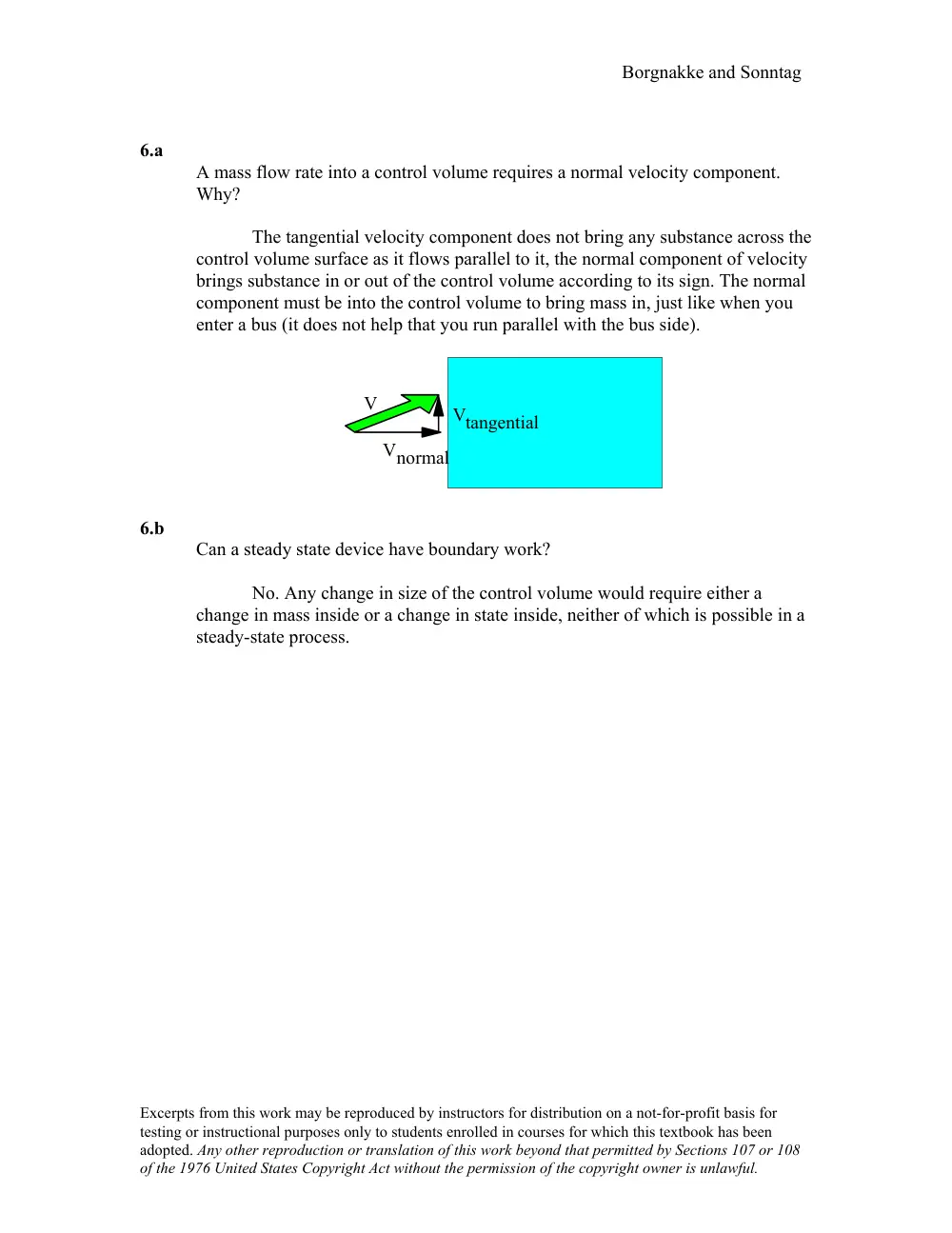
6.a
A mass flow rate into a control volume requires a normal velocity component.
Why?
The tangential velocity component does not bring any substance across the
control volume surface as it flows parallel to it, the normal component of velocity
brings substance in or out of the control volume according to its sign. The normal
component must be into the control volume to bring mass in, just like when you
enter a bus (it does not help that you run parallel with the bus side).
V
Vnormal
Vtangential
6.b
Can a steady state device have boundary work?
No. Any change in size of the control volume would require either a
change in mass inside or a change in state inside, neither of which is possible in a
steady-state process.
Excerpts from this work may be reproduced by instructors for distribution on a not-for-profit basis for
testing or instructional purposes only to students enrolled in courses for which this textbook has been
adopted. Any other reproduction or translation of this work beyond that permitted by Sections 107 or 108
of the 1976 United States Copyright Act without the permission of the copyright owner is unlawful.
Borgnakke and Sonntag
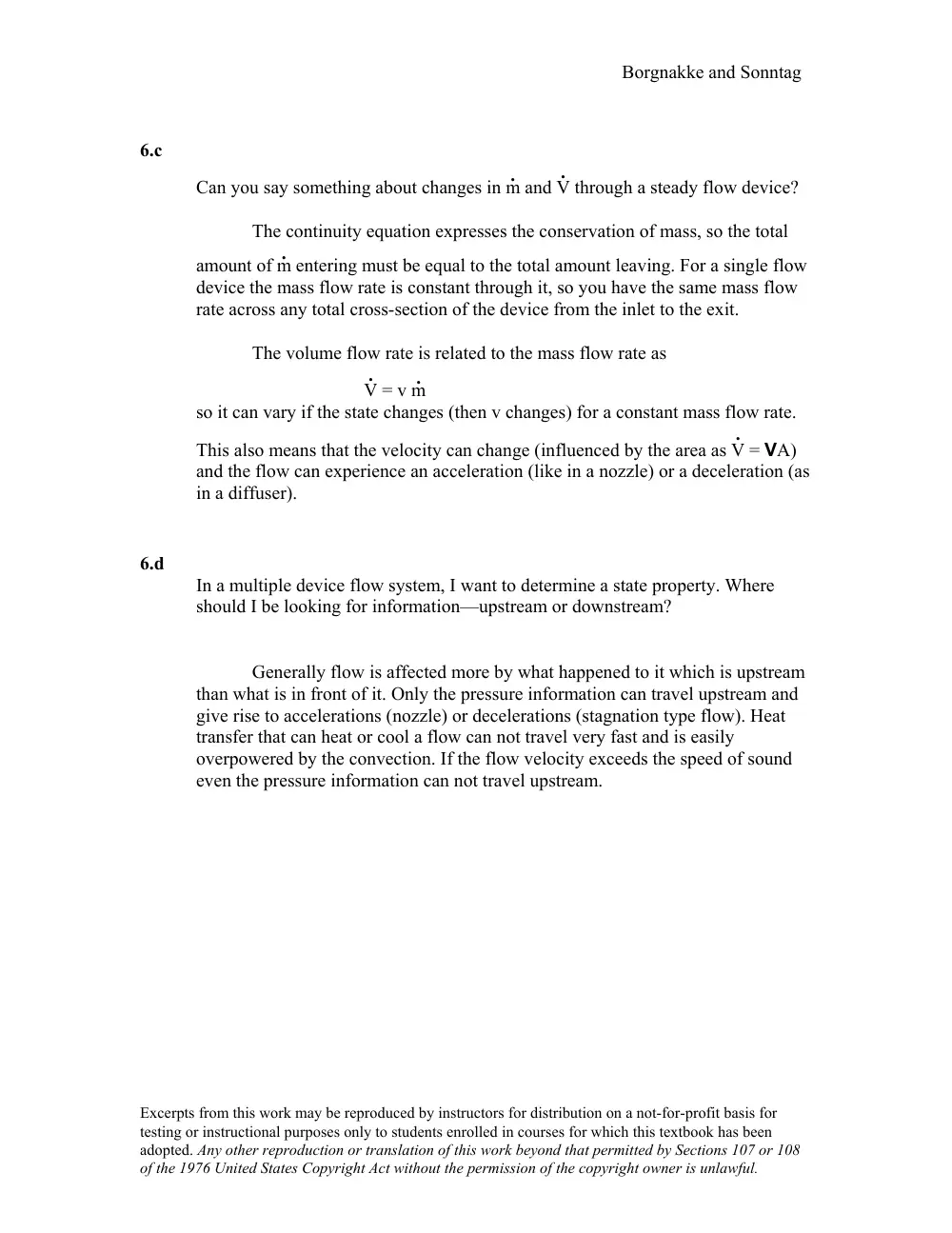
6.c
Can you say something about changes in m. and V
.
through a steady flow device?
The continuity equation expresses the conservation of mass, so the total
amount of m. entering must be equal to the total amount leaving. For a single flow
device the mass flow rate is constant through it, so you have the same mass flow
rate across any total cross-section of the device from the inlet to the exit.
The volume flow rate is related to the mass flow rate as
V
.
= v m.
so it can vary if the state changes (then v changes) for a constant mass flow rate.
This also means that the velocity can change (influenced by the area as V
.
= VA)
and the flow can experience an acceleration (like in a nozzle) or a deceleration (as
in a diffuser).
6.d
In a multiple device flow system, I want to determine a state property. Where
should I be looking for information—upstream or downstream?
Generally flow is affected more by what happened to it which is upstream
than what is in front of it. Only the pressure information can travel upstream and
give rise to accelerations (nozzle) or decelerations (stagnation type flow). Heat
transfer that can heat or cool a flow can not travel very fast and is easily
overpowered by the convection. If the flow velocity exceeds the speed of sound
even the pressure information can not travel upstream.
Excerpts from this work may be reproduced by instructors for distribution on a not-for-profit basis for
testing or instructional purposes only to students enrolled in courses for which this textbook has been
adopted. Any other reproduction or translation of this work beyond that permitted by Sections 107 or 108
of the 1976 United States Copyright Act without the permission of the copyright owner is unlawful.
Borgnakke and Sonntag
6.e
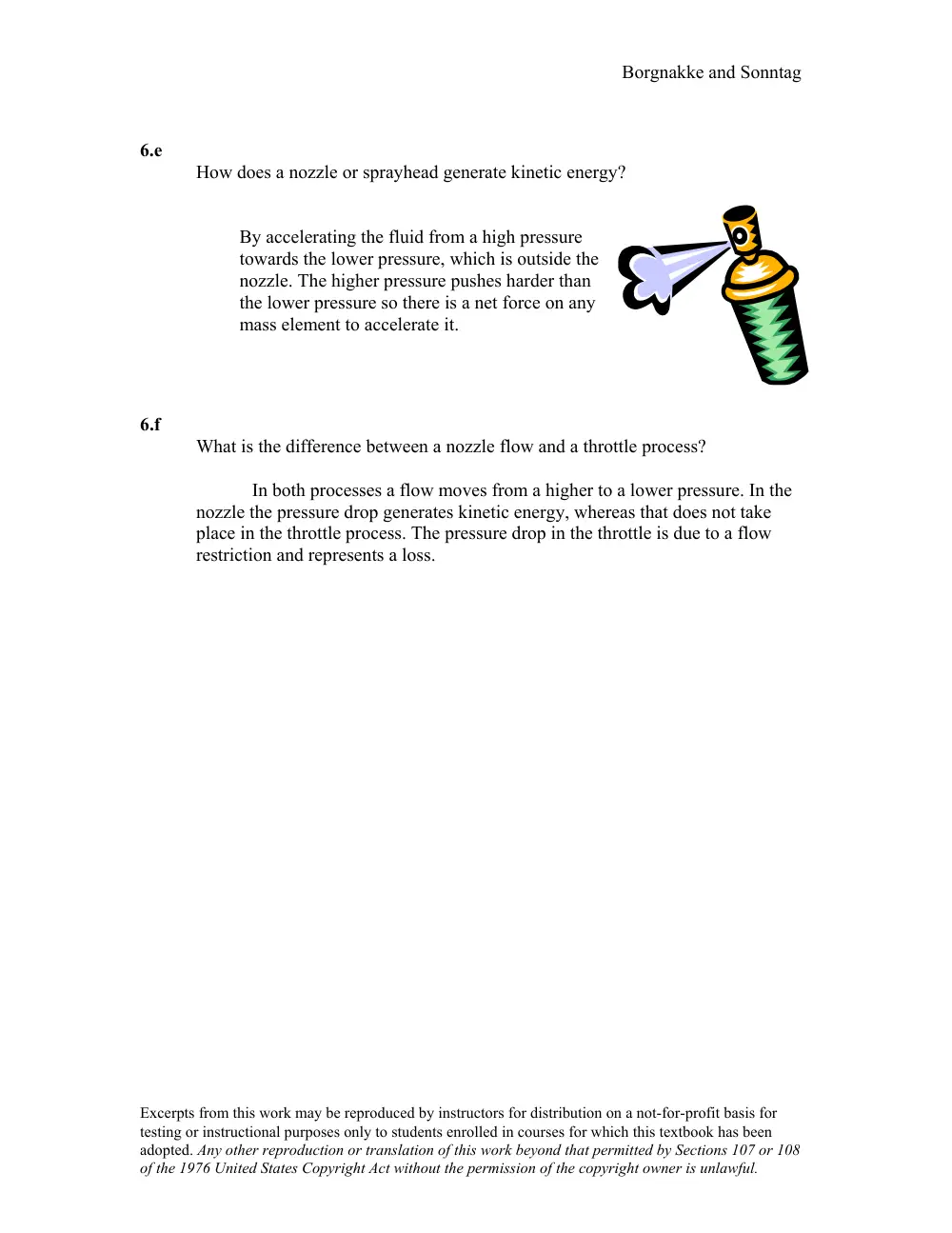
How does a nozzle or sprayhead generate kinetic energy?
By accelerating the fluid from a high pressure
towards the lower pressure, which is outside the
nozzle. The higher pressure pushes harder than
the lower pressure so there is a net force on any
mass element to accelerate it.
6.f
What is the difference between a nozzle flow and a throttle process?
In both processes a flow moves from a higher to a lower pressure. In the
nozzle the pressure drop generates kinetic energy, whereas that does not take
place in the throttle process. The pressure drop in the throttle is due to a flow
restriction and represents a loss.
Excerpts from this work may be reproduced by instructors for distribution on a not-for-profit basis for
testing or instructional purposes only to students enrolled in courses for which this textbook has been
adopted. Any other reproduction or translation of this work beyond that permitted by Sections 107 or 108
of the 1976 United States Copyright Act without the permission of the copyright owner is unlawful.
Borgnakke and Sonntag
6.g
If you throttle a saturated liquid what happens to the fluid state? What if this is
done to an ideal gas?
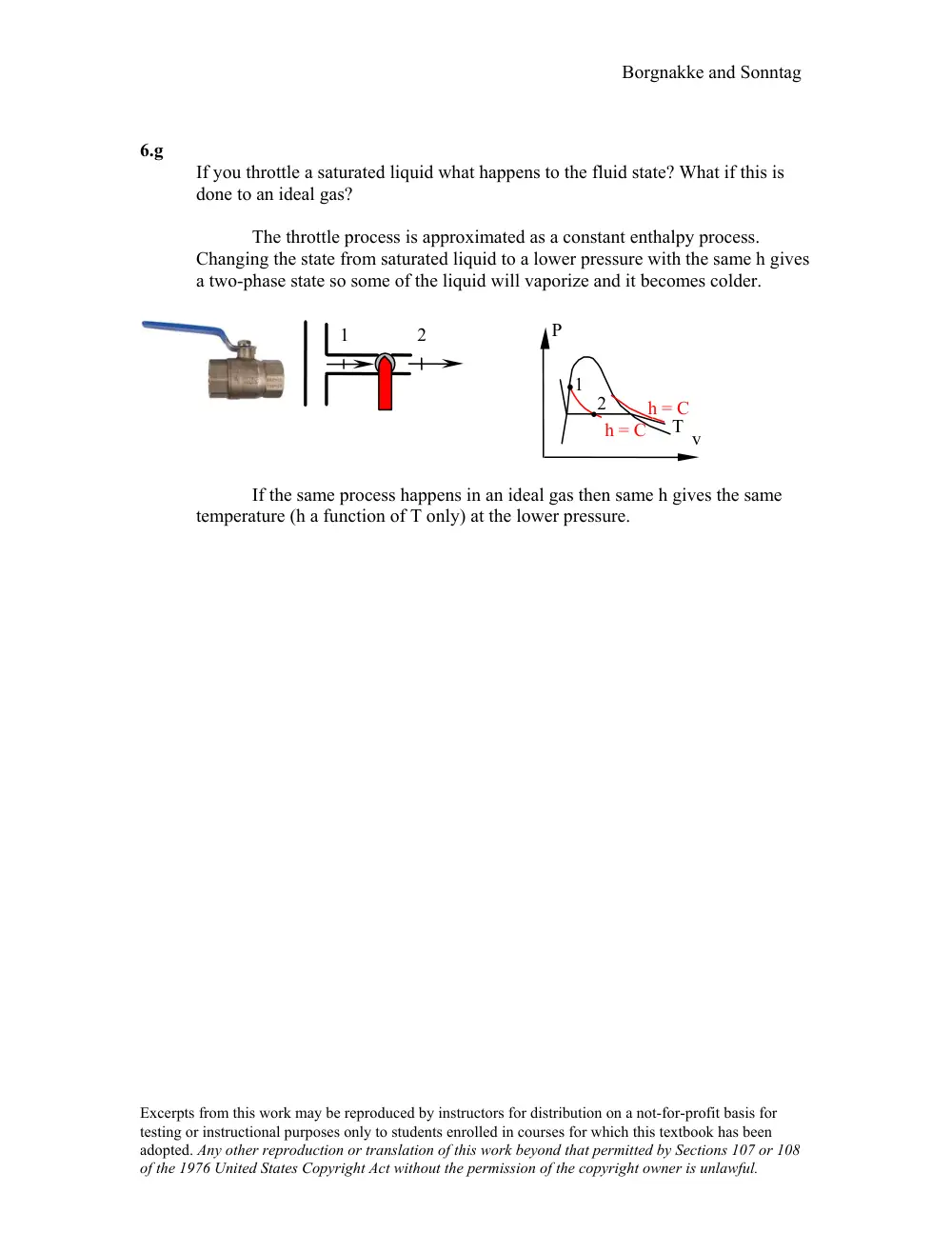
The throttle process is approximated as a constant enthalpy process.
Changing the state from saturated liquid to a lower pressure with the same h gives
a two-phase state so some of the liquid will vaporize and it becomes colder.
1
2
2
P
v
1
T
h = C
h = C
If the same process happens in an ideal gas then same h gives the same
temperature (h a function of T only) at the lower pressure.
Excerpts from this work may be reproduced by instructors for distribution on a not-for-profit basis for
testing or instructional purposes only to students enrolled in courses for which this textbook has been
adopted. Any other reproduction or translation of this work beyond that permitted by Sections 107 or 108
of the 1976 United States Copyright Act without the permission of the copyright owner is unlawful.
Borgnakke and Sonntag
6.h
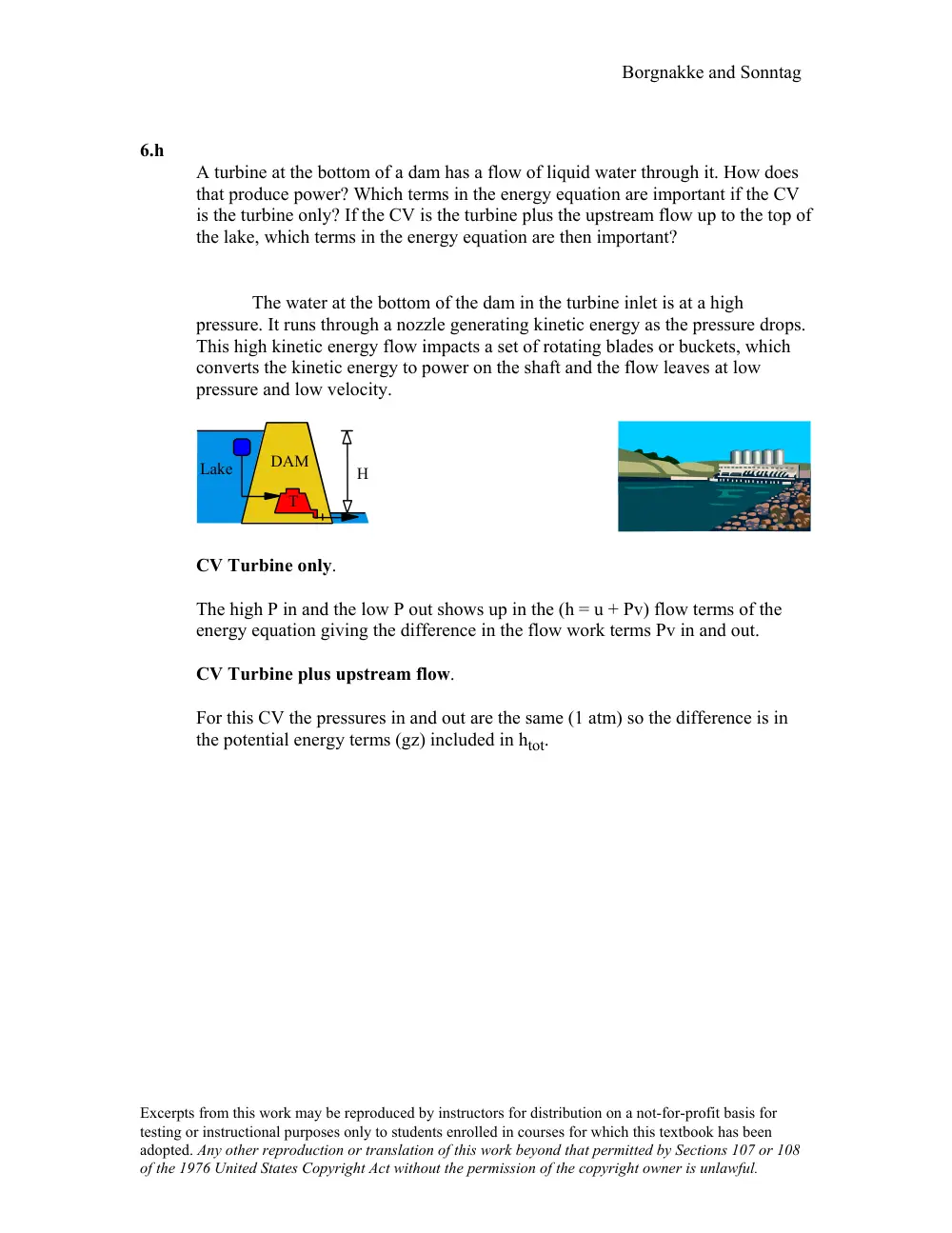
A turbine at the bottom of a dam has a flow of liquid water through it. How does
that produce power? Which terms in the energy equation are important if the CV
is the turbine only? If the CV is the turbine plus the upstream flow up to the top of
the lake, which terms in the energy equation are then important?
The water at the bottom of the dam in the turbine inlet is at a high
pressure. It runs through a nozzle generating kinetic energy as the pressure drops.
This high kinetic energy flow impacts a set of rotating blades or buckets, which
converts the kinetic energy to power on the shaft and the flow leaves at low
pressure and low velocity.
T
H
DAM
Lake
CV Turbine only.
The high P in and the low P out shows up in the (h = u + Pv) flow terms of the
energy equation giving the difference in the flow work terms Pv in and out.
CV Turbine plus upstream flow.
For this CV the pressures in and out are the same (1 atm) so the difference is in
the potential energy terms (gz) included in htot.
Excerpts from this work may be reproduced by instructors for distribution on a not-for-profit basis for
testing or instructional purposes only to students enrolled in courses for which this textbook has been
adopted. Any other reproduction or translation of this work beyond that permitted by Sections 107 or 108
of the 1976 United States Copyright Act without the permission of the copyright owner is unlawful.
Borgnakke and Sonntag
6.i
If you compress air the temperature goes up, why? When the hot air, high P flows
in long pipes it eventually cools to ambient T. How does that change the flow?
As the air is compressed, volume decreases so work is done on a mass
element, its energy and hence temperature goes up. If it flows at nearly
constant P and cools its density increases (v decreases) so it slows down
for same mass flow rate ( m
.
= ρAV ) and flow area.
Excerpts from this work may be reproduced by instructors for distribution on a not-for-profit basis for
testing or instructional purposes only to students enrolled in courses for which this textbook has been
adopted. Any other reproduction or translation of this work beyond that permitted by Sections 107 or 108
of the 1976 United States Copyright Act without the permission of the copyright owner is unlawful.
Borgnakke and Sonntag
6.j
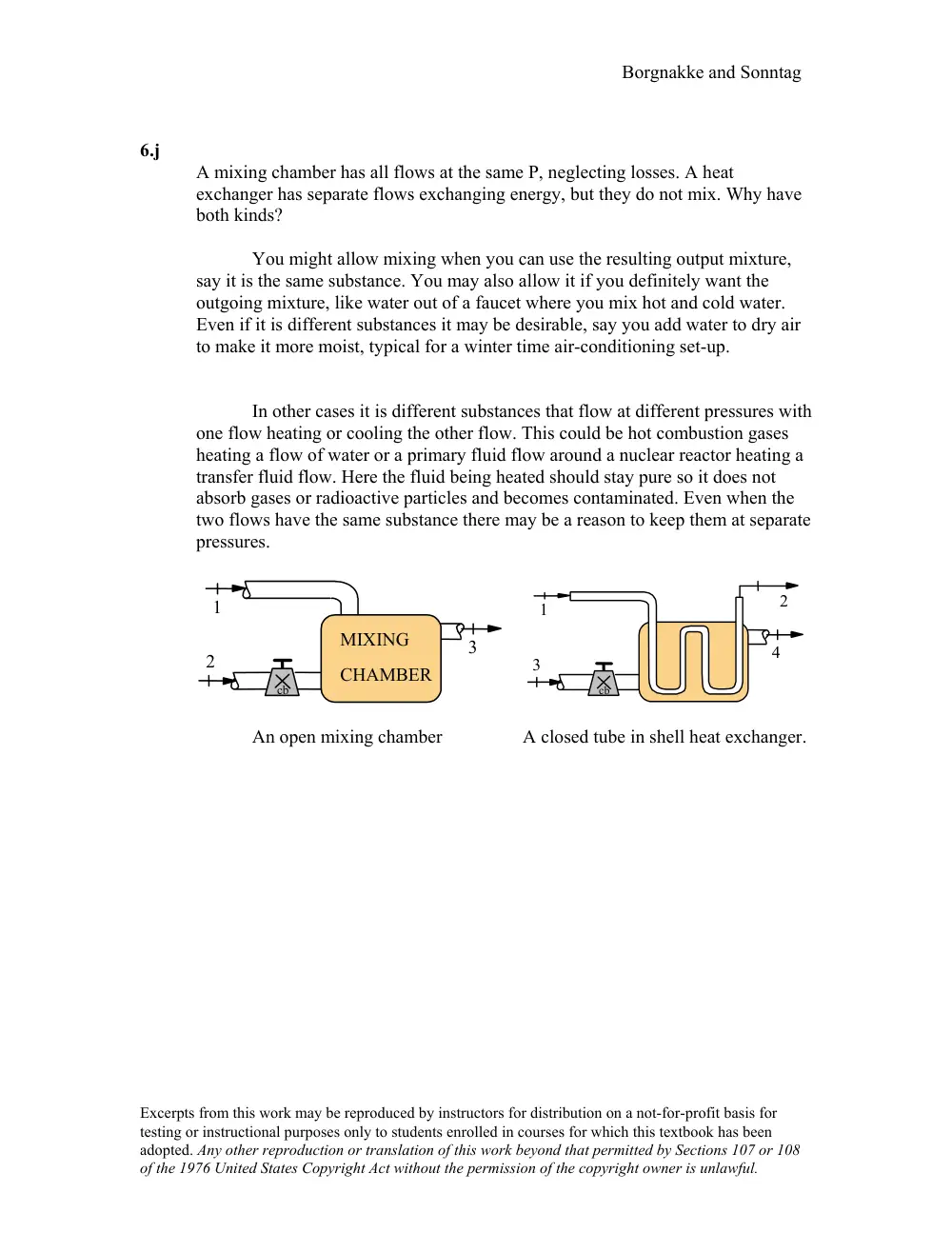
A mixing chamber has all flows at the same P, neglecting losses. A heat
exchanger has separate flows exchanging energy, but they do not mix. Why have
both kinds?
You might allow mixing when you can use the resulting output mixture,
say it is the same substance. You may also allow it if you definitely want the
outgoing mixture, like water out of a faucet where you mix hot and cold water.
Even if it is different substances it may be desirable, say you add water to dry air
to make it more moist, typical for a winter time air-conditioning set-up.
In other cases it is different substances that flow at different pressures with
one flow heating or cooling the other flow. This could be hot combustion gases
heating a flow of water or a primary fluid flow around a nuclear reactor heating a
transfer fluid flow. Here the fluid being heated should stay pure so it does not
absorb gases or radioactive particles and becomes contaminated. Even when the
two flows have the same substance there may be a reason to keep them at separate
pressures.
1
2
3
MIXING
CHAMBER
cb
1
2
3
cb
4
An open mixing chamber
A closed tube in shell heat exchanger.
Excerpts from this work may be reproduced by instructors for distribution on a not-for-profit basis for
testing or instructional purposes only to students enrolled in courses for which this textbook has been
adopted. Any other reproduction or translation of this work beyond that permitted by Sections 107 or 108
of the 1976 United States Copyright Act without the permission of the copyright owner is unlawful.
Borgnakke and Sonntag
6.k
An initially empty cylinder is filled with air from 20oC, 100 kPa until it is full.
Assuming no heat transfer is the final temperature larger, equal to or smaller than
20oC? Does the final T depend on the size of the cylinder?
This is a transient problem with no heat transfer and no work. The balance
equations for the tank as C.V. become
Continuity Eq.:
m2 – 0 = mi
Energy Eq.:
m2u2 – 0 = mihi + Q – W = mihi + 0 – 0
Final state:
u2 = hi = ui + Pivi
&
P2 = Pi
T2 > Ti and it does not depend on V
Excerpts from this work may be reproduced by instructors for distribution on a not-for-profit basis for
testing or instructional purposes only to students enrolled in courses for which this textbook has been
adopted. Any other reproduction or translation of this work beyond that permitted by Sections 107 or 108
of the 1976 United States Copyright Act without the permission of the copyright owner is unlawful.
Borgnakke and Sonntag
Concept-Study Guide Problems
Excerpts from this work may be reproduced by instructors for distribution on a not-for-profit basis for
testing or instructional purposes only to students enrolled in courses for which this textbook has been
adopted. Any other reproduction or translation of this work beyond that permitted by Sections 107 or 108
of the 1976 United States Copyright Act without the permission of the copyright owner is unlawful.
Borgnakke and Sonntag
6.1
A temperature difference drives a heat transfer. Does a similar concept apply to m. ?
Yes. A pressure difference drives the flow. The fluid is accelerated in the
direction of a lower pressure as it is being pushed harder behind it than in front of
it. This also means a higher pressure in front can decelerate the flow to a lower
velocity which happens at a stagnation on a wall.
F = P A
1
1
F = P A
2
2
Excerpts from this work may be reproduced by instructors for distribution on a not-for-profit basis for
testing or instructional purposes only to students enrolled in courses for which this textbook has been
adopted. Any other reproduction or translation of this work beyond that permitted by Sections 107 or 108
of the 1976 United States Copyright Act without the permission of the copyright owner is unlawful.
Borgnakke and Sonntag
6.2
What kind of effect can be felt upstream in a flow?
Only the pressure can be felt upstream in a subsonic flow. In a supersonic
flow no information can travel upstream. The temperature information travels by
conduction and even small velocities overpowers the conduction with the
convection of energy so the temperature at a given location is mainly given by the
upstream conditions and influenced very little by the downstream conditions.
6.3
Which one of the properties (P, v, T) can be controlled in a flow? How?
Since the flow is not contained there is no direct control over the volume
and thus no control of v. The pressure can be controlled by installation of a pump
or compressor if you want to increase it or use a turbine, nozzle or valve through
which the pressure will decrease. The temperature can be controlled by heating or
cooling the flow in a heat exchanger.
Excerpts from this work may be reproduced by instructors for distribution on a not-for-profit basis for
testing or instructional purposes only to students enrolled in courses for which this textbook has been
adopted. Any other reproduction or translation of this work beyond that permitted by Sections 107 or 108
of the 1976 United States Copyright Act without the permission of the copyright owner is unlawful.
Borgnakke and Sonntag
6.4
Air at 500 kPa is expanded to 100 kPa in two steady flow cases. Case one is a
nozzle and case two is a turbine, the exit state is the same for both cases. What
can you say about the specific turbine work relative to the specific kinetic energy
in the exit flow of the nozzle?
For these single flow devices let us assume they are adiabatic and that the turbine
does not have any exit kinetic energy then the energy equations become:
Energy Eq.6.13 nozzle:
h1+ 1
2 V2
1 + gZ1 = h2 + 1
2 V2
2 + gZ2
Energy Eq.6.13 turbine: h1+ 1
2 V2
1 + gZ1 = h2 + gZ2 + wT
Comparing the two we get 1
2 V2
2 = wT so the result is that the nozzle delivers
kinetic energy of the same amount as the turbine delivers shaft work.
Excerpts from this work may be reproduced by instructors for distribution on a not-for-profit basis for
testing or instructional purposes only to students enrolled in courses for which this textbook has been
adopted. Any other reproduction or translation of this work beyond that permitted by Sections 107 or 108
of the 1976 United States Copyright Act without the permission of the copyright owner is unlawful.
Borgnakke and Sonntag
6.5
Pipes that carry a hot fluid like steam in a power plant, exhaust pipe for a diesel
engine in a ship etc. are often insulated. Is that to reduce the heat loss or is there
another purpose?
You definitely want to insulate pipes that carry hot steam from the boiler to the
turbines in a power plant and pipes that flows hot water from one location to
another. Even if the energy in the flow is unwanted the pipes should be insulated
for safety. Any place that people could touch a hot surface there is a risk of a burn
and that should be avoided.
Pipes for district heating with hot water.
Excerpts from this work may be reproduced by instructors for distribution on a not-for-profit basis for
testing or instructional purposes only to students enrolled in courses for which this textbook has been
adopted. Any other reproduction or translation of this work beyond that permitted by Sections 107 or 108
of the 1976 United States Copyright Act without the permission of the copyright owner is unlawful.
Borgnakke and Sonntag
6.6
A windmill takes a fraction of the wind kinetic energy out as power on a shaft. In
what manner does the temperature and wind velocity influence the power? Hint:
write the power as mass flow rate times specific work.
The work as a fraction f of the flow of kinetic energy becomes
W
.
= m
.
w = m
.
f 1
2 V2
in = ρAVin f 1
2 V2
in
so the power is proportional to the velocity cubed. The temperature enters through
the density, so assuming air as ideal gas
ρ = 1/v = P/RT
and the power is inversely proportional to temperature.
A windmill farm west of Denmark in the North Sea.
Excerpts from this work may be reproduced by instructors for distribution on a not-for-profit basis for
testing or instructional purposes only to students enrolled in courses for which this textbook has been
adopted. Any other reproduction or translation of this work beyond that permitted by Sections 107 or 108
of the 1976 United States Copyright Act without the permission of the copyright owner is unlawful.
Borgnakke and Sonntag
6.7
An underwater turbine extracts a fraction of the kinetic energy from the ocean
current. In what manner does the temperature and water velocity influence the
power? Hint: write the power as mass flow rate times specific work.
The work as a fraction f of the flow of kinetic energy becomes
W
.
= m
.
w = m
.
f 1
2 V2
in = ρAVin f 1
2 V2
in
so the power is proportional to the velocity cubed. The temperature enters through
the density, so assuming water is incompressible density is constant and the
power does not vary with the temperature.
A proposed underwater tidal flow turbine farm. Each turbine is for 1 MW with a
diameter of 11.5 m mounted on the seafloor.
Excerpts from this work may be reproduced by instructors for distribution on a not-for-profit basis for
testing or instructional purposes only to students enrolled in courses for which this textbook has been
adopted. Any other reproduction or translation of this work beyond that permitted by Sections 107 or 108
of the 1976 United States Copyright Act without the permission of the copyright owner is unlawful.
Borgnakke and Sonntag
6.8
A liquid water turbine in the bottom of a dam takes energy out as power on a
shaft. Which term(s) in the energy equation are changing and important?
The water at the bottom of the dam in the turbine inlet is at a high
pressure. In a standard turbine it runs through blade passages like a propeller
shown below to the left. In this case the inlet high pressure is used directly to
generate the force on the moving blades.
For the Pelton turbine shown below it runs through a nozzle generating
kinetic energy as the pressure drops. The high kinetic energy flow impacts a set of
rotating blades or buckets and converts the kinetic energy to power on the shaft so
the flow leaves at low pressure and low velocity.
A Pelton turbine above and insert on left.
A blade type turbine to the left. The
pressure drop and flow rate determine
which one is best for the given case.
Excerpts from this work may be reproduced by instructors for distribution on a not-for-profit basis for
testing or instructional purposes only to students enrolled in courses for which this textbook has been
adopted. Any other reproduction or translation of this work beyond that permitted by Sections 107 or 108
of the 1976 United States Copyright Act without the permission of the copyright owner is unlawful.
Borgnakke and Sonntag
6.9
You blow a balloon up with air. What kind of work terms including flow work do
you see in that case? Where is the energy stored?
As the balloon is blown up mass flow in has flow work associated with it. Also as
the balloon grows there is a boundary work done by the inside gas and a smaller
boundary work from the outside of the balloon to the atmosphere. The difference
between the latter two work terms goes into stretching the balloon material and
thus becomes internal energy (or you may call that potential energy) of the
balloon material. The work term to the atmosphere is stored in the atmosphere
and the part of the flow work that stays in the gas is stored as the gas internal
energy.
Excerpts from this work may be reproduced by instructors for distribution on a not-for-profit basis for
testing or instructional purposes only to students enrolled in courses for which this textbook has been
adopted. Any other reproduction or translation of this work beyond that permitted by Sections 107 or 108
of the 1976 United States Copyright Act without the permission of the copyright owner is unlawful.
Borgnakke and Sonntag
6.10
A storage tank for natural gas (NG) has a top dome that can move up or down as
gas is added or subtracted from the tank maintaining 110 kPa, 290 K inside. A
pipeline at 110 kPa, 290 K now supplies some NG to the tank. Does it change
state during the filling process? What happens to the flow work?
As the pressure inside the storage tank is the same as in the pipeline the state does
not change. However the tank volume goes up and work is done on the moving
boundary at the 110 kPa so this work equals the flow work. The net effect is the
flow work goes into raising the dome.
Excerpts from this work may be reproduced by instructors for distribution on a not-for-profit basis for
testing or instructional purposes only to students enrolled in courses for which this textbook has been
adopted. Any other reproduction or translation of this work beyond that permitted by Sections 107 or 108
of the 1976 United States Copyright Act without the permission of the copyright owner is unlawful.
Borgnakke and Sonntag
Continuity equation and flow rates
Excerpts from this work may be reproduced by instructors for distribution on a not-for-profit basis for
testing or instructional purposes only to students enrolled in courses for which this textbook has been
adopted. Any other reproduction or translation of this work beyond that permitted by Sections 107 or 108
of the 1976 United States Copyright Act without the permission of the copyright owner is unlawful.
Borgnakke and Sonntag
6.11
Carbon dioxide at 200 kPa, 10oC flows at 1 kg/s in a 0.25 m2 cross sectional area
pipe. Find the velocity and the volume flow rate.
m
.
= AV/v = V
.
/v
v = RT/P = 0.1889 kJ/kg-K × 283.15 K/ 200 kPa = 0.267 m3/kg
V
.
= v m
.
= 0.267 × 1 = 0.267 m3/s
V = V
.
/ A = 0.267 (m3/s) / 0.25 m2 = 1.07 m/s
Excerpts from this work may be reproduced by instructors for distribution on a not-for-profit basis for
testing or instructional purposes only to students enrolled in courses for which this textbook has been
adopted. Any other reproduction or translation of this work beyond that permitted by Sections 107 or 108
of the 1976 United States Copyright Act without the permission of the copyright owner is unlawful.
Borgnakke and Sonntag
6.12
Air at 35°C, 105 kPa, flows in a 100 mm × 150 mm rectangular duct in a heating
system. The volumetric flow rate is 0.015 m3/s. What is the velocity of the air
flowing in the duct and what is the mass flow rate?
Solution:
Assume a constant velocity across the duct area with
A = 100 × 150 ×10-6 m2 = 0.015 m2
and the volumetric flow rate from Eq.6.3,
V
.
= m
.
v = AV
V = V
.
A = 0.015 m3/s
0.015 m2 = 1.0 m/s
Ideal gas so note:
v = RT
P = 0.287 × 308.2
105
= 0.8424 m3/kg
m
.
= V
.
v = 0.015
0.8424 = 0.0178 kg/s
Excerpts from this work may be reproduced by instructors for distribution on a not-for-profit basis for
testing or instructional purposes only to students enrolled in courses for which this textbook has been
adopted. Any other reproduction or translation of this work beyond that permitted by Sections 107 or 108
of the 1976 United States Copyright Act without the permission of the copyright owner is unlawful.
Borgnakke and Sonntag
6.13
An empty bathtub has its drain closed and is being filled with water from the
faucet at a rate of 10 kg/min. After 10 minutes the drain is opened and 4 kg/min
flows out and at the same time the inlet flow is reduced to 2 kg/min. Plot the mass
of the water in the bathtub versus time and determine the time from the very
beginning when the tub will be empty.
Solution:
During the first 10 minutes we have
dmcv
dt = m
.
i = 10 kg/min ,
∆m = m
.
∆t1 = 10 × 10 = 100 kg
So we end up with 100 kg after 10 min. For the remaining period we have
dmcv
dt = m
.
i - m
.
e= 2 – 4 = -2 kg/min
∆m2 = m
.
net ∆t2 � ∆t2 = ∆m
m
.
net
= -100/-2 = 50 min.
So it will take an additional 50 min. to empty
∆ttot = ∆t1 + ∆t2 = 10 + 50 = 60 min.
10
10
20
100
m
-2
0
10
0
0
t
min
0
m.
t
min
kg
Excerpts from this work may be reproduced by instructors for distribution on a not-for-profit basis for
testing or instructional purposes only to students enrolled in courses for which this textbook has been
adopted. Any other reproduction or translation of this work beyond that permitted by Sections 107 or 108
of the 1976 United States Copyright Act without the permission of the copyright owner is unlawful.
Borgnakke and Sonntag
6.14
Saturated vapor R-134a leaves the evaporator in a heat pump system at 10°C,
with a steady mass flow rate of 0.1 kg/s. What is the smallest diameter tubing that
can be used at this location if the velocity of the refrigerant is not to exceed 7
m/s?
Solution:
Mass flow rate Eq.6.3:
m
.
= V
.
/v = AV/v
Exit state Table B.5.1: (T = 10°C, x =1) => v = vg = 0.04945 m3/kg
The minimum area is associated with the maximum velocity for given m
.
AMIN =
m
.
vg
VMAX = 0.1 kg/s × 0.04945 m3/kg
7 m/s
= 0.000706 m2 = π
4 D2
MIN
DMIN = 0.03 m = 30 mm
cb
Exit
Excerpts from this work may be reproduced by instructors for distribution on a not-for-profit basis for
testing or instructional purposes only to students enrolled in courses for which this textbook has been
adopted. Any other reproduction or translation of this work beyond that permitted by Sections 107 or 108
of the 1976 United States Copyright Act without the permission of the copyright owner is unlawful.
Borgnakke and Sonntag
6.15
A boiler receives a constant flow of 5000 kg/h liquid water at 5 MPa, 20°C and it
heats the flow such that the exit state is 450°C with a pressure of 4.5 MPa.
Determine the necessary minimum pipe flow area in both the inlet and exit pipe(s)
if there should be no velocities larger than 20 m/s.
Solution:
Mass flow rate from Eq.6.3, both V ≤ 20 m/s
m
.
i = m
.
e = (AV/v) i = (AV/v) e = 5000 1
3600 kg/s
Table B.1.4
vi = 0.001 m3/kg,
Table B.1.3
ve = (0.08003 + 0.00633)/2 = 0.07166 m3/kg,
Ai ≥ vi m
.
/Vi = 0.001× 5000
3600 / 20 = 6.94 × 10⁻⁵ m2 = 0.69 cm2
Ae ≥ ve m
.
/Ve = 0.07166 × 5000
3600 / 20 = 4.98 × 10⁻³ m2 = 50 cm2
Inlet
liquid
i
e
Q
Q
boiler
Super
heater
vapor
cb
Exit
Superheated vapor
Excerpts from this work may be reproduced by instructors for distribution on a not-for-profit basis for
testing or instructional purposes only to students enrolled in courses for which this textbook has been
adopted. Any other reproduction or translation of this work beyond that permitted by Sections 107 or 108
of the 1976 United States Copyright Act without the permission of the copyright owner is unlawful.
Borgnakke and Sonntag
6.16
A hot air home heating system takes 0.25 m3/s air at 100 kPa, 17oC into a furnace
and heats it to 52oC and delivers the flow to a square duct 0.2 m by 0.2 m at 110
kPa. What is the velocity in the duct?
Solution:
The inflate flow is given by a m
.
i
Continuity Eq.: m
.
i = V
.
i / vi = m
.
e = AeVe/ve
Ideal gas: vi =
RTi
Pi = 0.287 × 290
100
= 0.8323 m3
kg
ve =
RTe
Pe = 0.287 × (52 + 273)
110
= 0.8479 m3/ kg
m
.
i = V
.
i/vi = 0.25/0.8323 = 0.30 kg/s
Ve = m
.
ve/ Ae = 0.3 × 0.8479
0.2 × 0.2 m3/s
m2 = 6.36 m/s
Excerpts from this work may be reproduced by instructors for distribution on a not-for-profit basis for
testing or instructional purposes only to students enrolled in courses for which this textbook has been
adopted. Any other reproduction or translation of this work beyond that permitted by Sections 107 or 108
of the 1976 United States Copyright Act without the permission of the copyright owner is unlawful.
Borgnakke and Sonntag
6.17
A flat channel of depth 1 m has a fully developed laminar flow of air at Po, To
with a velocity profile as: V = 4Vc (1 – x/H)x/H, where Vc is the velocity on the
center-line and x is the distance across the channel as shown in Fig. P6.17. Find
the total mass flow rate and the average velocity both as functions of Vc and H.
m
.
= AV/v = V
.
/v
Since the velocity is distributed we need to integrate over the area. From Eq.6.2
V
.
= ⌡⌠ Vlocal dA = ⌡⌠ V(x) W dx
where W is the depth. Substituting the velocity we get
V
.
= ⌡⌠ 4Vc (x/H) (1 - x/H) W dx
= 4 Vc WH ⌡⌠
0
1
z (1 - z) dz
(z = x/H)
= 4 Vc WH (1
2 z2 - 1
3 z3 | 1
0 = 2
3 Vc WH = 2
3 Vc A
V = V
.
/A = 2
3 Vc
m
.
= V
.
/v = 2
3 Vc WH/v
Excerpts from this work may be reproduced by instructors for distribution on a not-for-profit basis for
testing or instructional purposes only to students enrolled in courses for which this textbook has been
adopted. Any other reproduction or translation of this work beyond that permitted by Sections 107 or 108
of the 1976 United States Copyright Act without the permission of the copyright owner is unlawful.
Borgnakke and Sonntag
6.18
Nitrogen gas flowing in a 50-mm diameter pipe at 15°C, 200 kPa, at the rate of
0.05 kg/s, encounters a partially closed valve. If there is a pressure drop of 30 kPa
across the valve and essentially no temperature change, what are the velocities
upstream and downstream of the valve?
Solution:
Same inlet and exit area:
A = π
4 (0.050)2 = 0.001963 m2
Ideal gas: vi =
RTi
Pi = 0.2968 × 288.2
200
= 0.4277 m3/kg
From Eq.6.3,
Vi =
m
.
vi
A = 0.05 × 0.4277
0.001963
= 10.9 m/s
Ideal gas: ve =
RTe
Pe = 0.2968 × 288.2
170
= 0.5032 m3/kg
Ve =
m
.
ve
A = 0.05 × 0.5032
0.001963
= 12.8 m/s
E