
MECH 310 Problems Solution Manual Chapter 7, Fall 2011
American University of Beirut · Thermodynamics I · 129 pages · with solution

Showing the first 10 of 129 pages. Download the PDF to see all of it.
More MECH 310 files
- Essay Chapter 3 · Fall 2017ChapterView
- Problems Solution Manual Chapter 9 · Fall 2011Chapter · with solutionView
- Problems Chapter 5 Solutions · Fall 2011Chapter · with solutionView
- Problems Chapter 8 Solutions · Fall 2011Chapter · with solutionView
- Problems Chapter 9 Extra Problems · Fall 2011ChapterView
- Problems Chapter 6 Solutions · Fall 2011Chapter · with solutionView
- Problems Chapter 3 Solutions · Fall 2011Chapter · with solutionView
- Problems Chapter 4 Solutions · Fall 2011Chapter · with solutionView
Show the text of this chapter
SOLUTION MANUAL
CHAPTER 7
Borgnakke and Sonntag
CONTENT CHAPTER 7
SUBSECTION
PROB NO.
In-Text concept questions
a-g
Concept problems
1-14
Heat engines and refrigerators
15-36
Second law and processes
37-43
Carnot cycles and absolute temperature
44-77
Finite ∆T heat transfer
78-91
Ideal gas Carnot cycles
92-95
review problems
96-113
Excerpts from this work may be reproduced by instructors for distribution on a not-for-profit basis for
testing or instructional purposes only to students enrolled in courses for which this textbook has been
adopted. Any other reproduction or translation of this work beyond that permitted by Sections 107 or 108
of the 1976 United States Copyright Act without the permission of the copyright owner is unlawful.
Borgnakke and Sonntag
In-Text Concept Questions
Excerpts from this work may be reproduced by instructors for distribution on a not-for-profit basis for
testing or instructional purposes only to students enrolled in courses for which this textbook has been
adopted. Any other reproduction or translation of this work beyond that permitted by Sections 107 or 108
of the 1976 United States Copyright Act without the permission of the copyright owner is unlawful.
Borgnakke and Sonntag
7.a
Electrical appliances (TV, stereo) use electric power as input. What happens to
the power? Are those heat engines? What does the second law say about those
devices?
Most electric appliances such as TV, VCR, stereo and clocks dissipate
power in electrical circuits into internal energy (they get warm) some power goes
into light and some power into mechanical energy. The light is absorbed by the
room walls, furniture etc. and the mechanical energy is dissipated by friction so
all the power eventually ends up as internal energy in the room mass of air and
other substances.
These are not heat engines, just the opposite happens, namely electrical
power is turned into internal energy and redistributed by heat transfer. These are
irreversible processes.
Excerpts from this work may be reproduced by instructors for distribution on a not-for-profit basis for
testing or instructional purposes only to students enrolled in courses for which this textbook has been
adopted. Any other reproduction or translation of this work beyond that permitted by Sections 107 or 108
of the 1976 United States Copyright Act without the permission of the copyright owner is unlawful.
Borgnakke and Sonntag
7.b
Geothermal underground hot water or steam can be used to generate electric
power. Does that violate the second law?
No.
Since the earth is not uniform we consider the hot water or steam supply
as coming from one energy source (the high T) and we must reject heat to
a low temperature reservoir as the ocean, a lake or the atmosphere which
is another energy reservoir.
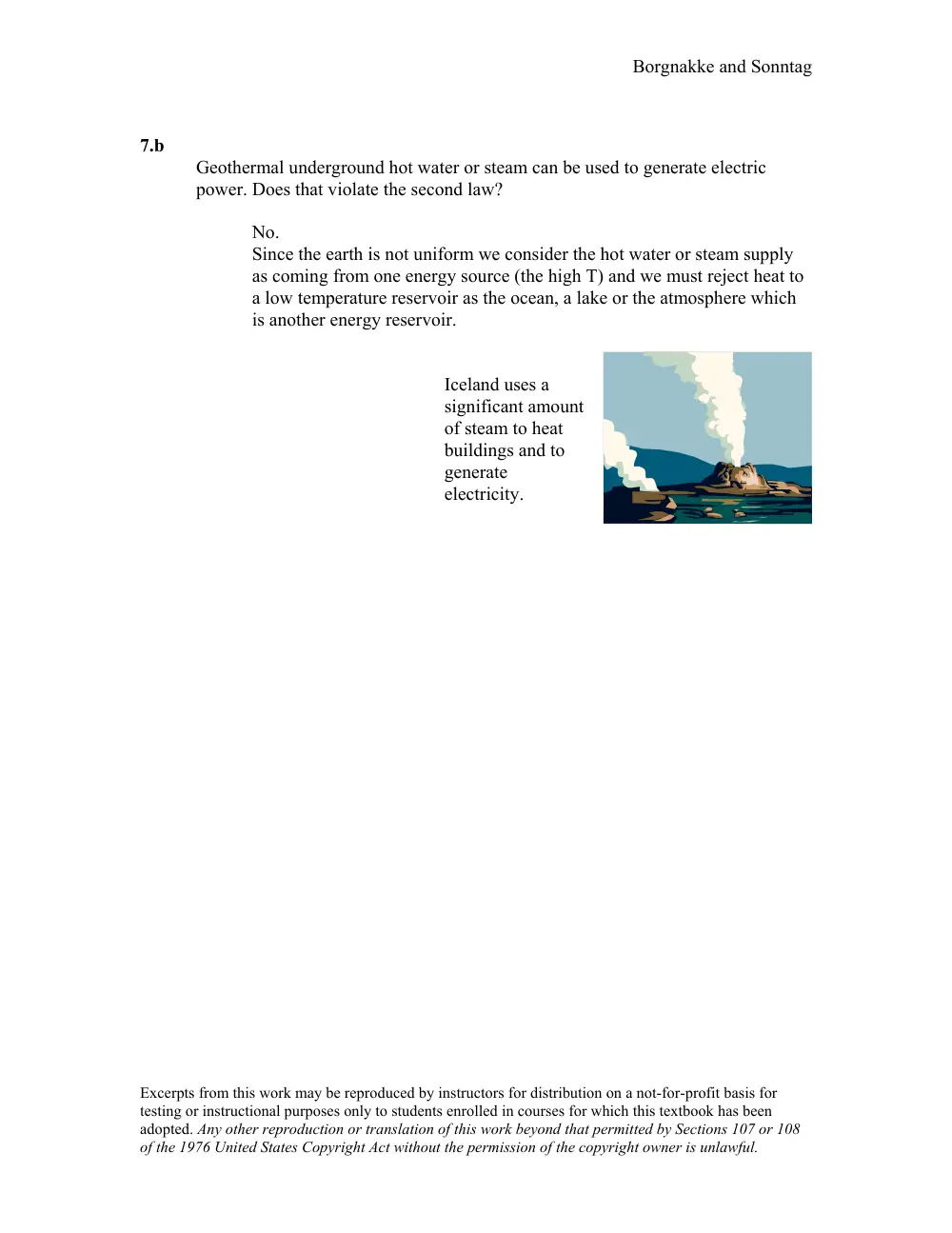
Iceland uses a
significant amount
of steam to heat
buildings and to
generate
electricity.
Excerpts from this work may be reproduced by instructors for distribution on a not-for-profit basis for
testing or instructional purposes only to students enrolled in courses for which this textbook has been
adopted. Any other reproduction or translation of this work beyond that permitted by Sections 107 or 108
of the 1976 United States Copyright Act without the permission of the copyright owner is unlawful.
Borgnakke and Sonntag
7.c
A windmill produces power on a shaft taking kinetic energy out of the wind. Is it
a heat engine? Is it a perpetual machine? Explain.
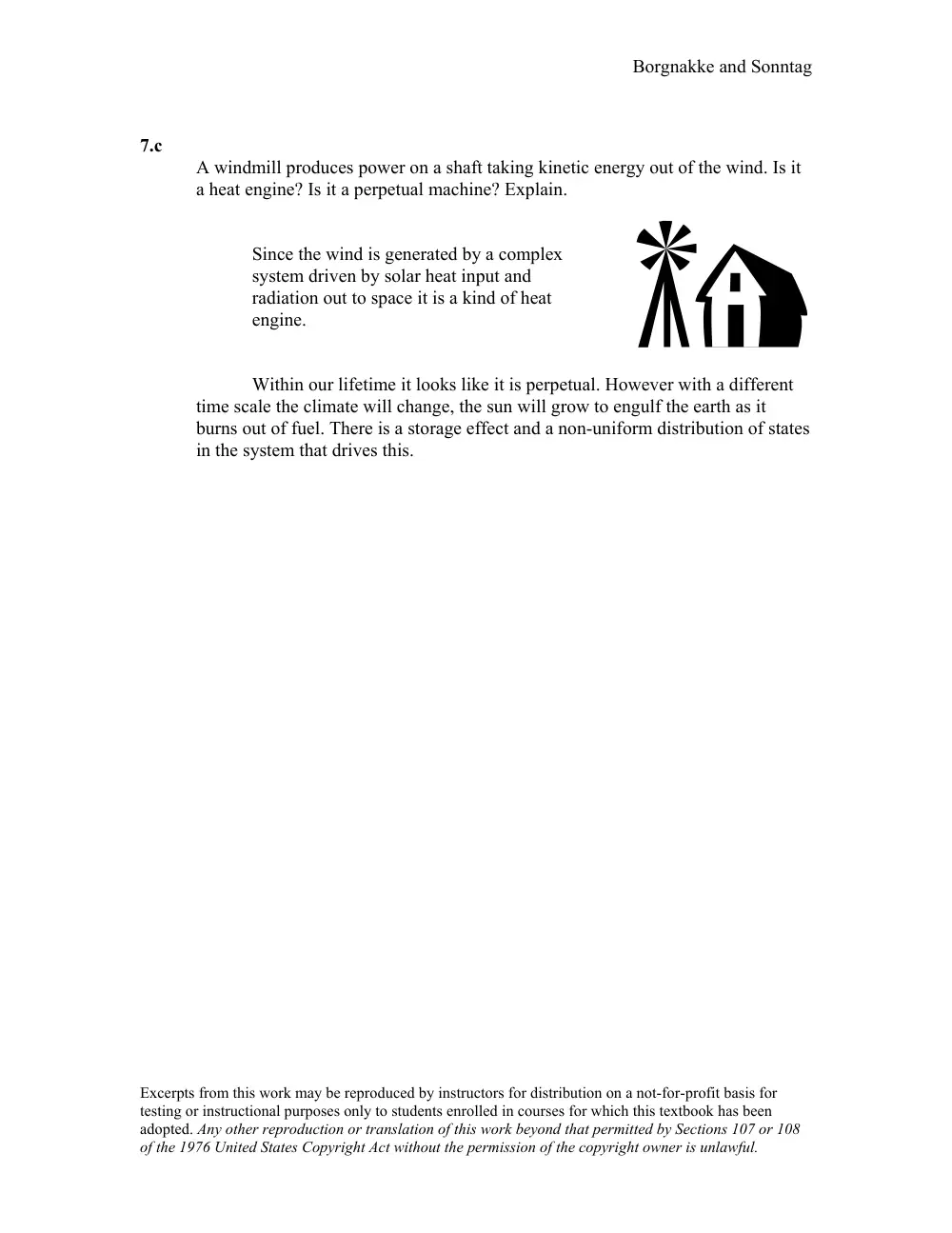
Since the wind is generated by a complex
system driven by solar heat input and
radiation out to space it is a kind of heat
engine.
Within our lifetime it looks like it is perpetual. However with a different
time scale the climate will change, the sun will grow to engulf the earth as it
burns out of fuel. There is a storage effect and a non-uniform distribution of states
in the system that drives this.
Excerpts from this work may be reproduced by instructors for distribution on a not-for-profit basis for
testing or instructional purposes only to students enrolled in courses for which this textbook has been
adopted. Any other reproduction or translation of this work beyond that permitted by Sections 107 or 108
of the 1976 United States Copyright Act without the permission of the copyright owner is unlawful.
Borgnakke and Sonntag
7.d
heat engines and heat pumps (refrigerators) are energy conversion devices
altering amounts of energy transfer between Q and W. Which conversion
direction (Q → W or W → Q) is limited and which is unlimited according to the
second law.
The work output of a heat engine is limited (Q to W).
You can transform W to Q unlimited (a heat pump that does not work well
or you may think about heat generated by friction).
7.e
Ice cubes in a glass of liquid water will eventually melt and all the water approach
room temperature. Is this a reversible process? Why?
There is heat transfer from the warmer ambient
to the water as long as there is a temperature
difference. Eventually the temperatures
approach each other and there is no more heat
transfer. This is irreversible, as we cannot
make ice-cubes out of the water unless we run
a refrigerator and that requires a work from the
surroundings, which does not leave the
surroundings unchanged.
Excerpts from this work may be reproduced by instructors for distribution on a not-for-profit basis for
testing or instructional purposes only to students enrolled in courses for which this textbook has been
adopted. Any other reproduction or translation of this work beyond that permitted by Sections 107 or 108
of the 1976 United States Copyright Act without the permission of the copyright owner is unlawful.
Borgnakke and Sonntag
7.f
Does a process become more or less reversible with respect to heat transfer if it is
fast rather than slow? Hint: Recall from Chapter 4 that Q
.
= CA ∆T.
If the higher heat transfer rate is caused by a larger ∆T then the process is more
irreversible so as the process would be slower due to a lower ∆T then it
approaches a reversible process. If the rate of heat transfer is altered due to the
factor CA with the same ∆T then it is irreversible to the same degree.
Excerpts from this work may be reproduced by instructors for distribution on a not-for-profit basis for
testing or instructional purposes only to students enrolled in courses for which this textbook has been
adopted. Any other reproduction or translation of this work beyond that permitted by Sections 107 or 108
of the 1976 United States Copyright Act without the permission of the copyright owner is unlawful.
Borgnakke and Sonntag
7.g
If you generated hydrogen from, say, solar power, which of these would be more
efficient: (1) transport it and then burn it in an engine or (2) convert the solar
power to electricity and transport that? What else would you need to know in
order to give a definite answer?
Case (1):
First there is a certain efficiency when converting solar power to hydrogen. Then
the transport and packaging of hydrogen has some energy expenditures associated
with it. The hydrogen could be compressed to a high pressure (typically 70 MPa)
which is expensive in terms of work input and then stored in a tank. One
alternative would be to cool it down to become a liquid to have a much smaller
volume but the temperature at which this happens is very low so the cooling and
continued cooling under transport requires a significant work input also. Certain
materials like metal-hydrides, boron salt slurries and nano-carbon fibers allows
storage of hydrogen at more modest pressures and are all currently under
investigation as other alternative storage methods. After the hydrogen is
transported to an engine then the engine efficiency determines the work output.
Case (2):
If the solar power is located where there is access to electrical transmission lines
then it can be used in solar panels, solar heating of water or other substance to run
a heat engine cycle like a power plant to generate electricity. To make new
transmission lines is costly and has an impact on the environment that must be
considered.
You also need to look at the time of day/year at which the power is required and
when it is available. The end use also presents some limitations like if the power
should be used for a car then the energy must be stored temporarily like in a
battery.
Excerpts from this work may be reproduced by instructors for distribution on a not-for-profit basis for
testing or instructional purposes only to students enrolled in courses for which this textbook has been
adopted. Any other reproduction or translation of this work beyond that permitted by Sections 107 or 108
of the 1976 United States Copyright Act without the permission of the copyright owner is unlawful.
Borgnakke and Sonntag
Concept Problems
Excerpts from this work may be reproduced by instructors for distribution on a not-for-profit basis for
testing or instructional purposes only to students enrolled in courses for which this textbook has been
adopted. Any other reproduction or translation of this work beyond that permitted by Sections 107 or 108
of the 1976 United States Copyright Act without the permission of the copyright owner is unlawful.
Borgnakke and Sonntag
7.1
Two heat engines operate between the same two energy reservoirs and both
receives the same QH. One engine is reversible and the other is not. What can you
say about the two QL’s?
The reversible heat engine can produce more work (has a higher efficiency) than
the irreversible heat engine and due to the energy conservation it then gives out a
smaller QL compared to the irreversible heat engine.
Wrev = QH - QL rev
>
Wirrev = QH - QL irrev
�
QL rev < QL irrev
Excerpts from this work may be reproduced by instructors for distribution on a not-for-profit basis for
testing or instructional purposes only to students enrolled in courses for which this textbook has been
adopted. Any other reproduction or translation of this work beyond that permitted by Sections 107 or 108
of the 1976 United States Copyright Act without the permission of the copyright owner is unlawful.
Borgnakke and Sonntag
7.2
Compare two domestic heat pumps (A and B) running with the same work input.
If A is better than B which one heats the house most?
The statement that A is better means it has a higher COP and since
QH A = COPA W > QH B = COPB W
it can thus provide more heat to the house. The higher heat comes from the higher
QL it is able to draw in.
Excerpts from this work may be reproduced by instructors for distribution on a not-for-profit basis for
testing or instructional purposes only to students enrolled in courses for which this textbook has been
adopted. Any other reproduction or translation of this work beyond that permitted by Sections 107 or 108
of the 1976 United States Copyright Act without the permission of the copyright owner is unlawful.
Borgnakke and Sonntag
7.3
Suppose we forget the model for heat transfer as Q
.
= CA ∆T, can we draw some
information about direction of Q from the second law?
One of the classical statements of the second law is the Clausius statement saying
that you cannot have heat transfer from a lower temperature domain to a higher
temperature domain without work input.
The opposite, namely a transfer of heat from a high temperature domain towards a
lower temperature domain can happen (which is a heat engine with zero
efficiency).
Excerpts from this work may be reproduced by instructors for distribution on a not-for-profit basis for
testing or instructional purposes only to students enrolled in courses for which this textbook has been
adopted. Any other reproduction or translation of this work beyond that permitted by Sections 107 or 108
of the 1976 United States Copyright Act without the permission of the copyright owner is unlawful.
Borgnakke and Sonntag
7.4
A combination of two heat engines is shown in Fig. P7.4. Find the overall thermal
efficiency as a function of the two individual efficiencies.
The overall efficiency
ηTH = W
.
net / Q
.
H = (W
.
1 + W
.
2) / Q
.
H = η1 + W
.
2 / Q
.
H
For the second heat engine and the energy Eq. for the first heat engine
W
.
2 = η2 Q
.
M = η2 (1 – η1) Q
.
H
so the final result is
ηTH = η1 + η2 (1 – η1)
Excerpts from this work may be reproduced by instructors for distribution on a not-for-profit basis for
testing or instructional purposes only to students enrolled in courses for which this textbook has been
adopted. Any other reproduction or translation of this work beyond that permitted by Sections 107 or 108
of the 1976 United States Copyright Act without the permission of the copyright owner is unlawful.
Borgnakke and Sonntag
7.5
Compare two heat engines receiving the same Q, one at 1200 K and the other at
1800 K; they both reject heat at 500 K. Which one is better?
The maximum efficiency for the engines are given by the Carnot heat
engine efficiency as
ηTH = W
.
net / Q
.
H = 1 –
TL
TH
Since they have the same low temperature the one with the highest TH will have a
higher efficiency and thus presumably better.
Excerpts from this work may be reproduced by instructors for distribution on a not-for-profit basis for
testing or instructional purposes only to students enrolled in courses for which this textbook has been
adopted. Any other reproduction or translation of this work beyond that permitted by Sections 107 or 108
of the 1976 United States Copyright Act without the permission of the copyright owner is unlawful.
Borgnakke and Sonntag
7.6
A car engine takes atmospheric air in at 20oC, no fuel, and exhausts the air at –
20oC producing work in the process. What do the first and the second laws say
about that?
Energy Eq.: W = QH − QL = change in energy of air. OK
2nd law: Exchange energy with only one reservoir. NOT OK.
This is a violation of the statement of Kelvin-Planck.
Remark: You cannot create and maintain your own energy reservoir.
Excerpts from this work may be reproduced by instructors for distribution on a not-for-profit basis for
testing or instructional purposes only to students enrolled in courses for which this textbook has been
adopted. Any other reproduction or translation of this work beyond that permitted by Sections 107 or 108
of the 1976 United States Copyright Act without the permission of the copyright owner is unlawful.
Borgnakke and Sonntag
7.7
A combination of two refrigerator cycles is shown in Fig. P7.7. Find the overall
COP as a function of COP1 and COP2.
The overall COP becomes
COP = β =
Q
.
L
W
.
tot
=
Q
.
L
W
.
1
W
.
1
W
.
tot
= COP1
W
.
1
W
.
tot
= COP1
1
1 + W
.
2/W
.
1
where we used W
.
tot = W
.
1 + W
.
2. Use definition of COP2 and energy equation for
refrigerator 1 to eliminate Q
.
M and we have
W
.
2 = Q
.
M / COP2 = (W
.
1 + Q
.
L) / COP2
so then
W
.
2 / W
.
1 = (1 + Q
.
L/W
.
1) / COP2 = (1 + COP1) / COP2
Finally substitute into the first equation and rearrange a little to get
COP = β =
COP1 COP2
COP1 + COP2 + 1
Excerpts from this work may be reproduced by instructors for distribution on a not-for-profit basis for
testing or instructional purposes only to students enrolled in courses for which this textbook has been
adopted. Any other reproduction or translation of this work beyond that permitted by Sections 107 or 108
of the 1976 United States Copyright Act without the permission of the copyright owner is unlawful.
Borgnakke and Sonntag
7.8
After you have returned from a car trip the car engine has cooled down and is thus
back to the state in which it started. What happened to all the energy released in
the burning of the gasoline? What happened to all the work the engine gave out?
Solution:
All the energy from the fuel generates heat and work out of the engine. The heat
is directly dissipated in the atmosphere and the work is turned into kinetic energy
and internal energy by all the frictional forces (wind resistance, rolling resistance,
brake action). Eventually the kinetic energy is lost by braking the car so in the end
all the energy is absorbed by the environment increasing its internal energy.
Excerpts from this work may be reproduced by instructors for distribution on a not-for-profit basis for
testing or instructional purposes only to students enrolled in courses for which this textbook has been
adopted. Any other reproduction or translation of this work beyond that permitted by Sections 107 or 108
of the 1976 United States Copyright Act without the permission of the copyright owner is unlawful.
Borgnakke and Sonntag
7.9
Does a reversible heat engine burning coal (which, in practice, cannot be done
reversibly) have impacts on our world other than depletion of the coal reserve?
Solution:
When you burn coal you form carbon dioxide CO2 which is a greenhouse gas. It
absorbs energy over a wide spectrum of wavelengths and thus traps energy in the
atmosphere that otherwise would go out into space.
Coal from various locations also has sulfur and other substances like heavy metals
in it. The sulfur generates sulfuric acid (resulting in acid rain) in the atmosphere
and can damage the forests.
Excerpts from this work may be reproduced by instructors for distribution on a not-for-profit basis for
testing or instructional purposes only to students enrolled in courses for which this textbook has been
adopted. Any other reproduction or translation of this work beyond that permitted by Sections 107 or 108
of the 1976 United States Copyright Act without the permission of the copyright owner is unlawful.
Borgnakke and Sonntag
7.10
If the efficiency of a power plant goes up as the low temperature drops, why do
power plants not just reject energy at say –40oC?
In order to reject heat the ambient must be at the low temperature. Only if
we moved the plant to the North Pole would we see such a low T.
Remark: You cannot create and maintain your own energy reservoir.
Excerpts from this work may be reproduced by instructors for distribution on a not-for-profit basis for
testing or instructional purposes only to students enrolled in courses for which this textbook has been
adopted. Any other reproduction or translation of this work beyond that permitted by Sections 107 or 108
of the 1976 United States Copyright Act without the permission of the copyright owner is unlawful.
Borgnakke and Sonntag
7.11
If the efficiency of a power plant goes up as the low temperature drops why not
let the heat rejection go to a refrigerator at, say, –10oC instead of ambient 20oC?
The refrigerator must pump the heat up to 20oC to reject it to the ambient. The
refrigerator must then have a work input that will exactly offset the increased
work output of the power plant, if they are both ideal. As we can not build ideal
devices the actual refrigerator will require more work than the power plant will
produce extra.
Excerpts from this work may be reproduced by instructors for distribution on a not-for-profit basis for
testing or instructional purposes only to students enrolled in courses for which this textbook has been
adopted. Any other reproduction or translation of this work beyond that permitted by Sections 107 or 108
of the 1976 United States Copyright Act without the permission of the copyright owner is unlawful.
Borgnakke and Sonntag
7.12
A coal-fired power plant operates with a high T of 600oC whereas a jet engine has
about 1400 K. Does that mean we should replace all power plants with jet
engines?
The thermal efficiency is limited by the Carnot heat engine efficiency.
That is, the low temperature is also important. Here the power plant has a
much lower T in the condenser than the jet engine has in the exhaust flow so the
jet engine does not necessarily have a higher efficiency than the power plant.
Gas-turbines are used in power plants where they can cover peak power
demands needed for shorter time periods and their high temperature exhaust can
be used to boil additional water for the steam cycle.
WT
Q H
Q L
.
W P, in
from coal
to ambient
Excerpts from this work may be reproduced by instructors for distribution on a not-for-profit basis for
testing or instructional purposes only to students enrolled in courses for which this textbook has been
adopted. Any other reproduction or translation of this work beyond that permitted by Sections 107 or 108
of the 1976 United States Copyright Act without the permission of the copyright owner is unlawful.
Borgnakke and Sonntag
7.13
A heat transfer requires a temperature difference, see chapter 4, to push the Q
.
.
What implications do that have for a real heat engine? A refrigerator?
This means that there are temperature differences between the source of
energy and the working substance so TH is smaller than the source temperature.
This lowers the maximum possible efficiency. As heat is rejected the working
substance must have a higher temperature TL than the ambient receiving the Q
.
L,
which lowers the efficiency further.
For a refrigerator the high temperature must be higher than the ambient to
which the Q
.
H is moved. Likewise the low temperature must be lower than the
cold space temperature in order to have heat transfer from the cold space to the
cycle substance. So the net effect is the cycle temperature difference is larger than
the reservoir temperature difference and thus the COP is lower than that estimated
from the cold space and ambient temperatures.
Excerpts from this work may be reproduced by instructors for distribution on a not-for-profit basis for
testing or instructional purposes only to students enrolled in courses for which this textbook has been
adopted. Any other reproduction or translation of this work beyond that permitted by Sections 107 or 108
of the 1976 United States Copyright Act without the permission of the copyright owner is unlawful.
Borgnakke and Sonntag
7.14
Hot combustion gases (air) at 1500 K are used as heat source in a heat engine
where the gas is cooled to 750 K and the ambient is at 300 K. This is not a
constant T source. How does that affect the efficiency?
Solution:
If the efficiency is written as
ηTH = W
.
net / Q
.
H = 1 –
TL
TH
then TH is somewhere between 1500 K
and 750 K and it is not a linear average.
H
Q
W
L
Q
T L
HE
1
2
cb
After studying chapter 8 and 9 we can solve this problem and find the
proper average high temperature based on properties at states 1 and 2.
Excerpts from this work may be reproduced by instructors for distribution on a not-for-profit basis for
testing or instructional purposes only to students enrolled in courses for which this textbook has been
adopted. Any other reproduction or translation of this work beyond that permitted by Sections 107 or 108
of the 1976 United States Copyright Act without the permission of the copyright owner is unlawful.
Borgnakke and Sonntag
Heat Engines and Refrigerators
Excerpts from this work may be reproduced by instructors for distribution on a not-for-profit basis for
testing or instructional purposes only to students enrolled in courses for which this textbook has been
adopted. Any other reproduction or translation of this work beyond that permitted by Sections 107 or 108
of the 1976 United States Copyright Act without the permission of the copyright owner is unlawful.
Borgnakke and Sonntag
7.15
A gasoline engine produces 20 hp using 35 kW of heat transfer from burning fuel.
What is its thermal efficiency and how much power is rejected to the ambient?
Conversion Table A.1: 20 hp = 20 × 0.7457 kW = 14.91 kW
Efficiency: ηTH = W
.
out/Q
.
H = 14.91
35 = 0.43
Energy equation: Q
.
L = Q
.
H - W
.
out = 35 – 14.91 = 20.1 kW
Q
.
H
⇒
Q
.
L
⇒
W
.
out
⇒
Excerpts from this work may be reproduced by instructors for distribution on a not-for-profit basis for
testing or instructional purposes only to students enrolled in courses for which this textbook has been
adopted. Any other reproduction or translation of this work beyond that permitted by Sections 107 or 108
of the 1976 United States Copyright Act without the permission of the copyright owner is unlawful.
Borgnakke and Sonntag
7.16
Calculate the thermal efficiency of the steam power plant cycle described in
Example 6.9.
Solution:
From solution to Example 6.9,
wnet = wt + wp = 640.7 – 4
= 636.7 kJ/kg
qH = qb = 2831 kJ/kg
ηTH = wnet/qH = 636.7
2831 = 0.225
WT
QH
Q L
.
WP, in
Q
1 2
Notice we cannot write wnet = qH − qL as there is an extra heat transfer 1Q
.
2
as a loss in the line. This needs to be accounted for in the overall energy
equation.
Excerpts from this work may be reproduced by instructors for distribution on a not-for-profit basis for
testing or instructional purposes only to students enrolled in courses for which this textbook has been
adopted. Any other reproduction or translation of this work beyond that permitted by Sections 107 or 108
of the 1976 United States Copyright Act without the permission of the copyright owner is unlawful.
Borgnakke and Sonntag
7.17
A refrigerator removes 1.5 kJ from the cold space using 1 kJ work input. How
much energy goes into the kitchen and what is its coefficient of performance?
C.V. Refrigerator. The energy QH goes into the kitchen air.
Energy Eq.:
QH = W + QL = 1 + 1.5 = 2.5 kJ
COP:
β =
QL
W = 1.5 / 1 = 1.5
The back side of
the refrigerator
has a black grille
that heats the
kitchen air. Other
models have that
at the bottom
with a fan to
drive the air over
it.
1
2
Air in, 3
Air out, 4
Excerpts from this work may be reproduced by instructors for distribution on a not-for-profit basis for
testing or instructional purposes only to students enrolled in courses for which this textbook has been
adopted. Any other reproduction or translation of this work beyond that permitted by Sections 107 or 108
of the 1976 United States Copyright Act without the permission of the copyright owner is unlawful.
Borgnakke and Sonntag
7.18
Calculate the coefficient of performance of the R-134a refrigerator given in
Example 6.10.
Solution:
From the definition
β = Q. L/W. IN = 14.54
5
= 2.91
Notice we cannot write W. IN = Q. H - Q. L
as there is a small Q. in the compressor.
This needs to be accounted for in the
overall energy equation.
Q H
-W
Q L
.
Evaporator
Condenser
Q.
loss
Excerpts from this work may be reproduced by instructors for distribution on a not-for-profit basis for
testing or instructional purposes only to students enrolled in courses for which this textbook has been
adopted. Any other reproduction or translation of this work beyond that permitted by Sections 107 or 108
of the 1976 United States Copyright Act without the permission of the copyright owner is unlawful.
Borgnakke and Sonntag
7.19
A coal fired power plant has an efficiency of 35% and produces net 500 MW of
electricity. Coal releases 25 000 kJ/kg as it burns so how much coal is used per
hour?
From the definition of the thermal efficiency and the energy release by the
combustion called heating value HV we get
W
.
= η Q
.
H = η· m
.
·HV
then
m
.
=
W
.
η × HV =
500 MW
0.35 × 25000 kJ/kg = 500 × 1000 kJ/s
0.35 × 25000 kJ/kg
= 57.14 kg/s = 205 714 kg/h
Excerpts from this work may be reproduced by instructors for distribution on a not-for-profit basis for
testing or instructional purposes only to students enrolled in courses for which this textbook has been
adopted. Any other reproduction or translation of this work beyond that permitted by Sections 107 or 108
of the 1976 United States Copyright Act without the permission of the copyright owner is unlawful.
Borgnakke and Sonntag
7.20
Assume we have a refrigerator operating at steady state using 500 W of electric
power with a COP of 2.5. What is the net effect on the kitchen air?
Take a C.V. around the whole kitchen. The only energy term that crosses
the control surface is the work input W
.
apart from energy exchanged with the
kitchen surroundings. That is the kitchen is being heated with a rate of W
.
.
Remark: The two heat transfer rates are both internal to the kitchen. Q
.
H goes into
the kitchen air and Q
.
L actually leaks from the kitchen into the refrigerated space,
which is the reason we need to drive it out again.
Excerpts from this work may be reproduced by instructors for distribution on a not-for-profit basis for
testing or instructional purposes only to students enrolled in courses for which this textbook has been
adopted. Any other reproduction or translation of this work beyond that permitted by Sections 107 or 108
of the 1976 United States Copyright Act without the permission of the copyright owner is unlawful.
Borgnakke and Sonntag
7.21
A room is heated with a 1500 W electric heater. How much power can be saved if
a heat pump with a COP of 2.0 is used instead?
Assume the heat pump has to deliver 1500 W as the Q
.
H.
Heat pump: β′ = Q
.
H/W
.
IN
W
.
IN = Q
.
H/β′ = 1500
2 = 750 W
So the heat pump requires an input of 750 W thus saving the difference
W
.
saved = 1500 W – 750 W = 750 W
H
Q
W
L
Q
T L
HP
Room
in
cb
Excerpts from this work may be reproduced by instructors for distribution on a not-for-profit basis for
testing or instructional purposes only to students enrolled in courses for which this textbook has been
adopted. Any other reproduction or translation of this work beyond that permitted by Sections 107 or 108
of the 1976 United States Copyright Act without the permission of the copyright owner is unlawful.
Borgnakke and Sonntag
7.22
An air-conditioner discards 5.1 kW to the ambient with a power input of 1.5 kW.
Find the rate of cooling and the coefficient of performance.
Solution:
In this case Q
.
H = 5.1 kW goes to the ambient so
Energy Eq. : Q
.
L = Q
.
H – W
.
= 5.1 – 1.5 = 3.6 kW
βREFRIG =
Q
.
L
W
. = 3.6
1.5 = 2.4
H
Q = 5.1 kW
W = 1.5 kW
L
Q
T L
T amb
REF
Excerpts from this work may be reproduced by instructors for distribution on a not-for-profit basis for
testing or instructional purposes only to students enrolled in courses for which this textbook h