
MECH 310 Problems Solution Manual Chapter 8, Fall 2011
American University of Beirut · Thermodynamics I · 207 pages · with solution


Showing the first 10 of 207 pages. Download the PDF to see all of it.
More MECH 310 files
- Essay Chapter 3 · Fall 2017ChapterView
- Problems Solution Manual Chapter 9 · Fall 2011Chapter · with solutionView
- Problems Chapter 5 Solutions · Fall 2011Chapter · with solutionView
- Problems Chapter 8 Solutions · Fall 2011Chapter · with solutionView
- Problems Chapter 9 Extra Problems · Fall 2011ChapterView
- Problems Chapter 6 Solutions · Fall 2011Chapter · with solutionView
- Problems Chapter 3 Solutions · Fall 2011Chapter · with solutionView
- Problems Chapter 4 Solutions · Fall 2011Chapter · with solutionView
Show the text of this chapter
SOLUTION MANUAL
CHAPTER 8
Borgnakke and Sonntag
CONTENT
SUBSECTION
PROB NO.
In-Text concept questions
a-j
Concept-Study Guide problems
1-16
Inequality of Clausius
17-23
Entropy of a pure substance
24-34
Reversible processes
35-66
Entropy of a liquid or solid
67-79
Entropy of ideal gases
80-103
Polytropic processes
104-116
Entropy generation
117-157
Rates or fluxes of entropy
158-168
Review
169-185
Problem solution repeated, but using the Pr and vr functions in Table
A.7.2:
97, 107, 112
Excerpts from this work may be reproduced by instructors for distribution on a not-for-profit basis for
testing or instructional purposes only to students enrolled in courses for which this textbook has been
adopted. Any other reproduction or translation of this work beyond that permitted by Sections 107 or 108
of the 1976 United States Copyright Act without the permission of the copyright owner is unlawful.
Borgnakke and Sonntag
In-Text Concept Questions
Excerpts from this work may be reproduced by instructors for distribution on a not-for-profit basis for
testing or instructional purposes only to students enrolled in courses for which this textbook has been
adopted. Any other reproduction or translation of this work beyond that permitted by Sections 107 or 108
of the 1976 United States Copyright Act without the permission of the copyright owner is unlawful.
Borgnakke and Sonntag
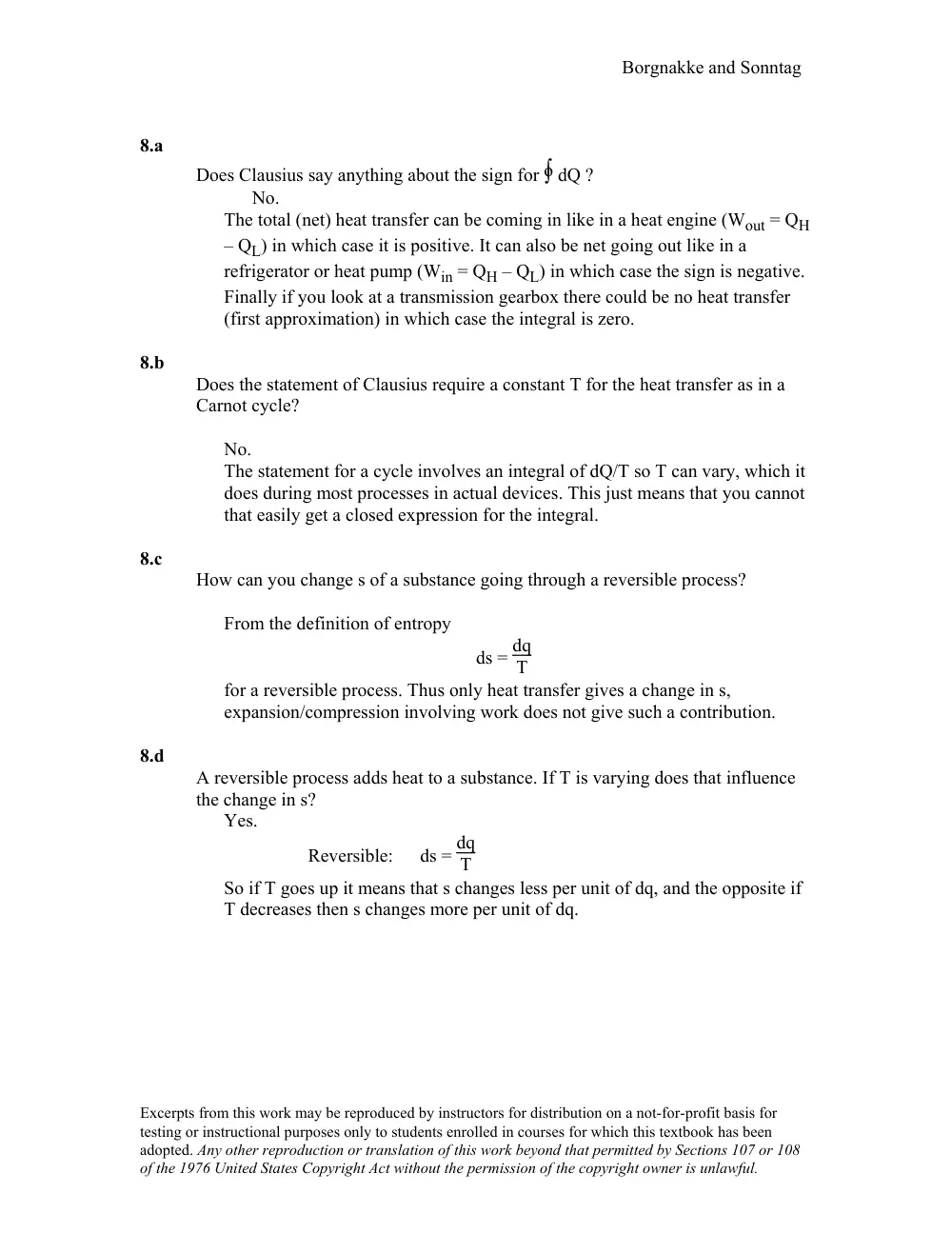
8.a
Does Clausius say anything about the sign for ∫o dQ ?
No.
The total (net) heat transfer can be coming in like in a heat engine (Wout = QH
– QL) in which case it is positive. It can also be net going out like in a
refrigerator or heat pump (Win = QH – QL) in which case the sign is negative.
Finally if you look at a transmission gearbox there could be no heat transfer
(first approximation) in which case the integral is zero.
8.b
Does the statement of Clausius require a constant T for the heat transfer as in a
Carnot cycle?
No.
The statement for a cycle involves an integral of dQ/T so T can vary, which it
does during most processes in actual devices. This just means that you cannot
that easily get a closed expression for the integral.
8.c
How can you change s of a substance going through a reversible process?
From the definition of entropy
ds = dq
T
for a reversible process. Thus only heat transfer gives a change in s,
expansion/compression involving work does not give such a contribution.
8.d
A reversible process adds heat to a substance. If T is varying does that influence
the change in s?
Yes.
Reversible:
ds = dq
T
So if T goes up it means that s changes less per unit of dq, and the opposite if
T decreases then s changes more per unit of dq.
Excerpts from this work may be reproduced by instructors for distribution on a not-for-profit basis for
testing or instructional purposes only to students enrolled in courses for which this textbook has been
adopted. Any other reproduction or translation of this work beyond that permitted by Sections 107 or 108
of the 1976 United States Copyright Act without the permission of the copyright owner is unlawful.
Borgnakke and Sonntag
8.e
Water at 100 kPa, 150oC receives 75 kJ/kg in a reversible process by heat
transfer. Which process changes s the most: constant T, constant v or constant P?
ds = dq
T
Look at the constant property lines in a T-s diagram, Fig. 8.5. The constant v
line has a higher slope than the constant P line also at positive slope. Thus
both the constant P and v processes have an increase in T. As T goes up the
change in s is smaller.
The constant T (isothermal) process therefore changes s the most.
8.f
A liquid is compressed in a reversible adiabatic process. What is the change in T?
If the process is reversible then s is constant, ds = dq
T = 0
Change in s for a liquid (an incompressible substance) is
Eq. 8.10:
ds = C
T dT
From this it follows that if ds = 0 then T is constant.
8.g
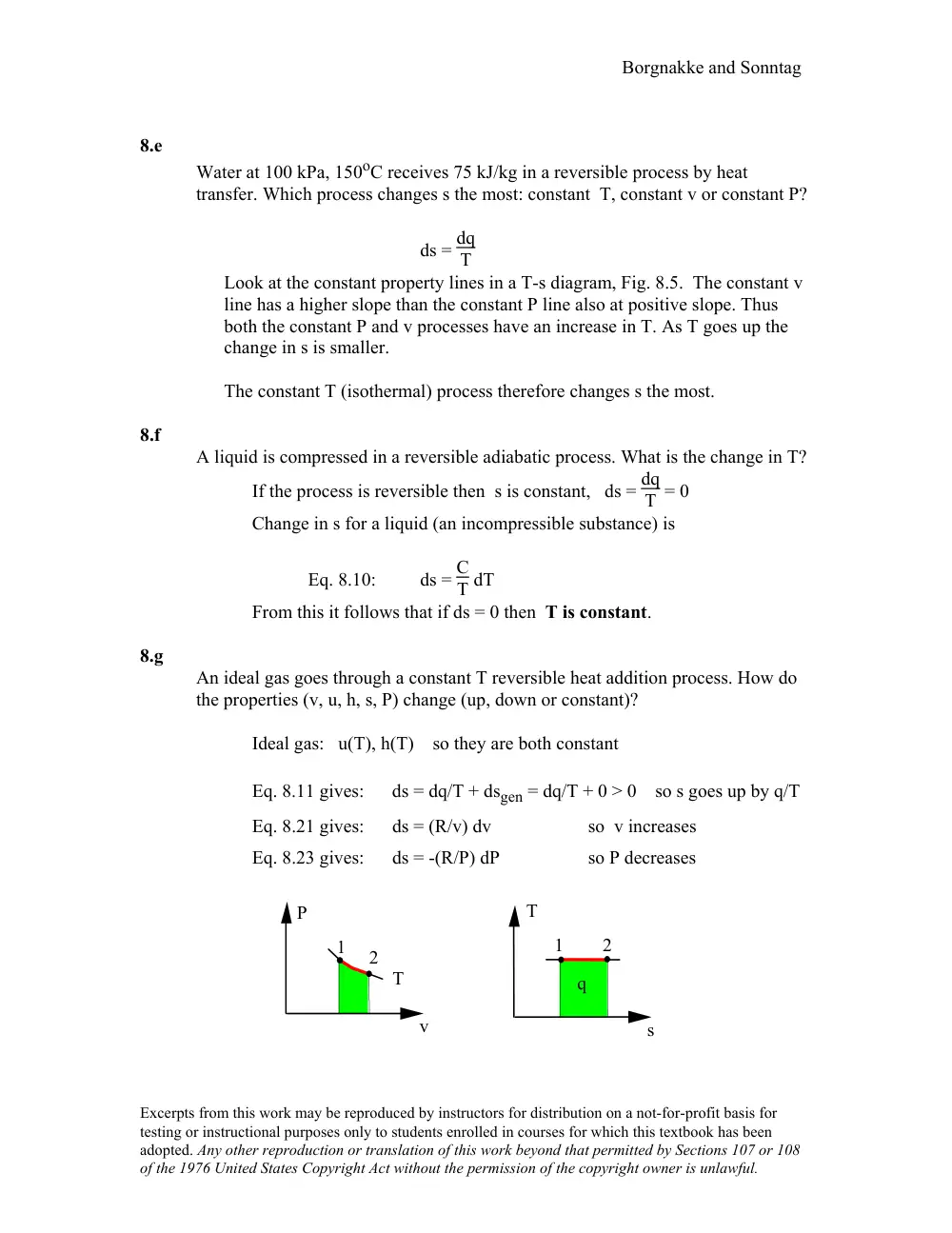
An ideal gas goes through a constant T reversible heat addition process. How do
the properties (v, u, h, s, P) change (up, down or constant)?
Ideal gas: u(T), h(T) so they are both constant
Eq. 8.11 gives: ds = dq/T + dsgen = dq/T + 0 > 0 so s goes up by q/T
Eq. 8.21 gives: ds = (R/v) dv
so v increases
Eq. 8.23 gives: ds = -(R/P) dP
so P decreases
2
1
P
v
T
s
1
2
T
q
Excerpts from this work may be reproduced by instructors for distribution on a not-for-profit basis for
testing or instructional purposes only to students enrolled in courses for which this textbook has been
adopted. Any other reproduction or translation of this work beyond that permitted by Sections 107 or 108
of the 1976 United States Copyright Act without the permission of the copyright owner is unlawful.
Borgnakke and Sonntag
Excerpts from this work may be reproduced by instructors for distribution on a not-for-profit basis for
testing or instructional purposes only to students enrolled in courses for which this textbook has been
adopted. Any other reproduction or translation of this work beyond that permitted by Sections 107 or 108
of the 1976 United States Copyright Act without the permission of the copyright owner is unlawful.
8.h
Carbon dioxide is compressed to a smaller volume in a polytropic process with n
= 1.2. How do the properties (u, h, s, P, T) change (up, down or constant)?
For carbon dioxide Table A.5 k = 1.289 so we have n < k and the
process curve can be recognized in Figure 8.18. From this we see a smaller
volume means moving to the left in the P-v diagram and thus also up.
From P-v diagram:
P up, T up
From T-s diagram
Since T is up then s down.
As T is up so is h and u.
T
P
2
2
1
1 T (n = 1)
n = 1.2
v
s
Borgnakke and Sonntag
8.i
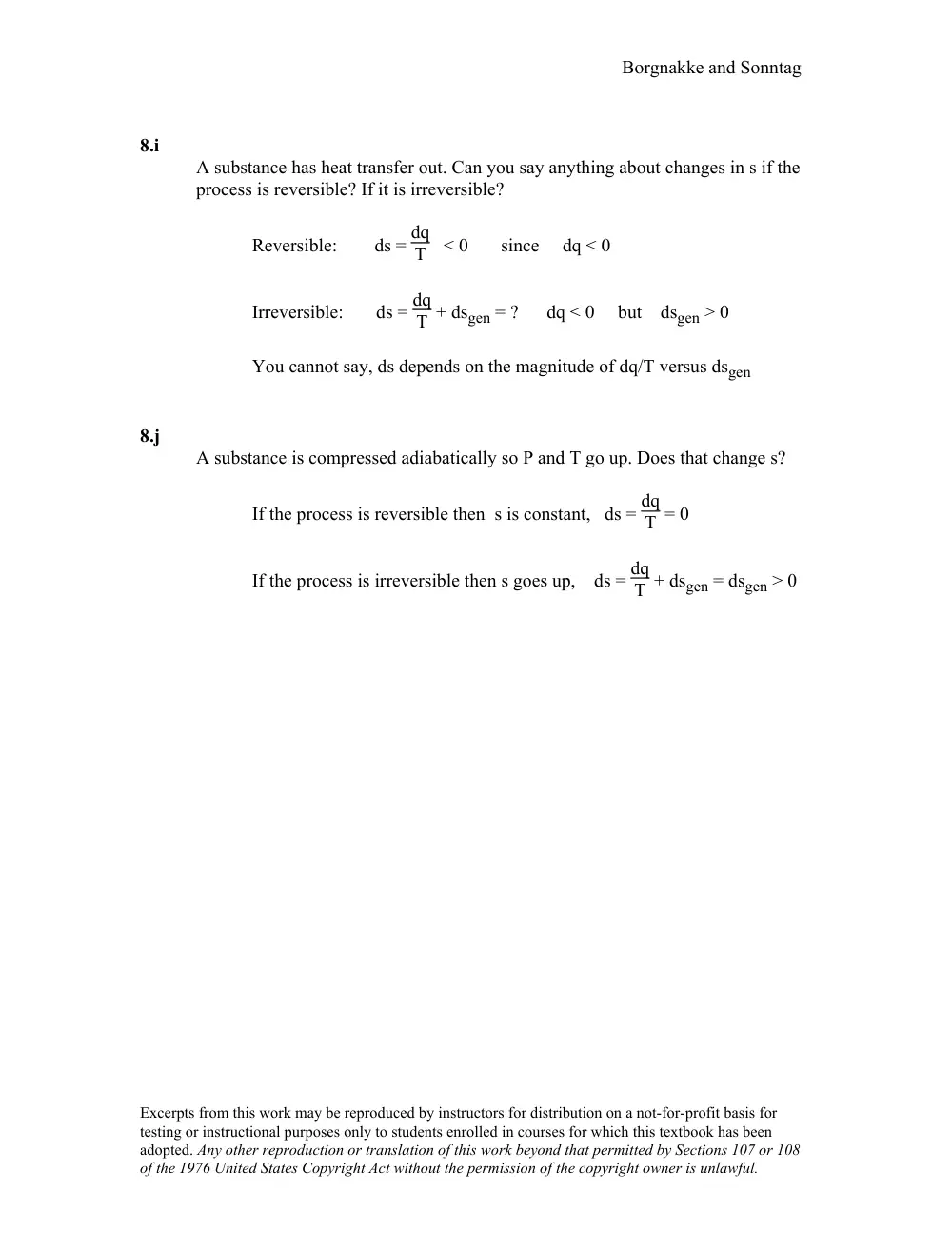
A substance has heat transfer out. Can you say anything about changes in s if the
process is reversible? If it is irreversible?
Reversible: ds = dq
T < 0 since dq < 0
Irreversible: ds = dq
T + dsgen = ? dq < 0 but dsgen > 0
You cannot say, ds depends on the magnitude of dq/T versus dsgen
8.j
A substance is compressed adiabatically so P and T go up. Does that change s?
If the process is reversible then s is constant, ds = dq
T = 0
If the process is irreversible then s goes up, ds = dq
T + dsgen = dsgen > 0
Excerpts from this work may be reproduced by instructors for distribution on a not-for-profit basis for
testing or instructional purposes only to students enrolled in courses for which this textbook has been
adopted. Any other reproduction or translation of this work beyond that permitted by Sections 107 or 108
of the 1976 United States Copyright Act without the permission of the copyright owner is unlawful.
Borgnakke and Sonntag
Concept Problems
Excerpts from this work may be reproduced by instructors for distribution on a not-for-profit basis for
testing or instructional purposes only to students enrolled in courses for which this textbook has been
adopted. Any other reproduction or translation of this work beyond that permitted by Sections 107 or 108
of the 1976 United States Copyright Act without the permission of the copyright owner is unlawful.
Borgnakke and Sonntag
8.1
When a substance has completed a cycle, v, u, h, and s are unchanged. Did
anything happen? Explain.
Yes.
During various parts of the cycle work and heat transfer may be transferred.
That happens at different P and T. The net work out equals the net heat
transfer in (energy conservation) so dependent upon the sign it is a heat
engine or a heat pump (refrigerator). The net effect is thus a conversion of
energy from one storage location to another and it may also change nature
(some Q was changed to W or the opposite)
Excerpts from this work may be reproduced by instructors for distribution on a not-for-profit basis for
testing or instructional purposes only to students enrolled in courses for which this textbook has been
adopted. Any other reproduction or translation of this work beyond that permitted by Sections 107 or 108
of the 1976 United States Copyright Act without the permission of the copyright owner is unlawful.
Borgnakke and Sonntag
8.2
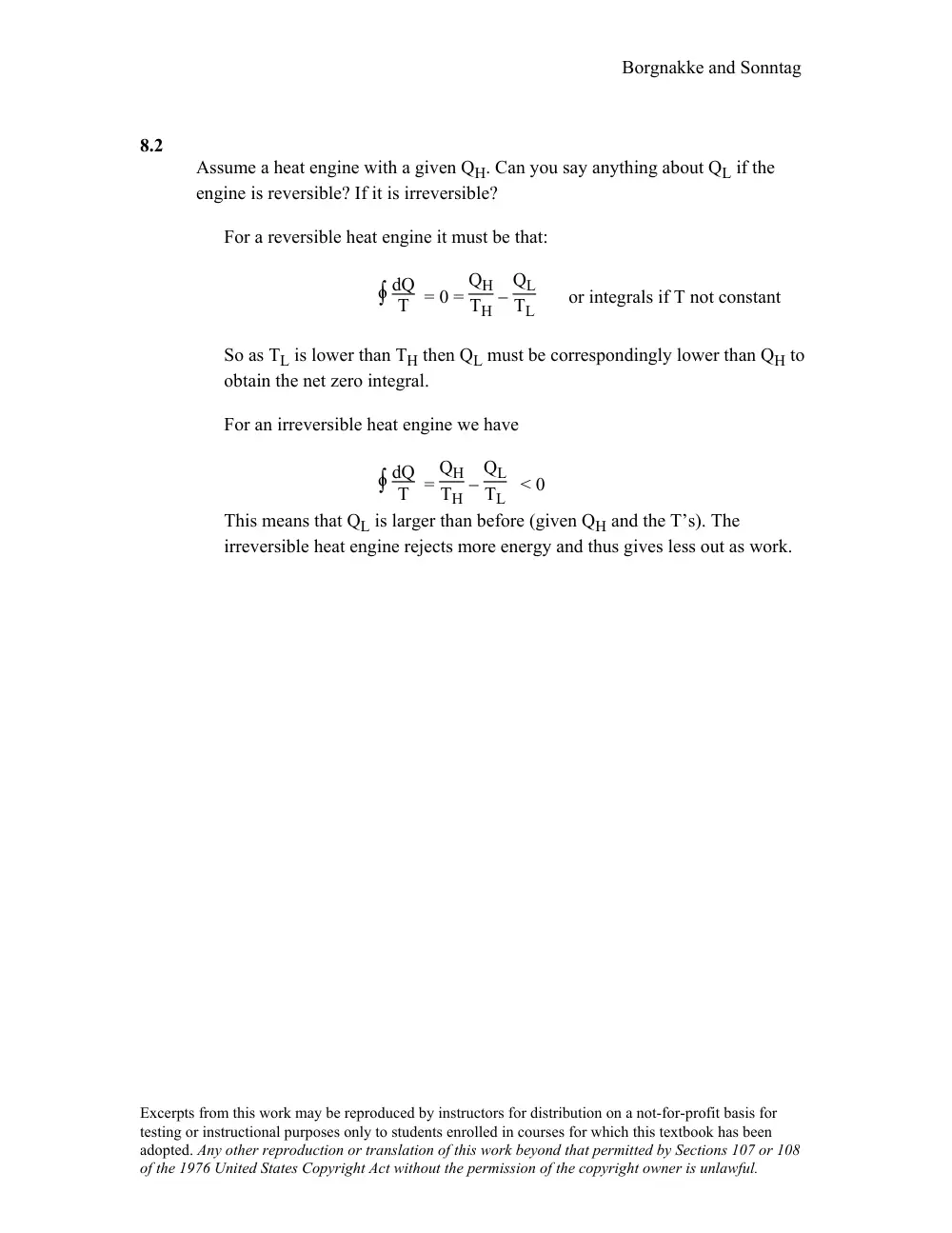
Assume a heat engine with a given QH. Can you say anything about QL if the
engine is reversible? If it is irreversible?
For a reversible heat engine it must be that:
∫o dQ
T = 0 =
QH
TH −
QL
TL or integrals if T not constant
So as TL is lower than TH then QL must be correspondingly lower than QH to
obtain the net zero integral.
For an irreversible heat engine we have
∫o dQ
T =
QH
TH −
QL
TL < 0
This means that QL is larger than before (given QH and the T’s). The
irreversible heat engine rejects more energy and thus gives less out as work.
Excerpts from this work may be reproduced by instructors for distribution on a not-for-profit basis for
testing or instructional purposes only to students enrolled in courses for which this textbook has been
adopted. Any other reproduction or translation of this work beyond that permitted by Sections 107 or 108
of the 1976 United States Copyright Act without the permission of the copyright owner is unlawful.
Borgnakke and Sonntag
Excerpts from this work may be reproduced by instructors for distribution on a not-for-profit basis for
testing or instructional purposes only to students enrolled in courses for which this textbook has been
adopted. Any other reproduction or translation of this work beyond that permitted by Sections 107 or 108
of the 1976 United States Copyright Act without the permission of the copyright owner is unlawful.
8.3
CV A is the mass inside a piston/cylinder, CV B is
that plus part of the wall out to a source of 1Q2 at Ts.
Write the entropy equation for the two control
volumes assuming no change of state of the piston
mass or walls.
Fig. P8.3
P o
m p
Ts
A
m
The general entropy equation for a control mass is Eq.8.37
S2 – S1 = ⌡⌠
1
2 dQ
T + 1S2 gen
The left hand side is storage so that depends of what is inside the C.V. and the
integral is summing the dQ/T that crosses the control volume surface while the
process proceeds from 1 to 2.
C.V. A: mA (s2 – s1) =
⌡⌠
1
2 dQ
TA + 1S2 gen CV A
C.V. B: mA (s2 – s1) =
⌡⌠
1
2 dQ
Ts + 1S2 gen CV B
In the first equation the temperature is that of mass mA which possibly changes
from 1 to 2 whereas in the second equation it is the reservoir temperature Ts. The
two entropy generation terms are also different the second one includes the first
one plus any s generated in the walls that separate the mass mA from the reservoir
and there is a Q over a finite temperature difference. When the storage effect in
the walls are neglected the left hand sides of the two equations are equal.
Borgnakke and Sonntag
8.4
Consider the previous set-up with the mass mA and the piston cylinder of mass
mp starting out at two different temperatures. After a while the temperature
becomes uniform without any external heat transfer. Write the entropy equation
storage term (S2 – S1) for the total mass.
In this case the storage effect must be summed up over all the mass inside the
control volume.
S2 – S1 = mA (s2 – s1)A + mP (s2 – s1)P
≈ mA (s2 – s1)A + mP CP ln (
T2
T1 P )
The last equation assumed a constant specific heat for the solid material of the
piston, a common assumption. There is only a single temperature T2, but there are
two different temperatures for state 1 T1 A and T1 P. The temperature T2 would be
found from the energy equation.
Excerpts from this work may be reproduced by instructors for distribution on a not-for-profit basis for
testing or instructional purposes only to students enrolled in courses for which this textbook has been
adopted. Any other reproduction or translation of this work beyond that permitted by Sections 107 or 108
of the 1976 United States Copyright Act without the permission of the copyright owner is unlawful.
Borgnakke and Sonntag
Excerpts from this work may be reproduced by instructors for distribution on a not-for-profit basis for
testing or instructional purposes only to students enrolled in courses for which this textbook has been
adopted. Any other reproduction or translation of this work beyond that permitted by Sections 107 or 108
of the 1976 United States Copyright Act without the permission of the copyright owner is unlawful.
8.5
Water at 100oC, quality 50% in a rigid box is heated to 110oC. How do the properties
(P, v, x, u and s) change? (increase, stay about the same, or decrease)
A fixed mass in a rigid box give a constant v process. So
P goes up (in the two-phase region P = Psat at given T)
v stays constant.
x goes up ( we get closer to the saturated vapor state see P-v diagram)
u goes up (Q in and no work)
s goes up (Q in)
P
T
2
2
1
1
v
s
Borgnakke and Sonntag
8.6
Liquid water at 20oC, 100 kPa is compressed in a piston/cylinder without any heat
transfer to a pressure of 200 kPa. How do the properties (T, v, u, and s) change?
(increase, stay about the same, or decrease)
Adiabatic dq = 0:
dq = T ds = 0;
Incompressible dv = 0:
dw = P dv = 0
(T, v, u, and s) they are all constant.
Only the pressure and enthalpy goes up.
Excerpts from this work may be reproduced by instructors for distribution on a not-for-profit basis for
testing or instructional purposes only to students enrolled in courses for which this textbook has been
adopted. Any other reproduction or translation of this work beyond that permitted by Sections 107 or 108
of the 1976 United States Copyright Act without the permission of the copyright owner is unlawful.
Borgnakke and Sonntag
Excerpts from this work may be reproduced by instructors for distribution on a not-for-profit basis for
testing or instructional purposes only to students enrolled in courses for which this textbook has been
adopted. Any other reproduction or translation of this work beyond that permitted by Sections 107 or 108
of the 1976 United States Copyright Act without the permission of the copyright owner is unlawful.
8.7
A reversible process in a piston/cylinder is
shown in Fig. P8.7. Indicate the storage
change u2 - u1 and transfers 1w2 and 1q2 as
positive, zero, or negative
P
T
2
u = C
1
2
1
s
v
1w2 = ∫ P dv > 0 ;
1q2 = ∫ T ds > 0
u2 - u1 > 0 from general shape of the constant u curves. Further out in the ideal
gas region the constant u curve become horizontal ( u = fct(T) only ).
Borgnakke and Sonntag
8.8
A reversible process in a piston/cylinder
is shown in Fig. P8.8. Indicate the
storage change u2 - u1 and transfers 1w2
and 1q2 as positive, zero, or negative
P
v
1
2
2
1
T
s
1w2 = ∫ P dv > 0 ;
1q2 = ∫ T ds = 0
u2 - u1 = 1q2 - 1w2 < 0
Excerpts from this work may be reproduced by instructors for distribution on a not-for-profit basis for
testing or instructional purposes only to students enrolled in courses for which this textbook has been
adopted. Any other reproduction or translation of this work beyond that permitted by Sections 107 or 108
of the 1976 United States Copyright Act without the permission of the copyright owner is unlawful.
Borgnakke and Sonntag
Excerpts from this work may be reproduced by instructors for distribution on a not-for-profit basis for
testing or instructional purposes only to students enrolled in courses for which this textbook has been
adopted. Any other reproduction or translation of this work beyond that permitted by Sections 107 or 108
of the 1976 United States Copyright Act without the permission of the copyright owner is unlawful.
8.9
Air at 290 K, 100 kPa in a rigid box is heated to 325 K. How do the properties (P, v,
u and s) change? (increase, stay about the same, or decrease)
Rigid box: v = constant, (P, u, and s) all increases.
T
P
2 P
2
2
P 1
1
1
s
v
Borgnakke and Sonntag
Excerpts from this work may be reproduced by instructors for distribution on a not-for-profit basis for
testing or instructional purposes only to students enrolled in courses for which this textbook has been
adopted. Any other reproduction or translation of this work beyond that permitted by Sections 107 or 108
of the 1976 United States Copyright Act without the permission of the copyright owner is unlawful.
8.10
Air at 20oC, 100 kPa is compressed in a piston/cylinder without any heat transfer to a
pressure of 200 kPa. How do the properties (T, v, u and s) change? (increase, about
the same or decrease)
T goes up,
v goes down
u goes up (work in, q = 0)
s = constant
T
P
2
P 2
2
P
1
1
1
s
v
Borgnakke and Sonntag
Excerpts from this work may be reproduced by instructors for distribution on a not-for-profit basis for
testing or instructional purposes only to students enrolled in courses for which this textbook has been
adopted. Any other reproduction or translation of this work beyond that permitted by Sections 107 or 108
of the 1976 United States Copyright Act without the permission of the copyright owner is unlawful.
8.11
Carbon dioxide is compressed to a smaller volume in a polytropic process with n
= 1.4. How do the properties (u, h, s, P, T) change (up, down or constant)?
For carbon dioxide Table A.5 k = 1.289 so we have n > k and the process
curve can be recognized in Figure 8.18. From this we see a smaller volume means
moving to the left in the P-v diagram and thus also up.
P up, T up. As T is up so is h and u.
From the T-s diagram as n > k then we move to larger T means s is up.
T
P
2
2
1 T (n = 1)
1
n = 1.4
v
s
Borgnakke and Sonntag
8.12
Process A: Air at 300 K, 100 kPa is heated to 310 K at constant pressure.
Process B: Heat air at 1300 K to 1310 K at constant 100 kPa.
Use the table below to compare the property changes.
Property
∆A > ∆B
∆A ≈ ∆B
∆A < ∆B
a
∆ = v2 – v1
√
b
∆ = h2 – h1
√
c
∆ = s2 – s1
√
a. Ideal gas Pv = RT so v goes with absolute T
∆v = (R/P) ∆T thus the same
b. Since dh = CP dT and CP increases with T
c. At constant P: ds = (CP/T) dT
CP is only 15% higher at 1300 K compared to 300 K (see Fig. 5.11)
Excerpts from this work may be reproduced by instructors for distribution on a not-for-profit basis for
testing or instructional purposes only to students enrolled in courses for which this textbook has been
adopted. Any other reproduction or translation of this work beyond that permitted by Sections 107 or 108
of the 1976 United States Copyright Act without the permission of the copyright owner is unlawful.
Borgnakke and Sonntag
8.13
Why do we write ∆S or S2 – S1 whereas we write ∫dQ/T and 1S2 gen?
This is similar to the terms in the continuity equation m2 – m1 versus mi, me and
the energy equation E2 – E1 versus 1Q2, 1W2. The first part is the change in the
storage S2 – S1 of entropy in the mass and the second part is the transfer or
generation during the process from 1 to 2. The storage terms correspond to the left
hand side of the balance equation for entropy. The integral ∫dQ/T represents a
transfer of entropy across the control volume surface during the process from 1
to 2 and the 1S2 gen expresses the total amount of entropy being generated inside
the control volume and both are on the right hand side of the balance equation.
Excerpts from this work may be reproduced by instructors for distribution on a not-for-profit basis for
testing or instructional purposes only to students enrolled in courses for which this textbook has been
adopted. Any other reproduction or translation of this work beyond that permitted by Sections 107 or 108
of the 1976 United States Copyright Act without the permission of the copyright owner is unlawful.
Borgnakke and Sonntag
8.14
A reversible heat pump has a flux of s entering as Q
.
L/TL. What can you say about
the exit flux of s at TH?
For the entropy equation 8.3 and 8.42, the rate of storage is zero and the
generation term is zero. Thus the entropy equation becomes
0 =
Q
.
L
TL –
Q
.
H
TH + 0
So:
Q
.
L
TL =
Q
.
H
TH = flux of s
We have the same flux of s in as out matching the result in chapter 7.
Excerpts from this work may be reproduced by instructors for distribution on a not-for-profit basis for
testing or instructional purposes only to students enrolled in courses for which this textbook has been
adopted. Any other reproduction or translation of this work beyond that permitted by Sections 107 or 108
of the 1976 United States Copyright Act without the permission of the copyright owner is unlawful.
Borgnakke and Sonntag
8.15
An electric baseboard heater receives 1500 W of electrical power that heats the
room air which loses the same amount out through the walls and windows. Specify
exactly where entropy is generated in that process.
a Electrical heating wire (electrical work turned into internal energy,
leaving as heat transfer).
b Heat transfer from hot wire to cooler room air, i.e. in the wire coverings
c Room air to walls
d Inside walls and windows, heat transfer over a finite ∆T
e from outside wall surface to ambient T
Excerpts from this work may be reproduced by instructors for distribution on a not-for-profit basis for
testing or instructional purposes only to students enrolled in courses for which this textbook has been
adopted. Any other reproduction or translation of this work beyond that permitted by Sections 107 or 108
of the 1976 United States Copyright Act without the permission of the copyright owner is unlawful.
Borgnakke and Sonntag
8.16
A 500 W electric space heater with a small fan inside heats air by blowing it over
a hot electrical wire. For each control volume: a) wire at Twire only b) all the
room air at Troom and c) total room plus the heater, specify the storage, entropy
transfer terms and entropy generation as rates (neglect any Q
.
through the room
walls or windows).
Storage
Q
.
/T
S
.
gen
C.V. Wire only
0
−500 W
Twire
500 W
Twire
C.V. Room air
500 W
Troom 500 W
Twire 500 W (
1
Troom − 1
Twire )
C.V. Total room
500 W
Troom
0
500 W
Troom
Remark: Room only receives the electrical power input of 500 W.
Excerpts from this work may be reproduced by instructors for distribution on a not-for-profit basis for
testing or instructional purposes only to students enrolled in courses for which this textbook has been
adopted. Any other reproduction or translation of this work beyond that permitted by Sections 107 or 108
of the 1976 United States Copyright Act without the permission of the copyright owner is unlawful.
Borgnakke and Sonntag
Inequality of Clausius
Excerpts from this work may be reproduced by instructors for distribution on a not-for-profit basis for
testing or instructional purposes only to students enrolled in courses for which this textbook has been
adopted. Any other reproduction or translation of this work beyond that permitted by Sections 107 or 108
of the 1976 United States Copyright Act without the permission of the copyright owner is unlawful.
Borgnakke and Sonntag
8.17
Consider the steam power plant in Example 6.9 and assume an average T in the
line between 1 and 2. Show that this cycle satisfies the inequality of Clausius.
Solution:
Show Clausius:
⌡⌠dQ
T ≤ 0
For this problem we have three heat transfer terms:
qb = 2831 kJ/kg, qloss = 21 kJ/kg, qc = 2173.3 kJ/kg
⌡⌠dq
T =
qb
Tb –
qloss
Tavg 1-2 –
qc
Tc
= 2831
573 − 21
568 − 2173.3
318
= –1.93 kJ/kg K < 0 OK
Excerpts from this work may be reproduced by instructors for distribution on a not-for-profit basis for
testing or instructional purposes only to students enrolled in courses for which this textbook has been
adopted. Any other reproduction or translation of this work beyond that permitted by Sections 107 or 108
of the 1976 United States Copyright Act without the permission of the copyright owner is unlawful.
Borgnakke and Sonntag
8.18
A heat engine receives 6 kW from a 250oC source and rejects heat at 30oC.
Examine each of three cases with respect to the inequality of Clausius.
a. W
.
= 6 kW
b. W
.
= 0 kW
c. Carnot cycle
Solution:
TH = 250 + 273 = 523 K ;
TL = 30 + 273 = 303 K
Case a) ⌡
⌠
dQ
.
T = 6000
523 – 0
303 = 11.47 kW/K > 0 Impossible
b) ⌡
⌠
dQ
.
T = 6000
523 – 6000
303 = –8.33 kW/K < 0
OK
c) ⌡
⌠
dQ
.
T = 0 = 6000
523 –
Q
.
L
303
⇒
Q
.
L = 303
523 × 6 kW = 3.476 kW
W
.
= Q
.
H – Q
.
L = 2.529 kW
Excerpts from this work may be reproduced by instructors for distribution on a not-for-profit basis for
testing or instructional purposes only to students enrolled in courses for which this textbook has been
adopted. Any other reproduction or translation of this work beyond that permitted by Sections 107 or 108
of the 1976 United States Copyright Act without the permission of the copyright owner is unlawful.
Borgnakke and Sonntag
8.19
Use the inequality of Clausius to show that heat transfer from a warm space
towards a colder space without work is a possible process i.e. a heat engine with
no work output.
Clausius: ⌡⌠dQ
T ≤ 0
or
⌡
⌠
dQ
.
T ≤ 0
Take C.V. as the space separating the warm and cold space. It is the same Q that
crosses each surface (from energy equation) so
⌡⌠dQ
T = Q
Twarm – Q
Tcold = Q (
1
Twarm – 1
Tcold) < 0
OK
Excerpts from this work may be reproduced by instructors for distribution on a not-for-profit basis for
testing or instructional purposes only to students enrolled in courses for which this textbook has been
adopted. Any other reproduction or translation of this work beyond that permitted by Sections 107 or 108
of the 1976 United States Copyright Act without the permission of the copyright owner is unlawful.
Borgnakke and Sonntag
8.20
Use the inequality of Clausius to show that heat transfer from a cold space
towards a warmer space without work is an impossible process i.e. a heat pump
with no work input.
Clausius: ⌡⌠dQ
T ≤ 0
or
⌡
⌠
dQ
.
T ≤ 0
Take C.V. as the space separating the warm and cold space. It is the same Q that
crosses each surface (from energy equation) so
⌡⌠dQ
T = Q
Tcold – Q
Twarm = Q ( 1
Tcold –
1
Twarm) > 0 Impossible!
Excerpts from this work may be reproduced by instructors for distribution on a not-for-profit basis for
testing or instructional purposes only to students enrolled in courses for which this textbook has been
adopted. Any other reproduction or translation of this work beyond that permitted by Sections 107 or 108
of the 1976 United States Copyright Act without the permission of the copyright owner is unlawful.
Borgnakke and Sonntag
8.21
Assume the heat engine in Problem 7.32 has a high temperature of 1200 K and a
low temperature of 400 K. What does the inequality of Clausius say about each of
the four cases?
Solution:
Cases a) ⌡
⌠
dQ
.
T = 6
1200 – 4
400 = – 0.005 kW/K < 0
OK
b) ⌡
⌠
dQ
.
T = 6
1200 – 0
400 = 0.005 kW/K > 0 Impossible
c) ⌡
⌠
dQ
.
T = 6
1200 – 2
400 = 0 kW/K
Possible if reversible
d) ⌡
⌠
dQ
.
T = 6
1200 – 6
400 = – 0.001 kW/K < 0
OK
H
Q
W
L
Q
H
HE
cb
T = 400 K
L
T = 1200 K
Excerpts from this work may be reproduced by instructors for distribution on a not-for-profit basis for
testing or instructional purposes only to students enrolled in courses for which this textbook has been
adopted. Any other reproduction or translation of this work beyond that permitted by Sections 107 or 108
of the 1976 United States Copyright Act without the permission of the copyright owner is unlawful.
Borgnakke and Sonntag
8.22
Let the steam power plant in Problem 7.35 have 700oC in the boiler and 40oC
during the heat rejection in the condenser. Does that satisfy the inequality of
Clausius? Repeat the question for the cycle operated in reverse as a refrigerator.
Solution:
Q
.
H = 1 MW
Q
.
L = 0.58 MW
⌡
⌠
dQ
.
T = 1000
973 – 580
313 = –0.82 kW/K < 0
OK
Refrigerator
⌡
⌠
dQ
.
T = 580
313 – 1000
973 = 0.82 > 0
Cannot be possible
WT
QH
QL
.
WP, in
Excerpts from this work may be reproduced by instructors for distribution on a not-for-profit basis for
testing or instructional purposes only to students enrolled in courses for which this textbook has been
adopted. Any other reproduction or translation of this work beyond that permitted by Sections 107 or 108
of the 1976 United States Copyright Act without the permission of the copyright owner is unlawful.
Borgnakke and Sonntag
8.23
Examine the heat engine given in Problem 7.54 to see if it satisfies the inequality
of Clausius.
Solution:
QH = 325 kJ at TH = 1000 K
QL = 125 kJ at TL = 400 K
⌡⌠ dQ
T = 325
1000 – 125
400 = 0.0125 kJ/K > 0
Impossible
H
Q = 325 kJ
W = 200 kJ
L
Q = 125 kJ
T = 1000 K
H
HE
cb
T = 400 K
L
Excerpts from this work may be reproduced by instructors for distribution on a not-for-profit basis for
testing or instructional purposes only to students enrolled in courses for which this textbook has been
adopted. Any other reproduction or translation of this work beyond that permitted by Sections 107 or 108
of the 1976 United States Copyright Act without the permission of the copyright owner is unlawful.
Borgnakke and Sonntag
Entropy of a pure substance
Excerpts from this work may be reproduced by instructors for distribution on a not-for-profit basis for
testing or instructional purposes only to students enrolled in courses for which this textbook has been
adopted. Any other reproduction or translation of this work beyond that permitted by Sections 107 or 108
of the 1976 United States Copyright Act without the permission of the copyright owner is unlawful.
Borgnakke and Sonntag
8.24
Find the missing properties of T, P, s and x for water at:
a.
P = 25 kPa, s = 7.7 kJ/kgK
b.
P = 10 MPa, u = 3400 kJ/kg
c.
T = 150oC, s = 7.4 kJ/kgK
Solution:
a) Table B.1.2 sf < s < sg so two-phase and T = Tsat(P) = 64.97°C
x = (s – sf)/sfg = 7.70 − 0.893
6.9383
= 0.981
h = 271.9 + 0.981 × 2346.3 = 2573.8 kJ/kg
b) Table B.1.2 u > ug => Superheated vapor Table B.1.3, x = undefined
T ≅ 682°C , s ≅ 7.1223 kJ/kg K
c) Table B.1.1 s > sg so superheated vapor. Table B.1.3, x = undefined
State is located between 100 and 200 kPa, so interpolate
P = 100 kPa + 100 kPa × 7.40 − 7.6133
7.2795 − 7.6133 = 163.9 kPa
b
P
v
T
s
b
a
a
T
P
c
c
Excerpts from this work may be reproduced by instructors for distribution on a not-for-profit basis for
testing or instructional purposes only to students enrolled in courses for which this textbook has b