
PHYS 205 Chapter 21, Fall 2017
American University of Beirut · Modern Physics for Life Sciences · 40 pages · Mr. Roy Aad

Showing the first 10 of 40 pages. Download the PDF to see all of it.
More PHYS 205 files
Show the text of this chapter
Chapter 21
Magnetic Forces and
Magnetic Fields
Outline
1.
Magnetic Fields
2.
The Force that a Magnetic Field
Exerts on a Moving Charge
3.
The Motion of a Charged Particle in
a Magnetic Field
4.
The Mass Spectrometer
5.
The Force on a Current in a
Magnetic Field
6.
The Force on a Current-Carrying
Coil
7.
Magnetic Fields Produced by
Currents
8.
Ampère’s Law
9.
Magnetic Materials
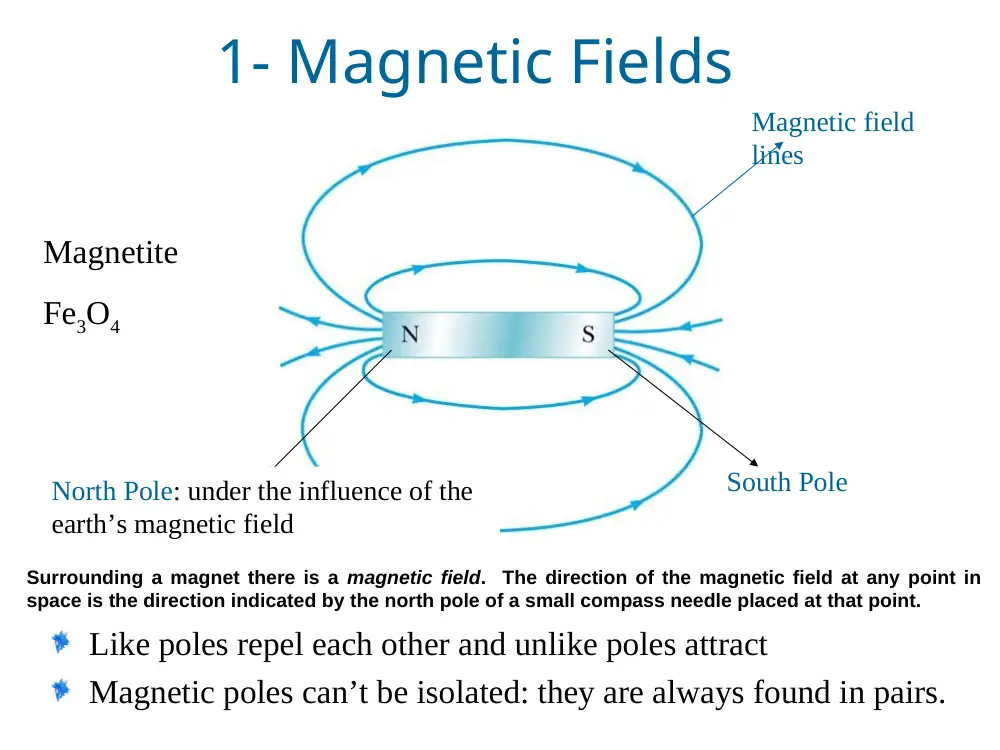
1- Magnetic Fields
Like poles repel each other and unlike poles attract
Magnetic poles can’t be isolated: they are always found in pairs.
North Pole: under the influence of the
earth’s magnetic field
South Pole
Magnetic field
lines
Magnetite
Fe3O4
Surrounding a magnet there is a magnetic field. The direction of the magnetic field at any point in
space is the direction indicated by the north pole of a small compass needle placed at that point.
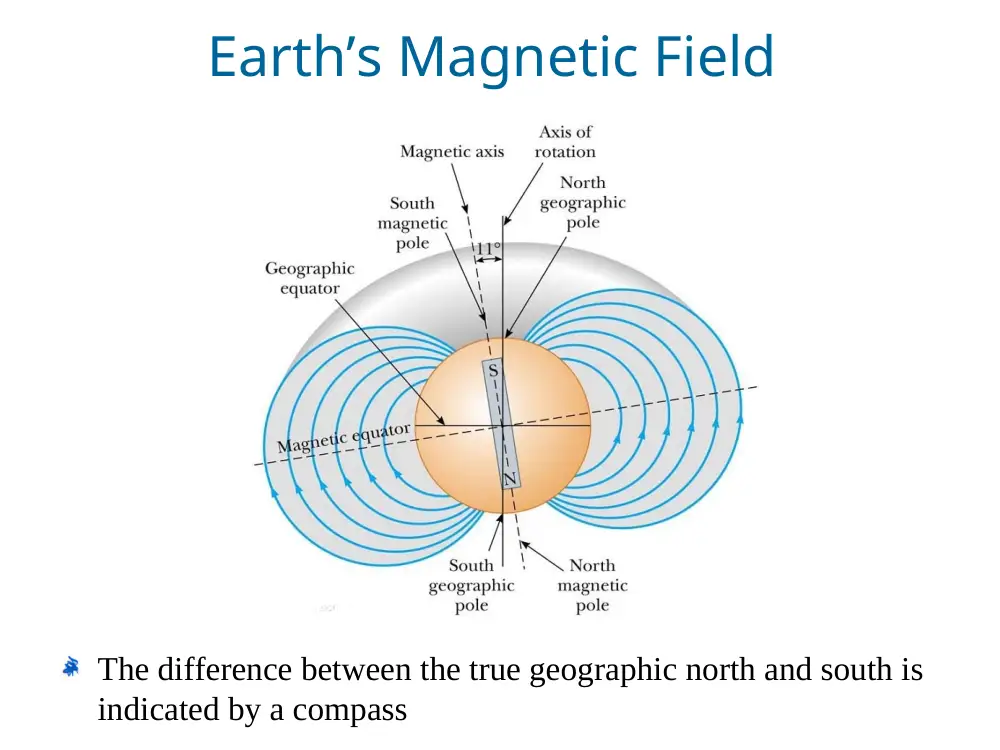
Earth’s Magnetic Field
The difference between the true geographic north and south is
indicated by a compass
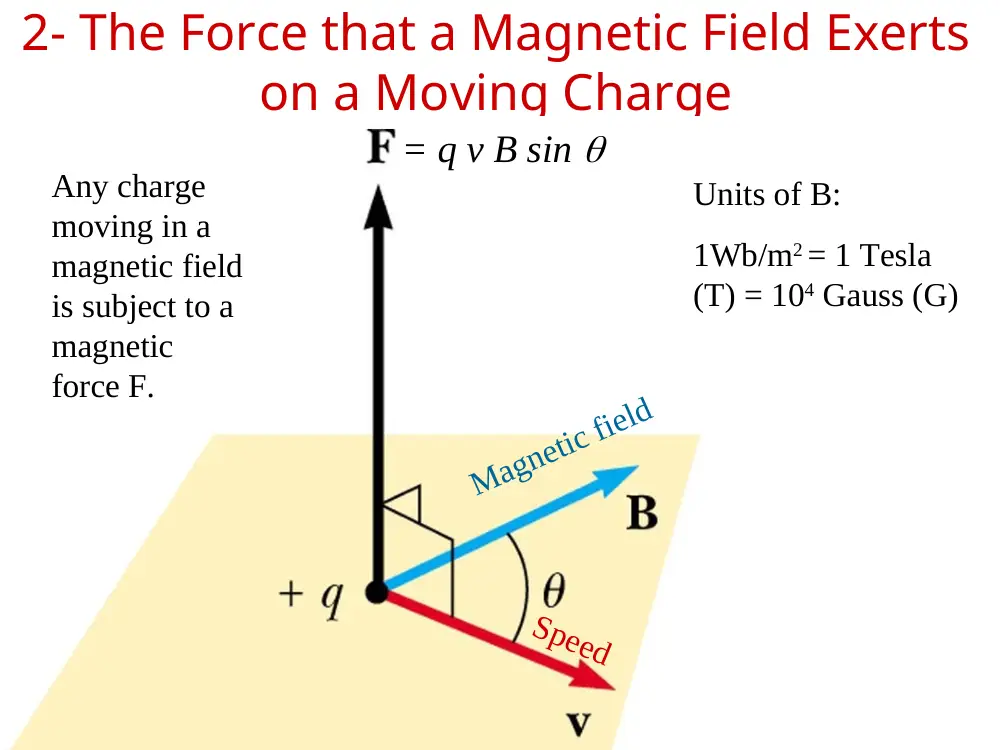
2- The Force that a Magnetic Field Exerts
on a Moving Charge
= q v B sin
Magnetic field
Speed
Units of B:
1Wb/m2 = 1 Tesla
(T) = 104 Gauss (G)
Any charge
moving in a
magnetic field
is subject to a
magnetic
force F.
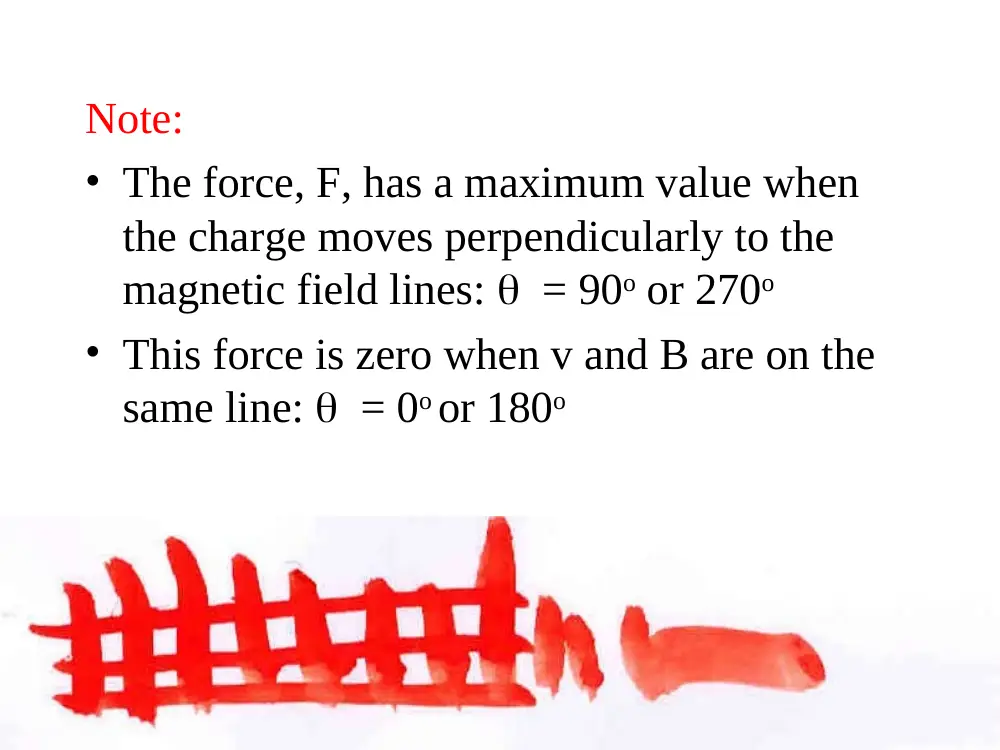
Note:
• The force, F, has a maximum value when
the charge moves perpendicularly to the
magnetic field lines: = 90o or 270o
• This force is zero when v and B are on the
same line: = 0o or 180o
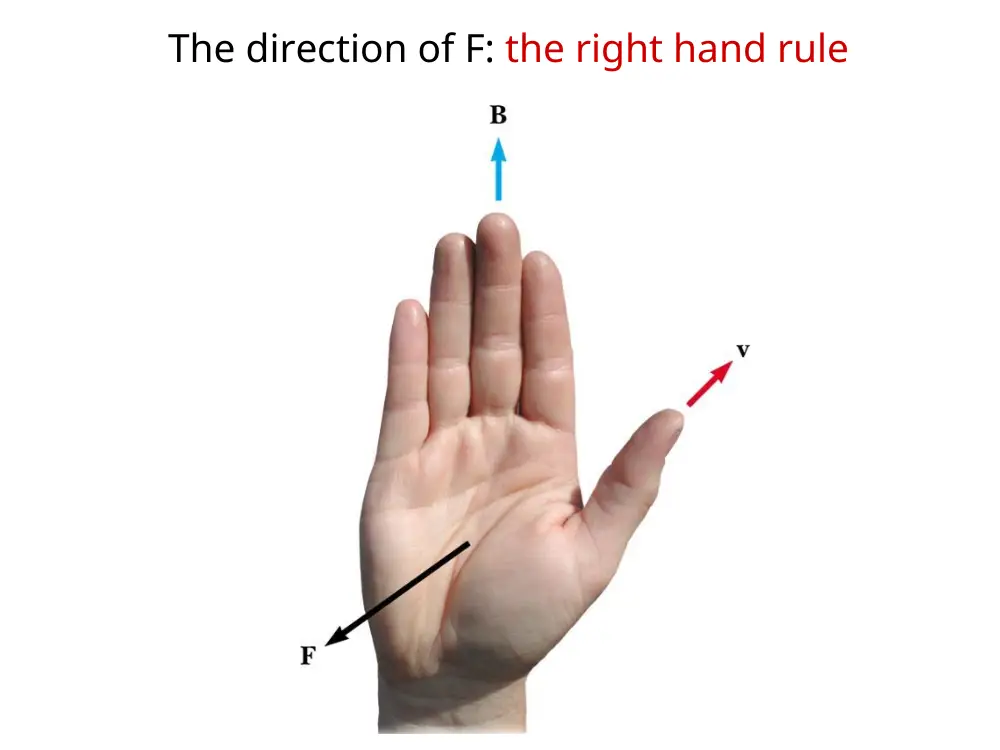
The direction of F: the right hand rule
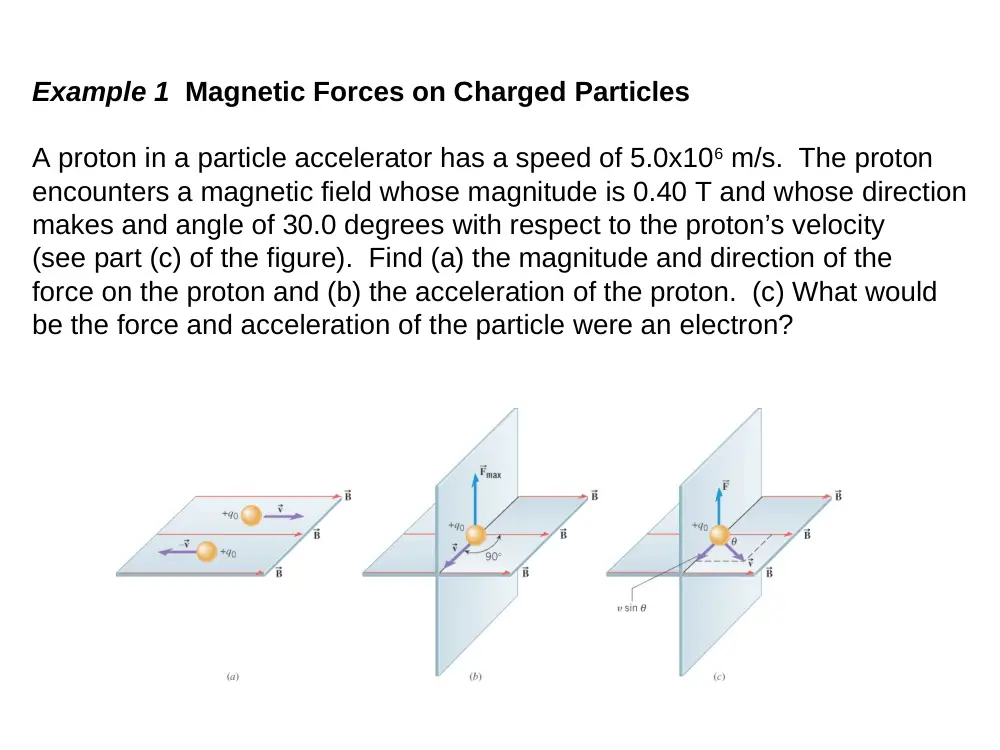
Example 1 Magnetic Forces on Charged Particles
A proton in a particle accelerator has a speed of 5.0x10⁶ m/s. The proton
encounters a magnetic field whose magnitude is 0.40 T and whose direction
makes and angle of 30.0 degrees with respect to the proton’s velocity
(see part (c) of the figure). Find (a) the magnitude and direction of the
force on the proton and (b) the acceleration of the proton. (c) What would
be the force and acceleration of the particle were an electron?
N
10
6.1
.0 40T sin 30 0.
10 m s
0.5
C
.1 60 10
sin
13
6
19
q vB
F
o
(a)
(b)
(c)
2
13
27
13
p
10 m s
6.9
kg
67 10
.1
N
10
6.1
m
F
a
Magnitude is the same, but direction is opposite.
2
17
31
13
e
m s
10
8.1
kg
11 10
.9
N
10
6.1
m
F
a
3- The Motion of a Charged Particle
in a Magnetic Field
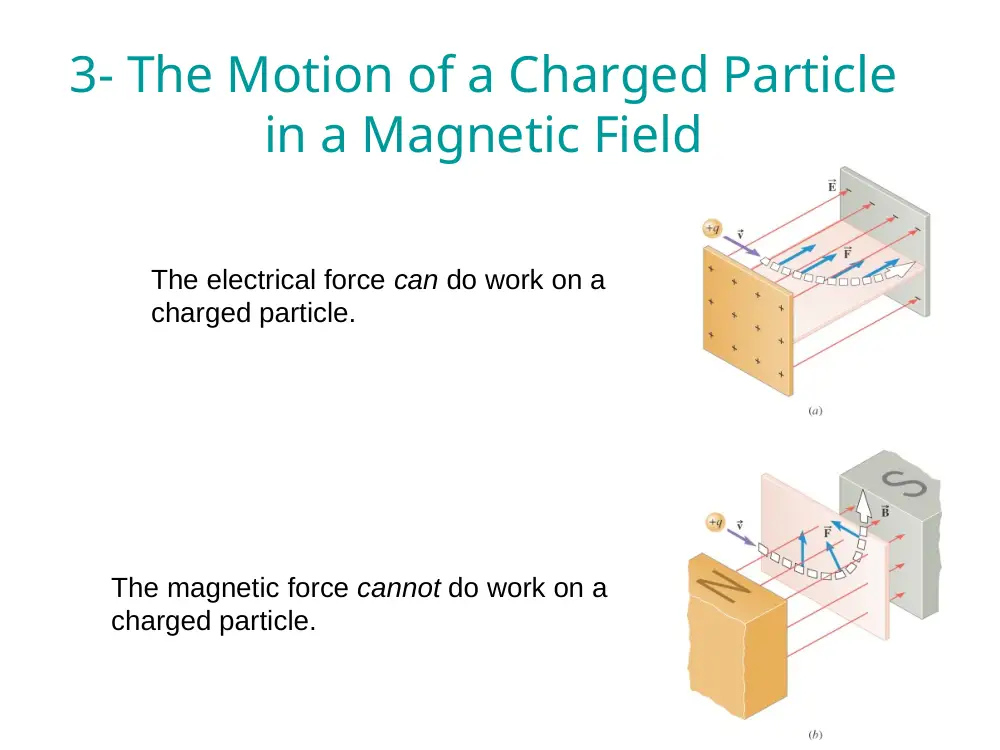
The electrical force can do work on a
charged particle.
The magnetic force cannot do work on a
charged particle.
The magnetic force always remains
perpendicular to the velocity and is
directed toward the center of the
circular path.
r
m v
Fc
2
r
m v
qvB
2
qB
r mv
The trajectory of an electron moving in
a magnetic field
4- The Mass Spectrometer
eB
mv
qB
mv
r
mv eV
2
2
1
magnitude of
electron charge
KE=PE
2
2
2
B
V
er
m
The mass spectrum of naturally
occurring neon, showing three
isotopes.
5- The Force on a Current in a Magnetic
Field
The magnetic force on the
moving charges pushes the
wire to the right.
qvBsin
F
v t Bsin
t
q
F
L
I
F ILBsin
Example 5 The Force and Acceleration in a Loudspeaker
The voice coil of a speaker has a diameter of 0.0025 m, contains 55 turns of
wire, and is placed in a 0.10-T magnetic field. The current in the voice coil is
2.0 A. (a) Determine the magnetic force that acts on the coil and the
cone. (b) The voice coil and cone have a combined mass of 0.0200 kg. Find
their acceleration.
(a)
86 N
.0
.0 10 T sin 90
.0 0025 m
A 55
0.2
sin
ILB
F
(b)
2s
43m
020 kg
.0
.0 86 N
m
F
a
6- The Torque on a Current-Carrying
Coil
Forces acting on each
segment of the loop:
1 and 2 : I and B are parallel,
thus F = 0
2 and 3 : F2 = I.B.b, into the
page
3 and 4 : I and B are parallel,
thus F = 0
4 and 1 : F1 = I.B.b, out of
the page
1
4
3
2
Loop fixed so that it rotates
about the axis O.
Torque =
F1. a / 2 + F2. a / 2
= I.B.b.a
= I.B.A.sin
With A being the area of the
loop
For N loops, the torque is:
= N.I.B.A.sin
Bottom view
Example 6 The Torque Exerted on a Current-Carrying Coil
A coil of wire has an area of 2.0x10⁻⁴m2, consists of 100 loops or turns,
and contains a current of 0.045 A. The coil is placed in a uniform magnetic
field of magnitude 0.15 T. (a) Determine the magnetic moment of the coil.
(b)Find the maximum torque that the magnetic field can exert on the
coil.
(a)
2
4
2
4
moment
magnetic
A m
10
0.9
m
10
0.2
.0 045 A
100
NIA
N m
10
4.1
.0 15 T sin 90
A m
10
0.9
sin
4
2
4
moment
magnetic
NIA B
(b)
7- Magnetic Fields Produced by
Currents
A current-carrying wire produces a magnetic field
Right-Hand Rule No. 2. Curl the fingers of the
right hand into the shape of a half-circle. Point
the thumb in the direction of the conventional
current, and the tips of the fingers will point
in the direction of the magnetic field.
r
I
B
o
2
T m A
10
4
7
o
permeability of
free space
Magnetic Field Created by a Current in
a Long, Strait Wire
Example 7 A Current Exerts a Magnetic Force on a Moving Charge
The long straight wire carries a current
of 3.0 A. A particle has a charge of
+6.5x10⁻⁶ C and is moving parallel to
the wire at a distance of 0.050 m. The
speed of the particle is 280 m/s.
Determine the magnitude and direction
of the magnetic force on the particle.
sin
2
sin
r
I
qv
qvB
F
o
r
I
B
o
2
Magnetic Force Between Two Parallel
Conductors
1,2
magnetic field created by wire 1 on wire 2
B
0 1
1,2
2
I
B
d
1,2
2
. 1,2
.
Force due to magnetic field on wire 2 of lengh
F
I B
l
l
0 1 2
1,2
.
2
I I
F
l
d
F2,1 has the same magnitude as F1,2 but it is
downwards
This results in attraction between the two
wires
Parallel conductors carrying currents in the
same direction attract each other
Parallel conductors carrying currents in the
opposite directions repel each other
Magnetic Field of a Current Loop
center of circular loop
R
I
B
o
2
The field lines around the bar magnet resemble those around the loop.
Example 10 Finding the Net Magnetic Field
A long straight wire carries a current of 8.0 A and a circular loop of
wire carries a current of 2.0 A and has a radius of 0.030 m. Find the
magnitude and direction of the magnetic field at the center of the loop.
Magnetic Field of a Solenoid
Interior of a solenoid
nI
B
o
number of turns per
unit length
8- Ampère’s Law
Ampère’s law states that the line integral around
any closed path equals µo I where I is the total
steady current passing through any surface
bounded by the closed path.
µo = 4 x 10⁻⁷ T m / A (permeability of free space)
.
.
.(2
)
o
o
o
o
B ds
I
B ds
I
B ds
I
B
r
I
2
oI
B
r
Simplified Ampere’s Law For Static
Magnetic Fields
For any current geometry that produces a
magnetic field that does not change in time,
I
B
o
||
net current
passing through
surface bounded
by path
Example 11 An Infinitely Long, Straight, Current-Carrying Wire
Use Ampere’s law to obtain the magnetic field.
I
B
o
||
I
B
o
I
r
B
o
2
r
I
B
o
2
9- Magnetic Materials
The intrinsic “spin” and orbital motion of electrons gives rise to the magnetic
properties of materials.
In ferromagnetic materials groups of neighboring atoms, forming
magnetic domains, the spins of electrons are naturally aligned with
each other.
Soft magnetic materials, such as iron, are
easily magnetized. They also tend to lose
their magnetism easily
Hard magnetic materials, such as cobalt and
nickel, are difficult to magnetize. They tend
to retain their magnetism