
PHYS 205 Chapter 28, Fall 2017
American University of Beirut · Modern Physics for Life Sciences · 28 pages · Mr. Roy Aad

Showing the first 10 of 28 pages. Download the PDF to see all of it.
More PHYS 205 files
Show the text of this chapter
Chapter 28
Special Relativity
1.
Events and Inertial
Reference Frames
2.
The Postulates of Special
Relativities
3.
The Relativity of Time:
Time Dilation
4.
The Relativity of Length:
Length Contraction
5.
Relativistic Momentum
6.
The Equivalence of Mass
Energy
7.
The Relativistic Addition
of Velocities
Outline
Physics at the turn of the
century
Mechanics Newton
Statistical and thermal physics laws
of thermodynamics and kinetic theory of
gases
Electromagnetism Maxwell
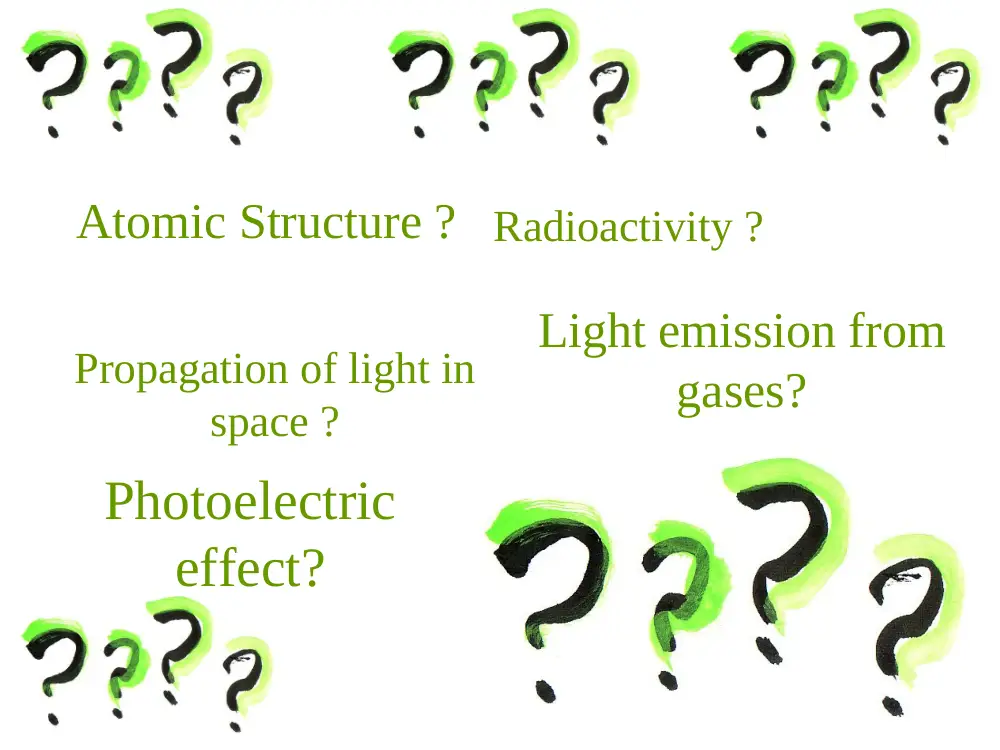
Atomic Structure ?
Propagation of light in
space ?
Radioactivity ?
Photoelectric
effect?
Light emission from
gases?
Modern physics
1900 … present
An event is a physical “happening” that occurs at a
certain place and
time.
To record the event, each observer uses a reference frame
that consists of a
coordinate system and a clock.
Each observer is at rest relative to her own reference frame.
An inertial reference frame is one in which Newton’s
law of inertia is
valid.
1- Events and inertial reference frames
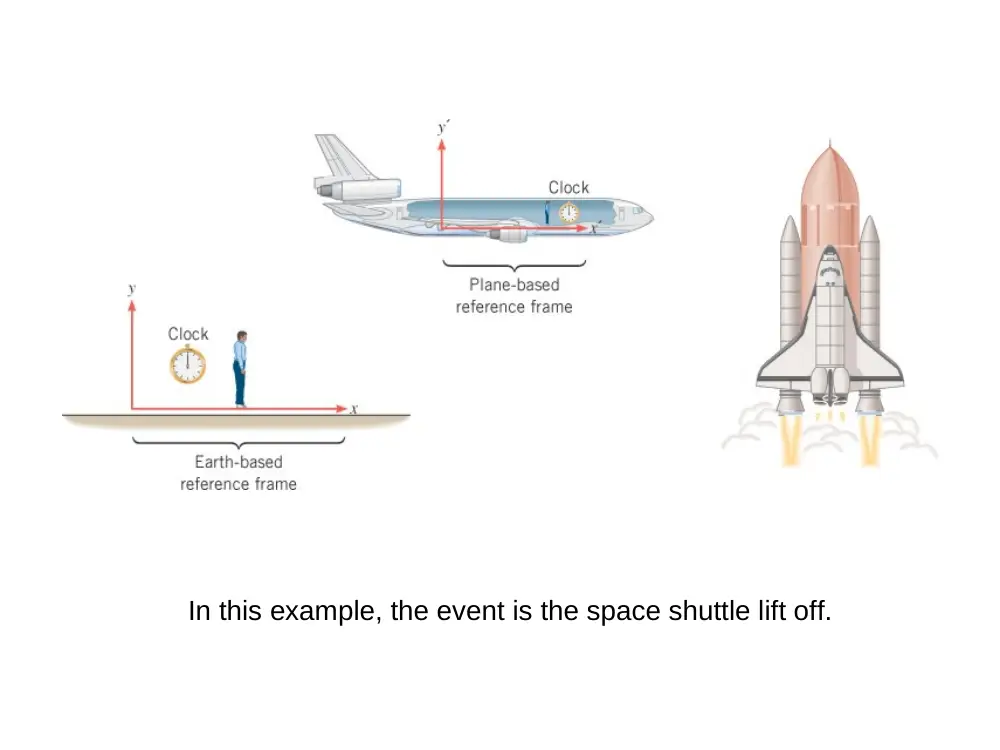
In this example, the event is the space shuttle lift off.
ˆ
velocity of system S with respect to S'
x
v
v i
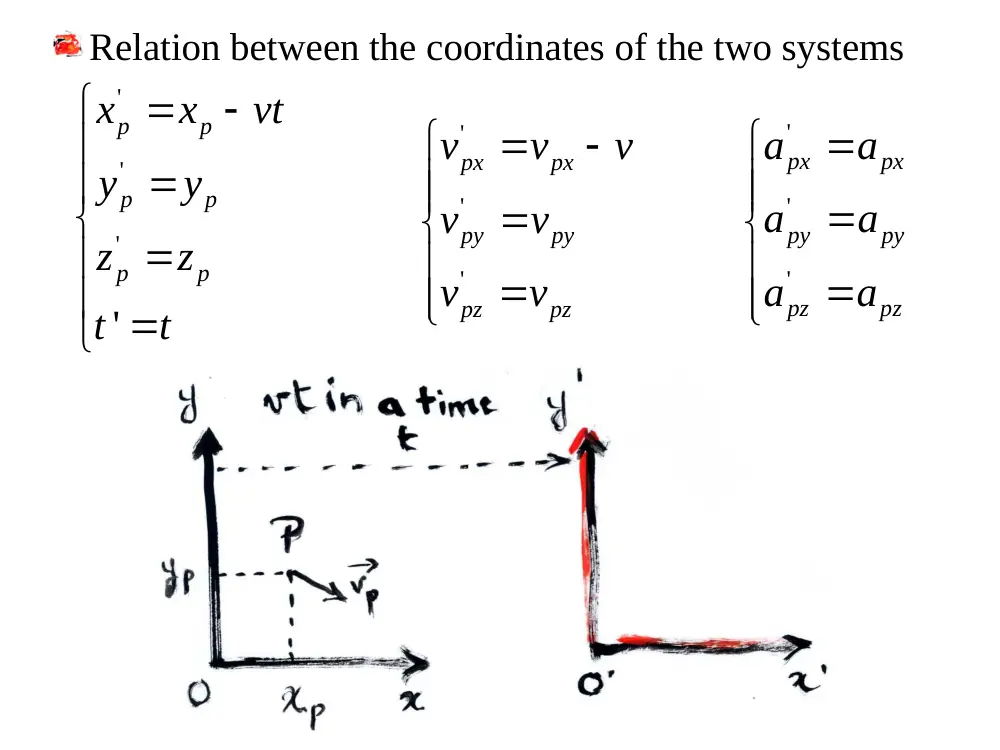
Relation between the coordinates of the two systems
'
'
'
'
p
p
p
p
p
p
x
x
vt
y
y
z
z
t
t
'
'
'
px
px
py
py
pz
pz
a
a
a
a
a
a
'
'
'
px
px
py
py
pz
pz
v
v
v
v
v
v
v
Inertial frames are reference frames in
which Newton’s Laws of Mechanics are
valid (and vice versa).
These are Galilean transformations of
coordinates velocity and acceleration.
All Newtonian physics applies in such
frames.
2- The postulates of special relativity
1.The Relativity Postulate. The laws of physics are the same
in every inertial reference frame.
2.The Speed of Light Postulate. The speed of light in a vacuum
,measured in any inertial reference frame, always has the same
value of c, no matter how fast the source of light and the observer
are moving relative to one another.
3- The relativity of time: time dilation
Time measured by O’ (observer at rest in the vehicle)
2
distance
Proper time
speed
p
d
t
c
For the observer O at rest in the the stationary frame,
Speed remains constant, but distance has increased
distance
speed
t
p
t
t
A clock in motion runs more slowly than an
identical stationary clock (muons, twins paradoxes)
Indeed,
2
2
2
2
1
1
with
1
1
p
p
t
t
t
v
c
v
c
2
2
2
2
2
2
1
d
d
c
t
c
v
v
c
2
2
2
2
4
4
c
v
t
d
2
2
2
2
2
c t
v t
d
Example 1 Time Dilation
The spacecraft is moving past the earth at a constant speed of
0.92 times the speed of light. the astronaut measures the time
interval between ticks of the spacecraft clock to be 1.0 s. What is
the time interval that an earth observer measures?
s 6.2
.0 92
1
s 0.1
1
2
2
2
c c
c
v
t
t
o
The time interval measured at rest with respect to the clock is
called the proper time interval.
In general, the proper time interval between events is the time
interval measured by an observer who is at rest relative to the
events.
Proper time interval
ot
Proper time interval
4- The relativity of length: length contraction
Lp is the proper length of an
object as measured by someone
at rest relative to the object
L is the length measured by the
observer in the spaceship
Relative to Earth, t = LP / v to go from star 1 to star 2
Relative to spaceship,
(due to time dilation )
p
t
t
2
2
P 1
v
L
L
c
LP
L
p
t
L
v t
v
Length contraction takes place only along the direction of motion
No contraction
Example 4 The Contraction of a Spacecraft
An astronaut, using a meter stick that is at rest relative to a cylindrical
spacecraft, measures the length and diameter to be 82 m and 21 m
respectively. The spacecraft moves with a constant speed of 0.95c
relative to the earth. What are the dimensions of the spacecraft,
as measured by an observer on earth.
26 m
.0 95
1
82 m
1
2
2
2
c c
c
v
L
L
o
Diameter stays the same.
5- Relativistic Momentum
v is the speed of the particle, m is its mass as measured by an observer at rest
with respect to the mass
When v << c, the denominator approaches 1 and so p approaches mv
(classical).
2
2
1
mv
p
mv
v
c
6- The equivalence of
mass and energy
The definition of kinetic energy requires
modification in relativistic mechanics
The kinetic energy is written:
KE = mc2 – mc2
The rest energy is written: ER = mc2
The total energy
2
2
TOT
2
2
mc
E
= mc =
1 v
c
Energy and Relativistic
Momentum
E2 = p2c2
+ (mc2)2
When the particle is at rest, p = 0 and E = mc2
Massless particles (m = 0) have E = pc
This is also used to express masses in
energy units
mass of an electron = 9.11 x 10⁻³¹ kg = 0.511
MeV/c2
Conversion: 1 u = 929.494 MeV/c2
Conceptual Example 9 When is a Massless Spring Not Massless?
The spring is initially unstrained and assumed to be massless. Suppose
that the spring is either stretched or compressed. Is the mass of
the spring still zero, or has it changed? If the mass has changed, is
the mass change greater for stretching or compressing?
6- The relativistic addition of
velocities
vmo = velocity of the motorcycle
with respect stationary observer.
Vbm = velocity of the ball with
respect to motorcycle
vbo = velocity of ball with
respect to the stationary
observer
2
1
bm
mo
bo
bm
mo
v
v
v
v v
c