
PHYS 210 Problems Chapter 6, Fall 2015
American University of Beirut · Introductory Physics II · 4 pages


More PHYS 210 files
Show the text of this chapter
Chapter VI
Class problems Solution
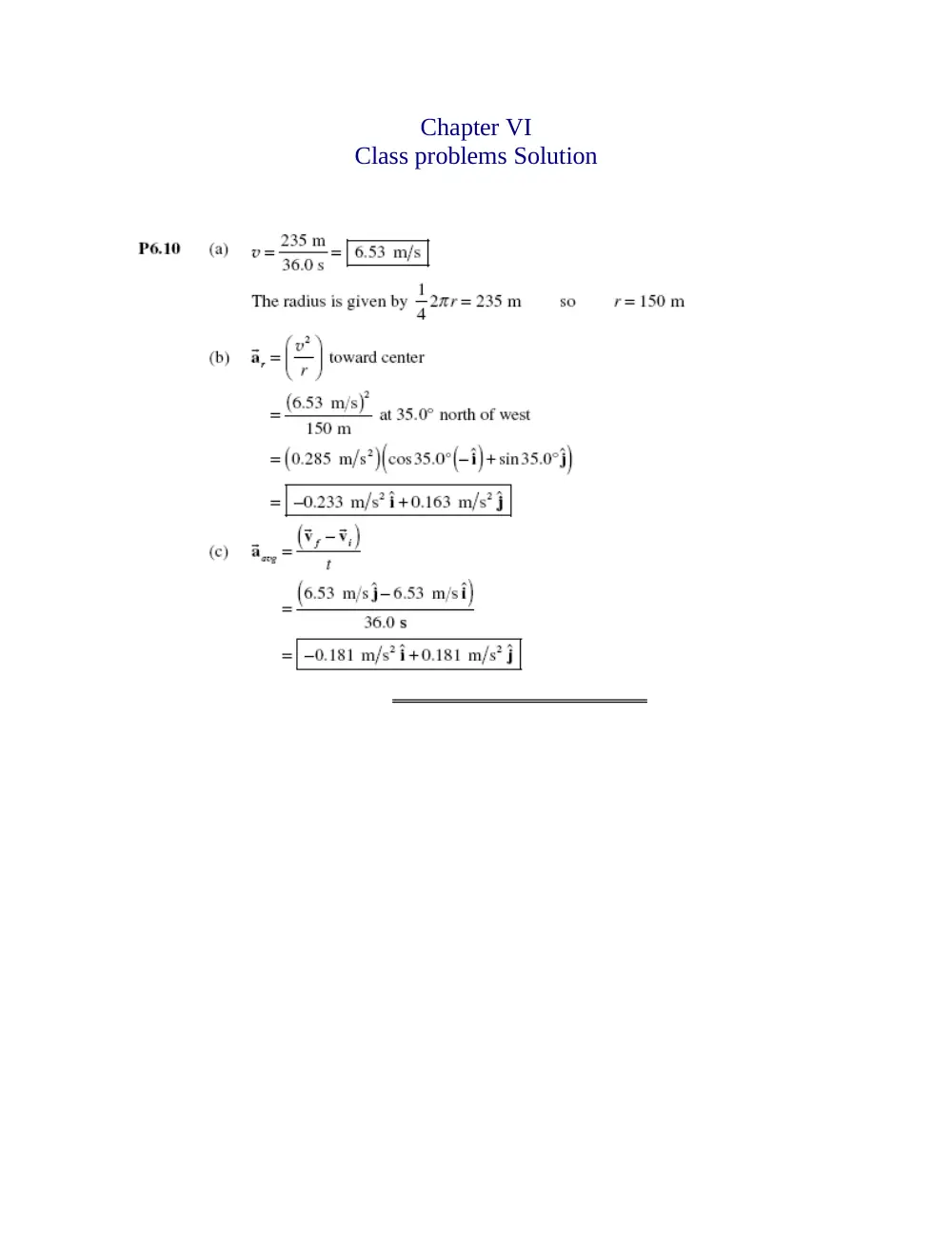
235 -
P6.10 (a) po m 6.53 m/s
36.0's -
The radius is given by qar= 235 m so r=150m
3°
i v
(b) a= | | toward center
y
\
_ (6.53 m/s)
150m
=(0.285 m/s*)(cos35.0°(-i) +sin35.0°j]
at 35.0° north of west
=| 0.233 m/s?i+0.163 m/s*j
(¥,-¥,)
cng ;
(6.53 m/sj-6.53 mjsi)
~ 36.0 s
=| -0.181 m/s?i+0.181 m/s" j
P6.14 (a) v=20.0 m/s,
n= force of track on roller coaster, and
R=10.0m
Mo
DF= Ro Ms FIG. P6.14
From this we find
500 kg)(20.0 m/s*
n= Mg+ 2 = (500 kg)(9.80 mn/s2) + (500 8)(20.0 m/s")
R 10.0 m
n= 4900 N+20000 N=| 2.49x 10° N
2
(b) ALB, n—Mg=-*2
R
The maximum speed at B corresponds to
n=0
2
-Mg=- ee = v,,, = VRg = V15.0(9.80) =] 12.1 m/s
23. Let the tensions on the strings connecting m2 and m; be 7>;, and that connecting m2
and m, be 7,2, respectively. Applying Newton’s second law (and Eq. 6-2, with Fy = mg
in this case) to the system we have
m,g —T,, =m,a
T,, — 4m,g —T,, =m,a
T,—-mg=ma
Adding up the three equations and using m, = M,m, =m, =2M, we obtain
2Mg — 244. Mg — Mg=5Ma.
With a = 0.500 m/s this yields zz = 0.372. Thus, the coefficient of kinetic friction is
roughly zu = 0.37.
26.
Fnax = F, +ma=591 N
Fain =F, —ma=391 N
(a) Adding, 2F, =982 N, F, =| 491 N
, . 491 N =
(b) Since F. = mg, mm =——— =| 50.1 kg
9.80 m/s?
(c) Subtracting the above equations,
2ma = 200 N -.a=| 2.00 m/s?
P6.58 (a) Since the object of mass 7m is in equilibrium, DF, =T-mg=0
or T=| mgg |.
(b) The tension in the string provides the required centripetal acceleration of the puck.
Thus, F, =T =| mg |.
mv"
(c) From F.= R
| RE.
we have v= |—=
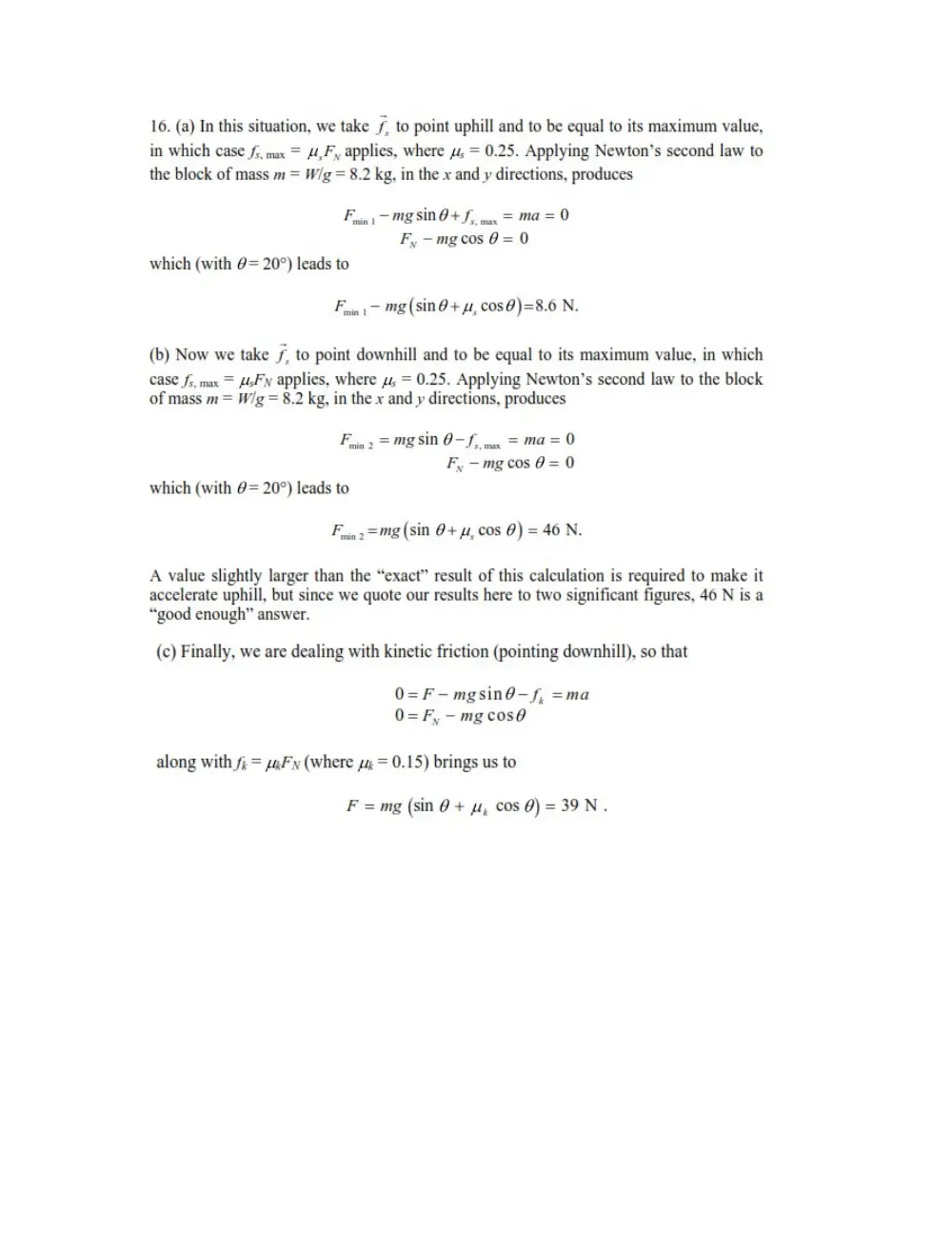
16. (a) In this situation, we take f. to point uphill and to be equal to its maximum value,
in which case f;, max = 4,Fy applies, where 44, = 0.25. Applying Newton’s second law to
the block of mass m = Wig = 8.2 kg, in the x and y directions, produces
Fig, —mgsind+ f, ,.. = ma=0
. max
F, —mgcos @= 0
which (with @= 20°) leads to
F.
— mg(sin@+ yu, cos@)=8.6 N.
(b) Now we take f, to point downhill and to be equal to its maximum value, in which
case fi max = fF applies, where yz, = 0.25. Applying Newton’s second law to the block
of mass m = Wig = 8.2 kg, in the x and y directions, produces
Fin 2 = mgsin O—f. ,., = ma=0
F,, —mg cos 0= 0
which (with @= 20°) leads to
F.
min 2
=mg (sin 0+ yu, cos @) = 46 N.
A value slightly larger than the “exact” result of this calculation is required to make it
accelerate uphill, but since we quote our results here to two significant figures, 46 N is a
“good enough” answer.
(c) Finally, we are dealing with kinetic friction (pointing downhill), so that
0=F-—mgsind—f, =ma
0=F,-—mgcosé
along with fi = a/v (where zy = 0.15) brings us to
F = mg (sin 0 + yt, cos @)=39N.