
CHM 201 Problems Solution for Chap 3 Exercises, Fall 2013
Lebanese American University · Chemical Principles · 39 pages · with solution



Showing the first 10 of 39 pages. Download the PDF to see all of it.
More CHM 201 files
- Questions Exam Quest · Fall 2015ProblemsView
- Problems Solution for Chap 7 · Fall 2013Problems · with solutionView
- Problems Solution for Chap 8 · Fall 2013Problems · with solutionView
- Problems Solution Manual · Fall 2013Problems · with solutionView
- Problems Solution for Chap 4 Exercises · Fall 2013Problems · with solutionView
- Problems Solution for Chap 5 Exercises · Fall 2013Problems · with solutionView
- Problems Solution for Chap 6 · Fall 2013Problems · with solutionView
- Final Sample · Spring 2017Final examView
Show the text of this problems
17
CHAPTER 3
STOICHIOMETRY
Atomic Masses and the Mass Spectrometer
23.
186.207 = 0.6260(186.956) + 0.3740(A), 186.207 117.0 = 0.3740(A)
A =
3740
.0
69 2.
= 185 amu (A = 184.95 amu without rounding to proper significant figures)
24.
A = 0.0140(203.973) + 0.2410(205.9745) + 0.2210(206.9759) + 0.5240(207.9766)
A = 2.86 + 49.64 + 45.74 + 109.0 = 207.2 amu; from the periodic table, the element is Pb.
25.
Average atomic mass = A = 0.0800(45.95269) + 0.0730(46.951764) + 0.7380(47.947947)
+ 0.0550(48.947841) + 0.0540(49.944792) = 47.88 amu
This is element Ti (titanium).
26.
Because we are not given the relative masses of the isotopes, we need to estimate the masses
of the isotopes. A good estimate is to assume that only the protons and neutrons contribute to
the overall mass of the atom and that the atomic mass of a proton and neutron are each 1.00
amu. So the masses are about: 54Fe, 54.00 amu; 56Fe, 56.00 amu; 57Fe, 57.00 amu; 58Fe,
58.00 amu. Using these masses and the abundances given in the mass spectrum, the
calculated average atomic mass would be:
0.0585(54.00) + 0.9175(56.00) + 0.0212(57.00) + 0.0028(58.00) = 55.91 amu
The average atomic mass listed in the periodic table is 55.85 amu.
27.
If silver is 51.82% 107Ag, then the remainder is 109Ag (48.18%). Determining the atomic
mass (A) of 109Ag:
107.868 =
100
48.18(A)
51.82(106.905)
10786.8 = 5540. + (48.18)A, A = 108.9 amu = atomic mass of 109Ag
28.
Let x = % of 151Eu and y = % of 153Eu, then x + y = 100 and y = 100 x.
151.96 =
100
)(152.9209)
(100
(150.9196)
x
x
15196 = (150.9196)x + 15292.09 (152.9209)x, 96 = (2.0013)x
x = 48%; 48% 151Eu and 100 48 = 52% 153Eu
18 CHAPTER 3 STOICHIOMETRY
29.
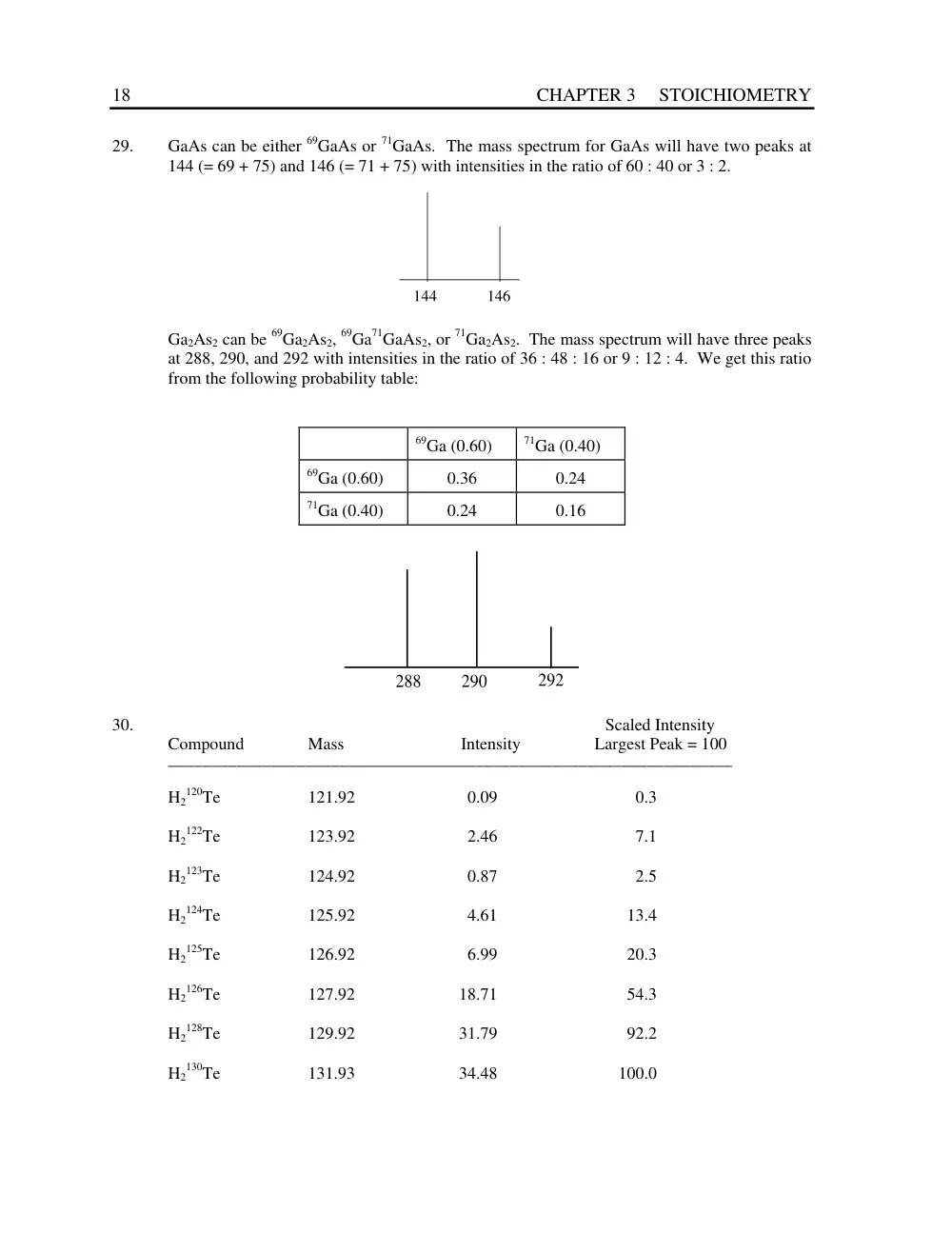
GaAs can be either 69GaAs or 71GaAs. The mass spectrum for GaAs will have two peaks at
144 (= 69 + 75) and 146 (= 71 + 75) with intensities in the ratio of 60 : 40 or 3 : 2.
Ga2As2 can be 69Ga2As2, 69Ga71GaAs2, or 71Ga2As2. The mass spectrum will have three peaks
at 288, 290, and 292 with intensities in the ratio of 36 : 48 : 16 or 9 : 12 : 4. We get this ratio
from the following probability table:
69Ga (0.60)
71Ga (0.40)
69Ga (0.60)
0.36
0.24
71Ga (0.40)
0.24
0.16
288
290
292
30.
Scaled Intensity
Compound
Mass
Intensity
Largest Peak = 100
__________________________________________________________________
H2
120Te
121.92
0.09
0.3
H2
122Te
123.92
2.46
7.1
H2
123Te
124.92
0.87
2.5
H2
124Te
125.92
4.61
13.4
H2
125Te
126.92
6.99
20.3
H2
126Te
127.92
18.71
54.3
H2
128Te
129.92
31.79
92.2
H2
130Te
131.93
34.48
100.0
144
146
CHAPTER 3 STOICHIOMETRY
19
31.
There are three peaks in the mass spectrum, each 2 mass units apart. This is consistent with
two isotopes, differing in mass by two mass units. The peak at 157.84 corresponds to a Br2
molecule composed of two atoms of the lighter isotope. This isotope has mass equal to
157.84/2, or 78.92. This corresponds to 79Br. The second isotope is 81Br with mass equal to
161.84/2 = 80.92. The peaks in the mass spectrum correspond to 79Br2, 79Br81Br, and 81Br2 in
order of increasing mass. The intensities of the highest and lowest masses tell us the two
isotopes are present at about equal abundance. The actual abundance is 50.68% 79Br and
49.32% 81Br.
Moles and Molar Masses
32.
4.24 g C6H6 ×
.11g
78
1mol
= 5.43 ×
2
10 mol C6H6
5.43 ×
2
10 mol C6H6 ×
mol
molecules
10
.6 022
23
= 3.27 × 10²² molecules C6H6
Each molecule of C6H6 contains 6 atoms C + 6 atoms H = 12 atoms total.
3.27 × 10²² molecules C6H6 ×
molecule
12atomstotal
= 3.92 × 10²³ atoms total
0.224 mol H2O ×
mol
18.02g
= 4.04 g H2O
0.224 mol H2O ×
mol
molecules
10
.6 022
23
= 1.35 × 10²³ molecules H2O
1.35 × 10²³ molecules H2O ×
molecule
3 atomstotal
= 4.05 × 10²³ atoms total
2.71 × 10²² molecules CO2 ×
molecules
10
022
.6
mol
1
23
= 4.50 ×
2
10 mol CO2
100
50
0
122
124
126
128
130
132
134
20 CHAPTER 3 STOICHIOMETRY
4.50 ×
2
10 mol CO2 ×
mol
44.01g
= 1.98 g CO2
2.71 × 10²² molecules CO2 ×
CO2
molecule
3 atomstotal
= 8.13 × 10²² atoms total
3.35 × 10²² atoms total ×
atomstotal
6
1molecule
= 5.58 × 10²¹ molecules CH3OH
5.58 × 10²¹ molecules CH3OH ×
molecules
10
022
.6
mol
1
23
= 9.27 ×
3
10 mol CH3OH
9.27 ×
3
10 mol CH3OH ×
mol
32.04g
= 0.297 g CH3OH
33. 4.0 g H2 ×
molH
1
atoms H
10
022
.6
molH
1
molH
2
016g H
.2
1molH
23
2
2
2
= 2.4 × 1024 atoms
4.0 g He ×
molHe
1
atoms He
10
022
.6
003g He
.4
1molHe
23
= 6.0 × 10²³ atoms
1.0 mol F2 ×
molF
1
atomsF
10
022
.6
molF
1
2 molF
23
2
= 1.2 × 1024 atoms
44.0 g CO2 ×
molatoms
1
atoms
10
022
.6
molCO
1
2 O)
molatoms 1( C
3
.01g CO
44
1molCO
23
2
2
2
= 1.81 × 1024 atoms
146 g SF6 ×
molatoms
1
atoms
022 10
.6
molSF
1
6 F)
molatoms 1( S
7
.07 g SF
146
1molSF
23
6
6
6
= 4.21 × 1024 atoms
The order is: 4.0 g He < 1.0 mol F2 < 44.0 g CO2 < 4.0 g H2 < 146 g SF6
34.
Molar mass of C6H8O6 = 6(12.011) + 8(1.0079) + 6(15.999) = 176.123 g/mol
500.0 mg ×
.12g
176
mol
1
mg
1000
1g
= 2.839 ×
3
10 mol
2.839 × 10⁻³ mol
mol
molecules
10
.6 022
23
= 1.710 × 10²¹ molecules
35.
a. 9(12.011) + 8(1.0079) + 4(15.999) = 180.158 g/mol
b. 500. mg ×
g
180.16
mol
1
mg
1000
1g
= 2.78 ×
3
10 mol
CHAPTER 3 STOICHIOMETRY
21
2.78 ×
3
10 mol ×
mol
molecules
10
.6 022
23
= 1.67 × 10²¹ molecules
36.
a. 14 mol C ×
C
mol
12.011g
+ 18 mol H ×
H
mol
.1 0079g
+ 2 mol N ×
N
mol
14.007g
+ 5 mol O ×
O
mol
15.999g
= 294.305 g/mol
b. 10.0 g C14H18N2O5 ×
5
2
18
14
5
2
18
14
3. g C H N O
294
1molC H N O
= 3.40 × 10² mol C14H18N2O5
c. 1.56 mol ×
mol
294 3. g
= 459 g C14H18N2O5
d. 5.0 mg ×
mol
molecles
02 10
.6
3. g
294
mol
1
mg
1000
1g
23
= 1.0 × 10¹⁹ molecules C14H18N2O5
e. 1.2 g C14H18N2O5 ×
N
mol
atomsN
10
02
.6
C H N O
mol
molN
2
3. g C H N O
294
1molC H N O
23
5
2
18
14
5
2
18
14
5
2
14 18
= 4.9 × 10²¹ atoms N
f.
1.0 × 10⁹ molecules ×
mol
3. g
294
atoms
10
02
.6
mol
1
23
= 4.9 × 10¹³ g
g. 1 molecule
mol
.305g
294
atoms
10
022
.6
mol
1
23
= 4.887 × 10²² g C14H18N2O5
37.
a.
2(12.01) + 3(1.008) + 3(35.45) + 2(16.00) = 165.39 g/mol
b. 500.0 g ×
.39 g
165
1 mol
= 3.023 mol C2H3Cl3O2
c. 2.0 × 10⁻² mol ×
mol
165.39g
= 3.3 g C2H3Cl3O2
d. 5.0 g C2H3Cl3O2 ×
molecule
atomsCl
3
mol
molecules
10
02
.6
.39g
165
1mol
23
= 5.5 × 10²² atoms of chlorine
e.
1.0 g Cl ×
2
3
3
2
2
3
3
2
2
3
3
2
C H Cl O
mol
.39g C H Cl O
165
molCl
3
molC H Cl O
1
.45g
35
1molCl
= 1.6 g chloral hydrate
22 CHAPTER 3 STOICHIOMETRY
f.
500 molecules ×
mol
.39g
165
molecules
10
022
.6
mol
1
23
= 1.373 × 10¹⁹ g
38.
1.0 lb flour ×
2
4
2
2
4
2
2
4
2
9
9. g C H Br
187
molC H Br
1
flour
g
g C H Br
10
0.
30
flour
lb
454g flour
2
4
2
23
C H Br
mol
molecules
10
.6 02
= 4.4 × 10¹⁶ molecules C2H4Br2
39.
a. 20.0 mg C8H10N4O2 ×
.20g
194
mol
1
mg
1000
1g
= 1.03 ×
4
10 mol C8H10N4O2
b. 2.72 × 10²¹ molecules C2H5OH ×
molecules
10
022
.6
mol
1
23
= 4.52 ×
3
10 mol C2H5OH
c. 1.50 g CO2 ×
.01g
44
1mol
= 3.41 ×
2
10 mol CO2
40. a. A chemical formula gives atom ratios as well as mole ratios. We will use both ratios to
illustrate how these conversion factors can be used.
Molar mass of C2H5O2N = 2(12.01) + 5(1.008) + 2(16.00) + 14.0l = 75.07 g/mol
5.00 g C2H5O2N ×
C H O N
mol
10 molecules C H O N
022
.6
.07 g C H O N
75
molC H O N
1
2
5
2
2
5
2
23
2
5
2
2
5
2
×
C H O N
molecule
atomN
1
2
5
2
= 4.01 × 10²² atoms N
b. Molar mass of Mg3N2 = 3(24.31) + 2(14.01) = 100.95 g/mol
5.00 g Mg3N2 ×
2
3
2
3
23
2
3
2
3
Mg N
mol
formulaunitsMg N
10
022
.6
.95g Mg N
100
1molMg N
Mg3N2
mol
2 atoms
= 5.97 × 10²² atoms N
c. Molar mass of Ca(NO3)2 = 40.08 + 2(14.01) + 6(16.00) = 164.10 g/mol
5.00 g Ca(NO3)2 ×
2
3
2
3
.10g Ca(NO )
164
molCa(NO )
1
Ca(NO3)2
mol
2 molN
N
mol
atomsN
10
.6 022
23
= 3.67 × 10²² atoms N
CHAPTER 3 STOICHIOMETRY
23
d. Molar mass of N2O4 = 2(14.01) + 4(16.00) = 92.02 g/mol
5.00 g N2O4 ×
4
2
4
2
4
2
N O
mol
molN
2
.02g N O
92
1molN O
N
mol
atomsN
10
.6 022
23
= 6.54 × 10²² atoms N
Percent Composition
41.
NO: Mass % N =
.01g NO
30
14.01g N
× 100 = 46.68% N
NO2: Mass % N =
.01g NO2
46
14.01g N
× 100 = 30.45% N
N2O: Mass % N =
.02g N O
44
(14.01) g N
2
2
× 100 = 63.65% N
From the calculated mass percents, only NO is 46.7% N by mass, so NO could be this
species. Any other compound having NO as an empirical formula could also be the
compound.
42.
a. C8H10N4O2: Molar mass = 8(12.01) + 10(1.008) + 4(14.0l) + 2(16.00) = 194.20 g/mol
Mass % C =
2
4
8 10
.20g C H N O
194
8(12.01) g C
× 100 =
.20
194
96.08
× 100 = 49.47% C
b. C12 H22O11: Molar mass = 12(12.01) + 22(1.008) + 11(16.00) = 342.30 g/mol
Mass % C =
11
22
12
.30g C H O
342
12(12.01) g C
× 100 = 42.10% C
c. C2H5OH: Molar mass = 2(12.01) + 6(1.008) + 1(16.00) = 46.07 g/mol
Mass % C =
.07 g C H OH
46
(12.01) g C
2
5
2
× 100 = 52.14% C
The order from lowest to highest mass percentage of carbon is:
sucrose (C12H22O11) < caffeine (C8H10N4O2) < ethanol (C2H5OH)
43.
Molar mass = 20(12.01) + 29(1.008) + 19.00 + 3(16.00) = 336.43 g/mol
24 CHAPTER 3 STOICHIOMETRY
Mass % C =
.43g compound
336
20(12.01) g C
× 100 = 71.40% C
Mass % H =
.43g compound
336
29 .1( 008) g H
× 100 = 8.689% H
Mass % F =
.43g compound
336
19.00g F
× 100 = 5.648% F
Mass % O = 100.00 (71.40 + 8.689 + 5.648) = 14.26% O or:
Mass % O =
.43g compound
336
(3 16.00) g O
× 100 = 14.27% O
44.
a. C3H4O2: Molar mass = 3(12.011) + 4(1.0079) + 2(15.999) = 36.033 + 4.0316 + 31.998
= 72.063 g/mol
Mass % C =
g compound
72.063
36.033g C
× 100 = 50.002% C
Mass % H =
g compound
72.063
4.0316g H
× 100 = 5.5945% H
Mass % O = 100.000 (50.002 + 5.5945) = 44.404% O or:
% O =
g
72.063
31.998g
× 100 = 44.403% O
b. C4H6O2: Molar mass = 4(12.011) + 6(1.0079) + 2(15.999) = 48.044 + 6.0474 + 31.998
= 86.089 g/mol
Mass % C =
g
86.089
48.044g
× 100 = 55.807% C; mass % H =
g
86.089
6.0474g
× 100 = 7.0246% H
Mass % O = 100.000 (55.807 + 7.0246) = 37.168% O
c. C3H3N: Molar mass = 3(12.011) + 3(1.0079) + 1(14.007) = 36.033 + 3.0237 + 14.007
= 53.064 g/mol
Mass % C =
g
53.064
36.033g
× 100 = 67.905% C; mass % H =
g
53.064
3.0237g
× 100 = 5.6982% H
Mass % N =
g
53.064
14.007g
× 100 = 26.396% N or % N = 100.000 (67.905 + 5.6982)
= 26.397% N
45.
In 1 mole of YBa2Cu3O7, there are 1 mole of Y, 2 moles of Ba, 3 moles of Cu, and 7 moles
of O.
CHAPTER 3 STOICHIOMETRY
25
Molar mass = 1 mol Y
Ba
mol
2 molBa 1373. g Ba
Y
mol
88.91g Y
+ 3 mol Cu
Cu
mol
63.55g Cu
+ 7 mol O
O
mol
16.00g O
Molar mass = 88.91 + 274.6 + 190.65 + 112.00 = 666.2 g/mol
Mass % Y =
2. g
666
88.91g
× 100 = 13.35% Y; mass % Ba =
2. g
666
274 6. g
× 100 = 41.22% Ba
Mass % Cu =
2. g
666
190.65g
× 100 = 28.62% Cu; mass % O =
2. g
666
112 0. g
× 100 = 16.81% O
46.
If we have 100.0 g of Portland cement, we have 50. g Ca3SiO5, 25 g Ca2SiO4, 12 g Ca3Al2O6,
8.0 g Ca2AlFeO5, and 3.5 g CaSO42H2O.
Mass percent Ca:
50. g Ca3SiO5 ×
molCa
1
.08g Ca
40
molCa SiO
1
molCa
3
.33g Ca SiO
228
molCa SiO
1
5
3
5
3
5
3
= 26 g Ca
25 g Ca2SiO4 ×
.25g Ca2SiO 4
172
80.16g Ca
= 12 g Ca
12 g Ca3Al2O6 ×
6
2
3
.20g Ca Al O
270
120.24g Ca
= 5.3 g Ca
8.0 g Ca2AlFeO5 ×
.99g Ca2AlFeO5
242
80.16g Ca
= 2.6 g Ca
3.5 g CaSO42H2O ×
2 H O
.18g CaSO
172
.08g Ca
40
2
4
= 0.81 g Ca
Mass of Ca = 26 + 12 + 5.3 + 2.6 + 0.81 = 47 g Ca
% Ca =
0. g cement
100
47 g Ca
× 100 = 47% Ca
Mass percent Al:
12 g Ca3 Al2O6 ×
6
2
3
.20 g Ca Al O
270
53.96 g Al
= 2.4 g Al
26 CHAPTER 3 STOICHIOMETRY
8.0 g Ca2AlFeO5 ×
.99g Ca2AlFeO5
242
26.98g Al
= 0.89 g Al
% Al =
0. g
100
.0 89g
g
4.2
× 100 = 3.3% Al
Mass percent Fe:
8.0 g Ca2AlFeO5 ×
.99g Ca2AlFeO5
242
55.85g Fe
= 1.8 g Fe; % Fe =
0. g
100
g
8.1
× 100 = 1.8% Fe
47.
There are 0.390 g Cu for every 100.000 g of fungal laccase. Let’s assume 100.000 g fungal
laccase.
Mol fungal laccase = 0.390 g Cu
molCu
4
molfungal laccase
1
g Cu
63.55
1molCu
= 1.53 × 10³ mol
molfungal laccase
1
x g fungal laccase
=
mol
10
53
.1
.000g
100
3
, x = molar mass = 6.54 × 10⁴ g/mol
48.
Assuming 100.00 g cyanocobalamin:
mol cyanocobalamin = 4.34 g Co
Co
mol
amin
molcyanocobal
1
g Co
58.93
1molCo
= 7.36 × 10² mol cyanocobalamin
mol
36 10
.7
.00g
100
amin
molcyanocobal
1
amin
cyanocobal
g
2
x
, x = molar mass = 1360 g/mol
Empirical and Molecular Formulas
49.
a. SNH: Empirical formula mass = 32.07 + 14.01 + 1.008 = 47.09 g/mol
.09g
47
188.35g
= 4.000; so the molecular formula is (SNH)4 or S4N4H4.
b. NPCl2: Empirical formula mass = 14.01 + 30.97 + 2(35.45) = 115.88 g/mol
.88g
115
347.64g
= 3.0000; molecular formula is (NPCl2)3 or N3P3Cl6.
c. CoC4O4: 58.93 + 4(12.01) + 4(16.00) = 170.97 g/mol
.97 g
170
341.94g
= 2.0000; molecular formula: Co2C8O8
CHAPTER 3 STOICHIOMETRY
27
d. SN: 32.07 + 14.01 = 46.08 g/mol;
.08g
46
184.32g
= 4.000; molecular formula: S4N4
50.
a. The molecular formula is N2O4. The smallest whole number ratio of the atoms (the
empirical formula) is NO2.
b. Molecular formula: C3H6; empirical formula: CH2
c. Molecular formula: P4O10; empirical formula: P2O5
d. Molecular formula: C6H12O6; empirical formula: CH2O
51.
a. Molar mass of CH2O = 1 mol C
C
mol
12.011g
+ 2 mol H
H
mol
.1 0079g
+ 1 mol O
O
mol
15.999g
= 30.026 g/mol
% C =
.026g CH O
30
.011g C
12
2
× 100 = 40.002% C; % H =
.026g CH O
30
0158g H
.2
2
× 100 = 6.7135% H
% O =
.026g CH O
30
.999g O
15
2
× 100 = 53.284% O or % O = 100.000 (40.002 + 6.7135)
= 53.285%
b. Molar mass of C6H12O6 = 6(12.011) + 12(1.0079) + 6(15.999) = 180.155 g/mol
% C =
6
6 12
.155g C H O
180
72.066g C
× 100 = 40.002%;
% H =
.155g
180
12 .1( 0079) g
× 100 = 6.7136%
% O = 100.00 (40.002 + 6.7136) = 53.284%
c. Molar Mass of HC2H3O2 = 2(12.011) + 4(1.0079) + 2(15.999) = 60.052 g/mol
% C =
.052g
60
24.022g
× 100 = 40.002%; % H =
.052g
60
.4 0316g
× 100 = 6.7135%
% O = 100.000 (40.002 + 6.7135) = 53.285%
All three compounds have the same empirical formula, CH2O, and different molecular
formulas. The composition of all three in mass percent is also the same (within rounding
differences). Therefore, elemental analysis will give us only the empirical formula.
28 CHAPTER 3 STOICHIOMETRY
52.
Assuming 100.00 g of compound (mass oxygen = 100.00 g 41.39 g C 3.47 g H
= 55.14 g O):
41.39 g C ×
.011g C
12
1molC
= 3.446 mol C; 3.47 g H ×
008g H
.1
1molH
= 3.44 mol H
55.14 g O ×
.999g O
15
1molO
= 3.446 mol O
All are the same mole values, so the empirical formula is CHO. The empirical formula mass
is 12.01 + 1.008 + 16.00 = 29.02 g/mol.
Molar mass =
129mol
.0
15 0. g
= 116 g/mol
mass
Empirical
Molar mass
=
29.02
116 = 4.00; molecular formula = (CHO)4 = C4H4O4
53.
Assuming 100.0 g of compound:
26.7 g P ×
.97 g P
30
1molP
= 0.862 mol P; 12.1 g N ×
.01g N
14
1molN
= 0.864 mol N
61.2 g Cl ×
.45g Cl
35
1molCl
= 1.73 mol Cl
.0 862
.1 73
= 2.01; the empirical formula is PNCl2.
The empirical formula mass is 31.0 + 14.0 + 2(35.5) = 116 g/mol.
116
580
formulamass
Empirical
Molar mass
= 5.0; the molecular formula is (PNCl2)5 = P5N5Cl10.
54.
Out of 100.00 g of adrenaline, there are:
56.79 g C ×
.011g C
12
1molC
= 4.728 mol C; 6.56 g H ×
008g H
.1
1molH
= 6.51 mol H
28.37 g O ×
.999g O
15
1molO
= 1.773 mol O; 8.28 g N ×
.01g N
14
1molN
= 0.591 mol N
Dividing each mole value by the smallest number:
.0 591
.4 728
= 8.00;
.0 591
.6 51
= 11.0;
.0 591
.1 773
= 3.00;
.0 591
.0 591
= 1.00
This gives adrenaline an empirical formula of C8H11O3N.
CHAPTER 3 STOICHIOMETRY
29
55.
Compound I: mass O = 0.6498 g HgxOy 0.6018 g Hg = 0.0480 g O
0.6018 g Hg ×
6. g Hg
200
1 mol Hg
= 3.000 × 10³ mol Hg
0.0480 g O ×
.00g O
16
1molO
= 3.00 × 10³ mol O
The mole ratio between Hg and O is 1 : 1, so the empirical formula of compound I is HgO.
Compound II: mass Hg = 0.4172 g HgxOy 0.016 g O = 0.401 g Hg
0.401 g Hg ×
6. g Hg
200
1 mol Hg
= 2.00 × 10³ mol Hg; 0.016 g O ×
.00g O
16
1molO
= 1.0 × 10³ mol O
The mole ratio between Hg and O is 2 : 1, so the empirical formula is Hg2O.
56.
1.121 g N ×
g N
14.007
1molN
= 8.003 ×
2
10 mol N; 0.161 g H ×
008g H
.1
1molH
= 1.60 ×
1
10 mol H
0.480 g C ×
.01g C
12
1molC
= 4.00 ×
2
10 mol C; 0.640 g O ×
.00g O
16
1molO
= 4.00 ×
2
10 mol O
Dividing all mole values by the smallest number:
2
2
10
00
.4
10
003
.8
= 2.00;
2
1
10
00
.4
10
60
.1
= 4.00;
2
2
10
00
.4
10
00
.4
= 1.00
The empirical formula is N2H4CO.
57.
First, we will determine composition in mass percent. We assume that all the carbon in the
0.213 g CO2 came from the 0.157 g of the compound and that all the hydrogen in the 0.0310
g H2O came from the 0.157 g of the compound.
0.213 g CO2 ×
.01g CO2
44
12.01g C
= 0.0581 g C; % C =
157g compound
.0
.0 0581g C
× 100 = 37.0% C
0.0310 g H2O ×
.02 g H O
18
016g H
.2
2
= 3.47 × 10³ g H; % H =
157g
.0
g
10
.3 47
3
100 = 2.21% H
We get the mass percent of N from the second experiment:
0.0230 g NH3 ×
.03g NH3
17
14.01g N
= 1.89 × 10² g N
30 CHAPTER 3 STOICHIOMETRY
% N =
103 g
.0
g
.1 89 10
2
× 100 = 18.3% N
The mass percent of oxygen is obtained by difference:
% O = 100.00 (37.0 + 2.21 + 18.3) = 42.5% O
So, out of 100.00 g of compound, there are:
37.0 g C ×
.01g C
12
1 mol C
= 3.08 mol C; 2.21 g H ×
008g H
.1
1molH
= 2.19 mol H
18.3 g N ×
.01g N
14
1molN
= 1.31 mol N; 42.5 g O ×
.00g O
16
1molO
= 2.66 mol O
Lastly, and often the hardest part, we need to find simple whole number ratios. Divide all
mole values by the smallest number:
.1 31
.3 08
= 2.35;
.1 31
.2 19
= 1.67;
.1 31
.1 31
= 1.00;
.1 31
.2 66
= 2.03
Multiplying all these ratios by 3 gives an empirical formula of C7H5N3O6.
58.
a. Only acrylonitrile contains nitrogen. If we have 100.00 g of polymer:
8.80 g N ×
molC H N
1
.06g C H N
53
.01g N
14
molC H N
1
3
3
3
3
3 3
= 33.3 g C3H3N
% C3H3N =
.00g polymer
100
33 3. g C H N
3
3
= 33.3% C3H3N
Only butadiene in the polymer reacts with Br2:
0.605 g Br2 ×
6
4
6
4
2
6
4
2
2
C H
mol
.09g C H
54
Br
mol
molC H
1
8. g Br
159
1molBr
= 0.205 g C4H6
% C4H6 =
20g
.1
.0 205g
× 100 = 17.1% C4H6
b. If we have 100.0 g of polymer:
33.3 g C3H3N ×
.06g
53
1molC H N
3
3
= 0.628 mol C3H3N
17.1 g C4H6 ×
6
4
6
4
.09g C H
54
1molC H
= 0.316 mol C4H6
CHAPTER 3 STOICHIOMETRY
31
49.6 g C8H8 ×
8
8
8
8
.14g C H
104
1molC H
= 0.476 mol C8H8
Dividing by 0.316:
.0 316
.0 628
= 1.99;
.0 316
.0 316
= 1.00;
.0 316
.0 476
= 1.51
This is close to a mole ratio of 4 : 2 : 3. Thus there are 4 acrylonitrile to 2 butadiene to 3
styrene molecules in the polymer, or (A4B2S3)n.
59.
First, we will determine composition by mass percent:
16.01 mg CO2 ×
g
mg
1000
.009g CO
44
.011g C
12
mg
1000
g
1
2
= 4.369 mg C
% C =
.68mg compound
10
.4 369mg C
× 100 = 40.91% C
4.37 mg H2O ×
g
mg
1000
.02g H O
18
016g H
.2
mg
1000
g
1
2
= 0.489 mg H
% H =
.68mg
10
.0 489mg
× 100 = 4.58% H; % O = 100.00 - (40.91 + 4.58) = 54.51% O
So, in 100.00 g of the compound, we have:
40.91 g C ×
.011g C
12
1molC
= 3.406 mol C; 4.58 g H ×
008g H
.1
1molH
= 4.54 mol H
54.51 g O ×
.999g O
15
1molO
= 3.407 mol O
Dividing by the smallest number:
406
.3
.4 54
= 1.33 3
4 ; the empirical formula is C3H4O3.
The empirical formula mass of C3H4O3 is ≈ 3(12) + 4(1) + 3(16) = 88 g.
Because 88
1.
176 = 2.0, the molecular formula is C6H8O6.
60.
41.98 mg CO2 ×
.009 mg CO2
44
12.011mg C
= 11.46 mg C; % C =
.81mg
19
11.46 mg
× 100 = 57.85% C
6.45 mg H2O ×
.02 mg H O
18
016mg H
.2
2
= 0.722 mg H; % H =
.81mg
19
.0 722mg
× 100 = 3.64% H
32 CHAPTER 3 STOICHIOMETRY
% O = 100.00 (57.85 + 3.64) = 38.51% O
Out of 100.00 g terephthalic acid, there are:
57.85 g C ×
.011g C
12
1molC
= 4.816 mol C; 3.64 g H ×
008g H
.1
1molH
= 3.61 mol H
38.51 g O ×
.999g O
15
1molO
= 2.407 mol O
.2 407
.4 816
= 2.001;
407
.2
.3 61
= 1.50;
.2 407
.2 407
= 1.000
The C : H : O mole ratio is 2 : 1.5 : 1 or 4 : 3 : 2. The empirical formula is C4H3O2. Mass of
C4H3O2 4(12) + 3(1) + 2(16) = 83.
Molar mass =
250mol
.0
41 5. g
= 166 g/mol; 83
166 = 2.0; the molecular formula is C8H6O4.
Balancing Chemical Equations
61.
a. 16 Cr(s) + 3 S8(s) 8 Cr2S3(s)
b. 2 NaHCO3(s) Na2CO3(s) + CO2(g) + H2O(g)
c. 2 KClO3(s) 2 KCl(s) + 3 O2(g)
d. 2 Eu(s) + 6 HF(g) 2 EuF3(s) + 3 H2(g)
e. 2 C6H6(l) + 15 O2(g) 12 CO2(g) + 6 H2O(g)
62.
An important part to this problem is writing out correct formulas. If the formulas are
incorrect, then the balanced reaction is incorrect.
a. C2H5OH(l) + 3 O2(g) 2 CO2(g) + 3 H2O(g)
b. 3 Pb(NO3)2(aq) + 2 Na3PO4(aq) Pb3(PO4)2(s) + 6 NaNO3(aq)
63.
Only one product is formed in this representation. This product has two Ys bonded to an X.
The other substance present in the product mixture is just the excess of one of the reactants
(Y). The best equation has smallest whole numbers. Here, answer c would be this smallest
whole number equation (X + 2 Y XY2). Answers a and b have incorrect products listed,
and for answer d, an equation only includes the reactants that go to produce the product;
excess reactants are not shown in an equation.
CHAPTER 3 STOICHIOMETRY
33
64.
a. 2 KO2(s) + 2 H2O(l) 2 KOH(aq) + O2(g) + H2O2(aq) or
4 KO2(s) + 6 H2O(l) 4 KOH(aq) + O2(g) + 4 H2O2(aq)
b. Fe2O3(s) + 6 HNO3(aq) 2 Fe(NO3)3(aq) + 3 H2O(l)
c. 4 NH3(g) + 5 O2(g) 4 NO(g) + 6 H2O(g)
d. PCl5(l) + 4 H2O(l) H3PO4(aq) + 5 HCl(g)
e. 2 CaO(s) + 5 C(s) 2 CaC2(s) + CO2(g)
f.
2 MoS2(s) + 7 O2(g) 2 MoO3(s) + 4 SO2(g)
g. FeCO3(s) + H2CO3(aq) Fe(HCO3)2(aq)
65.
When balancing reactions, start with elements that appear in only one of the reactants and one
of the products, and then go on to balance the remaining elements.
a. C6H12O6(s) + O2(g) CO2(g) + H2O(g)
Balance C atoms: C6H12O6 + O2 6 CO2 + H2O
Balance H atoms: C6H12O6 + O2 6 CO2 + 6 H2O
Lastly, balance O atoms: C6H12O6(s) + 6 O2(g) 6 CO2(g) + 6 H2O(g)
b. Fe2S3(s) + HCl(g) FeCl3(s) + H2S(g)
Balance Fe atoms: Fe2S3 + HCl 2 FeCl3 + H2S
Balance S atoms: Fe2S3 + HCl 2 FeCl3 + 3 H2S
There are 6 H and 6 Cl on right, so balance with 6 HCl on left:
Fe2S3(s) + 6 HCl(g) 2 FeCl3(s) + 3 H2S(g)
c. CS2(l) + NH3(g) H2S(g) + NH4SCN(s)
C and S are balanced; balance N:
CS2 + 2 NH3 H2S + NH4SCN
H is also balanced. CS2(l) + 2 NH3(g) H2S(g) + NH4SCN(s).
66.
a. SiO2(s) + C(s) Si(s) + CO(g); Si is balanced.
Balance oxygen atoms: SiO2 + C Si + 2 CO
Balance carbon atoms: SiO2(s) + 2 C(s) Si(s) + 2 CO(g)
b. SiCl4(l) + Mg(s) Si(s) + MgCl2(s); Si is balanced.
Balance Cl atoms: SiCl4 + Mg Si + 2 MgCl2
Balance Mg atoms: SiCl4(l) + 2 Mg(s) Si(s) + 2 MgCl2(s)
34 CHAPTER 3 STOICHIOMETRY
c. Na2SiF6(s) + Na(s) Si(s) + NaF(s); Si is balanced.
Balance F atoms:
Na2SiF6 + Na Si + 6 NaF
Balance Na atoms: Na2SiF6(s) + 4 Na(s) Si(s) + 6 NaF(s)
Reaction Stoichiometry
67.
2 LiOH(s) + CO2(g) → Li2CO3(aq) + H2O(l)
The total volume of air exhaled each minute for the 7 astronauts is 7 × 20. = 140 L/min.
25,000 g LiOH ×
2
2
2
2
g CO
0.4
g air
100
CO
mol
.01g CO
44
molLiOH
2
molCO
1
.95g LiOH
23
1molLiOH
min
60
h
1
L air
140
min
1
mL
1000
L
1
0010g air
.0
1mLair
= 68 h = 2.8 days
68.
1.0 × 10⁴ kg waste ×
4
2
7
5
4
4
4
molNH
55
molC H O N
1
.04g NH
18
molNH
1
kg
g
1000
kg waste
100
kg NH
0.3
C H O N
mol
1. g C H O N
113
2
7
5
2
7
5
= 3.4 × 10⁴ g tissue if all NH4
+ converted
Because only 95% of the NH4
+ ions react:
mass of tissue = (0.95)(3.4 × 10⁴ g) = 3.2 × 10⁴ g or 32 kg bacterial tissue
69.
1.0 × 10³ g phosphorite ×
4 2
3
4 2
3
4 2
3
.18g Ca (PO )
310
molCa (PO )
1
e
g phosphorit
100
75g Ca (PO )
4 2
3
4
molCa (PO )
2
molP
1
×
4
4
P
mol
123.88g P
= 150 g P4
70.
Total mass of copper used:
10,000 boards ×
3
cm
96g
.8
board
.0 060cm)
16 0. cm
cm
( 0.8
= 6.9 × 10⁵ g Cu
Amount of Cu to be recovered = 0.80 × (6.9 × 105 g) = 5.5 × 10⁵ g Cu
5.5 × 10⁵ g Cu ×
2
4
3
2
3 4
2
4
3
Cu(NH ) Cl
mol
6. g Cu(NH ) Cl
202
Cu
mol
molCu(NH ) Cl
1
.55g Cu
63
1molCu
= 1.8 × 10⁶ g Cu(NH3)4Cl2
CHAPTER 3 STOICHIOMETRY
35
5.5 × 10⁵ g Cu ×
3
3
3
NH
mol
.03g NH
17
Cu
mol
molNH
4
.55g Cu
63
1molCu
= 5.9 × 10⁵ g NH3
71.
1.000 kg Al ×
4
4
4
4
4
4
NH ClO
mol
.49g NH ClO
117
molAl
3
molNH ClO
3
.98g Al
26
molAl
1
Al
kg
1000g Al
= 4355 g NH4ClO4
72.
10 KClO3(s) + 3 P4(s) 3 P4O10(s) + 10 KCl(s)
52.9 g KClO3 ×
10
4
10
4
3
10
4
3
3
P O
mol
.88g P O
283
molKClO
10
molP O
3
.55g KClO
122
1molKClO
= 36.8 g P4O10
73.
Fe2O3(s) + 2 Al(s) 2 Fe(l) + Al2O3(s)
15.0 g Fe ×
.85g Fe
55
1molFe
= 0.269 mol Fe; 0.269 mol Fe ×
Al
mol
.98g Al
26
molFe
2
2 molAl
= 7.26 g Al
0.269 mol Fe ×
3
2
3
2
3
2
Fe O
mol
.70g Fe O
159
molFe
2
1molFe O
= 21.5 g Fe2O3
0.269 mol Fe ×
3
2
3
2
3
2
Al O
mol
.96g Al O
101
molFe
2
1molAl O
= 13.7 g Al2O3
74.
1.0 × 10⁶ kg HNO3
3
3
3
3
0. g HNO
63
molHNO
1
HNO
kg
1000g HNO
= 1.6 × 10⁷ mol HNO3
We need to get the relationship between moles of HNO3 and moles of NH3. We have to use
all three equations:
3
2
2
3
molNH
4
molNO
4
molNO
2
molNO
2
molNO
3
2 molHNO
=
3
3
molNH
24
16 molHNO
Thus we can produce 16 mol HNO3 for every 24 mol NH3 that we begin with:
1.6 × 10⁷ mol HNO3 ×
3
3
3
3
NH
mol
0. g NH
17
molHNO
16
24 molNH
= 4.1 × 10⁸ g or 4.1 × 10⁵ kg NH3
This is an oversimplified answer. In practice, the NO produced in the third step is recycled
back continuously into the process in the second step. If this is taken into consideration, then
the conversion factor between mol NH3 and mol HNO3 turns out to be 1 : 1; that is, 1 mol of
NH3 produces 1 mol of HNO3. Taking into consideration that NO is recycled back gives an
answer of 2.7 × 10⁵ kg NH3 reacted.
36 CHAPTER 3 STOICHIOMETRY
Limiting Reactants and Percent Yield
75.
One method to solve limiting-reagent problems is to assume that each reactant is limiting and
then calculate how much product could be produced from each reactant. The reactant that
produces the smallest amount of product will run out first and is the limiting reagent.
5.00 × 10⁶ g NH3
3
3
3
molNH
2
molHCN
2
.03g NH
17
1molNH
= 2.94 × 10⁵ mol HCN
5.00 × 10⁶ g O2
2
2
2
molO
3
molHCN
2
.00g O
32
1molO
= 1.04 × 10⁵ mol HCN
5.00 × 10⁶ g CH4
4
4
4
molCH
2
molHCN
2
.04g CH
16
1molCH
= 3.12 × 10⁵ mol HCN
O2 is limiting because it produces the smallest amount of HCN. Although more product
could be produced from NH3 and CH4, only enough O2 is present to produce 1.04 × 10⁵ mol
HCN. The mass of HCN that can be produced is:
1.04 × 10⁵ mol HCN ×
HCN
mol
27.03g HCN
= 2.81 × 10⁶ g HCN
5.00 × 10⁶ g O2
molH O
1
.02g H O
18
molO
3
molH O
6
.00g O
32
molO
1
2
2
2
2
2
2
= 5.63 × 10⁶ g H2O
76.
2 C3H6(g) + 2 NH3(g) + 3 O2(g) 2 C3H3N(g) + 6 H2O(g)
a. We will solve this limiting reagent problem using the same method as described in
Exercise 3.75.
1.00 × 10³ g C3H6
6
3
3
3
6
3
6
3
molC H
2
molC H N
2
.08g C H
42
1molC H
= 23.8 mol C3H3N
1.50 × 10³ g NH3
3
3
3
3
3
molNH
2
molC H N
2
.03g NH
17
1molNH
= 88.1 mol C3H3N
2.00 × 10³ g O2
2
3
3
2
2
molO
3
molC H N
2
.00g O
32
1molO
= 41.7 mol C3H3N
C3H6 is limiting because it produces the smallest amount of product, and the mass of
acrylonitrile that can be produced is:
23.8 mol ×
mol
53.06g C H N
3
3
= 1.26 × 10³ g C3H3N
CHAPTER 3 STOICHIOMETRY
37
b. 23.8 mol C3H3N
H O
mol
.02g H O
18
molC H N
2
molH O
6
2
2
3
3
2
= 1.29 × 10³ g H2O
Amount NH3 needed:
23.8 mol C3H3N
3
3
3
3
3
NH
mol
.03g NH
17
molC H N
2
2 molNH
= 405 g NH3
Amount NH3 in excess = 1.50 × 10³ g 405 g = 1.10 × 10³ g NH3
Amount O2 needed:
23.8 mol C3H3N
2
2
3
3
2
O
mol
.00g O
32
molC H N
2
3 molO
= 1.14 × 10³ g O2
Amount O2 in excess = 2.00 × 10³ g 1.14 × 10³ g = 860 g O2
1.10 × 10³ g NH3 and 860 g O2 are in excess.
77.
The product formed in the reaction is NO2; the other species present in the product picture is
excess O2. Therefore, NO is the limiting reactant. In the pictures, 6 NO molecules react with
3 O2 molecules to form 6 NO2 molecules.
6 NO(g) + 3 O2(g) 6 NO2(g)
For smallest whole numbers, the balanced reaction is:
2 NO(g) + O2(g) 2 NO2(g)
78.
In the following table we have listed three rows of information. The “Initial” row is the
number of molecules present initially, the “Change” row is the number of molecules that
react to reach completion, and the “Final” row is the number of molecules present at
completion. To determine the limiting reactant, let’s calculate how much of one reactant is
necessary to react with the other.
10 molecules O2 ×
2
3
moleculesO
5
4 moleculesNH
= 8 molecules NH3 to react with all the O2
Because we have 10 molecules of NH3 and only 8 molecules of NH3 are necessary to react
with all the O2, O2 is limiting.
4 NH3(g) + 5 O2(g) 4 NO(g) + 6 H2O(g)
Initial
10 molecules
10 molecules
0
0
Change
-8 molecules -10 molecules
+8 molecules
+12 molecules
Final
2 molecules
0
8 molecules
12 molecules
38 CHAPTER 3 STOICHIOMETRY
The total number of molecules present after completion = 2 molecules NH3 + 0 molecules O2
+ 8 molecules NO + 12 molecules H2O = 22 molecules.
79.
1.50 g BaO2 ×
2
2
3. g BaO
169
1molBaO
= 8.86 × 10³ mol BaO2
25.0 mL
.46g HCl
36
molHCl
1
mL
.0 0272g HCl
= 1.87 × 10² mol HCl
The required mole ratio from the balanced reaction is 2 mol HCl to 1 mol BaO2. The actual
mole ratio is:
2
3
2
molBaO
10
86
.8
molHCl
10
87
.1
= 2.11
Because the actual mole ratio is larger than the required mole ratio, the denominator (BaO2)
is the limiting reagent.
8.86 × 10³ mol BaO2 ×
2
2
2
2
2
2
2
H O
mol
.02g H O
34
BaO
mol
1molH O
= 0.301 g H2O2
The amount of HCl reacted is:
8.86 × 10³ mol BaO2 ×
BaO2
mol
2 molHCl
= 1.77 × 10² mol HCl
Excess mol HCl = 1.87 × 10² mol 1.77 × 10² mol = 1.0 × 10³ mol HCl
Mass of excess HCl = 1.0 × 10³ mol HCl ×
HCl
mol
36.46g HCl
= 3.6 × 10² g HCl
80.
25.0 g Ag2O ×
8. g
231
1mol
= 0.108 mol Ag2O
50.0 g C10H10N4SO2 ×
.29g
250
1mol
= 0.200 mol C10H10N4SO2
Ag O
mol
C H N SO
mol
2
2
4
10
10
(actual) =
.0 108
.0 200
= 1.85
The actual mole ratio is less than the required mole ratio (2), so C10H10N4SO2 is limiting.
0.200 mol C10H10N4SO2 ×
2
4
9
10
2
4
10
10
2
4
9
10
AgC H N SO
mo