
CHM 201 Problems Solution for Chap 8, Fall 2013
Lebanese American University · Chemical Principles · 93 pages · with solution
Showing the first 10 of 93 pages. Download the PDF to see all of it.
More CHM 201 files
- Questions Exam Quest · Fall 2015ProblemsView
- Problems Solution for Chap 6 · Fall 2013Problems · with solutionView
- Problems Solution for Chap 7 · Fall 2013Problems · with solutionView
- Problems Solution Manual · Fall 2013Problems · with solutionView
- Problems Solution for Chap 3 Exercises · Fall 2013Problems · with solutionView
- Problems Solution for Chap 4 Exercises · Fall 2013Problems · with solutionView
- Problems Solution for Chap 5 Exercises · Fall 2013Problems · with solutionView
- Final Sample · Spring 2017Final examView
Show the text of this problems
270
CHAPTER 8
APPLICATIONS OF AQUEOUS EQUILIBRIA
Buffers
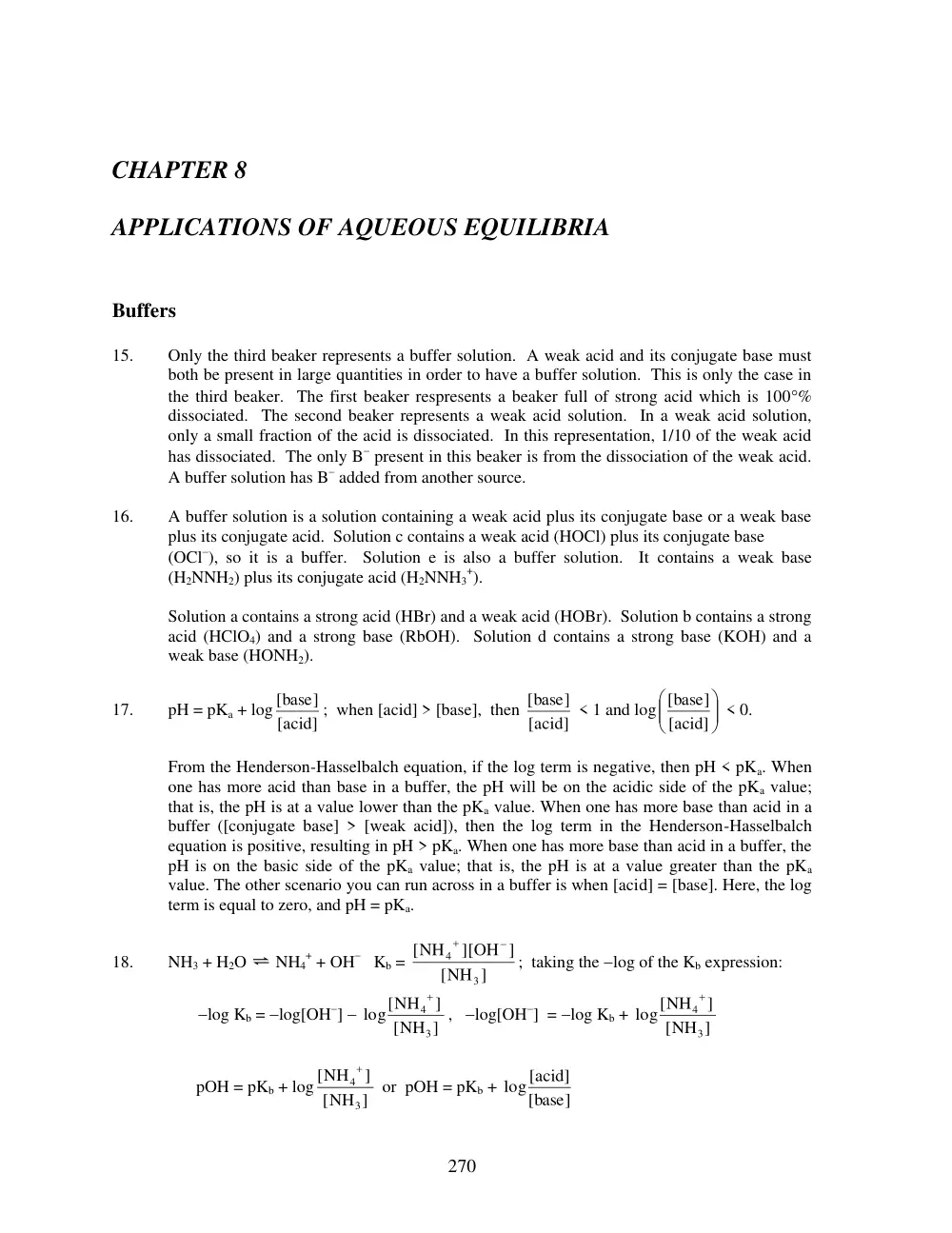
15.
Only the third beaker represents a buffer solution. A weak acid and its conjugate base must
both be present in large quantities in order to have a buffer solution. This is only the case in
the third beaker. The first beaker respresents a beaker full of strong acid which is 100%
dissociated. The second beaker represents a weak acid solution. In a weak acid solution,
only a small fraction of the acid is dissociated. In this representation, 1/10 of the weak acid
has dissociated. The only B present in this beaker is from the dissociation of the weak acid.
A buffer solution has B added from another source.
16.
A buffer solution is a solution containing a weak acid plus its conjugate base or a weak base
plus its conjugate acid. Solution c contains a weak acid (HOCl) plus its conjugate base
(OCl), so it is a buffer. Solution e is also a buffer solution. It contains a weak base
(H2NNH2) plus its conjugate acid (H2NNH3
+).
Solution a contains a strong acid (HBr) and a weak acid (HOBr). Solution b contains a strong
acid (HClO4) and a strong base (RbOH). Solution d contains a strong base (KOH) and a
weak base (HONH2).
17.
pH = pKa + log
acid]
[
[base]
; when [acid] > [base], then
acid]
[
[base]
< 1 and log
acid]
[
[base]
< 0.
From the Henderson-Hasselbalch equation, if the log term is negative, then pH < pKa. When
one has more acid than base in a buffer, the pH will be on the acidic side of the pKa value;
that is, the pH is at a value lower than the pKa value. When one has more base than acid in a
buffer ([conjugate base] > [weak acid]), then the log term in the Henderson-Hasselbalch
equation is positive, resulting in pH > pKa. When one has more base than acid in a buffer, the
pH is on the basic side of the pKa value; that is, the pH is at a value greater than the pKa
value. The other scenario you can run across in a buffer is when [acid] = [base]. Here, the log
term is equal to zero, and pH = pKa.
18.
NH3 + H2O ⇌ NH4
+ + OH Kb =
NH ]
[
[] OH ]
NH
[
3
4
; taking the log of the Kb expression:
log Kb = log[OH]
NH ]
[
]
[NH
log
3
4
, log[OH] = log Kb +
NH ]
[
]
[NH
log
3
4
pOH = pKb + log
NH ]
[
]
NH
[
3
4
or pOH = pKb +
base]
[
log[acid]
CHAPTER 8 APPLICATIONS OF AQUEOUS EQUILIBRIA 271
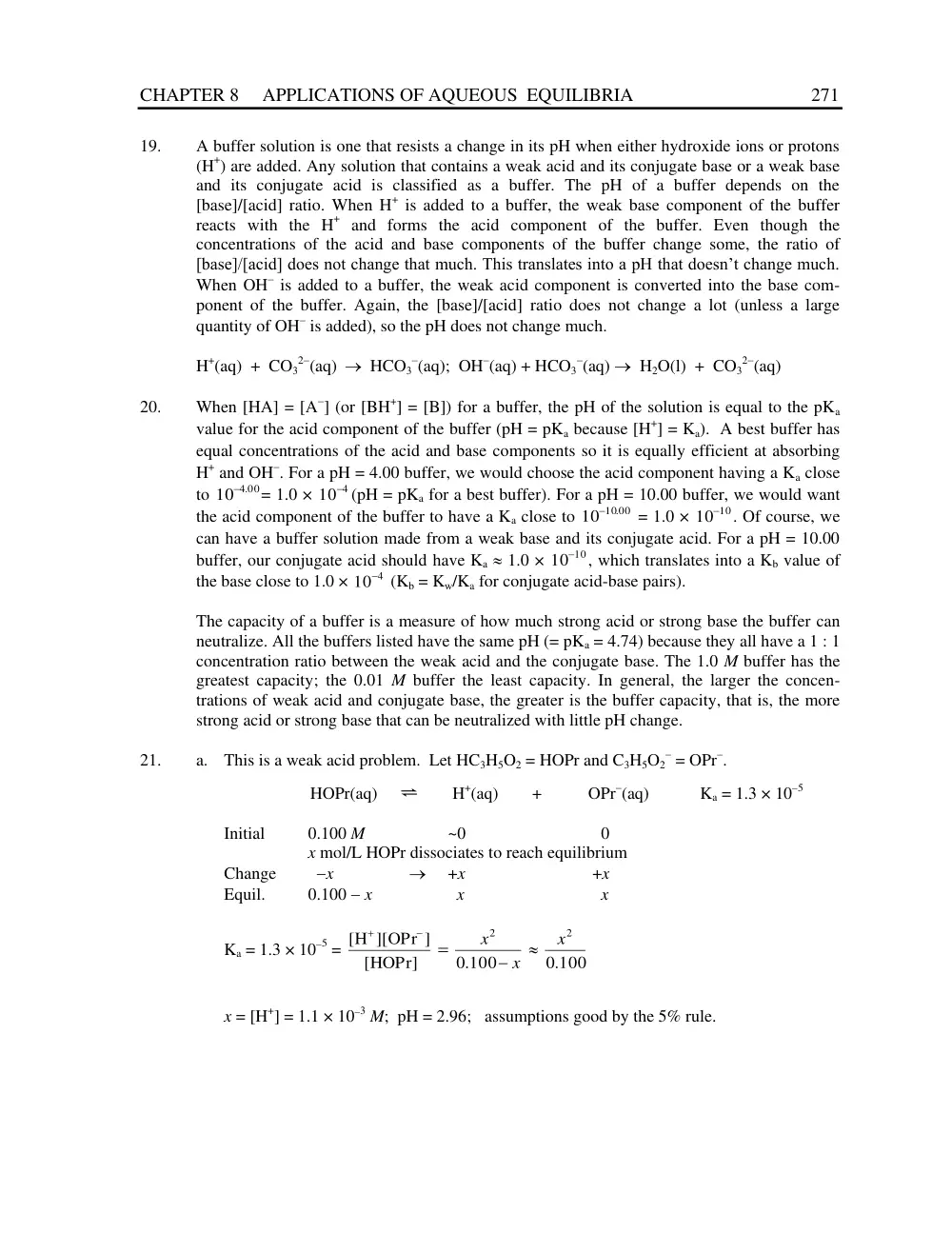
19.
A buffer solution is one that resists a change in its pH when either hydroxide ions or protons
(H+) are added. Any solution that contains a weak acid and its conjugate base or a weak base
and its conjugate acid is classified as a buffer. The pH of a buffer depends on the
[base]/[acid] ratio. When H+ is added to a buffer, the weak base component of the buffer
reacts with the H+ and forms the acid component of the buffer. Even though the
concentrations of the acid and base components of the buffer change some, the ratio of
[base]/[acid] does not change that much. This translates into a pH that doesn’t change much.
When OH is added to a buffer, the weak acid component is converted into the base com-
ponent of the buffer. Again, the [base]/[acid] ratio does not change a lot (unless a large
quantity of OH is added), so the pH does not change much.
H+(aq) + CO3
2(aq) HCO3
(aq); OH(aq) + HCO3
(aq) H2O(l) + CO3
2(aq)
20.
When [HA] = [A] (or [BH+] = [B]) for a buffer, the pH of the solution is equal to the pKa
value for the acid component of the buffer (pH = pKa because [H+] = Ka). A best buffer has
equal concentrations of the acid and base components so it is equally efficient at absorbing
H+ and OH. For a pH = 4.00 buffer, we would choose the acid component having a Ka close
to
10 .4 00
= 1.0 ×
4
10 (pH = pKa for a best buffer). For a pH = 10.00 buffer, we would want
the acid component of the buffer to have a Ka close to
1010.00
= 1.0 ×
1010
. Of course, we
can have a buffer solution made from a weak base and its conjugate acid. For a pH = 10.00
buffer, our conjugate acid should have Ka 1.0 ×
1010
, which translates into a Kb value of
the base close to 1.0 ×
4
10 (Kb = Kw/Ka for conjugate acid-base pairs).
The capacity of a buffer is a measure of how much strong acid or strong base the buffer can
neutralize. All the buffers listed have the same pH (= pKa = 4.74) because they all have a 1 : 1
concentration ratio between the weak acid and the conjugate base. The 1.0 M buffer has the
greatest capacity; the 0.01 M buffer the least capacity. In general, the larger the concen-
trations of weak acid and conjugate base, the greater is the buffer capacity, that is, the more
strong acid or strong base that can be neutralized with little pH change.
21.
a. This is a weak acid problem. Let HC3H5O2 = HOPr and C3H5O2
= OPr.
HOPr(aq) ⇌ H+(aq)
+
OPr(aq)
Ka = 1.3 × 10⁵
Initial
0.100 M
~0
0
x mol/L HOPr dissociates to reach equilibrium
Change
x
+x
+x
Equil.
0.100 x
x
x
Ka = 1.3 × 105 =
.0 100
.0 100
[HOPr]
[H ][OPr ]
2
2
x
x
x
x = [H+] = 1.1 × 10³ M; pH = 2.96; assumptions good by the 5% rule.
272 CHAPTER 8 APPLICATIONS OF AQUEOUS EQUILIBRIA
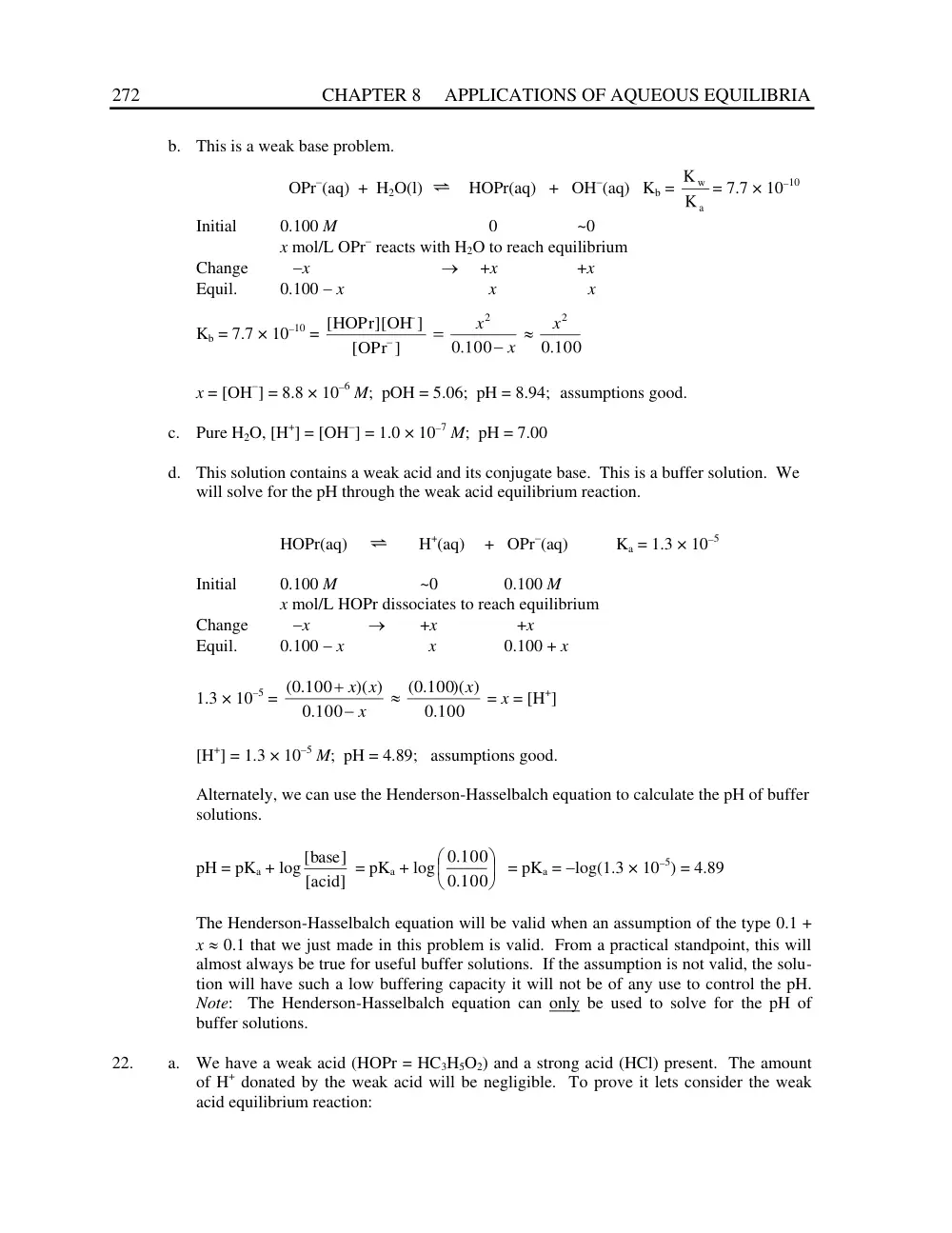
b. This is a weak base problem.
OPr(aq) + H2O(l) ⇌ HOPr(aq) + OH(aq) Kb =
a
w
K
K
= 7.7 × 10¹⁰
Initial
0.100 M
0
~0
x mol/L OPr reacts with H2O to reach equilibrium
Change
x
+x
+x
Equil.
0.100 x
x
x
Kb = 7.7 × 1010 =
.0 100
.0 100
]
[OPr
[HOPr][OH ]
2
2
x
x
x
x = [OH] = 8.8 × 10⁶ M; pOH = 5.06; pH = 8.94; assumptions good.
c. Pure H2O, [H+] = [OH] = 1.0 × 10⁷ M; pH = 7.00
d. This solution contains a weak acid and its conjugate base. This is a buffer solution. We
will solve for the pH through the weak acid equilibrium reaction.
HOPr(aq) ⇌ H+(aq) + OPr(aq)
Ka = 1.3 × 10⁵
Initial
0.100 M
~0
0.100 M
x mol/L HOPr dissociates to reach equilibrium
Change
x
+x
+x
Equil.
0.100 x
x
0.100 + x
1.3 × 105 =
100
.0
)
.0 100 ()
(
100
.0
)
()
( .0 100
x
x
x x
= x = [H+]
[H+] = 1.3 × 10⁵ M; pH = 4.89; assumptions good.
Alternately, we can use the Henderson-Hasselbalch equation to calculate the pH of buffer
solutions.
pH = pKa + log
acid]
[
[base]
= pKa + log
.0 100
.0 100
= pKa = log(1.3 × 10⁵) = 4.89
The Henderson-Hasselbalch equation will be valid when an assumption of the type 0.1 +
x 0.1 that we just made in this problem is valid. From a practical standpoint, this will
almost always be true for useful buffer solutions. If the assumption is not valid, the solu-
tion will have such a low buffering capacity it will not be of any use to control the pH.
Note: The Henderson-Hasselbalch equation can only be used to solve for the pH of
buffer solutions.
22.
a. We have a weak acid (HOPr = HC3H5O2) and a strong acid (HCl) present. The amount
of H+ donated by the weak acid will be negligible. To prove it lets consider the weak
acid equilibrium reaction:
CHAPTER 8 APPLICATIONS OF AQUEOUS EQUILIBRIA 273
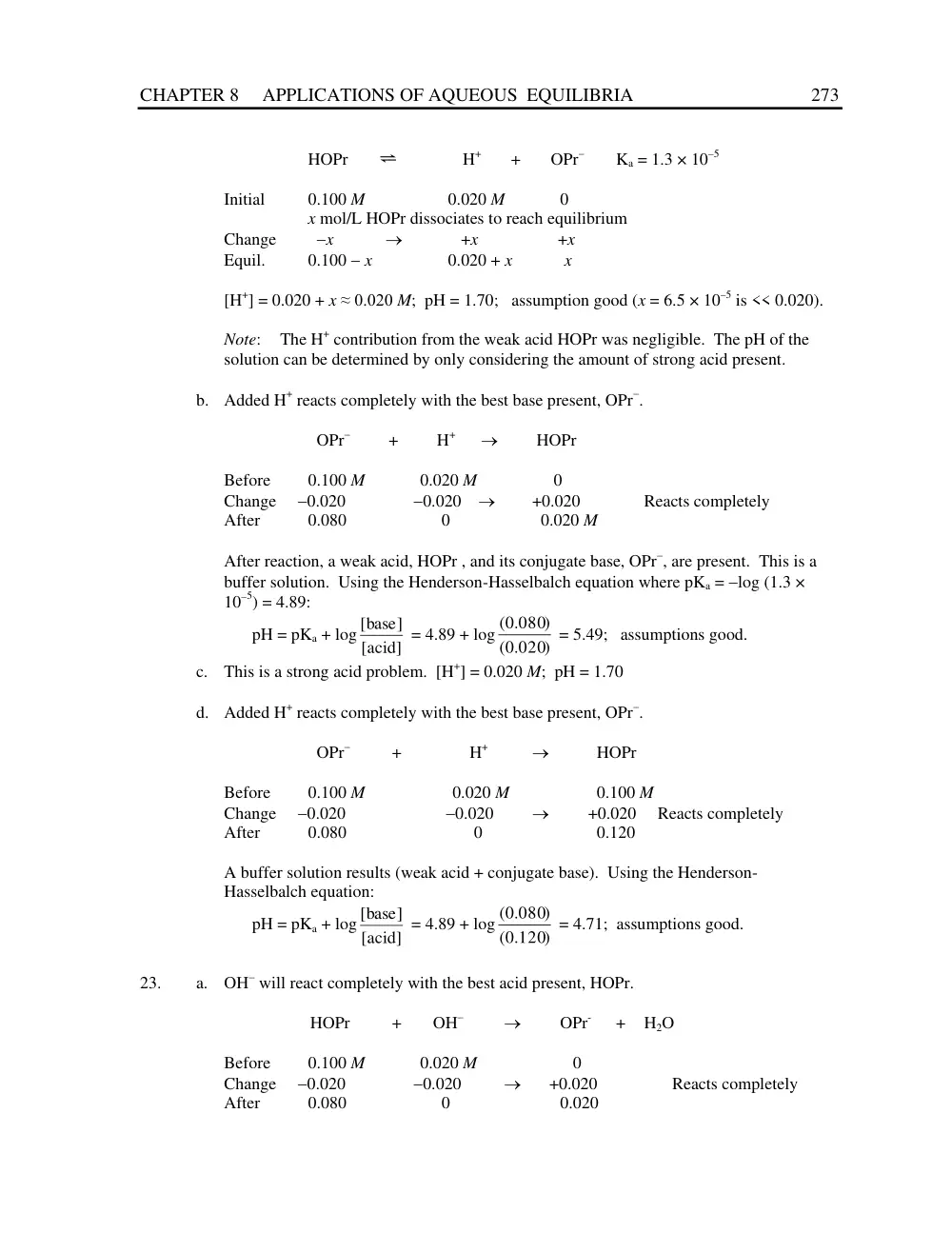
HOPr ⇌ H+ + OPr
Ka = 1.3 × 10⁵
Initial
0.100 M
0.020 M
0
x mol/L HOPr dissociates to reach equilibrium
Change
x
+x
+x
Equil.
0.100 x
0.020 + x
x
[H+] = 0.020 + x ≈ 0.020 M; pH = 1.70; assumption good (x = 6.5 × 10⁵ is << 0.020).
Note:
The H+ contribution from the weak acid HOPr was negligible. The pH of the
solution can be determined by only considering the amount of strong acid present.
b. Added H+ reacts completely with the best base present, OPr.
OPr + H+ HOPr
Before
0.100 M
0.020 M
0
Change 0.020
0.020
+0.020
Reacts completely
After
0.080
0
0.020 M
After reaction, a weak acid, HOPr , and its conjugate base, OPr, are present. This is a
buffer solution. Using the Henderson-Hasselbalch equation where pKa = log (1.3 ×
105) = 4.89:
pH = pKa + log
acid]
[
[base]
= 4.89 + log
.0 020)
(
( .0 080)
= 5.49; assumptions good.
c. This is a strong acid problem. [H+] = 0.020 M; pH = 1.70
d. Added H+ reacts completely with the best base present, OPr.
OPr
+
H+
HOPr
Before
0.100 M
0.020 M
0.100 M
Change 0.020
0.020
+0.020 Reacts completely
After
0.080
0
0.120
A buffer solution results (weak acid + conjugate base). Using the Henderson-
Hasselbalch equation:
pH = pKa + log
acid]
[
[base]
= 4.89 + log
.0 120)
(
( .0 080)
= 4.71; assumptions good.
23.
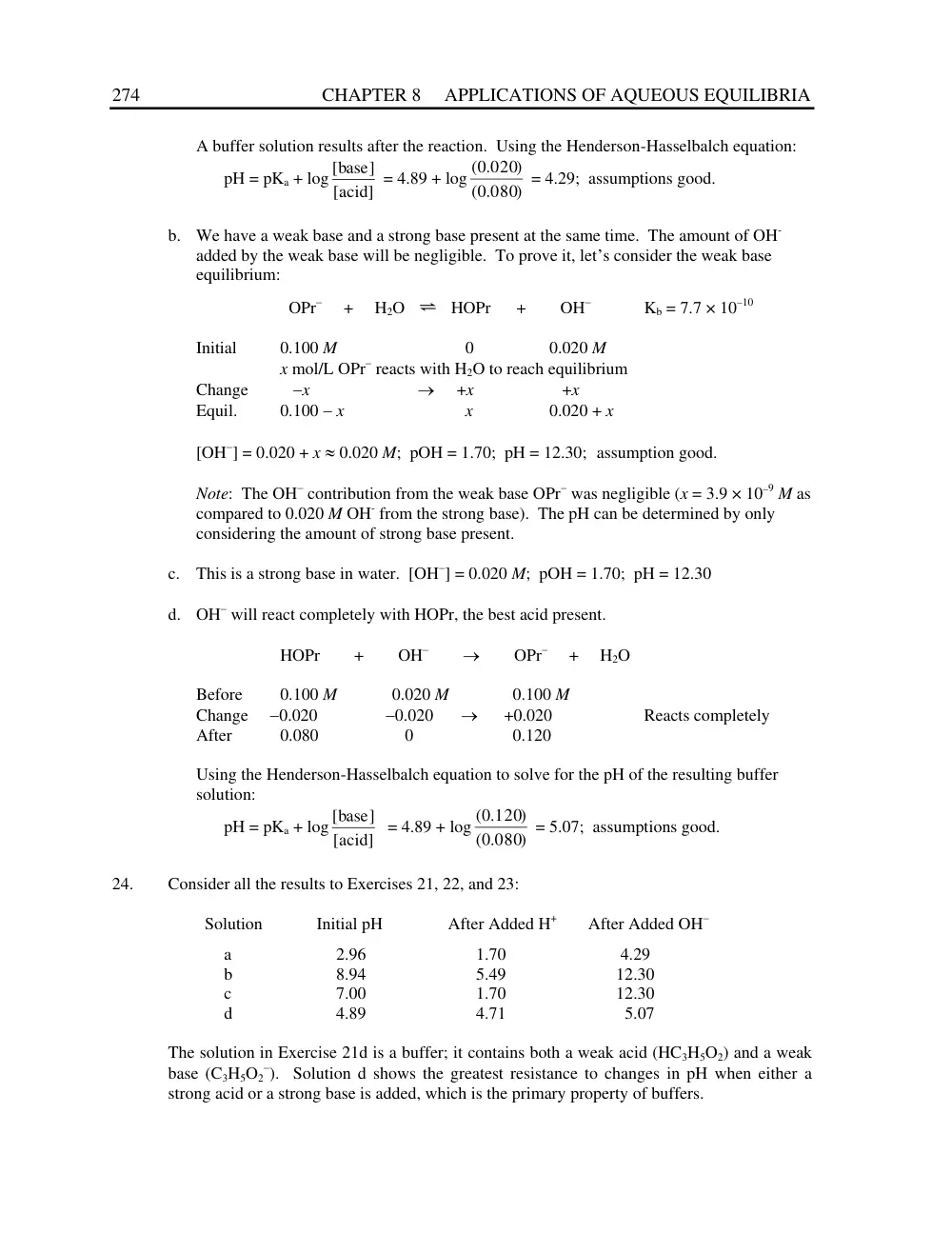
a. OH will react completely with the best acid present, HOPr.
HOPr
+
OH
OPr-
+
H2O
Before
0.100 M
0.020 M
0
Change 0.020
0.020
+0.020
Reacts completely
After
0.080
0
0.020
274 CHAPTER 8 APPLICATIONS OF AQUEOUS EQUILIBRIA
A buffer solution results after the reaction. Using the Henderson-Hasselbalch equation:
pH = pKa + log
acid]
[
[base]
= 4.89 + log
.0 080)
(
( .0 020)
= 4.29; assumptions good.
b. We have a weak base and a strong base present at the same time. The amount of OH-
added by the weak base will be negligible. To prove it, let’s consider the weak base
equilibrium:
OPr + H2O ⇌ HOPr + OH
Kb = 7.7 × 10¹⁰
Initial
0.100 M
0
0.020 M
x mol/L OPr reacts with H2O to reach equilibrium
Change
x
+x
+x
Equil.
0.100 x
x
0.020 + x
[OH] = 0.020 + x 0.020 M; pOH = 1.70; pH = 12.30; assumption good.
Note: The OH contribution from the weak base OPr was negligible (x = 3.9 × 10⁹ M as
compared to 0.020 M OH- from the strong base). The pH can be determined by only
considering the amount of strong base present.
c. This is a strong base in water. [OH] = 0.020 M; pOH = 1.70; pH = 12.30
d. OH will react completely with HOPr, the best acid present.
HOPr + OH OPr + H2O
Before
0.100 M
0.020 M
0.100 M
Change 0.020
0.020
+0.020
Reacts completely
After
0.080
0
0.120
Using the Henderson-Hasselbalch equation to solve for the pH of the resulting buffer
solution:
pH = pKa + log
acid]
[
[base]
= 4.89 + log
.0 080)
(
( .0 120)
= 5.07; assumptions good.
24.
Consider all the results to Exercises 21, 22, and 23:
Solution
Initial pH
After Added H+
After Added OH
a
2.96
1.70
4.29
b
8.94
5.49
12.30
c
7.00
1.70
12.30
d
4.89
4.71
5.07
The solution in Exercise 21d is a buffer; it contains both a weak acid (HC3H5O2) and a weak
base (C3H5O2
). Solution d shows the greatest resistance to changes in pH when either a
strong acid or a strong base is added, which is the primary property of buffers.
CHAPTER 8 APPLICATIONS OF AQUEOUS EQUILIBRIA 275
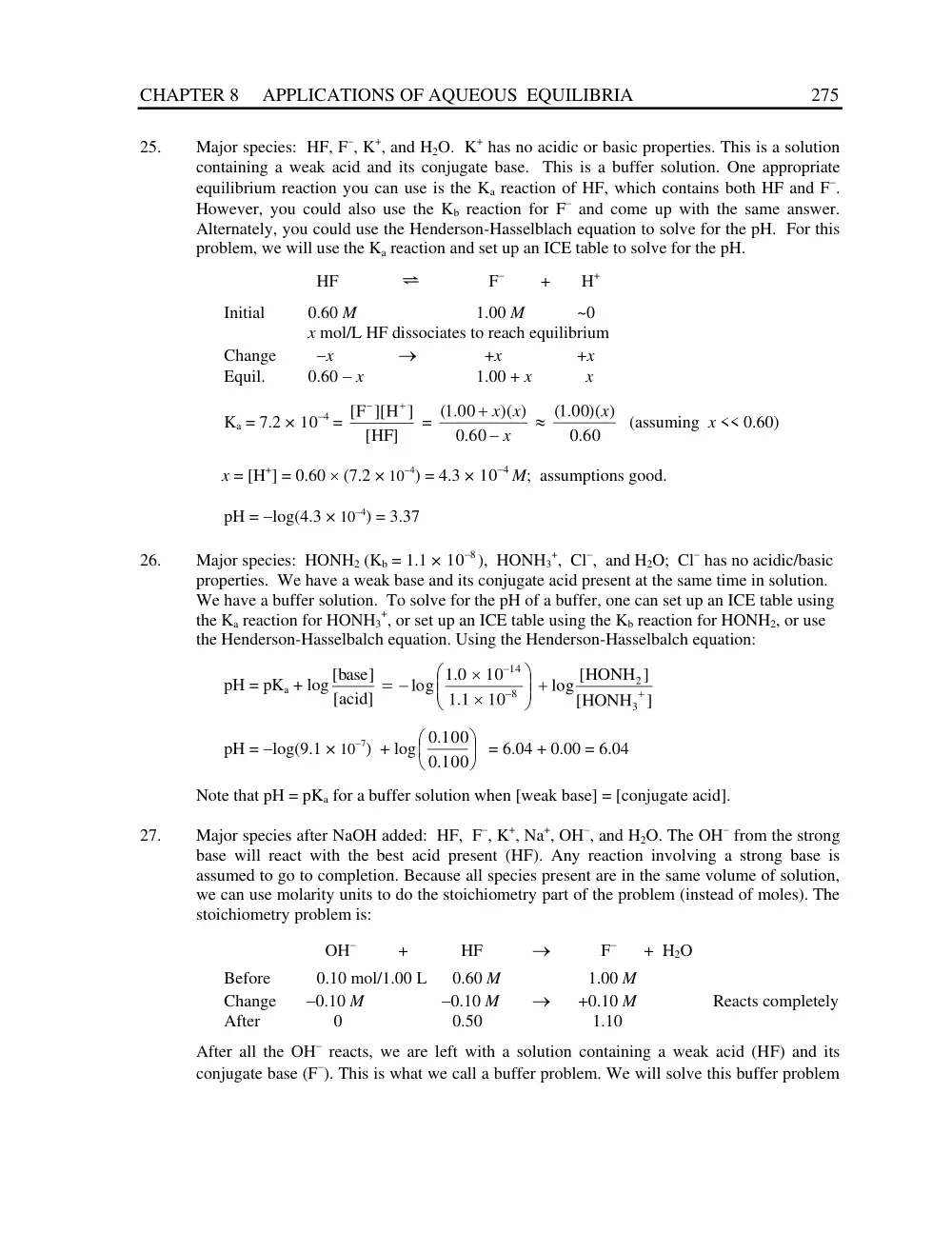
25.
Major species: HF, F, K+, and H2O. K+ has no acidic or basic properties. This is a solution
containing a weak acid and its conjugate base. This is a buffer solution. One appropriate
equilibrium reaction you can use is the Ka reaction of HF, which contains both HF and F.
However, you could also use the Kb reaction for F and come up with the same answer.
Alternately, you could use the Henderson-Hasselblach equation to solve for the pH. For this
problem, we will use the Ka reaction and set up an ICE table to solve for the pH.
HF
⇌
F
+ H+
Initial
0.60 M
1.00 M
~0
x mol/L HF dissociates to reach equilibrium
Change
x
+x
+x
Equil.
0.60 x
1.00 + x
x
Ka = 7.2 ×
4
10 =
HF]
[
[] H ]
[F
=
x
x x
60
.0
)( )
.1( 00
60
.0
.1( 00)( )
x
(assuming x << 0.60)
x = [H+] = 0.60 (7.2 × 10⁴) = 4.3 ×
4
10 M; assumptions good.
pH = log(4.3 × 10⁴) = 3.37
26.
Major species: HONH2 (Kb = 1.1 ×
8
10 ), HONH3
+, Cl, and H2O; Cl has no acidic/basic
properties. We have a weak base and its conjugate acid present at the same time in solution.
We have a buffer solution. To solve for the pH of a buffer, one can set up an ICE table using
the Ka reaction for HONH3
+, or set up an ICE table using the Kb reaction for HONH2, or use
the Henderson-Hasselbalch equation. Using the Henderson-Hasselbalch equation:
pH = pKa + log
]
HONH
[
[HONH ]
log
10
1.1
10
0.1
log
acid]
[
base]
[
3
2
8
14
pH = log(9.1 × 10⁷) + log
.0 100
.0 100
= 6.04 + 0.00 = 6.04
Note that pH = pKa for a buffer solution when [weak base] = [conjugate acid].
27.
Major species after NaOH added: HF, F, K+, Na+, OH, and H2O. The OH from the strong
base will react with the best acid present (HF). Any reaction involving a strong base is
assumed to go to completion. Because all species present are in the same volume of solution,
we can use molarity units to do the stoichiometry part of the problem (instead of moles). The
stoichiometry problem is:
OH +
HF
F
+ H2O
Before
0.10 mol/1.00 L
0.60 M
1.00 M
Change 0.10 M
0.10 M
+0.10 M
Reacts completely
After
0
0.50
1.10
After all the OH reacts, we are left with a solution containing a weak acid (HF) and its
conjugate base (F). This is what we call a buffer problem. We will solve this buffer problem
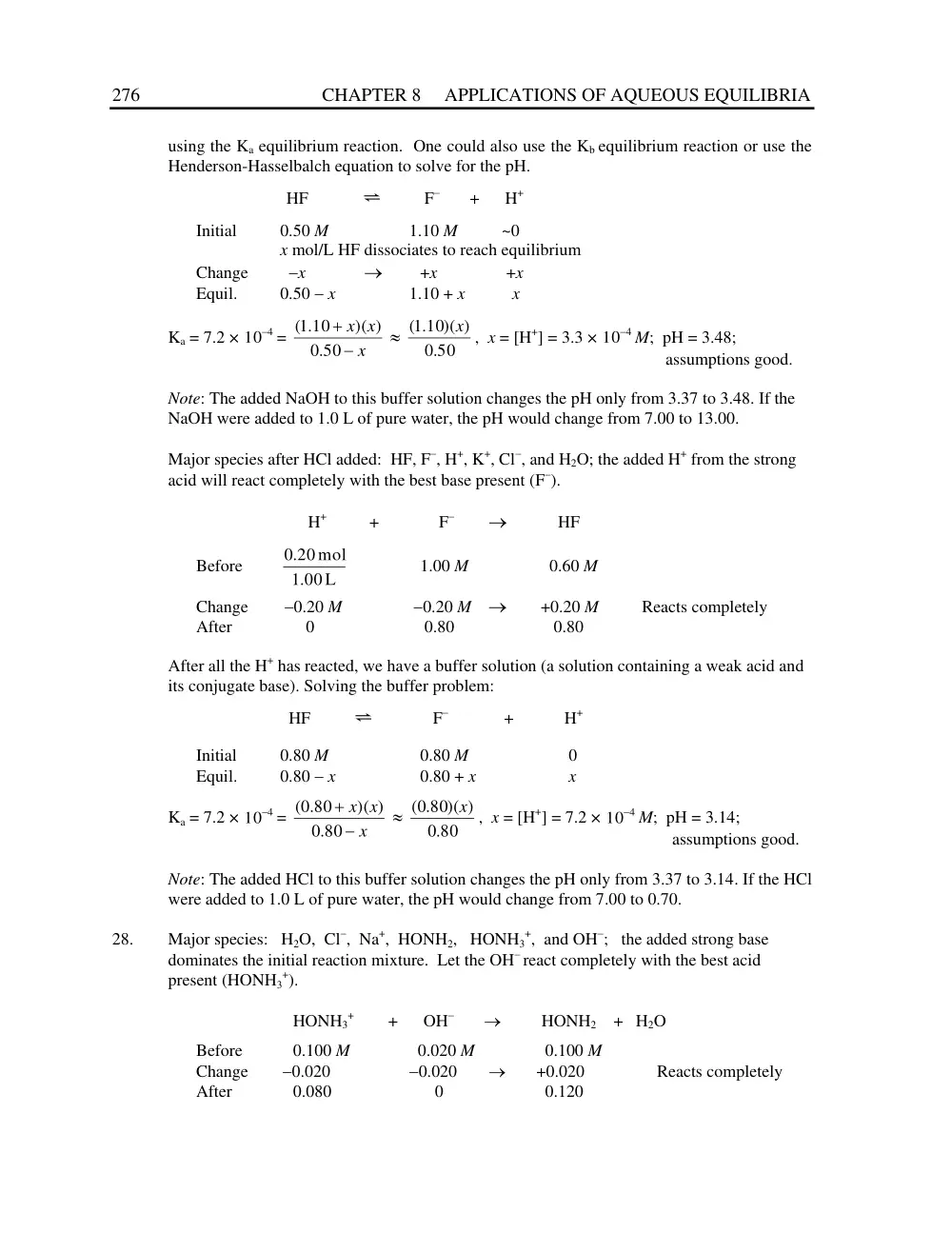
276 CHAPTER 8 APPLICATIONS OF AQUEOUS EQUILIBRIA
using the Ka equilibrium reaction. One could also use the Kb equilibrium reaction or use the
Henderson-Hasselbalch equation to solve for the pH.
HF ⇌
F + H+
Initial
0.50 M
1.10 M
~0
x mol/L HF dissociates to reach equilibrium
Change
x
+x +x
Equil.
0.50 x
1.10 + x x
Ka = 7.2 ×
4
10 =
x
x x
50
.0
)( )
.1( 10
50
.0
.1( 10)( )
x , x = [H+] = 3.3 ×
4
10 M; pH = 3.48;
assumptions good.
Note: The added NaOH to this buffer solution changes the pH only from 3.37 to 3.48. If the
NaOH were added to 1.0 L of pure water, the pH would change from 7.00 to 13.00.
Major species after HCl added: HF, F, H+, K+, Cl, and H2O; the added H+ from the strong
acid will react completely with the best base present (F).
H+ + F
HF
Before
00 L
.1
.0 20 mol
1.00 M
0.60 M
Change
0.20 M
0.20 M +0.20 M Reacts completely
After
0
0.80
0.80
After all the H+ has reacted, we have a buffer solution (a solution containing a weak acid and
its conjugate base). Solving the buffer problem:
HF
⇌
F
+
H+
Initial
0.80 M
0.80 M
0
Equil.
0.80 x
0.80 + x
x
Ka = 7.2 ×
4
10 =
x
x x
80
.0
)( )
( .0 80
80
.0
( .0 80)( )
x , x = [H+] = 7.2 ×
4
10 M; pH = 3.14;
assumptions good.
Note: The added HCl to this buffer solution changes the pH only from 3.37 to 3.14. If the HCl
were added to 1.0 L of pure water, the pH would change from 7.00 to 0.70.
28.
Major species: H2O, Cl, Na+, HONH2, HONH3
+, and OH; the added strong base
dominates the initial reaction mixture. Let the OH react completely with the best acid
present (HONH3
+).
HONH3
+ + OH
HONH2 + H2O
Before
0.100 M
0.020 M
0.100 M
Change 0.020
0.020
+0.020
Reacts completely
After
0.080
0
0.120
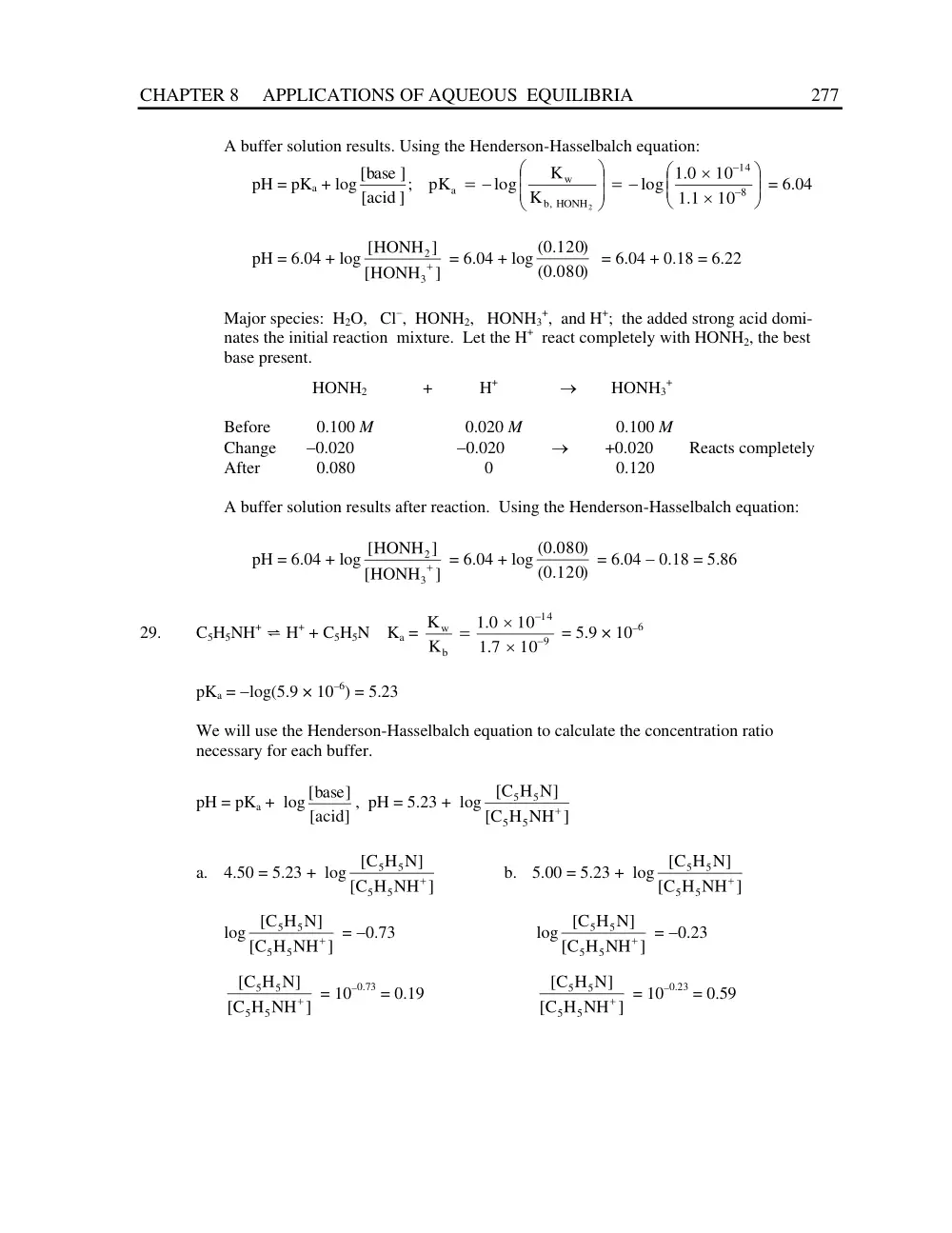
CHAPTER 8 APPLICATIONS OF AQUEOUS EQUILIBRIA 277
A buffer solution results. Using the Henderson-Hasselbalch equation:
pH = pKa + log
8
14
HONH
,b
w
a
10
1.1
10
0.1
log
K
K
log
pK
acid ;]
[
base ]
[
2
= 6.04
pH = 6.04 + log
]
HONH
[
HONH ]
[
3
2
= 6.04 + log
.0 080)
(
( .0 120)
= 6.04 + 0.18 = 6.22
Major species: H2O, Cl, HONH2, HONH3
+, and H+; the added strong acid domi-
nates the initial reaction mixture. Let the H+ react completely with HONH2, the best
base present.
HONH2 + H+
HONH3
+
Before
0.100 M
0.020 M
0.100 M
Change 0.020
0.020
+0.020
Reacts completely
After
0.080
0
0.120
A buffer solution results after reaction. Using the Henderson-Hasselbalch equation:
pH = 6.04 + log
]
HONH
[
HONH ]
[
3
2
= 6.04 + log
.0 120)
(
( .0 080)
= 6.04 0.18 = 5.86
29.
C5H5NH+ ⇌ H+ + C5H5N Ka =
9
14
b
w
10
7.1
10
0.1
K
K
= 5.9 × 10⁶
pKa = log(5.9 × 10⁶) = 5.23
We will use the Henderson-Hasselbalch equation to calculate the concentration ratio
necessary for each buffer.
pH = pKa + log
acid]
[
[base]
, pH = 5.23 + log
C H NH ]
[
C H N]
[
5
5
5
5
a. 4.50 = 5.23 + log
C H NH ]
[
C H N]
[
5
5
5
5
b. 5.00 = 5.23 + log
C H NH ]
[
C H N]
[
5
5
5
5
log
C H NH ]
[
C H N]
[
5
5
5
5
= 0.73
log
C H NH ]
[
C H N]
[
5
5
5
5
= 0.23
C H NH ]
[
C H N]
[
5
5
5
5
= 100.73 = 0.19
C H NH ]
[
C H N]
[
5
5
5
5
= 100.23 = 0.59
278 CHAPTER 8 APPLICATIONS OF AQUEOUS EQUILIBRIA
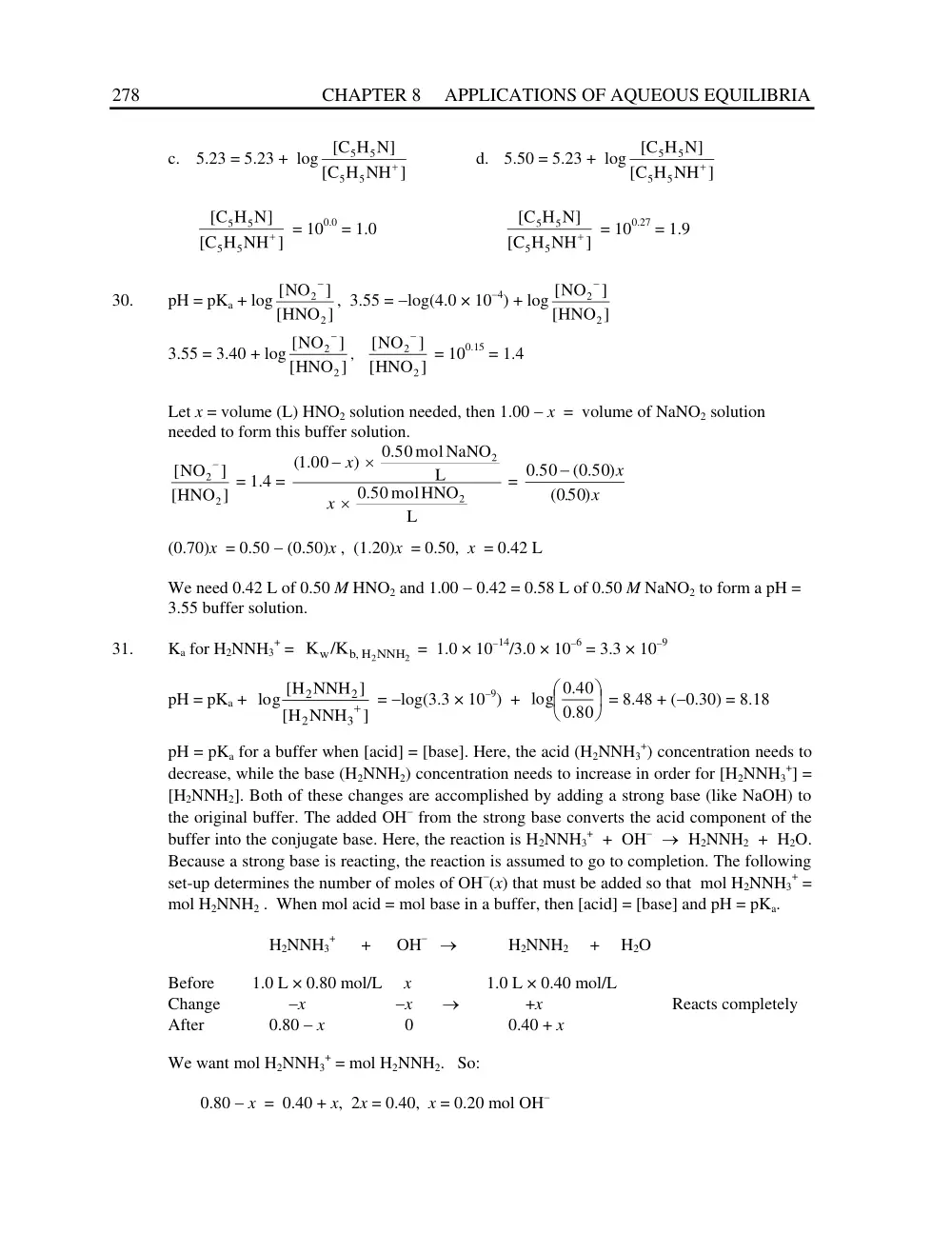
c. 5.23 = 5.23 + log
C H NH ]
[
C H N]
[
5
5
5
5
d. 5.50 = 5.23 + log
C H NH ]
[
C H N]
[
5
5
5
5
C H NH ]
[
C H N]
[
5
5
5
5
= 100.0 = 1.0
C H NH ]
[
C H N]
[
5
5
5
5
= 100.27 = 1.9
30.
pH = pKa + log
HNO ]
[
]
NO
[
2
2
, 3.55 = log(4.0 × 10⁴) + log
HNO ]
[
]
NO
[
2
2
3.55 = 3.40 + log
HNO ]
[
]
NO
[
2
2
,
HNO ]
[
]
NO
[
2
2
= 100.15 = 1.4
Let x = volume (L) HNO2 solution needed, then 1.00 x = volume of NaNO2 solution
needed to form this buffer solution.
HNO ]
[
]
NO
[
2
2
= 1.4 =
L
50 molHNO
.0
L
.0 50 molNaNO
)
00
.1(
2
2
x
x
=
x
x
.050)
(
( .0 50)
.0 50
(0.70)x = 0.50 (0.50)x , (1.20)x = 0.50, x = 0.42 L
We need 0.42 L of 0.50 M HNO2 and 1.00 0.42 = 0.58 L of 0.50 M NaNO2 to form a pH =
3.55 buffer solution.
31.
Ka for H2NNH3
+ =
Kw/Kb, H2NNH2
= 1.0 × 10¹⁴/3.0 × 106 = 3.3 × 10⁹
pH = pKa +
]
H NNH
[
[H NNH ]
log
3
2
2
2
= log(3.3 × 10⁹) +
.0 80
.0 40
log
= 8.48 + (0.30) = 8.18
pH = pKa for a buffer when [acid] = [base]. Here, the acid (H2NNH3
+) concentration needs to
decrease, while the base (H2NNH2) concentration needs to increase in order for [H2NNH3
+] =
[H2NNH2]. Both of these changes are accomplished by adding a strong base (like NaOH) to
the original buffer. The added OH from the strong base converts the acid component of the
buffer into the conjugate base. Here, the reaction is H2NNH3
+ + OH H2NNH2 + H2O.
Because a strong base is reacting, the reaction is assumed to go to completion. The following
set-up determines the number of moles of OH(x) that must be added so that mol H2NNH3
+ =
mol H2NNH2 . When mol acid = mol base in a buffer, then [acid] = [base] and pH = pKa.
H2NNH3
+ + OH H2NNH2 + H2O
Before
1.0 L × 0.80 mol/L x
1.0 L × 0.40 mol/L
Change
x x +x
Reacts completely
After
0.80 x
0
0.40 + x
We want mol H2NNH3
+ = mol H2NNH2. So:
0.80 x = 0.40 + x, 2x = 0.40, x = 0.20 mol OH
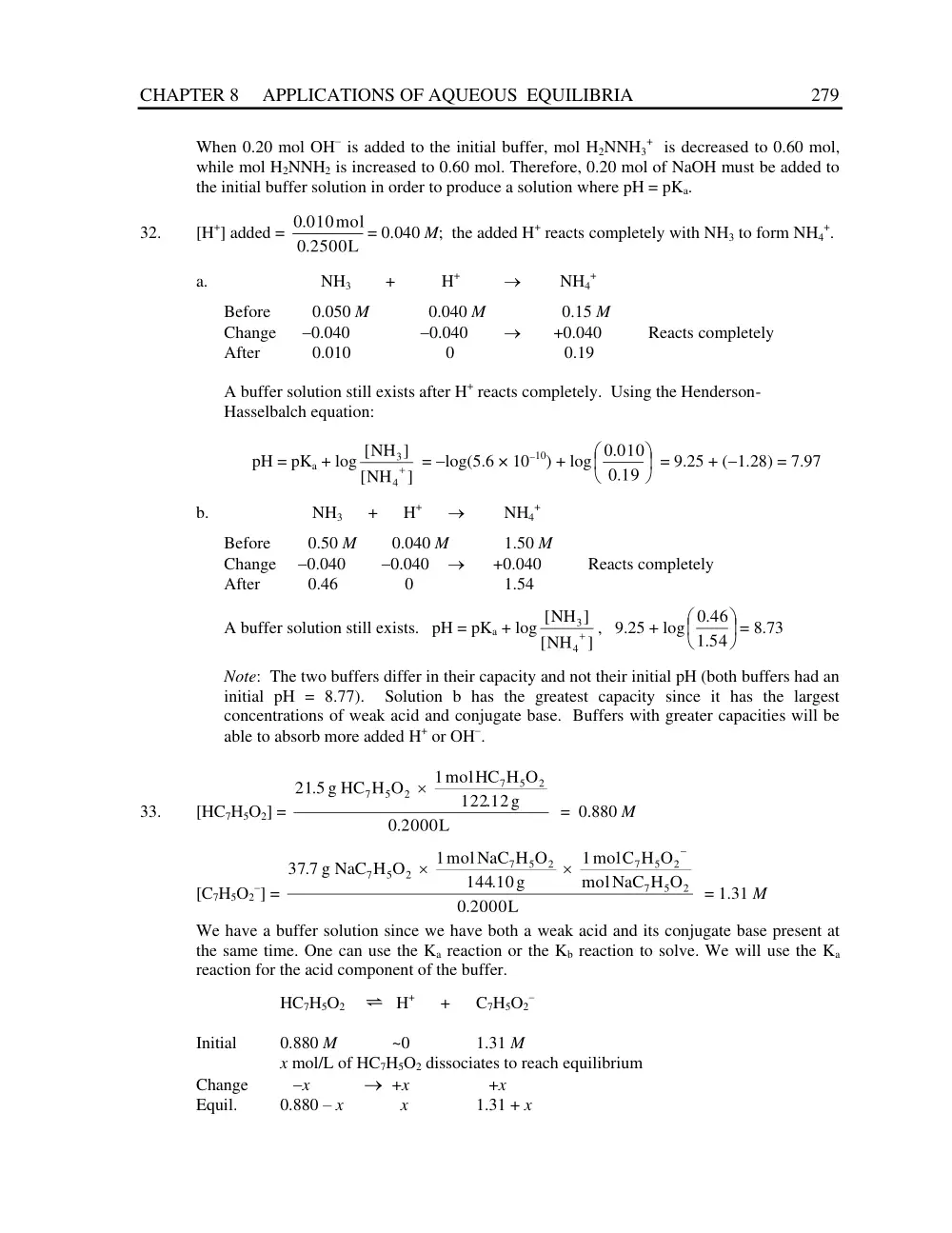
CHAPTER 8 APPLICATIONS OF AQUEOUS EQUILIBRIA 279
When 0.20 mol OH is added to the initial buffer, mol H2NNH3
+ is decreased to 0.60 mol,
while mol H2NNH2 is increased to 0.60 mol. Therefore, 0.20 mol of NaOH must be added to
the initial buffer solution in order to produce a solution where pH = pKa.
32.
[H+] added =
2500L
.0
.0 010mol
= 0.040 M; the added H+ reacts completely with NH3 to form NH4
+.
a.
NH3 +
H+
NH4
+
Before
0.050 M
0.040 M
0.15 M
Change 0.040
0.040
+0.040
Reacts completely
After
0.010
0
0.19
A buffer solution still exists after H+ reacts completely. Using the Henderson-
Hasselbalch equation:
pH = pKa + log
]
NH
[
NH ]
[
4
3
= log(5.6 × 10¹⁰) + log
.0 19
.0 010
= 9.25 + (1.28) = 7.97
b.
NH3 + H+
NH4
+
Before
0.50 M
0.040 M
1.50 M
Change 0.040
0.040
+0.040
Reacts completely
After
0.46
0
1.54
A buffer solution still exists. pH = pKa + log
]
NH
[
NH ]
[
4
3
, 9.25 + log
.1 54
.0 46
= 8.73
Note: The two buffers differ in their capacity and not their initial pH (both buffers had an
initial pH = 8.77). Solution b has the greatest capacity since it has the largest
concentrations of weak acid and conjugate base. Buffers with greater capacities will be
able to absorb more added H+ or OH.
33.
[HC7H5O2] =
2000L
.0
.12g
122
1molHC H O
21 5. g HC H O
2
5
7
2
5
7
= 0.880 M
[C7H5O2
] =
2000L
.0
NaC H O
mol
molC H O
1
.10g
144
1molNaC H O
7. g NaC H O
37
2
5
7
2
5
7
2
5
7
2
5
7
= 1.31 M
We have a buffer solution since we have both a weak acid and its conjugate base present at
the same time. One can use the Ka reaction or the Kb reaction to solve. We will use the Ka
reaction for the acid component of the buffer.
HC7H5O2 ⇌ H+ +
C7H5O2
Initial
0.880 M
~0
1.31 M
x mol/L of HC7H5O2 dissociates to reach equilibrium
Change
x
+x
+x
Equil.
0.880 – x
x
1.31 + x
280 CHAPTER 8 APPLICATIONS OF AQUEOUS EQUILIBRIA
Ka = 6.4 ×
5
10 =
x
x
x
880
.0
)
.1( 31
880
.0
31)
.1(x
, x = [H+] = 4.3 ×
5
10 M
pH = log(4.3 ×
5
10 ) = 4.37; assumptions good.
Alternatively, we can use the Henderson-Hasselbalch equation to calculate the pH of buffer
solutions.
pH = pKa + log
acid]
[
[base]
= pKa + log
HC H O ]
[
]
C H O
[
2
5
7
2
5
7
pH = log(6.4 ×
5
10 ) + log
.0 880
.1 31
= 4.19 + 0.173 = 4.36
Within round-off error, this is the same answer we calculated solving the equilibrium
problem using the Ka reaction.
The Henderson-Hasselbalch equation will be valid when an assumption of the type 1.31 + x ≈
1.31 that we just made in this problem is valid. From a practical standpoint, this will almost
always be true for useful buffer solutions. If the assumption is not valid, the solution will
have such a low buffering capacity that it will be of no use to control the pH. Note: The
Henderson-Hasselbalch equation can only be used to solve for the pH of buffer solutions.
34.
pH = pKa +
HOCl]
[
[OCl ]
log
= log(3.5 × 10⁸) +
.0 20
.0 90
log
= 7.46 + 0.65 = 8.11
pH = pKa when [HOCl] = [OCl] (or when mol HOCl = mol OCl). Here, the moles of the
base component of the buffer must decrease, while the moles of the acid component of the
buffer must increase in order to achieve a solution where pH = pKa. Both of these changes
occur when a strong acid (like HCl) is added. Let x = mol H+ added from the strong acid
HCl.
H+ + OCl HOCl
Before
x
1.0 L × 0.90 mol/L
1.0 L × 0.20 mol/L
Change x x +x
Reacts completely
After 0 0.90 x
0.20 + x
We want mol HOCl = mol OCl. Therefore:
0.90 x = 0.20 + x, 2x = 0.70, x = 0.35 mol H+
When 0.35 mol H+ is added, mol OCl is decreased to 0.55 mol, while the mol HOCl is
increased to 0.55 mol Therefore, 0.35 mol of HCl must be added to the original buffer
solution in order to produce a solution where pH = pKa.
35.
pH = pKa + log
HC H O ]
[
]
C H O
[
2
3
2
2
3
2
; pKa = log(1.8 × 10⁵) = 4.74
CHAPTER 8 APPLICATIONS OF AQUEOUS EQUILIBRIA 281
Because the buffer components, C2H3O2
and HC2H3O2, are both in the same volume of
water, the concentration ratio of [C2H3O2
]/[HC2H3O2] will equal the mole ratio of mol
C2H3O2
/mol HC2H3O2.
5.00 = 4.74 + log
2
3
2
2
3
2
HC H O
mol
molC H O
; mol HC2H3O2 = 0.5000 L ×
L
.0 200mol
= 0.100 mol
0.26 = log
100mol
.0
molC H O
,
100mol
.0
molC H O
2
3
2
2
3
2
= 100.26 = 1.8, mol C2H3O2
= 0.18 mol
Mass NaC2H3O2 = 0.18 mol NaC2H3O2 ×
mol
82.03g
= 15 g NaC2H3O2
36.
Added OH converts HC2H3O2 into C2H3O2
: HC2H3O2 + OH C2H3O2
+ H2O
From this reaction, the moles of C2H3O2
produced equal the moles of OH added. Also, the
total concentration of acetic acid plus acetate ion must equal 2.0 M (assuming no volume
change on addition of NaOH). Summarizing for each solution:
[C2H3O2
] + [HC2H3O] = 2.0 M and [C2H3O2
] produced = [OH] added
a. pH = pKa + log
HC H O ]
[
]
C H O
[
2
3
2
2
3
2
; for pH = pKa, log
HC H O ]
[
]
C H O
[
2
3
2
2
3
2
= 0
Therefore,
HC H O ]
[
]
C H O
[
2
3
2
2
3
2
= 1.0 and [C2H3O2
] = [HC2H3O2].
Because [C2H3O2
] + [HC2H3O2] = 2.0 M:
[C2H3O2
] = [HC2H3O2] = 1.0 M = [OH] added
To produce a 1.0 M C2H3O2
solution, we need to add 1.0 mol of NaOH to 1.0 L of the
2.0 M HC2H3O2 solution. The resulting solution will have pH = pKa = 4.74.
b. 4.00 = 4.74 + log
HC H O ]
[
]
C H O
[
2
3
2
2
3
2
,
HC H O ]
[
]
C H O
[
2
3
2
2
3
2
= 100.74 = 0.18
[C2H3O2
] = 0.18[HC2H3O2] or [HC2H3O2] = 5.6[C2H3O2
]
Because [C2H3O2
] + [HC2H3O2] = 2.0 M:
[C2H3O2
] + 5.6[C2H3O2
] = 2.0 M, [C2H3O2
] =
6.6
0.2
= 0.30 M = [OH] added
We need to add 0.30 mol of NaOH to 1.0 L of 2.0 M HC2H3O2 solution to produce 0.30
M C2H3O2
. The resulting solution will have pH = 4.00.
c. 5.00 = 4.74 + log
HC H O ]
[
]
C H O
[
2
3
2
2
3
2
,
HC H O ]
[
]
C H O
[
2
3
2
2
3
2
= 100.26 = 1.8
282 CHAPTER 8 APPLICATIONS OF AQUEOUS EQUILIBRIA
1.8[HC2H3O2] = [C2H3O2
] or [HC2H3O2] = 0.56[C2H3O2
]
1.56[C2H3O2
] = 2.0 M, [C2H3O2
] = 1.3 M = [OH] added
We need to add 1.3 mol of NaOH to 1.0 L of 2.0 M HC2H3O2 to produce a solution with
pH = 5.00.
37.
When H+ is added, it converts C2H3O2
into HC2H3O2: C2H3O2
+ H+ → HC2H3O2. From
this reaction, the moles of HC2H3O2 produced must equal the moles of H+ added and the total
concentration of acetate ion + acetic acid must equal 1.0 M (assuming no volume change).
Summarizing for each solution:
[C2H3O2
] + [HC2H3O2] = 1.0 M and [HC2H3O2] = [H+] added
a. pH = pKa + log
HC H O ]
[
]
C H O
[
2
3
2
2
3
2
; for pH = pKa, [C2H3O2
] = [HC2H3O2].
For this to be true, [C2H3O2
] = [HC2H3O2] = 0.50 M = [H+] added, which means that
0.50 mol of HCl must be added to 1.0 L of the initial solution to produce a solution with
pH = pKa.
b. 4.20 = 4.74 + log
HC H O ]
[
]
[C H O
,]
HC H O
[
]
C H O
[
2
3
2
2
3
2
2
3
2
2
3
2
=
10 .0 54
= 0.29
[C2H3O2
] = 0.29[HC2H3O2]; 0.29[HC2H3O2] + [HC2H3O2] = 1.0 M
[HC2H3O2] = 0.78 M = [H+] added
0.78 mol of HCl must be added to produce a solution with pH = 4.20.
c. 5.00 = 4.74 + log
HC H O ]
[
]
[C H O
,]
HC H O
[
]
C H O
[
2
3
2
2
3
2
2
3
2
2
3
2
= 100.26 = 1.8
[C2H3O2
] = 1.8[HC2H3O2]; 1.8[HC2H3O2] + [HC2H3O2] = 1.0 M
[HC2H3O2] = 0.36 M = [H+] added
0.36 mol of HCl must be added to produce a solution with pH = 5.00.
38.
50.0 g NH4Cl ×
.49g NH Cl
53
molNH Cl
1
4
4
= 0.935 mol NH4Cl added to 1.00 L; [NH4
+] = 0.935 M
Using the Henderson Hasselbalch equation to solve for the pH of this buffer solution:
pH = pKa + log
]
NH
[
NH ]
[
4
3
= log(5.6 × 10¹⁰) + log
.0 935
.0 75
= 9.25 0.096 = 9.15
CHAPTER 8 APPLICATIONS OF AQUEOUS EQUILIBRIA 283
39.
a. pKb for C6H5NH2 = log(3.8 × 10¹⁰) = 9.42; pKa for C6H5NH3
+ = 14.00 9.42 = 4.58
pH = pKa + log
]
C H NH
[
C H NH ]
[
3
5
6
2
5
6
, 4.20 = 4.58 + log
]
C H NH
[
50
.0
3
5
6
M
0.38 = log
]
C H NH
[
50
.0
3
5
6
M
, [C6H5NH3
+] = [C6H5NH3Cl] = 1.2 M
b. 4.0 g NaOH ×
NaOH
mol
molOH
1
.00g
40
1molNaOH
= 0.10 mol OH; [OH] =
L
0.1
.0 10 mol
= 0.10 M
C6H5NH3
+ + OH C6H5NH2 + H2O
Before
1.2 M
0.10 M
0.50 M
Change 0.10
0.10 +0.10
After
1.1
0
0.60
A buffer solution exists. pH = 4.58 + log
1.1
.0 60
= 4.32
40.
pH = pKa + log
HC H O ]
[
]
C H O
[
2
3
2
2
3
2
, 4.00 = log(1.8 ×
5
10 ) + log
HC H O ]
[
]
C H O
[
2
3
2
2
3
2
HC H O ]
[
]
C H O
[
2
3
2
2
3
2
= 0.18; this is also equal to the mole ratio between C2H3O2
and HC2H3O2.
Let x = volume of 1.00 M HC2H3O2 and y = volume of 1.00 M NaC2H3O2
x + y = 1.00 L, x = 1.00 – y
x(1.00 mol/L) = mol HC2H3O2; y(1.00 mol/L) = mol NaC2H3O2 = mol C2H3O2
Thus: x
y = 0.18 or
y
y
.1 00
= 0.18; solving: y = 0.15 L, so x = 1.00 0.15 = 0.85 L.
We need 850 mL of 1.00 M HC2H3O2 and 150 mL of 1.00 M NaC2H3O2 to produce a buffer
solution at pH = 4.00.
41.
a. pH = pKa + log
acid]
[
[base]
, 7.15 = log(6.2 ×
8
10 ) + log
]
H PO
[
]
HPO
[
4
2
2
4
7.15 = 7.21 + log
]
H PO
[
]
HPO
[
4
2
2
4
,
]
H PO
[
]
HPO
[
4
2
2
4
=
10 .0 06
= 0.9,
]
HPO
[
]
H PO
[
2
4
4
2
9.0
1
= 1.1 ≈ 1
b. A best buffer has approximately equal concentrations of weak acid and conjugate base, so
pH ≈ pKa for a best buffer. The pKa value for a H3PO4/H2PO4
buffer is log(7.5 ×
10 3)
= 2.12. A pH of 7.15 is too high for a H3PO4/H2PO4
buffer to be effective. At this
high of pH, there would be so little H3PO4 present that we could hardly consider it a
buffer; this solution would not be effective in resisting pH changes, especially when a
strong base is added.
284 CHAPTER 8 APPLICATIONS OF AQUEOUS EQUILIBRIA
42.
pH = pKa +
H CO ]
[
]
[HCO
log
3
2
3
, 7.40 = log(4.3 × 10⁷) +
0012
.0
]
[HCO
log
3
0012
.0
]
[HCO
log
3
= 7.40 – 6.37 = 1.03,
0012
.0
]
[HCO
3
= 101.03, [HCO3
] = 1.3 × 10² M
43.
At pH = 7.40: 7.40 = log(4.3 × 10⁷) +
H CO ]
[
]
[HCO
log
3
2
3
H CO ]
[
]
[HCO
log
3
2
3
= 7.40 – 6.37 = 1.03,
H CO ]
[
]
HCO
[
3
2
3
= 101.03,
]
HCO
[
H CO ]
[
3
3
2
= 101.03 = 0.093
At pH = 7.35:
H CO ]
[
]
[HCO
log
3
2
3
= 7.35 – 6.37 = 0.98,
H CO ]
[
]
HCO
[
3
2
3
= 100.98
]
HCO
[
H CO ]
[
3
3
2
= 100.98 = 0.10
The [H2CO3] : [HCO3
] concentration ratio must increase from 0.093 to 0.10 in order for the
onset of acidosis to occur.
44.
Because we have added two solutions together, the concentration of each reagent has
changed. What hasn’t changed is the moles or millimoles of each reagent. Let’s determine
the millimoles of each reagent present by multiplying the volume in milliters by the molarity
in units of mmol/mL.
100.0 mL × 0.100 M = 10.0 mmol NaF; 100.0 mL × 0.025 M = 2.5 mmol HCl
H+ + F HF; 2.5 mmol H+ converts 2.5 mmol F into 2.5 mmol HF. After the reaction, a
buffer solution results containing 2.5 mmol HF and (10.0 2.5 =) 7.5 mmol F in 200.0 mL
of solution.
pH = pKa + log
HF]
[
[F ]
= 3.14 + log
mmol/ 2000. mL
5.2
mmol/ 2000. mL
5.7
= 3.62; assumptions good.
45.
A best buffer has large and equal quantities of weak acid and conjugate base. Because [acid]
= [base] for a best buffer, pH = pKa + log
acid]
[
[base]
= pKa + 0 = pKa (pH pKa for a best
buffer).
The best acid choice for a pH = 7.00 buffer would be the weak acid with a pKa close to 7.0 or
Ka ≈ 1 × 10⁷. HOCl is the best choice in Table 7.2 (Ka = 3.5 × 10⁸; pKa = 7.46). To make
this buffer, we need to calculate the [base]/[acid] ratio.
7.00 = 7.46 + log
HOCl]
[
[OCl ]
acid ,]
[
[base]
= 100.46 = 0.35
CHAPTER 8 APPLICATIONS OF AQUEOUS EQUILIBRIA 285
Any OCl/HOCl buffer in a concentration ratio of 0.35 : 1 will have a pH = 7.00. One
possibility is [NaOCl] = 0.35 M and [HOCl] = 1.0 M.
46.
For a pH = 5.00 buffer, we want an acid with a pKa close to 5.00. For a conjugate acid-base
pair, 14.00 = pKa + pKb. So for a pH = 5.00 buffer, we want the base to have a pKb close to
(14.0 5.0 =) 9.0 or a Kb close to 1 × 10⁹. The best choice in Table 7.3 is pyridine (C5H5N)
with Kb = 1.7 × 10⁹.
pH = pKa + log
9
14
b
w
a
10
7.1
10
0.1
K
K
K
acid ;]
[
base]
[
= 5.9 × 10⁶
5.00 = log(5.9 × 10⁻⁶) + log
C H NH ]
[
[C H N]
acid ,]
[
base]
[
5
5
5
5
= 100.23 = 0.59
There are many possibilities to make this buffer. One possibility is a solution of [C5H5N] =
0.59 M and [C5H5NHCl] = 1.0 M. The pH of this solution will be 5.00 because the base to
acid concentration ratio is 0.59 : 1.
47.
a. No; a solution of a strong acid (HNO3) and its conjugate base (NO3
) is not ge