
CHM 201 Problems Solution for Chap 5 Exercises, Fall 2013
Lebanese American University · Chemical Principles · 56 pages · with solution
Showing the first 10 of 56 pages. Download the PDF to see all of it.
More CHM 201 files
- Questions Exam Quest · Fall 2015ProblemsView
- Problems Solution for Chap 7 · Fall 2013Problems · with solutionView
- Problems Solution for Chap 8 · Fall 2013Problems · with solutionView
- Problems Solution Manual · Fall 2013Problems · with solutionView
- Problems Solution for Chap 3 Exercises · Fall 2013Problems · with solutionView
- Problems Solution for Chap 4 Exercises · Fall 2013Problems · with solutionView
- Problems Solution for Chap 6 · Fall 2013Problems · with solutionView
- Final Sample · Spring 2017Final examView
Show the text of this problems
104
CHAPTER 5
GASES
Pressure
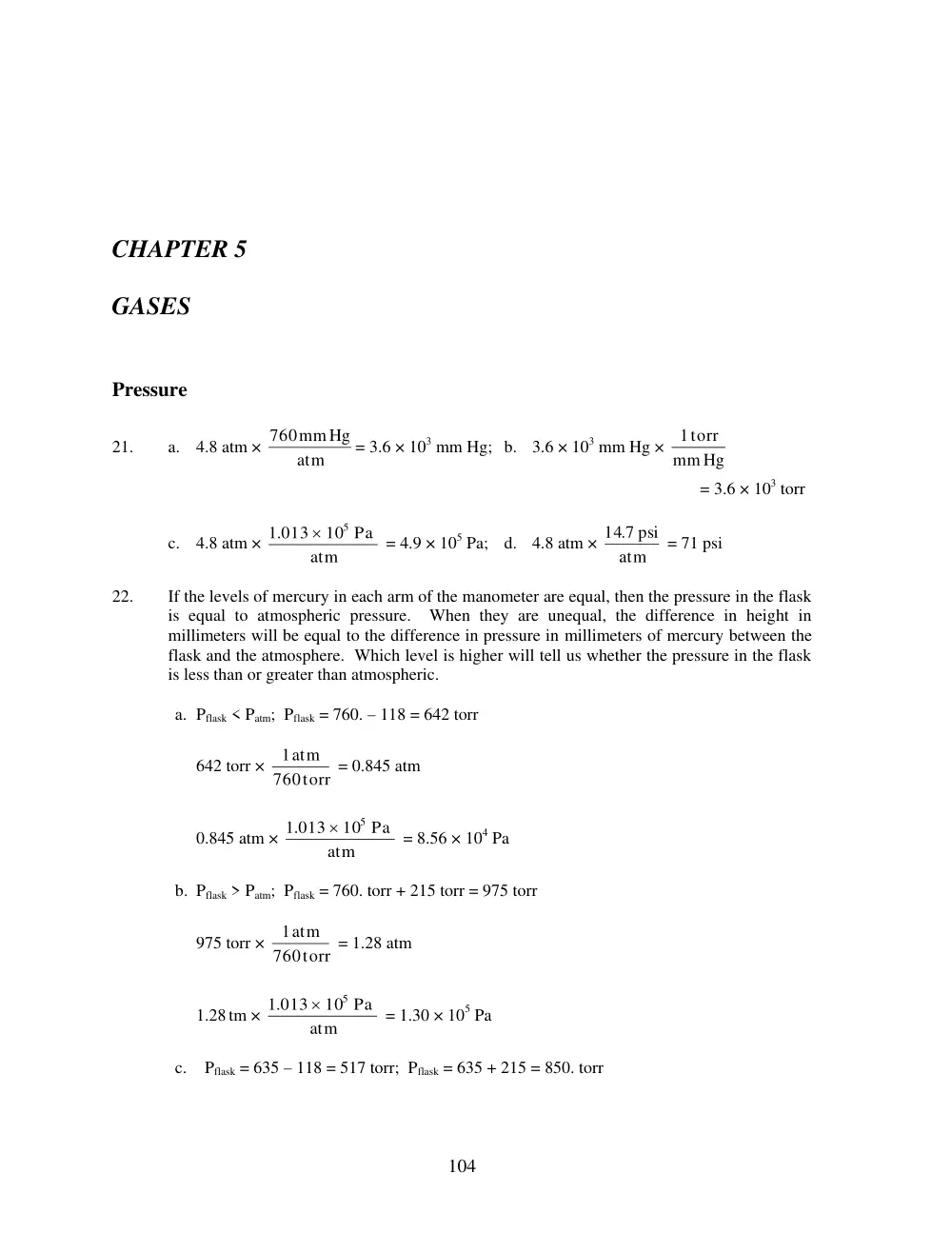
21.
a. 4.8 atm ×
atm
760mm Hg
= 3.6 × 103 mm Hg; b. 3.6 × 103 mm Hg ×
Hg
mm
1torr
= 3.6 × 10³ torr
c. 4.8 atm ×
atm
10 Pa
.1 013
5
= 4.9 × 10⁵ Pa; d. 4.8 atm ×
atm
14 7. psi
= 71 psi
22.
If the levels of mercury in each arm of the manometer are equal, then the pressure in the flask
is equal to atmospheric pressure. When they are unequal, the difference in height in
millimeters will be equal to the difference in pressure in millimeters of mercury between the
flask and the atmosphere. Which level is higher will tell us whether the pressure in the flask
is less than or greater than atmospheric.
a. Pflask < Patm; Pflask = 760. 118 = 642 torr
642 torr ×
torr
760
1atm
= 0.845 atm
0.845 atm ×
atm
10 Pa
.1 013
5
= 8.56 × 10⁴ Pa
b. Pflask > Patm; Pflask = 760. torr + 215 torr = 975 torr
975 torr ×
torr
760
1atm
= 1.28 atm
1.28 tm ×
atm
10 Pa
.1 013
5
= 1.30 × 10⁵ Pa
c. Pflask = 635 118 = 517 torr; Pflask = 635 + 215 = 850. torr
CHAPTER 5 GASES 105
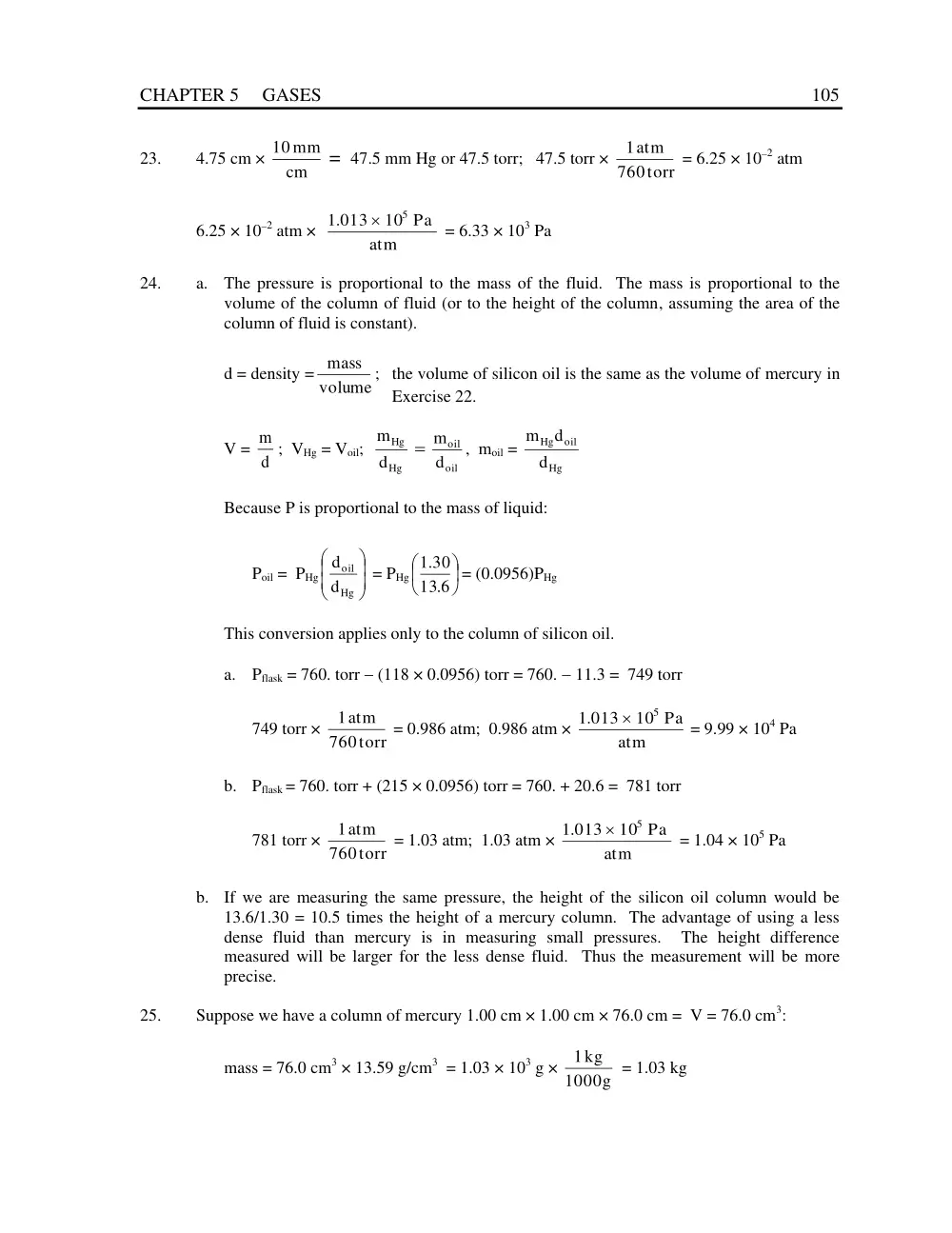
23.
4.75 cm ×
cm
10 mm
= 47.5 mm Hg or 47.5 torr; 47.5 torr ×
torr
760
1atm
= 6.25 × 10² atm
6.25 × 10² atm ×
atm
10 Pa
.1 013
5
= 6.33 × 10³ Pa
24.
a. The pressure is proportional to the mass of the fluid. The mass is proportional to the
volume of the column of fluid (or to the height of the column, assuming the area of the
column of fluid is constant).
d = density = volume
mass ; the volume of silicon oil is the same as the volume of mercury in
Exercise 22.
V = d
m ; VHg = Voil;
oil
oil
Hg
Hg
d
m
d
m
, moil =
Hg
Hg oil
d
d
m
Because P is proportional to the mass of liquid:
Poil = PHg
Hg
oil
d
d
= PHg
6.
13
.1 30
= (0.0956)PHg
This conversion applies only to the column of silicon oil.
a. Pflask = 760. torr (118 × 0.0956) torr = 760. 11.3 = 749 torr
749 torr ×
torr
760
1atm
= 0.986 atm; 0.986 atm ×
atm
10 Pa
.1 013
5
= 9.99 × 10⁴ Pa
b. Pflask
= 760. torr + (215 × 0.0956) torr = 760. + 20.6 = 781 torr
781 torr ×
torr
760
1atm
= 1.03 atm; 1.03 atm ×
atm
10 Pa
.1 013
5
= 1.04 × 10⁵ Pa
b. If we are measuring the same pressure, the height of the silicon oil column would be
13.6/1.30 = 10.5 times the height of a mercury column. The advantage of using a less
dense fluid than mercury is in measuring small pressures. The height difference
measured will be larger for the less dense fluid. Thus the measurement will be more
precise.
25.
Suppose we have a column of mercury 1.00 cm × 1.00 cm × 76.0 cm = V = 76.0 cm3:
mass = 76.0 cm3 × 13.59 g/cm3 = 1.03 × 10³ g ×
g
1000
1kg
= 1.03 kg
CHAPTER 5 GASES
106
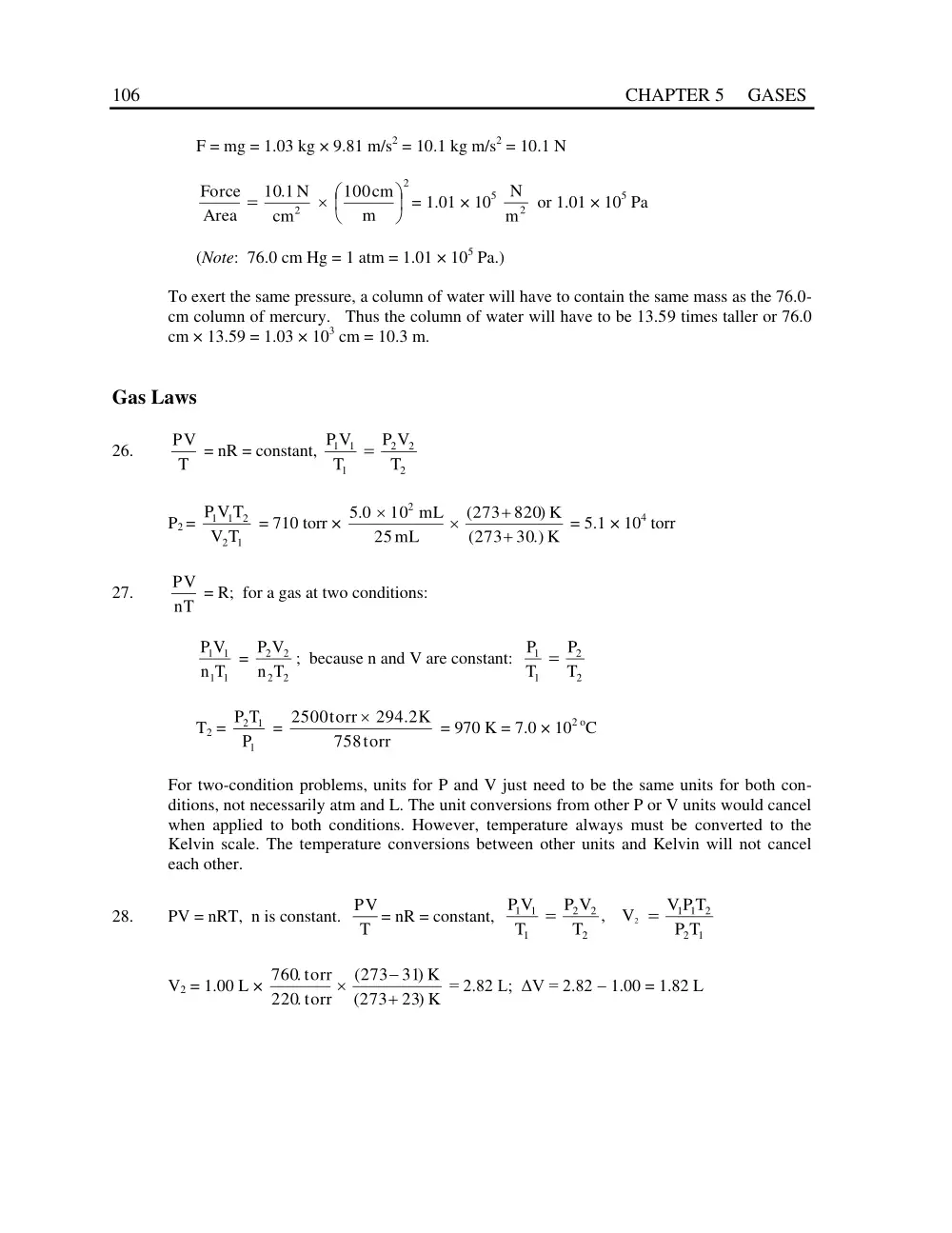
F = mg = 1.03 kg × 9.81 m/s2 = 10.1 kg m/s2 = 10.1 N
2
2
m
cm
100
cm
1. N
10
Area
Force
= 1.01 × 10⁵
m2
N or 1.01 × 10⁵ Pa
(Note: 76.0 cm Hg = 1 atm = 1.01 × 10⁵ Pa.)
To exert the same pressure, a column of water will have to contain the same mass as the 76.0-
cm column of mercury. Thus the column of water will have to be 13.59 times taller or 76.0
cm × 13.59 = 1.03 × 103 cm = 10.3 m.
Gas Laws
26.
T
PV = nR = constant,
2
2
2
1
1
1
T
V
P
T
P V
P2 =
1
2
2
1
1
T
V
P V T
= 710 torr ×
30.) K
273
(
820) K
273
(
mL
25
10 mL
0.5
2
= 5.1 × 10⁴ torr
27.
nT
PV = R; for a gas at two conditions:
1
1
1 1
T
n
P V
=
2
2
2 2
T
n
P V
; because n and V are constant:
2
2
1
1
T
P
T
P
T2 =
1
2 1
P
P T
=
torr
758
294.2K
2500torr
= 970 K = 7.0 × 10² oC
For two-condition problems, units for P and V just need to be the same units for both con-
ditions, not necessarily atm and L. The unit conversions from other P or V units would cancel
when applied to both conditions. However, temperature always must be converted to the
Kelvin scale. The temperature conversions between other units and Kelvin will not cancel
each other.
28.
PV = nRT, n is constant. T
PV = nR = constant,
1
2
2
1
1
2
2
2
1
1
1
T
P
V P T
V
,
T
V
P
T
V
P
2
V2 = 1.00 L ×
23) K
273
(
31) K
273
(
. torr
220
. torr
760
= 2.82 L; ΔV = 2.82 1.00 = 1.82 L
CHAPTER 5 GASES 107
29.
Treat each gas separately, and use the relationship P1V1 = P2V2 (n and T are constant).
For H2: P2 =
2
1 1
V
P V
= 475 torr ×
00 L
.3
.2 00 L
= 317 torr
For N2: P2 = 0.200 atm ×
00 L
.3
.1 00 L
= 0.0667 atm; 0.0667 atm ×
atm
760torr
= 50.7 torr
Ptotal =
2
2
N
H
P
P
= 317 + 50.7 = 368 torr
30.
For H2: P2 =
2
1 1
V
P V
= 360. torr ×
00 L
.3
.2 00 L
= 240. torr
Ptotal =
2
2
2
2
H
total
N
N
H
P
P
P
,
P
P
= 320. torr 240. torr = 80. torr
For N2: P1 =
1
2 2
V
P V
= 80. torr ×
00 L
.1
.3 00 L
= 240 torr
31.
As NO2 is converted completely into N2O4, the moles of gas present will decrease by a factor
of one-half (from the 2 : 1 mol ratio in the balanced equation). Using Avogadro’s law:
2
1
25 0. mL
n
n
V
V
n ,
V
n
V
1
2
1
2
2
2
1
1
= 12.5 mL
N2O4(g) will occupy one-half the original volume of NO2(g).
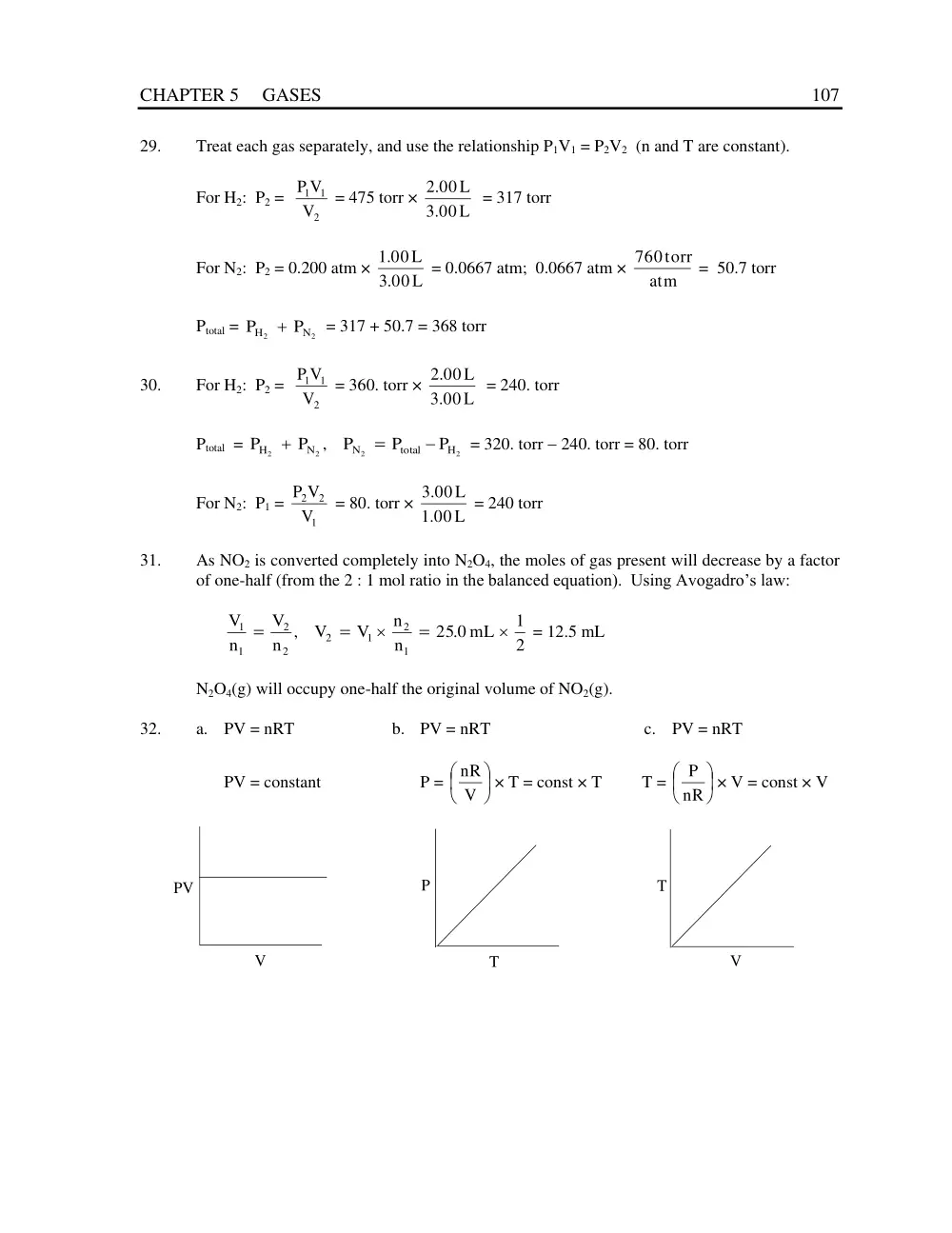
32.
a. PV = nRT
b. PV = nRT
c. PV = nRT
PV = constant
P =
V
nR × T = const × T T =
nR
P
× V = const × V
T
V
T
P
V
PV
CHAPTER 5 GASES
108
d. PV = nRT
e. P =
V
constant
V
nR
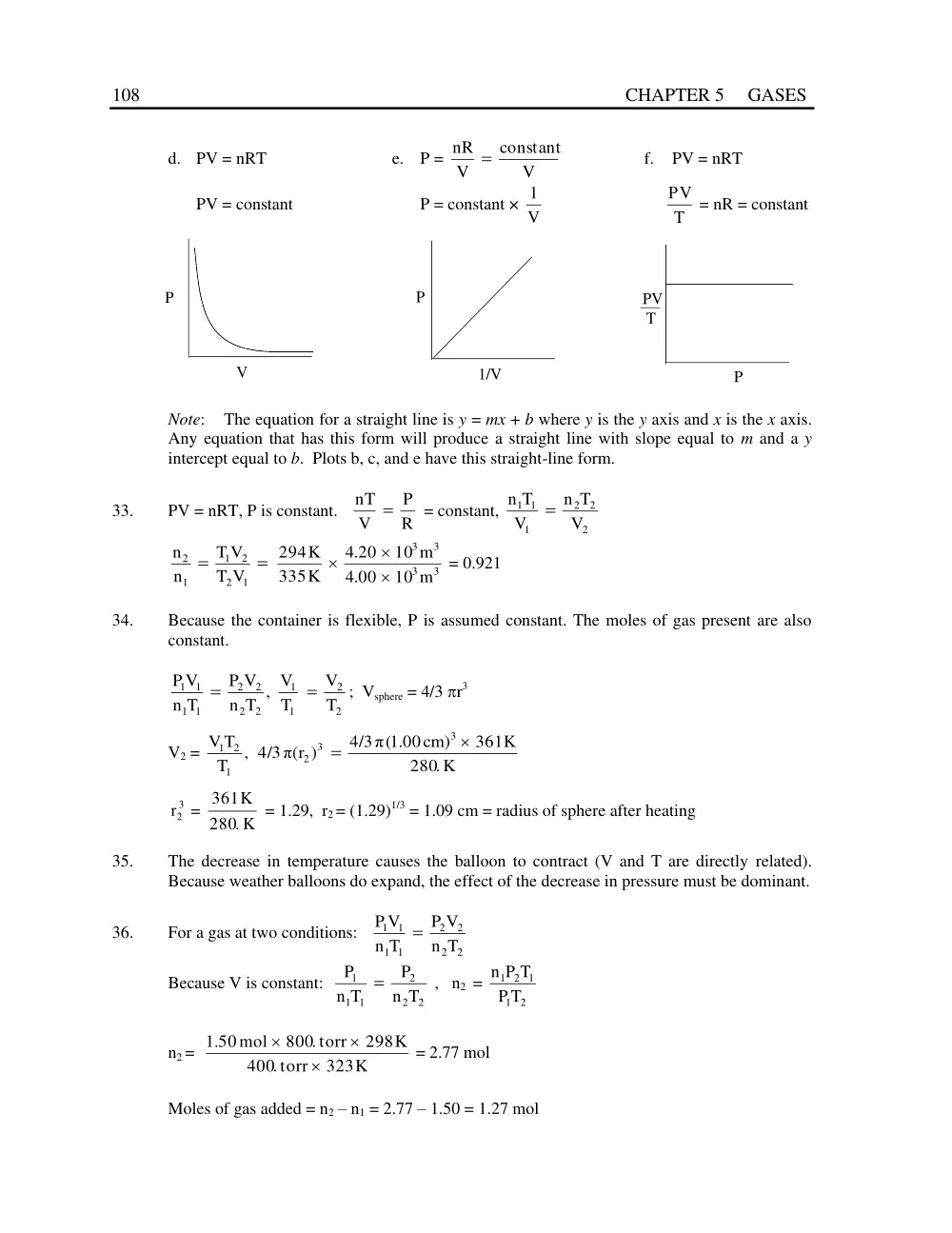
f.
PV = nRT
PV = constant
P = constant × V
1
T
PV = nR = constant
Note:
The equation for a straight line is y = mx + b where y is the y axis and x is the x axis.
Any equation that has this form will produce a straight line with slope equal to m and a y
intercept equal to b. Plots b, c, and e have this straight-line form.
33.
PV = nRT, P is constant.
R
P
V
nT
= constant,
2
2
2
1
1
1
V
T
n
V
n T
3
3
3
3
1
2
2
1
1
2
10 m
00
.4
10 m
20
.4
K
335
K
294
V
T
V
T
n
n
= 0.921
34.
Because the container is flexible, P is assumed constant. The moles of gas present are also
constant.
2
2
1
1
2
2
2
2
1
1
1
1
T
V
T
T , V
n
V
P
T
n
P V
; Vsphere = 4/3 r3
V2 =
. K
280
361K
.1( 00cm)
4/3π
, 4/3π r( )
T
V T
3
3
2
1
1 2
3
2r =
. K
280
361K
= 1.29, r2
= (1.29)1/3 = 1.09 cm = radius of sphere after heating
35.
The decrease in temperature causes the balloon to contract (V and T are directly related).
Because weather balloons do expand, the effect of the decrease in pressure must be dominant.
36.
For a gas at two conditions:
2
2
2
2
1
1
1
1
T
n
V
P
T
n
P V
Because V is constant:
2
2
2
1
1
1
T
n
P
n T
P
, n2 =
2
1
1
2
1
T
P
n P T
n2 =
323K
. torr
400
298K
800. torr
50 mol
.1
= 2.77 mol
Moles of gas added = n2 – n1 = 2.77 – 1.50 = 1.27 mol
P
V
1/V
P
PV
T
P
CHAPTER 5 GASES 109
37.
n =
24) K
(273
mol
K
08206L atm
.0
2000. L
atm
135
RT
PV
= 1.11 × 10³ mol
For He: 1.11 × 10³ mol ×
mol
.4 003g He
= 4.44 × 10³ g He
For H2: 1.11 × 10³ mol ×
mol
.2 016g H
2 = 2.24 × 10³ g H2
38.
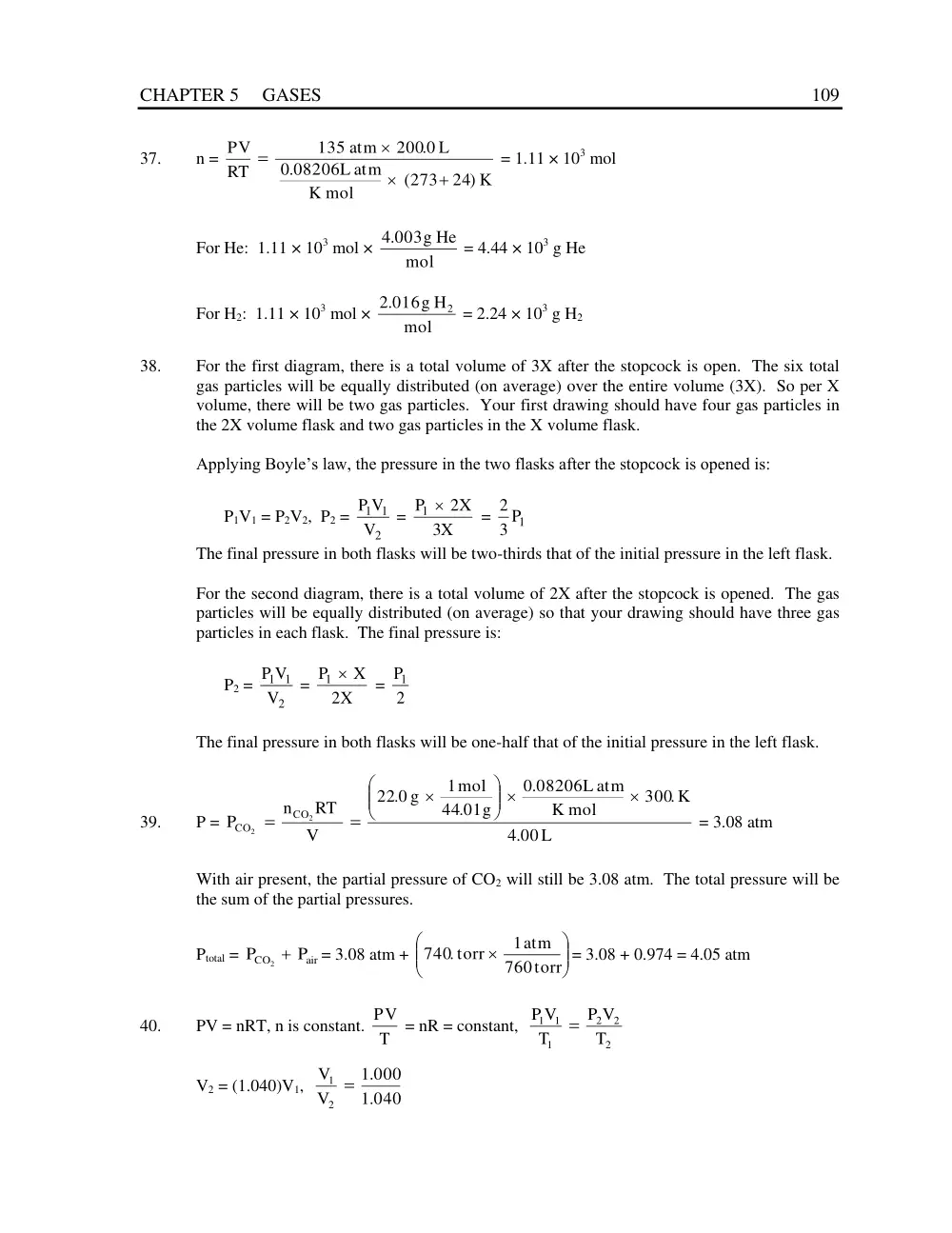
For the first diagram, there is a total volume of 3X after the stopcock is open. The six total
gas particles will be equally distributed (on average) over the entire volume (3X). So per X
volume, there will be two gas particles. Your first drawing should have four gas particles in
the 2X volume flask and two gas particles in the X volume flask.
Applying Boyle’s law, the pressure in the two flasks after the stopcock is opened is:
P1V1 = P2V2, P2 =
2
1 1
V
P V
=
X
3
P1 2X
=
3 1P
2
The final pressure in both flasks will be two-thirds that of the initial pressure in the left flask.
For the second diagram, there is a total volume of 2X after the stopcock is opened. The gas
particles will be equally distributed (on average) so that your drawing should have three gas
particles in each flask. The final pressure is:
P2 =
2
1 1
V
P V
=
X
2
P1 X
= 2
P1
The final pressure in both flasks will be one-half that of the initial pressure in the left flask.
39.
P =
00 L
.4
300. K
mol
K
08206L atm
.0
.01g
44
1mol
0. g
22
V
RT
n
P
2
2
CO
CO
= 3.08 atm
With air present, the partial pressure of CO2 will still be 3.08 atm. The total pressure will be
the sum of the partial pressures.
Ptotal =
air
CO
P
P
2
= 3.08 atm +
torr
760
1atm
740. torr
= 3.08 + 0.974 = 4.05 atm
40.
PV = nRT, n is constant. T
PV = nR = constant,
2
2
2
1
1
1
T
V
P
T
P V
V2 = (1.040)V1,
.1 040
000
.1
V
V
2
1
CHAPTER 5 GASES
110
P2 =
1
2
2
1
1
T
V
P V T
= 75 psi ×
273 19) K
(
58) K
273
(
.1 040
000
.1
= 82 psi
41.
PV = nRT,
R
V
P
nT
= constant,
2
2
2
1
1
1
P
T
n
P
n T
; moles × molar mass = mass
2
2
2
1
1
1
2
2
2
1
1
1
P
T
mass
P
T
, mass
P
(molarmass)T
n
P
n (molarmass)T
mass2 =
2050. psi
K
299
650. psi
291K
10 g
00
.1
P
T
T P
mass
3
1
2
1 2
1
= 309 g
42.
If we had 100.0 g of the gas, we would have 50.0 g He and 50.0 g Xe.
Xe
He
He
He
n
n
n
χ
g/mol
131.3
g
50.0
g/mol
4.003
g
50.0
g/mol
4.003
g
50.0
.0 970
.0 381molXe
5. molHe
12
12 5. molHe
PHe = χHePtotal = 0.970 × 600. torr = 582 torr; PXe = 600. 582 = 18 torr
43.
H O
He
P 2
P
= 1.00 atm = 760. torr = PHe + 23.8 torr, PHe = 736 torr
nHe = 0.586 g ×
.4 003g
1mol
= 0.146 mol He
V =
torr
760
1atm
torr
736
298K
mol
K
.0 08206L atm
146mol
.0
P
RT
n
He
He
= 3.69 L
44.
The container has 5 He atoms, 3 Ne atoms, and 2 Ar atoms for a total of 10 atoms. The mole
fractions of the various gases will be equal to the molecule fractions.
He =
totalatoms
10
5 He atoms
= 0.50; Ne =
totalatoms
10
3 Ne atoms
= 0.30
Ar = 1.00 – 0.50 – 0.30 = 0.20
PHe = He Ptotal = 0.50(1.00 atm) = 0.50 atm
PNe = Ne PTotal = 0.30(1.00atm) = 0.30 atm
PAr = 1.00 atm – 0.50 atm – 0.30 atm = 0.20 atm
CHAPTER 5 GASES 111
45.
a. Mole fraction CH4 =
.0 250atm
175atm
.0
175atm
.0
P
P
χ
total
CH
CH
4
4
= 0.412
χO2
= 1.000 – 0.412 = 0.588
b. PV = nRT, ntotal =
338K
mol
K
08206L atm
.0
10 5. L
425atm
.0
RT
V
Ptotal
= 0.161 mol
c.
total
CH
CH
total
CH
CH
n
χ
, n
n
n
χ
4
4
4
4
= 0.412 × 0.161 mol = 6.63 × 10² mol CH4
6.63 × 10² mol CH4 ×
4
4
CH
mol
16.04g CH
= 1.06 g CH4
nO2
= 0.588 × 0.161 mol = 9.47 × 10² mol O2; 9.47 × 10² mol O2 ×
2
2
O
mol
32.00g O
= 3.03 g O2
46.
Ptotal = 1.00 atm = 760. torr =
2
2
2
N
H O
N
P
P
P
+ 17.5 torr,
PN2
= 743 torr
293K
mol
K
08206L atm
.0
mL)
1000
1L
10 mL
( .2 50
torr)
760
1atm
743torr
(
RT
V
P
n
2
N
N
2
2
= 1.02 × 10² mol N2
1.02 × 10² mol N2 ×
2
2
N
mol
28.02g N
= 0.286 g N2
47.
We can use the ideal gas law to calculate the partial pressure of each gas or to calculate the
total pressure. There will be less math if we calculate the total pressure from the ideal gas
law.
nO2
= 1.5 × 10² mg O2
2
2
.00g O
32
molO
1
mg
1000
1g
= 4.7 × 10³ mol O2
nNH3
= 5.0 × 10²¹ molecules NH3 ×
3
23
3
moleculesNH
10
022
.6
molNH
1
= 8.3 × 10⁻³ mol NH3
ntotal =
3
2
2
NH
O
N
n
n
n
= 5.0 × 10² + 4.7 × 10³ + 8.3 × 103 = 6.3 × 10² mol total
atm
4.1
L
0.1
273K
mol
K
.0 08206L atm
mol
10
3.6
V
RT
n
P
2
total
total
CHAPTER 5 GASES
112
atm
1.1
atm
4.1
mol
10
3.6
mol
10
0.5
; P
n
n
,
P
P
2
2
N
total
N
N
total
N
N
2
2
2
2
2
.0 18atm
atm
4.1
10
3.6
10
3.8
.0 10atm; P
atm
4.1
10
3.6
10
7.4
P
2
3
NH
2
3
O
3
2
48.
For O2, n and T are constant, so P1V1 = P2V2.
P1 =
1
2
2
V
P V
= 785 torr ×
00 L
.2
.1 94 L
= 761 torr =
PO2
Ptotal =
H O
H O
O
2
2
2
, P
P
P
= 785 – 761 = 24 torr
49.
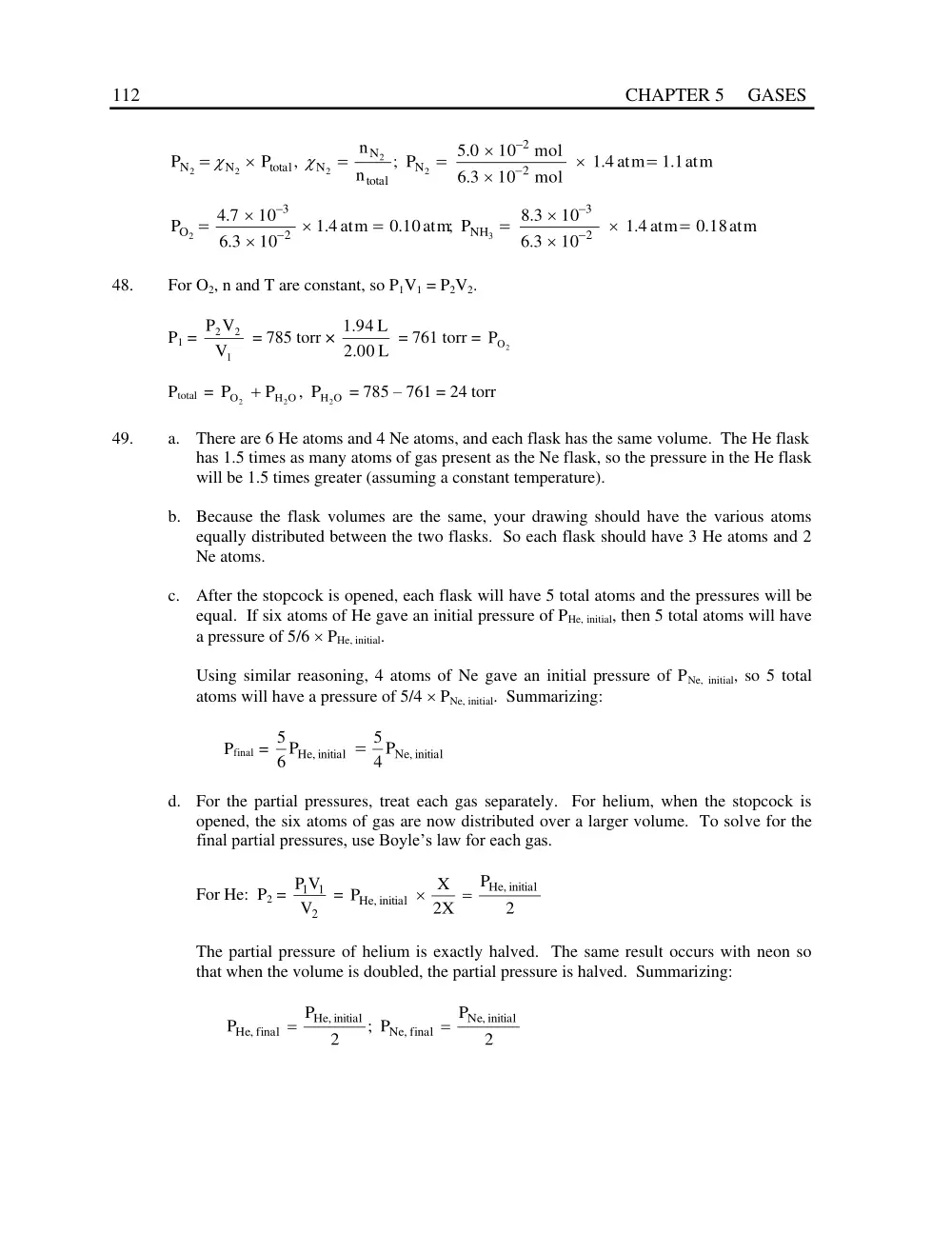
a. There are 6 He atoms and 4 Ne atoms, and each flask has the same volume. The He flask
has 1.5 times as many atoms of gas present as the Ne flask, so the pressure in the He flask
will be 1.5 times greater (assuming a constant temperature).
b. Because the flask volumes are the same, your drawing should have the various atoms
equally distributed between the two flasks. So each flask should have 3 He atoms and 2
Ne atoms.
c. After the stopcock is opened, each flask will have 5 total atoms and the pressures will be
equal. If six atoms of He gave an initial pressure of PHe, initial, then 5 total atoms will have
a pressure of 5/6 PHe, initial.
Using similar reasoning, 4 atoms of Ne gave an initial pressure of PNe, initial, so 5 total
atoms will have a pressure of 5/4 PNe, initial. Summarizing:
Pfinal =
Ne, initial
He, initial
4 P
5
6 P
5
d. For the partial pressures, treat each gas separately. For helium, when the stopcock is
opened, the six atoms of gas are now distributed over a larger volume. To solve for the
final partial pressures, use Boyle’s law for each gas.
For He: P2 =
2
1 1
V
P V
=
2
P
2X
X
P
, initial
He
He, initial
The partial pressure of helium is exactly halved. The same result occurs with neon so
that when the volume is doubled, the partial pressure is halved. Summarizing:
2
P
; P
2
P
P
, initial
Ne
, final
Ne
, initial
He
He, final
CHAPTER 5 GASES 113
Gas Density, Molar Mass, and Reaction Stoichiometry
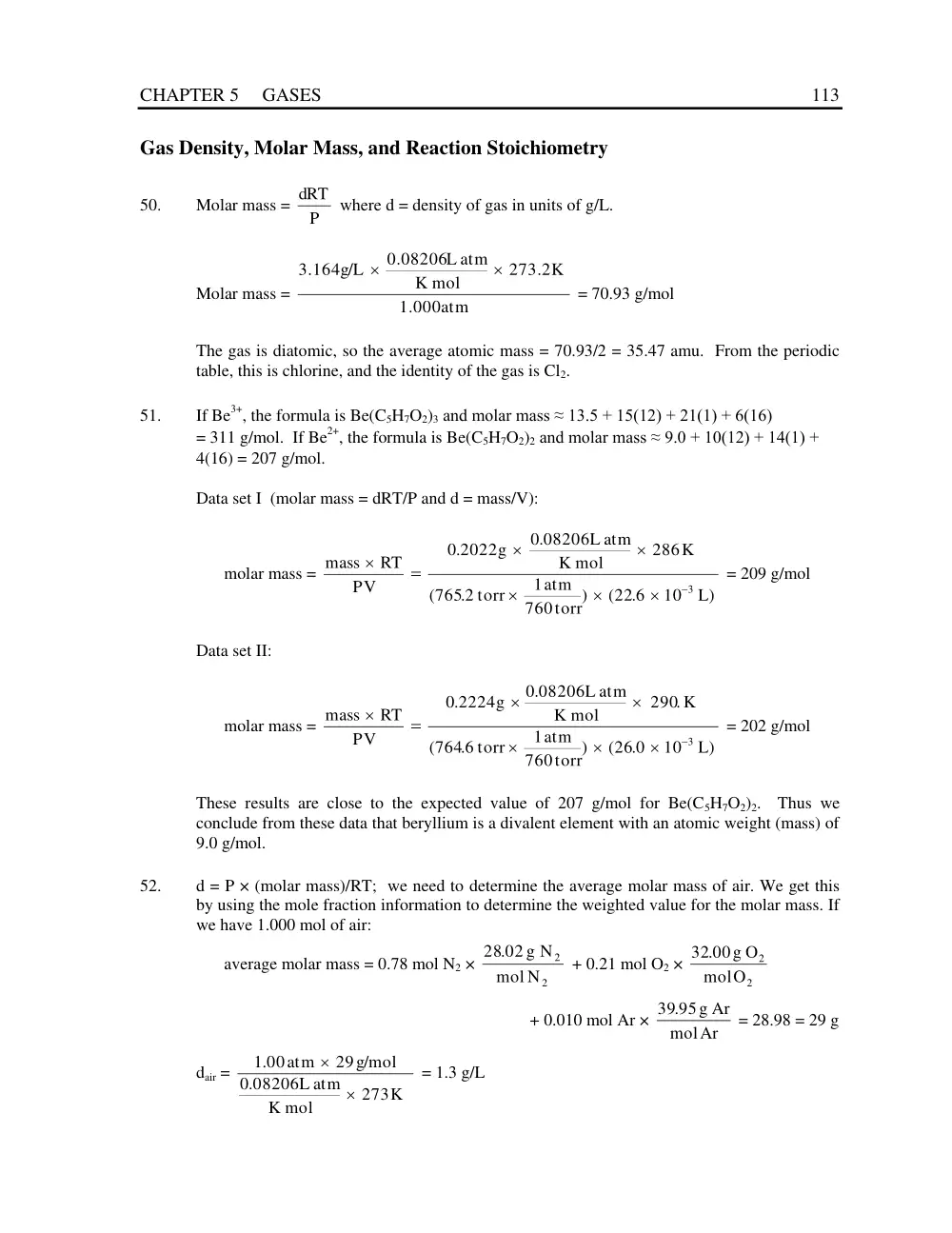
50.
Molar mass =
P
dRT where d = density of gas in units of g/L.
Molar mass =
atm
1.000
273.2K
mol
K
0.08206L atm
3.164g/L
= 70.93 g/mol
The gas is diatomic, so the average atomic mass = 70.93/2 = 35.47 amu. From the periodic
table, this is chlorine, and the identity of the gas is Cl2.
51.
If Be3+, the formula is Be(C5H7O2)3 and molar mass ≈ 13.5 + 15(12) + 21(1) + 6(16)
= 311 g/mol. If Be2+, the formula is Be(C5H7O2)2 and molar mass ≈ 9.0 + 10(12) + 14(1) +
4(16) = 207 g/mol.
Data set I (molar mass = dRT/P and d = mass/V):
molar mass =
L)
10
(22 6.
torr)
760
1atm
765 2. torr
(
286K
mol
K
.0 08206L atm
2022g
.0
PV
RT
mass
3
= 209 g/mol
Data set II:
molar mass =
L)
10
(26 0.
torr)
760
1atm
764 6. torr
(
290. K
mol
K
.0 08206L atm
2224g
.0
PV
RT
mass
3
= 202 g/mol
These results are close to the expected value of 207 g/mol for Be(C5H7O2)2. Thus we
conclude from these data that beryllium is a divalent element with an atomic weight (mass) of
9.0 g/mol.
52.
d = P × (molar mass)/RT; we need to determine the average molar mass of air. We get this
by using the mole fraction information to determine the weighted value for the molar mass. If
we have 1.000 mol of air:
average molar mass = 0.78 mol N2 ×
2
2
N
mol
28.02 g N
+ 0.21 mol O2 ×
2
2
O
mol
32.00g O
+ 0.010 mol Ar ×
Ar
mol
39.95g Ar
= 28.98 = 29 g
dair =
273K
mol
K
08206L atm
.0
29g/mol
00atm
.1
= 1.3 g/L
CHAPTER 5 GASES
114
53.
Rigid container: As temperature is increased, the gas molecules move with a faster average
velocity. This results in more frequent and more forceful collisions, resulting in an increase in
pressure. Density = mass/volume; the moles of gas are constant, and the volume of the
container is constant, so density in this case must be temperature-independent (density is
constant).
Flexible container: The flexible container is a constant-pressure container. Therefore, the
final internal pressure will be unaffected by an increase in temperature. The density of the
gas, however, will be affected because the container volume is affected. As T increases, there
is an immediate increase in P inside the container. The container expands its volume to
reduce the internal pressure back to the external pressure. We have the same mass of gas in a
larger volume. Gas density will decrease in the flexible container as T increases.
54.
We assume that 28.01 g/mol is the true value for the molar mass of N2. The value of 28.15
g/mol is the average molar mass of the amount of N2 and Ar in air. Assume 100.00 mol of
total gas present, and let x = the number of moles that are N2 molecules. Then 100.00 x =
the number of moles that are Ar atoms. Solving:
28.15 =
.00
100
)(39.95)
(100.00
(28.01)
x
x
2815 = (28.01)x + 3995 (39.95)x, (11.94)x = 1180.
x = 98.83% N2; % Ar = 100.00 x = 1.17% Ar
Ratio of moles of Ar to moles of N2 =
.83
98
.1 17
= 1.18 × 10².
55.
Out of 100.0 g of compound, there are:
87.4 g N ×
.01 g N
14
1molN
= 6.24 mol N;
.6 24
.6 24
= 1.00
12.6 g H ×
008 g H
.1
1molH
= 12.5 mol H;
24
.6
12 5.
= 2.00
Empirical formula is NH2. P × (molar mass) = dRT, where d = density.
Molar mass =
torr
760
1atm
. torr
710
373K
mol
K
08206L atm
.0
L
977g
.0
P
dRT
= 32.0 g/mol
Empirical formula mass of NH2 = 16.0 g. Therefore, the molecular formula is N2H4.
56.
P × (molar mass) = dRT, d =
volume,
mass
P × (molar mass) =
V
mass × RT
CHAPTER 5 GASES 115
Molar mass =
.0 256L
torr)
760
1atm
750. torr
(
373K
mol
K
.0 08206L atm
800g
.0
PV
RT
mass
= 96.9 g/mol
Mass of CHCl 12.0 + 1.0 + 35.5 = 48.5;
5.
48
96 9.
= 2.00; molecular formula is C2H2Cl2.
57.
2 NaClO3(s) 2 NaCl(s) + 3 O2(g)
Ptotal =
H O
total
O
H O
O
2
2
2
2
P
P
, P
P
P
= 734 torr – 19.8 torr = 714 torr
22) K
(273
mol
K
08206L atm
.0
.0 0572L
torr
760
1atm
torr
714
RT
V
P
n
2
2
O
O
= 2.22 × 10³ mol O2
Mass NaClO3 decomposed = 2.22 × 10³ mol O2 ×
3
3
2
3
NaClO
mol
.44g NaClO
106
molO
3
2 molNaClO
= 0.158 g NaClO3
Mass % NaClO3 =
8765g
.0
.0 158g
× 100 = 18.0%
58.
For ammonia (in 1 minute):
496K
mol
K
08206L atm
.0
500. L
.atm
90
RT
V
P
n
3
3
3
NH
NH
NH
= 1.1 × 10³ mol NH3
NH3 flows into the reactor at a rate of 1.1 × 10³ mol/min.
For CO2 (in 1 minute):
496K
mol
K
08206L atm
.0
600. L
atm
45
RT
V
P
n
2
2
2
CO
CO
CO
= 6.6 × 10² mol CO2
CO2 flows into the reactor at 6.6 × 10² mol/min.
To react completely with 1.1 × 10³ mol NH3/min, we need:
3
2
3
3
molNH
2
molCO
1
min
10 molNH
1.1
= 5.5 × 10² mol CO2/min
CHAPTER 5 GASES
116
Because 660 mol CO2/min are present, ammonia is the limiting reagent.
urea
mol
.06g urea
60
molNH
2
molurea
1
min
10 molNH
1.1
3
3
3
= 3.3 × 10⁴ g urea/min
59.
150 g (CH3)2N2H2 ×
2
2
2
3
2
2
2
2
3
(CH ) N H
mol
molN
3
.10g
60
1mol(CH ) N H
= 7.5 mol N2 produced
V
nRT
P
2
N
=
L
250
300. K
mol
K
.0 08206L atm
mol
5.7
= 0.74 atm
We could do a similar calculation for
PH2O
and
PCO2
and then calculate
H O
N
total
2
2
P
P
(
P
)
P
CO2
. Or we can recognize that 9 total moles of gaseous products form for every mole of
(CH3)2N2H2 reacted. This is three times the moles of N2 produced. Therefore, Ptotal will be
three times larger than
.
P
2
N Ptotal = 3 ×
PN2
= 3 × 0.74 atm = 2.2 atm.
60.
Rigid container (constant volume): As reactants are converted to products, the moles of gas
particles present decrease by one-half. As n decreases, the pressure will decrease (by one-
half). Density is the mass per unit volume. Mass is conserved in a chemical reaction, so the
density of the gas will not change because mass and volume do not change.
Flexible container (constant pressure): Pressure is constant because the container changes
volume in order to keep a constant pressure. As the moles of gas particles decrease by a
factor of 2, the volume of the container will decrease (by one-half). We have the same mass
of gas in a smaller volume, so the gas density will increase (is doubled).
61.
For NH3: P2 =
2
1 1
V
P V
= 0.500 atm
00 L
.3
.2 00 L
= 0.333 atm
For O2: P2 =
2
1 1
V
P V
= 1.50 atm ×
00 L
.3
.1 00 L
= 0.500 atm
After the stopcock is opened, V and T will be constant, so P n. The balanced equation
requires:
4
5
P
P
n
n
3
2
3
2
NH
O
NH
O
= 1.25
The actual ratio present is:
333atm
.0
500atm
.0
P
P
3
2
NH
O
= 1.50
CHAPTER 5 GASES 117
The actual ratio is larger than the required ratio, so NH3 in the denominator is limiting.
Because equal moles of NO will be produced as NH3 reacted, the partial pressure of NO
produced is 0.333 atm (the same as
PNH3
reacted).
62.
2 NaN3(s) 2 Na(s) + 3 N2(g)
273K
mol
K
08206L atm
.0
70 0. L
00atm
.1
RT
PV
n
2
N
= 3.12 mol N2 are needed to fill the air bag.
Mass NaN3 reacted = 3.12 mol N2 ×
3
3
2
3
NaN
mol
.02g NaN
65
molN
3
2 molNaN
= 135 g NaN3
63.
273K
mol
K
08206L atm
.0
cm
1000
L
1
m
100cm
4800m
atm
0.1
RT
PV
n
3
3
3
H2
= 2.1 × 10⁵ mol
2.1 × 10⁵ mol H2 are in the balloon. This is 80.% of the total amount of H2 that had to be
generated:
0.80(total mol H2) = 2.1 × 10⁵, total mol H2 = 2.6 × 10⁵ mol H2
2.6 × 10⁵ mol H2 ×
Fe
mol
.85g Fe
55
H
mol
molFe
1
2
= 1.5 × 10⁷ g Fe
2.6 × 10⁵ mol H2 ×
4
2
4
2
4
2
2
4
2
g H SO
98
g reagent
100
H SO
mol
.09g H SO
98
H
mol
1molH SO
= 2.6 × 10⁷ g of 98%
sulfuric acid
64.
0.2766 g CO2 ×
.009gCO2
44
12.011g C
= 7.549 × 10² g C; % C =
1023g
.0
g
.7 549 10
2
× 100 = 73.79% C
0.0991 g H2O ×
.02gH O
18
016g H
.2
2
= 1.11 × 10² g H; % H =
1023g
.0
g
10
.1 11
2
× 100 = 10.9% H
PV = nRT,
273K
mol
K
08206L atm
.0
L
10
27 6.
00atm
.1
RT
PV
n
3
N2
= 1.23 × 10³ mol N2
1.23 × 10³ mol N2 ×
2
2
N
mol
28.02g N
= 3.45 × 10² g nitrogen
Mass % N =
4831g
.0
g
10
.3 45
2
× 100 = 7.14% N
CHAPTER 5 GASES
118
Mass % O = 100.00 (73.79 + 10.9 + 7.14) = 8.2% O
Out of 100.00 g of compound, there are:
73.79 g C ×
.011g
12
1mol
= 6.144 mol C; 7.14 g N ×
.01g
14
1mol
= 0.510 mol N
10.9 g H ×
008g
.1
1mol
= 10.8 mol H; 8.2 g O ×
.00g
16
1mol
= 0.51 mol O
Dividing all values by 0.51 gives an empirical formula of C12H21NO.
Molar mass =
torr
760
1atm
torr
256
400. K
mol
K
08206L atm
.0
L
02g
.4
P
dRT
= 392 g/mol
Empirical formula mass of C12H21NO ≈ 195 g/mol and 195
392 ≈ 2.
Thus the molecular formula is C24H42N2O2.
65.
2 NH3(g) N2(g) + 3 H2(g); as reactants are converted into products, we go from 2 moles
of gaseous reactants to 4 moles of gaseous products (1 mol N2 + 3 mol H2). Because the
moles of gas doubles as reactants are converted into products, the volume of the gases will
double (at constant P and T).
PV = nRT, P =
n
V
RT
= (constant)n; pressure is directly related to n at constant T and V.
As the reaction occurs, the moles of gas will double, so the pressure will double. Because 1
mol of N2 is produced for every 2 mol of NH3 reacted,
.
1/2 P
P
o
NH
N
3
2
Owing to the 3 to 2
mole ratio in the balanced equation,
o
NH
H
3
2
3/2 P
P
.
Note:
o
NH
o
NH
o
NH
N
H
total
3
3
3
2
2
2 P
1/2P
3/2P
P
P
P
. As we said earlier, the total pres-
sure doubles as reactants are completely converted into products for this reaction
66.
1.00 × 10³ kg Mo ×
.94g Mo
95
molMo
1
kg
1000g
= 1.04 × 10⁴ mol Mo
1.04 × 10⁴ mol Mo ×
3
2
3
MoO
mol
molO
7/2
Mo
mol
1molMoO
= 3.64 × 10⁴ mol O2
CHAPTER 5 GASES 119
00atm
.1
290. K
mol
K
.0 08206L atm
10 mol
64
.3
P
RT
n
V
4
O
O
2
2
= 8.66 × 10⁵ L of O2
8.66 × 10⁵ L O2 ×
L O2
21
100L air
= 4.1 × 10⁶ L air
1.04 × 10⁴ mol Mo ×
Mo
mol
3 molH
2 = 3.12 × 10⁴ mol H2
00atm
.1
290. K
mol
K
.0 08206L atm
10 mol
12
.3
V
4
H2
= 7.42 × 10⁵ L of H2
67.
Ptotal =
2
2
2
N
H O
N
, P
P
P
= 726 torr – 23.8 torr = 702 torr
torr
760
1atm
= 0.924 atm
298K
mol
K
08206L atm
.0
L
10
31 8.
924atm
.0
RT
V
P
n
3
N
N
2
2
= 1.20 × 10³ mol N2
Mass of N in compound = 1.20 × 10³ mol N2 ×
mol
28.02g N
2 = 3.36 × 10² g nitrogen
Mass % N =
253g
.0
g
.3 36 10
2
× 100 = 13.3% N
68.
10.10 atm 7.62 atm = 2.48 atm is the pressure of the amount of F2 reacted.
PV = nRT, V and T are constant.
2
1
2
1
2
2
1
1
n
n
P
or P
n
P
n
constant, P
n
P
24atm
.1
48atm
.2
Xe reacted
Mol
MolF reacted
2
= 2.00; so: Xe + 2 F2 XeF4
69.
Because P and T are constant, V and n are directly proportional. The balanced equation
requires 2 L of H2 to react with 1 L of CO (2 : 1 volume ratio due to 2 : 1 mole ratio in the
balanced equation). The actual volume ratio present in 1 minute is 16.0 L/25.0 L = 0.640
(0.640 : 1). Because the actual volume ratio present is smaller than the required volume ratio,
H2 is the limiting reactant. The volume of CH3OH produced at STP will be one-half the
volume of H2 reacted due to the 1 : 2 mole ratio in the balanced equation. In 1 minute,
16.0 L/2 = 8.00 L CH3OH are produced (theoretical yield).
CHAPTER 5 GASES
120
nCH3OH
= RT
PV =
273K
mol
K
08206L atm
.0
.8 00 L
00atm
.1
= 0.357 mol CH3OH in 1 minute
0.357 mol CH3OH ×
CH OH
mol
.04g CH OH
32
3
3
= 11.4 g CH3OH (theoretical yield per minute)
Percent yield =
l yield
theoretica
actual yield
× 100 =
4. g
11
.5 30 g
100 = 46.5% yield
70.
CH3OH + 3/2 O2 CO2 + 2 H2O or 2 CH3OH(l) + 3 O2(g) 2 CO2(g) + 4 H2O(g)
50.0 mL ×
.04g
32
mol
1
mL
.0 850g
= 1.33 mol CH3OH(l) available
nO2
= RT
PV =
300. K
mol
K
08206L atm
.0
22 8. L
00atm
.2
= 1.85 mol O2 available
1.33 mol CH3OH ×
molCH OH
2
molO
3
3
2
= 2.00 mol O2
2.00 mol O2 are required to react completely with all the CH3OH available. We only have
1.85 mol O2, so O2 is limiting.
1.85 mol O2 ×
2
2
molO
3
4 molH O
= 2.47 mol H2O
71.
Molar mass =
000atm
.1
273 2. K
mol
K
08206L atm
.0
L
70902g
.0
P
dRT
= 15.90 g/mol
15.90 g/mol is the average molar mass of the mixture of methane and helium. Assume
100.00 mol of total gas present, and let x = mol of CH4 in the 100.00 mol mixture. This value
of x is also equal to the volume percentage of CH4 in 100.00 L of mixture because T and P
are constant.
15.90 =
.00
100
)( .4 003)
(100.00
(16.04)
x
x
, 1590. = (16.04)x + 400.3 (4.003)x
1190. = (12.04)x, x = 98.84% CH4 by volume; % He = 100.00 x = 1.16% He by volume
CHAPTER 5 GASES 121
Kinetic Molecular Theory and Real Gases
72.
a. Containers ii, iv, vi, and viii have volumes twice those of containers i, iii, v, and vii.
Containers iii, iv, vii, and viii have twice the number of molecules present than
containers i, ii, v, and vi. The container with the lowest pressure will be the one which
has the fewest moles of gas present in the largest volume (containers ii and vi both have
the lowest P). The smallest container with the most moles of gas present will have the
highest pressure (containers iii and vii both have the highest P). All the other containers
(i, iv, v and viii) will have the same pressure between the two extremes. The order is ii =
vi < i = iv = v = viii < iii = vii.
b. All have the same average kinetic energy because the temperature is the same in each
container. Only temperature determines the average kinetic energy.
c. The least dense gas will be in container ii because it has the fewest of the lighter Ne
atoms present in the largest volume. Container vii has the most dense gas because the
largest number of the heavier Ar atoms are present in the smallest volume. To figure out
the ordering for the other containers, we will calculate the relative density of each. In the
table below, m1 equals the mass of Ne in container i, V1 equals the volume of container i,
and d1 equals the density of the gas in container i.
Container
i
ii
iii
iv
v
vi
vii
viii
mass,
volume
m1, V1
m1, 2V1
2m1, V1
2m1, 2V1
2m1, V1
2m1, 2V1
4m1, V1
4m1, 2V1
density
volume
mass
1
1
V
m
= d1
1
1
1
d
2V
m
2
1
1
1
V
m
2
= 2d1
1
1
V
2
m
2
= d1
1
1
V
m
2
= 2d1
1
1
V
2
m
2
= d1
1
1
V
4 m
= 4d1
1
1
V
2
4 m
= 2d1
From the table, the order of gas density is ii < i = iv = vi < iii = v = viii < vii.
d. µrms = (3RT/M)1/2; the root mean square velocity only depends on the temperature and the
molar mass. Because T is constant, the heavier argon molecules will have a slower root
mean square velocity than the neon molecules. The order is v = vi = vii = viii < i = ii =
iii = iv.
73.
The kinetic molecular theory assumes that gas particles do not exert forces on each other and
that gas particles are volumeless. Real gas particles do exert attractive forces for each other,
and real gas particles do have volumes. A gas behaves most ideally at low pressures and high
temperatures. The effect of attractive forces is minimized at high temperatures because the
gas particles are moving very rapidly. At low pressure, the container volume is relatively
large (P and V are inversely related), so the volume of the container taken up by the gas
particles is negligible.
74.
a. At constant temperature, the average kinetic energy of the He gas sample will equal the
average kinetic energy of the Cl2 gas sample. In order for the average kinetic energies to
be the same, the smaller He atoms must move at a faster average velocity than Cl2
molecules. Therefore, plot A, with the slower average velocity, would be for the Cl2
CHAPTER 5 GASES
122
sample, and plot B would be for the He sample. Note the average velocity in each plot is
a little past the top of the peak.
b. As temperature increases, the average velocity of a gas will increase. Plot A would be for
O2(g) at 273 K, and plot B, with the faster average velocity, would be for O2(g) at 1273
K.
Because a gas behaves more ideally at higher temperatures, O2(g) at 1273 K would
behave most ideally.
75.
V, T, and P are all constant, so n must be constant. Because we have equal moles of gas in
each container, gas B molecules must be heavier than gas A molecules.
a. Both gas samples have the same number of molecules present (n is constant).
b. Because T is constant, KEave must be the same for both gases (KEave = 3/2 RT).
c. The lighter gas A molecules will have the faster average velocity.
d. The heavier gas B molecules do collide more forcefully, but gas A molecules, with the
faster average velocity, collide more frequently. The end result is that P is constant
between the two containers.
76.
Boyle's law: P 1/V at constant n and T
In the kinetic molecular theory (KMT), P is proportional to the collision frequency which is
proportional to 1/V. As the volume increases, there will be fewer collisions per unit area with
the walls of the container, and pressure will decrease (Boyle's law).
Charles's law: V T at constant n and P
When a gas is heated to a higher temperature, the velocities of the gas molecules increase and
thus hit the walls of the container more often and with more force. In order to keep the
pressure constant, the volume of the container must increase (this increases surface area,
which decreases the number of collisions per unit area, which decreases the pressure).
Therefore, volume and temperature are directly related at constant n and P (Charles’s law).
Avogadro’s law: V n at constant P and T
As gas is added to a container (n increases), there will be an immediate increase in the
number of gas particle collisions with the walls of the container. This results in an increase in
pressure in the container. However, the container is such that it wants to keep the pressure
constant. In order to keep pressure constant, the volume of the container increases in order to
reduce the collision frequency, which reduces the pressure. V is directly related to n at
constant P and