
CHM 201 Problems Solution for Chap 7, Fall 2013
Lebanese American University · Chemical Principles · 66 pages · with solution


Showing the first 10 of 66 pages. Download the PDF to see all of it.
More CHM 201 files
- Questions Exam Quest · Fall 2015ProblemsView
- Problems Solution for Chap 6 · Fall 2013Problems · with solutionView
- Problems Solution for Chap 8 · Fall 2013Problems · with solutionView
- Problems Solution Manual · Fall 2013Problems · with solutionView
- Problems Solution for Chap 3 Exercises · Fall 2013Problems · with solutionView
- Problems Solution for Chap 4 Exercises · Fall 2013Problems · with solutionView
- Problems Solution for Chap 5 Exercises · Fall 2013Problems · with solutionView
- Final Sample · Spring 2017Final examView
Show the text of this problems
204
CHAPTER 7
ACIDS AND BASES
Nature of Acids and Bases
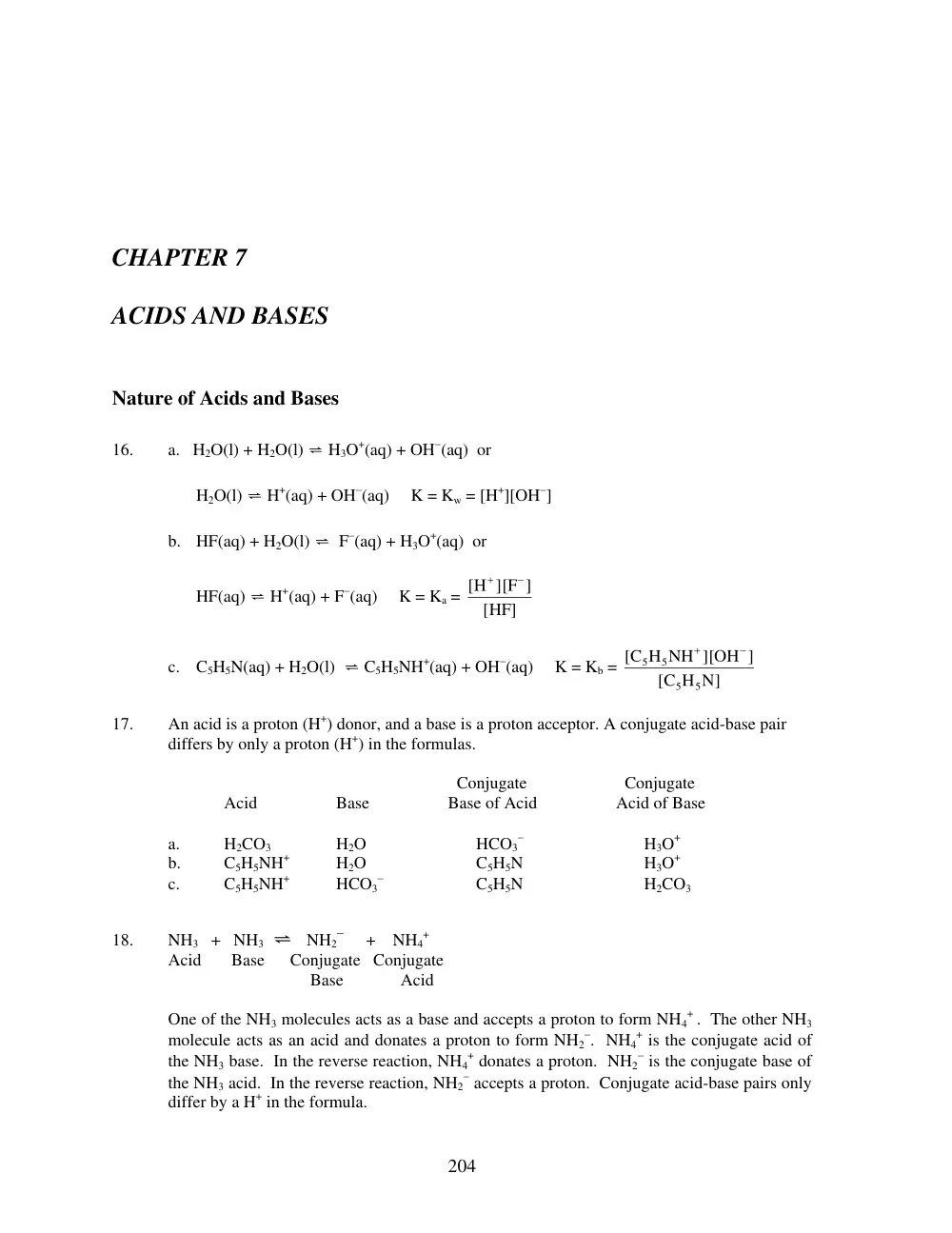
16.
a. H2O(l) + H2O(l) ⇌ H3O+(aq) + OH(aq) or
H2O(l) ⇌ H+(aq) + OH(aq) K = Kw = [H+][OH]
b. HF(aq) + H2O(l) ⇌ F(aq) + H3O+(aq) or
HF(aq) ⇌ H+(aq) + F(aq) K = Ka =
HF]
[
[H ][F ]
c. C5H5N(aq) + H2O(l) ⇌ C5H5NH+(aq) + OH(aq) K = Kb =
C H N]
[
C H NH ][OH ]
[
5
5
5
5
17.
An acid is a proton (H+) donor, and a base is a proton acceptor. A conjugate acid-base pair
differs by only a proton (H+) in the formulas.
Conjugate
Conjugate
Acid
Base
Base of Acid
Acid of Base
a.
H2CO3
H2O
HCO3
H3O+
b.
C5H5NH+
H2O
C5H5N
H3O+
c.
C5H5NH+
HCO3
C5H5N
H2CO3
18.
NH3 + NH3 ⇌ NH2
+ NH4
+
Acid Base Conjugate Conjugate
Base
Acid
One of the NH3 molecules acts as a base and accepts a proton to form NH4
+ . The other NH3
molecule acts as an acid and donates a proton to form NH2
. NH4
+ is the conjugate acid of
the NH3 base. In the reverse reaction, NH4
+ donates a proton. NH2
is the conjugate base of
the NH3 acid. In the reverse reaction, NH2
accepts a proton. Conjugate acid-base pairs only
differ by a H+ in the formula.
CHAPTER 7 ACIDS AND BASES 205
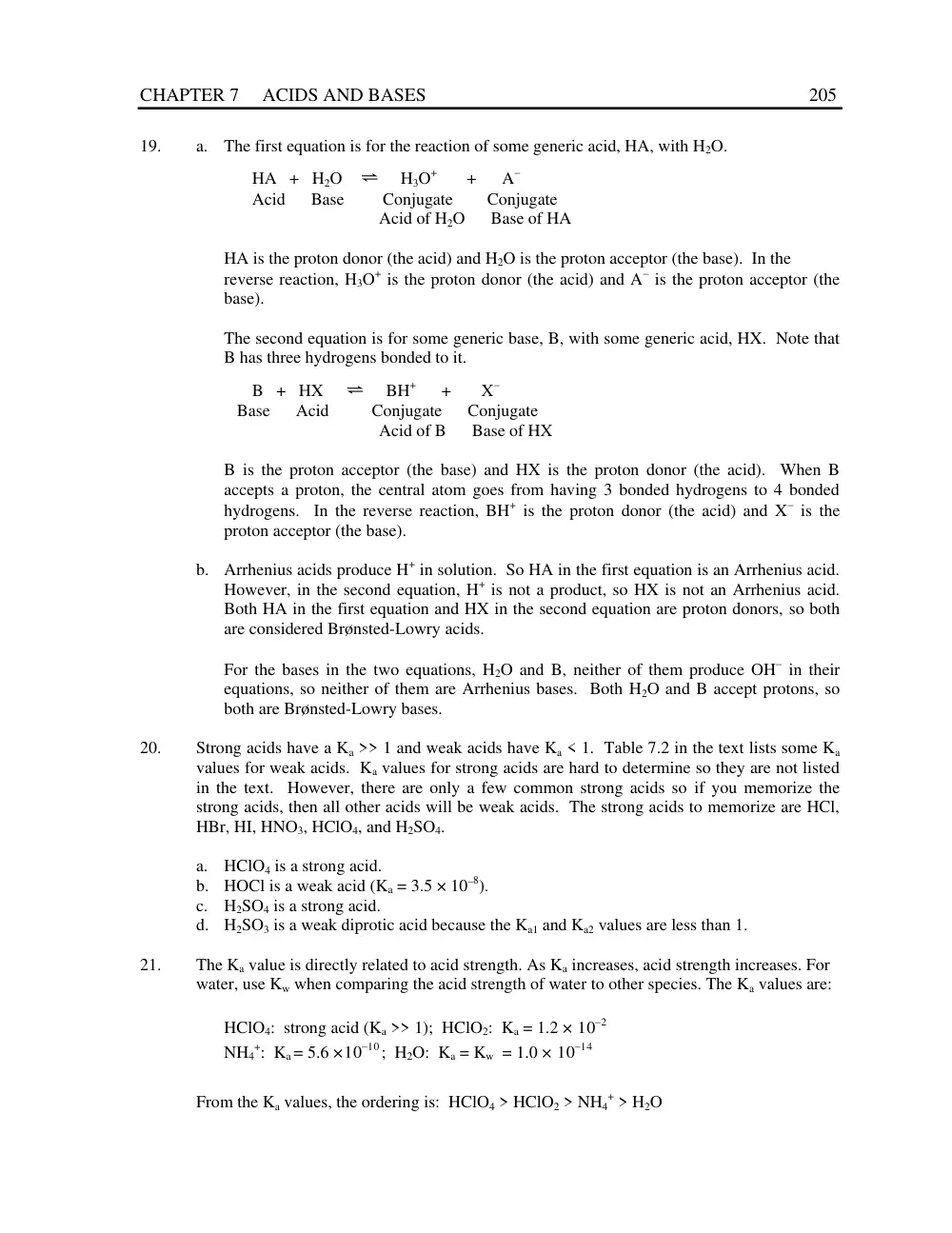
19.
a. The first equation is for the reaction of some generic acid, HA, with H2O.
HA + H2O ⇌ H3O+ + A
Acid Base Conjugate Conjugate
Acid of H2O Base of HA
HA is the proton donor (the acid) and H2O is the proton acceptor (the base). In the
reverse reaction, H3O+ is the proton donor (the acid) and A is the proton acceptor (the
base).
The second equation is for some generic base, B, with some generic acid, HX. Note that
B has three hydrogens bonded to it.
B + HX ⇌ BH+ + X
Base Acid Conjugate Conjugate
Acid of B Base of HX
B is the proton acceptor (the base) and HX is the proton donor (the acid). When B
accepts a proton, the central atom goes from having 3 bonded hydrogens to 4 bonded
hydrogens. In the reverse reaction, BH+ is the proton donor (the acid) and X is the
proton acceptor (the base).
b. Arrhenius acids produce H+ in solution. So HA in the first equation is an Arrhenius acid.
However, in the second equation, H+ is not a product, so HX is not an Arrhenius acid.
Both HA in the first equation and HX in the second equation are proton donors, so both
are considered Brønsted-Lowry acids.
For the bases in the two equations, H2O and B, neither of them produce OH in their
equations, so neither of them are Arrhenius bases. Both H2O and B accept protons, so
both are Brønsted-Lowry bases.
20.
Strong acids have a Ka >> 1 and weak acids have Ka < 1. Table 7.2 in the text lists some Ka
values for weak acids. Ka values for strong acids are hard to determine so they are not listed
in the text. However, there are only a few common strong acids so if you memorize the
strong acids, then all other acids will be weak acids. The strong acids to memorize are HCl,
HBr, HI, HNO3, HClO4, and H2SO4.
a. HClO4 is a strong acid.
b. HOCl is a weak acid (Ka = 3.5 × 10⁸).
c. H2SO4 is a strong acid.
d. H2SO3 is a weak diprotic acid because the Ka1 and Ka2 values are less than 1.
21.
The Ka value is directly related to acid strength. As Ka increases, acid strength increases. For
water, use Kw when comparing the acid strength of water to other species. The Ka values are:
HClO4: strong acid (Ka >> 1); HClO2: Ka = 1.2 ×
2
10
NH4
+: Ka
= 5.6 ×
1010
; H2O: Ka = Kw = 1.0 ×
1014
From the Ka values, the ordering is: HClO4 > HClO2 > NH4
+ > H2O
206 CHAPTER 7 ACIDS AND BASES
22.
Except for water, these are the conjugate bases of the acids in the preceding exercise. In
general, the weaker the acid, the stronger the conjugate base. ClO4
is the conjugate base of a
strong acid; it is a terrible base (worse than water). The ordering is NH3
> ClO2
> H2O >
ClO4
.
23.
The dissociation reaction (the Ka reaction) of an acid in water commonly omits water as a
reactant. We will follow this practice. All dissociation reactions produce H+ and the
conjugate base of the acid that is dissociated.
a. HC2H3O2(aq) ⇌ H+(aq) + C2H3O2
(aq)
Ka =
HC H O ]
[
]
H ][C H O
[
2
3
2
2
3
2
b. Co(H2O)6
3+(aq) ⇌ H+(aq) + Co(H2O)5(OH)2+(aq)
Ka =
]
Co(H O)
[
]
H ][Co(H O) (OH)
[
3
6
2
2
5
2
c. CH3NH3
+(aq) ⇌ H+(aq) + CH3NH2(aq)
Ka =
]
CH NH
[
H ][CH NH ]
[
3
3
2
3
24.
a. HClO4(aq) + H2O(l) H3O+(aq) + ClO4
(aq). Only the forward reaction is indicated
because HClO4 is a strong acid and is basically 100% dissociated in water. For acids, the
dissociation reaction is commonly written without water as a reactant. The common
abbreviation for this reaction is HClO4(aq) H+(aq) + ClO4
(aq). This reaction is also
called the Ka reaction because the equilibrium constant for this reaction is designated as
Ka.
b. Propanoic acid is a weak acid, so it is only partially dissociated in water. The
dissociation reaction is CH3CH2CO2H(aq) + H2O(l) ⇌ H3O+(aq) + CH3CH2CO2
(aq) or
CH3CH2CO2H(aq) ⇌ H+(aq) + CH3CH2CO2
(aq).
c. NH4
+ is a weak acid. Similar to propanoic acid, the dissociation reaction is:
NH4
+(aq) + H2O(l) ⇌ H3O+(aq) + NH3(aq) or NH4
+(aq) ⇌ H+(aq) + NH3(aq)
25.
a. HCl is a strong acid, and water is a very weak acid with Ka = Kw = 1.0 ×
10 14.
HCl is a
much stronger acid than H2O.
b. H2O, Ka = Kw = 1.0 ×
1014
; HNO2, Ka = 4.0 ×
4
10 ; HNO2 is a stronger acid than H2O
because Ka for HNO2 > Kw for H2O.
c. HOC6H5 , Ka = 1.6 ×
10 10;
HCN, Ka = 6.2 ×
1010
; HCN is a slightly stronger acid than
HOC6H5 because Ka for HCN > Ka for HOC6H5.
26.
a. H2O; the conjugate bases of strong acids are extremely weak bases (Kb < 1 ×
1014
).
b. NO2
; the conjugate bases of weak acids are weak bases (1 ×
1014
< Kb < 1).
CHAPTER 7 ACIDS AND BASES 207
c. OC6H5
; for a conjugate acid-base pair, Ka × Kb = Kw. From this relationship, the
stronger the acid, the weaker is the conjugate base (Kb decreases as Ka increases).
Because HCN is a stronger acid than HOC6H5 (Ka for HCN > Ka for HOC6H5), OC6H5
will be a stronger base than CN.
27.
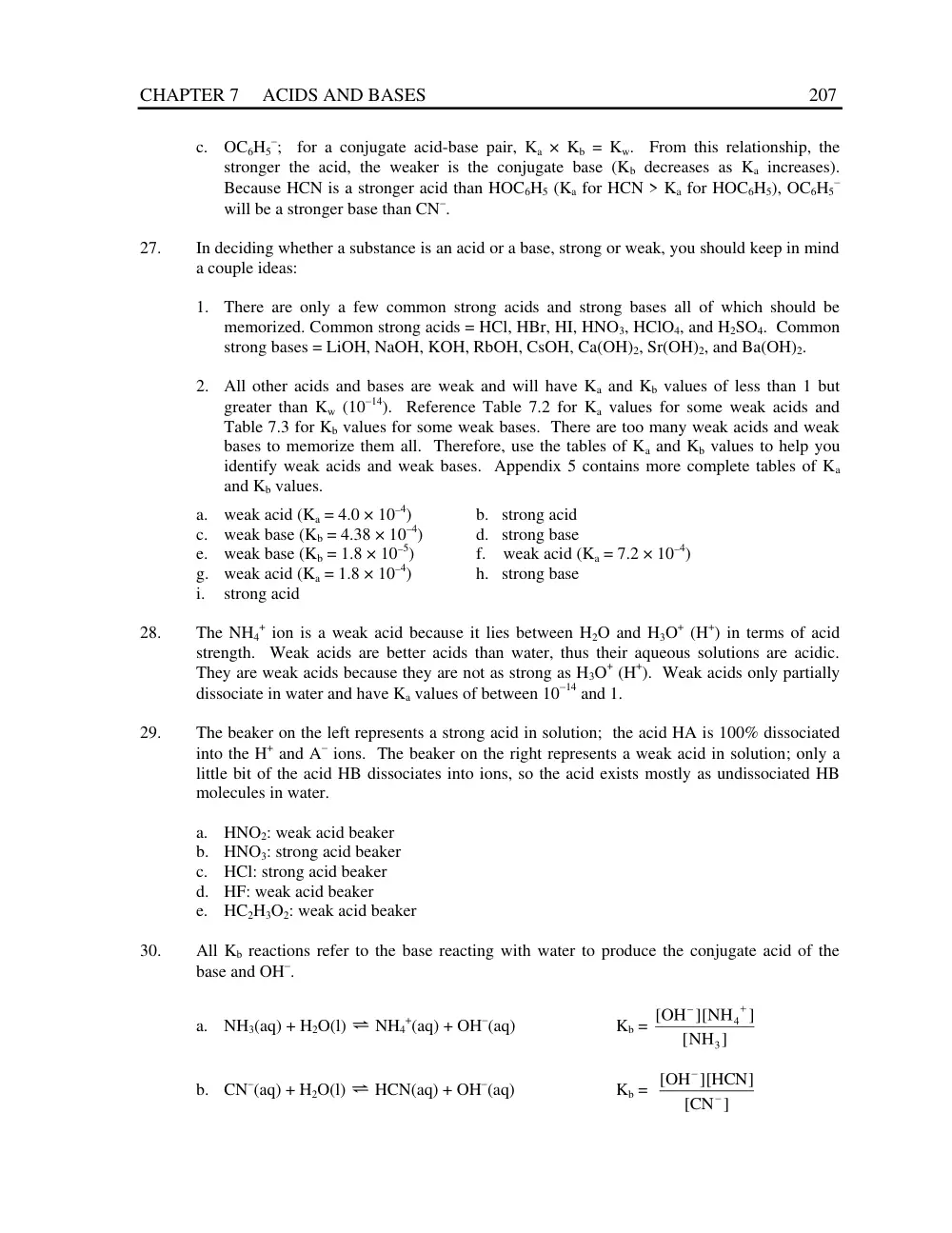
In deciding whether a substance is an acid or a base, strong or weak, you should keep in mind
a couple ideas:
1. There are only a few common strong acids and strong bases all of which should be
memorized. Common strong acids = HCl, HBr, HI, HNO3, HClO4, and H2SO4. Common
strong bases = LiOH, NaOH, KOH, RbOH, CsOH, Ca(OH)2, Sr(OH)2, and Ba(OH)2.
2. All other acids and bases are weak and will have Ka and Kb values of less than 1 but
greater than Kw (1014). Reference Table 7.2 for Ka values for some weak acids and
Table 7.3 for Kb values for some weak bases. There are too many weak acids and weak
bases to memorize them all. Therefore, use the tables of Ka and Kb values to help you
identify weak acids and weak bases. Appendix 5 contains more complete tables of Ka
and Kb values.
a. weak acid (Ka = 4.0 × 10⁴)
b. strong acid
c. weak base (Kb = 4.38 × 10⁴)
d. strong base
e. weak base (Kb = 1.8 × 10⁵)
f. weak acid (Ka = 7.2 × 10⁴)
g. weak acid (Ka = 1.8 × 10⁴)
h. strong base
i. strong acid
28.
The NH4
+ ion is a weak acid because it lies between H2O and H3O+ (H+) in terms of acid
strength. Weak acids are better acids than water, thus their aqueous solutions are acidic.
They are weak acids because they are not as strong as H3O+ (H+). Weak acids only partially
dissociate in water and have Ka values of between 1014 and 1.
29.
The beaker on the left represents a strong acid in solution; the acid HA is 100% dissociated
into the H+ and A ions. The beaker on the right represents a weak acid in solution; only a
little bit of the acid HB dissociates into ions, so the acid exists mostly as undissociated HB
molecules in water.
a. HNO2: weak acid beaker
b. HNO3: strong acid beaker
c. HCl: strong acid beaker
d. HF: weak acid beaker
e. HC2H3O2: weak acid beaker
30.
All Kb reactions refer to the base reacting with water to produce the conjugate acid of the
base and OH.
a. NH3(aq) + H2O(l) ⇌ NH4
+(aq) + OH(aq)
Kb =
NH ]
[
]
OH ][NH
[
3
4
b. CN(aq) + H2O(l) ⇌ HCN(aq) + OH(aq)
Kb =
CN ]
[
OH ][HCN]
[
208 CHAPTER 7 ACIDS AND BASES
c. C5H5N(aq) + H2O(l) ⇌ C5H5NH+(aq) + OH(aq)
Kb =
C H N]
[
OH ][C H NH ]
[
5
5
5
5
d. C6H5NH2(aq) + H2O(l) ⇌ C6H5NH3
+(aq) + OH(aq)
Kb =
C H NH ]
[
]
OH ][C H NH
[
2
5
6
3
5
6
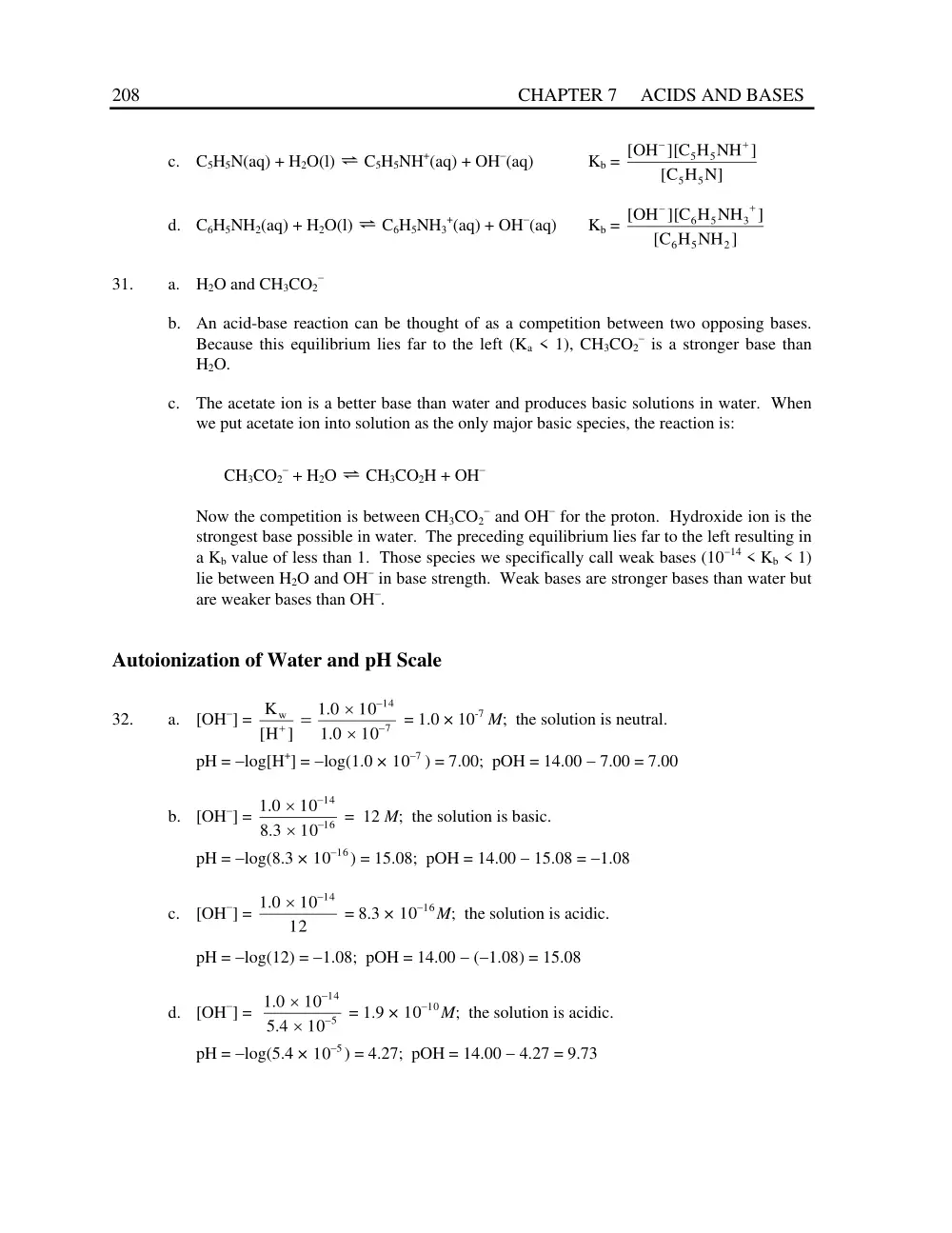
31.
a. H2O and CH3CO2
b. An acid-base reaction can be thought of as a competition between two opposing bases.
Because this equilibrium lies far to the left (Ka < 1), CH3CO2
is a stronger base than
H2O.
c. The acetate ion is a better base than water and produces basic solutions in water. When
we put acetate ion into solution as the only major basic species, the reaction is:
CH3CO2
+ H2O ⇌ CH3CO2H + OH
Now the competition is between CH3CO2
and OH for the proton. Hydroxide ion is the
strongest base possible in water. The preceding equilibrium lies far to the left resulting in
a Kb value of less than 1. Those species we specifically call weak bases (1014 < Kb < 1)
lie between H2O and OH in base strength. Weak bases are stronger bases than water but
are weaker bases than OH.
Autoionization of Water and pH Scale
32.
a. [OH] =
7
14
w
10
0.1
10
0.1
[H ]
K
= 1.0 × 10⁻⁷ M; the solution is neutral.
pH = log[H+] = log(1.0 ×
7
10 ) = 7.00; pOH = 14.00 7.00 = 7.00
b. [OH] =
16
14
10
3.8
10
0.1
= 12 M; the solution is basic.
pH = log(8.3 ×
1016
) = 15.08; pOH = 14.00 15.08 = 1.08
c. [OH] =
12
10
0.1
14
= 8.3 ×
1016
M; the solution is acidic.
pH = log(12) = 1.08; pOH = 14.00 (1.08) = 15.08
d. [OH] =
5
14
10
4.5
10
0.1
= 1.9 ×
1010
M; the solution is acidic.
pH = log(5.4 ×
5
10 ) = 4.27; pOH = 14.00 4.27 = 9.73
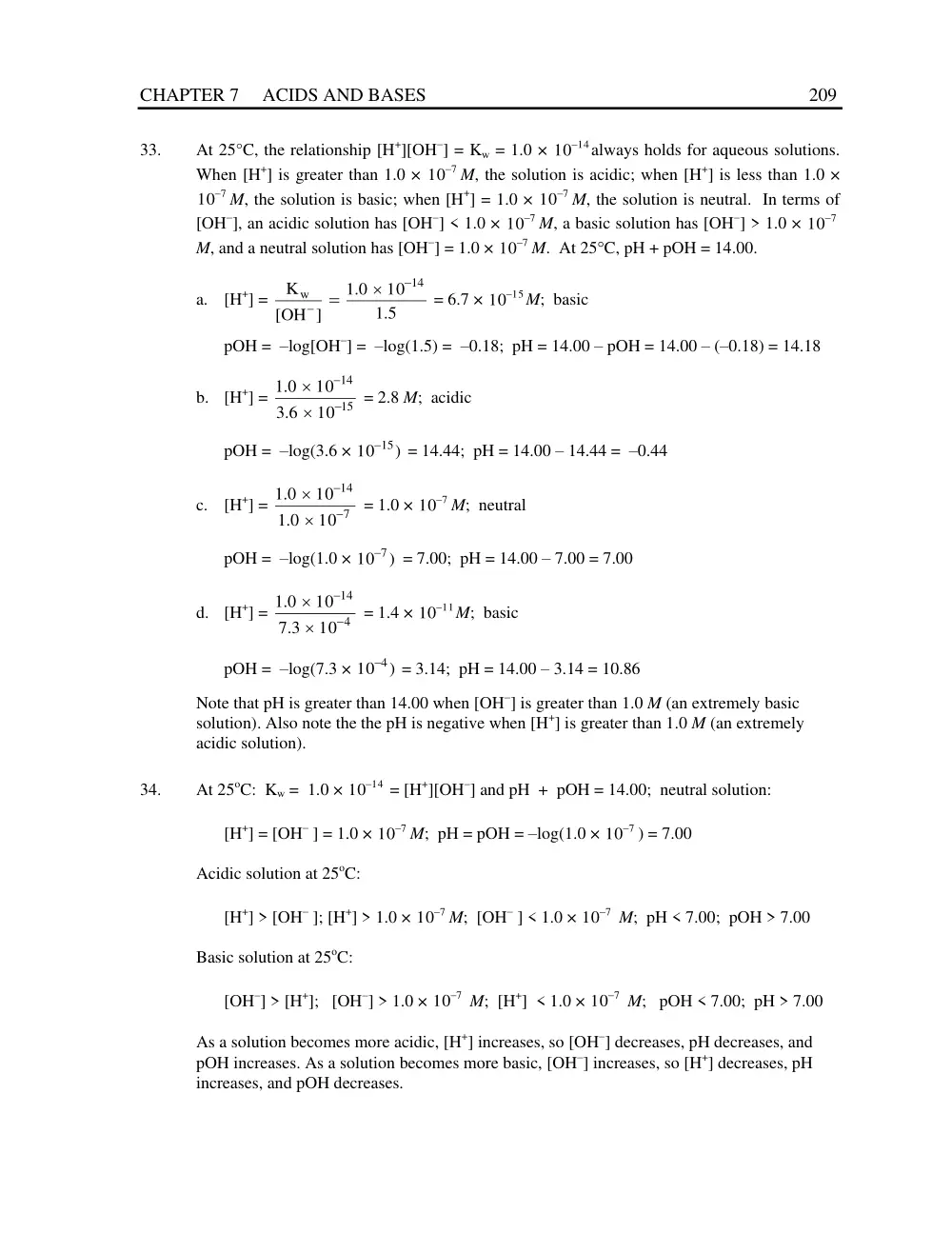
CHAPTER 7 ACIDS AND BASES 209
33.
At 25°C, the relationship [H+][OH] = Kw = 1.0 ×
1014
always holds for aqueous solutions.
When [H+] is greater than 1.0 ×
7
10 M, the solution is acidic; when [H+] is less than 1.0 ×
7
10 M, the solution is basic; when [H+] = 1.0 ×
7
10 M, the solution is neutral. In terms of
[OH], an acidic solution has [OH] < 1.0 ×
7
10 M, a basic solution has [OH] > 1.0 ×
7
10
M, and a neutral solution has [OH] = 1.0 ×
7
10 M. At 25C, pH + pOH = 14.00.
a. [H+] =
5.1
10
0.1
OH ]
[
K
14
w
= 6.7 ×
1015
M; basic
pOH = –log[OH] = –log(1.5) = –0.18; pH = 14.00 – pOH = 14.00 – (–0.18) = 14.18
b. [H+] =
15
14
10
6.3
10
0.1
= 2.8 M; acidic
pOH = –log(3.6 ×
10 15)
= 14.44; pH = 14.00 – 14.44 = –0.44
c. [H+] =
7
14
10
0.1
10
0.1
= 1.0 ×
7
10 M; neutral
pOH = –log(1.0 ×
10 7 )
= 7.00; pH = 14.00 – 7.00 = 7.00
d. [H+] =
4
14
10
3.7
10
0.1
= 1.4 ×
1011
M; basic
pOH = –log(7.3 ×
10 4 )
= 3.14; pH = 14.00 – 3.14 = 10.86
Note that pH is greater than 14.00 when [OH] is greater than 1.0 M (an extremely basic
solution). Also note the the pH is negative when [H+] is greater than 1.0 M (an extremely
acidic solution).
34.
At 25oC: Kw = 1.0 ×
1014
= [H+][OH] and pH + pOH = 14.00; neutral solution:
[H+] = [OH ] = 1.0 ×
7
10 M; pH = pOH = –log(1.0 ×
7
10 ) = 7.00
Acidic solution at 25oC:
[H+] > [OH ]; [H+] > 1.0 ×
7
10 M; [OH ] < 1.0 ×
7
10 M; pH < 7.00; pOH > 7.00
Basic solution at 25oC:
[OH] > [H+]; [OH] > 1.0 ×
7
10 M; [H+] < 1.0 ×
7
10 M; pOH < 7.00; pH > 7.00
As a solution becomes more acidic, [H+] increases, so [OH] decreases, pH decreases, and
pOH increases. As a solution becomes more basic, [OH] increases, so [H+] decreases, pH
increases, and pOH decreases.
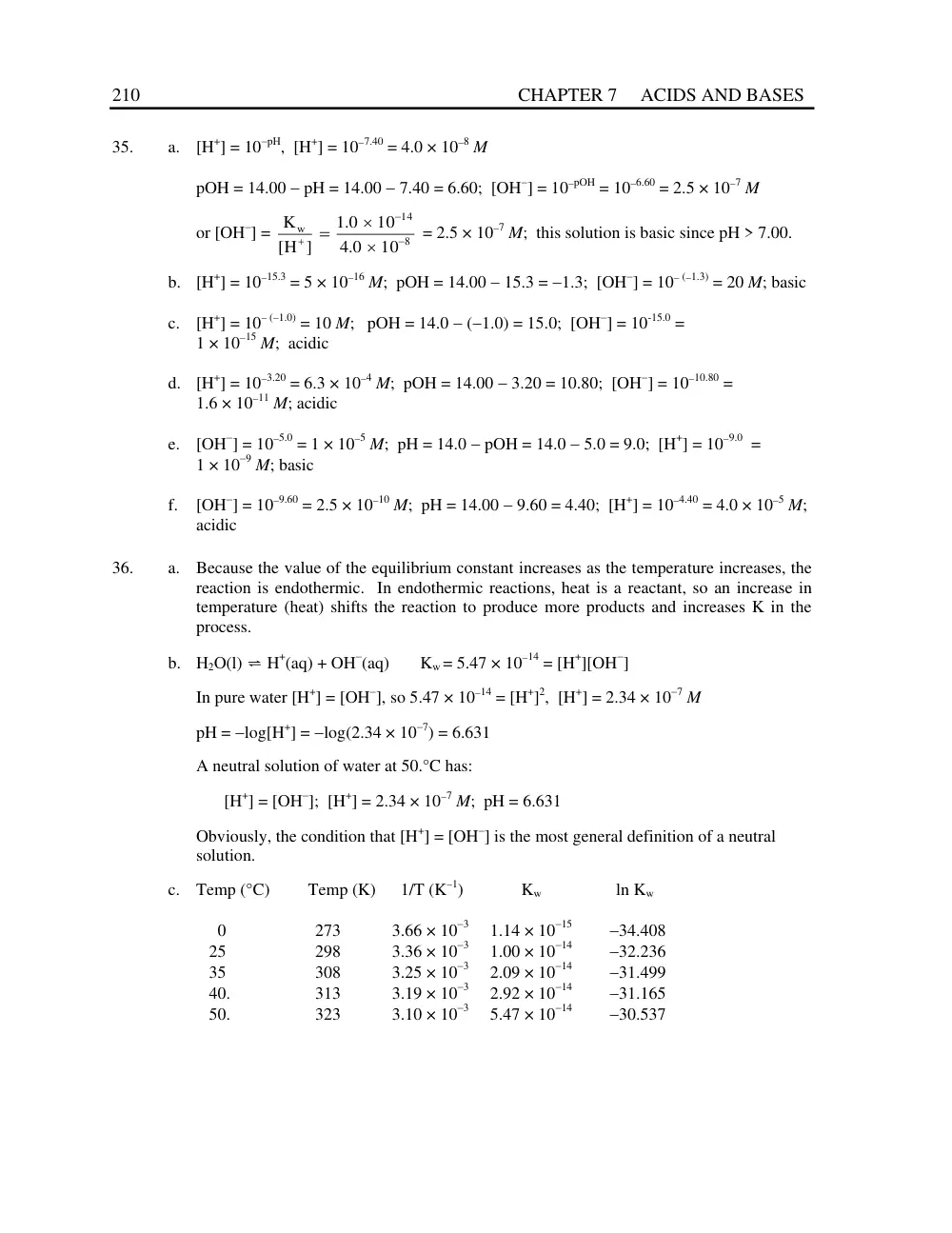
210 CHAPTER 7 ACIDS AND BASES
35.
a. [H+] = 10pH, [H+] = 107.40 = 4.0 × 10⁸ M
pOH = 14.00 pH = 14.00 7.40 = 6.60; [OH] = 10pOH = 106.60 = 2.5 × 10⁷ M
or [OH] =
8
14
w
10
0.4
10
0.1
[H ]
K
= 2.5 × 10⁷ M; this solution is basic since pH > 7.00.
b. [H+] = 1015.3 = 5 × 10¹⁶ M; pOH = 14.00 15.3 = 1.3; [OH] = 10 (1.3) = 20 M; basic
c. [H+] = 10 (1.0) = 10 M; pOH = 14.0 (1.0) = 15.0; [OH] = 10-15.0 =
1 × 10¹⁵ M; acidic
d. [H+] = 103.20 = 6.3 × 10⁴ M; pOH = 14.00 3.20 = 10.80; [OH] = 1010.80 =
1.6 × 10¹¹ M; acidic
e. [OH] = 105.0 = 1 × 10⁵ M; pH = 14.0 pOH = 14.0 5.0 = 9.0; [H+] = 109.0 =
1 × 10⁹ M; basic
f.
[OH] = 109.60 = 2.5 × 10¹⁰ M; pH = 14.00 9.60 = 4.40; [H+] = 104.40 = 4.0 × 10⁵ M;
acidic
36.
a. Because the value of the equilibrium constant increases as the temperature increases, the
reaction is endothermic. In endothermic reactions, heat is a reactant, so an increase in
temperature (heat) shifts the reaction to produce more products and increases K in the
process.
b. H2O(l) ⇌ H+(aq) + OH(aq)
Kw
= 5.47 × 1014 = [H+][OH]
In pure water [H+] = [OH], so 5.47 × 1014 = [H+]2, [H+] = 2.34 × 10⁷ M
pH = log[H+] = log(2.34 × 10⁷) = 6.631
A neutral solution of water at 50.°C has:
[H+] = [OH]; [H+] = 2.34 × 10⁷ M; pH = 6.631
Obviously, the condition that [H+] = [OH] is the most general definition of a neutral
solution.
c. Temp (°C)
Temp (K) 1/T (K1)
Kw
ln Kw
0
273
3.66 × 10³
1.14 × 10¹⁵ 34.408
25
298
3.36 × 10³
1.00 × 10¹⁴ 32.236
35
308
3.25 × 10³
2.09 × 10¹⁴ 31.499
40.
313
3.19 × 10³
2.92 × 10¹⁴ 31.165
50.
323
3.10 × 10³
5.47 × 10¹⁴ 30.537
CHAPTER 7 ACIDS AND BASES 211
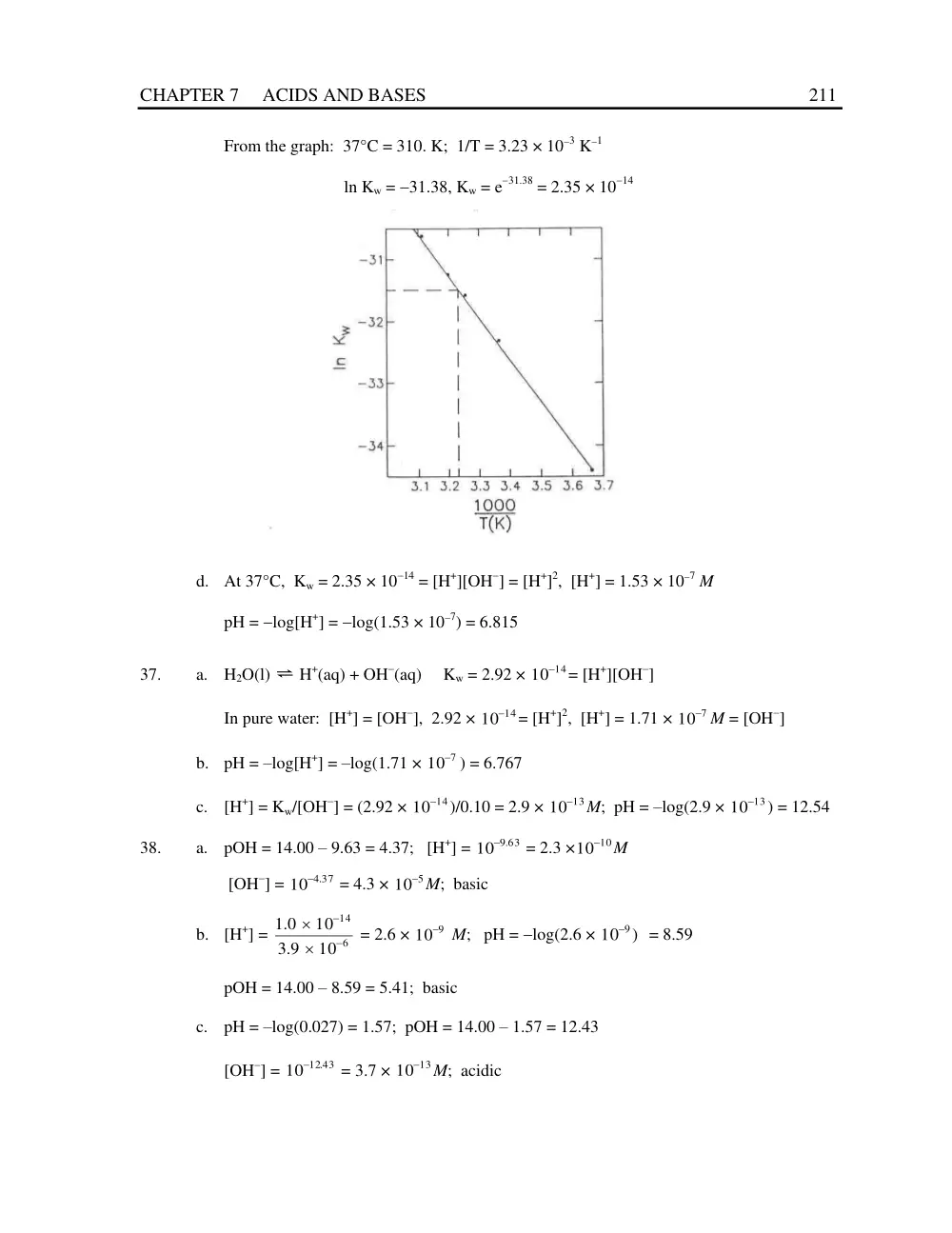
From the graph: 37°C = 310. K; 1/T = 3.23 × 10³ K1
ln Kw = 31.38, Kw = e31.38 = 2.35 × 10¹⁴
d. At 37°C, Kw = 2.35 × 1014 = [H+][OH] = [H+]2, [H+] = 1.53 × 10⁷ M
pH = log[H+] = log(1.53 × 10⁷) = 6.815
37.
a. H2O(l) ⇌ H+(aq) + OH(aq) Kw = 2.92 ×
1014
= [H+][OH]
In pure water: [H+] = [OH], 2.92 ×
1014
= [H+]2, [H+] = 1.71 ×
7
10 M = [OH]
b. pH = –log[H+] = –log(1.71 ×
7
10 ) = 6.767
c. [H+] = Kw/[OH] = (2.92 ×
1014
)/0.10 = 2.9 ×
1013
M; pH = –log(2.9 ×
1013
) = 12.54
38.
a. pOH = 14.00 – 9.63 = 4.37; [H+] =
10 .9 63
= 2.3 ×
1010
M
[OH] =
10 .4 37
= 4.3 ×
5
10 M; basic
b. [H+] =
6
14
10
9.3
10
0.1
= 2.6 ×
9
10 M; pH = log(2.6 ×
10 9 )
= 8.59
pOH = 14.00 – 8.59 = 5.41; basic
c. pH = –log(0.027) = 1.57; pOH = 14.00 – 1.57 = 12.43
[OH] =
1012.43
= 3.7 ×
1013
M; acidic
212 CHAPTER 7 ACIDS AND BASES
d. pH = 14.0 – 12.2 = 1.8; [H+] =
10 8.1
= 1.6 ×
2
10 M
[OH] =
1012 2.
= 6 ×
1013
M; acidic
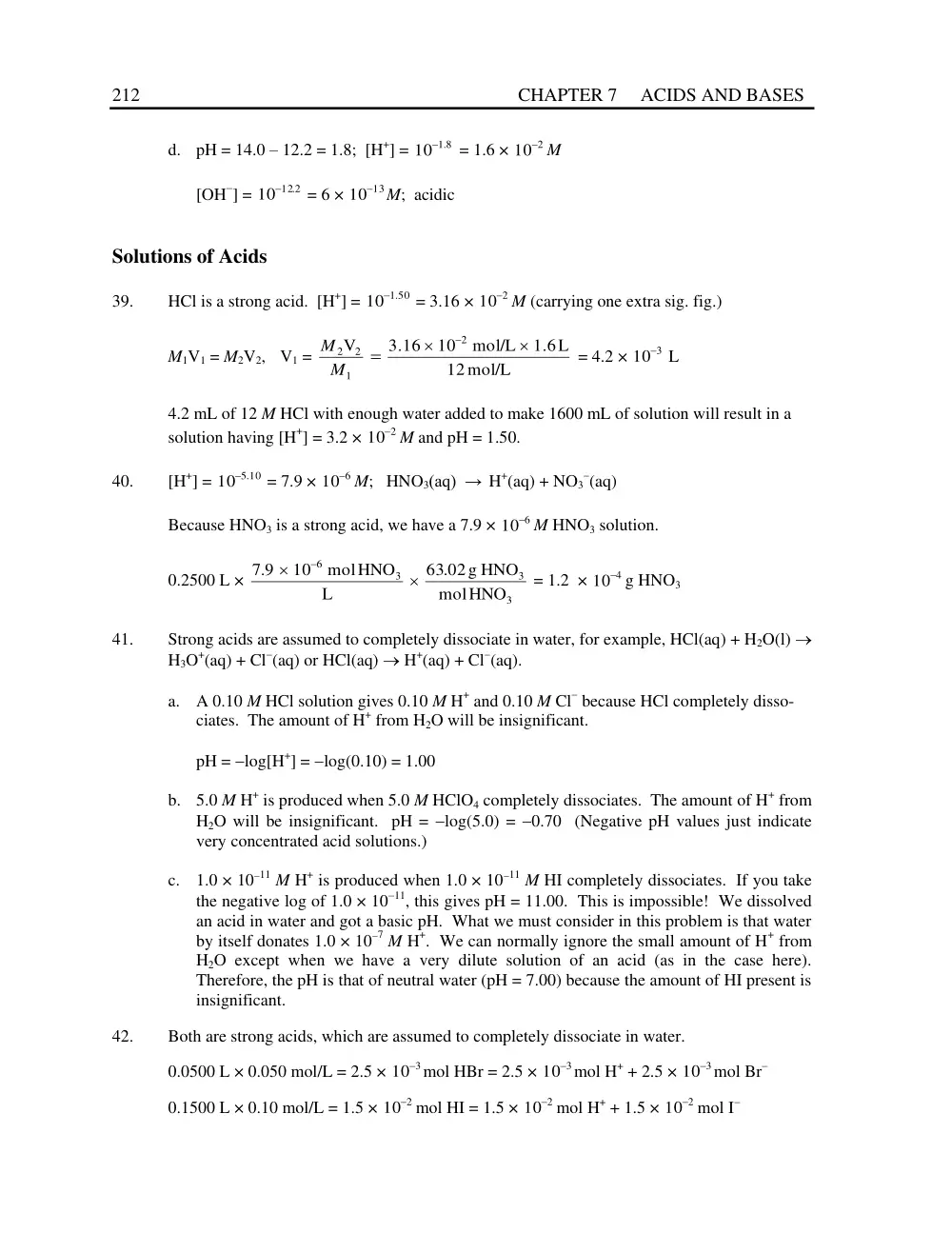
Solutions of Acids
39.
HCl is a strong acid. [H+] =
10 .1 50
= 3.16 ×
2
10 M (carrying one extra sig. fig.)
M1V1 = M2V2, V1 =
mol/L
12
1.6L
mol/L
10
3.16
V
2
1
2 2
M
M
= 4.2 ×
3
10 L
4.2 mL of 12 M HCl with enough water added to make 1600 mL of solution will result in a
solution having [H+] = 3.2 ×
2
10 M and pH = 1.50.
40.
[H+] =
10 .5 10
= 7.9 ×
6
10 M; HNO3(aq) → H+(aq) + NO3
(aq)
Because HNO3 is a strong acid, we have a 7.9 ×
6
10 M HNO3 solution.
0.2500 L ×
3
3
3
6
HNO
mol
.02g HNO
63
L
molHNO
10
9.7
= 1.2 ×
4
10 g HNO3
41.
Strong acids are assumed to completely dissociate in water, for example, HCl(aq) + H2O(l)
H3O+(aq) + Cl(aq) or HCl(aq) H+(aq) + Cl(aq).
a. A 0.10 M HCl solution gives 0.10 M H+ and 0.10 M Cl because HCl completely disso-
ciates. The amount of H+ from H2O will be insignificant.
pH = log[H+] = log(0.10) = 1.00
b. 5.0 M H+ is produced when 5.0 M HClO4 completely dissociates. The amount of H+ from
H2O will be insignificant. pH = log(5.0) = 0.70 (Negative pH values just indicate
very concentrated acid solutions.)
c. 1.0 × 10¹¹ M H+ is produced when 1.0 × 10¹¹ M HI completely dissociates. If you take
the negative log of 1.0 × 10¹¹, this gives pH = 11.00. This is impossible! We dissolved
an acid in water and got a basic pH. What we must consider in this problem is that water
by itself donates 1.0 × 10⁷ M H+. We can normally ignore the small amount of H+ from
H2O except when we have a very dilute solution of an acid (as in the case here).
Therefore, the pH is that of neutral water (pH = 7.00) because the amount of HI present is
insignificant.
42.
Both are strong acids, which are assumed to completely dissociate in water.
0.0500 L × 0.050 mol/L = 2.5 ×
3
10 mol HBr = 2.5 ×
3
10 mol H+ + 2.5 ×
3
10 mol Br
0.1500 L × 0.10 mol/L = 1.5 ×
2
10 mol HI = 1.5 ×
2
10 mol H+ + 1.5 ×
2
10 mol I
CHAPTER 7 ACIDS AND BASES 213
[H+] =
2000L
.0
) mol
10
5.1
10
5.2
(
2
3
= 0.088 M; pH = log(0.088) = 1.06
43.
a. HA is a weak acid. Most of the acid is present as HA molecules; only one set of H+
and A ions is present. In a strong acid, all of the acid would be dissociated into H+
and A ions.
b. This picture is the result of 1 out of 10 HA molecules dissociating.
Percent dissociation = 10
1 100 = 10% (an exact number)
HA ⇌ H+ + A
Ka =
HA]
[
[] A ]
[H
Initial
0.20 M
~0
0
x mol/L HA dissociates to reach equilibrium
Change
x +x
+x
Equil.
0.20 x x x
[H+] = [A] = x = 0.10 0.20 M = 0.020 M; [HA] = 0.20 – 0.020 = 0.18 M
Ka =
18
.0
( .0 020)
2
= 2.2 103
44.
a. HOC6H5 (Ka = 1.6 ×
1010
) and H2O (Ka = Kw = 1.0 ×
1014
) are the major species. The
major equilibrium is the dissociation of HOC6H5. Solving the weak acid problem:
HOC6H5 ⇌
H+
+
OC6H5
Initial
0.250 M
~0
0
x mol/L HOC6H5 dissociates to reach equilibrium
Change
x
+x
+x
Equil.
0.250 x
x
x
Ka = 1.6 ×
1010
=
HOC H ]
[
]
H ][OC H
[
5
6
5
6
=
x
x
250
.0
2
250
.0
x2
(assuming x << 0.250)
x = [H+] = 6.3 ×
6
10 M; checking assumption: x is 2.5 × 10³% of 0.250, so assumption
is valid by the 5% rule.
pH = log(6.3 ×
10 6 )
= 5.20
b. HCN (Ka = 6.2 ×
10 10)
and H2O are the major species. HCN is the major source of H+.
HCN ⇌ H+
+
CN
Initial
0.250 M
~0
0
x mol/L HCN dissociates to reach equilibrium
Change
x
+x
+x
Equil.
0.250 x
x
x
214 CHAPTER 7 ACIDS AND BASES
Ka = 6.2 ×
1010
=
HCN]
[
[H ][CN ]
=
x
x
250
.0
2
250
.0
x2
(assuming x << 0.250)
x = [H+] = 1.2 ×
5
10 M; checking assumption: x is 4.8 × 10⁻³% of 0.250.
Assumptions good. pH = log(1.2 ×
10 5 )
= 4.92
45.
a. HNO2 (Ka = 4.0 ×
10 4 )
and H2O (Ka = Kw = 1.0 ×
10 14)
are the major species. HNO2
is a much stronger acid than H2O, so it is the major source of H+. However, HNO2 is a
weak acid (Ka < 1), so it only partially dissociates in water. We must solve an equilibrium
problem to determine [H+]. In the Solutions Guide, we will summarize the initial, change,
and equilibrium concentrations into one table called the ICE table. Solving the weak acid
problem:
HNO2 ⇌
H+
+
NO2
Initial
0.250 M
~0
0
x mol/L HNO2
dissociates to reach equilibrium
Change
x
+x
+x
Equil.
0.250 x
x
x
Ka =
HNO ]
[
]
H ][NO
[
2
2
= 4.0 ×
4
10 =
x
x
250
.0
2
; if we assume x << 0.250, then:
4.0 ×
4
10
( .0 250)
10
0.4
250,
.0
4
2
x
x
= 0.010 M
We must check the assumption:
.0 250
.0 010
100
.0 250
x
× 100 = 4.0%
All the assumptions are good. The H+ contribution from water (1 ×
7
10 M) is negligible,
and x is small compared to 0.250 (percent error = 4.0%). If the percent error is less than
5% for an assumption, we will consider it a valid assumption (called the 5% rule).
Finishing the problem: x = 0.010 M = [H+]; pH = log(0.010) = 2.00
b. CH3CO2H (Ka = 1.8 ×
5
10 ) and H2O (Ka = Kw = 1.0 ×
10 14 )
are the major species.
CH3CO2H is the major source of H+. Solving the weak acid problem:
CH3CO2H ⇌
H+
+
CH3CO2
Initial
0.250 M
~0
0
x mol/L CH3CO2H dissociates to reach equilibrium
Change
x
+x
+x
Equil.
0.250 x
x
x
Ka =
CH CO H]
[
]
H ][CH CO
[
2
3
2
3
, 1.8 ×
5
10 =
x
x
250
.0
2
250
.0
x2
(assuming x << 0.250)
CHAPTER 7 ACIDS AND BASES 215
x = 2.1 × 10⁻³ M; checking assumption:
250
.0
10
1.2
3
× 100 = 0.84%. Assumptions good.
[H+] = x = 2.1 ×
3
10 M; pH = log(2.1 ×
10 3)
= 2.68
46.
Major species: HC2H2ClO2 (Ka = 1.35 × 10³) and H2O; major source of H+: HC2H2ClO2
HC2H2ClO2 ⇌ H+ + C2H2ClO2
Initial
0.10 M
~0
0
x mol/L HC2H2ClO2 dissociates to reach equilibrium
Change x
+x
+x
Equil.
0.10 x
x
x
Ka = 1.35 × 103 =
.0 10
10
.0
2
2
x
x
x
, x = 1.2 × 10² M
Checking the assumptions finds that x is 12% of 0.10 which fails the 5% rule. We must solve
1.35 × 103 = x2/(0.10 x) exactly using either the method of successive approximations or
the quadratic equation. Using either method gives x = [H+] = 1.1 × 10² M. pH = log[H+] =
log(1.1 × 10²) = 1.96.
47.
This is a weak acid in water. Solving the weak acid problem:
HF
⇌
H+
+
F
Ka = 7.2 × 10⁴
Initial
0.020 M
~0
0
x mol/L HF dissociates to reach equilibrium
Change x
+x
+x
Equil.
0.020 x
x
x
Ka = 7.2 × 104 =
.0 020
.0 020
HF]
[
[H ][F ]
2
2
x
x
x
(assuming x << 0.020)
x = [H+] = 3.8 × 10³ M; check assumptions:
020
.0
10
8.3
100
020
.0
3
x
× 100 = 19%
The assumption x << 0.020 is not good (x is more than 5% of 0.020). We must solve
x2/(0.020 x) = 7.2 × 10⁴ exactly by using either the quadratic formula or the method of
successive approximations (see Appendix 1 of the text). Using successive approximations,
we let 0.016 M be a new approximation for [HF]. That is, in the denominator try x = 0.0038
(the value of x we calculated making the normal assumption) so that 0.020 0.0038 = 0.016;
then solve for a new value of x in the numerator.
.0 016
020
.0
2
2
x
x
x
= 7.2 × 10⁴, x = 3.4 × 10³
216 CHAPTER 7 ACIDS AND BASES
We use this new value of x to further refine our estimate of [HF], that is, 0.020 x =
0.020 0.0034 = 0.0166 (carrying an extra sig. fig.).
.0 0166
020
.0
2
2
x
x
x
= 7.2 × 10⁴, x = 3.5 × 10³
We repeat until we get a self-consistent answer. This would be the same answer we would
get solving exactly using the quadratic equation. In this case it is, x = 3.5 × 10³.
Thus:
[H+] = [F] = x = 3.5 × 10³ M; [OH] = Kw/[H+] = 2.9 × 10¹² M
[HF] = 0.020 x = 0.020 0.0035 = 0.017 M; pH = 2.46
Note: When the 5% assumption fails, use whichever method you are most comfortable
with to solve exactly. The method of successive approximations is probably fastest when
the percent error is less than ~25% (unless you have a graphing calculator).
48.
HClO2 ⇌ H+
+
ClO2
−
Ka = 1.2 × 10²
Initial
0.22 M
~0
0
x mol/L HClO2 dissociates to reach equilibrium
Change
x +x
+x
Equil.
0.22 x
x
x
Ka = 1.2 × 102 =
.0 22
.0 22
HClO ]
[
]
H ][ClO
[
2
2
2
2
x
x
x
, x = 5.1 × 10²
The assumption that x is small is not good (x is 23% of 0.22). Using the method of
successive approximations and carrying extra significant figures:
.0 169
.0 051
22
.0
2
2
x
x
= 1.2 × 10², x = 4.5 × 10²
175
.0
x2
= 1.2 × 10², x = 4.6 × 10² (consistent answer)
[H+] = [ClO2
−] = x = 4.6 × 10² M; percent dissociation =
22
.0
10
6.4
2
× 100 = 21%
49.
[HC9H7O4] =
237L
.0
.15g
180
molHC H O
1
tablet
.0 325g HC H O
2 tablets
4
7
9
4
7
9
= 0.0152 M
CHAPTER 7 ACIDS AND BASES 217
HC9H7O4 ⇌ H+ + C9H7O4
Initial
0.0152 M
~0 0
x mol/L HC9H7O4 dissociates to reach equilibrium
Change
–x
–x
–x
Equil.
0.0152 – x
x
x
Ka = 3.3 ×
4
10 =
HC H O ]
[
]
[] C H O
H
[
4
7
9
4
7
9
=
x
x
0152
.0
2
0152
.0
x2
, x = 2.2 ×
3
10 M
Assumption that 0.0152 – x 0.0152 fails the 5% rule:
0152
.0
10
2.2
3
× 100 = 14%
Using successive approximations or the quadratic equation gives an exact answer of
x = 2.1 ×
3
10 M.
[H+] = x = 2.1 ×
3
10 M; pH = –log(2.1 ×
3
10 ) = 2.68
50.
HBz ⇌
H+ + Bz
HBz = C6H5CO2H
Initial
C
~0
0
C = [HBz]0 = concentration of HBz that
dissolves to give saturated solution.
x mol/L HBz dissociates to reach equilibrium
Change
x
+x
+x
Equil.
C x
x
x
Ka =
HBz]
[
[H ][Bz ]
= 6.4 × 105 =
x
x
C
2
, where x = [H+]
6.4 × 105 =
;
[H ]
C
[H ]
2
pH = 2.80; [H+] = 102.80 = 1.6 × 10³ M
C 1.6 × 103 =
5
2
3
10
4.6
10 )
6.1(
= 4.0 × 10², C = (4.0 × 10²) + (1.6 × 10³) = 4.2 × 10² M
The molar solubility of C6H5CO2H is 4.2 × 10² mol/L.
C H CO H
mol
1. g C H CO H
122
L
molC H CO H
10
2.4
2
5
6
2
5
6
2
5
6
2
× 0.100 L = 0.51 g per 100. mL solution
218 CHAPTER 7 ACIDS AND BASES
51.
Major species: HIO3, H2O; major source of H+: HIO3 (a weak acid, Ka = 0.17)
HIO3 ⇌ H+ + IO3
Initial
0.010 M
~0
0
x mol/L HIO3 dissociates to reach equilibrium
Change
x
+x
+x
Equil.
0.010 x
x
x
Ka = 0.17 =
.0 010
.0 010
HIO ]
[
]
[H ][IO
2
2
3
3
x
x
x
, x = 0.041; check assumption.
Assumption is horrible (x is more than 400% of 0.010). When the assumption is this poor, it
is generally quickest to solve exactly using the quadratic formula (see Appendix 1 in text).
Using the quadratic formula and carrying extra significant figures:
0.17 =
x
x
010
.0
2
, x2 = 0.17(0.010 x), x2 + (0.17)x 1.7 × 103 = 0
x =
2
.0 189
17
.0
)1(
2
10 )]
7.1
4 1( )(
[( .0 17)
.0 17
1/2
3
2
, x = 9.5 × 10³ M
(x must be positive)
x = 9.5 × 10³ M = [H+]; pH = log(9.5 × 10³) = 2.02
52.
HC3H5O2 (Ka = 1.3 × 10⁵) and H2O (Ka = Kw = 1.0 × 10¹⁴) are the major species present.
HC3H5O2 will be the dominant producer of H+ because HC3H5O2 is a stronger acid than H2O.
Solving the weak acid problem:
HC3H5O2 ⇌
H+ + C3H5O2
Initial
0.100 M
~0
0
x mol/L HC3H5O2 dissociates to reach equilibrium
Change x
+x
+x
Equil.
0.100 x
x
x
Ka = 1.3 × 105 =
.0 100
.0 100
HC H O ]
[
]
[H ][C H O
2
2
2
5
3
2
3 5
x
x
x
x = [H+] = 1.1 × 10³ M; pH = log(1.1 × 10³) = 2.96
Assumption follows the 5% rule (x is 1.1% of 0.100).
[H+] = [C3H5O2
] = 1.1 × 10³ M; [OH] = Kw/[H+] = 9.1 × 10¹² M
[HC3H5O2] = 0.100 1.1 × 103 = 0.099 M
Percent dissociation =
100
.0
10
1.1
100
HC H O ]
[
[H ]
3
2 0
5
3
× 100 = 1.1%
CHAPTER 7 ACIDS AND BASES 219
53.
This is a weak acid in water. We must solve a weak acid problem. Let HBz = C6H5CO2H.
0.56 g HBz ×
1. g
122
1molHBz
= 4.6 × 10³ mol; [HBz]0 = 4.6 × 10³ M
HBz ⇌ H+ + Bz
Initial
4.6 × 10³ M
~0
0
x mol/L HBz dissociates to reach equilibrium
Change x
+x
+x
Equil.
4.6 × 10³ x
x
x
Ka = 6.4 × 105 =
3
2
3
2
10
6.4
10
( 6.4
HBz]
[
H ][Bz ]
[
x
x)
x
x = [H+] = 5.4 × 10⁴; check assumptions:
3
4
3
10
6.4
10
4.5
100
10
6.4
x
× 100 = 12%
Assumption is not good (x is 12% of 4.6 × 10³). When assumption(s) fail, we must solve
exactly using the quadratic formula or the method of successive approximations (see
Appendix 1 of text). Using successive approximations:
)
10
( 4.5
10 )
6.4
(
4
3
2
x
= 6.4 × 10⁵, x = 5.1 × 10⁴
)
10
( 1.5
10 )
6.4
(
4
3
2
x
= 6.4 × 10⁵, x = 5.1 × 10⁴ M (consistent answer)
Thus: x = [H+] = [Bz] = [C6H5CO2
] = 5.1 × 10⁴ M
[HBz] = [C6H5CO2H] = 4.6 × 10³ x = 4.1 × 10³ M
pH = log(5.1 × 10⁴) = 3.29; pOH = 14.00 pH = 10.71; [OH] = 1010.71 = 1.9 × 10¹¹ M
54.
HClO4 is a strong acid with [H+] = 0.040 M. This equals the [H+] in the trichloroacetic acid
solution. Set up the problem using the Ka equilibrium reaction for CCl3CO2H.
CCl3CO2H ⇌
H+ + CCl3CO2
Initial
0.050 M
~0
0
Equil.
0.050 x
x
x
Ka =
CCl CO H]
[
]
H ][CCl CO
[
2
3
2
3
=
x
x
050
.0
2
; from the problem, x = [H+] = 4.0 × 10² M.
Ka =
)
10
( 0.4
050
.0
10 )
0.4
(
2
2
2
= 0.16
220 CHAPTER 7 ACIDS AND BASES
55.
HX ⇌
H+ + X
Initial
I
~0
0
where I = [HX]0
x mol/L HX dissociates to reach equilibrium
Change
x
+x
+x
Equil.
I x
x
x
From the problem, x = 0.25(I) and I x = 0.30 M.
I 0.25(I) = 0.30 M, I = 0.40 M and x = 0.25(0.40 M) = 0.10 M
Ka =
HX]
[
[H ][X ]
=
30
.0
.0 10)
(
I
2
2
x
x
= 0.033
56.
Let HSac = saccharin and I = [HSac]0.
HSac ⇌ H+
+
Sac
Ka = 1011.70 = 2.0 ×
1012
Initial
I
~0
0
Equil.
I – x
x
x
Ka = 2.0 ×
1012
=
x
x
I
2
; x = [H+] =
10 .5 75
= 1.8 ×
6
10 M
2.0 ×
1012
=
)
10
8.1(
I
10 )
8.1(
6
2
6
, I = 1.6 M = [HSac]0.
100.0 g HC7H4NSO3
L
mL
1000
mol
6.1
L
1
.19g
183
1mol
= 340 mL
57.
pH = 2.77, [H+] = 102.77 = 1.7 × 10³ M
HOCN ⇌
H+ + OCN
Initial 0.0100
~0
0
Equil. 0.0100 x
x
x
x = [H+] = [OCN] = 1.7 × 10³ M; [HOCN] = 0.0100 x = 0.0100 0.0017 = 0.0083 M
Ka =
HOCN]
[
[H ][OCN ]
=
3
2
3
10
3.8
10 )
7.1(
= 3.5 × 10⁴
58.
HF and HOC6H5 are both weak acids with Ka values of 7.2 × 10⁴ and 1.6 × 10¹⁰,
respectively. Because the Ka value for HF is much greater than the Ka value for HOC6H5, HF
will be the dominant producer of H+ (we can ignore the amount of H+ produced from
HOC6H5 because it will be insignificant).
CHAPTER 7 ACIDS AND BASES 221
HF ⇌
H+ + F
Initial
1.0 M
~0
0
x mol/L HF dissociates to reach equilibrium
Change x
+x
+x
Equil.
1.0 x
x
x
Ka = 7.2 × 104 =
HF]
[
[H ][F ]
=
0.1
0.1
2
2
x
x
x
x = [H+] = 2.7 × 10² M; pH = log(2.7 × 10²) = 1.57; assumptions good.
Solving for [OC6H5
] using HOC6H5 ⇌ H+ + OC6H5
equilibrium:
Ka = 1.6 × 1010 =
,
0.1
]
10 )[OC H
7.2
(
HOC H ]
[
]
[H ][OC H
5
6
2
5
6
5
6
[OC6H5
] = 5.9 × 10⁹ M
Note that this answer indicates that only 5.9 × 10⁹ M HOC6H5 dissociates, which
indicates that HF is truly the only significant producer of H+ in this solution.
59.
a. HCl is a strong acid. It will produce 0.10 M H+. HOCl is a weak acid. Let's consider
the equilibrium:
HOCl ⇌
H+ + OCl
Ka = 3.5 × 10⁸
Initial
0.10 M
0.10 M
0
x mol/L HOCl dissociates to reach equilibrium
Change x
+x
+x
Equil.
0.10 x
0.10 + x x
Ka = 3.5 × 108 =
x, x
x
x x
10
.0
)( )
.0 10
(
HOCl]
[
[H ][OCl ]
= 3.5 × 10⁸ M
Assumptions are great (x is 0.000035% of 0.10). We are really assuming that HCl is the
only important source of H+, which it is. The [H+] contribution from HOCl, x, is negli-
gible. Therefore, [H+] = 0.10 M; pH = 1.00.
b. HNO3 is a strong acid, giving an initial concentration of H+ equal to 0.050 M. Consider
the equilibrium:
HC2H3O2 ⇌ H+ + C2H3O2
Ka = 1.8 × 10⁵
Initial
0.50 M
0.050 M
0
x mol/L HC2H3O2 dissociates to reach equilibrium
Change x
+x
+x
Equil.
0.50 x
0.050 + x
x
222 CHAPTER 7 ACIDS AND BASES
Ka = 1.8 × 105 =
50
.0
.0 050)
(
)
.0 50
(
)
.0 050
(
HC H O ]
[
]
H ][C H O
[
2
3
2
2
3
2
x
x
x x
x = 1.8 × 10⁴; assumptions are good (well within the 5% rule).
[H+] = 0.050 + x = 0.050 M and pH = 1.30
60.
In all parts of this problem, acetic acid (HC2H3O2) is the best weak acid present. We must
solve a weak acid problem.
a.
HC2H3O2 ⇌
H+ + C2H3O2
Initial
0.50 M
~0
0