
CHM 201 Problems Solution Manual, Fall 2013
Lebanese American University · Chemical Principles · 52 pages · with solution

Showing the first 10 of 52 pages. Download the PDF to see all of it.
More CHM 201 files
- Questions Exam Quest · Fall 2015ProblemsView
- Problems Solution for Chap 6 · Fall 2013Problems · with solutionView
- Problems Solution for Chap 7 · Fall 2013Problems · with solutionView
- Problems Solution for Chap 8 · Fall 2013Problems · with solutionView
- Problems Solution for Chap 3 Exercises · Fall 2013Problems · with solutionView
- Problems Solution for Chap 4 Exercises · Fall 2013Problems · with solutionView
- Problems Solution for Chap 5 Exercises · Fall 2013Problems · with solutionView
- Final Sample · Spring 2017Final examView
Show the text of this problems
523
CHAPTER 13
BONDING: GENERAL CONCEPTS
Chemical Bonds and Electronegativity
11.
Electronegativity is the ability of an atom in a molecule to attract electrons to itself.
Electronegativity is a bonding term. Electron affinity is the energy change when an electron is
added to a substance. Electron affinity deals with isolated atoms in the gas phase.
A covalent bond is a sharing of electron pair(s) in a bond between two atoms. An ionic bond
is a complete transfer of electrons from one atom to another to form ions. The electrostatic
attraction of the oppositely charged ions is the ionic bond.
A pure covalent bond is an equal sharing of shared electron pair(s) in a bond. A polar
covalent bond is an unequal sharing.
Ionic bonds form when there is a large difference in electronegativity between the two atoms
bonding together. This usually occurs when a metal with a small electronegativity is bonded
to a nonmetal having a large electronegativity. A pure covalent bond forms between atoms
having identical or nearly identical eletronegativities. A polar covalent bond forms when
there is an intermediate electronegativity difference. In general, nonmetals bond together by
forming covalent bonds, either pure covalent or polar covalent.
Ionic bonds form due to the strong electrostatic attraction between two oppositely charged
ions. Covalent bonds form because the shared electrons in the bond are attracted to two
different nuclei, unlike the isolated atoms where electrons are only attracted to one nuclei.
The attraction to another nuclei overrides the added electron-electron repulsions.
12.
The possible ionic bonds that can form are between the metal Cs and the nonmetals P, O, and
H. These ionic compounds are Cs3P, Cs2O, and CsH. The bonding between the various
nonmetals will be covalent. P4, O2, and H2 are all pure covalent (or just covalent) with equal
sharing of the bonding electrons. PH will also be a covalent bond because P and H have
identical electronegativities. The other possible covalent bonds that can form will all be polar
covalent because the nonmetals involved in the bonds all have intermediate differences in
electronegativities. The possible polar covalent bonds are PO and OH.
Note: The bonding among cesium atoms is called metallic. This type of bonding between
metals will be discussed in Chapter 16.
13.
Of the compounds listed, P2O5 is the only compound containing only covalent bonds.
(NH4)2SO4, Ca3(PO4)2, K2O, and KCl are all compounds composed of ions, so they exhibit
ionic bonding. The polyatomic ions in (NH4)2SO4 are NH4
+ and SO4
2. Covalent bonds exist
between the N and H atoms in NH4
+ and between the S and O atoms in SO4
2. Therefore,
(NH4)2SO4 contains both ionic and covalent bonds. The same is true for Ca3(PO4)2. The
524 CHAPTER 13 BONDING: GENERAL CONCEPTS
bonding is ionic between the Ca2+ and PO4
3 ions and covalent between the P and O atoms in
PO4
3. Therefore, (NH4)2SO4 and Ca3(PO4)2 are the compounds with both ionic and covalent
bonds.
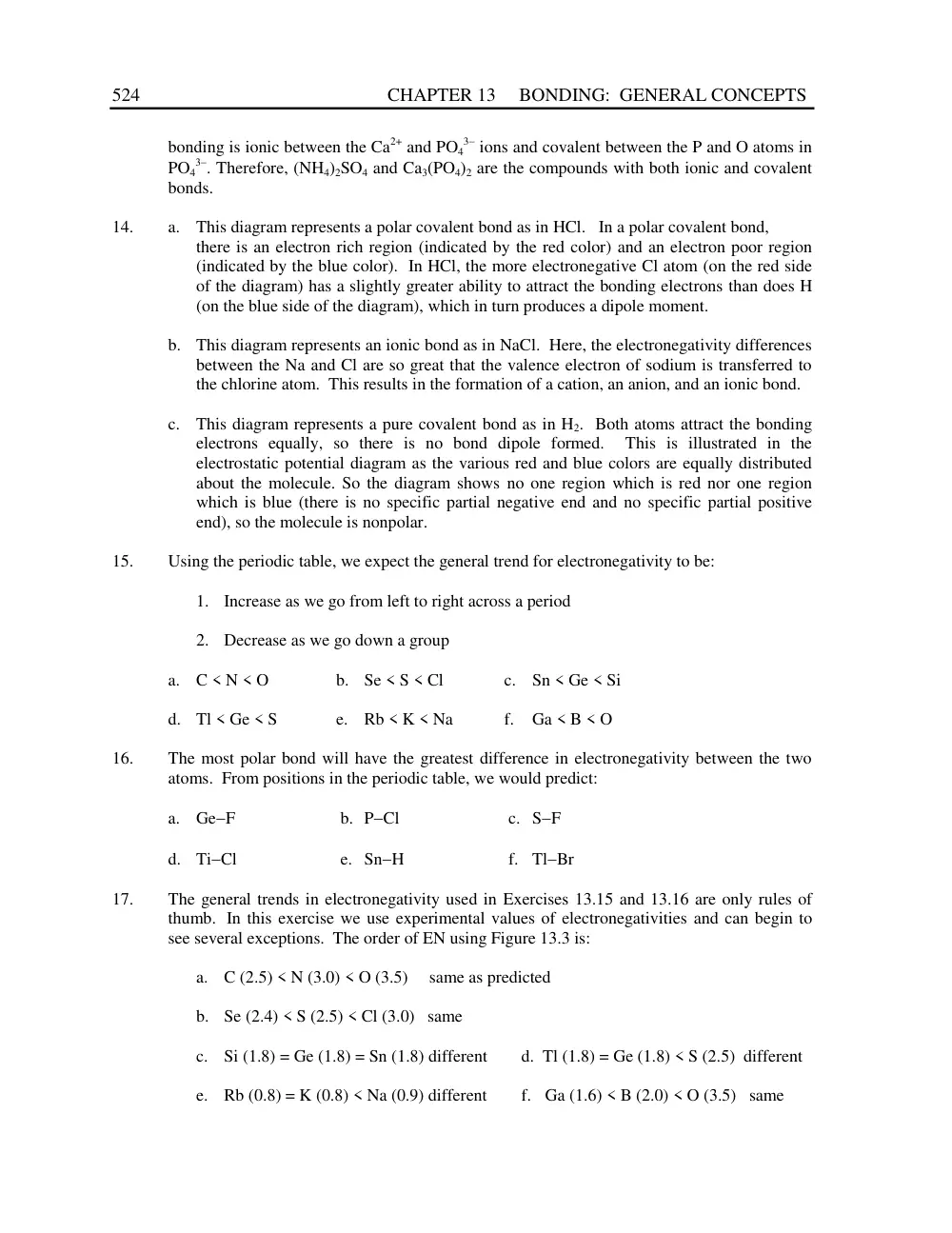
14.
a. This diagram represents a polar covalent bond as in HCl. In a polar covalent bond,
there is an electron rich region (indicated by the red color) and an electron poor region
(indicated by the blue color). In HCl, the more electronegative Cl atom (on the red side
of the diagram) has a slightly greater ability to attract the bonding electrons than does H
(on the blue side of the diagram), which in turn produces a dipole moment.
b. This diagram represents an ionic bond as in NaCl. Here, the electronegativity differences
between the Na and Cl are so great that the valence electron of sodium is transferred to
the chlorine atom. This results in the formation of a cation, an anion, and an ionic bond.
c. This diagram represents a pure covalent bond as in H2. Both atoms attract the bonding
electrons equally, so there is no bond dipole formed. This is illustrated in the
electrostatic potential diagram as the various red and blue colors are equally distributed
about the molecule. So the diagram shows no one region which is red nor one region
which is blue (there is no specific partial negative end and no specific partial positive
end), so the molecule is nonpolar.
15.
Using the periodic table, we expect the general trend for electronegativity to be:
1. Increase as we go from left to right across a period
2. Decrease as we go down a group
a. C < N < O
b. Se < S < Cl
c. Sn < Ge < Si
d. Tl < Ge < S
e. Rb < K < Na
f.
Ga < B < O
16.
The most polar bond will have the greatest difference in electronegativity between the two
atoms. From positions in the periodic table, we would predict:
a. GeF
b. PCl
c. SF
d. TiCl
e. SnH
f. TlBr
17.
The general trends in electronegativity used in Exercises 13.15 and 13.16 are only rules of
thumb. In this exercise we use experimental values of electronegativities and can begin to
see several exceptions. The order of EN using Figure 13.3 is:
a. C (2.5) < N (3.0) < O (3.5) same as predicted
b. Se (2.4) < S (2.5) < Cl (3.0) same
c. Si (1.8) = Ge (1.8) = Sn (1.8) different d. Tl (1.8) = Ge (1.8) < S (2.5) different
e. Rb (0.8) = K (0.8) < Na (0.9) different f. Ga (1.6) < B (2.0) < O (3.5) same
CHAPTER 13 BONDING: GENERAL CONCEPTS 525
Most polar bonds using actual EN values:
a. SiF and GeF (GeF predicted)
b. PCl (same as predicted)
c. SF (same as predicted)
d. TiCl (same as predicted)
e. SiH and SnH (SnH predicted)
f.
AlBr (TlBr predicted)
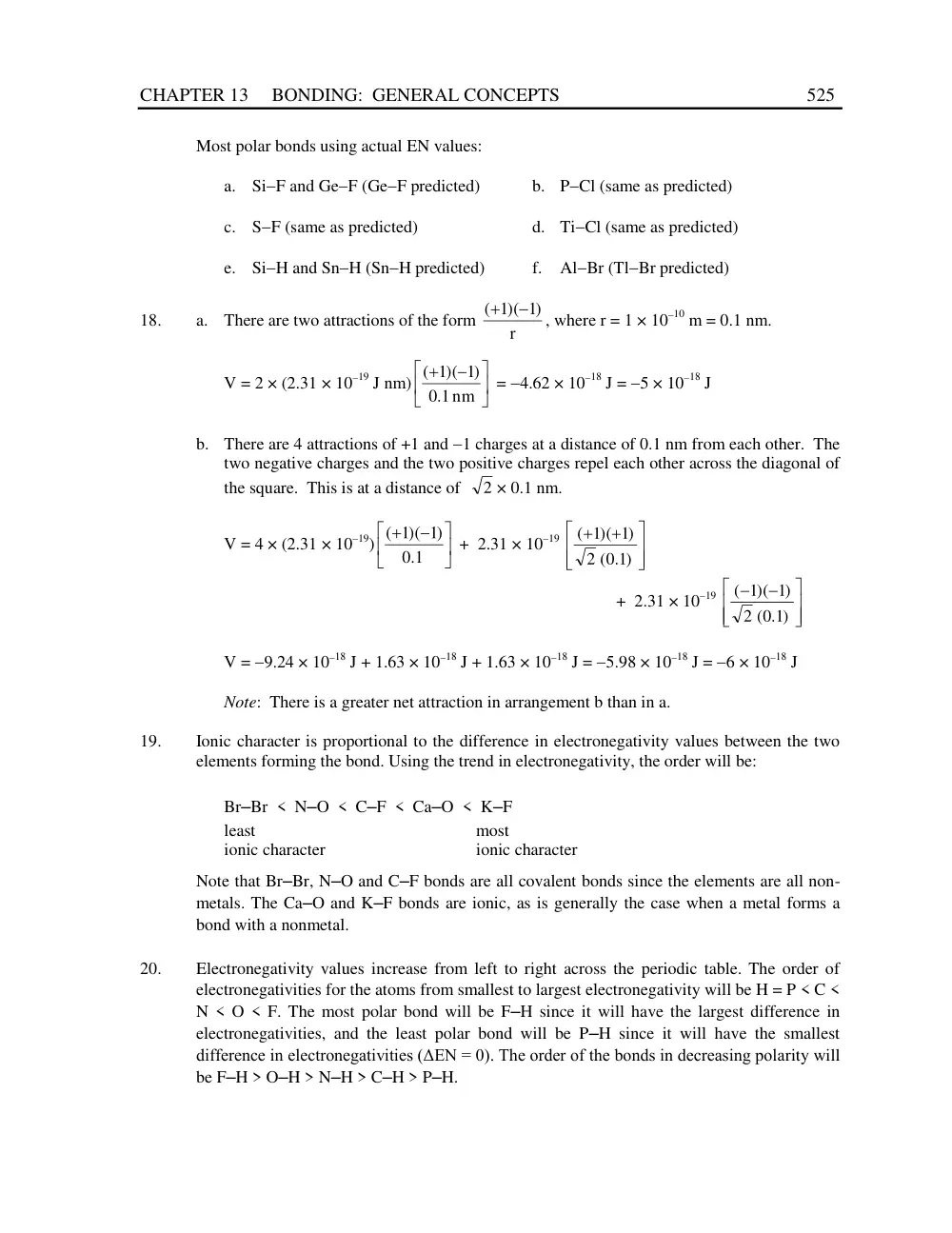
18.
a. There are two attractions of the form
r
)1
( 1)(
, where r = 1 × 10¹⁰ m = 0.1 nm.
V = 2 × (2.31 × 1019 J nm)
nm
1.0
)1
( 1)(
= 4.62 × 10¹⁸ J = 5 × 10¹⁸ J
b. There are 4 attractions of +1 and 1 charges at a distance of 0.1 nm from each other. The
two negative charges and the two positive charges repel each other across the diagonal of
the square. This is at a distance of
2 × 0.1 nm.
V = 4 × (2.31 × 1019)
1.0
)1
( 1)(
+ 2.31 × 10¹⁹
)1.0
(
2
)1
( 1)(
+ 2.31 × 10¹⁹
)1.0
(
2
)1
( 1)(
V = 9.24 × 10¹⁸ J + 1.63 × 10¹⁸ J + 1.63 × 10¹⁸ J = 5.98 × 10¹⁸ J = 6 × 10¹⁸ J
Note: There is a greater net attraction in arrangement b than in a.
19.
Ionic character is proportional to the difference in electronegativity values between the two
elements forming the bond. Using the trend in electronegativity, the order will be:
Br‒Br < N‒O < C‒F < Ca‒O < K‒F
least
most
ionic character
ionic character
Note that Br‒Br, N‒O and C‒F bonds are all covalent bonds since the elements are all non-
metals. The Ca‒O and K‒F bonds are ionic, as is generally the case when a metal forms a
bond with a nonmetal.
20.
Electronegativity values increase from left to right across the periodic table. The order of
electronegativities for the atoms from smallest to largest electronegativity will be H = P < C <
N < O < F. The most polar bond will be F‒H since it will have the largest difference in
electronegativities, and the least polar bond will be P‒H since it will have the smallest
difference in electronegativities (ΔEN = 0). The order of the bonds in decreasing polarity will
be F‒H > O‒H > N‒H > C‒H > P‒H.
526 CHAPTER 13 BONDING: GENERAL CONCEPTS
21.
(IE EA)
(IE EA)/502
EN (text)
2006/502 = 4.0
F
2006 kJ/mol
4.0
4.0
Cl
1604 kJ/mol
3.2
3.0
Br
1463 kJ/mol
2.9
2.8
I
1302 kJ/mol
2.6
2.5
The values calculated from IE and EA show the same trend as (and agree fairly closely) with
the values given in the text.
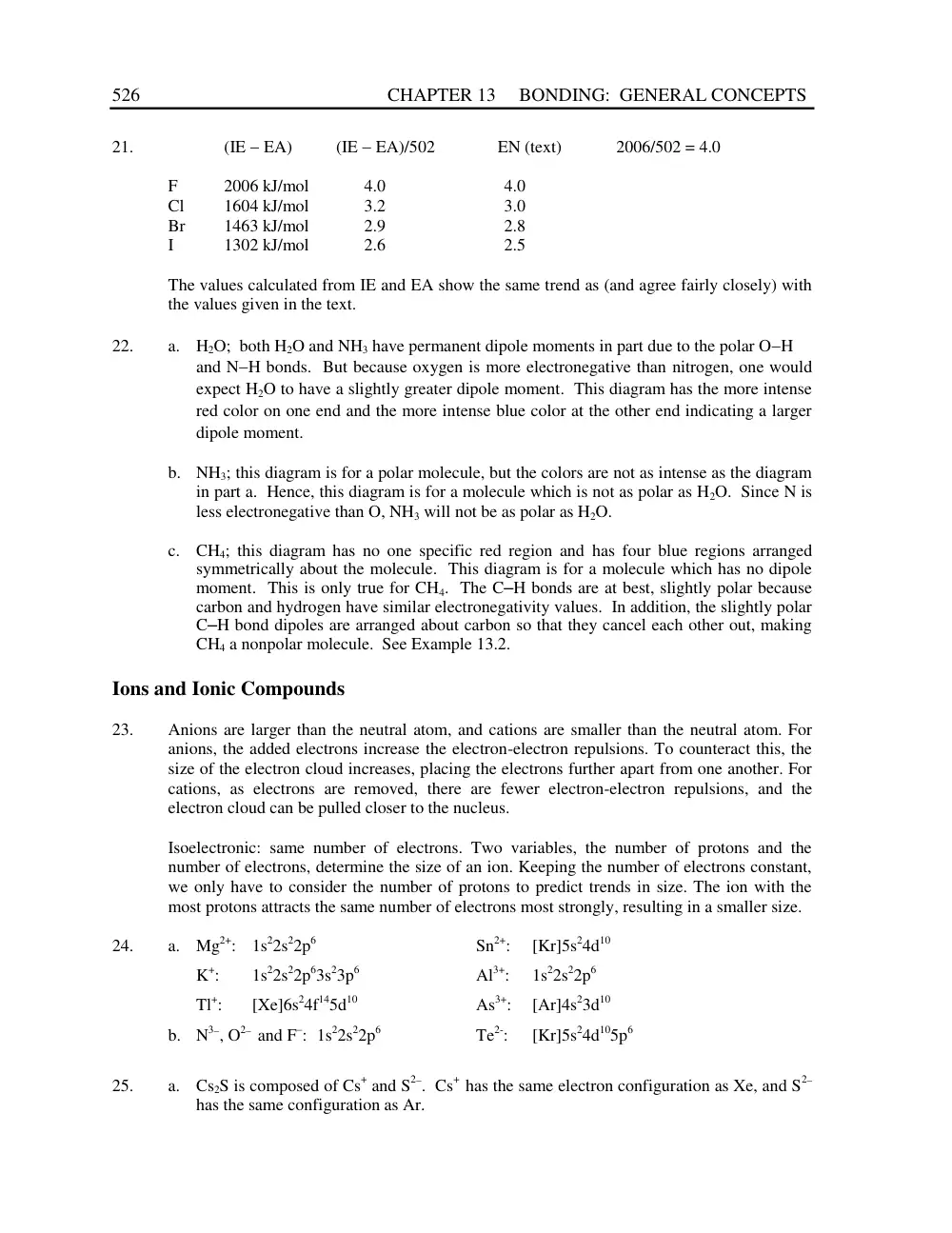
22.
a. H2O; both H2O and NH3 have permanent dipole moments in part due to the polar OH
and NH bonds. But because oxygen is more electronegative than nitrogen, one would
expect H2O to have a slightly greater dipole moment. This diagram has the more intense
red color on one end and the more intense blue color at the other end indicating a larger
dipole moment.
b. NH3; this diagram is for a polar molecule, but the colors are not as intense as the diagram
in part a. Hence, this diagram is for a molecule which is not as polar as H2O. Since N is
less electronegative than O, NH3 will not be as polar as H2O.
c. CH4; this diagram has no one specific red region and has four blue regions arranged
symmetrically about the molecule. This diagram is for a molecule which has no dipole
moment. This is only true for CH4. The C‒H bonds are at best, slightly polar because
carbon and hydrogen have similar electronegativity values. In addition, the slightly polar
C‒H bond dipoles are arranged about carbon so that they cancel each other out, making
CH4 a nonpolar molecule. See Example 13.2.
Ions and Ionic Compounds
23.
Anions are larger than the neutral atom, and cations are smaller than the neutral atom. For
anions, the added electrons increase the electron-electron repulsions. To counteract this, the
size of the electron cloud increases, placing the electrons further apart from one another. For
cations, as electrons are removed, there are fewer electron-electron repulsions, and the
electron cloud can be pulled closer to the nucleus.
Isoelectronic: same number of electrons. Two variables, the number of protons and the
number of electrons, determine the size of an ion. Keeping the number of electrons constant,
we only have to consider the number of protons to predict trends in size. The ion with the
most protons attracts the same number of electrons most strongly, resulting in a smaller size.
24.
a. Mg2+: 1s22s22p6
Sn2+:
[Kr]5s24d10
K+:
1s22s22p63s23p6
Al3+:
1s22s22p6
Tl+:
[Xe]6s24f145d10
As3+:
[Ar]4s23d10
b. N3, O2 and F: 1s22s22p6
Te2-:
[Kr]5s24d105p6
25.
a. Cs2S is composed of Cs+ and S2. Cs+ has the same electron configuration as Xe, and S2
has the same configuration as Ar.
CHAPTER 13 BONDING: GENERAL CONCEPTS 527
b. SrF2; Sr2+ has the Kr electron configuration, and F has the Ne configuration.
c. Ca3N2; Ca2+ has the Ar electron configuration, and N3 has the Ne configuration.
d. AlBr3; Al3+ has the Ne electron configuration, and Br has the Kr configuration.
26.
a. Ne has 10 electrons. AlN, MgF2, and Na2O are some possible ionic compounds where
each ion has 10 electrons.
b. CaS, K3P, and KCl are some examples where each ion is isoelectronic with Ar; i.e., each
ion has 18 electrons.
c. Each ion in Sr3As2, SrBr2, and Rb2Se is isoelectronic with Kr.
d. Each ion in BaTe and CsI is isoelectronic with Xe.
27.
Rb+: [Ar]4s23d104p6; Ba2+: [Kr]5s24d105p6; Se2: [Ar]4s23d104p6
I−: [Kr]5s24d105p6
28.
a. Sc3+
b. Te2
c. Ce4+ and Ti4+
d. Ba2+
All of these have the number of electrons of a noble gas.
29.
a. Cu > Cu+ > Cu2+
b. Pt2+ > Pd2+ > Ni2+
c. O2 > O > O
d. La3+ > Eu3+ > Gd3+ > Yb3+
e. Te2 > I > Cs+ > Ba2+ > La3+
For answer a, as electrons are removed from an atom, size decreases. Answers b and d
follow the radius trend. For answer c, as electrons are added to an atom, size increases.
Answer e follows the trend for an isoelectronic series, i.e., the smallest ion has the most
protons.
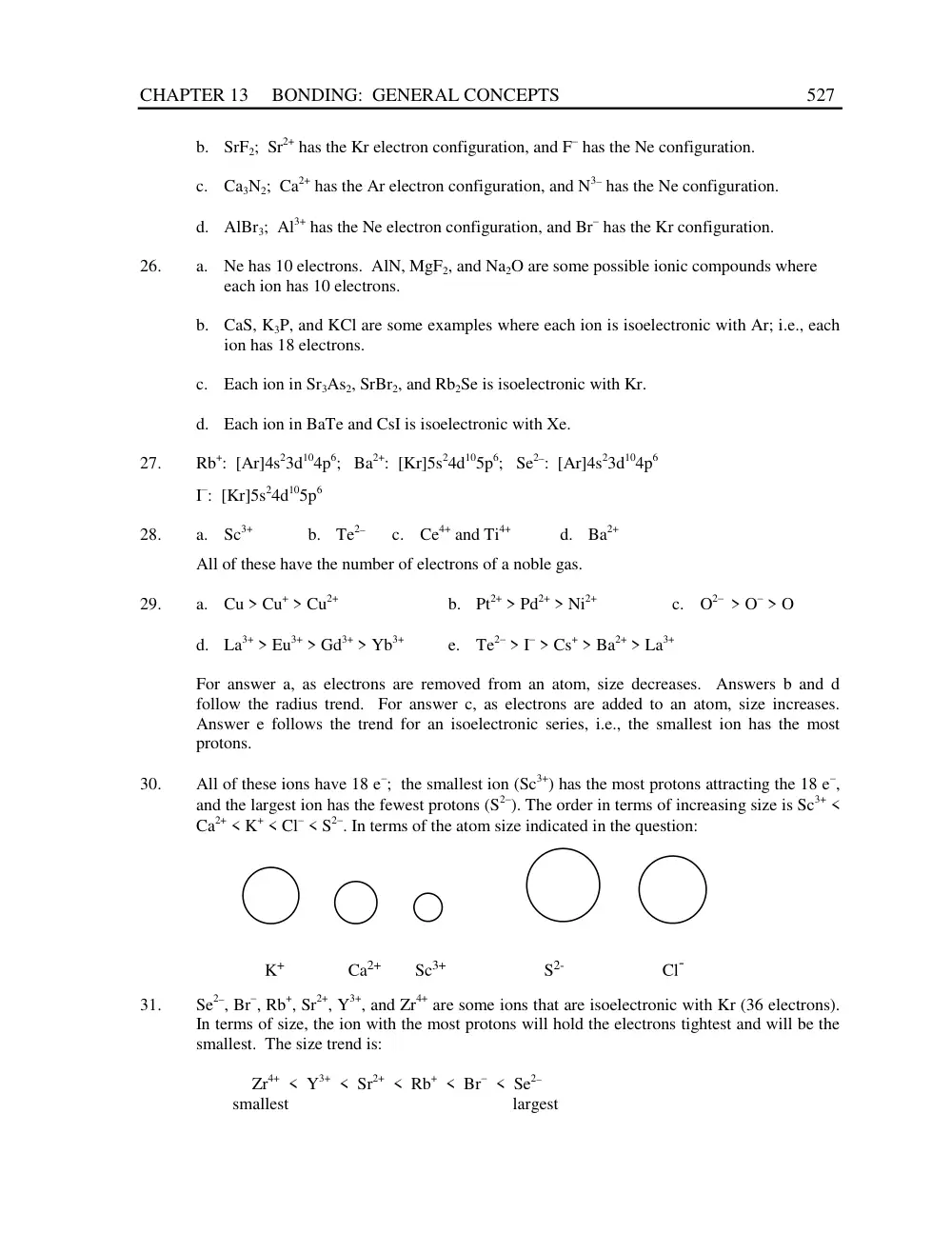
30.
All of these ions have 18 e; the smallest ion (Sc3+) has the most protons attracting the 18 e,
and the largest ion has the fewest protons (S2). The order in terms of increasing size is Sc3+ <
Ca2+ < K+ < Cl < S2. In terms of the atom size indicated in the question:
31.
Se2, Br, Rb+, Sr2+, Y3+, and Zr4+ are some ions that are isoelectronic with Kr (36 electrons).
In terms of size, the ion with the most protons will hold the electrons tightest and will be the
smallest. The size trend is:
Zr4+ < Y3+ < Sr2+ < Rb+ < Br < Se2
smallest
largest
K+ Ca2+ Sc3+ S2- Cl-
528 CHAPTER 13 BONDING: GENERAL CONCEPTS
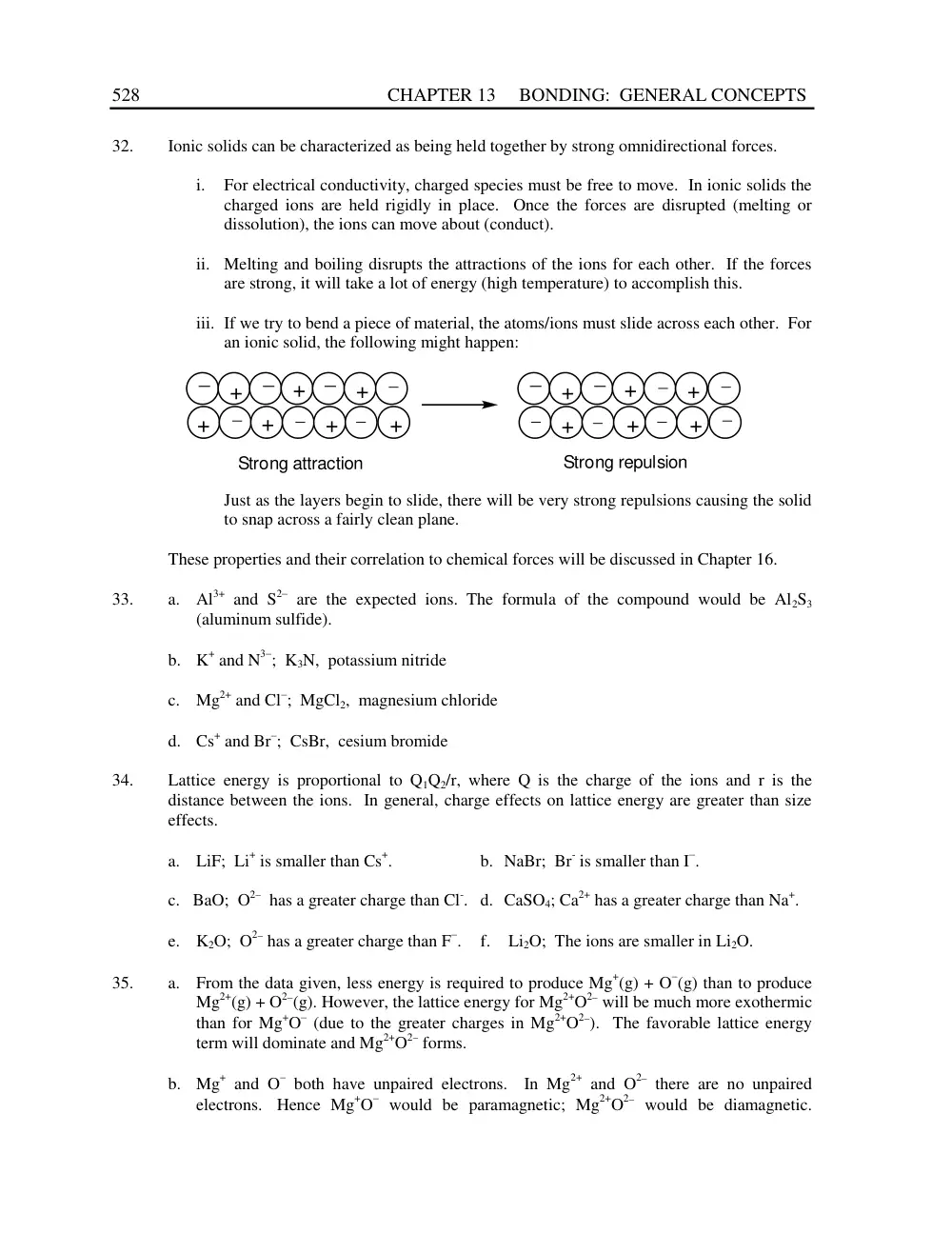
32.
Ionic solids can be characterized as being held together by strong omnidirectional forces.
i.
For electrical conductivity, charged species must be free to move. In ionic solids the
charged ions are held rigidly in place. Once the forces are disrupted (melting or
dissolution), the ions can move about (conduct).
ii. Melting and boiling disrupts the attractions of the ions for each other. If the forces
are strong, it will take a lot of energy (high temperature) to accomplish this.
iii. If we try to bend a piece of material, the atoms/ions must slide across each other. For
an ionic solid, the following might happen:
Just as the layers begin to slide, there will be very strong repulsions causing the solid
to snap across a fairly clean plane.
These properties and their correlation to chemical forces will be discussed in Chapter 16.
33.
a. Al3+ and S2 are the expected ions. The formula of the compound would be Al2S3
(aluminum sulfide).
b. K+ and N3; K3N, potassium nitride
c. Mg2+ and Cl; MgCl2, magnesium chloride
d. Cs+ and Br; CsBr, cesium bromide
34.
Lattice energy is proportional to Q1Q2/r, where Q is the charge of the ions and r is the
distance between the ions. In general, charge effects on lattice energy are greater than size
effects.
a. LiF; Li+ is smaller than Cs+.
b. NaBr; Br- is smaller than I.
c. BaO; O2 has a greater charge than Cl-. d. CaSO4; Ca2+ has a greater charge than Na+.
e. K2O; O2 has a greater charge than F. f. Li2O; The ions are smaller in Li2O.
35.
a. From the data given, less energy is required to produce Mg+(g) + O(g) than to produce
Mg2+(g) + O2(g). However, the lattice energy for Mg2+O2 will be much more exothermic
than for Mg+O (due to the greater charges in Mg2+O2). The favorable lattice energy
term will dominate and Mg2+O2 forms.
b. Mg+ and O both have unpaired electrons. In Mg2+ and O2 there are no unpaired
electrons. Hence Mg+O would be paramagnetic; Mg2+O2 would be diamagnetic.
+
+
+
+
+
+
+
+
+
+
+
+
+
Strong attraction
Strong repulsion
CHAPTER 13 BONDING: GENERAL CONCEPTS 529
Paramagnetism can be detected by measuring the mass of a sample in the presence and
absence of a magnetic field. The apparent mass of a paramagnetic substance will be
larger in a magnetic field because of the force between the unpaired electrons and the
field.
36.
Two other factors that must be considered are the ionization energy needed to produce more
positively charged ions and the electron affinity needed to produce more negatively charged
ions. The favorable lattice energy more than compensates for the unfavorable ionization
energy of the metal and for the unfavorable electron affinity of the nonmetal, as long as
electrons are added to or removed from the valence shell. Once the valence shell is full, the
ionization energy required to remove another electron is extremely unfavorable; the same is
true for electron affinity when an electron is added to a higher n shell. These two quantities
are so unfavorable after the valence shell is complete that they overshadow the favorable
lattice energy, and the higher-charged ionic compounds do not form.
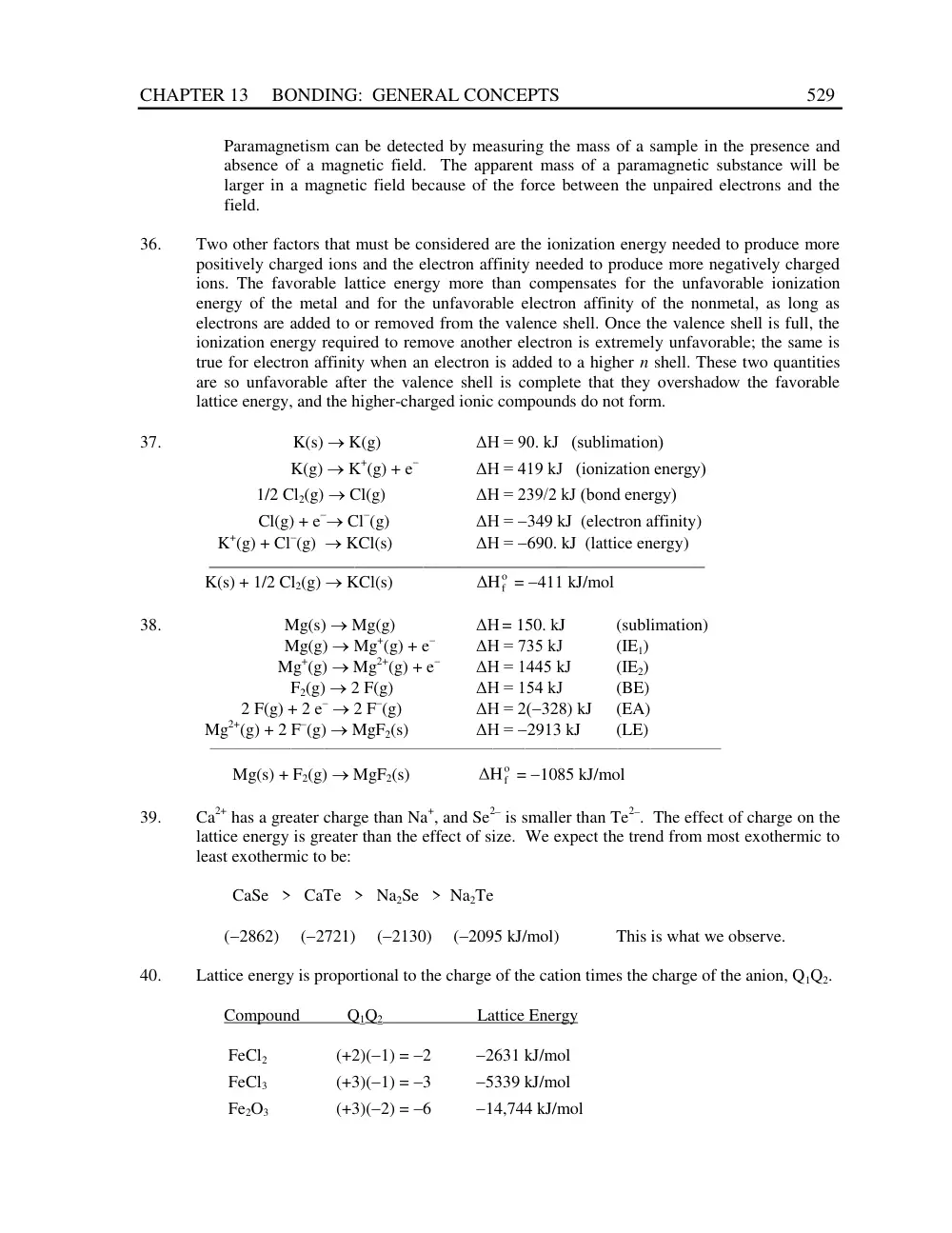
37.
K(s) K(g)
ΔH = 90. kJ (sublimation)
K(g) K+(g) + e
ΔH = 419 kJ (ionization energy)
1/2 Cl2(g) Cl(g)
ΔH = 239/2 kJ (bond energy)
Cl(g) + e Cl(g)
ΔH = 349 kJ (electron affinity)
K+(g) + Cl(g) KCl(s)
ΔH = 690. kJ (lattice energy)
__________________________________________________________
K(s) + 1/2 Cl2(g) KCl(s)
o
ΔHf
= 411 kJ/mol
38.
Mg(s) Mg(g)
ΔH = 150. kJ
(sublimation)
Mg(g) Mg+(g) + e
ΔH = 735 kJ
(IE1)
Mg+(g) Mg2+(g) + e
ΔH = 1445 kJ
(IE2)
F2(g) 2 F(g)
ΔH = 154 kJ
(BE)
2 F(g) + 2 e 2 F(g)
ΔH = 2(328) kJ
(EA)
Mg2+(g) + 2 F(g) MgF2(s)
ΔH = 2913 kJ
(LE)
______________________________________________________________________________________________
Mg(s) + F2(g) MgF2(s)
o
ΔHf
= 1085 kJ/mol
39.
Ca2+ has a greater charge than Na+, and Se2 is smaller than Te2. The effect of charge on the
lattice energy is greater than the effect of size. We expect the trend from most exothermic to
least exothermic to be:
CaSe > CaTe > Na2Se > Na2Te
(2862) (2721) (2130) (2095 kJ/mol)
This is what we observe.
40.
Lattice energy is proportional to the charge of the cation times the charge of the anion, Q1Q2.
Compound Q1Q2 Lattice Energy
FeCl2
(+2)(1) = 2
2631 kJ/mol
FeCl3
(+3)(1) = 3
5339 kJ/mol
Fe2O3
(+3)(2) = 6
14,744 kJ/mol
530 CHAPTER 13 BONDING: GENERAL CONCEPTS
41.
Use Figure 13.11 as a template for this problem.
Li(s) Li(g)
ΔHsub = ?
Li(g) Li+(g) + e
ΔH = 520. kJ
1/2 I2(g) I(g)
ΔH = 151/2 kJ
I(g) + e I(g)
ΔH = 295 kJ
Li+(g) + I(g) LiI(s)
ΔH = 753 kJ
________________________________________________________________________
Li(s) + 1/2 I2(g) LiI(s)
ΔH = 292 kJ
ΔHsub + 520. + 151/2 295 753 = 292, ΔHsub = 161 kJ
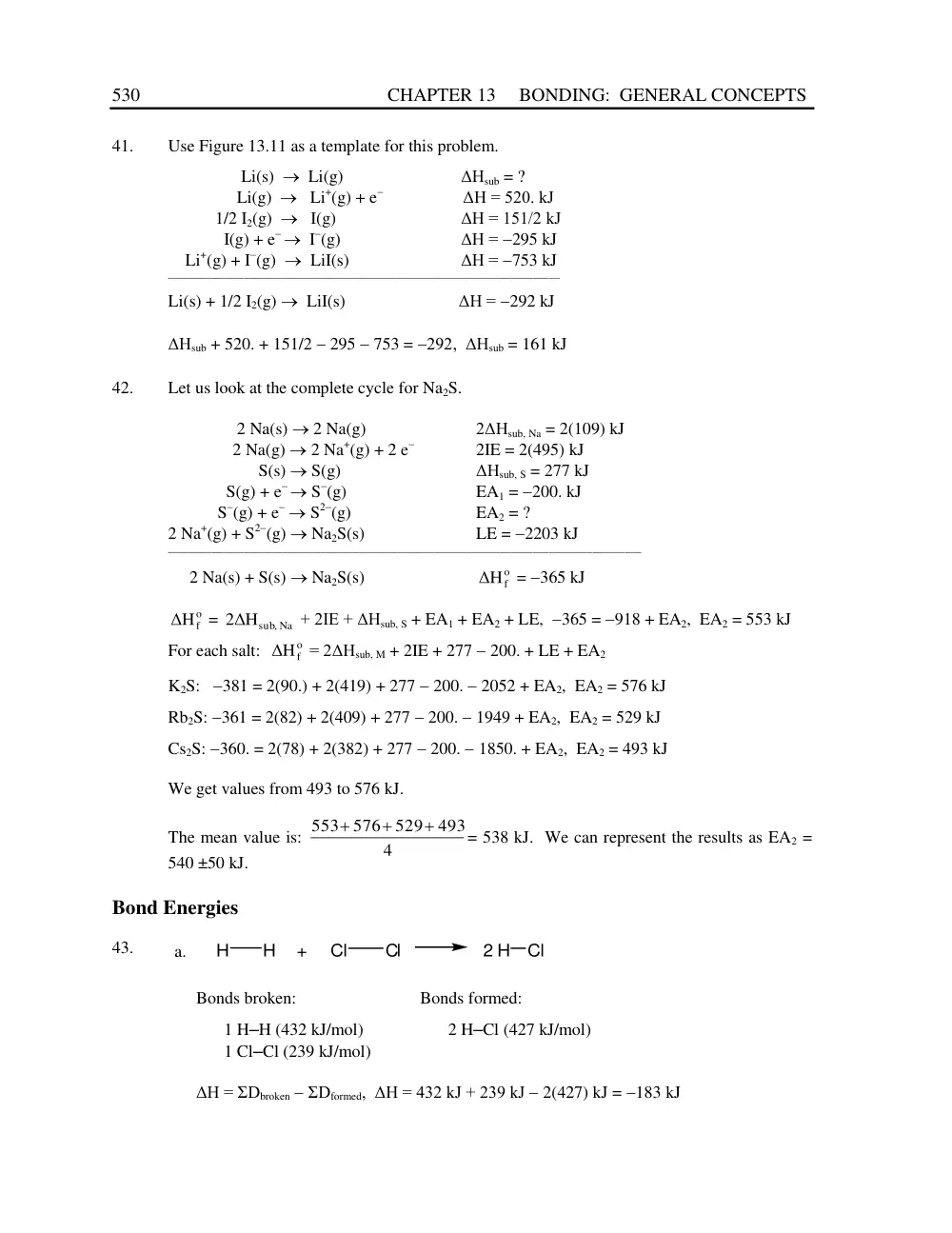
42.
Let us look at the complete cycle for Na2S.
2 Na(s) 2 Na(g)
2ΔHsub, Na = 2(109) kJ
2 Na(g) 2 Na+(g) + 2 e
2IE = 2(495) kJ
S(s) S(g)
ΔHsub, S = 277 kJ
S(g) + e S(g)
EA1 = 200. kJ
S(g) + e S2(g)
EA2 = ?
2 Na+(g) + S2(g) Na2S(s)
LE = 2203 kJ
_______________________________________________________________________________________
2 Na(s) + S(s) Na2S(s)
o
ΔHf
= 365 kJ
o
ΔHf
=
2ΔHsub, Na
+ 2IE + ΔHsub, S + EA1 + EA2 + LE, 365 = 918 + EA2, EA2 = 553 kJ
For each salt:
o
ΔHf
= 2ΔHsub, M + 2IE + 277 200. + LE + EA2
K2S: 381 = 2(90.) + 2(419) + 277 200. 2052 + EA2, EA2 = 576 kJ
Rb2S: 361 = 2(82) + 2(409) + 277 200. 1949 + EA2, EA2 = 529 kJ
Cs2S: 360. = 2(78) + 2(382) + 277 200. 1850. + EA2, EA2 = 493 kJ
We get values from 493 to 576 kJ.
The mean value is:
4
493
529
576
553
= 538 kJ. We can represent the results as EA2 =
540 ±50 kJ.
Bond Energies
43.
a.
Bonds broken:
Bonds formed:
1 H‒H (432 kJ/mol)
2 H‒Cl (427 kJ/mol)
1 Cl‒Cl (239 kJ/mol)
ΔH = ΣDbroken ΣDformed, ΔH = 432 kJ + 239 kJ 2(427) kJ = 183 kJ
H
H
+
Cl
Cl
2 H
Cl
CHAPTER 13 BONDING: GENERAL CONCEPTS 531
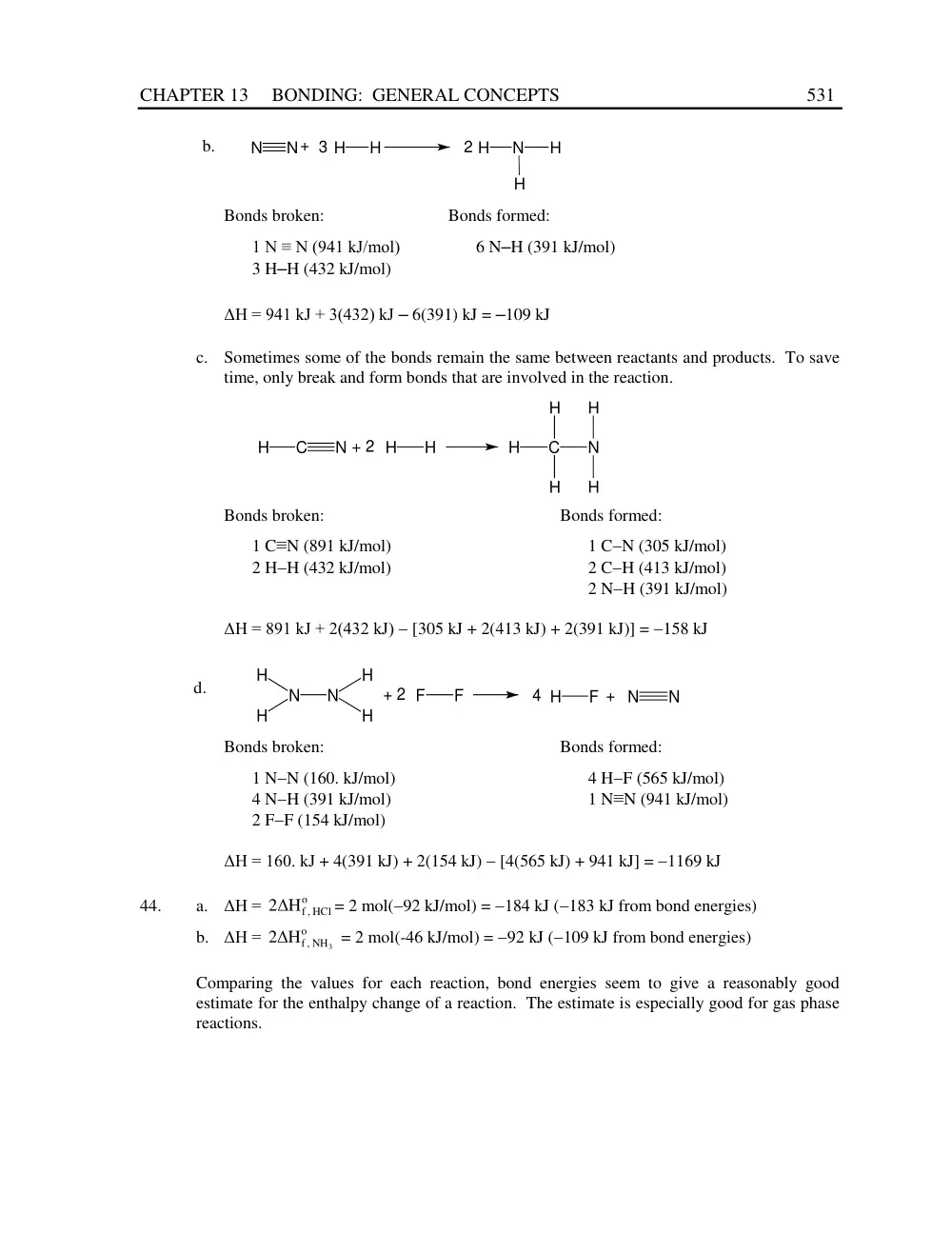
b.
Bonds broken:
Bonds formed:
1 N ≡ N (941 kJ/mol)
6 N‒H (391 kJ/mol)
3 H‒H (432 kJ/mol)
ΔH = 941 kJ + 3(432) kJ ‒ 6(391) kJ = ‒109 kJ
c. Sometimes some of the bonds remain the same between reactants and products. To save
time, only break and form bonds that are involved in the reaction.
Bonds broken:
Bonds formed:
1 C≡N (891 kJ/mol)
1 CN (305 kJ/mol)
2 HH (432 kJ/mol)
2 CH (413 kJ/mol)
2 NH (391 kJ/mol)
ΔH = 891 kJ + 2(432 kJ) [305 kJ + 2(413 kJ) + 2(391 kJ)] = 158 kJ
d.
Bonds broken:
Bonds formed:
1 NN (160. kJ/mol)
4 HF (565 kJ/mol)
4 NH (391 kJ/mol)
1 N≡N (941 kJ/mol)
2 FF (154 kJ/mol)
ΔH = 160. kJ + 4(391 kJ) + 2(154 kJ) [4(565 kJ) + 941 kJ] = 1169 kJ
44.
a. ΔH =
o
2ΔH ,f HCl
= 2 mol(92 kJ/mol) = 184 kJ (183 kJ from bond energies)
b. ΔH =
o
NH
,f
3
2ΔH
= 2 mol(-46 kJ/mol) = 92 kJ (109 kJ from bond energies)
Comparing the values for each reaction, bond energies seem to give a reasonably good
estimate for the enthalpy change of a reaction. The estimate is especially good for gas phase
reactions.
H
C
N + 2 H
H H
C
N
H
H
H
H
N
N
H
H
H
H
F
F
+ 2
+
H
F N
N
4
+ 3
2
H
H
H
N
H
H
N
N
532 CHAPTER 13 BONDING: GENERAL CONCEPTS
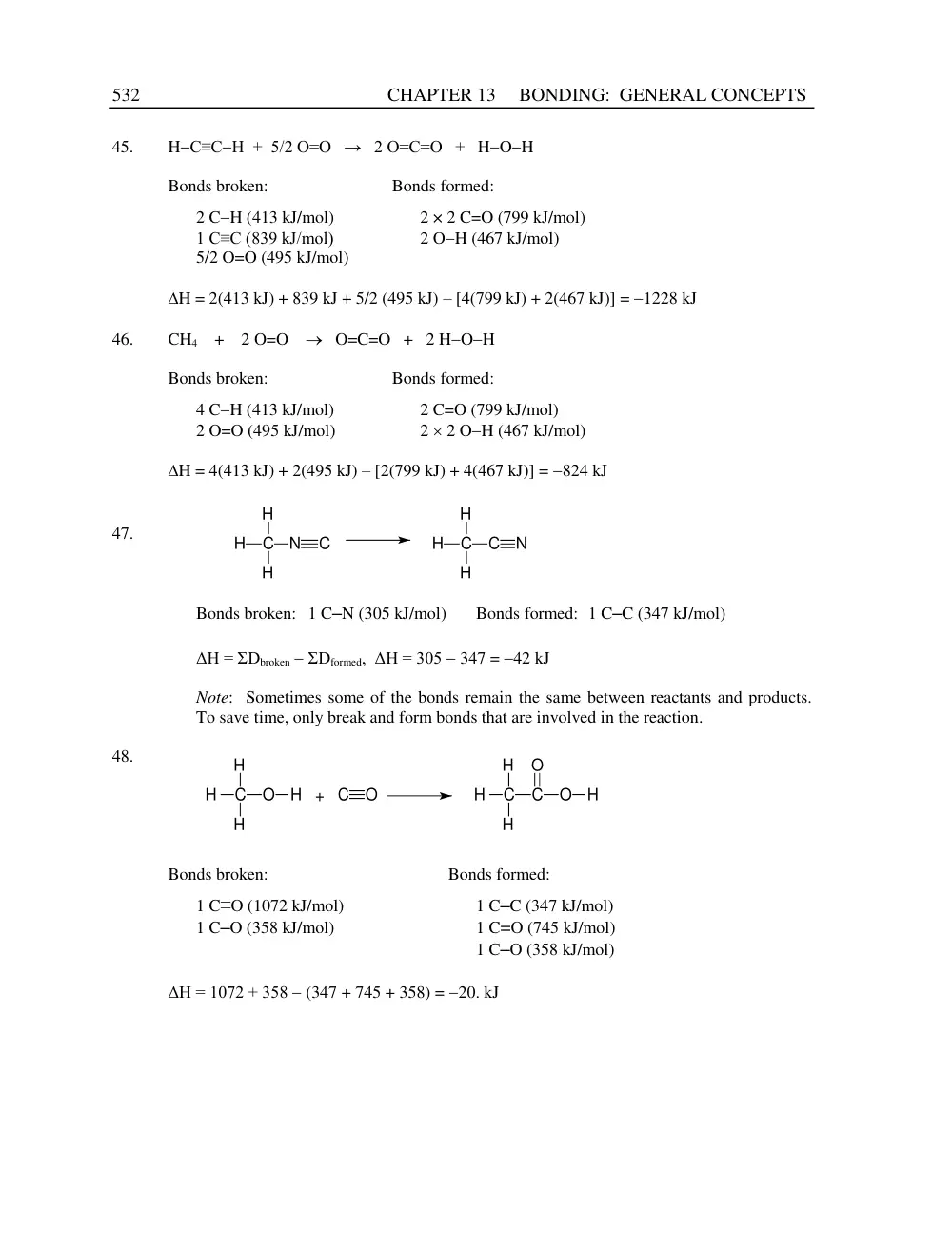
45.
HC≡CH + 5/2 O=O → 2 O=C=O + HOH
Bonds broken:
Bonds formed:
2 CH (413 kJ/mol)
2 × 2 C=O (799 kJ/mol)
1 C≡C (839 kJ/mol)
2 OH (467 kJ/mol)
5/2 O=O (495 kJ/mol)
H = 2(413 kJ) + 839 kJ + 5/2 (495 kJ) – [4(799 kJ) + 2(467 kJ)] = 1228 kJ
46.
CH4 + 2 O=O O=C=O + 2 HOH
Bonds broken:
Bonds formed:
4 CH (413 kJ/mol)
2 C=O (799 kJ/mol)
2 O=O (495 kJ/mol)
2 2 OH (467 kJ/mol)
H = 4(413 kJ) + 2(495 kJ) – [2(799 kJ) + 4(467 kJ)] = 824 kJ
47.
Bonds broken: 1 C‒N (305 kJ/mol)
Bonds formed: 1 C‒C (347 kJ/mol)
ΔH = ΣDbroken ΣDformed, ΔH = 305 347 = 42 kJ
Note: Sometimes some of the bonds remain the same between reactants and products.
To save time, only break and form bonds that are involved in the reaction.
48.
Bonds broken:
Bonds formed:
1 C≡O (1072 kJ/mol)
1 C‒C (347 kJ/mol)
1 C‒O (358 kJ/mol)
1 C=O (745 kJ/mol)
1 C‒O (358 kJ/mol)
ΔH = 1072 + 358 (347 + 745 + 358) = 20. kJ
H
C
C
N
H
H
H
C
N
C
H
H
+
H
C
O
H
H
H
C
O
H
C
C
O
H
H
O
H
CHAPTER 13 BONDING: GENERAL CONCEPTS 533
CH3OH(g) + CO(g) CH3COOH(l) ΔH° = 484 kJ [(201 kJ) + (110.5 kJ)] = 173 kJ
Using bond energies, ΔH = 20. kJ. For this reaction, bond energies give a much poorer
estimate for ΔH as compared with gas phase reactions. The major reason for the large
discrepancy is that not all species are gases in this exercise. Bond energies do not account for
the energy changes that occur when liquids and solids form instead of gases. These energy
changes are due to intermolecular forces and will be discussed in Chapter 16.
49.
Bonds broken:
Bonds formed:
9 N‒N (160. kJ/mol)
24 O‒H (467 kJ/mol)
4 N‒C (305 kJ/mol)
9 N≡N (941 kJ/mol)
12 C‒H (413 kJ/mol)
8 C=O (799 kJ/mol)
12 N‒H (391 kJ/mol)
10 N=O (607 kJ/mol)
10 N‒O (201 kJ/mol)
ΔH = 9(160.) + 4(305) + 12(413) + 12(391) + 10(607) + 10(201)
[24(467) + 9(941) + 8(799)]
ΔH = 20,388 kJ 26,069 kJ = 5681 kJ
50.
a. I.
Bonds broken (*):
Bonds formed (*):
1 C‒O (358 kJ)
1 O‒H (467 kJ)
1 C‒H (413 kJ)
1 C‒C (347 kJ)
ΔHI = 358 kJ + 413 kJ (467 kJ + 347 kJ) = 43 kJ
N
N
H
H
H
C
H
H
H
4
5
+
O
N
N
O
O
O
H
O
H
N
N
O
C
O
+ 4
+ 9
12
C
C
H
H
H
H
O *
+
H
C
N
*
H
C
C
H
H
H
O
H
C
N
*
*
534 CHAPTER 13 BONDING: GENERAL CONCEPTS
II.
Bonds broken (*):
Bonds formed (*):
1 C‒O (358 kJ/mol)
1 H‒O (467 kJ/mol)
1 C‒H (413 kJ/mol)
1 C=C (614 kJ/mol)
1 C‒C (347 kJ/mol)
ΔHII
= 358 kJ + 413 kJ + 347 kJ [467 kJ + 614 kJ] = +37 kJ
ΔHoverall = ΔHI + ΔHII = 43 kJ + 37 kJ = 6 kJ
b.
Bonds broken:
Bonds formed:
4 × 3 C‒H (413 kJ/mol)
4 C≡N (891 kJ/mol)
6 N=O (630. kJ/mol)
6 × 2 H‒O (467 kJ/mol)
1 N≡N (941 kJ/mol)
ΔH = 12(413) + 6(630.) [4(891) + 12(467) + 941] = 1373 kJ
c.
Bonds broken:
Bonds formed:
2 × 3 C‒H (413 kJ/mol)
2 C≡N (891 kJ/mol)
2 × 3 N‒H (391 kJ/mol)
6 × 2 O‒H (467 kJ/mol)
3 O=O (495 kJ/mol)
ΔH = 6(413) + 6(391) + 3(495) [2(891) + 12(467)] = 1077 kJ
51.
Because both reactions are highly exothermic, the high temperature is not needed to provide
energy. It must be necessary for some other reason. The reason is to increase the speed of
the reaction. This will be discussed in Chapter 15 on kinetics.
H
C
C
C
N
OH H
H
H
*
*
*
*
+
H *
O
H
C
C
H
H
C
N
H
C
C
H
H
C
H
H
H
H
H
N
H
H
O2
C
C
H
H
H
C
N
H
O
H
+ 2
2
+ 6
+ 3
2
C
C
H
H
C
H
H
H
H
4
+ 6 NO
4
+ 6
C
C
H
H
H
C
N
H
O
H
+
N
N
CHAPTER 13 BONDING: GENERAL CONCEPTS 535
52.
Let x = bond energy for A2, and then 2x = bond energy for AB.
H = 285 kJ = x + 432 kJ – [2(2x)], 3x = 717, x = 239 kJ/mol = bond energy for A2
53.
NH3(g) N(g) + 3 H(g)
ΔH° = 3DNH = 472.7 kJ + 3(216.0 kJ) (46.1 kJ) = 1166.8 kJ
DNH =
molNH bonds
3
1166.8 kJ
= 388.93 kJ/mol
Dcalc = 389 kJ/mol compared with 391 kJ/mol in the table. There is good agreement.
54.
1/2 N2(g) + 1/2 O2(g) NO(g)
H = 90. kJ
Bonds broken:
Bonds formed:
1/2 NN (941 kJ/mol)
1 NO
1/2 O=O (495 kJ/mol)
H = 90. kJ = 1/2(941) + 1/2(495) – (DNO), DNO = NO bond energy = 628 kJ/mol
55.
a. HF(g) H(g) + F(g)
ΔH = 565 kJ
H(g) H+(g) + e
ΔH = 1312 kJ
F(g) + e F(g)
ΔH = 327.8 kJ
___________________________________________________________________
HF(g) H+(g) + F(g)
ΔH = 1549 kJ
b. HCl(g) H(g) + Cl(g)
ΔH = 427 kJ
H(g) H+(g) + e
ΔH = 1312 kJ
Cl(g) + e Cl(g)
ΔH = 348.7 kJ
____________________________________________________________________
HCl(g) H+(g) + Cl(g)
ΔH = 1390. kJ
c. HI(g) H(g) + I(g)
ΔH = 295 kJ
H(g) H+(g) + e
ΔH = 1312 kJ
I(g) + e I(g)
ΔH = 295.2 kJ
___________________________________________________________________
HI(g) H+(g) + I(g)
ΔH = 1312 kJ
d.
H2O(g) OH(g) + H(g)
ΔH = 467 kJ
H(g) H+(g) + e
ΔH = 1312 kJ
OH(g) + e OH(g)
ΔH = 180. kJ
_____________________________________________________________________
H2O(g) H+(g) + OH(g)
ΔH = 1599 kJ
536 CHAPTER 13 BONDING: GENERAL CONCEPTS
56.
a. Using SF4 data: SF4(g) S(g) + 4 F(g)
ΔH° = 4DSF = 278.8 kJ + 4(79.0 kJ) (775 kJ) = 1370. kJ
DSF =
molSF bonds
4
1370. kJ
= 342.5 kJ/mol
Using SF6 data: SF6(g) S(g) + 6 F(g)
ΔH° = 6DSF = 278.8 kJ + 6(79.0 kJ) (1209 kJ) = 1962 kJ
DSF = 1962 kJ/6 = 327.0 kJ/mol
b. The S‒F bond energy in Table 13.6 is 327 kJ/mol. The value in the table was based on
the S‒F bond in SF6.
c. S(g) and F(g) are not the most stable form of the element at 25°C and 1 atm. The most
stable forms are S8(s) and F2(g);
o
ΔHf
= 0 for these two species.
Lewis Structures and Resonance
57.
Drawing Lewis structures is mostly trial and error. However, the first two steps are always
the same. These steps are (1) count the valence electrons available in the molecule/ion, and
(2) attach all atoms to each other with single bonds (called the skeletal structure). Unless
noted otherwise, the atom listed first is assumed to be the atom in the middle, called the
central atom, and all other atoms in the formula are attached to this atom. The most notable
exceptions to the rule are formulas that begin with H, e.g., H2O, H2CO, etc. Hydrogen can
never be a central atom since this would require H to have more than two electrons. In these
compounds, the atom listed second is assumed to be the central atom.
After counting valence electrons and drawing the skeletal structure, the rest is trial and error.
We place the remaining electrons around the various atoms in an attempt to satisfy the octet
rule (or duet rule for H). Keep in mind that practice makes perfect. After practicing, you can
(and will) become very adept at drawing Lewis structures.
a. HCN has 1 + 4 + 5 = 10 valence b. PH3 has 5 + 3(1) = 8 valence electrons.
electrons.
Skeletal structure uses 4 e; 6 e remain
Skeletal structures uses 6 e; 2 e remain
Skeletal
structure
H
P
H
H
H
P
H
H
Lewis
structure
Skeletal
structure
H
C
N
Lewis
structure
H
C
N
CHAPTER 13 BONDING: GENERAL CONCEPTS 537
c. CHCl3 has 4 + 1 + 3(7) = 26 valence
d. NH4
+ has 5 + 4(1) 1 = 8 valence
electrons. electrons.
Note: Subtract
valence electrons
for positive
charged ions.
e. H2CO has 2(1) + 4 + 6 = 12 valence
f.
SeF2 has 6 + 2(7) = 20 valence
electrons.
electrons.
g. CO2 has 4 + 2(6) = 16 valence electrons. h. O2 has 2(6) = 12 valence electrons.
i.
HBr has 1 + 7 = 8 valence electrons.
58.
a. POCl3 has 5 + 6 + 3(7) = 32 valence electrons.
Note: This structure uses all 32 e while
satisfying the octet rule for all atoms. This is
a valid Lewis structure.
SO4
2 has 6 + 4(6) + 2 = 32 valence electrons.
Note: A negatively charged ion will have
additional electrons to those that come from
the valence shell of the atoms.
Lewis
structure
Skeletal
structure
Cl
C
Cl
Cl
H
Cl
C
Cl
Cl
H
Lewis
structure
H
N
H
H
H
+ Note: Subtract
valence electrons
for positive
charged ions.
O
C
H
H
F
Se
F
O
C
O
O
O
H
Br
Cl
P
Cl
O
Cl
Cl
P
Cl
O
Cl
Skeletal
structure
Lewis
structure
O
S
O
O
O
2-
538 CHAPTER 13 BONDING: GENERAL CONCEPTS
XeO4, 8 + 4(6) = 32 e
PO4
3, 5 + 4(6) + 3 = 32 e
ClO4
has 7 + 4(6) + 1 = 32 valence electrons.
Note: All these species have the same number of atoms and the same number of valence
electrons. They also have the same Lewis structure.
b. NF3 has 5 + 3(7) = 26 valence electrons.
SO3
2, 6 + 3(6) + 2 = 26 e
PO3
3, 5 + 3(6) + 3 = 26 e
ClO3
, 7 + 3(6) + 1 = 26 e
Note: Species with the same number of atoms and valence electrons have similar Lewis
structures.
c. ClO2
has 7 + 2(6) + 1 = 20 valence electrons.
Skeletal structure
Lewis structure
O
S
O
O
2-
O
Xe
O
O
O
F
N
F
F
F
N
F
F
Skeletal
structure
Lewis
structure
O
Cl
O
O
Cl
O
-
-
O
Cl
O
O
O
O
Cl
O
O
O
P
O
O
3-
O
P
O
O
O
3-
CHAPTER 13 BONDING: GENERAL CONCEPTS 539
SCl2, 6 + 2(7) = 20 e
PCl2
, 5 + 2(7) + 1 = 20 e
Note: Species with the same number of atoms and valence electrons have similar Lewis
structures.
59.
Molecules/ions that have the same number of valence electrons and the same number of
atoms will have similar Lewis structures.
60.
a. NO2
has 5 + 2(6) + 1 = 18 valence electrons. The skeletal structure is: O ‒ N ‒ O
To get an octet about the nitrogen and only use 18 e , we must form a double bond to
one of the oxygen atoms.
Because there is no reason to have the double bond to a particular oxygen atom, we can
draw two resonance structures. Each Lewis structure uses the correct number of
electrons and satisfies the octet rules, so each is a valid Lewis structure. Resonance
structures occur when you have multiple bonds that can be in various positions. We say
the actual structure is an average of these two resonance structures.
NO3
has 5 + 3(6) + 1 = 24 valence electrons. We can draw three resonance structures
for NO3
, with the double bond rotating between the three oxygen atoms.
N2O4 has 2(5) + 4(6) = 34 valence electrons. We can draw four resonance structures for
N2O4.
O
N
O
O
N
O
N
O
O
O
N
O
O
O
N
O
O
O
N
N
O
O
O
O
N
N
O
O
O
O
N
N
O
O
O
O
N
N
O
O
O
O
-
Cl
S Cl
Cl
P Cl
540 CHAPTER 13 BONDING: GENERAL CONCEPTS
b. OCN has 6 + 4 + 5 + 1 = 16 valence electrons. We can draw three resonance structures
for OCN.
SCN has 6 + 4 + 5 + 1 = 16 valence electrons. Three resonance structures can be drawn.
N3
has 3(5) + 1 = 16 valence electrons. As with OCN- and SCN-, three different
resonance structures can be drawn.
61.
Ozone: O3 has 3(6) = 18 valence electrons. Two resonance structures can be drawn.
Sulfur dioxide: SO2 has 6 + 2(6) = 18 valence electrons. Two resonance structures are
possible.
Sulfur trioxide: SO3 has 6 + 3(6) = 24 valence electrons. Three resonance structures are
possible.
62.
PAN (H3C2NO5) has 3(1) + 2(4) + 5 + 5(6) = 46 valence electrons.
This is the skeletal structure with complete octets
about oxygen atoms (46 electrons used).
O
C
N
O
C
N
O
C
N
S
C
N
S
C
N
S
C
N
N
N
N
N
N
N
N
N
N
O
O
O
O
O
O
O
S
O
O
S
O
O
S
O
O
O
S
O
O
O
S
O
O
H
C
C
O
O
N
O
H
H
O
O
CHAPTER 13 BONDING: GENERAL CONCEPTS 541
This structure has used all 46 electrons, but there are only six electrons around one of the
carbon atoms and the nitrogen atom. Two unshared pairs must become shared; i.e., we must
form double bonds.
63.
CH3NCO has 4 + 3(1) + 5 + 4 + 6 = 22 valence electrons. The order of the elements in the
formula give the skeletal structure.
64.
Resonance occurs w