
CHM 201 Problems Solution for Chap 4 Exercises, Fall 2013
Lebanese American University · Chemical Principles · 48 pages · with solution



Showing the first 10 of 48 pages. Download the PDF to see all of it.
More CHM 201 files
- Questions Exam Quest · Fall 2015ProblemsView
- Problems Solution for Chap 7 · Fall 2013Problems · with solutionView
- Problems Solution for Chap 8 · Fall 2013Problems · with solutionView
- Problems Solution Manual · Fall 2013Problems · with solutionView
- Problems Solution for Chap 3 Exercises · Fall 2013Problems · with solutionView
- Problems Solution for Chap 5 Exercises · Fall 2013Problems · with solutionView
- Problems Solution for Chap 6 · Fall 2013Problems · with solutionView
- Final Sample · Spring 2017Final examView
Show the text of this problems
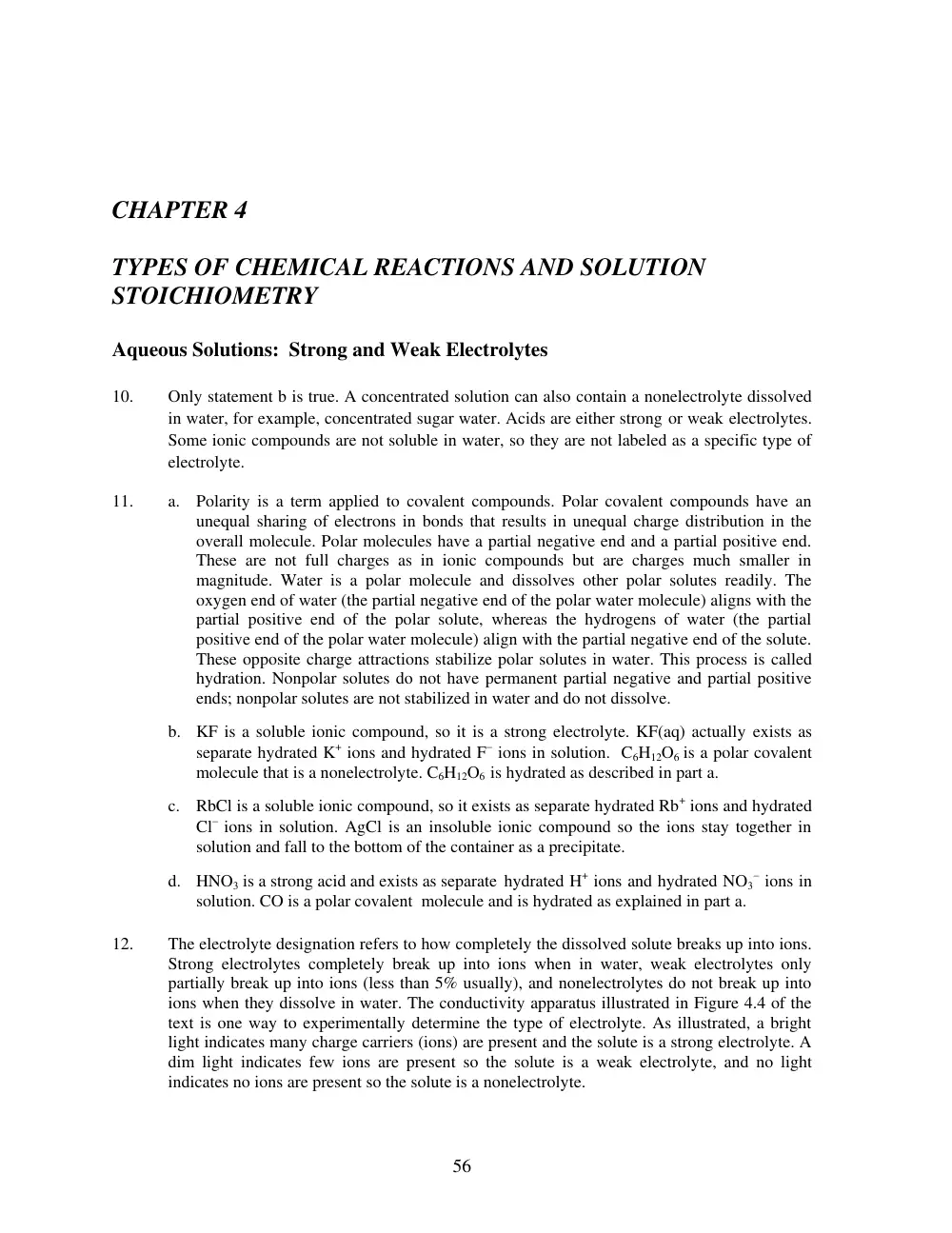
56
CHAPTER 4
TYPES OF CHEMICAL REACTIONS AND SOLUTION
STOICHIOMETRY
Aqueous Solutions: Strong and Weak Electrolytes
10.
Only statement b is true. A concentrated solution can also contain a nonelectrolyte dissolved
in water, for example, concentrated sugar water. Acids are either strong or weak electrolytes.
Some ionic compounds are not soluble in water, so they are not labeled as a specific type of
electrolyte.
11.
a. Polarity is a term applied to covalent compounds. Polar covalent compounds have an
unequal sharing of electrons in bonds that results in unequal charge distribution in the
overall molecule. Polar molecules have a partial negative end and a partial positive end.
These are not full charges as in ionic compounds but are charges much smaller in
magnitude. Water is a polar molecule and dissolves other polar solutes readily. The
oxygen end of water (the partial negative end of the polar water molecule) aligns with the
partial positive end of the polar solute, whereas the hydrogens of water (the partial
positive end of the polar water molecule) align with the partial negative end of the solute.
These opposite charge attractions stabilize polar solutes in water. This process is called
hydration. Nonpolar solutes do not have permanent partial negative and partial positive
ends; nonpolar solutes are not stabilized in water and do not dissolve.
b. KF is a soluble ionic compound, so it is a strong electrolyte. KF(aq) actually exists as
separate hydrated K+ ions and hydrated F ions in solution. C6H12O6 is a polar covalent
molecule that is a nonelectrolyte. C6H12O6 is hydrated as described in part a.
c. RbCl is a soluble ionic compound, so it exists as separate hydrated Rb+ ions and hydrated
Cl ions in solution. AgCl is an insoluble ionic compound so the ions stay together in
solution and fall to the bottom of the container as a precipitate.
d. HNO3 is a strong acid and exists as separate hydrated H+ ions and hydrated NO3
ions in
solution. CO is a polar covalent molecule and is hydrated as explained in part a.
12.
The electrolyte designation refers to how completely the dissolved solute breaks up into ions.
Strong electrolytes completely break up into ions when in water, weak electrolytes only
partially break up into ions (less than 5% usually), and nonelectrolytes do not break up into
ions when they dissolve in water. The conductivity apparatus illustrated in Figure 4.4 of the
text is one way to experimentally determine the type of electrolyte. As illustrated, a bright
light indicates many charge carriers (ions) are present and the solute is a strong electrolyte. A
dim light indicates few ions are present so the solute is a weak electrolyte, and no light
indicates no ions are present so the solute is a nonelectrolyte.
CHAPTER 4 SOLUTION STOICHIOMETRY 57
13.
a. Ba(NO3)2(aq) Ba2+(aq) + 2 NO3
(aq); picture iv represents the Ba2+ and NO3
ions
present in Ba(NO3)2(aq).
b. NaCl(aq) Na+(aq) + Cl(aq); picture ii represents NaCl(aq).
c. K2CO3(aq) 2 K+(aq) + CO3
2(aq); picture iii represents K2CO3(aq).
d. MgSO4(aq) Mg2+(aq) + SO4
2(aq); picture i represents MgSO4(aq).
14.
MgSO4(s) Mg2+(aq) + SO4
2(aq); NH4NO3(s) NH4
+(aq) + NO3
(aq)
15.
Solution A:
L
0.1
4 molecules
; solution B:
L
0.1
molecules
5.1
L
0.4
6 molecules
Solution C:
L
0.1
molecules
2
L
0.2
4 molecules
; solution D:
L
0.1
molecules
3
L
0.2
6 molecules
Solution A has the most molecules per unit volume so solution A is most concentrated. This
is followed by solution D, then solution C. Solution B has the fewest molecules per unit
volume, so solution B is least concentrated.
Solution Concentration: Molarity
16.
a. 1.00 L solution ×
L
.0 50 molH SO
4
2
= 0.50 mol H2SO4
0.50 mol H2SO4 ×
molH2SO 4
18
1L
= 2.8 ×
2
10 L concentrated H2SO4 or 28 mL
Dilute 28 mL of concentrated H2SO4 to a total volume of 1.00 L with water. The resulting
1.00 L of solution will be a 0.50 M H2SO4 solution.
b. We will need 0.50 mol HCl.
0.50 mol HCl ×
molHCl
12
1L
= 4.2 ×
2
10 L = 42 mL
Dilute 42 mL of concentrated HCl to a final volume of 1.00 L.
c. We need 0.50 mol NiCl2.
0.50 mol NiCl2 ×
6H O
NiCl
mol
6H O
.69g NiCl
237
NiCl
mol
6H O
molNiCl
1
2
2
2
2
2
2
2
= 118.8 g NiCl2•6H2O ≈ 120 g
Dissolve 120 g NiCl2•6H2O in water, and add water until the total volume of the solution
is 1.00 L.
58 CHAPTER 4 SOLUTION STOICHIOMETRY
d. 1.00 L ×
L
.0 50 molHNO
3 = 0.50 mol HNO3
0.50 mol HNO3 ×
molHNO3
16
1L
= 0.031 L = 31 mL
Dissolve 31 mL of concentrated reagent in water. Dilute to a total volume of 1.00 L.
e. We need 0.50 mol Na2CO3.
0.50 mol Na2CO3 ×
mol
.99g Na CO
105
3
2
= 53 g Na2CO3
Dissolve 53 g Na2CO3 in water, dilute to 1.00 L.
17.
a. 2.00 L
mol
.00 g NaOH
40
L
.0 250 mol NaOH
= 20.0 g NaOH
Place 20.0 g NaOH in a 2-L volumetric flask; add water to dissolve the NaOH, and fill to
the mark with water, mixing several times along the way.
b. 2.00 L
00molNaOH
.1
L stock
1
L
.0 250molNaOH
= 0.500 L
Add 500. mL of 1.00 M NaOH stock solution to a 2-L volumetric flask; fill to the mark
with water, mixing several times along the way.
c. 2.00 L
4
2
4
2
4
2
K CrO
mol
.20g K CrO
194
L
.0 100molK CrO
= 38.8 g K2CrO4
Similar to the solution made in part a, instead using 38.8 g K2CrO4.
d. 2.00 L
4
2
4
2
75molK CrO
.1
L stock
1
L
.0 100molK CrO
= 0.114 L
Similar to the solution made in part b, instead using 114 mL of the 1.75 M K2CrO4 stock
solution.
18.
75.0 mL ×
1. g
46
mol
1
mL
.0 79g
= 1.3 mol C2H5OH; molarity =
250L
.0
mol
3.1
= 5.2 M C2H5OH
19.
Mol Na2CO3 = 0.0700 L ×
L
molNa CO
0.3
3
2
= 0.21 mol Na2CO3
Na2CO3(s) → 2 Na+(aq) + CO3
2(aq); mol Na+ = 2(0.21 mol) = 0.42 mol
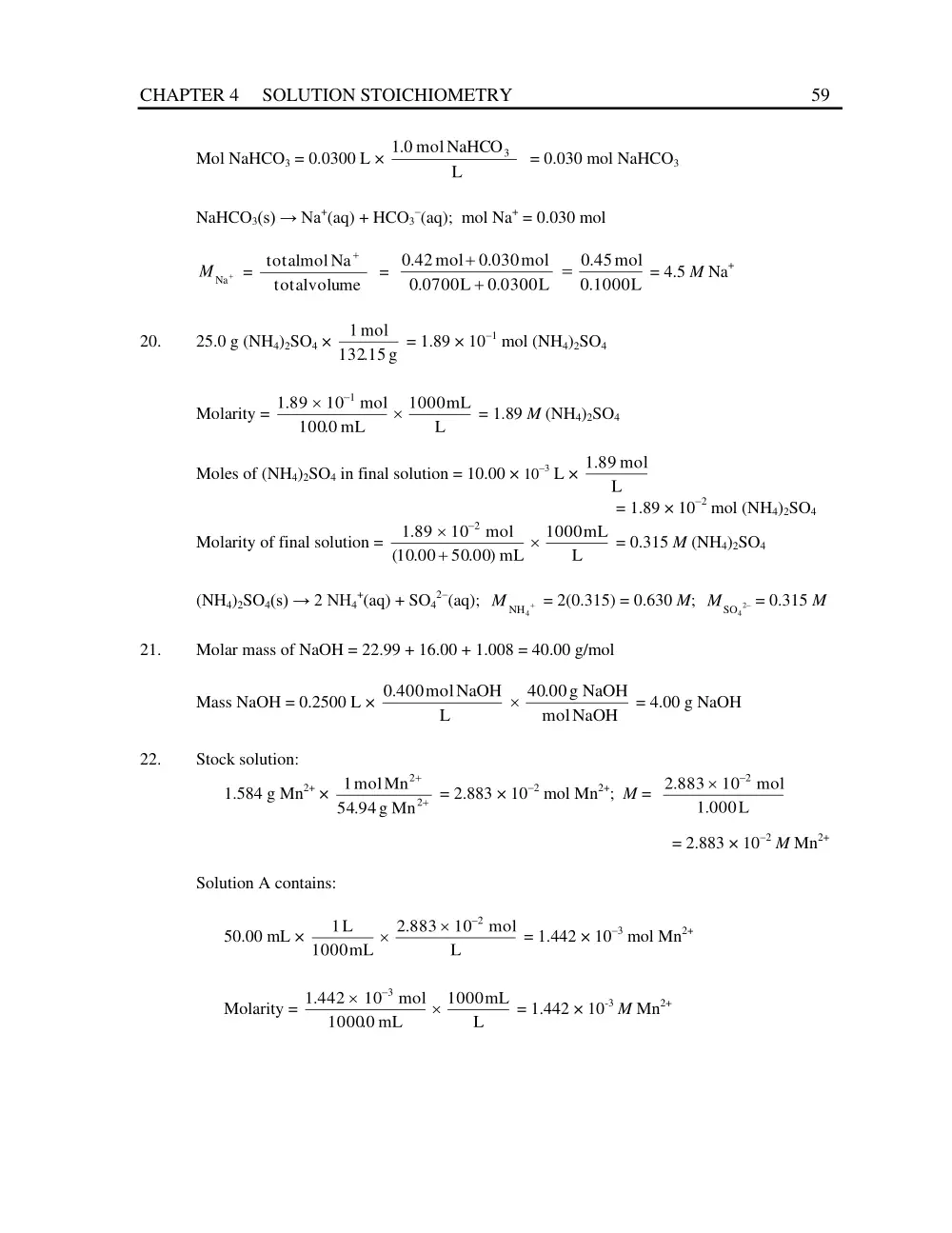
CHAPTER 4 SOLUTION STOICHIOMETRY 59
Mol NaHCO3 = 0.0300 L ×
L
molNaHCO
0.1
3
= 0.030 mol NaHCO3
NaHCO3(s) → Na+(aq) + HCO3
(aq); mol Na+ = 0.030 mol
MNa
=
volume
total
totalmolNa
=
1000L
.0
45mol
.0
.0 0300L
0700L
.0
.0 030mol
.0 42 mol
= 4.5 M Na+
20.
25.0 g (NH4)2SO4 ×
.15 g
132
1 mol
= 1.89 × 101 mol (NH4)2SO4
Molarity =
L
mL
1000
0. mL
100
mol
10
.1 89
1
= 1.89 M (NH4)2SO4
Moles of (NH4)2SO4 in final solution = 10.00 × 10³ L ×
L
.1 89 mol
= 1.89 × 10² mol (NH4)2SO4
Molarity of final solution =
L
mL
1000
50.00) mL
10.00
(
mol
10
.1 89
2
= 0.315 M (NH4)2SO4
(NH4)2SO4(s) → 2 NH4
+(aq) + SO4
2(aq);
MNH4
= 2(0.315) = 0.630 M;
2
MSO4
= 0.315 M
21.
Molar mass of NaOH = 22.99 + 16.00 + 1.008 = 40.00 g/mol
Mass NaOH = 0.2500 L ×
NaOH
mol
.00g NaOH
40
L
.0 400molNaOH
= 4.00 g NaOH
22.
Stock solution:
1.584 g Mn2+ ×
2
2
.94g Mn
54
1molMn
= 2.883 × 10² mol Mn2+; M =
000L
.1
mol
10
.2 883
2
= 2.883 × 10² M Mn2+
Solution A contains:
50.00 mL ×
L
mol
10
883
.2
mL
1000
1L
2
= 1.442 × 10³ mol Mn2+
Molarity =
L
mL
1000
0. mL
1000
mol
10
.1 442
3
= 1.442 × 10⁻³ M Mn2+
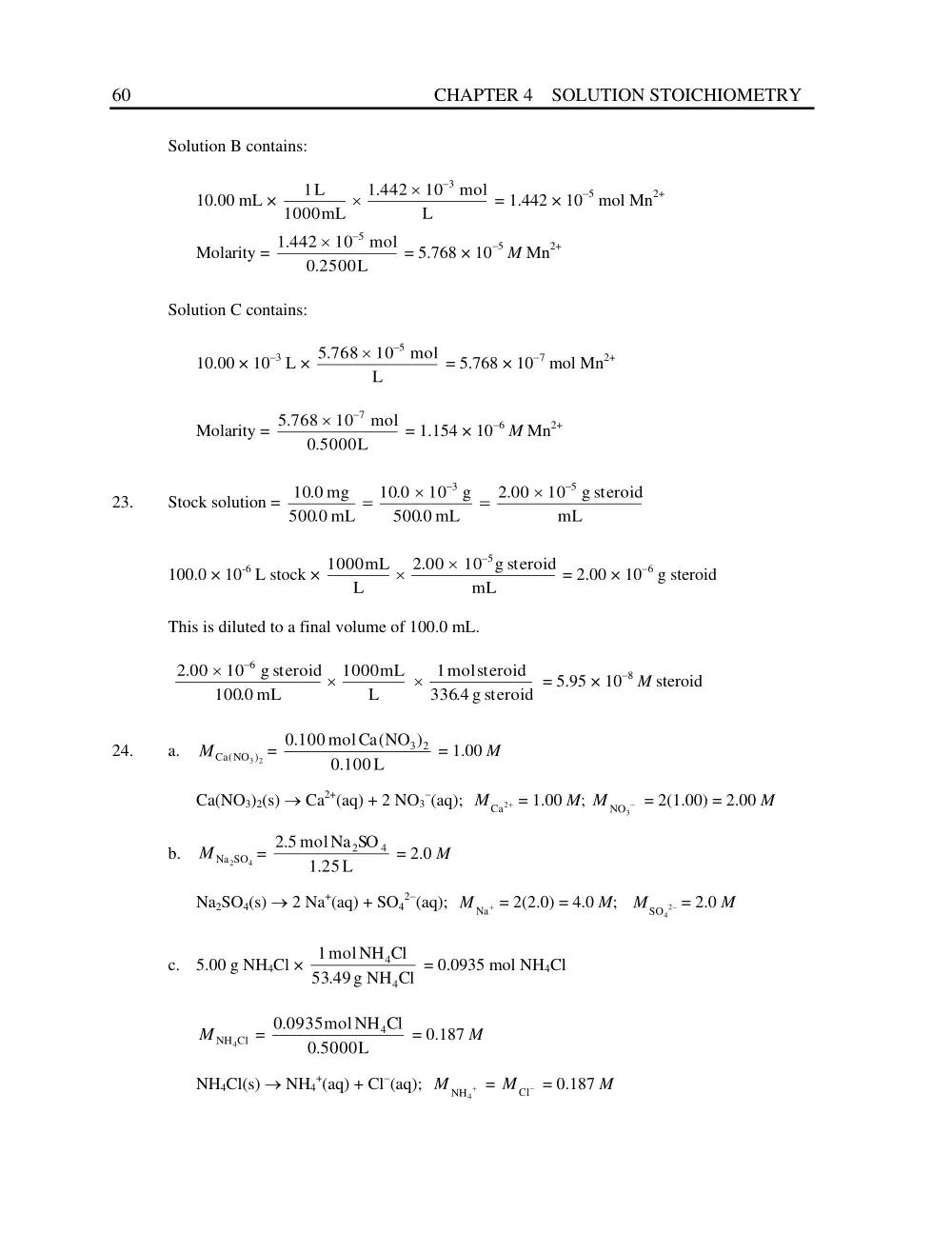
60 CHAPTER 4 SOLUTION STOICHIOMETRY
Solution B contains:
10.00 mL ×
L
mol
10
442
.1
mL
1000
1L
3
= 1.442 × 10⁵ mol Mn2+
Molarity =
2500L
.0
mol
10
.1 442
5
= 5.768 × 10⁵ M Mn2+
Solution C contains:
10.00 × 10³ L ×
L
mol
10
.5 768
5
= 5.768 × 10⁷ mol Mn2+
Molarity =
5000L
.0
mol
10
.5 768
7
= 1.154 × 10⁶ M Mn2+
23.
Stock solution =
mL
g steroid
10
00
.2
0. mL
500
g
10
0.
10
0. mL
500
10 0. mg
5
3
100.0 × 10⁻⁶ L stock ×
mL
10 g steroid
00
.2
L
1000mL
5
= 2.00 × 10⁶ g steroid
This is diluted to a final volume of 100.0 mL.
4. g steroid
336
molsteroid
1
L
mL
1000
0. mL
100
g steroid
10
.2 00
6
= 5.95 × 10⁸ M steroid
24.
a.
MCa(NO3)2
=
100 L
.0
.0 100 molCa(NO )
3 2
= 1.00 M
Ca(NO3)2(s) Ca2+(aq) + 2 NO3
(aq);
MCa2
= 1.00 M;
MNO3
= 2(1.00) = 2.00 M
b.
MNa2SO4
=
25L
.1
molNa SO
5.2
4
2
= 2.0 M
Na2SO4(s) 2 Na+(aq) + SO4
2(aq);
MNa
= 2(2.0) = 4.0 M;
2
MSO4
= 2.0 M
c. 5.00 g NH4Cl ×
.49g NH Cl
53
molNH Cl
1
4
4
= 0.0935 mol NH4Cl
MNH4Cl
=
5000L
.0
.0 0935molNH Cl
4
= 0.187 M
NH4Cl(s) NH4
+(aq) + Cl(aq);
MNH4
=
MCl
= 0.187 M
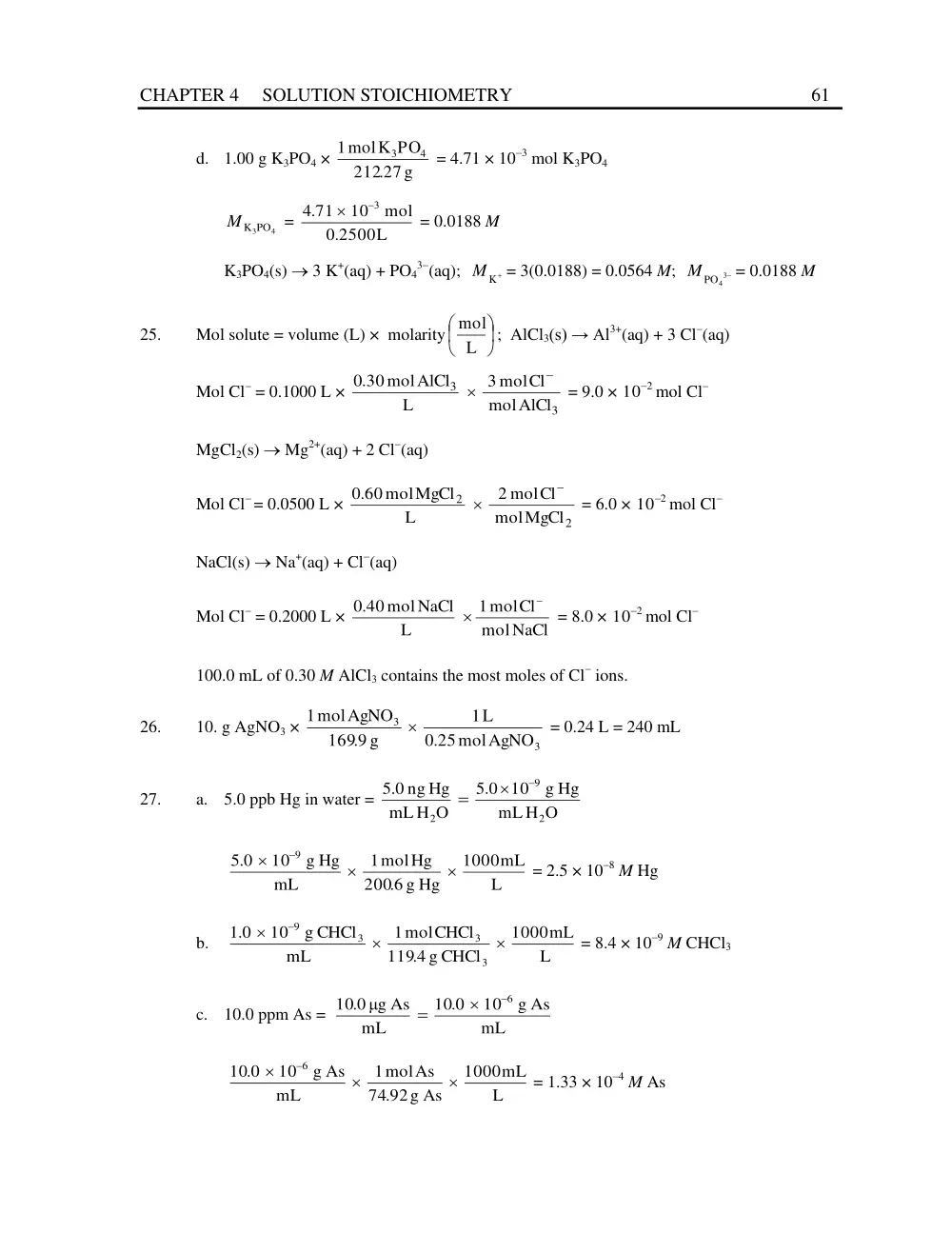
CHAPTER 4 SOLUTION STOICHIOMETRY 61
d. 1.00 g K3PO4 ×
.27 g
212
1molK PO
4
3
= 4.71 × 10³ mol K3PO4
MK3PO4
=
2500L
.0
mol
10
.4 71
3
= 0.0188 M
K3PO4(s) 3 K+(aq) + PO4
3(aq);
MK
= 3(0.0188) = 0.0564 M;
3
MPO4
= 0.0188 M
25.
Mol solute = volume (L) × molarity
L
mol ; AlCl3(s) → Al3+(aq) + 3 Cl(aq)
Mol Cl = 0.1000 L ×
3
3
AlCl
mol
molCl
3
L
.0 30 molAlCl
= 9.0 ×
2
10 mol Cl
MgCl2(s) Mg2+(aq) + 2 Cl(aq)
Mol Cl = 0.0500 L ×
2
2
MgCl
mol
molCl
2
L
.0 60 molMgCl
= 6.0 ×
2
10 mol Cl
NaCl(s) Na+(aq) + Cl(aq)
Mol Cl = 0.2000 L ×
NaCl
mol
molCl
1
L
.0 40 molNaCl
= 8.0 ×
2
10 mol Cl
100.0 mL of 0.30 M AlCl3 contains the most moles of Cl ions.
26.
10. g AgNO3 ×
3
3
25molAgNO
.0
L
1
9. g
169
1molAgNO
= 0.24 L = 240 mL
27.
a. 5.0 ppb Hg in water =
H O
mL
g Hg
10
0.5
H O
mL
ng Hg
0.5
2
9
2
L
mL
1000
6. g Hg
200
molHg
1
mL
g Hg
10
0.5
9
= 2.5 × 10⁸ M Hg
b.
L
mL
1000
4. g CHCl
119
molCHCl
1
mL
g CHCl
10
0.1
3
3
3
9
= 8.4 × 10⁹ M CHCl3
c. 10.0 ppm As =
mL
g As
10
0.
10
mL
10 0. μg As
6
L
mL
1000
.92g As
74
molAs
1
mL
g As
10
10 0.
6
= 1.33 × 10⁴ M As
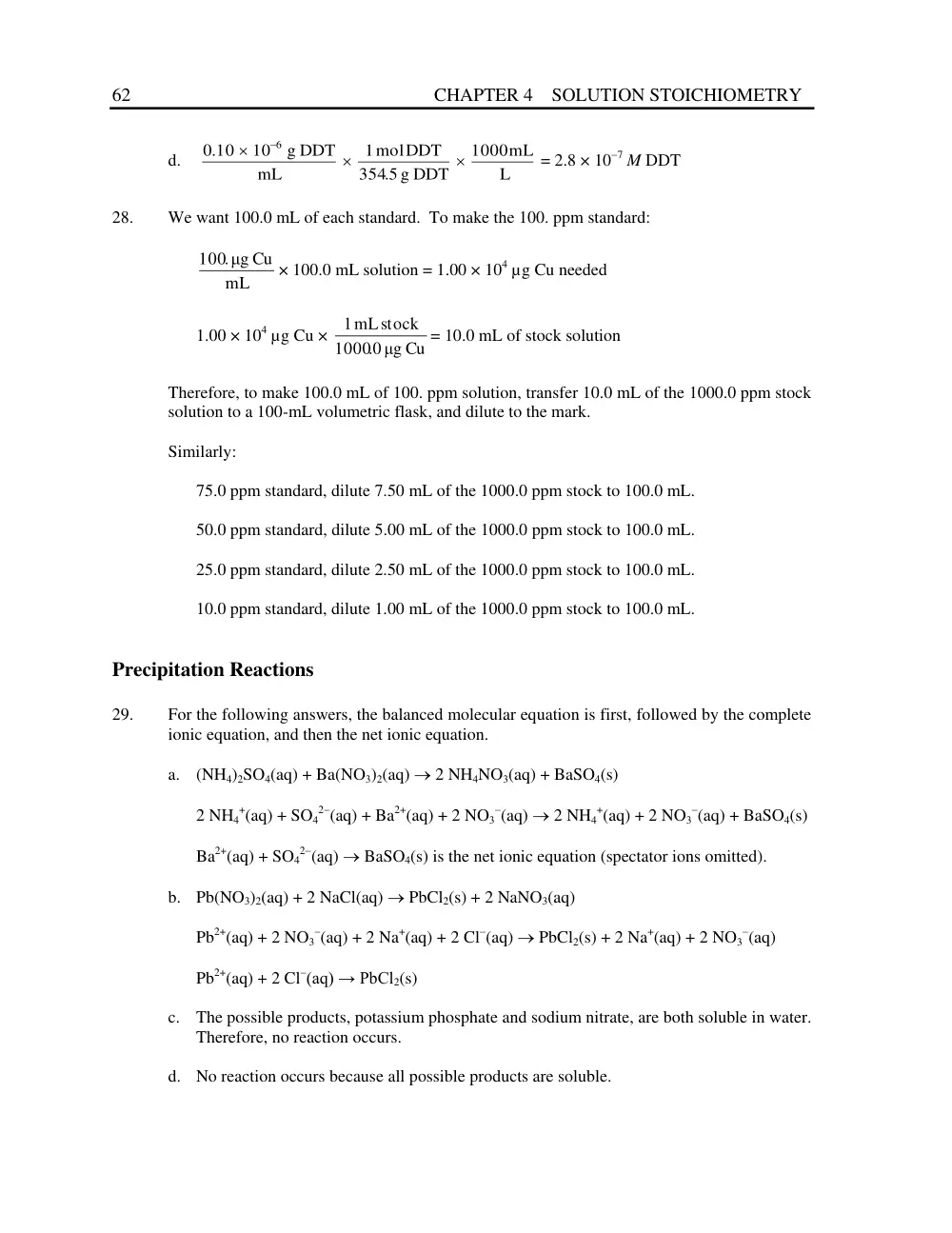
62 CHAPTER 4 SOLUTION STOICHIOMETRY
d.
L
mL
1000
5. g DDT
354
molDDT
1
mL
g DDT
10
.0 10
6
= 2.8 × 10⁷ M DDT
28.
We want 100.0 mL of each standard. To make the 100. ppm standard:
mL
100.μg Cu
× 100.0 mL solution = 1.00 × 10⁴ µg Cu needed
1.00 × 10⁴ µg Cu ×
0. μg Cu
1000
1mLstock
= 10.0 mL of stock solution
Therefore, to make 100.0 mL of 100. ppm solution, transfer 10.0 mL of the 1000.0 ppm stock
solution to a 100-mL volumetric flask, and dilute to the mark.
Similarly:
75.0 ppm standard, dilute 7.50 mL of the 1000.0 ppm stock to 100.0 mL.
50.0 ppm standard, dilute 5.00 mL of the 1000.0 ppm stock to 100.0 mL.
25.0 ppm standard, dilute 2.50 mL of the 1000.0 ppm stock to 100.0 mL.
10.0 ppm standard, dilute 1.00 mL of the 1000.0 ppm stock to 100.0 mL.
Precipitation Reactions
29.
For the following answers, the balanced molecular equation is first, followed by the complete
ionic equation, and then the net ionic equation.
a. (NH4)2SO4(aq) + Ba(NO3)2(aq) 2 NH4NO3(aq) + BaSO4(s)
2 NH4
+(aq) + SO4
2(aq) + Ba2+(aq) + 2 NO3
(aq) 2 NH4
+(aq) + 2 NO3
(aq) + BaSO4(s)
Ba2+(aq) + SO4
2(aq) BaSO4(s) is the net ionic equation (spectator ions omitted).
b. Pb(NO3)2(aq) + 2 NaCl(aq) PbCl2(s) + 2 NaNO3(aq)
Pb2+(aq) + 2 NO3
(aq) + 2 Na+(aq) + 2 Cl(aq) PbCl2(s) + 2 Na+(aq) + 2 NO3
(aq)
Pb2+(aq) + 2 Cl(aq) → PbCl2(s)
c. The possible products, potassium phosphate and sodium nitrate, are both soluble in water.
Therefore, no reaction occurs.
d. No reaction occurs because all possible products are soluble.
CHAPTER 4 SOLUTION STOICHIOMETRY 63
e. CuCl2(aq) + 2 NaOH(aq) Cu(OH)2(s) + 2 NaCl(aq)
Cu2+(aq) + 2 Cl(aq) + 2 Na+(aq) + 2 OH(aq) Cu(OH)2(s) + 2 Na+(aq) + 2 Cl(aq)
Cu2+(aq) + 2 OH(aq) Cu(OH)2(s)
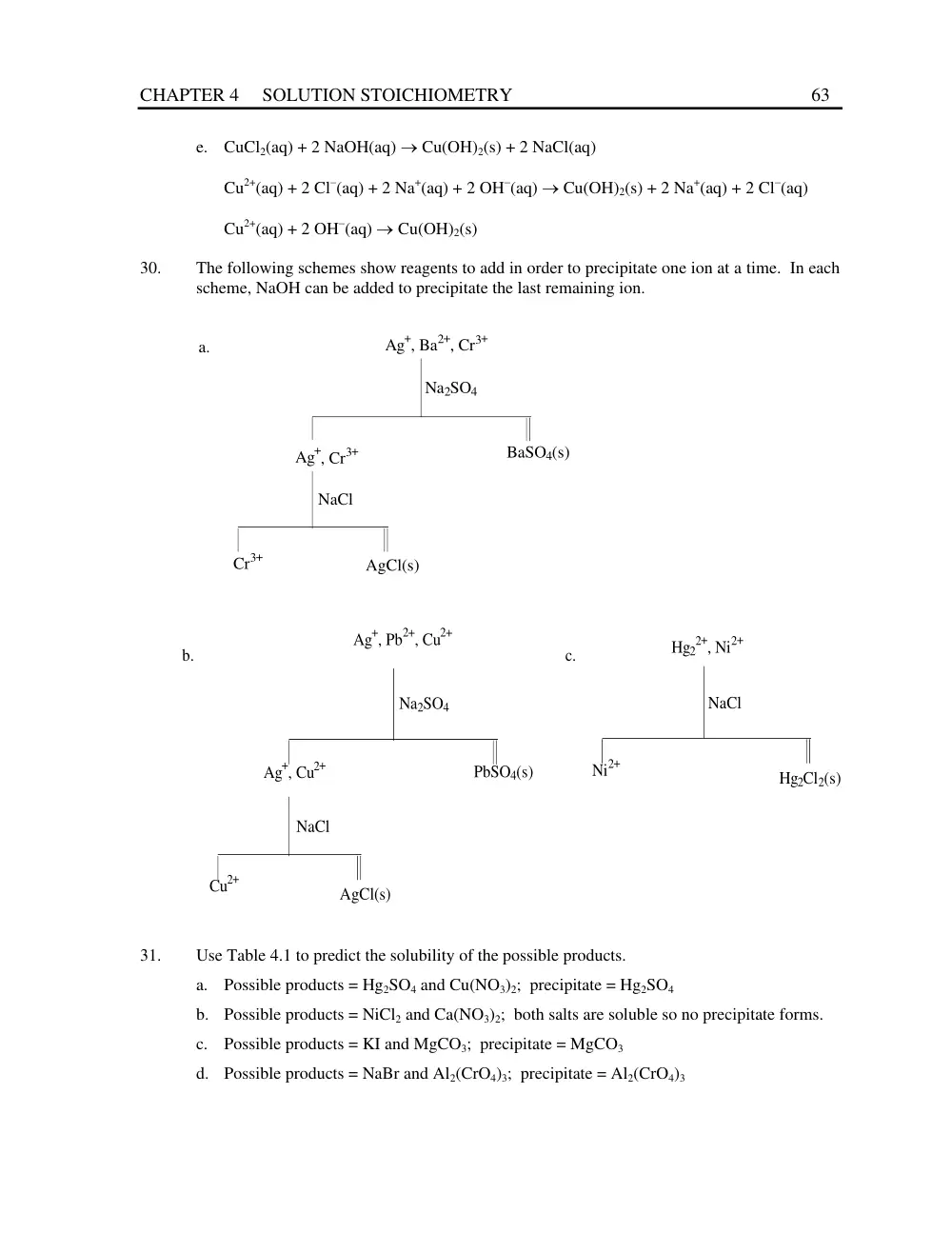
30.
The following schemes show reagents to add in order to precipitate one ion at a time. In each
scheme, NaOH can be added to precipitate the last remaining ion.
31.
Use Table 4.1 to predict the solubility of the possible products.
a. Possible products = Hg2SO4 and Cu(NO3)2; precipitate = Hg2SO4
b. Possible products = NiCl2 and Ca(NO3)2; both salts are soluble so no precipitate forms.
c. Possible products = KI and MgCO3; precipitate = MgCO3
d. Possible products = NaBr and Al2(CrO4)3; precipitate = Al2(CrO4)3
Na2SO4
Ni2+
Hg2
2+, Ni2+
Hg2Cl2(s)
c.
PbSO4(s)
Cu2+
Ag+, Cu2+
Ag+, Pb2+, Cu2+
b.
AgCl(s)
NaCl
NaCl
BaSO4(s)
a.
AgCl(s)
Cr3+
, Cr3+
Ag+
Ag+, Ba2+, Cr3+
Na2SO4
NaCl
64 CHAPTER 4 SOLUTION STOICHIOMETRY
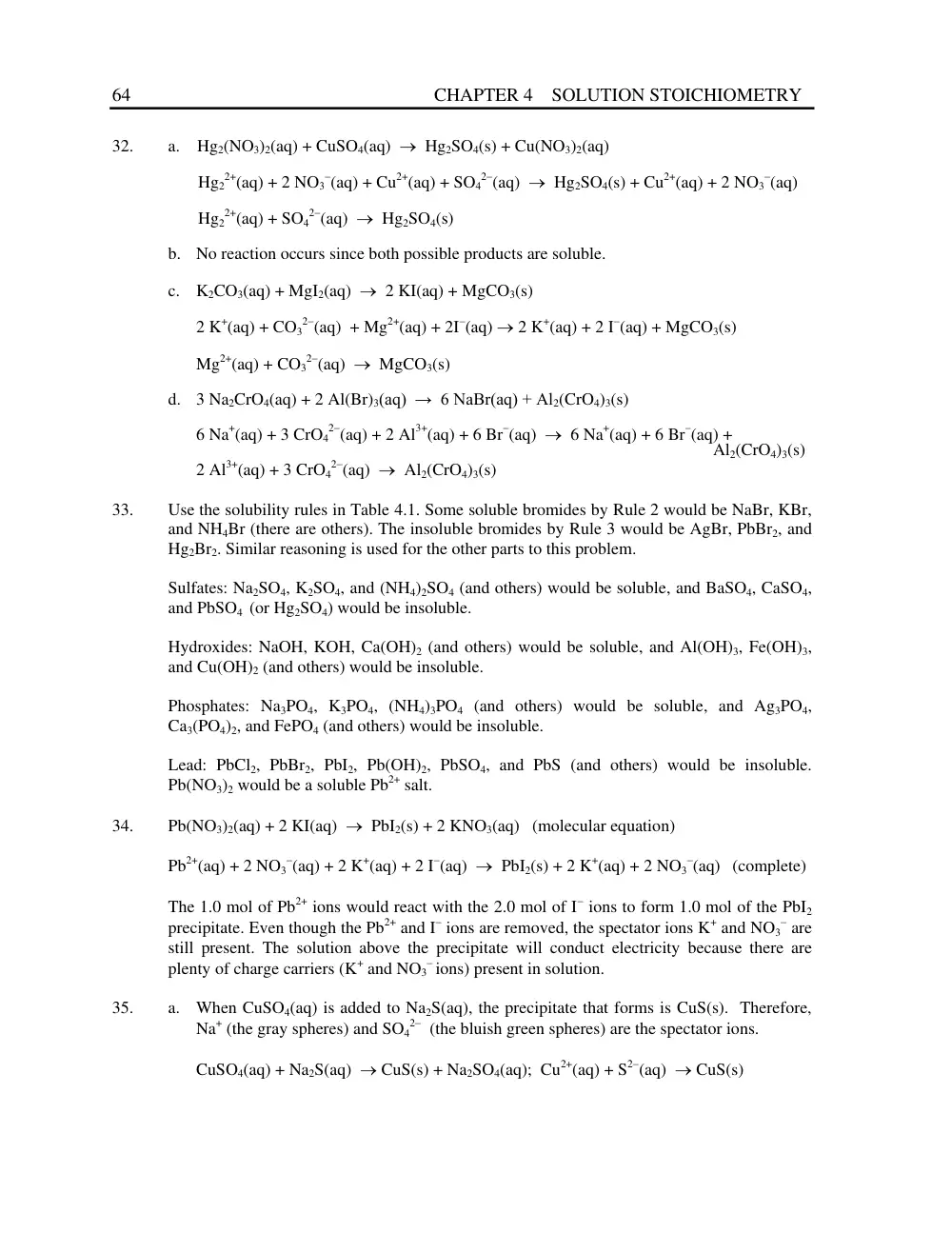
32.
a. Hg2(NO3)2(aq) + CuSO4(aq) Hg2SO4(s) + Cu(NO3)2(aq)
Hg2
2+(aq) + 2 NO3
(aq) + Cu2+(aq) + SO4
2(aq) Hg2SO4(s) + Cu2+(aq) + 2 NO3
(aq)
Hg2
2+(aq) + SO4
2(aq) Hg2SO4(s)
b. No reaction occurs since both possible products are soluble.
c. K2CO3(aq) + MgI2(aq) 2 KI(aq) + MgCO3(s)
2 K+(aq) + CO3
2(aq) + Mg2+(aq) + 2I(aq) 2 K+(aq) + 2 I(aq) + MgCO3(s)
Mg2+(aq) + CO3
2(aq) MgCO3(s)
d. 3 Na2CrO4(aq) + 2 Al(Br)3(aq) → 6 NaBr(aq) + Al2(CrO4)3(s)
6 Na+(aq) + 3 CrO4
2(aq) + 2 Al3+(aq) + 6 Br(aq) 6 Na+(aq) + 6 Br(aq) +
Al2(CrO4)3(s)
2 Al3+(aq) + 3 CrO4
2(aq) Al2(CrO4)3(s)
33.
Use the solubility rules in Table 4.1. Some soluble bromides by Rule 2 would be NaBr, KBr,
and NH4Br (there are others). The insoluble bromides by Rule 3 would be AgBr, PbBr2, and
Hg2Br2. Similar reasoning is used for the other parts to this problem.
Sulfates: Na2SO4, K2SO4, and (NH4)2SO4 (and others) would be soluble, and BaSO4, CaSO4,
and PbSO4 (or Hg2SO4) would be insoluble.
Hydroxides: NaOH, KOH, Ca(OH)2 (and others) would be soluble, and Al(OH)3, Fe(OH)3,
and Cu(OH)2 (and others) would be insoluble.
Phosphates: Na3PO4, K3PO4, (NH4)3PO4 (and others) would be soluble, and Ag3PO4,
Ca3(PO4)2, and FePO4 (and others) would be insoluble.
Lead: PbCl2, PbBr2, PbI2, Pb(OH)2, PbSO4, and PbS (and others) would be insoluble.
Pb(NO3)2 would be a soluble Pb2+ salt.
34.
Pb(NO3)2(aq) + 2 KI(aq) PbI2(s) + 2 KNO3(aq) (molecular equation)
Pb2+(aq) + 2 NO3
(aq) + 2 K+(aq) + 2 I(aq) PbI2(s) + 2 K+(aq) + 2 NO3
(aq) (complete)
The 1.0 mol of Pb2+ ions would react with the 2.0 mol of I ions to form 1.0 mol of the PbI2
precipitate. Even though the Pb2+ and I ions are removed, the spectator ions K+ and NO3
are
still present. The solution above the precipitate will conduct electricity because there are
plenty of charge carriers (K+ and NO3
ions) present in solution.
35.
a. When CuSO4(aq) is added to Na2S(aq), the precipitate that forms is CuS(s). Therefore,
Na+ (the gray spheres) and SO4
2 (the bluish green spheres) are the spectator ions.
CuSO4(aq) + Na2S(aq) CuS(s) + Na2SO4(aq); Cu2+(aq) + S2(aq) CuS(s)
CHAPTER 4 SOLUTION STOICHIOMETRY 65
b. When CoCl2(aq) is added to NaOH(aq), the precipitate that forms is Co(OH)2(s).
Therefore, Na+ (the gray spheres) and Cl- (the green spheres) are the spectator ions.
CoCl2(aq) + 2 NaOH(aq) Co(OH)2(s) + 2 NaCl(aq)
Co2+(aq) + 2 OH(aq) Co(OH)2(s)
c. When AgNO3(aq) is added to KI(aq), the precipitate that forms is AgI(s). Therefore, K+
(the red spheres) and NO3
(the blue spheres) are the spectator ions.
AgNO3(aq) + KI(aq) → AgI(s) + KNO3(aq); Ag+(aq) + I(aq) → AgI(s)
36.
XCl2(aq) + 2 AgNO3(aq) 2 AgCl(s) + X(NO3)2(aq)
1.38 g AgCl ×
molAgCl
2
molXCl
1
4. g
143
1molAgCl
2
= 4.81 ×
3
10 mol XCl2
2
3
2
molXCl
10
4.91
g XCl
1.00
= 208 g/mol; x + 2(35.45) = 208, x = 137 g/mol
The metal X is barium (Ba).
37.
M2SO4(aq) + CaCl2(aq) CaSO4(s) + 2 MCl(aq)
1.36 g CaSO4 ×
4
4
2
4
4
CaSO
mol
molM SO
1
.15g CaSO
136
1molCaSO
= 9.99 × 10³ mol M2SO4
From the problem, 1.42 g M2SO4 was reacted, so:
molar mass =
4
2
3
4
2
molM SO
10
99
.9
42g M SO
.1
= 142 g/mol
142 amu = 2(atomic mass M) + 32.07 + 4(16.00), atomic mass M = 23 amu
From periodic table, M is Na (sodium).
38.
a. Cu(NO3)2(aq) + 2 KOH(aq) Cu(OH)2(s) + 2 KNO3(aq)
Solution A contains 2.00 L × 2.00 mol/L = 4.00 mol Cu(NO3)2, and solution B contains
2.00 L × 3.00 mol/L = 6.00 mol KOH. Let’s assume in our picture that we have 4
formula units of Cu(NO3)2 (4 Cu2+ ions and 8 NO3
ions) and 6 formula units of KOH (6
K+ ions and 6 OH ions). With 4 Cu2+ ions and 6 OH ions present, then OH is limiting.
One Cu2+ ion remains as 3 Cu(OH)2(s) formula units form as precipitate. The following
illustration summarizes the ions that remain in solution and the relative amount of
precipitate that forms. Note that K+ and NO3
ions are spectator ions. In the illustration,
V1 is the volume of solution A or B and V2 is the volume of the combined solutions with
V2 = 2V1. The illustration exaggerates the amount of precipitate that would actually
form.
66 CHAPTER 4 SOLUTION STOICHIOMETRY
b. The spectator ion concentrations will be one-half the original spectator ion concentrations
in the individual beakers because the volume was doubled. Or using moles,
MK
=
00 L
.4
.6 00 molK
= 1.50 M and
MNO3
=
00 L
.4
.8 00 molNO
3
= 2.00 M. The concentration of
OH ions will be zero because OH is the limiting reagent. From the drawing, the number
of Cu2+ ions will decrease by a factor of four as the precipitate forms. Because the
volume of solution doubled, the concentration of Cu2+ ions will decrease by a factor of
eight after the two beakers are mixed:
MCu
= 2.00 M
8
1 = 0.250 M
Alternately, one could certainly use moles to solve for
MCu2
:
Mol Cu2+ reacted = 2.00 L ×
molOH
2
molCu
1
L
.3 00 molOH
2
= 3.00 mol Cu2+ reacted
Mol Cu2+ present initially = 2.00 L ×
L
.2 00 molCu
2
= 4.00 mol Cu2+ present initially
Excess Cu2+ present after reaction = 4.00 mol 3.00 mol = 1.00 mol Cu2+ excess
MCu2
=
.2 00 L
00 L
.2
.1 00 molCu
2
= 0.250 M
Mass of precipitate = 6.00 mol KOH ×
2
2
2
Cu(OH)
mol
.57 g Cu(OH)
97
molKOH
2
1molCu(OH)
Mass of precipitate = 293 g Cu(OH)2
39.
2 AgNO3(aq) + Na2CrO4(aq) Ag2CrO4(s) + 2 NaNO3(aq)
NO3
-
K+
Cu(OH)2
Cu(OH)2
Cu(OH)2
NO3
- K+
NO3
-
K+
NO3
-
Cu2+
NO3
-
K+
NO3
-
K+
NO3
- K+
NO3
-
V1
V2
CHAPTER 4 SOLUTION STOICHIOMETRY 67
0.0750 L ×
4
2
4
2
3
4
2
3
Na CrO
mol
.98g Na CrO
161
molAgNO
2
molNa CrO
1
L
.0 100molAgNO
= 0.607 g Na2CrO4
40.
2 Na3PO4(aq) + 3 Pb(NO3)2(aq) Pb3(PO4)2(s) + 6 NaNO3(aq)
0.1500 L ×
4
3
4
3
2
3
4
3
2
3
100mol Na PO
.0
L Na PO
1
molPb(NO )
3
mol Na PO
2
L
.0 250molPb(NO )
= 0.250 L
= 250. mL Na3PO4
41.
2 AgNO3(aq) + CaCl2(aq) 2 AgCl(s) + Ca(NO3)2(aq)
Mol AgNO3 = 0.1000 L ×
L
.0 20 molAgNO
3 = 0.020 mol AgNO3
Mol CaCl2 = 0.1000 L ×
L
.0 15molCaCl
2 = 0.015 mol CaCl2
The required mol AgNO3 to mol CaCl2 ratio is 2 : 1 (from the balanced equation). The actual
mole ratio present is 0.020/0.015 = 1.3 (1.3 : 1). Therefore, AgNO3 is the limiting reagent.
Mass AgCl = 0.020 mol AgNO3 ×
AgCl
mol
4. g AgCl
143
molAgNO
1
molAgCl
1
3
= 2.9 g AgCl
The net ionic equation is Ag+(aq) + Cl(aq) AgCl(s). The ions remaining in solution are
the unreacted Cl ions and the spectator ions, NO3
and Ca2+ (all Ag+ is used up in forming
AgCl). The moles of each ion present initially (before reaction) can be easily determined
from the moles of each reactant. 0.020 mol AgNO3 dissolves to form 0.020 mol Ag+ and
0.020 mol NO3
. 0.015 mol CaCl2 dissolves to form 0.015 mol Ca2+ and 2(0.015) = 0.030
mol Cl.
Mol unreacted Cl = 0.030 mol Cl initially 0.020 mol Cl reacted
Mol unreacted Cl = 0.010 mol Cl
MCl
=
.0 1000L
1000L
.0
010molCl
.0
volume
total
010molCl
.0
= 0.050 M Cl
The molarity of the spectator ions are:
MNO3
=
2000L
.0
.0 020molNO
3
= 0.10 M NO3
;
MCa2
=
2000L
.0
.0 015molCa
2
= 0.075 M Ca2+
42.
Use the silver nitrate data to calculate the mol Cl present, then use the formula of douglasite
to convert from Cl to douglasite. The net ionic reaction is Ag+ + Cl AgCl(s).
0.03720 L
mol
.88g douglasite
311
molCl
4
moldouglasite
1
Ag
mol
molCl
1
L
.0 1000molAg
= 0.2900 g douglasite
68 CHAPTER 4 SOLUTION STOICHIOMETRY
Mass % douglasite =
4550g
.0
.0 2900g
× 100 = 63.74%
43.
All the sulfur in BaSO4 came from the saccharin. The conversion from BaSO4 to saccharin
uses the molar masses and formulas of each compound.
0.5032 g BaSO4
g S
32.07
g saccharin
183.9
g BaSO
233.4
g S
32.07
4
= 0.3949 g saccharin
tablet
.49 mg
39
tablet
g
10
949
.3
tablets
10
3949g
.0
Tablet
Averagemass
2
Average mass % =
5894g
.0
.0 3949g saccharin
× 100 = 67.00% saccharin by mass
44.
All the Tl in TlI came from Tl in Tl2SO4. The conversion from TlI to Tl2SO4 uses the molar
masses and formulas of each compound.
0.1824 g TlI
8. g Tl
408
9. g Tl SO
504
3. g TlI
331
2044. g Tl
4
2
= 0.1390 g Tl2SO4
Mass % Tl2SO4 =
486g pesticide
.9
.0 1390g Tl SO
4
2
× 100 = 1.465% Tl2SO4
45.
Use aluminum in the formulas to convert from mass of Al(OH)3 to mass of Al2(SO4)3 in the
mixture.
0.107 g Al(OH)3 ×
3
4 3
2
3
3
3
molAl
2
molAl (SO )
1
Al(OH)
mol
molAl
1
.00g
78
1molAl(OH)
4 3
2
4 3
2
Al (SO )
mol
342.17g Al (SO )
= 0.235 g Al2(SO4)3
Mass % Al2(SO4)3 =
45g
.1
.0 235g
× 100 = 16.2%
46.
There are many acceptable choices for spectator ions. We will generally choose Na+ and
NO3
as the spectator ions because sodium salts and nitrate salts are usually soluble in water.
a. Fe(NO3)3(aq) + 3 NaOH(aq) Fe(OH)3(s) + 3 NaNO3(aq)
b. Hg2(NO3)2(aq) + 2 NaCl(aq) Hg2Cl2(s) + 2 NaNO3(aq)
c. Pb(NO3)2(aq) + Na2SO4(aq) PbSO4(s) + 2 NaNO3(aq)
d. BaCl2(aq) + Na2CrO4(aq) BaCrO4(s) + 2 NaCl(aq)
CHAPTER 4 SOLUTION STOICHIOMETRY 69
47.
Because a precipitate formed with Na2SO4, the possible cations are Ba2+, Pb2+, Hg2
2+, and
Ca2+ (from the solubility rules). Because no precipitate formed with KCl, Pb2+, and Hg2
2+
cannot be present. Because both Ba2+ and Ca2+ form soluble chlorides and soluble
hydroxides, both these cations could be present. Therefore, the cations could be Ba2+ and Ca2+
(by the solubility rules in Table 4.1). For students who do a more rigorous study of solubility,
Sr2+ could also be a possible cation (it forms an insoluble sulfate salt, whereas the chloride
and hydroxide salts of strontium are soluble).
Acid-Base Reactions
48.
Strong bases contain the hydroxide ion, OH. The reaction that occurs is H+ + OH → H2O.
0.0120 L ×
H
mol
molOH
1
L
.0 150molH
= 1.80 ×
3
10 mol OH
The 30.0 mL of the unknown strong base contains 1.80 ×
3
10 mol OH .
0300L
.0
molOH
10
8.1
3
= 0.0600 M OH
The unknown base concentration is one-half the concentration of OH ions produced from
the base, so the base must contain 2 OH in each formula unit. The three soluble strong bases
that have 2 OH ions in the formula are Ca(OH)2, Sr(OH)2, and Ba(OH)2. These are all
possible identities for the strong base.
49.
If we begin with 50.00 mL of 0.100 M NaOH, then:
50.00 × 10³ L ×
L
.0 100mol
= 5.00 × 10³ mol NaOH to be neutralized.
a. NaOH(aq) + HCl(aq) NaCl(aq) + H2O(l)
5.00 × 10³ mol NaOH ×
mol
0.100
L soln
1
NaOH
mol
1molHCl
= 5.00 × 10² L or 50.0 mL
b. 2 NaOH(aq) + H2SO3(aq) 2 H2O(l) + Na2SO3(aq)
5.00 × 10³ mol NaOH ×
3
2
3
2
molH SO
0.100
L soln
1
molNaOH
2
1molH SO
= 2.50 × 10² L or 25.0 mL
c. 3 NaOH(aq) + H3PO4(aq) Na3PO4(aq) + 3 H2O(l)
5.00 × 10³ mol NaOH ×
4
3
4
3
molH PO
0.200
L soln
1
molNaOH
3
1molH PO
= 8.33 × 10³ L or 8.33 mL
d. HNO3(aq) + NaOH(aq) H2O(l) + NaNO3(aq)
70 CHAPTER 4 SOLUTION STOICHIOMETRY
5.00 × 10³ mol NaOH ×
3
3
molHNO
0.150
L soln
1
NaOH
mol
1molHNO
= 3.33 × 10² L or 33.3 mL
e. HC2H3O2(aq) + NaOH(aq) H2O(l) + NaC2H3O2(aq)
5.00 × 10³ mol NaOH ×
2
3
2
2
3
2
molHC H O
0.200
L soln
1
NaOH
mol
1molHC H O
= 2.50 × 10² L
or 25.0 mL
f.
H2SO4(aq) + 2 NaOH(aq) 2 H2O(l) + Na2SO4(aq)
5.00 × 10³ mol NaOH ×
4
2
4
2
molH SO
0.300
L soln
1
molNaOH
2
1molH SO
= 8.33 × 10³ L or 8.33 mL
50.
a. NH3(aq) + HNO3(aq) NH4NO3(aq)
(molecular equation)
NH3(aq) + H+(aq) + NO3
(aq) NH4
+(aq) + NO3
(aq) (complete ionic equation)
NH3(aq) + H+(aq) NH4
+(aq)
(net ionic equation)
b.
Ba(OH)2(aq) + 2 HCl(aq) 2 H2O(l) + BaCl2(aq)
Ba2+(aq) + 2 OH(aq) + 2 H+(aq) + 2 Cl(aq) Ba2+(aq) + 2 Cl(aq) + 2 H2O(l)
OH(aq) + H+(aq) H2O(l)
c.
3 HClO4(aq) + Fe(OH)3(s) 3 H2O(l) + Fe(ClO4)3(aq)
3 H+(aq) + 3 ClO4
-(aq) + Fe(OH)3(s) 3 H2O(l) + Fe3+(aq) + 3 ClO4
(aq)
3 H+(aq) + Fe(OH)3(s) 3 H2O(l) + Fe3+(aq)
d. AgOH(s) + HBr(aq) AgBr(s) + H2O(l)
AgOH(s) + H+(aq) + Br(aq) AgBr(s) + H2O(l)
AgOH(s) + H+(aq) + Br(aq) AgBr(s) + H2O(l)
51.
a. Perchloric acid reacted with potassium hydroxide is a possibility.
HClO4(aq) + KOH(aq) H2O(l) + KClO4(aq)
b. Nitric acid reacted with cesium hydroxide is a possibility.
HNO3(aq) + CsOH(aq) H2O(l) + CsNO3(aq)
c. Hydroiodic acid reacted with calcium hydroxide is a possibility.
2 HI(aq) + Ca(OH)2(aq) 2 H2O(l) + CaI2(aq)
CHAPTER 4 SOLUTION STOICHIOMETRY 71
52.
We get the empirical formula from the elemental analysis. Out of 100.00 g carminic acid
there are:
53.66 g C ×
.011g C
12
1molC
= 4.468 mol C; 4.09 g H ×
008g H
.1
1molH
= 4.06 mol H
42.25 g O ×
.999g O
15
1molO
= 2.641 mol O
Dividing the moles by the smallest number gives:
.1 54
.2 641
.4 06
.1 692;
.2 641
.4 468
These numbers don’t give obvious mole ratios. Let’s determine the mol C to mol H ratio:
10
11
.1 10
.4 06
.4 468
So let's try 10
.4 06
= 0.406 as a common factor:
10 ;0.
.0 406
.4 06
11 ;0.
.0 406
.4 468
.6 50
.0 406
.2 641
Therefore, C22H20O13 is the empirical formula.
We can get molar mass from the titration data. The balanced reaction is HA(aq) + OH(aq)
H2O(l) + A(aq) where HA is an abbreviation for carminic acid, an acid with one acidic
proton (H+).
18.02 × 10³ L soln ×
NaOH
mol
molcarminicacid
1
soln
L
0.0406molNaOH
= 7.32 × 10⁴ mol carminic acid
Molar mass =
mol
g
492
mol
10
32
.7
3602g
.0
4
The empirical formula mass of C22H20O13 22(12) + 20(1) + 13(16) = 492 g.
Therefore, the molecular formula of carminic acid is also C22H20O13.
53.
HCl and HNO3 are strong acids; Ca(OH)2 and RbOH are strong bases. The net ionic equation
that occurs is H+(aq) + OH(aq) H2O(l).
Mol H+ = 0.0500 L ×
HCl
mol
molH
1
L
.0 100molHCl
+
0.1000 L ×
3
3
HNO
mol
molH
1
L
.0 200molHNO
= 0.00500 + 0.0200 = 0.0250 mol H+
72 CHAPTER 4 SOLUTION STOICHIOMETRY
Mol OH = 0.5000 L ×
2
2
Ca(OH)
mol
molOH
2
L
.0 0100molCa(OH)
+
0.2000 L ×
RbOH
mol
molOH
1
L
.0 100molRbOH
= 0.0100 + 0.0200 = 0.0300 mol OH
We have an excess of OH, so the solution is basic (not neutral). The moles of excess OH =
0.0300 mol OH initially 0.0250 mol OH reacted (with H+) = 0.0050 mol OH excess.
M
M
3
OH
10
9.5
8500L
.0
0050mol
.0
.0 2000) L
.0 5000
.0 1000
.0 05000
(
.0 0050molOH
54.
Because KHP is a monoprotic acid, the reaction is (KHP is an abbreviation for potassium
hydrogen phthalate):
NaOH(aq) + KHP(aq) NaKP(aq) + H2O(l)
0.1082 g KHP ×
KHP
mol
molNaOH
1
.22g KHP
204
1molKHP
= 5.298 × 10⁴ mol NaOH
There is 5.298 × 10⁴ mol of sodium hydroxide in 34.67 mL of solution. Therefore, the
concentration of sodium hydroxide is:
L
10
.67
34
mol
10
298
.5
3
4
= 1.528 × 10² M NaOH
55.
HC2H3O2(aq) + NaOH(aq) H2O(l) + NaC2H3O2(aq)
a. 16.58 × 10³ L soln
NaOH
mol
molaceticacid
1
soln
L
.0 5062molNaOH
= 8.393 × 10³ mol acetic acid
Concentration of acetic acid =
01000L
.0
mol
10
.8 393
3
= 0.8393 M HC2H3O2
b. If we have 1.000 L of solution: total mass = 1000. mL ×
mL
.1 006g
= 1006 g solution
Mass of HC2H3O2 = 0.8393 mol ×
mol
60.052g
= 50.40 g HC2H3O2
Mass % acetic acid =
g
1006
50.40g
× 100 = 5.010%
56.
39.47 × 10³ L HCl ×
HCl
mol
molNH
1
L
.0 0984molHCl
3
= 3.88 × 10³ mol NH3
Molarity of NH3 =
L
10
.00
50
mol
10
88
.3
3
3
= 0.0776 M NH3
CHAPTER 4 SOLUTION STOICHIOMETRY 73
57.
Ba(OH)2(aq) + 2 HCl(aq) BaCl2(aq) + 2 H2O(l); H+(aq) + OH(aq) H2O(l)
75.0 × 10³ L ×
L
.0 250molHCl
= 1.88 × 10² mol HCl = 1.88 × 10² mol H+ +
1.88 × 10² mol Cl
225.0 × 10³ L ×
L
.0 0550molBa(OH)
2 = 1.24 × 10² mol Ba(OH)2 = 1.24 × 10² mol Ba2+ +
2.48 × 10² mol OH
The net ionic equation requires a 1 : 1 mol ratio between OH and H+. The actual mol OH to
mol H+ ratio is greater than 1 : 1, so OH is in excess. Because 1.88 × 10² mol OH will be
neutralized by the H+, we have (2.48 1.88) × 102 = 0.60 × 10² mol OH in excess.
MOH
=
.0 2250L
0750L
.0
molOH
10
0.6
volume
total
molOH excess
3
= 2.0 × 10² M OH
58.
Because KHP is a monoprotic acid, the reaction is: NaOH(aq) + KHP(aq) H2O(l) +
NaKP(aq)
Mass KHP = 0.02046 L NaOH ×
KHP
mol
.22g KHP
204
NaOH
mol
molKHP
1
NaOH
L
.0 1000molNaOH
= 0.4178 g KHP
59.
The acid is a diprotic acid (H2A) meaning that it has two H+ ions in the formula to donate to a
base. The reaction is H2A(aq) + 2 NaOH(aq) 2 H2O(l) + Na2A(aq), where A2 is what is
left over from the acid formula when the two protons (H+ ions) are reacted.
For the HCl reaction, the base has the ability to accept two protons. The most common
examples are Ca(OH)2, Sr(OH)2, and Ba(OH)2. A possible reaction would be 2 HCl(aq) +
Ca(OH)2(aq) 2 H2O(l) + CaCl2(aq).
60.
Let HA = unknown acid; HA(aq) + NaOH(aq) NaA(aq) + H2O(l)
Mol HA present = 0.0250 L ×
molNaOH
1
molHA
1
L
.0 500molNaOH
= 0.0125 mol HA
HA
mol
x g HA
=
0125molHA
.0
.2 20g HA
, x = molar mass of HA = 176 g/mol
Empirical formula mass ≈ 3(12) + 4(1) + 3(16) = 88 g/mol.
Because 176/88 = 2.0, the molecular formula is (C3H4O3)2 = C6H8O6.
61.
The pertinent reactions are:
2 NaOH(aq) + H2SO4(aq) Na2SO4(aq) + 2 H2O(l)
HCl(aq) + NaOH(aq) NaCl(aq) + H2O(l)
74 CHAPTER 4 SOLUTION STOICHIOMETRY
Amount of NaOH added = 0.0500 L ×
L
.0 213mol
= 1.07 × 10² mol NaOH
Amount of NaOH neutralized by HCl:
0.01321 L HCl ×
HCl
mol
molNaOH
1
HCl
L
.0 103molHCl
= 1.36 × 10³ mol NaOH
The difference, 9.3 × 10³ mol, is the amount of NaOH neutralized by the sulfuric acid.
9.3 × 10³ mol NaOH ×
molNaOH
2
1molH SO
4
2
= 4.7 × 10³ mol H2SO4
Concentration of H2SO4 =
1000L
.0
mol
10
7.4
3
= 4.7 × 10² M H2SO4
62.
2 H3PO4(aq) + 3 Ba(OH)2(aq) 6 H2O(l) + Ba3(PO4)2(s)
0.01420 L ×
2
2
4
3
2
4
3
0521molBa(OH)
.0
L Ba(OH)
1
molH PO
2
molBa(OH)
3
L
.0 141molH PO
= 0.0576 L
= 57.6 mL Ba(OH)2
Oxidation-Reduction Reactions
63.
a. SrCr2O7: Composed of Sr2+ and Cr2O7
2 ions. Sr, +2; O, 2; Cr, 2x + 7(2) = 2, x = +6
b. Cu, +2; Cl, 1;
c. O, 0;
d. H, +1; O, 1
e. Mg2+ and CO3
2 ions present. Mg, +2; O, 2; C, +4; f.
Ag, 0
g. Pb2+ and SO3
2 ions present. Pb, +2; O, 2; S, +4;
h. O, 2; Pb, +4
i.
Na+ and C2O4
2 ions present. Na, +1; O, 2; C, 2x + 4(2) = 2, x = +3
j.
O, 2; C, +4
k. Ammonium ion has a 1+ charge (NH4
+), and sulfate ion has a 2 charge (SO4
2).
Therefore, the oxidation state of cerium must be +4 (Ce4+). H, +1; N, 3; O, 2; S, +6
l.
O, 2; Cr, +3
64.
a. UO2
2+: O, 2; for U: x + 2(2) = +2, x = +6
b. As2O3: O, 2; for As: 2(x) + 3(2) = 0, x = +3
c. NaBiO3: Na, +1; O, 2; for Bi: +1 + x + 3(2) = 0, x = +5
d. As4: As, 0
e. HAsO2: Assign H = +1 and O = -2; for As: +1 + x + 2(2) = 0, x = +