
ACO 201 Chapter 3, Spring 2013
Notre Dame University–Louaize · Principles of Accounting I · 38 pages




Showing the first 10 of 38 pages. Download the PDF to see all of it.
More ACO 201 files
- Chapter 1 · Spring 2013ChapterView
- Chapter 2 · Spring 2013ChapterView
- Chapter 4 · Spring 2013ChapterView
- Chapter 5 · Spring 2013ChapterView
- Chapter 6 · Spring 2013ChapterView
- Chapter 7 · Spring 2013ChapterView
- Problems Chapter 2 Solution · Spring 2013Chapter · with solutionView
- Problems Chapter 3 Solution · Spring 2013Chapter · with solutionView
Show the text of this chapter
McGraw-Hill/Irwin
Copyright © 2010 by The McGraw-Hill Companies, Inc. All rights reserved.
The Accounting Cycle:
The Accounting Cycle:
Capturing Economic Events
Capturing Economic Events
Chapter 3
3-2
The Role of Accounting
The Role of Accounting
Records
Records
Establishes accountability for assets
and transactions.
Establishes accountability for assets
and transactions.
Keeps track of routine business
activities.
Keeps track of routine business
activities.
Obtains detailed information about a
particular transaction.
Obtains detailed information about a
particular transaction.
Evaluates efficiency and
performance within company.
Evaluates efficiency and
performance within company.
Maintains evidence of a company’s
business activities.
Maintains evidence of a company’s
business activities.
3-3
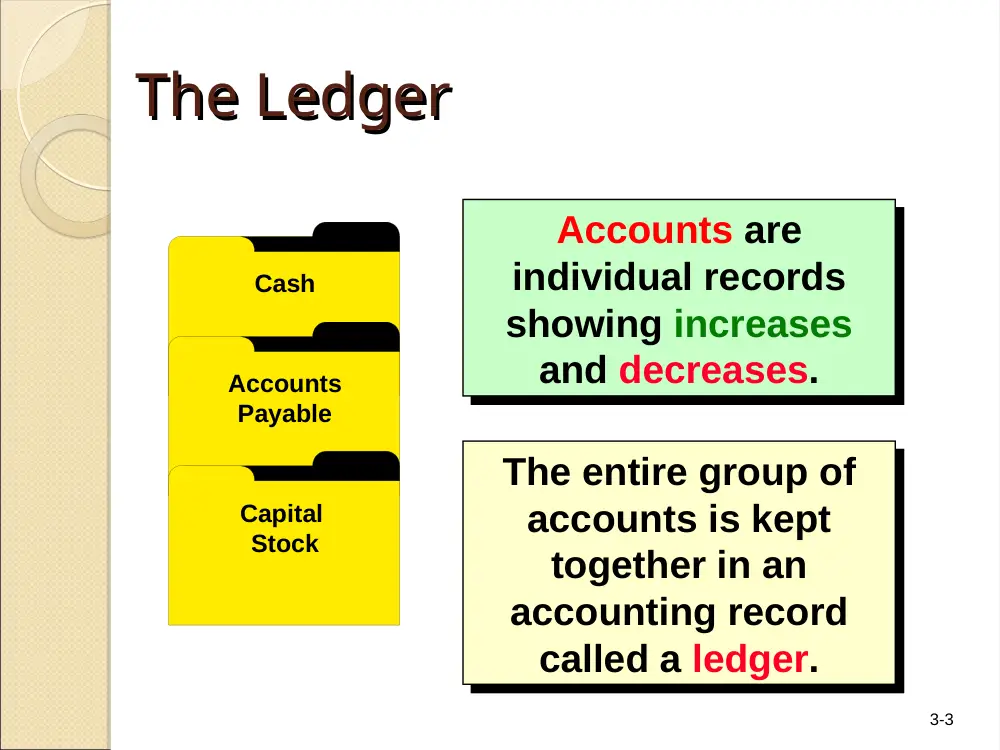
The Ledger
The Ledger
The entire group of
accounts is kept
together in an
accounting record
called a ledger.
The entire group of
accounts is kept
together in an
accounting record
called a ledger.
Cash
Accounts
Payable
Capital
Stock
Accounts are
individual records
showing increases
and decreases.
Accounts are
individual records
showing increases
and decreases.
3-4
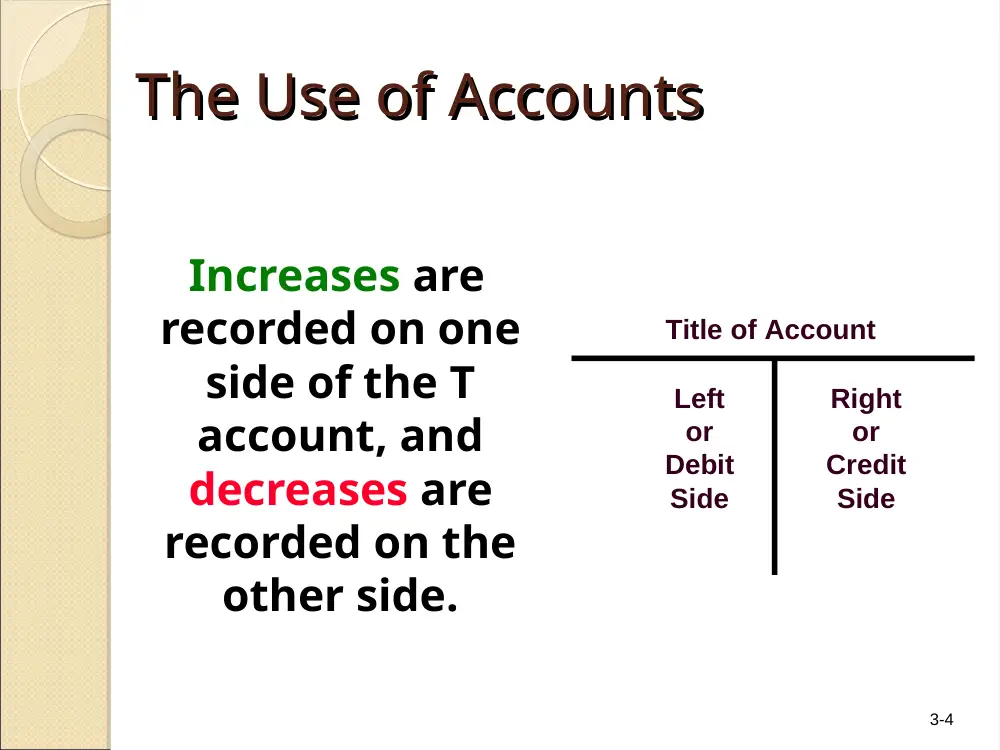
The Use of Accounts
The Use of Accounts
Increases are
recorded on one
side of the T
account, and
decreases are
recorded on the
other side.
Left
or
Debit
Side
Right
or
Credit
Side
Title of Account
3-5
Cash
5/1
8,000
5/2
2,500
5/25
75
5/8
2,000
5/29
750
5/28
150
5/31
50
5/31
4,125
Bal.
Cash
5/1
8,000
5/2
2,500
5/25
75
5/8
2,000
5/29
750
5/28
150
5/31
50
5/31
4,125
Bal.
Receipts are
on the debit
side.
Payments are
on the credit
side.
The balance is the
difference between the
debit and credit entries
in the account.
The balance is the
difference between the
debit and credit entries
in the account.
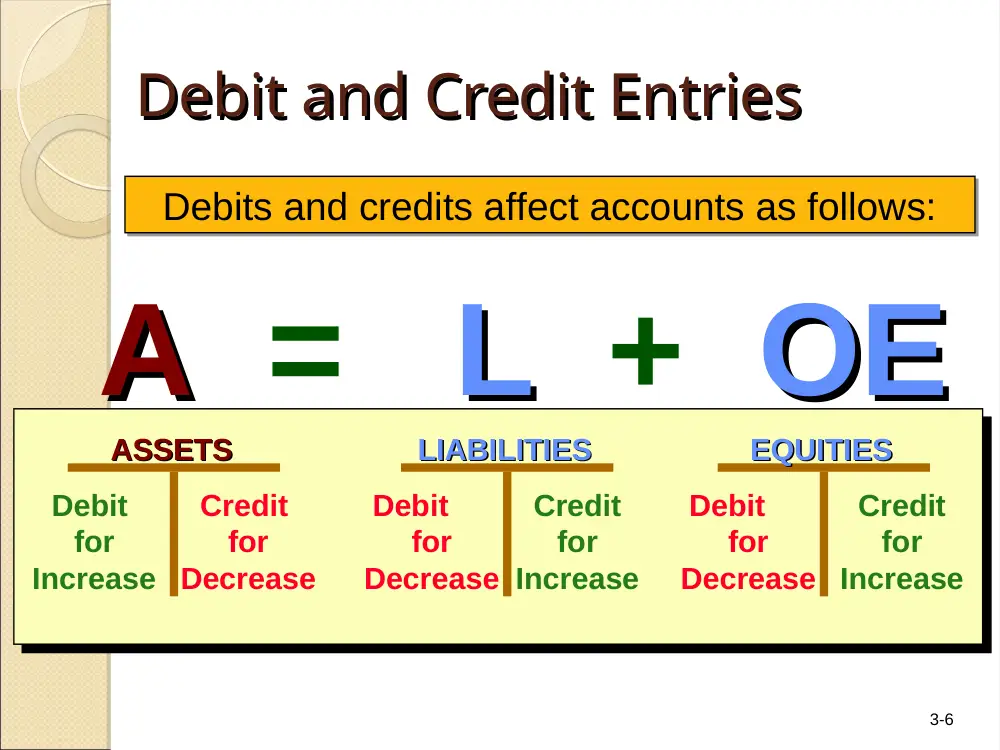
Debit and Credit Entries
Debit and Credit Entries
3-6
AA = LL + OE
OE
ASSETS
ASSETS
Debit
for
Increase
Credit
for
Decrease
EQUITIES
EQUITIES
Debit
for
Decrease
Credit
for
Increase
LIABILITIES
LIABILITIES
Debit
for
Decrease
Credit
for
Increase
Debits and credits affect accounts as follows:
Debits and credits affect accounts as follows:
Debit and Credit Entries
Debit and Credit Entries
3-7
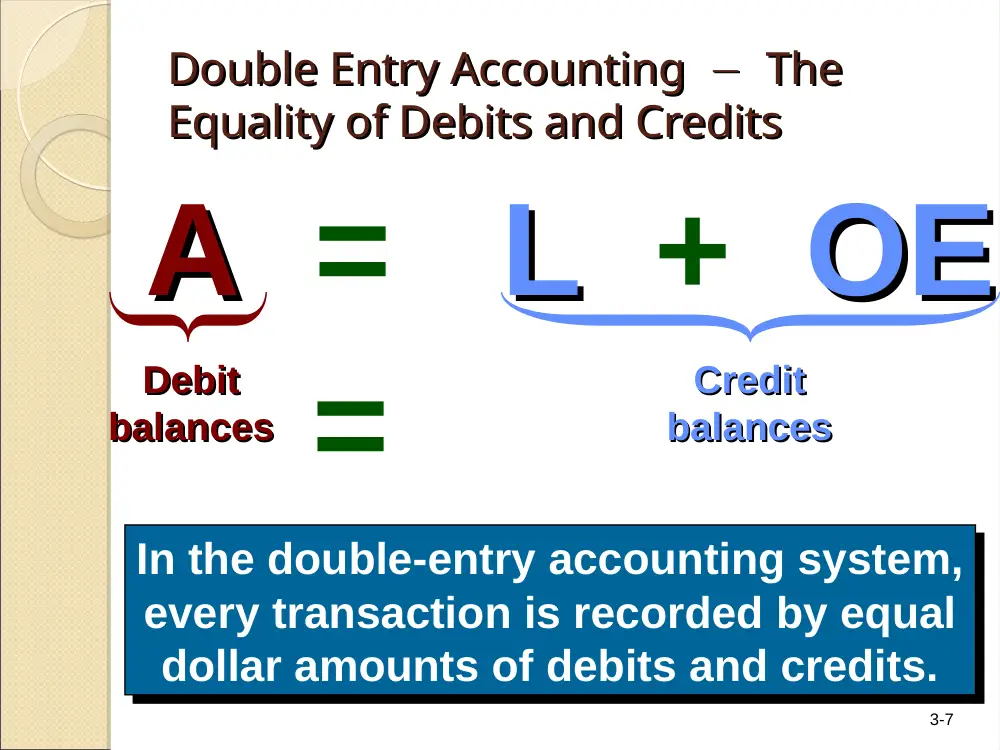
AA = LL + OE
OE
Debit
Debit
balances
balances
Credit
Credit
balances
balances
=
In the double-entry accounting system,
every transaction is recorded by equal
dollar amounts of debits and credits.
In the double-entry accounting system,
every transaction is recorded by equal
dollar amounts of debits and credits.
Double Entry Accounting
Double Entry Accounting
The
The
Equality of Debits and Credits
Equality of Debits and Credits
3-8
Let’s record
selected
transactions
for JJ’s Lawn
Care Service in
the accounts.
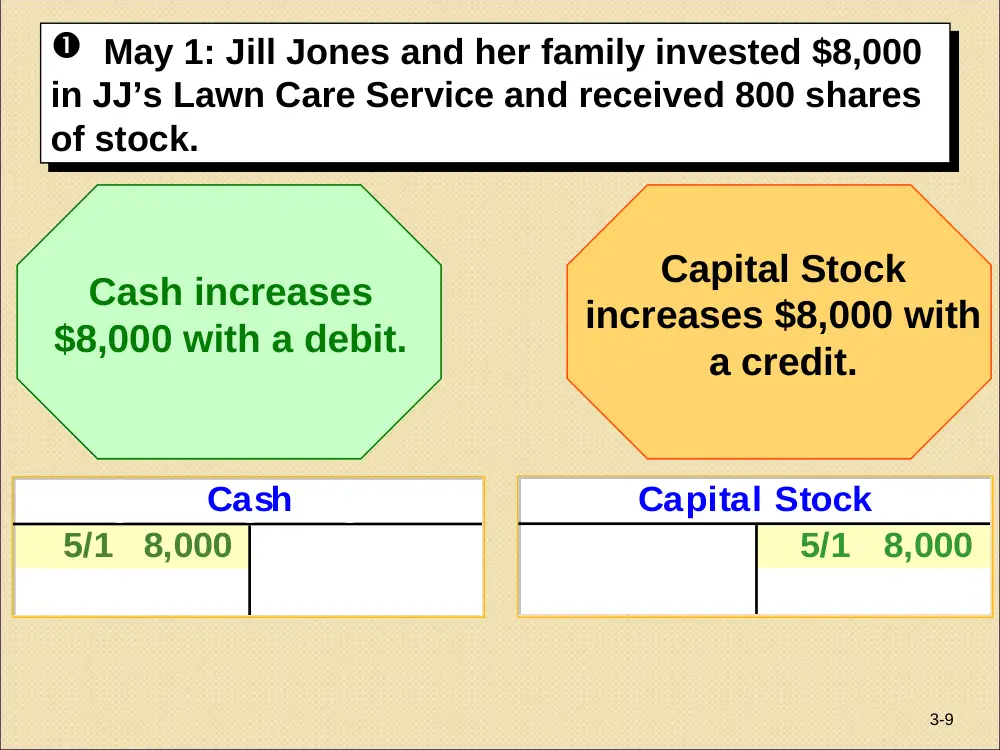
May 1: Jill Jones and her family invested $8,000
in JJ’s Lawn Care Service and received 800 shares
of stock.
May 1: Jill Jones and her family invested $8,000
in JJ’s Lawn Care Service and received 800 shares
of stock.
Will Cash increase
or decrease?
Will Capital Stock
increase or
decrease?
Capital Stock
5/1
8,000
Cash
5/1
8,000
Cash increases
$8,000 with a debit.
Capital Stock
increases $8,000 with
a credit.
3-9
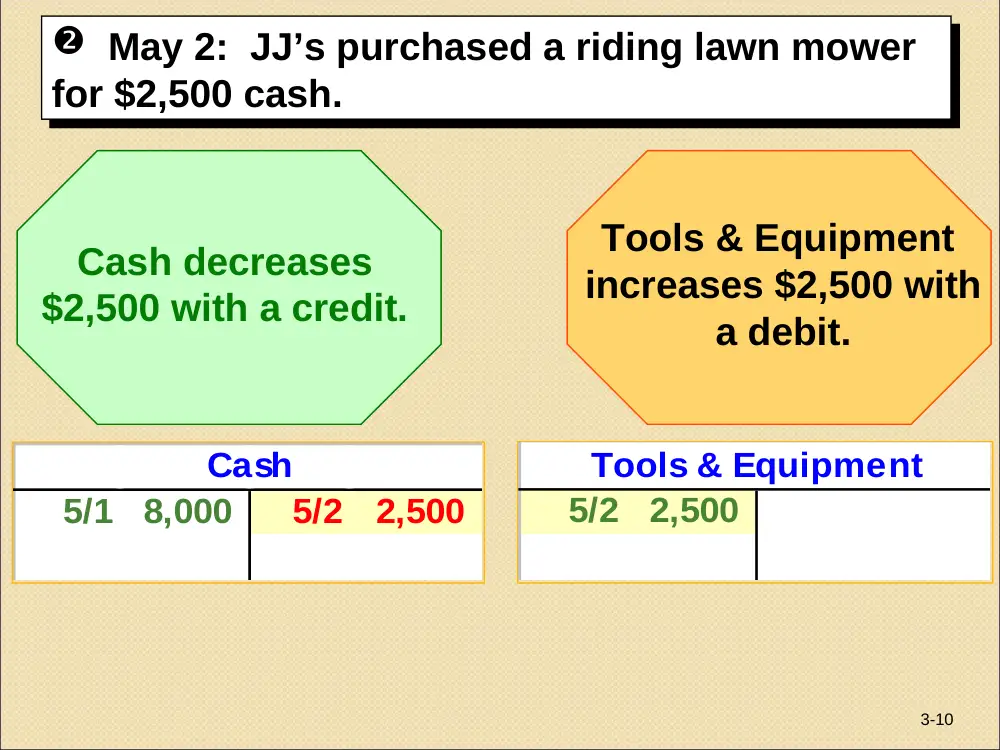
May 2: JJ’s purchased a riding lawn mower
for $2,500 cash.
May 2: JJ’s purchased a riding lawn mower
for $2,500 cash.
Will Cash increase
or decrease?
Will Tools &
Equipment increase
or decrease?
Tools & Equipment
5/2
2,500
Cash
5/1
8,000
5/2
2,500
Cash decreases
$2,500 with a credit.
Tools & Equipment
increases $2,500 with
a debit.
3-10
May 8: JJ’s purchased a $15,000 truck. JJ’s
paid $2,000 in cash and issued a note payable
for the remaining $13,000.
May 8: JJ’s purchased a $15,000 truck. JJ’s
paid $2,000 in cash and issued a note payable
for the remaining $13,000.
Will Truck increase
or decrease?
Will Cash and
Notes Payable
increase or
decrease?
Truck
5/8
15,000
Cash
5/1
8,000
5/2
2,500
5/8
2,000
Notes Payable
5/8
13,000
Truck increases
$15,000 with a debit.
3-11
May 11: JJ’s purchased some repair parts
for $300 on account.
May 11: JJ’s purchased some repair parts
for $300 on account.
Will Tools &
Equipment increase
or decrease?
Will Accounts
Payable increase or
decrease?
Tools & Equipment
increases $300 with
a debit.
Tools & Equipment
5/2
2,500
5/11
300
Accounts Payable
5/11
300
3-12
May 18: JJ’s sold half of the repair parts to
ABC Lawns for $150, a price equal to JJ’s cost.
ABC Lawns agrees to pay JJ’s within 30 days.
May 18: JJ’s sold half of the repair parts to
ABC Lawns for $150, a price equal to JJ’s cost.
ABC Lawns agrees to pay JJ’s within 30 days.
Will Tools &
Equipment increase
or decrease?
Will Accounts
Receivable increase
or decrease?
Tools & Equipment
decreases $150 with
a credit.
Tools & Equipment
5/2
2,500
5/18
150
5/11
300
Accounts Receivable
5/18
150
3-13
3-14
In an actual accounting system,
transactions are initially recorded in the
journal.
In an actual accounting system,
transactions are initially recorded in the
journal.
GENERAL JOURNAL
Date
Account Titles and Explanation
P
R Debit
Credit
2009
May
1 Cash
8,000
Capital Stock
8,000
Owners invest cash in the business.
The Journal
The Journal
3-15
Posting Journal Entries to
Posting Journal Entries to
the Ledger Accounts
the Ledger Accounts
Posting simply
means updating the
ledger accounts for
the effects of the
transactions
recorded in the
journal.
3-16
GENERAL JOURNAL
Date
Account Titles and Explanation
P
R Debit
Credit
2009
May
1 Cash
8,000
Capital Stock
8,000
Owners invest cash in the business.
General Ledger
Cash
Date
Debit
Credit
Balance
2009
May
1
8,000
8,000
Posting Journal Entries to
Posting Journal Entries to
the Ledger Accounts
the Ledger Accounts
3-17
GENERAL JOURNAL
Date
Account Titles and Explanation
P
R Debit
Credit
2009
May
1 Cash
8,000
Capital Stock
8,000
Owners invest cash in the business.
General Ledger
Capital Stock
Date
Debit
Credit
Balance
2009
May
1
8,000
8,000
Posting Journal Entries to
Posting Journal Entries to
the Ledger Accounts
the Ledger Accounts
3-18
GENERAL JOURNAL
Date
Account Titles and Explanation
P
R Debit
Credit
2009
May
2 Tools & Equipment
2,500
Cash
2,500
Purchased lawn mower.
Let’s see what the cash account looks like
after posting the cash portion of this
transaction for JJ’s Lawn Care Service.
Let’s see what the cash account looks like
after posting the cash portion of this
transaction for JJ’s Lawn Care Service.
Posting Journal Entries to the
Posting Journal Entries to the
Ledger Accounts
Ledger Accounts
3-19
General Ledger
Cash
Date
Debit
Credit
Balance
2009
May
1
8,000
8,000
2
2,500
5,500
This ledger format is referred to as a
running balance.
This ledger format is referred to as a
running balance.
Ledger Accounts After
Ledger Accounts After
Posting
Posting
3-20
General Ledger
Cash
Date
Debit
Credit
Balance
2009
May
1
8,000
8,000
2
2,500
5,500
T accounts are simplified versions of
the ledger account that only show the
debit and credit columns.
T accounts are simplified versions of
the ledger account that only show the
debit and credit columns.
Ledger Accounts After
Ledger Accounts After
Posting
Posting
3-21
Net income is not an asset it’s an increase
in owners’ equity from profits of the
business.
Net income is not an asset it’s an increase
in owners’ equity from profits of the
business.
AA = LL + OE
OE
Increase
Decrease
As income is earned,
either an asset is
increased or a liability is
decreased.
Increase
Net income
always results in
the increase of
Owners’ Equity
What is Net Income?
What is Net Income?
3-22
AA = LL + OE
OE
Retained Earnings
Retained Earnings
Capital
Stock
Retained
Earnings
The balance in the Retained Earnings account
represents the total net income of the corporation
over the entire lifetime of the business, less all
amounts which have been distributed to the
stockholders as dividends.
3-23
JJ's Lawn Care Service
Income Statement
For the Month Ended May 31, 2009
Sales Revenue
750
$
Operating Expense:
Gasoline Expense
50
Net Income
700
$
The income statement summarizes the
profitability of a business for a specified period
of time.
The income statement summarizes the
profitability of a business for a specified period
of time.
The Income Statement: A
The Income Statement: A
Preview
Preview
3-24
Accounting Periods
Accounting Periods
Time Period Principle
To provide users of
financial statements
with timely information,
net income is
measured for relatively
short accounting
periods of equal length.
Time Period Principle
To provide users of
financial statements
with timely information,
net income is
measured for relatively
short accounting
periods of equal length.
3-25
Revenue and Expenses
Revenue and Expenses
The price for
goods sold
and services
rendered during a
given accounting
period.
Increases
owners’ equity.
The costs of
goods and
services used up
in the process of
earning revenue.
Decreases
owner’s equity.
3-26
The Matching Principle:
The Matching Principle:
When To Record Revenue
When To Record Revenue
Matching Principle
Revenue should be
recognized at the
time goods are sold
and services are
rendered.
3-27
The Matching Principle:
The Matching Principle:
When To Record Expenses
When To Record Expenses
Matching Principle
Expenses should be
recorded in the
period in which they
are used up.
3-28
The Accrual Basis of
The Accrual Basis of
Accounting
Accounting
Current
Accounting Period
Future
Accounting Period
Jan. 1, 2009
Jan. 1, 2009
Dec. 1, 2009
Dec. 1, 2009
Jan. 1, 2010
Jan. 1, 2010
Dec. 1, 2010
Dec. 1, 2010
Cash is received or
paid here
Cash is received or
paid here
The income statement
reports revenue or
expense here
The income statement
reports revenue or
expense here
The income statement
reports revenue or
expenses here
The income statement
reports revenue or
expenses here
Cash is received or
paid here
Cash is received or
paid here
OR
OR
But . . .
But . . .
3-29
Debit and Credit Rules for
Debit and Credit Rules for
Revenue and Expenses
Revenue and Expenses
EQUITIES
Debit
for
Decrease
Credit
for
Increase
Expenses
decrease
owners’
equity.
Revenues
increase
owners’
equity.
EXPENSES
Credit
for
Decrease
Debit
for
Increase
REVENUES
Debit
for
Decrease
Credit
for
Increase
3-30
EQUITIES
Debit
for
Decrease
Credit
for
Increase
Payments to
owners
decrease
owners’
equity.
Owners’
investments
increase
owners’
equity.
DIVIDENDS
Credit
for
Decrease
Debit
for
Increase
Dividends
Dividends
CAPITAL STOCK
Debit
for
Decrease
Credit
for
Increase
3-31
Let’s analyze the
revenue and
expense
transactions for
JJ’s Lawn Care
Service for the
month of May.
We will also
analyze a dividend
transaction.
Let’s analyze the
revenue and
expense
transactions for
JJ’s Lawn Care
Service for the
month of May.
We will also
analyze a dividend
transaction.
May 29: JJ’s provided lawn care services for
a client and received $750 in cash.
May 29: JJ’s provided lawn care services for
a client and received $750 in cash.
Will Cash increase
or decrease?
Will Sales Revenue
increase or
decrease?
Sales Revenue
5/29
750
Cash increases
$750 with a debit.
Cash
5/1
8,000
5/2
2,500
5/29
750
5/8
2,000
3-32
May 31: JJ’s purchased gasoline for the lawn
mower and the truck for $50 cash.
May 31: JJ’s purchased gasoline for the lawn
mower and the truck for $50 cash.
Will Cash increase
or decrease?
Will Gasoline
Expense increase or
decrease?
Gasoline Expense
5/31
50
Cash decreases $50
with a credit.
Cash
5/1
8,000
5/2
2,500
5/29
750
5/8
2,000
5/31
50
3-33
May 31: JJ’s Lawn Care paid Jill Jones and
her family a $200 dividend.
May 31: JJ’s Lawn Care paid Jill Jones and
her family a $200 dividend.
Will Cash increase
or decrease?
Will Dividends
increase or
decrease?
Dividends
5/31
200
Cash decreases
$200 with a credit.
Cash
5/1
8,000
5/2
2,500
5/29
750
5/8
2,000
5/31
50
5/31
200
3-34
3-35
Now, let’s look at
the Trial Balance
for JJ’s Lawn
Care Service for
the month of May.
Now, let’s look at
the Trial Balance
for JJ’s Lawn
Care Service for
the month of May.
3-36
JJ's Lawn Care Service
Unadjusted Trial Balance
May 31, 2009
Cash
3,925
$
Accounts receivable
75
Tools & equipment
2,650
Truck
15,000
Notes payable
13,000
$
Accounts payable
150
Capital stock
8,000
Dividends
200
Sales revenue
750
Gasoline expense
50
Total
21,900
$
21,900
$
All balances are taken from the ledger accounts on May
31 after considering all of JJ’s transactions for the
month.
3-37
The Accounting Cycle in
The Accounting Cycle in
Perspective
Perspective
Accountants spend
much of their time
focusing on the
more analytical
aspects of their
discipline.
3-38
End of Chapter 3
End of Chapter 3