
ACO 201 Chapter 6, Spring 2013
Notre Dame University–Louaize · Principles of Accounting I · 40 pages



Showing the first 10 of 40 pages. Download the PDF to see all of it.
More ACO 201 files
- Chapter 1 · Spring 2013ChapterView
- Chapter 2 · Spring 2013ChapterView
- Chapter 3 · Spring 2013ChapterView
- Chapter 4 · Spring 2013ChapterView
- Chapter 5 · Spring 2013ChapterView
- Chapter 7 · Spring 2013ChapterView
- Problems Chapter 2 Solution · Spring 2013Chapter · with solutionView
- Problems Chapter 3 Solution · Spring 2013Chapter · with solutionView
Show the text of this chapter
Copyright © 2010 by The McGraw-Hill Companies, Inc. All rights reserved.
McGraw-Hill/Irwin
Merchandising Activities
Merchandising Activities
Chapter 6
6-2
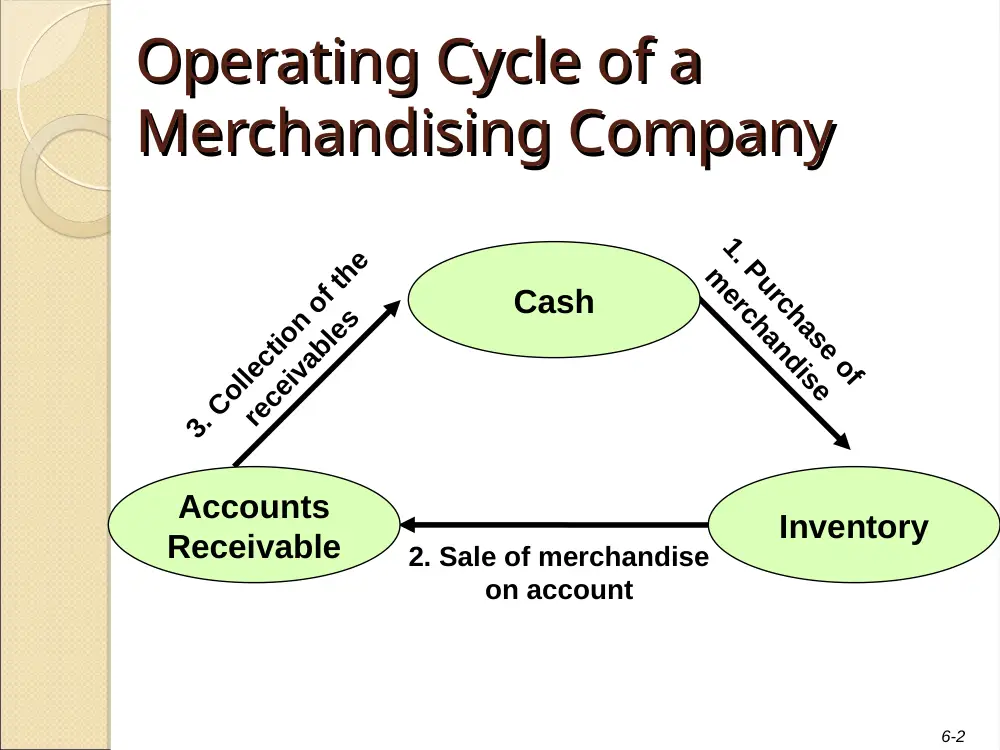
Operating Cycle of a
Operating Cycle of a
Merchandising Company
Merchandising Company
1. Purchase of
merchandise
3. Collection of the
receivables
2. Sale of merchandise
on account
Cash
Inventory
Accounts
Receivable
6-3
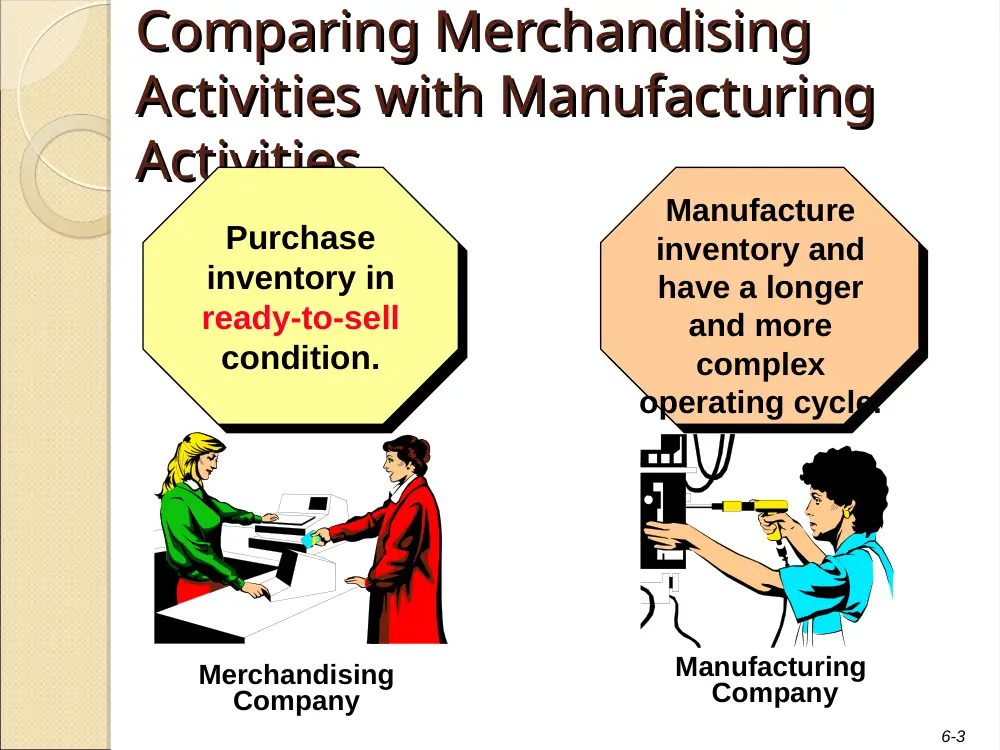
Comparing Merchandising
Comparing Merchandising
Activities with Manufacturing
Activities with Manufacturing
Activities
Activities
Merchandising
Company
Purchase
inventory in
ready-to-sell
condition.
Manufacturing
Company
Manufacture
inventory and
have a longer
and more
complex
operating cycle.
6-4
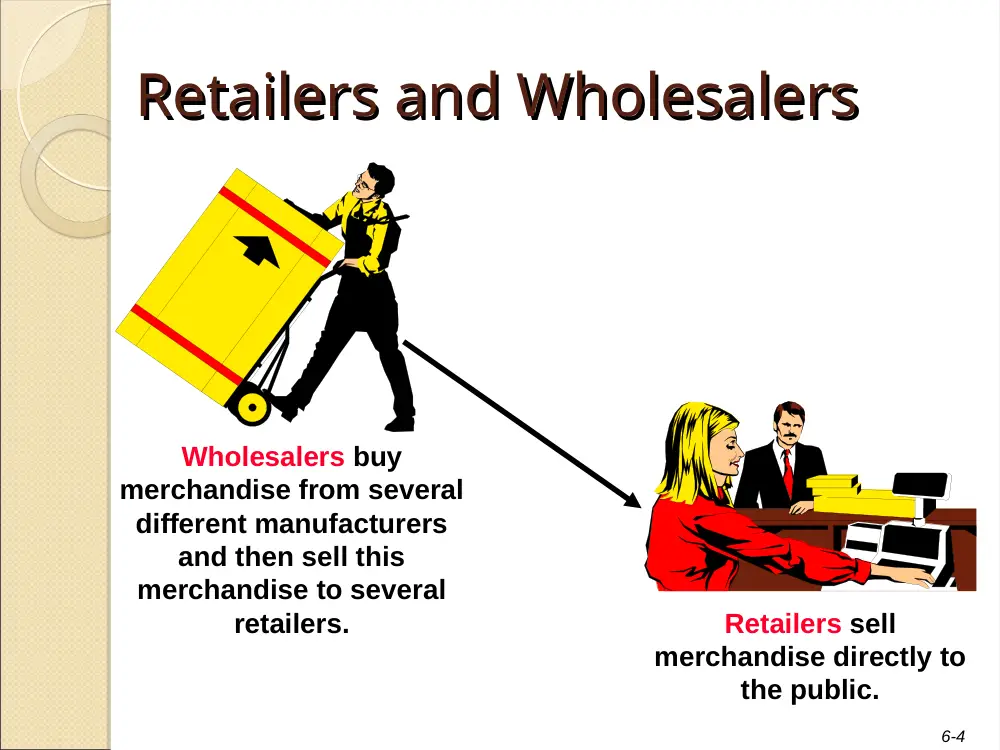
Retailers and Wholesalers
Retailers and Wholesalers
Retailers sell
merchandise directly to
the public.
Wholesalers buy
merchandise from several
different manufacturers
and then sell this
merchandise to several
retailers.
6-5
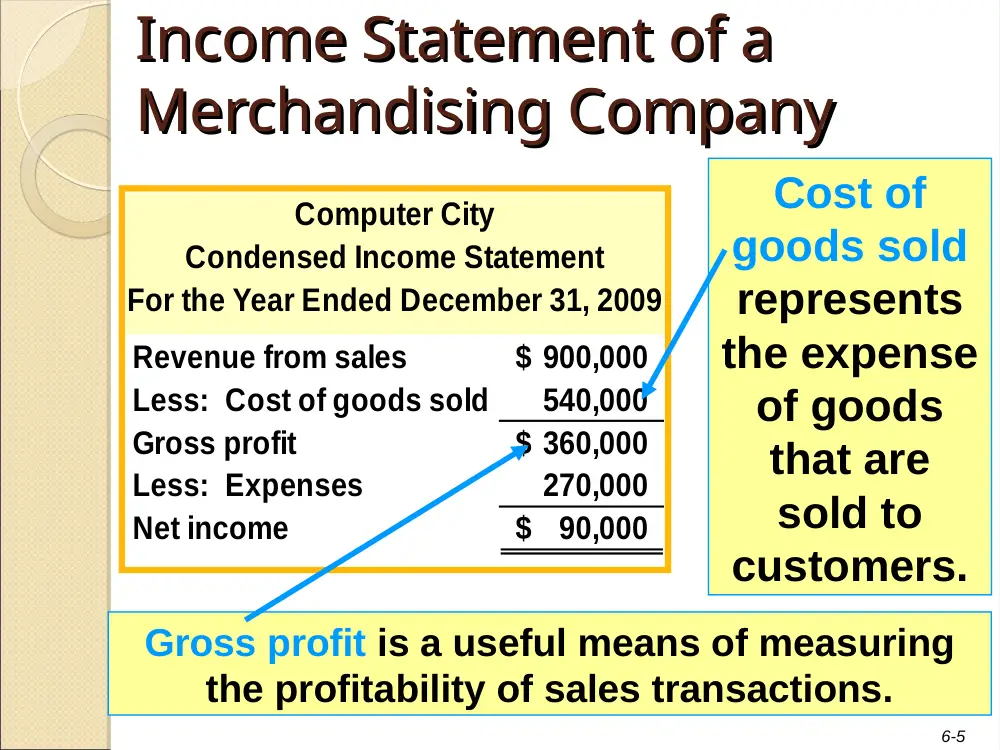
Income Statement of a
Income Statement of a
Merchandising Company
Merchandising Company
Computer City
Condensed Income Statement
For the Year Ended December 31, 2009
Revenue from sales
900,000
$
Less: Cost of goods sold
540,000
Gross profit
360,000
$
Less: Expenses
270,000
Net income
90,000
$
Cost of
goods sold
represents
the expense
of goods
that are
sold to
customers.
Gross profit is a useful means of measuring
the profitability of sales transactions.
6-6
Accounting System
Accounting System
Requirements for
Requirements for
Merchandising Companies
Merchandising Companies
General Ledger
Accounts Receivable
Date
Debit
Credit
Balance
2009
June
1
10,000
10,000
15
3,000
7,000
Control Account
Subsidiary Ledger
Heather Jacobs Company
Date
Debit
Credit
Balance
2009
June
1
7,000
7,000
15
2,000
5,000
Subsidiary Ledger
Sparks, Inc.
Date
Debit
Credit
Balance
2009
June
1
3,000
3,000
15
1,000
2,000
Subsidiary Ledgers
6-7
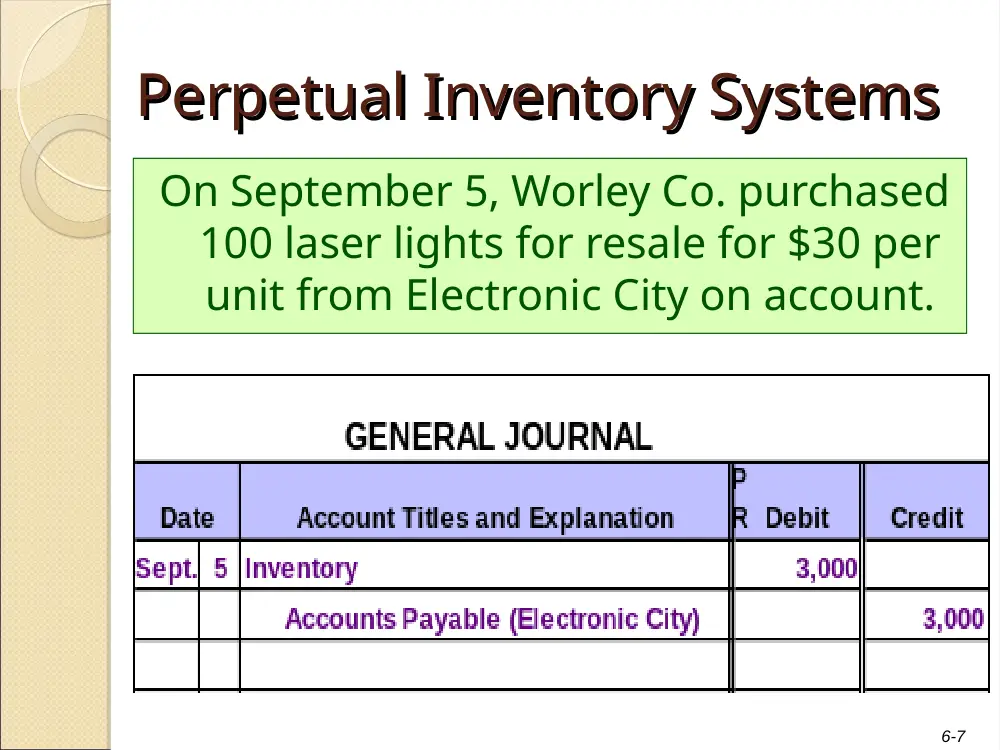
On September 5, Worley Co. purchased
100 laser lights for resale for $30 per
unit from Electronic City on account.
Perpetual Inventory Systems
Perpetual Inventory Systems
6-8
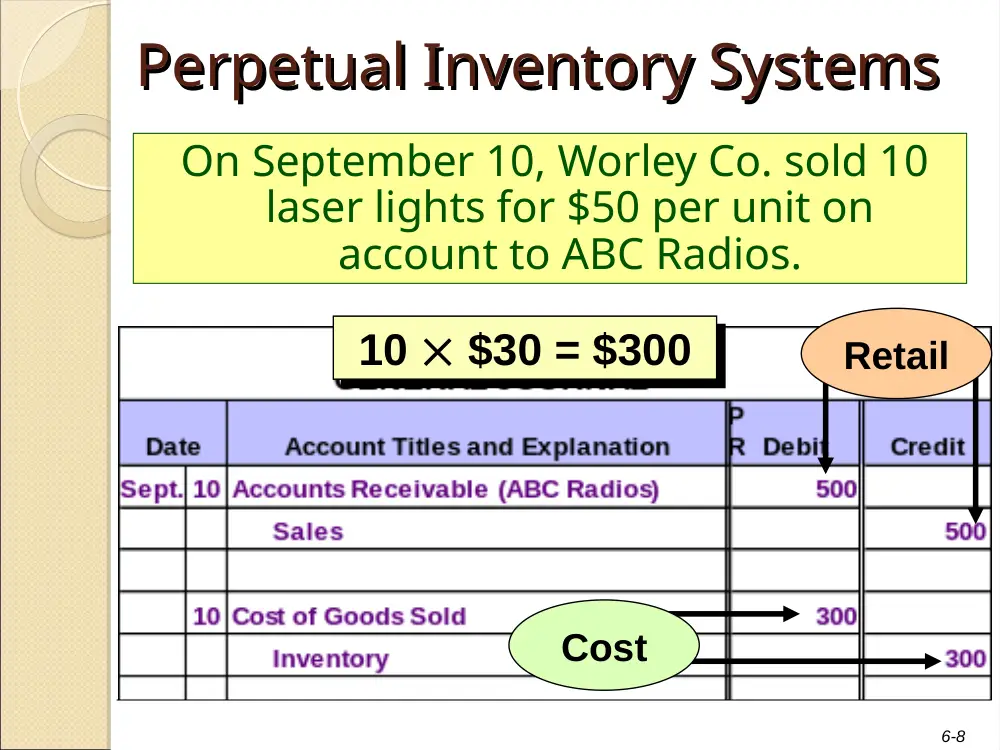
On September 10, Worley Co. sold 10
laser lights for $50 per unit on
account to ABC Radios.
10 $30 = $300
10 $30 = $300
Cost
Retail
Perpetual Inventory Systems
Perpetual Inventory Systems
6-9
On September 15, Worley Co. paid
Electronic City $3,000 for the
September 5 purchase.
Perpetual Inventory Systems
Perpetual Inventory Systems
6-10
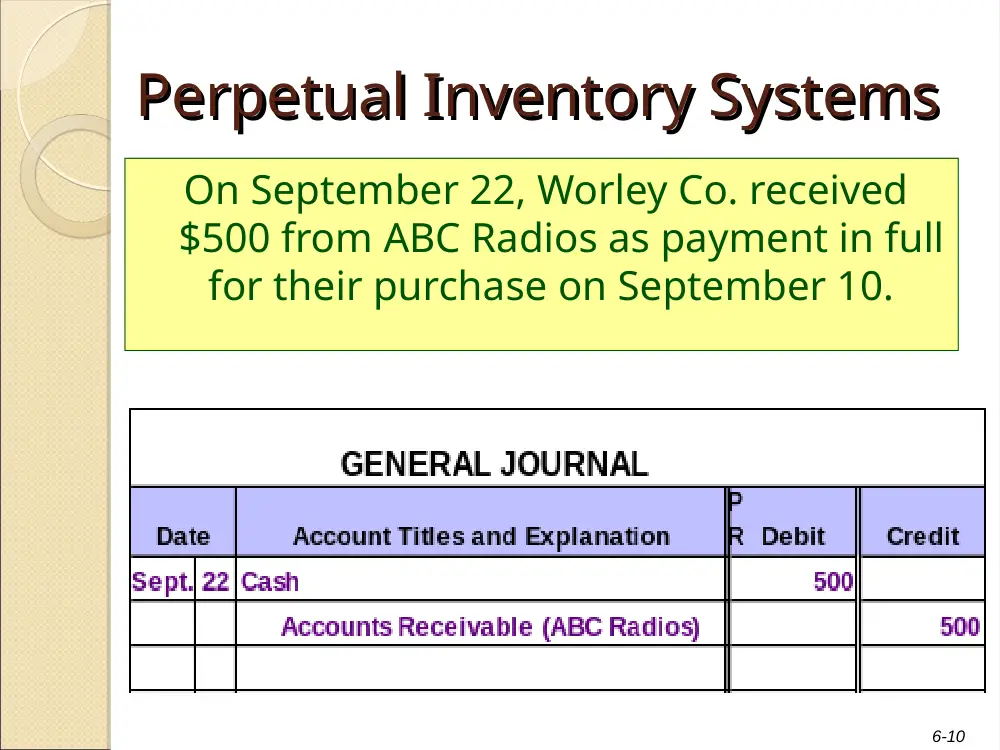
On September 22, Worley Co. received
$500 from ABC Radios as payment in full
for their purchase on September 10.
Perpetual Inventory Systems
Perpetual Inventory Systems
6-11
In order to ensure the accuracy of their perpetual
records, most businesses take a complete physical
count of the merchandise on hand at least once a year.
Taking a Physical Inventory
Taking a Physical Inventory
On December 31, Worley Co. counts its inventory.
An inventory shortage of $2,000 is discovered.
Reasonable amounts of inventory shrinkage are viewed as a
normal cost of doing business.
Examples include breakage, spoilage and theft.
6-12
Closing Entries in a Perpetual
Closing Entries in a Perpetual
Inventory System
Inventory System
Close Revenue accounts
(including Sales) to Income
Summary.
Close Expense accounts
(including Cost of Goods
Sold) to Income Summary.
Close Income Summary
account to Retained
Earnings.
Close Dividends to Retained
Earnings.
The closing
entries are the
same!
6-13
On September 5, Worley Co. purchased
100 laser lights for resale for $30 per
unit from Electronic City on account.
Notice that no entry is
made to Inventory.
Notice that no entry is
made to Inventory.
Periodic Inventory System
Periodic Inventory System
6-14
On September 10, Worley Co. sold 10
laser lights for $50 per unit on account
to
ABC Radios.
Retail
Periodic Inventory System
Periodic Inventory System
6-15
On September 15, Worley Co. paid
Electronic City $3,000 for the
September 5 purchase.
Periodic Inventory System
Periodic Inventory System
6-16
On September 22, Worley Co. received
$500 from ABC Radios as payment in full
for their purchase on September 10.
Periodic Inventory System
Periodic Inventory System
6-17
Computing Cost of Goods
Computing Cost of Goods
Sold
Sold
The accounting records of Party
Supply show the following:
Inventory, Jan. 1
$ 14,000
Purchases (during year) 130,000
Inventory, Dec. 31
12,000
The accounting records of Party
Supply show the following:
Inventory, Jan. 1
$ 14,000
Purchases (during year) 130,000
Inventory, Dec. 31
12,000
Inventory (beginning of the year)
14,000
$
Add: Purchases
130,000
Cost of goods available for sale
144,000
Less: Inventory (end of year)
12,000
Cost of goods sold
$ 132,000
6-18
Creating a Cost of Goods Sold
Creating a Cost of Goods Sold
Account
Account
Party Supply must create the Cost of
Goods Sold account.
Party Supply must record the ending
inventory amount.
6-19
Selecting an Inventory
Selecting an Inventory
System
System
Factors Suggesting a
Perpetual Inventory System
Factors Suggesting a
Periodic Inventory System
Large company with
professional management.
Small company, run by
owner.
Management and employees
wanting information about
items in inventory and the
quantities of specific
products that are selling.
Accounting records of
inventories and specific
product sales not needed in
daily operations; such
information developed
primarily for use in annual
income tax returns.
Items in inventory with a high
per-unit cost.
Inventory with many different
kinds of low-cost items.
Low volume of sales
transactions or a
computerized accounting
system.
High volume of sales
transactions and a manual
accounting system.
Merchandise stored at
multiple locations or in
warehouses separate from
sales sites.
All merchandise stored at the
sales site (for example, in the
store).
6-20
Credit Terms and Cash Discounts
Credit Terms and Cash Discounts
2/10, n/30
Percentage
of Discount
# of Days
Discount Is
Available
Otherwise, the
Full Amount Is
Due
# of Days when
Full Amount Is
Due
Read as: “Two ten, net thirty”
When manufacturers and wholesalers
sell their products on account, the
credit terms are stated in the invoice.
6-21
Recording Purchases at Net
Recording Purchases at Net
Cost
Cost
$4,000 98% =
$3 920
$4,000 98% =
$3 920
On July 6, Jack & Jill, Inc. purchased $4,000 of
merchandise on credit with terms of
2/10, n/30 from Kid’s Clothes.
Prepare the journal entry for Jack & Jill, Inc.
6-22
On July 15, Jack & Jill, Inc. pays the full
amount due to Kid’s Clothes. Prepare
the journal entry for Jack & Jill, Inc.
Recording Purchases at Net
Recording Purchases at Net
Cost
Cost
6-23
Now, assume that Jack & Jill, Inc. waited
until July 20 to pay the amount due in
full to Kid’s Clothes.
Prepare the journal entry for Jack & Jill,
Inc.
Recording Purchases at Net
Recording Purchases at Net
Cost
Cost
Nonoperating Expense
Nonoperating Expense
6-24
Recording Purchases at Gross
Recording Purchases at Gross
Invoice Price
Invoice Price
On July 6, Jack & Jill, Inc. purchased $4,000
of merchandise on credit with terms of 2/10,
n/30 from Kid’s Clothes.
Prepare the journal entry for Jack & Jill, Inc.
6-25
Reduces Cost of
Goods Sold
Reduces Cost of
Goods Sold
$4,000 98% =
$3,920
$4,000 98% =
$3,920
On July 15, Jack & Jill, Inc. pays the full
amount due to Kid’s Clothes.
Prepare the journal entry for Jack & Jill,
Inc.
Recording Purchases at Gross
Recording Purchases at Gross
Invoice Price
Invoice Price
6-26
Now, assume that Jack & Jill, Inc. waited
until July 20 to pay the full amount due
to
Kid’s Clothes.
Prepare the journal entry for Jack & Jill,
Inc.
Recording Purchases at Gross
Recording Purchases at Gross
Invoice Price
Invoice Price
6-27
$500 98% = $490
$500 98% = $490
On August 5, Jack & Jill, Inc. returned $500 of
unsatisfactory merchandise purchased from
Kid’s Clothes on credit terms of 2/10, n/30.
The purchase was originally recorded at net
cost. Prepare the entry for Jack & Jill, Inc.
Returns of Unsatisfactory
Returns of Unsatisfactory
Merchandise
Merchandise
6-28
Transportation costs related to
the acquisition of assets are part
of the cost of the asset being
acquired.
Transportation costs related to
the acquisition of assets are part
of the cost of the asset being
acquired.
Transportation Costs on
Transportation Costs on
Purchases
Purchases
6-29
Computer City
Partial Income Statement
For the Year Ended December 31, 2009
Revenue
Sales
912,000
$
Less: Sales returns and allowances
8,000
$
Sales discounts
4,000
12,000
Net sales
900,000
$
Credit terms and merchandise returns
affect the amount of revenue earned by
the seller.
Transactions Related to Sales
Transactions Related to Sales
6-30
On August 2, Kid’s Clothes sold $2,000 of merchandise
to Jack & Jill, Inc. on credit terms 2/10, n/30. Kid’s
Clothes originally paid $1,000 for the merchandise.
Because Kid’s Clothes uses a perpetual inventory
system, they must make two entries.
Sales
Sales
6-31
Contra-revenue
Contra-revenue
On August 5, Jack & Jill, Inc. returned $500 of
unsatisfactory merchandise to Kid’s Clothes
from the August 2 sale. Kid’s Clothes cost for
this merchandise was $250.
Because Kid’s Clothes uses a perpetual inventory
system, they must make two entries.
Sales Returns and Allowances
Sales Returns and Allowances
6-32
On July 6, Kid’s Clothes sold $4,000 of merchandise to
Jack & Jill, Inc. on credit with terms of 2/10, n/30.
The merchandise originally cost Kid’s Clothes $2,000.
Because Kid’s Clothes uses a perpetual inventory
system, they must make two entries.
Sales Discounts
Sales Discounts
6-33
$4,000 98% =
$3,920
$4,000 98% =
$3,920
Contra-revenue
Contra-revenue
On July 15, Kid’s Clothes receives the full
amount due from Jack & Jill, Inc. from the
July 6 sale.
Prepare the journal entry for Kid’s Clothes.
Sales Discounts
Sales Discounts
6-34
Now, assume that it wasn’t until July 20 that
Kid’s Clothes received the full amount due
from Jack & Jill, Inc. from the July 6 sale.
Prepare the journal entry for Kid’s Clothes.
Sales Discounts
Sales Discounts
6-35
Delivery costs incurred by sellers
are debited to Delivery Expense, an
operating expense.
Delivery costs incurred by sellers
are debited to Delivery Expense, an
operating expense.
Delivery Expenses
Delivery Expenses
6-36
Businesses collect sales tax at the point
of sale.
Then, they remit the tax to the
appropriate governmental agency at
times specified by law.
$1,000 sale 7% tax = $70 sales tax
$1,000 sale 7% tax = $70 sales tax
Accounting for Sales Taxes
Accounting for Sales Taxes
6-37
Modifying an Accounting
Modifying an Accounting
System
System
Most businesses use special journals
rather than a general journal to record
routine transactions that occur
frequently.
6-38
Financial Analysis
Financial Analysis
Net Sales
Gross
Profit
Margins
• Trends over time
• Comparable store sales
• Sales per square foot of
selling space
• Trends over time
• Comparable store sales
• Sales per square foot of
selling space
• Gross profit Net sales
• Overall gross profit margin
• Gross profit margins by
department and products
• Gross profit Net sales
• Overall gross profit margin
• Gross profit margins by
department and products
6-39
Ethics, Fraud, and
Ethics, Fraud, and
Corporate Governance
Corporate Governance
Sales discounts and allowances are contra-
revenue accounts. Sales discounts and
allowances reduce gross sales. As such, net
income will be incorrect if discounts and
allowances are not properly recorded.
The pressure brought to bear on subordinates to
implement fraudulent schemes developed by top
management can often be intense. Top
management can threaten employees with
termination if they fail to participate in the fraud.
Unfortunately, employees who acquiesce to
such pressure face tremendous legal risks.
6-40
End of Chapter 6
End of Chapter 6