
ACO 201 Problems Chapter 2 Solution, Spring 2013
Notre Dame University–Louaize · Principles of Accounting I · 53 pages · Ms. Sandra Khalil · with solution

Showing the first 10 of 53 pages. Download the PDF to see all of it.
More ACO 201 files
- Chapter 1 · Spring 2013ChapterView
- Chapter 2 · Spring 2013ChapterView
- Chapter 3 · Spring 2013ChapterView
- Chapter 4 · Spring 2013ChapterView
- Chapter 5 · Spring 2013ChapterView
- Chapter 6 · Spring 2013ChapterView
- Chapter 7 · Spring 2013ChapterView
- Problems Chapter 3 Solution · Spring 2013Chapter · with solutionView
Show the text of this chapter
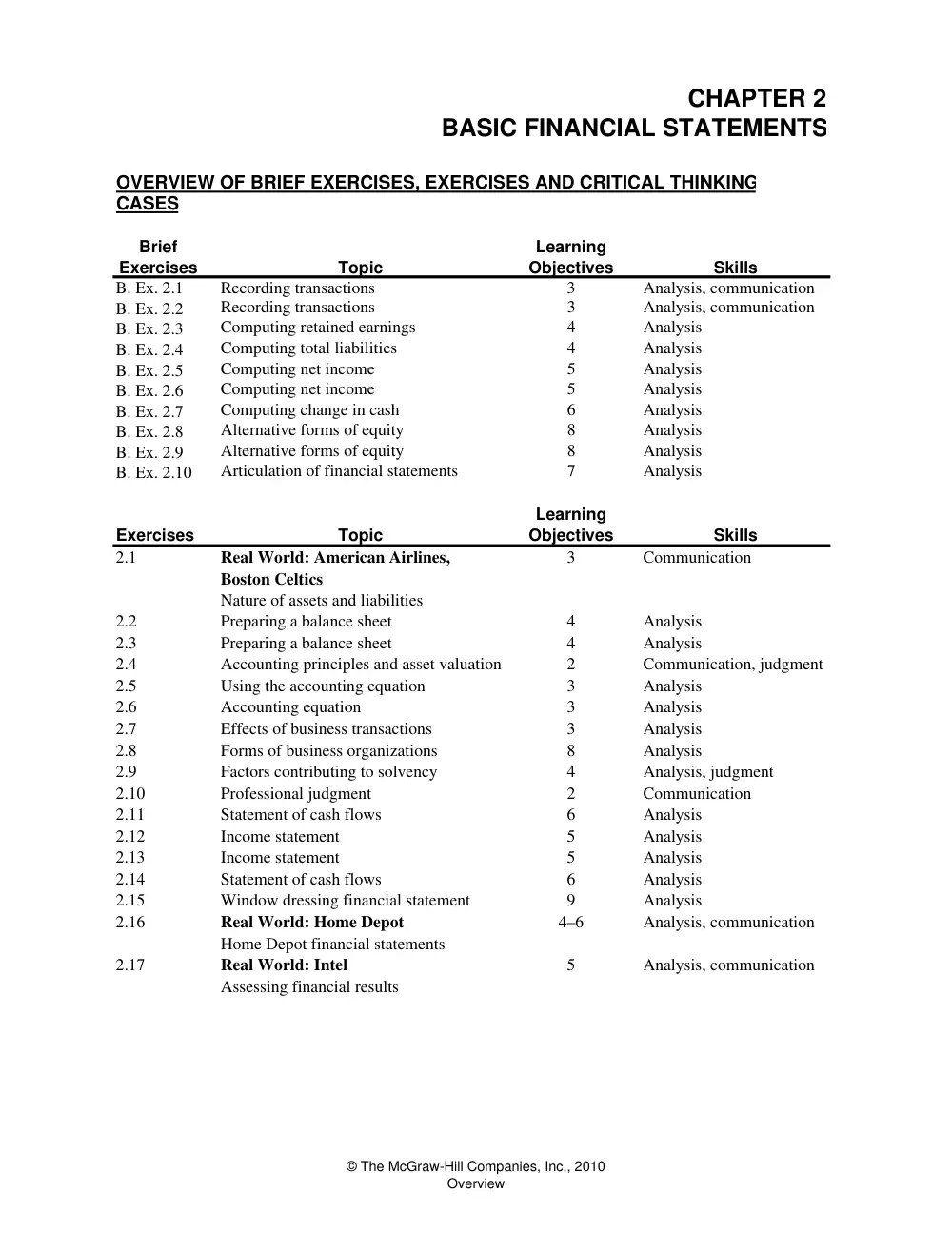
Brief
Learning
Exercises
Topic
Objectives
Skills
B. Ex. 2.1
Recording transactions
3
Analysis, communication
B. Ex. 2.2
Recording transactions
3
Analysis, communication
B. Ex. 2.3
Computing retained earnings
4
Analysis
B. Ex. 2.4
Computing total liabilities
4
Analysis
B. Ex. 2.5
Computing net income
5
Analysis
B. Ex. 2.6
Computing net income
5
Analysis
B. Ex. 2.7
Computing change in cash
6
Analysis
B. Ex. 2.8
Alternative forms of equity
8
Analysis
B. Ex. 2.9
Alternative forms of equity
8
Analysis
B. Ex. 2.10
Articulation of financial statements
7
Analysis
Learning
Exercises
Topic
Objectives
Skills
2.1
Real World: American Airlines,
3
Communication
Boston Celtics
Nature of assets and liabilities
2.2
Preparing a balance sheet
4
Analysis
2.3
Preparing a balance sheet
4
Analysis
2.4
2
Communication, judgment
2.5
Using the accounting equation
3
Analysis
2.6
Accounting equation
3
Analysis
2.7
Effects of business transactions
3
Analysis
2.8
Forms of business organizations
8
Analysis
2.9
Factors contributing to solvency
4
Analysis, judgment
2.10
Professional judgment
2
Communication
2.11
Statement of cash flows
6
Analysis
2.12
Income statement
5
Analysis
2.13
Income statement
5
Analysis
2.14
Statement of cash flows
6
Analysis
2.15
Window dressing financial statement
9
Analysis
2.16
Real World: Home Depot
4–6
Analysis, communication
Home Depot financial statements
2.17
Real World: Intel
5
Analysis, communication
Assessing financial results
CHAPTER 2
BASIC FINANCIAL STATEMENTS
Accounting principles and asset valuation
OVERVIEW OF BRIEF EXERCISES, EXERCISES AND CRITICAL THINKING
CASES
© The McGraw-Hill Companies, Inc., 2010
Overview
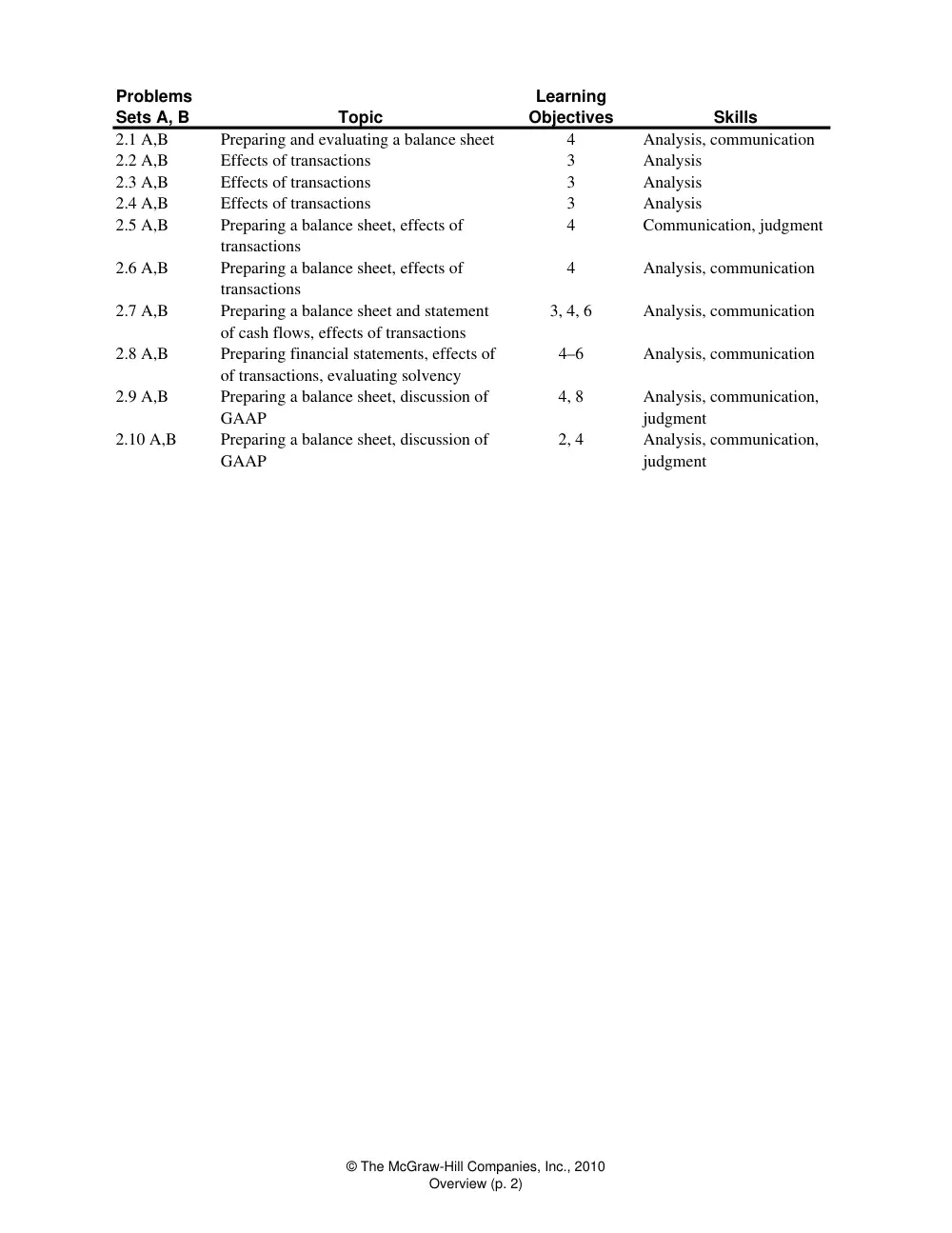
Problems
Learning
Sets A, B
Topic
Objectives
Skills
2.1 A,B
4
Analysis, communication
2.2 A,B
Effects of transactions
3
Analysis
2.3 A,B
Effects of transactions
3
Analysis
2.4 A,B
Effects of transactions
3
Analysis
2.5 A,B
Preparing a balance sheet, effects of
4
Communication, judgment
transactions
2.6 A,B
Preparing a balance sheet, effects of
4
Analysis, communication
transactions
2.7 A,B
Preparing a balance sheet and statement
3, 4, 6
Analysis, communication
of cash flows, effects of transactions
2.8 A,B
Preparing financial statements, effects of
4–6
Analysis, communication
of transactions, evaluating solvency
2.9 A,B
4, 8
2.10 A,B
2, 4
Preparing and evaluating a balance sheet
Preparing a balance sheet, discussion of
GAAP
Preparing a balance sheet, discussion of
GAAP
Analysis, communication,
judgment
Analysis, communication,
judgment
© The McGraw-Hill Companies, Inc., 2010
Overview (p. 2)
2.1
Prepare a realistic balance sheet for a
4
hypothetical entity
2.2
Real World: Company of student choice
4–6
2.3
Using a balance sheet
4
2.4
Using a statement of cash flows
6
2.5
Window dressing
9
2.6
9
(Ethics, fraud & corporate governance)
2.7
1-7
2.8
4-5
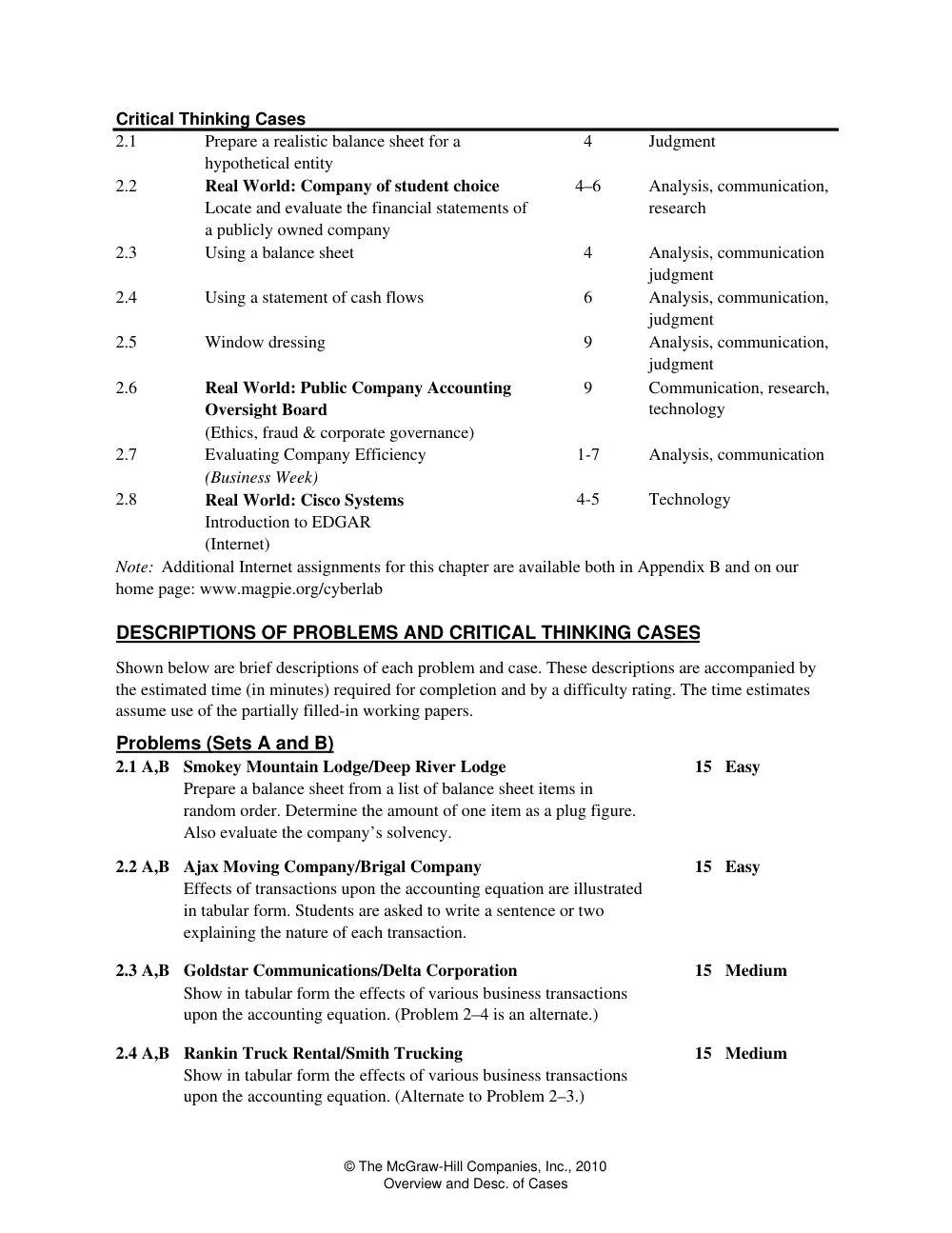
DESCRIPTIONS OF PROBLEMS AND CRITICAL THINKING CASES
Problems (Sets A and B)
2.1 A,B
15 Easy
2.2 A,B
15 Easy
2.3 A,B
15 Medium
2.4 A,B
15 Medium
(Internet)
(Business Week)
Introduction to EDGAR
Locate and evaluate the financial statements of
a publicly owned company
Critical Thinking Cases
Analysis, communication,
research
Analysis, communication
judgment
Analysis, communication,
judgment
Analysis, communication,
judgment
Communication, research,
technology
Ajax Moving Company/Brigal Company
Smokey Mountain Lodge/Deep River Lodge
Shown below are brief descriptions of each problem and case. These descriptions are accompanied by
the estimated time (in minutes) required for completion and by a difficulty rating. The time estimates
assume use of the partially filled-in working papers.
Real World: Public Company Accounting
Oversight Board
Technology
Evaluating Company Efficiency
Analysis, communication
Real World: Cisco Systems
Rankin Truck Rental/Smith Trucking
Show in tabular form the effects of various business transactions
upon the accounting equation. (Alternate to Problem 2–3.)
Prepare a balance sheet from a list of balance sheet items in
random order. Determine the amount of one item as a plug figure.
Also evaluate the company’s solvency.
Effects of transactions upon the accounting equation are illustrated
in tabular form. Students are asked to write a sentence or two
explaining the nature of each transaction.
Goldstar Communications/Delta Corporation
Show in tabular form the effects of various business transactions
upon the accounting equation. (Problem 2–4 is an alternate.)
Judgment
Note: Additional Internet assignments for this chapter are available both in Appendix B and on our
home page: www.magpie.org/cyberlab
© The McGraw-Hill Companies, Inc., 2010
Overview and Desc. of Cases
Problems (cont'd)
Here Come the Clowns/Circus World
Wilson Farms, Inc./Apple Valley Farms
The Oven Bakery/The City Butcher
The Sweet Soda Shop/The Candy Shop
Berkeley Playhouse/Old Town Playhouse
Big Screen Scripts/Hit Scripts
Critical Thinking Cases
Content of a Balance Sheet
Using Financial Statements
*Omits time required to obtain an annual report.
2.5 A,B
20 Medium
2.6 A,B
20 Medium
Preparation of a balance sheet for a circus—an entity with an unusual variety
of asset accounts. Also requires students to explain the effects upon this
balance sheet of a fire that destroys one of the assets. (Problem 2–6 is an
alternate.)
Prepare a balance sheet for a farm—an entity with a wide variety of assets.
Also, explain the effects upon this balance sheet of the destruction of one of
the assets. (Alternate to Problem 2–5.)
2.7 A,B
35 Medium
2.8 A,B
40 Strong
Prepare a balance sheet from an alphabetical listing of accounts, and prepare a
second balance sheet and a statement of cash flows after some additional
transactions. Evaluate the company’s relative solvency at each date.
The student is asked to prepare a balance sheet from an alphabetical list of
accounts and then to prepare a second balance sheet as well as an income
statement and a statement of cash flows, after several transactions. Evaluate
the company’s relative solvency at each date.
35 Strong
2.10 A,B
30 Strong
Given an improperly prepared balance sheet, student is asked to prepare a
corrected balance sheet and to explain the proper valuation of assets,
liabilities, and owners’ equity. Stresses generally accepted accounting
principles.
Given a balance sheet and supplementary information concerning the assets
and liabilities, the student is asked to prepare a corrected balance sheet and to
explain the violations that exist as to asset valuation and the entity concept.
Stresses GAAP.
2.9 A,B
30 Medium
2.2
30 Strong*
Students are to obtain an annual report from the library and answer questions
about the company’s balance sheet, income statement, and statement of cash
flows. Suitable assignment for groups or individuals.
Students are to prepare a realistic balance sheet for a hypothetical
business—the nature of which is specified by the instructor. Challenges the
student to think about the types of assets and liabilities arising in an actual
business. Suitable assignment either for groups or individuals.
2.1
© The McGraw-Hill Companies, Inc., 2010
Desc. of Prob & Cases
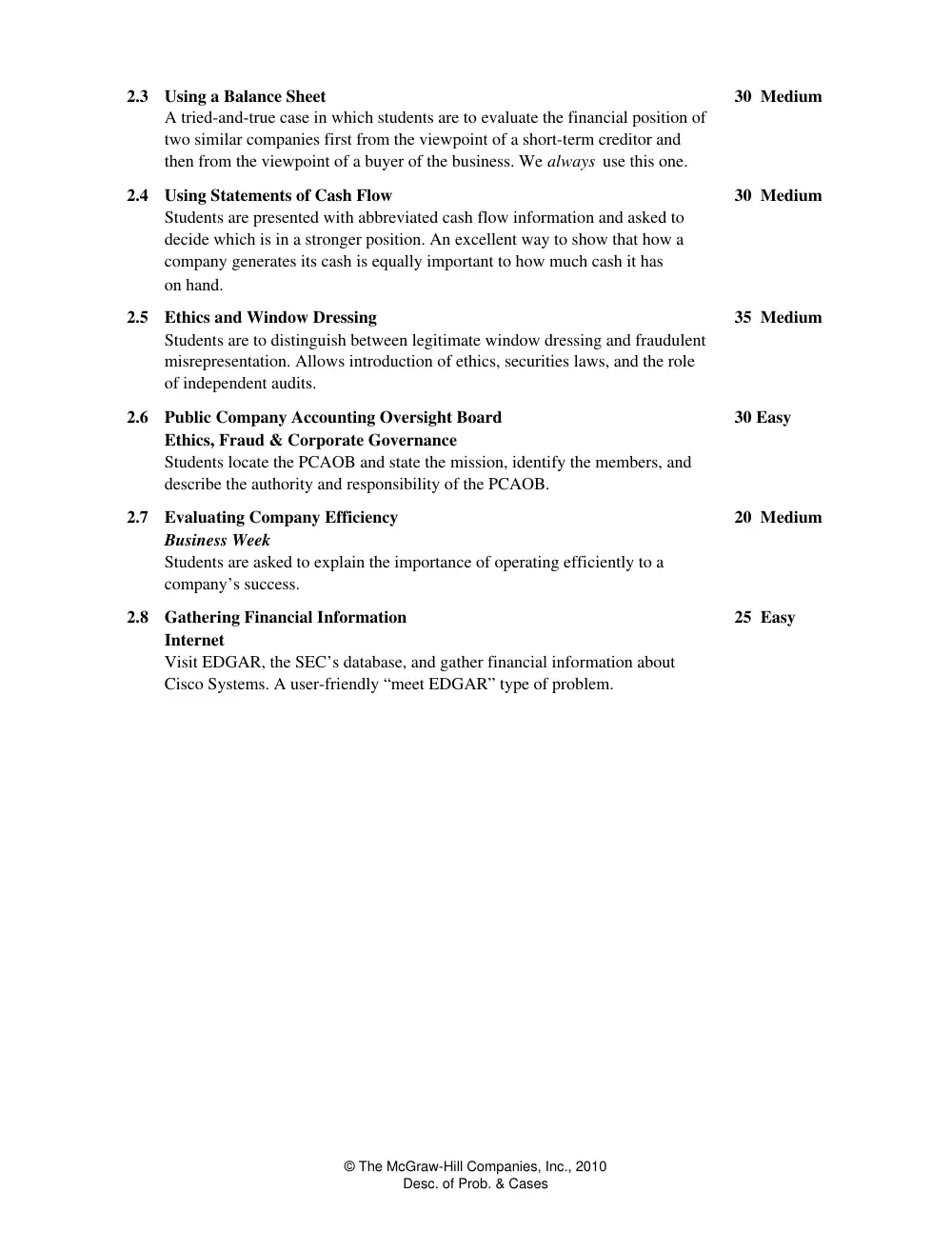
Using a Balance Sheet
Using Statements of Cash Flow
on hand.
Ethics and Window Dressing
2.6
Public Company Accounting Oversight Board
30 Easy
Ethics, Fraud & Corporate Governance
Evaluating Company Efficiency
Business Week
Gathering Financial Information
Internet
2.5
2.3
2.4
Students locate the PCAOB and state the mission, identify the members, and
describe the authority and responsibility of the PCAOB.
30 Medium
A tried-and-true case in which students are to evaluate the financial position of
two similar companies first from the viewpoint of a short-term creditor and
then from the viewpoint of a buyer of the business. We always use this one.
35 Medium
Students are presented with abbreviated cash flow information and asked to
decide which is in a stronger position. An excellent way to show that how a
company generates its cash is equally important to how much cash it has
Students are to distinguish between legitimate window dressing and fraudulent
misrepresentation. Allows introduction of ethics, securities laws, and the role
of independent audits.
30 Medium
2.8
25 Easy
Students are asked to explain the importance of operating efficiently to a
company’s success.
Visit EDGAR, the SEC’s database, and gather financial information about
Cisco Systems. A user-friendly “meet EDGAR” type of problem.
2.7
20 Medium
© The McGraw-Hill Companies, Inc., 2010
Desc. of Prob. & Cases
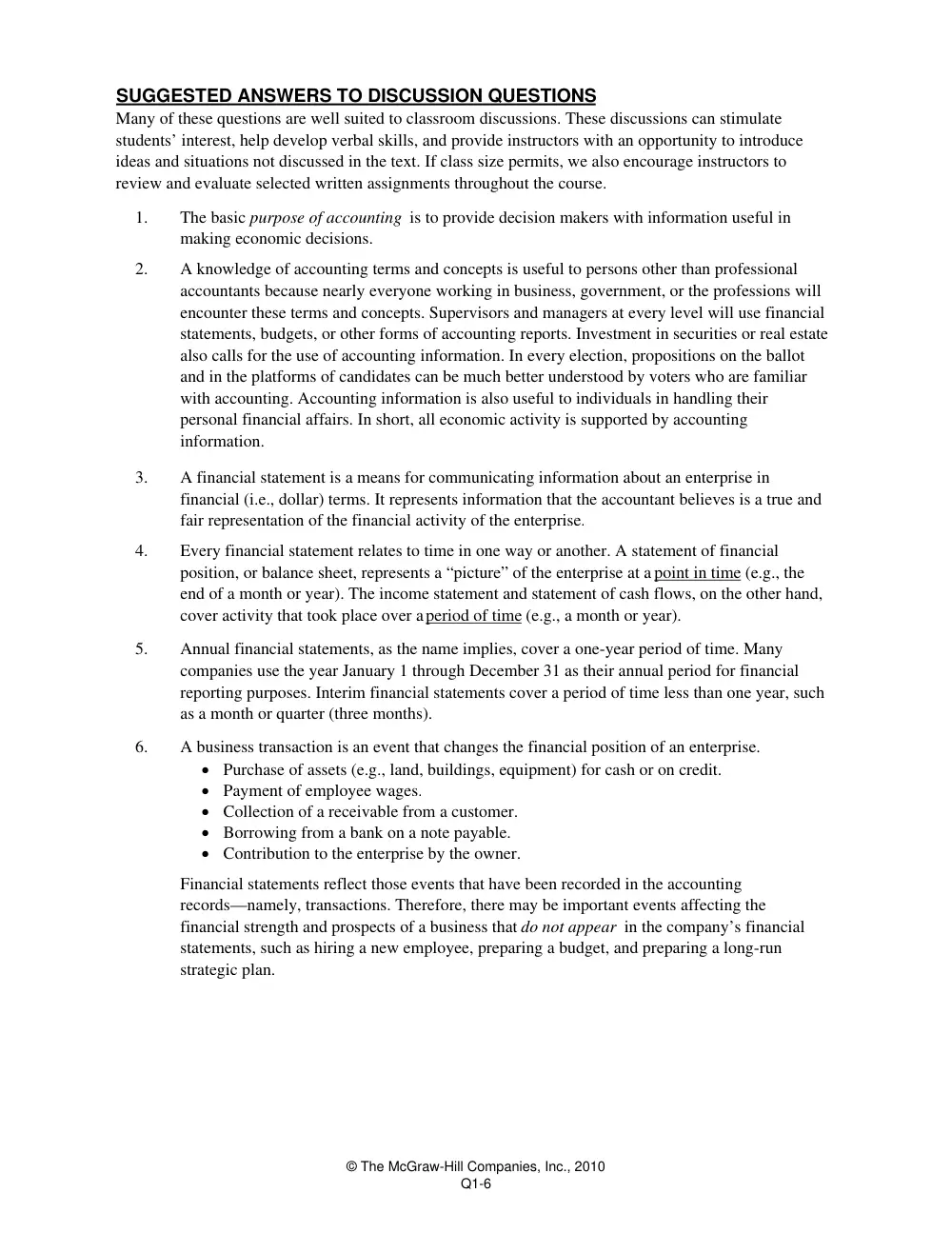
1.
2.
3.
4.
5.
A financial statement is a means for communicating information about an enterprise in
financial (i.e., dollar) terms. It represents information that the accountant believes is a true and
fair representation of the financial activity of the enterprise.
Every financial statement relates to time in one way or another. A statement of financial
position, or balance sheet, represents a “picture” of the enterprise at a point in time (e.g., the
end of a month or year). The income statement and statement of cash flows, on the other hand,
cover activity that took place over a period of time (e.g., a month or year).
Annual financial statements, as the name implies, cover a one-year period of time. Many
companies use the year January 1 through December 31 as their annual period for financial
reporting purposes. Interim financial statements cover a period of time less than one year, such
as a month or quarter (three months).
6.
Borrowing from a bank on a note payable.
Contribution to the enterprise by the owner.
SUGGESTED ANSWERS TO DISCUSSION QUESTIONS
Many of these questions are well suited to classroom discussions. These discussions can stimulate
students’ interest, help develop verbal skills, and provide instructors with an opportunity to introduce
ideas and situations not discussed in the text. If class size permits, we also encourage instructors to
review and evaluate selected written assignments throughout the course.
The basic purpose of accounting is to provide decision makers with information useful in
making economic decisions.
A knowledge of accounting terms and concepts is useful to persons other than professional
accountants because nearly everyone working in business, government, or the professions will
encounter these terms and concepts. Supervisors and managers at every level will use financial
statements, budgets, or other forms of accounting reports. Investment in securities or real estate
also calls for the use of accounting information. In every election, propositions on the ballot
and in the platforms of candidates can be much better understood by voters who are familiar
with accounting. Accounting information is also useful to individuals in handling their
personal financial affairs. In short, all economic activity is supported by accounting
information.
Financial statements reflect those events that have been recorded in the accounting
records—namely, transactions. Therefore, there may be important events affecting the
financial strength and prospects of a business that do not appear in the company’s financial
statements, such as hiring a new employee, preparing a budget, and preparing a long-run
strategic plan.
A business transaction is an event that changes the financial position of an enterprise.
Purchase of assets (e.g., land, buildings, equipment) for cash or on credit.
Payment of employee wages.
Collection of a receivable from a customer.
© The McGraw-Hill Companies, Inc., 2010
Q1-6
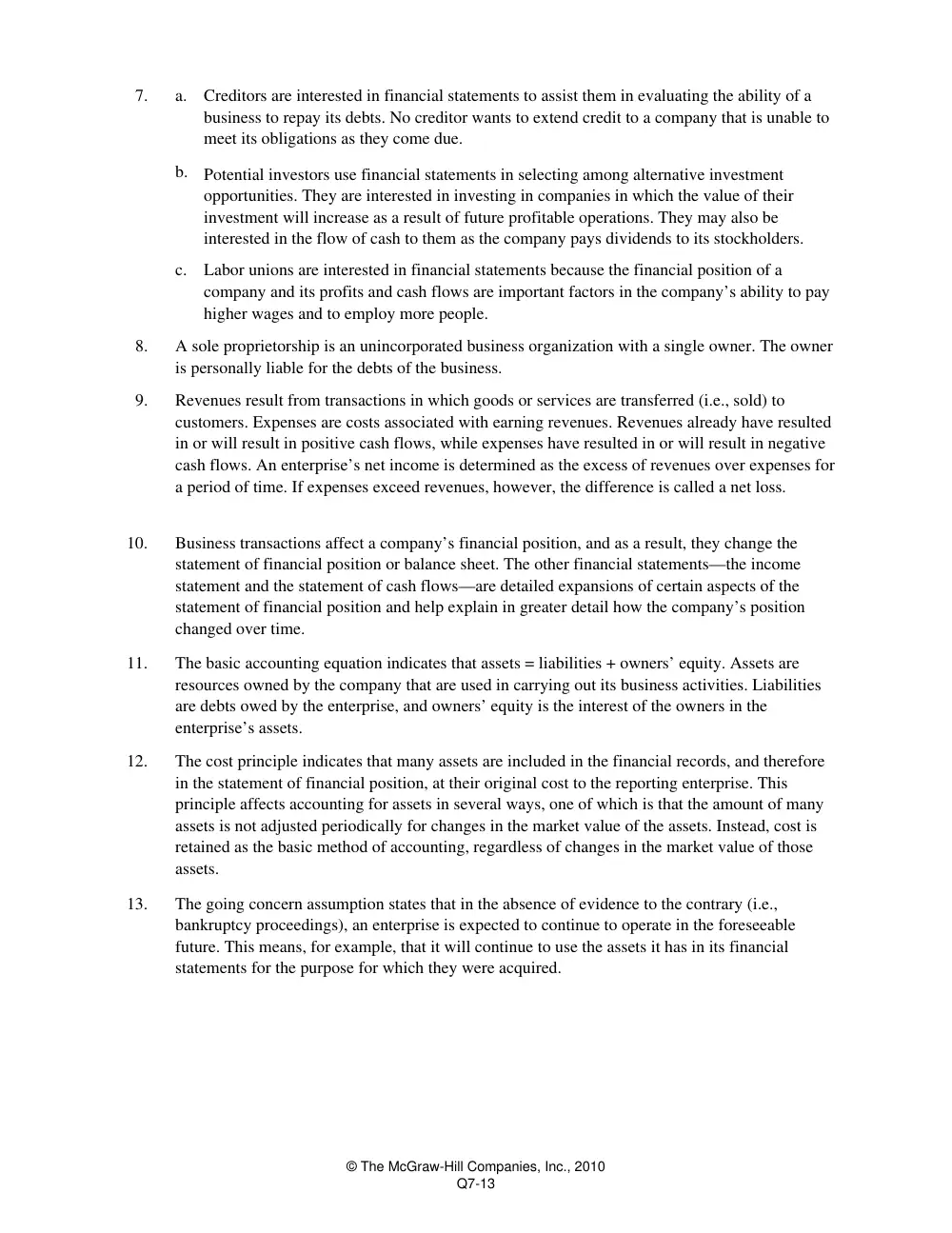
7.
a.
b.
c.
8.
9.
10.
11.
12.
13.
Creditors are interested in financial statements to assist them in evaluating the ability of a
business to repay its debts. No creditor wants to extend credit to a company that is unable to
meet its obligations as they come due.
Potential investors use financial statements in selecting among alternative investment
opportunities. They are interested in investing in companies in which the value of their
investment will increase as a result of future profitable operations. They may also be
interested in the flow of cash to them as the company pays dividends to its stockholders.
Labor unions are interested in financial statements because the financial position of a
company and its profits and cash flows are important factors in the company’s ability to pay
higher wages and to employ more people.
A sole proprietorship is an unincorporated business organization with a single owner. The owner
is personally liable for the debts of the business.
Revenues result from transactions in which goods or services are transferred (i.e., sold) to
customers. Expenses are costs associated with earning revenues. Revenues already have resulted
in or will result in positive cash flows, while expenses have resulted in or will result in negative
cash flows. An enterprise’s net income is determined as the excess of revenues over expenses for
a period of time. If expenses exceed revenues, however, the difference is called a net loss.
The cost principle indicates that many assets are included in the financial records, and therefore
in the statement of financial position, at their original cost to the reporting enterprise. This
principle affects accounting for assets in several ways, one of which is that the amount of many
assets is not adjusted periodically for changes in the market value of the assets. Instead, cost is
retained as the basic method of accounting, regardless of changes in the market value of those
assets.
The going concern assumption states that in the absence of evidence to the contrary (i.e.,
bankruptcy proceedings), an enterprise is expected to continue to operate in the foreseeable
future. This means, for example, that it will continue to use the assets it has in its financial
statements for the purpose for which they were acquired.
Business transactions affect a company’s financial position, and as a result, they change the
statement of financial position or balance sheet. The other financial statements—the income
statement and the statement of cash flows—are detailed expansions of certain aspects of the
statement of financial position and help explain in greater detail how the company’s position
changed over time.
The basic accounting equation indicates that assets = liabilities + owners’ equity. Assets are
resources owned by the company that are used in carrying out its business activities. Liabilities
are debts owed by the enterprise, and owners’ equity is the interest of the owners in the
enterprise’s assets.
© The McGraw-Hill Companies, Inc., 2010
Q7-13
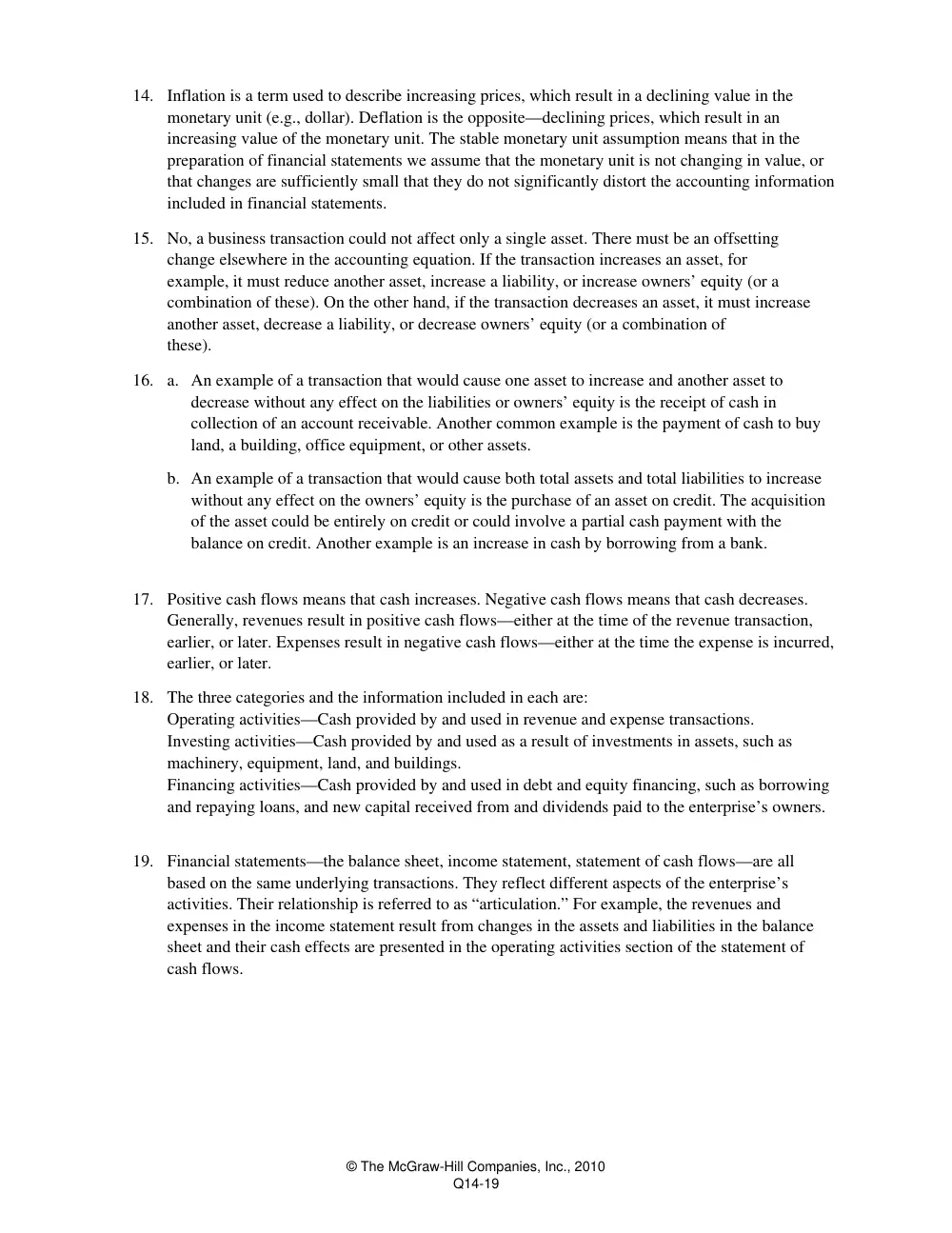
14.
15.
16. a.
b.
17.
18.
19.
Inflation is a term used to describe increasing prices, which result in a declining value in the
monetary unit (e.g., dollar). Deflation is the opposite—declining prices, which result in an
increasing value of the monetary unit. The stable monetary unit assumption means that in the
preparation of financial statements we assume that the monetary unit is not changing in value, or
that changes are sufficiently small that they do not significantly distort the accounting information
included in financial statements.
No, a business transaction could not affect only a single asset. There must be an offsetting
change elsewhere in the accounting equation. If the transaction increases an asset, for
example, it must reduce another asset, increase a liability, or increase owners’ equity (or a
combination of these). On the other hand, if the transaction decreases an asset, it must increase
another asset, decrease a liability, or decrease owners’ equity (or a combination of
these).
An example of a transaction that would cause one asset to increase and another asset to
decrease without any effect on the liabilities or owners’ equity is the receipt of cash in
collection of an account receivable. Another common example is the payment of cash to buy
land, a building, office equipment, or other assets.
Operating activities—Cash provided by and used in revenue and expense transactions.
Investing activities—Cash provided by and used as a result of investments in assets, such as
machinery, equipment, land, and buildings.
Financial statements—the balance sheet, income statement, statement of cash flows—are all
based on the same underlying transactions. They reflect different aspects of the enterprise’s
activities. Their relationship is referred to as “articulation.” For example, the revenues and
expenses in the income statement result from changes in the assets and liabilities in the balance
sheet and their cash effects are presented in the operating activities section of the statement of
cash flows.
An example of a transaction that would cause both total assets and total liabilities to increase
without any effect on the owners’ equity is the purchase of an asset on credit. The acquisition
of the asset could be entirely on credit or could involve a partial cash payment with the
balance on credit. Another example is an increase in cash by borrowing from a bank.
Positive cash flows means that cash increases. Negative cash flows means that cash decreases.
Generally, revenues result in positive cash flows—either at the time of the revenue transaction,
earlier, or later. Expenses result in negative cash flows—either at the time the expense is incurred,
earlier, or later.
The three categories and the information included in each are:
Financing activities—Cash provided by and used in debt and equity financing, such as borrowing
and repaying loans, and new capital received from and dividends paid to the enterprise’s owners.
© The McGraw-Hill Companies, Inc., 2010
Q14-19
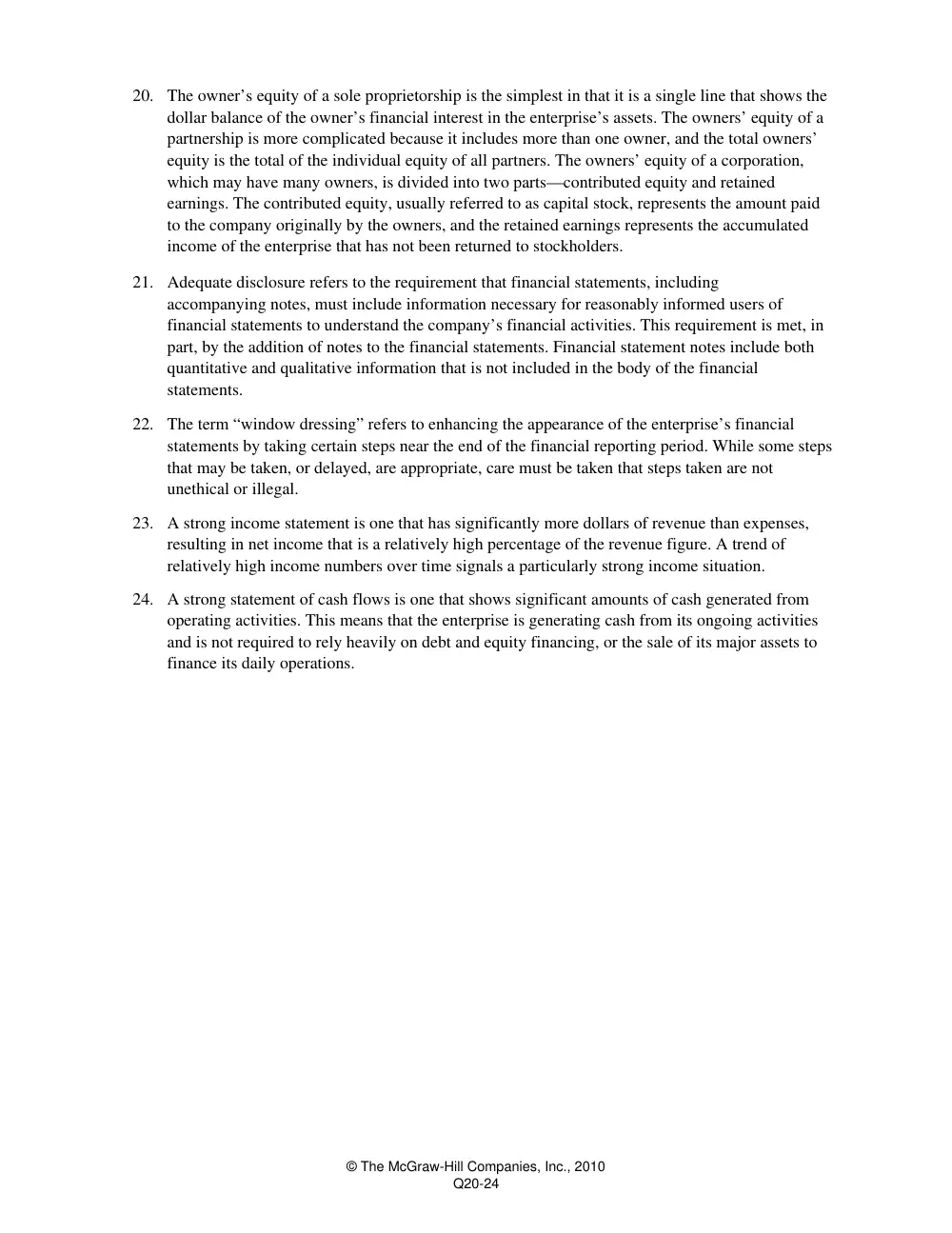
20.
21.
22.
23.
24.
A strong income statement is one that has significantly more dollars of revenue than expenses,
resulting in net income that is a relatively high percentage of the revenue figure. A trend of
relatively high income numbers over time signals a particularly strong income situation.
A strong statement of cash flows is one that shows significant amounts of cash generated from
operating activities. This means that the enterprise is generating cash from its ongoing activities
and is not required to rely heavily on debt and equity financing, or the sale of its major assets to
finance its daily operations.
The owner’s equity of a sole proprietorship is the simplest in that it is a single line that shows the
dollar balance of the owner’s financial interest in the enterprise’s assets. The owners’ equity of a
partnership is more complicated because it includes more than one owner, and the total owners’
equity is the total of the individual equity of all partners. The owners’ equity of a corporation,
which may have many owners, is divided into two parts—contributed equity and retained
earnings. The contributed equity, usually referred to as capital stock, represents the amount paid
to the company originally by the owners, and the retained earnings represents the accumulated
income of the enterprise that has not been returned to stockholders.
Adequate disclosure refers to the requirement that financial statements, including
accompanying notes, must include information necessary for reasonably informed users of
financial statements to understand the company’s financial activities. This requirement is met, in
part, by the addition of notes to the financial statements. Financial statement notes include both
quantitative and qualitative information that is not included in the body of the financial
statements.
The term “window dressing” refers to enhancing the appearance of the enterprise’s financial
statements by taking certain steps near the end of the financial reporting period. While some steps
that may be taken, or delayed, are appropriate, care must be taken that steps taken are not
unethical or illegal.
© The McGraw-Hill Companies, Inc., 2010
Q20-24
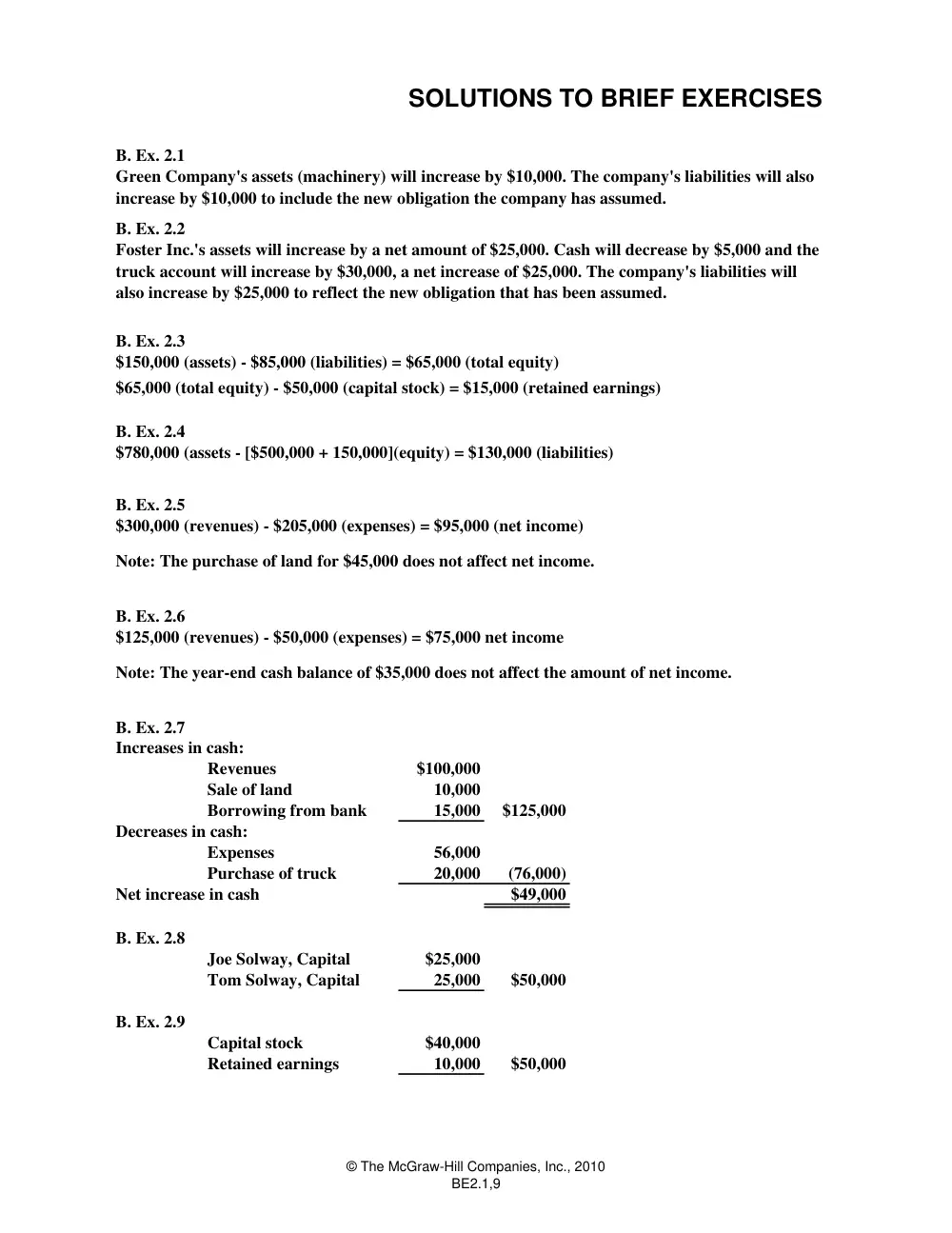
B. Ex. 2.1
B. Ex. 2.2
B. Ex. 2.3
B. Ex. 2.4
B. Ex. 2.5
B. Ex. 2.6
B. Ex. 2.7
Increases in cash:
Revenues
$100,000
Sale of land
10,000
Borrowing from bank
15,000
$125,000
Decreases in cash:
Expenses
56,000
Purchase of truck
20,000
(76,000)
Net increase in cash
$49,000
B. Ex. 2.8
Joe Solway, Capital
$25,000
Tom Solway, Capital
25,000
$50,000
B. Ex. 2.9
Capital stock
$40,000
Retained earnings
10,000
$50,000
$65,000 (total equity) - $50,000 (capital stock) = $15,000 (retained earnings)
SOLUTIONS TO BRIEF EXERCISES
Green Company's assets (machinery) will increase by $10,000. The company's liabilities will also
increase by $10,000 to include the new obligation the company has assumed.
Foster Inc.'s assets will increase by a net amount of $25,000. Cash will decrease by $5,000 and the
truck account will increase by $30,000, a net increase of $25,000. The company's liabilities will
also increase by $25,000 to reflect the new obligation that has been assumed.
$150,000 (assets) - $85,000 (liabilities) = $65,000 (total equity)
$125,000 (revenues) - $50,000 (expenses) = $75,000 net income
Note: The year-end cash balance of $35,000 does not affect the amount of net income.
$780,000 (assets - [$500,000 + 150,000](equity) = $130,000 (liabilities)
$300,000 (revenues) - $205,000 (expenses) = $95,000 (net income)
Note: The purchase of land for $45,000 does not affect net income.
© The McGraw-Hill Companies, Inc., 2010
BE2.1,9
B. Ex. 2.10
50,000
$
Add:
10,000
25,000
85,000
$
Net income for 2009………………………………
Balance, December 31, 2009…………………………………
The end-of-year balance of owner’s equity in the balance sheet is $85,000.
This amount articulates with the amount of net income in the income
statement because net income is added to the amount of beginning owner’s
equity, plus additional investment, to determine the ending balance that
appears in the December 31, balance sheet. The accounting equation stays in
balance because the amount of net income is reflected in changes in the
balances of various assets and liabilities that are also presented in the
balance sheet.
John Franklin, owner’s equity:
Balance, January 1, 2009………………………………………
Investment during 2009…………………………
© The McGraw-Hill Companies, Inc., 2010
BE2.10
Ex. 2.1
a.
1.
2.
b.
1.
2.
Liabilities:
$69,000
$288,000
70,000
26,000
14,000
$314,000
70,000
Owners’ equity:
80,000
92,000
165,000
62,000
$468,000
$468,000
Liabilities & Owners' Equity
Notes payable ……………………
Accounts payable …………………
Total liabilities………………..
Capital stock……………………..
SOLUTIONS TO EXERCISES
Assets
Cash ……………………….
Accounts receivable ………
Supplies ……………………
Land ………………………
Building …………………..
Automobiles ………………
Total ………………………
Total…………………………………
Retained earnings………………..
Note to instructor: You may wish to expand this solution to include intangible assets, such as
the team’s league franchise, and player contracts, the right to receive the future services of a
given player. (Player contracts only appear as an asset if they have a cost—that is, if they were
purchased from other teams. Advance payments to players usually are shown as prepaid
expenses.) We address intangible assets in Chapter 9, but the concept is consistent with the
discussion of assets in Chapter 2.
Liabilities are existing debts and other obligations of the entity.
Among the liabilities of American Airlines, we might expect to find accounts
payable, notes payable (or mortgages or bonds payable) stemming from
purchases of aircraft, salaries payable, interest payable, rent payable (for
space in airports), and income taxes payable.
The balance sheet of a professional sports team might include accounts
payable, rent payable (for the stadium), salaries payable, interest payable, and
income taxes payable.
Note to instructor: In a classroom discussion, you might want to point out that both an airline
and a professional sports team may have liabilities for unearned revenue. The airline sells
many tickets in advance, thus incurring an obligation to render services (flights) or to refund
the customers’ money. A sports team has a similar obligation with respect to advance sales of
season tickets. We discuss unearned revenue in Chapter 4, but the concept can be introduced
earlier at the instructor’s discretion.
Ex. 2.2
DIXIE TRANSPORTATION SERVICE
Balance Sheet
February 28, 2009
Assets are economic resources owned by the business entity.
Among the assets of American Airlines we might expect to find
investments, accounts receivable (say, from travel agents), fuel (in
storage), maintenance supplies, aircraft, and various types of equipment.
The company also owns land and buildings—as, for example, its corporate
headquarters.
Among the assets of a professional sports team are investments (in stocks and
bonds), notes receivable (often from players), training equipment, supplies,
and office furniture. (The balance sheet of a professional sports team usually
does not include land or buildings, as they generally do not own the stadiums
in which they play.)
© The McGraw-Hill Companies, Inc., 2010
E2.1,2
$36,300
Liabilities:
56,700
Notes payable ……………………………
$207,000
90,000
Accounts payable ………………………
43,800
210,000
$250,800
12,400
Owners’ equity:
Capital stock ……………………………
75,000
79,600
$405,400
$405,400
Ex. 2.4
a.
b.
c.
Ex. 2.5
a.
b.
c.
The amount of retained earnings is calculated as the difference between total assets and
liabilities plus capital stock: $405,400 – ($250,800 + $75,000) = $79,600
The supplies should be presented at $1,700 in World-Wide’s balance sheet.
Presenting the supplies at their estimated liquidation value violates the assumption
that World-Wide is a going concern, and will use these supplies in business
operations, rather than sell them on the open market. The $500 amount also violates
the objectivity principle, as it is largely a matter of personal opinion, and also the cost
principle.
$236,000: Assets $578,000 liabilities $342,000 = owners’ equity $236,000
$1,132,500: Liabilities $562,500 + owners’ equity $570,000 = assets $1,132,500
$120,300: Assets $307,500 owners’ equity $187,200 = liabilities $120,300
The presentation of the two land parcels at a combined value of $320,000 conforms
to generally accepted accounting principles. This treatment illustrates both the cost
principle and the stable-dollar assumption.
The presentation of the computer system at $14,000 in the December 31
balance sheet conforms to generally accepted accounting principles, as this is
the cost of the system, and at the balance sheet date, it was an asset owned by
the company. The retail value of $20,000 is not presented in the balance sheet, as
this amount is not the cost incurred by the entity, nor is it an objective
measurement.
However, the company’s failure to disclose the loss of the equipment subsequent to
the balance sheet date may violate the principle of adequate disclosure. To properly
interpret the company’s balance sheet, users may need to be aware that this asset no
longer exists. Several issues must be considered in deciding whether or not disclosure
of the burglary loss is necessary. For example, was the asset insured? And is a
$14,000 asset significant (material) in relation to the assets and operations of this
business? Is this amount large enough that it might impact investors’ and creditors’
decisions regarding the company?
Balance Sheet
December 31, 2009
Total…………………………………………
Retained earnings ………………………
Total …………………………
Total liabilities…………………………
Liabilities & Owners' Equity
Cash …………………………
Ex. 2.3
MERCER COMPANY
Assets
Accounts receivable …………
Land …………………………
Building ……………………..
Office equipment……………
© The McGraw-Hill Companies, Inc., 2010
E2.3,4,5
Ex. 2.6
Assets
=
Liabilities
+
Owners’
I
I
NE
NE*
NE
NE
D
D
NE
D
D
NE
I
NE
I
I
I
NE
I
NE
I
NE*
NE
NE
NE*
NE
NE
Ex. 2.7
a.
b.
c.
d.
e.
Ex. 2.8
a.
$ 390,000
$ 240,000
150,000
$ 390,000
$ 250,000
140,000
$ 390,000
Retained earnings ……………………………………………………
Total stockholders' equity ………………………………………
*Capital stock = 25 $10,000. Retained earnings = $390,000 capital stock.
Total …………………………………………………………….
*Yato’s capital = $390,000 Small’s capital, $240,000
(3) Stockholders' equity:
Capital Stock …………………………………………………………
Johanna Small, capital ………………………………………….
*$850,000 in assets $460,000 in liabilities
(2) Partners' equity:
f
g
h
i
Note to instructor: These are examples, but many others exist.
(1) Owners' equity
Transaction
a
b
c
d
e
Johanna Small, capital …………………………………………….
Mikki Yato, capital …………………………………………………
*Could be I/D offsetting
The purchase of office equipment (or any other asset) on credit will cause an increase
in the asset (office equipment) and an increase in a liability.
The cash payment of an account payable or note payable will cause a decrease in the
asset cash and a decrease in the liability paid.
The collection of an account receivable will cause an increase in one asset (cash) and a
decrease in another asset (accounts receivable). Other examples include the purchase
of land for cash, and the sale of land for cash or on credit.
The investment of cash in the business by the owners will cause an increase in an asset
(cash) and an increase in the owners’ equity.
The purchase of an automobile (or other asset) paying part of the cost in cash and
promising to pay the remainder at a later time would cause an increase in one asset
(automobile), a decrease in another asset (cash), and an increase in a liability by the
amount of the unpaid portion.
© The McGraw-Hill Companies, Inc., 2010
E2.6,7,8
b.
Ex. 2.9
a.
b.
c.
d.
Ex. 2.10
a.
b.
The situations encountered in the practice of accounting and auditing are too
complex and too varied for all specific answers to be set forth in a body of official
rules. Therefore, individual accountants must resolve many situations, based upon
their general knowledge of accounting, their experience, and their ethical
standards—in short, their professional judgment.
Accountants must rely upon their professional judgment in such matters as
determining (three required) (1) how to record an unusual transaction that is not
discussed in accounting literature, (2) whether or not a specific situation requires
disclosure, (3) what information will be most useful to specific decision makers, (4)
ho