
CSC 426 Chapter 02, Fall 2011
Notre Dame University–Louaize · Principles of Database Systems · 26 pages · Dr. Maya Samaha
Showing the first 10 of 26 pages. Download the PDF to see all of it.
More CSC 426 files
Show the text of this chapter
Chapter 2
Overview of Database Languages and
Architectures
Data Models, Schemas, and Instances
The Database System Environment
Centralized and Client/Server Architectures
for DBMSs
Classification of Database Management
Systems
Chapter 2 Outline
Basic client/server DBMS architecture
◦ Client module
◦ Server module
Database System Concepts
and Architecture
Data abstraction
◦ Suppression of details of data organization and
storage
◦ Highlighting of the essential features for an improved
understanding of data
Data Models, Schemas, and
Instances
Data model
◦ Collection of concepts that describe the structure of a
database
◦ Provides means to achieve data abstraction
◦ Basic operations
• Specify retrievals and updates on the database
◦ Dynamic aspect or behavior of a database
application
• Allows the database designer to specify a set of valid
operations allowed on database objects
Data Models, Schemas, and
Instances (cont'd.)
Entity
◦ Represents a real-world object or concept
Attribute
◦ Represents some property of interest
◦ Further describes an entity
Relationship among two or more entities
◦ Represents an association among the entities
◦ Entity-Relationship model
Categories of Data Models
(cont'd.)
Relational data model
◦ Used most frequently in traditional commercial
DBMSs
Categories of Data Models
(cont'd.)
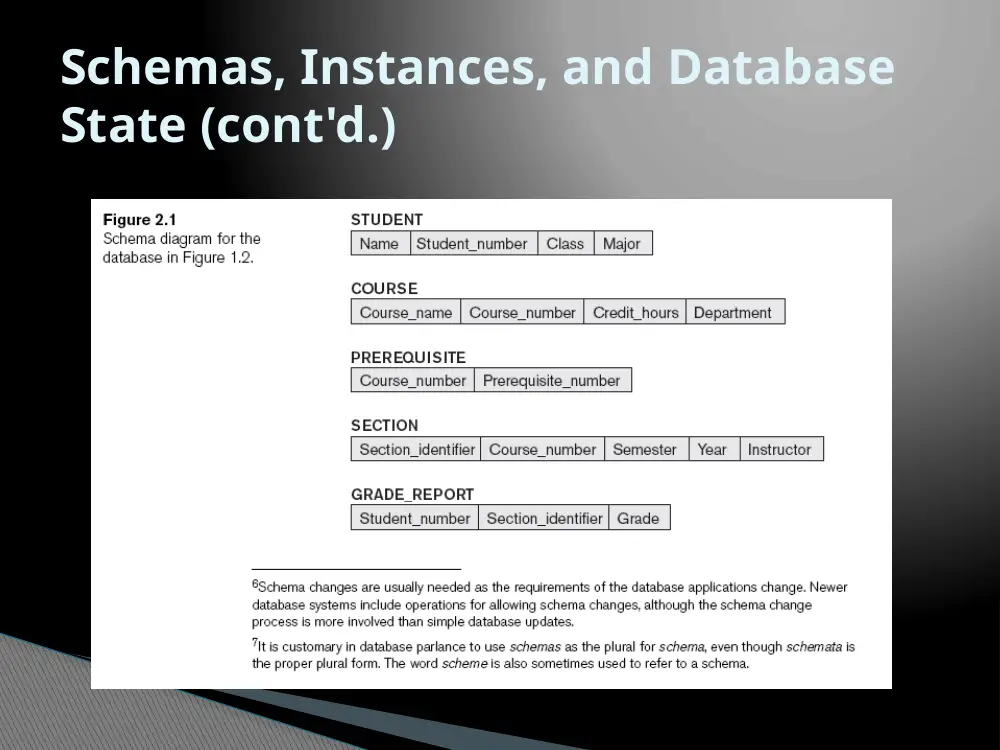
Database schema
◦ Description of a database
Schema diagram
◦ Displays selected aspects of schema
Database state or snapshot
◦ Data in database at a particular moment in time
Schemas, Instances, and Database
State
Schemas, Instances, and Database
State (cont'd.)
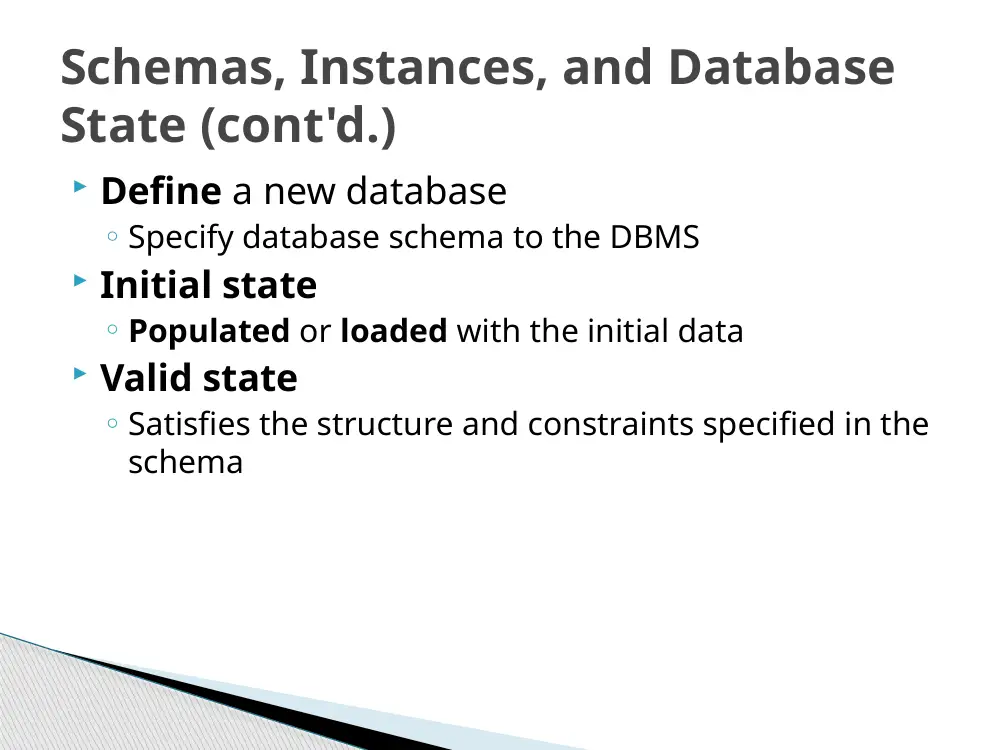
Define a new database
◦ Specify database schema to the DBMS
Initial state
◦ Populated or loaded with the initial data
Valid state
◦ Satisfies the structure and constraints specified in the
schema
Schemas, Instances, and Database
State (cont'd.)
Schema evolution
◦ Changes applied to schema as application
requirements change
Schemas, Instances, and Database
State (cont'd.)
Loading
◦ Load existing data files
Backup
◦ Creates a backup copy of the database
Database System Utilities
Database storage reorganization
◦ Reorganize a set of database files into different file
organizations
Performance monitoring
◦ Monitors database usage and provides statistics to
the DBA
Database System Utilities
(cont'd.)
Centralized DBMSs Architecture
◦ All DBMS functionality, application program
execution, and user interface processing carried out
on one machine
Centralized and Client/Server
Architectures for DBMSs
Servers with specific functionalities
◦ File server
• Maintains the files of the client machines.
◦ Printer server
• Connected to various printers; all print requests by the
clients are forwarded to this machine
◦ Web servers or e-mail servers
Basic Client/Server
Architectures
Client machines
◦ Provide user with:
• Appropriate interfaces to utilize these servers
• Local processing power to run local applications
Basic Client/Server Architectures
(cont'd.)
Client
◦ User machine that provides user interface capabilities
and local processing
Server
◦ System containing both hardware and software
◦ Provides services to the client machines
• Such as file access, printing, archiving, or database
access
Basic Client/Server Architectures
(cont'd.)
Server handles
◦ Query and transaction functionality related to SQL
processing
Client handles
◦ User interface programs and application programs
Two-Tier Client/Server Architectures
for DBMSs
Open Database Connectivity (ODBC)
◦ Provides application programming interface (API)
◦ Allows client-side programs to call the DBMS
• Both client and server machines must have the necessary
software installed
JDBC
◦ Allows Java client programs to access one or more
DBMSs through a standard interface
Two-Tier Client/Server Architectures
(cont'd.)
Application server or Web server
◦ Adds intermediate layer between client and the
database server
◦ Runs application programs and stores business rules
N-tier
◦ Divide the layers between the user and the stored
data further into finer components
Three-Tier and n-Tier Architectures
for Web Applications
Data model
• Relational
• Object
• Hierarchical and network (legacy)
• Native XML DBMS
Number of users
• Single-user
• Multiuser
Classification of Database
Management Systems
Number of sites
• Centralized
• Distributed
• Homogeneous
• Heterogeneous
Cost
• Open source
• Different types of licensing
Classification of Database
Management Systems (cont'd.)
Concepts used in database systems
Main categories of data models
Interfaces provided by the DBMS
DBMS classification criteria:
◦ Data model, number of users, number of sties, access
paths, cost
Summary