
CSC 426 Chapter 14, Fall 2011
Notre Dame University–Louaize · Principles of Database Systems · 48 pages · Dr. Maya Samaha




Showing the first 10 of 48 pages. Download the PDF to see all of it.
More CSC 426 files
Show the text of this chapter
Chapter 14
Introduction to Normalization Using
Functional and Multivalued Dependencies
Chapter 14 Outline
Informal Design Guidelines for Relation
Schemas
Functional Dependencies
Normal Forms Based on Primary Keys
General Definitions of Second and Third
Normal Forms
Boyce-Codd Normal Form
Introduction
Levels at which we can discuss goodness of
relation schemas
Logical (or conceptual) level
Implementation (or physical storage) level
Approaches to database design:
Bottom-up or top-down
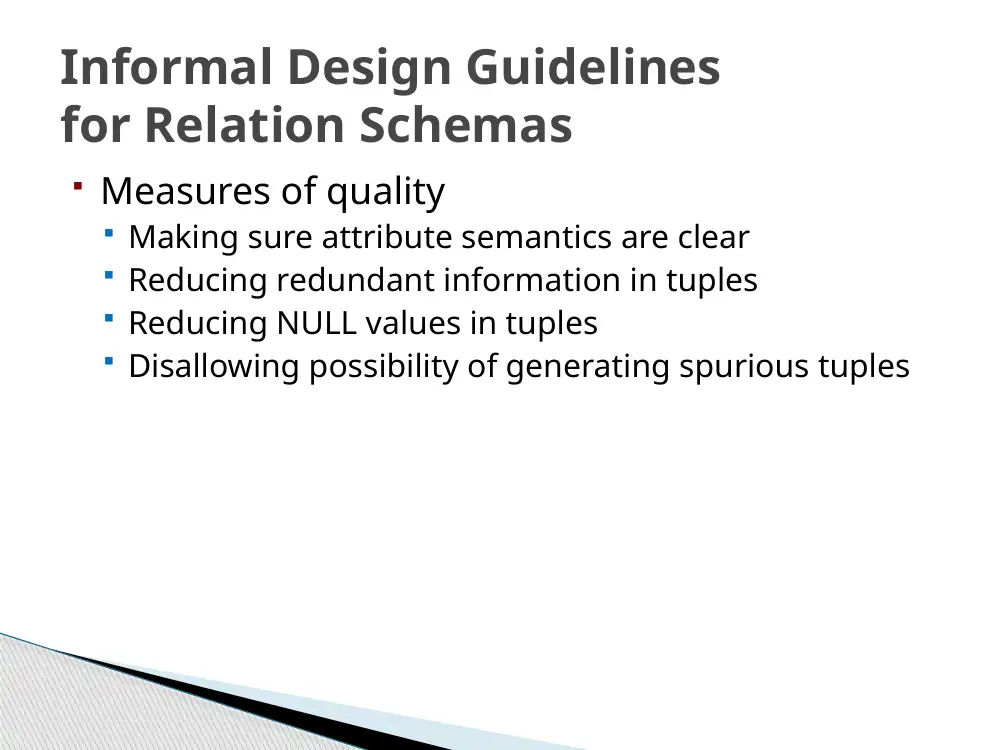
Informal Design Guidelines
for Relation Schemas
Measures of quality
Making sure attribute semantics are clear
Reducing redundant information in tuples
Reducing NULL values in tuples
Disallowing possibility of generating spurious tuples
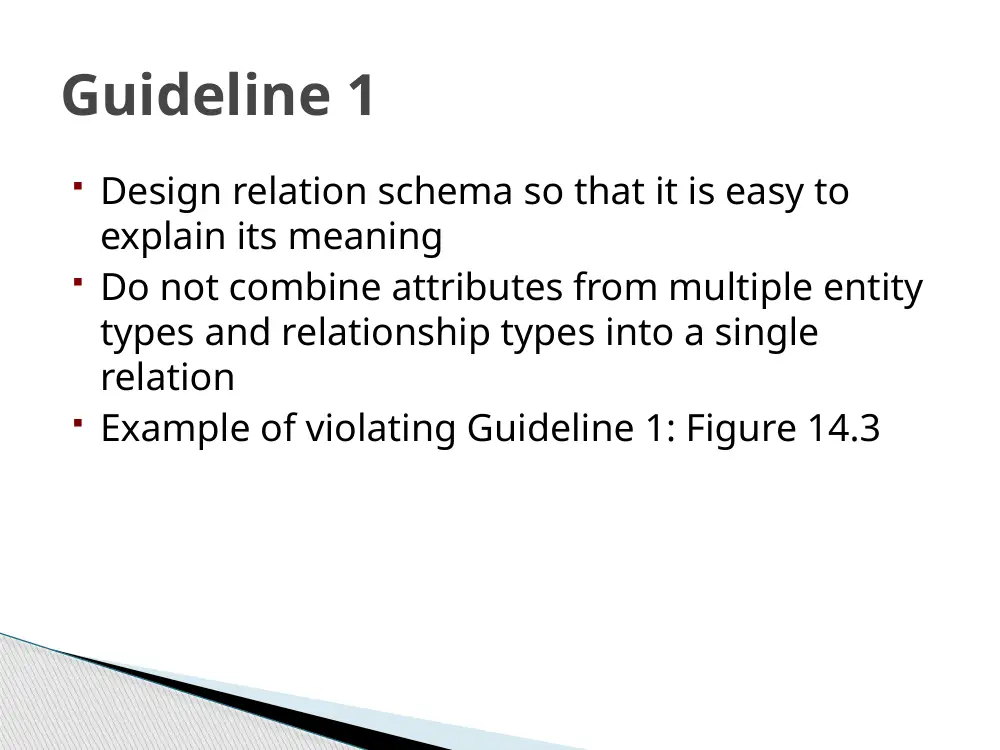
Guideline 1
Design relation schema so that it is easy to
explain its meaning
Do not combine attributes from multiple entity
types and relationship types into a single
relation
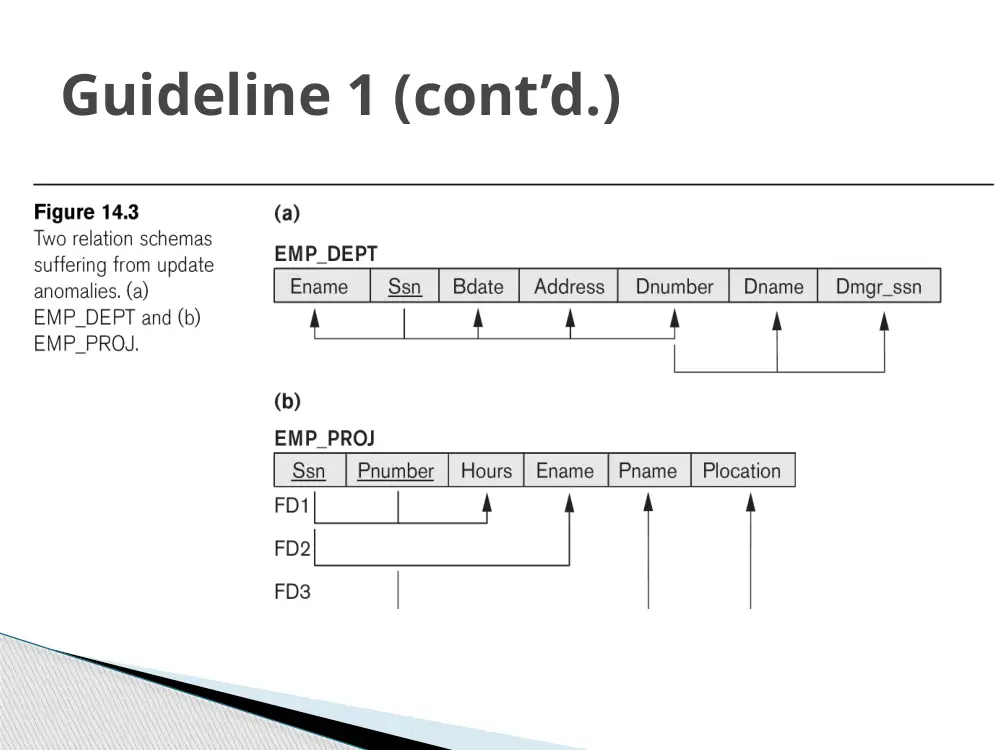
Example of violating Guideline 1: Figure 14.3
Guideline 1 (cont’d.)
Redundant Information in Tuples
and Update Anomalies
Grouping attributes into relation schemas
Significant effect on storage space
Storing natural joins of base relations leads to
update anomalies
Types of update anomalies:
Insertion
Deletion
Modification
Guideline 2
Design base relation schemas so that no
update anomalies are present in the relations
If any anomalies are present:
Note them clearly
Make sure that the programs that update the
database will operate correctly
Staff and DistributionCenter tables with
StaffDistributionCenter table
13
NULL Values in Tuples
May group many attributes together into a “fat”
relation
Can end up with many NULLs
Problems with NULLs
Wasted storage space
Problems understanding meaning
Guideline 3
Avoid placing attributes in a base relation
whose values may frequently be NULL
If NULLs are unavoidable:
Make sure that they apply in exceptional cases only,
not to a majority of tuples
Guideline 4
Design relation schemas to be joined with
equality conditions on attributes that are
appropriately related
Guarantees that no spurious tuples are generated
Avoid relations that contain matching
attributes that are not (foreign key, primary
key) combinations
Summary and Discussion of Design
Guidelines
Anomalies cause redundant work to be done
Waste of storage space due to NULLs
Difficulty of performing operations and joins
due to NULL values
Generation of invalid and spurious data during
joins
Functional Dependencies
Formal tool for analysis of relational schemas
Enables us to detect and describe some of the
above-mentioned problems in precise terms
Theory of functional dependency
Definition of Functional
Dependency
Constraint between two sets of attributes from
the database
Property of semantics or meaning of the
attributes
Legal relation states
Satisfy the functional dependency constraints
Definition of Functional
Dependency (cont’d.)
Given a populated relation
Cannot determine which FDs hold and which do not
Unless meaning of and relationships among
attributes known
Can state that FD does not hold if there are tuples
that show violation of such an FD
Normal Forms Based on Primary
Keys
Normalization process
Approaches for relational schema design
Perform a conceptual schema design using a
conceptual model then map conceptual design into a
set of relations
Design relations based on external knowledge
derived from existing implementation of files or
forms or reports
Normalization of Relations
Takes a relation schema through a series of
tests
Certify whether it satisfies a certain normal form
Proceeds in a top-down fashion
Normal form tests
Normalization of Relations
(cont’d.)
Properties that the relational schemas should
have:
Nonadditive join property
• Extremely critical
Dependency preservation property
• Desirable but sometimes sacrificed for other factors
Practical Use of Normal Forms
Normalization carried out in practice
Resulting designs are of high quality and meet the
desirable properties stated previously
Pays particular attention to normalization only up to
3NF, BCNF, or at most 4NF
Do not need to normalize to the highest
possible normal form
Definitions of Keys and Attributes
Participating in Keys
Definition of superkey and key
Candidate key
If more than one key in a relation schema
• One is primary key
• Others are secondary keys
First Normal Form
Part of the formal definition of a relation in the
basic (flat) relational model
Only attribute values permitted are single
atomic (or indivisible) values
Techniques to achieve first normal form
Remove attribute and place in separate relation
Expand the key
Use several atomic attributes
First Normal Form (cont’d.)
Does not allow nested relations
Each tuple can have a relation within it
To change to 1NF:
Remove nested relation attributes into a new relation
Propagate the primary key into it
Unnest relation into a set of 1NF relations
First normal form (1NF)
Only 1NF is critical in creating appropriate
tables for relational databases. All subsequent
normal forms are optional.
A table in which the intersection of every
column and record contains only one value.
31
DistributionCenter table is not in
1NF
32
Converting DistributionCenter table
to 1NF
33
Second Normal Form
Based on concept of full functional
dependency
Versus partial dependency
Second normalize into a number of 2NF
relations
Nonprime attributes are associated only with part of
primary key on which they are fully functionally
dependent
Third Normal Form
Based on concept of transitive dependency
Problematic FD
Left-hand side is part of primary key
Left-hand side is a nonkey attribute
Second normal form (2NF)
A table that is in 1NF and in which the values
of each non-primary-key column are
determined by the values in all the columns
that make up the primary key.
To assess whether a table breaks 2NF form
requires identification of the primary key
and functional dependencies associated
with that table.
2NF only applies to tables with composite
primary keys.
36
Functional dependency
Describes the relationship between columns
in a table and indicates how columns relate
to one another.
For example, consider a table with columns
a and b, where b is functionally dependent
on a (denoted a → b). If we know the value
of a, we find only one value of b in all the
records that has this value of a, at any
moment in time. However, for a given value
of b there may be several different values of
a.
37
Second normal form (2NF)
Formal definition of 2NF is a table that is in 1NF
and every non-primary-key column is fully
functional dependent on the primary key.
Full functional dependency indicates that if a
and b are columns of a table, b is fully
determined by a, if b is not determined by any
subset of a. If b is determined by a subset of a,
this is referred to as a partial dependency.
Identification of partial dependencies on the
primary key is evidence that a table is breaking
2NF and may suffer from update anomalies.
38
TempStaffAllocation table is not in
2NF
39
Converting TempStaffAllocation
table to 2NF
40
Third normal form (3NF)
A table that is in 1NF and 2NF and in which
the values in all non-primary-key column
can be determined from only the primary
key column(s) and no other columns.
The formal definition of 3NF is a table that
is in 1NF and 2NF and in which no non-
primary-key column is transitively
dependent on the primary key.
41
Third normal form (3NF)
A transitive dependency describes a
relationship between columns a, b, and c. If
a determines b (a
b) and b determines c (b
→
→ c), then c is transitively dependent on a via
b (provided that b or c does not determine
a).
Identification of transitive dependencies on
the primary key is evidence that a table is
breaking 3NF and may suffer from update
anomalies.
42
The StaffDistributionCenter table is
not in 3NF
43
Converting StaffDistributionCenter
table to 3NF
44
General Definitions of Second
and Third Normal Forms
More examples
Summary
Informal guidelines for good design
Functional dependency
Basic tool for analyzing relational schemas
Normalization:
1NF, 2NF, 3NF,