
CSC 426 Chapter 09, Fall 2011
Notre Dame University–Louaize · Principles of Database Systems · 36 pages · Dr. Maya Samaha


Showing the first 10 of 36 pages. Download the PDF to see all of it.
More CSC 426 files
Show the text of this chapter
Chapter 9
UML for Database Application Design
1
Objectives
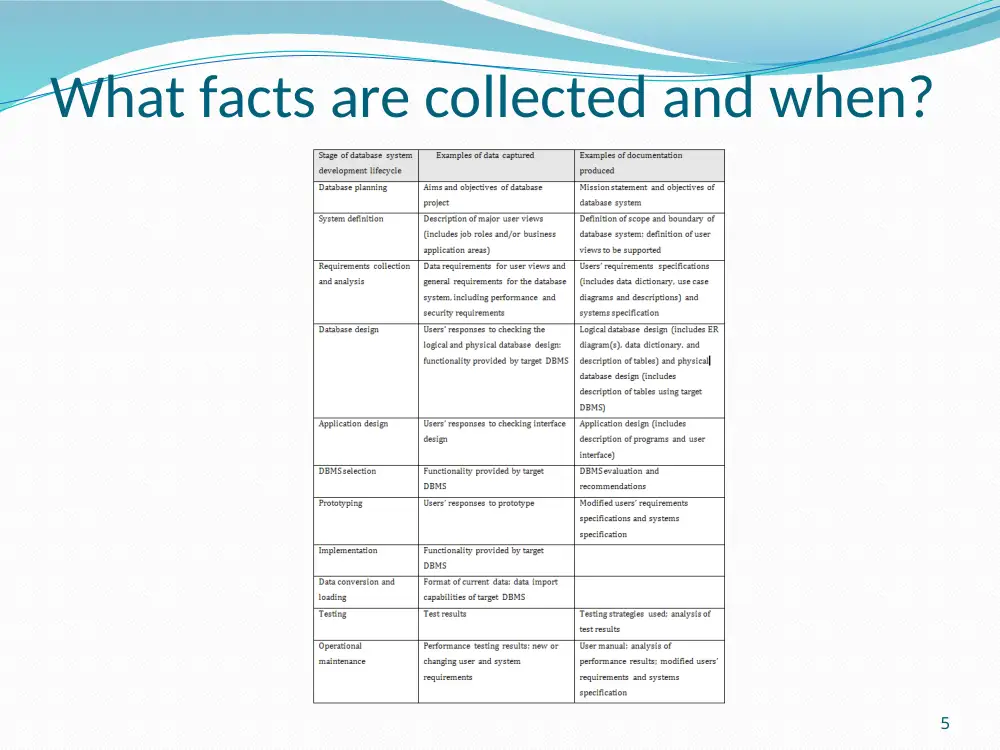
When fact-finding techniques are used in the
database system development lifecycle.
The types of facts collected throughout the
database system development lifecycle.
The types of documentation produced
throughout the database system development
lifecycle.
The most commonly used fact-finding
techniques.
How to use each fact-finding technique and the
advantages and disadvantages of each.
2
Objectives
About a Web-based DVD rental company called
StayHome Online Rentals.
How to use fact-finding techniques in the
database planning, systems definition, and
requirements collection and analysis stages of
the database system development lifecycle.
Examples of the types of documentation created
in the database planning, systems definition, and
requirements collection and analysis stages of
the database system development lifecycle.
3
Fact-finding
The formal process of using techniques such as
interviews and questionnaires to collect facts
about systems, requirements, and preferences.
Many occasions for fact-finding during the
database system development lifecycle.
Particularly crucial to the early stages of the
lifecycle, including the database planning,
system definition, and requirements collection
and analysis stages.
4
What facts are collected and when?
5
Fact-finding techniques
A database developer normally uses several
fact-finding techniques during a single
database project, including:
Examining documentation,
Interviewing,
Observing the business in operation,
Research,
Questionnaires.
6
Examining documentation
Examining documents, forms, reports, and files
associated with the current system, is a good way
to quickly gain some understanding of the
system.
7
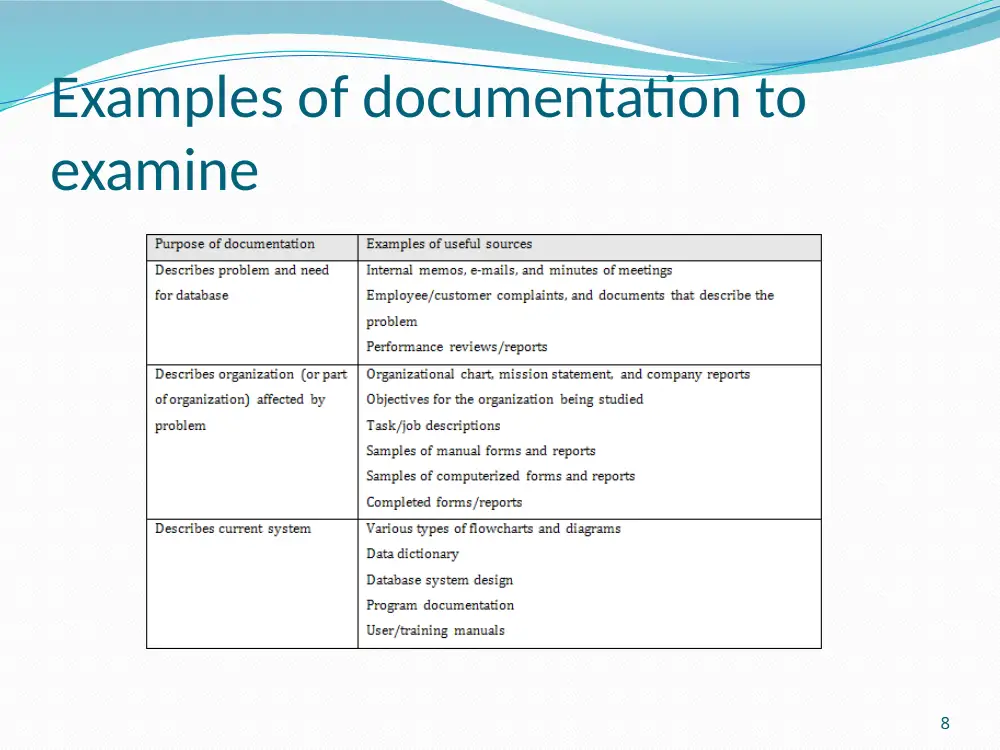
Examples of documentation to
examine
8
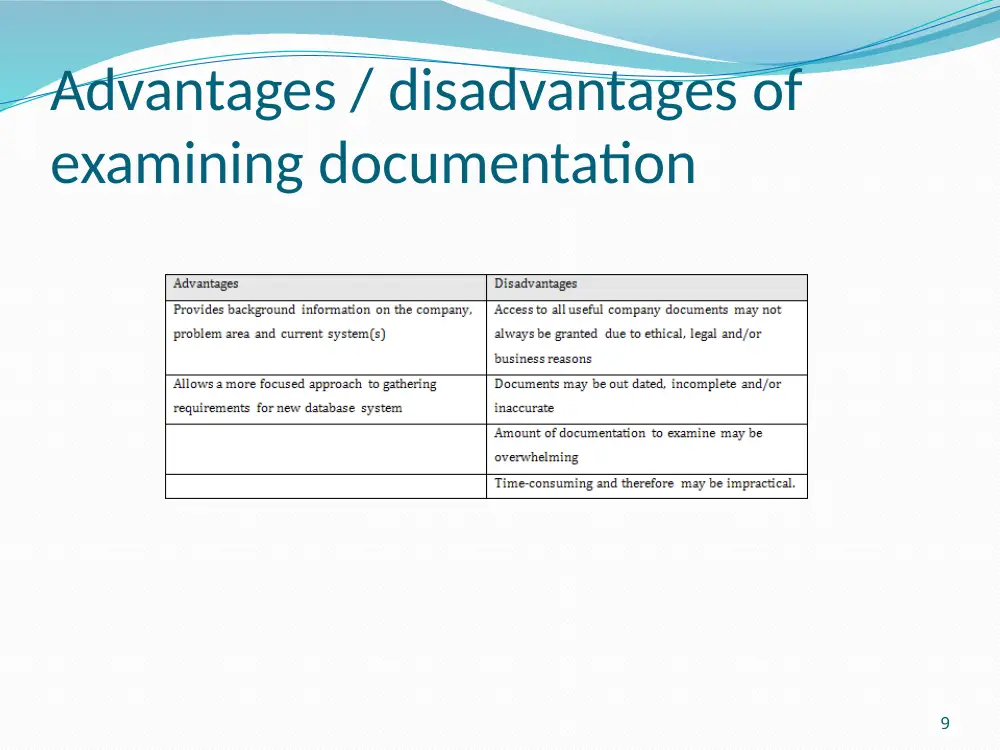
Advantages / disadvantages of
examining documentation
9
Interviewing
Interviewing is the most commonly used,
and normally most useful, fact-finding
technique.
Objectives include:
finding out and/or checking facts;
generating user interest and/or feelings of
involvement;
identifying requirements and/or gathering
ideas and opinions.
10
Advantages / disadvantages of
interviewing
11
Interviewing
Management activities that allow stages of
database system development lifecycle to
be realized as efficiently and effectively as
possible.
Should be integrated with overall IS
strategy of the organization.
Includes creation of the mission statement
and mission objectives for the database
system.
12
Interviewing
There are two types of interviews:
unstructured and structured.
Unstructured interviews are conducted with
only a general objective in mind and with few, if
any, specific questions.
In structured interviews, the interviewer has a
specific set of questions to ask the interviewee.
13
Interviewing
There are two types of questions: open-
ended and closed.
Open-ended questions allow the interviewee to
respond in any way that seems appropriate.
Closed-ended questions restrict answers to
either specific choices or short, direct responses.
14
Observing the business in operation
One of the most effective techniques.
Can either participate in, or watch a person
perform activities to learn about the system.
15
Advantages / disadvantages of
observation
16
Research
Useful to research the application and
problem.
Computer trade journals, reference books,
and the Internet are good sources of
information.
May find how others have solved similar
problems, plus you can learn whether or
not software packages exist to solve your
problem.
17
Advantages / disadvantages of
research
18
Questionnaires
Can conduct surveys through questionnaires.
Questionnaires are special-purpose
documents that allow you to gather facts from
a large number of people while maintaining
some control over their responses.
19
Questionnaires
There are two formats for questionnaires:
free-format and fixed-format.
Free-format questionnaires offer the
respondent greater freedom in providing
answers.
Fixed-format questionnaires contain
questions that require specific responses
from individuals.
20
Advantages / disadvantages of
questionnaires
21
The StayHome case study
This case study describes aon online DVD
rental company called StayHome, which rents
out DVDs to its members. The first warehouse
and head offices of StayHome was established
in 1982 in Seattle but the company has now
grown and has three additional warehouses
in different states of the United States.
22
Home page for the StayHome Online
Rentals Web site
23
Web page of member of staff called
Sally Adams
24
Web page (1) for new member of
StayHome Online Rentals
25
Web page (2) for new member of
StayHome Online Rentals
26
Web page for browsing DVDs
available at StayHome Online Rentals
27
An example of the DVDs that Ann
Peters wishes to view
28
StayHome case study – database
planning (mission statement)
29
StayHome case study – database
planning (mission objectives)
30
StayHome case study – system
definition (system Boundary)
31
StayHome case study – system
definition (user views)
32
Cross-reference of user views with
the main types of data
33
Use case diagram for the Member
user view
34
Use case diagram for the Assistant
user view
35
Use case diagram for the Manager
user view
36