
CSC 426 Chapter 03, Fall 2011
Notre Dame University–Louaize · Principles of Database Systems · 42 pages · Dr. Maya Samaha



Showing the first 10 of 42 pages. Download the PDF to see all of it.
More CSC 426 files
Show the text of this chapter
Chapter 3
The basic relational model
The Relational Data Model and
Relational Database Constraints
Relational Model Constraints
and Relational Database Schemas
Update Operations, Transactions,
and Dealing with Constraint Violations
Chapter 3 Outline
Relational model
◦ First commercial implementations available in early
1980s
◦ Has been implemented in a large number of
commercial system
The Relational Data Model and
Relational Database Constraints
Represents data as a collection of relations
Table of values
◦ Row
• Represents a collection of related data values
• Fact that typically corresponds to a real-world entity or
relationship
• Tuple
◦ Table name and column names
• Interpret the meaning of the values in each row attribute
Relational Model Concepts
Relational Model Concepts
(cont’d.)
Domain D
◦ Set of atomic values
Atomic
◦ Each value indivisible
Specifying a domain
◦ Data type specified for each domain
Domains, Attributes, Tuples, and
Relations
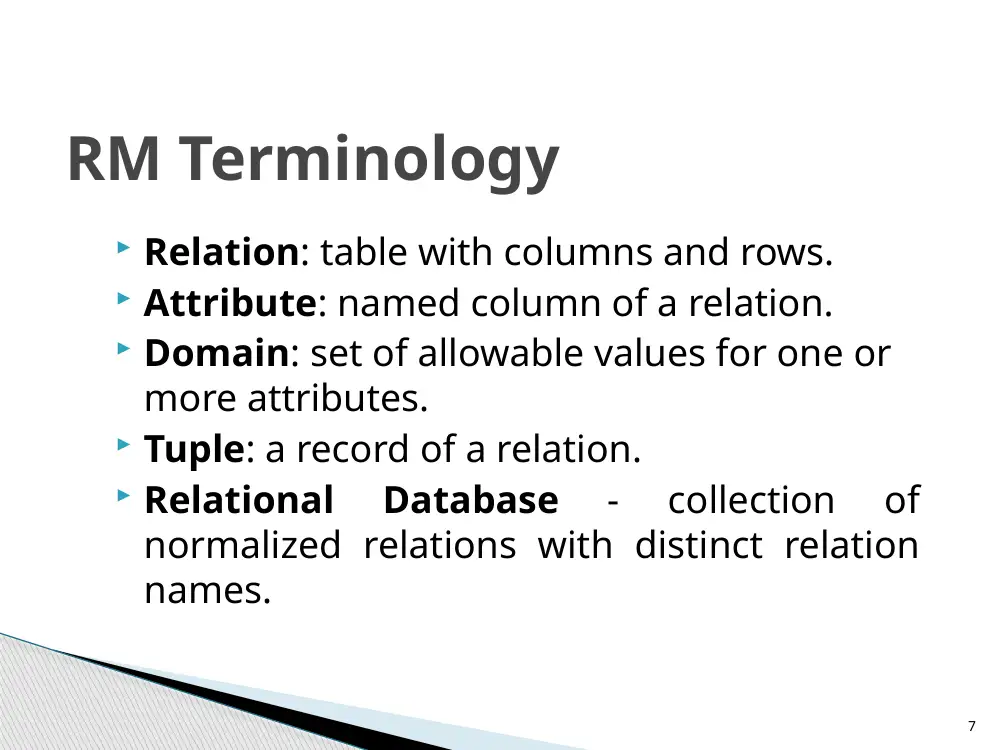
RM Terminology
Relation: table with columns and rows.
Attribute: named column of a relation.
Domain: set of allowable values for one or
more attributes.
Tuple: a record of a relation.
Relational
Database
-
collection
of
normalized relations with distinct relation
names.
7
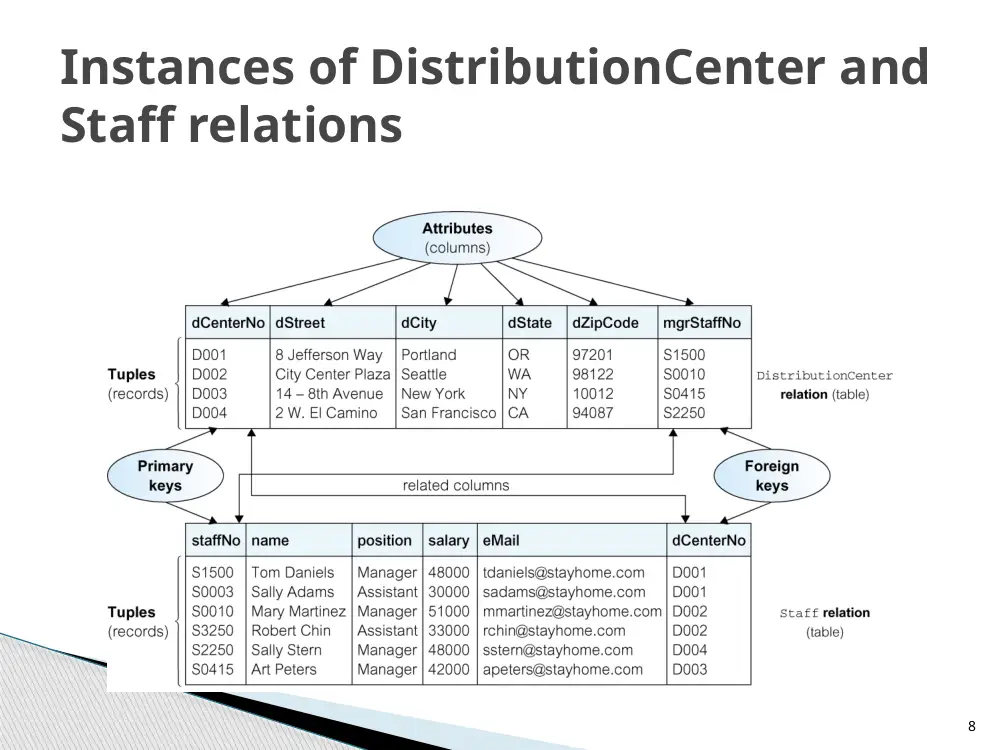
Instances of DistributionCenter and
Staff relations
8
Domains for some attributes of
distributionCenter and staff relations
9
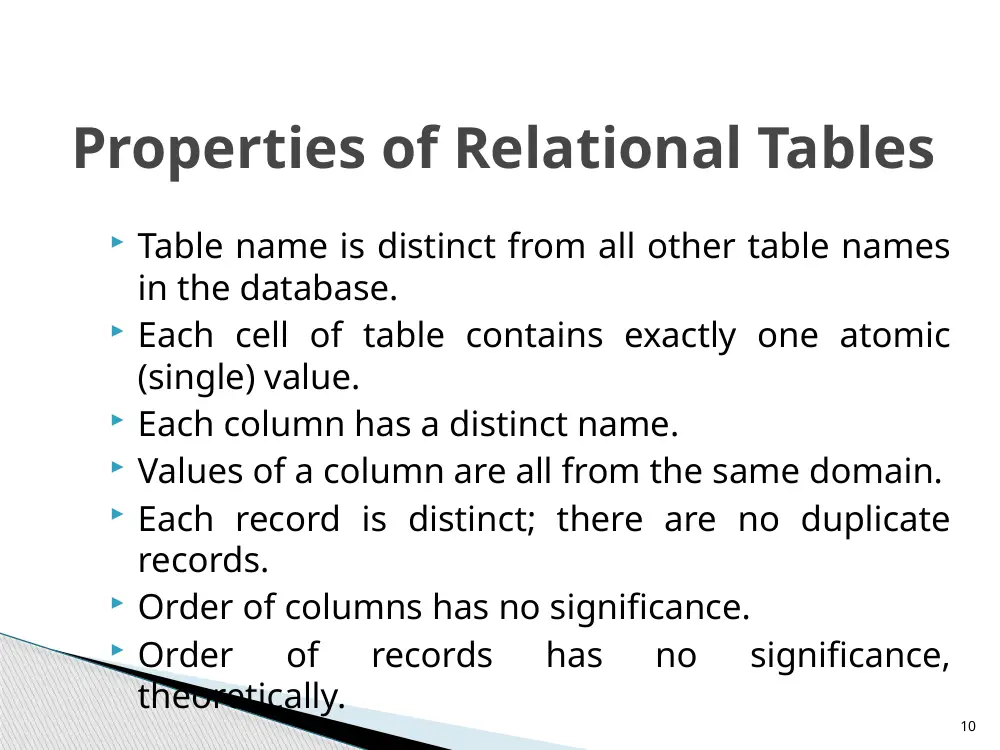
Properties of Relational Tables
Table name is distinct from all other table names
in the database.
Each cell of table contains exactly one atomic
(single) value.
Each column has a distinct name.
Values of a column are all from the same domain.
Each record is distinct; there are no duplicate
records.
Order of columns has no significance.
Order
of
records
has
no
significance,
theoretically.
10
Relational Keys
Superkey
◦ A column, or a set of columns, that uniquely
identifies a record within a table.
Candidate Key
◦ A superkey that contains only the minimum
number of columns necessary for unique
identification.
◦ In each record, values of the candidate key
uniquely identify that record (uniqueness).
◦ No proper subset of the candidate key has the
uniqueness property (irreducibility).
11
Relational Keys
Composite Key
◦ A key consists of more than one column
Primary Key
◦ The candidate key that is selected to identify
records uniquely within table.
Alternate Keys
◦ Candidate keys that are not selected to be
primary key.
Foreign Key
◦ Column, or set of columns, within one table that
matches the candidate key of some (possibly the
same) table.
12
Relational Integrity
Nulls
◦ Represents value for a column that is
currently unknown or not applicable for
record.
◦ Deals with incomplete or exceptional data.
◦ Represents the absence of a value and is not
the same as zero or spaces, which are
values.
13
Relational Integrity
Entity Integrity
◦ In a base table, no column of a primary key
can be null.
Referential Integrity
◦ If a foreign key exists in a table, either
foreign key value must match a candidate
key value of some record in its home table
or foreign key value must be wholly null.
Integrity Constraints
◦ Rules that define or constrain some aspect
of the data used by the organization.
14
Relation schema R
◦ Denoted by R(A1, A2, ...,An)
◦ Made up of a relation name R and a list of attributes,
A1, A2, ..., An
Attribute Ai
◦ Name of a role played by some domain D in the
relation schema R
Degree (or arity) of a relation
◦ Number of attributes n of its relation schema
Domains, Attributes, Tuples, and
Relations (cont’d.)
Relation (or relation state)
◦ Set of n-tuples r = {t1, t2, ..., tm}
◦ Each n-tuple t
• Ordered list of n values t =<v1, v2, ..., vn
• Each value vi, 1
i
≤ ≤ n
, is an element of dom(Ai) or is a
special NULL value
Domains, Attributes, Tuples, and
Relations (cont’d.)
Cardinality
◦ Total number of values in domain
Current relation state
◦ Relation state at a given time
◦ Reflects only the valid tuples that represent a
particular state of the real world
Attribute names
◦ Indicate different roles, or interpretations, for the
domain
Domains, Attributes, Tuples, and
Relations (cont’d.)
Ordering of tuples in a relation
◦ Relation defined as a set of tuples
◦ Elements have no order among them
Ordering of values within a tuple and an
alternative definition of a relation
◦ Order of attributes and values is not that important
◦ As long as correspondence between attributes and
values maintained
Characteristics of Relations
Characteristics of Relations
(cont’d.)
Relation schema R of degree n
◦ Denoted by R(A1, A2, ..., An)
Uppercase letters Q, R, S
◦ Denote relation names
Lowercase letters q, r, s
◦ Denote relation states
Letters t, u, v
◦ Denote tuples
Relational Model Notation
Name of a relation schema: STUDENT
◦ Indicates the current set of tuples in that relation
Notation: STUDENT(Name, Ssn, ...)
◦ Refers only to relation schema
Attribute A can be qualified with the relation
name R to which it belongs
◦ Using the dot notation R.A
Relational Model Notation
n-tuple t in a relation r(R)
◦ Denoted by t = <v1, v2, ..., vn>
◦ vi is the value corresponding to attribute Ai
Component values of tuples:
◦ t[Ai] and t.Ai refer to the value vi in t for attribute Ai
◦ t[Au, Aw, ..., Az] and t.(Au, Aw, ..., Az) refer to the subtuple
of values <vu, vw, ..., vz> from t corresponding to the
attributes specified in the list
Relational Model Notation
Constraints
◦ Restrictions on the actual values in a database state
◦ Derived from the rules in the miniworld that the
database represents
Inherent model-based constraints or implicit
constraints
◦ Inherent in the data model
Relational Model Constraints
Typically include:
◦ Numeric data types for integers and real numbers
◦ Characters
◦ Booleans
◦ Fixed-length strings
◦ Variable-length strings
◦ Date, time, timestamp
◦ Money
◦ Other special data types
Domain Constraints
No two tuples can have the same combination
of values for all their attributes.
Superkey
◦ No two distinct tuples in any state r of R can have the
same value for SK
Key
◦ Superkey of R
◦ Removing any attribute A from K leaves a set of
attributes K that is not a superkey of R any more
Key Constraints and Constraints on
NULL Values
Key satisfies two properties:
◦ Two distinct tuples in any state of relation cannot
have identical values for (all) attributes in key
◦ Minimal superkey
• Cannot remove any attributes and still have uniqueness
constraint in above condition hold
Key Constraints and Constraints on
NULL Values (cont’d.)
Candidate key
◦ Relation schema may have more than one key
Primary key of the relation
◦ Designated among candidate keys
◦ Underline attribute
Other candidate keys are designated as unique
keys
Key Constraints and Constraints on
NULL Values (cont’d.)
Key Constraints and Constraints on
NULL Values (cont’d.)
Relational database schema S
◦ Set of relation schemas S = {R1, R2, ..., Rm}
◦ Set of integrity constraints IC
Relational database state
◦ Set of relation states DB = {r1, r2, ..., rm}
◦ Each ri is a state of Ri and such that the ri relation
states satisfy integrity constraints specified in IC
Relational Databases and Relational
Database Schemas
Invalid state
◦ Does not obey all the integrity constraints
Valid state
◦ Satisfies all the constraints in the defined set of
integrity constraints IC
Relational Databases and Relational
Database Schemas (cont’d.)
Entity integrity constraint
◦ No primary key value can be NULL
Referential integrity constraint
◦ Specified between two relations
◦ Maintains consistency among tuples in two relations
Integrity, Referential Integrity,
and Foreign Keys
Foreign key rules:
◦ The attributes in FK have the same domain(s) as the
primary key attributes PK
◦ Value of FK in a tuple t1 of the current state r1(R1)
either occurs as a value of PK for some tuple t2 in the
current state r2(R2) or is NULL
Integrity, Referential Integrity,
and Foreign Keys (cont’d.)
Diagrammatically display referential integrity
constraints
◦ Directed arc from each foreign key to the relation it
references
All integrity constraints should be specified on
relational database schema
Integrity, Referential Integrity,
and Foreign Keys (cont’d.)
Operations of the relational model can be
categorized into retrievals and updates
Basic operations that change the states of
relations in the database:
◦ Insert
◦ Delete
◦ Update (or Modify)
Update Operations, Transactions, and
Dealing with Constraint Violations
Provides a list of attribute values for a new
tuple t that is to be inserted into a relation R
Can violate any of the four types of constraints
If an insertion violates one or more constraints
◦ Default option is to reject the insertion
The Insert Operation
Can violate only referential integrity
◦ If tuple being deleted is referenced by foreign keys
from other tuples
◦ Restrict
• Reject the deletion
◦ Cascade
• Propagate the deletion by deleting tuples that reference
the tuple that is being deleted
◦ Set null or set default
• Modify the referencing attribute values that cause the
violation
The Delete Operation
Necessary to specify a condition on attributes
of relation
◦ Select the tuple (or tuples) to be modified
If attribute not part of a primary key nor of a
foreign key
◦ Usually causes no problems
Updating a primary/foreign key
◦ Similar issues as with Insert/Delete
The Update Operation
Transaction
◦ Executing program
◦ Includes some database operations
◦ Must leave the database in a valid or consistent state
Online transaction processing (OLTP)
systems
◦ Execute transactions at rates that reach several
hundred per second
The Transaction Concept
Characteristics differentiate relations from
ordinary tables or files
Classify database constraints into:
◦ Inherent model-based constraints, explicit schema-
based constraints, and application-based constraints
Modification operations on the relational
model:
◦ Insert, Delete, and Update
Summary