
CSC 426 Chapter 08, Fall 2011
Notre Dame University–Louaize · Principles of Database Systems · 45 pages · Dr. Maya Samaha



Showing the first 10 of 45 pages. Download the PDF to see all of it.
More CSC 426 files
Show the text of this chapter
Chapter 8
Mapping a Conceptual Design into a
Logical Design
Chapter 8 Outline
Conceptual Database Design
Relational Database Design Using ER-to-
Relational Mapping
Mapping EER Model Constructs to Relations
What is a design
methodology?
A structured approach that uses
procedures, techniques, tools, and
documentation aids to support and
facilitate the process of design.
3
Phases of database design
Three main phases:
◦ conceptual database design,
◦ logical database design,
◦ physical database design.
Conceptual database design
◦ The process of constructing a model of the data
used in an organization independent of all
physical considerations.
4
Phases of database design
Logical database design
◦ Process of constructing a model of data used in
an organization based on a specific data model,
but independent of a particular DBMS and other
physical considerations.
5
Phases of database design
Physical database design
◦ Process of producing a description of the
implementation of the database on secondary
storage; it describes the base tables, file
organizations, and indexes used to achieve
efficient access to the data, and any associated
integrity constraints and security restrictions.
6
Critical success factors in database
design
Work interactively with the users as much as
possible.
Follow a structured methodology throughout
the data modeling process.
Employ a data-driven approach.
Incorporate structural and integrity
considerations into the data models.
Use normalization and transaction validation
techniques in the methodology.
7
Critical success factors in database
design
Use diagrams to represent as much of the data
models as possible.
Use a database design language (DBDL).
Critical success factors in database design
Build a data dictionary to supplement the data
model diagrams.
Be willing to repeat steps.
8
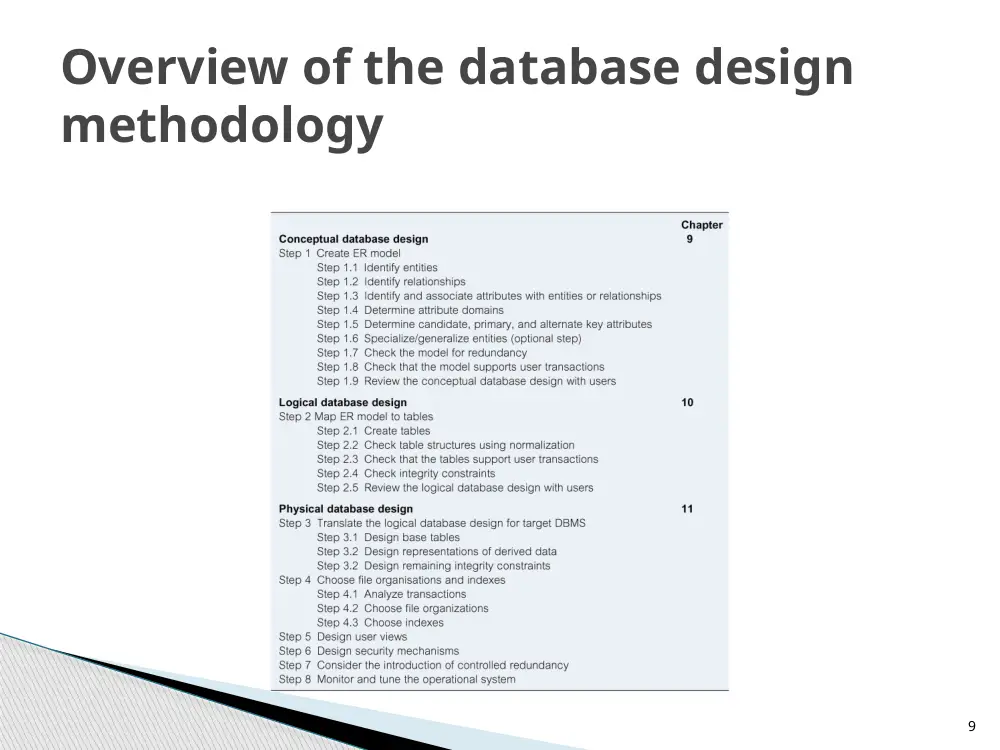
Overview of the database design
methodology
9
Step 1: Conceptual database design (Create ER model)
Step 1.1
Identify entities
Step 1.2
Identify relationships
Step 1.3
Identify and associate attributes
with entities or relationships
Step 1.4
Determine attribute domains
Step 1.5
Determine candidate, primary,
and alternate key attributes
10
Step 1: Conceptual database design methodology (Create ER
model)
Step 1.6
Specialize/Generalize entities
(optional step)
Step 1.7
Check model for redundancy
Step 1.8
Check model supports user
transactions
Step 1.9
Review conceptual database
design with users
11
Extract from the data dictionary
12
Main relationships for StayHome
Online Rentals
13
First draft ER diagram
14
Multiplicity constraints for the
relationships
15
Adding multiplicity constraints to
the ER diagram
16
Extract from the data
dictionary
17
ER diagram for StayHome Online
Rentals showing primary keys
18
Check ER model supports data
requirements
19
ER diagram showing all entities, relationships, and
attributes
20
Relational Database
Design by ER- and EER-to-Relational
Mapping
Design a relational database schema
Based on a conceptual schema design
Seven-step algorithm to convert the basic ER
model constructs into relations
Additional steps for EER model
Relational Database Design Using
ER-to-Relational Mapping
ER-to-Relational Mapping
Algorithm
COMPANY database example
Assume that the mapping will create tables with
simple single-valued attributes
Step 1: Mapping of Regular Entity Types
For each regular entity type, create a relation R that
includes all the simple attributes of E
Called entity relations
• Each tuple represents an entity instance
ER-to-Relational Mapping Algorithm
(cont’d.)
Step 2: Mapping of Weak Entity Types
For each weak entity type, create a relation R and
include all simple attributes of the entity type as
attributes of R
Include primary key attribute of owner as foreign key
attributes of R
ER-to-Relational Mapping Algorithm
(cont’d.)
ER-to-Relational Mapping Algorithm
(cont’d.)
Step 3: Mapping of Binary 1:1 Relationship Types
For each binary 1:1 relationship type R
• Identify relations S and T that correspond to entity types
participating in R
3 Possible approaches:
• Foreign key approach :Choose the entity type with total
participation –S, say-and include in S the primary key of T, and
include all simple attributes of R
• Merged relation approach: Merge the 2 entities S and T into a
single relation(do it when both participation are total)
• Cross-reference approach: Create a 3rd relation Rfor cross-
referencing the primary keys of S and T (similar to step 5)
1:1 relationship mandatory both
entities (a) ER diagram (b) table
28
1:1 relationship mandatory one
entity only (a) ER diagram (b) tables
29
1:1 relationship mandatory one
entity only (a) ER diagram (b) tables
30
1:1 relationship optional both
entities (a) ER diagram (b) tables
31
ER-to-Relational Mapping Algorithm
(cont’d.)
Step 4: Mapping of Binary 1:N Relationship
Types
For each regular binary 1:N relationship type
• Identify relation that represents participating entity type
at N-side of relationship type
• Include primary key of other entity type as foreign key in
S
• Include simple attributes of 1:N relationship type as
attributes of S
ER-to-Relational Mapping Algorithm
(cont’d.)
Step 5: Mapping of Binary M:N Relationship
Types
For each binary M:N relationship type
• Create a new relation S
• Include primary key of participating entity types as
foreign key attributes in S
• Include any simple attributes of M:N relationship type
*:* relationship
(a) ER diagram (b) tables
34
ER-to-Relational Mapping Algorithm
(cont’d.)
Step 6: Mapping of Multivalued Attributes
For each multivalued attribute A
• Create a new relation R
• R includes an attribute corresponding to A, plus the
primary Key attribute K (from the entity that has A a
multivalue) as a foreign key in R
• Primary key of R is the combination of A and K
Multi-valued attribute
(a) ER diagram (b) tables
36
ER-to-Relational Mapping Algorithm
(cont’d.)
Step 7: Mapping of N-ary Relationship Types
For each n-ary relationship type R
• Create a new relation S to represent R
• Include primary keys of participating entity types as
foreign keys
• Include any simple attributes as attributes
Complex (ternary) relationship
(a) ER diagram (b) tables
38
Discussion and Summary of
Mapping for ER Model Constructs
Mapping EER Model Constructs to
Relations
Extending ER-to-relational mapping algorithm
Mapping of Specialization or
Generalization
Step 8: Options for Mapping Specialization or
Generalization (see pages 294-295)
Option 8A: Multiple relations—superclass and
subclasses
• For any specialization (total or partial, disjoint or
overlapping)
Option 8B: Multiple relations—subclass relations
only
• Subclasses are total
• Specialization has disjointedness constraint
Mapping of Specialization or
Generalization (cont’d.)
Option 8C: Single relation with one type attribute
• Type or discriminating attribute indicates subclass of
tuple
• Subclasses are disjoint
• Potential for generating many NULL values if many specific
attributes exist in the subclasses
Option 8D: Single relation with multiple type
attributes
• Subclasses are overlapping
• Will also work for a disjoint specialization
Mapping of Shared Subclasses
(Multiple Inheritance)
Apply any of the options discussed in step 8 to
a shared subclass
Summary
Map conceptual schema design in the ER
model to a relational database schema
Algorithm for ER-to-relational mapping
Illustrated by examples from the COMPANY database
Include additional steps in the algorithm for
mapping constructs from EER model into
relational model