
MEN 201 Problems For Chapter 21 with Solutions, Spring 2012
Notre Dame University–Louaize · Engineering Mechanics- Dynamics · 72 pages · with solution

Showing the first 10 of 72 pages. Download the PDF to see all of it.
More MEN 201 files
- Problems For Chapter 14 with Solutions · Spring 2012Chapter · with solutionView
- Problems For Chapter 18 with Solutions · Spring 2012Chapter · with solutionView
- Problems For Chapter 16 with Solutions · Spring 2012Chapter · with solutionView
- Problems For Chapter 19 with Solutions · Spring 2012Chapter · with solutionView
- Problems For Chapter 15 with Solutions · Spring 2012Chapter · with solutionView
- Problems For Chapter 13 with Solutions · Spring 2012Chapter · with solutionView
- Problems For Chapter 12 with Solutions · Spring 2012Chapter · with solutionView
- Problems For Chapter 17 with Solutions · Spring 2012Chapter · with solutionView
Show the text of this chapter
Engineering Mechanics - Dynamics
Chapter 21
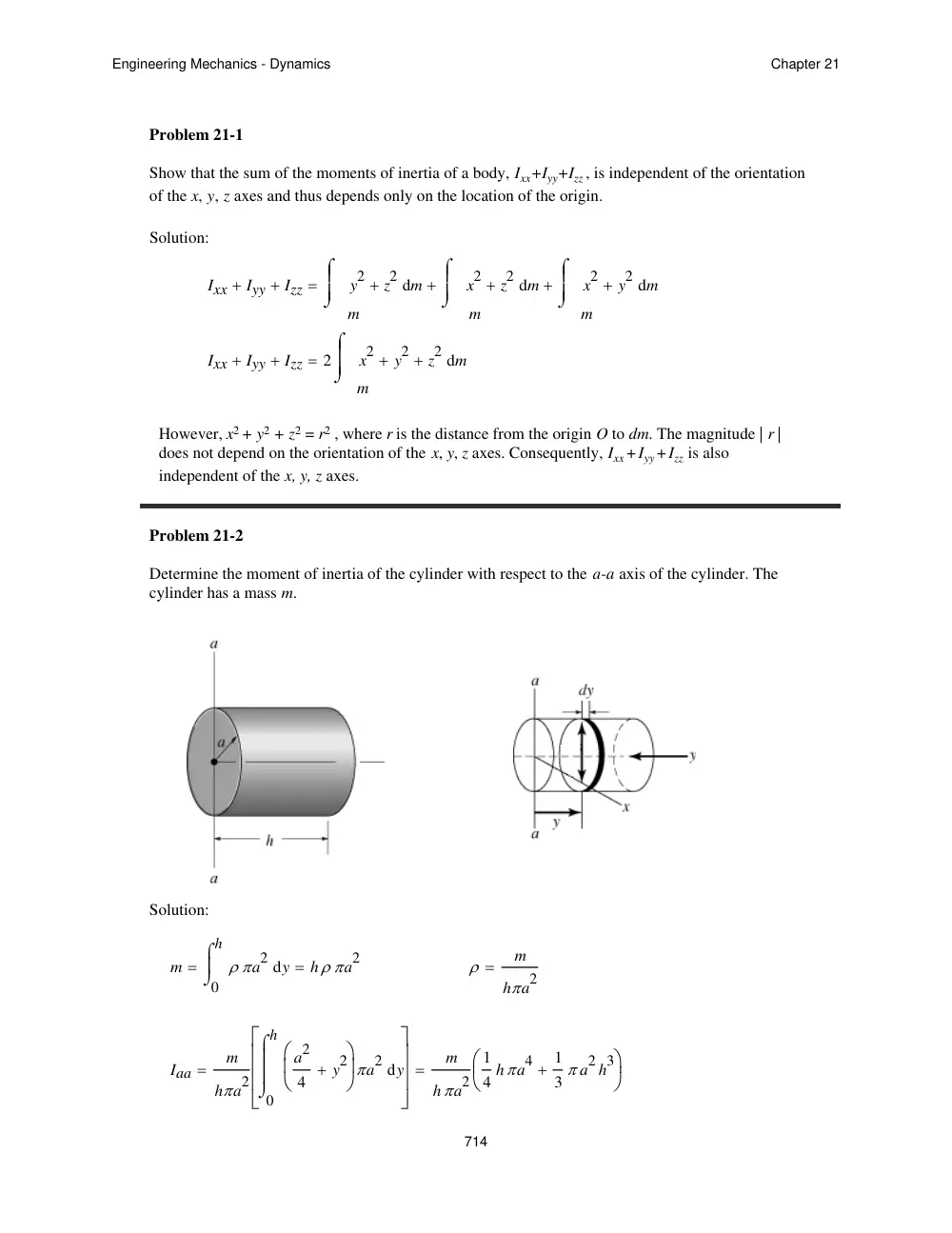
Problem 21-1
Show that the sum of the moments of inertia of a body, Ixx+Iyy+Izz , is independent of the orientation
of the x, y, z axes and thus depends only on the location of the origin.
Solution:
Ixx
+ Iyy
+ Izz
m
y2
+ z2
⌠⎮
⎮⌡
d
m
x2
+ z2
⌠⎮
⎮⌡
d
+
m
x2
+ y2
⌠⎮
⎮⌡
d
+
=
m
m
m
Ixx
+ Iyy
+ Izz
2
m
x2
+ y2
+ z2
⌠⎮
⎮⌡
d
=
m
However, x2 + y2 + z2 = r2 , where r is the distance from the origin O to dm. The magnitude | r |
does not depend on the orientation of the x, y, z axes. Consequently, Ixx + Iyy + Izz is also
independent of the x, y, z axes.
Problem 21-2
Determine the moment of inertia of the cylinder with respect to the a-a axis of the cylinder. The
cylinder has a mass m.
Solution:
m
0
h
y
ρ πa2
⌠
⎮⌡
d
=
= hρ πa2
ρ
m
hπa2
=
Iaa
m
hπa2
0
h
y
a2
4
+ y2
⎛⎜
⎝
⎞⎟
⎠
πa2
⌠
⎮
⎮
⌡
d
⎡⎢
⎢
⎢⎣
⎤⎥
⎥
⎥⎦
=
m
hπa2
1
4 hπa4
1
+ 3 π a2 h3
⎛⎜⎝
⎞⎟⎠
=
714
Engineering Mechanics - Dynamics
Chapter 21
Iaa
m a2
4
h2
+ 3
⎛⎜
⎝
⎞⎟
⎠
=
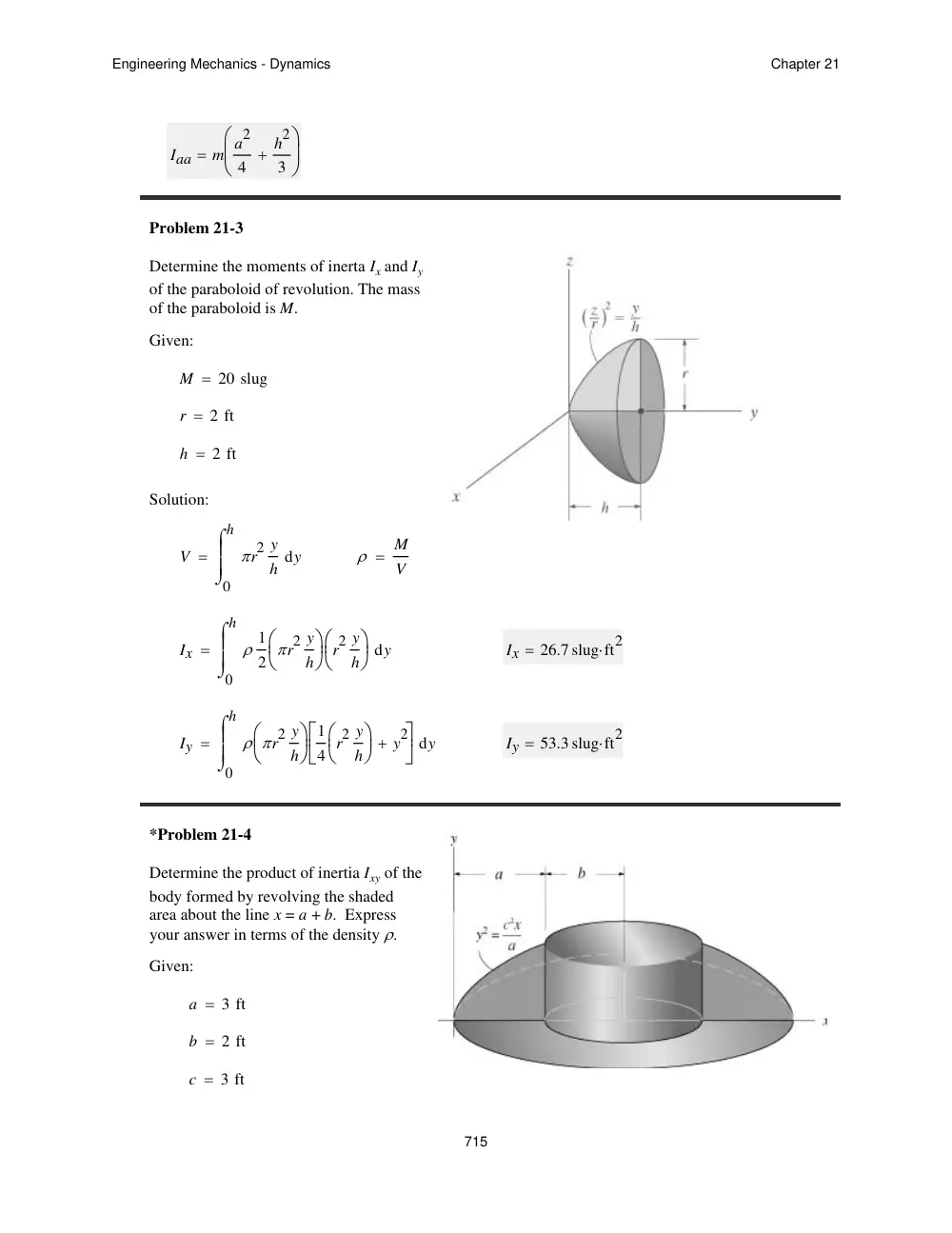
Problem 21-3
Determine the moments of inerta Ix and Iy
of the paraboloid of revolution. The mass
of the paraboloid is M.
Given:
M
20 slug
=
r
2 ft
=
h
2 ft
=
Solution:
V
0
h
y
πr2 y
h
⌠⎮
⎮⌡
d
=
ρ
M
V
=
Ix
0
h
y
ρ 1
2 πr2 y
h
⎛⎜⎝
⎞⎟⎠
r2 y
h
⎛⎜⎝
⎞⎟⎠
⌠⎮
⎮⌡
d
=
Ix
26.7 slug ft2
⋅
=
Iy
0
h
y
ρ πr2 y
h
⎛⎜⎝
⎞⎟⎠
1
4 r2 y
h
⎛⎜⎝
⎞⎟⎠
+ y2
⎡⎢⎣
⎤⎥⎦
⌠⎮
⎮⌡
d
=
Iy
53.3 slug ft2
⋅
=
*Problem 21-4
Determine the product of inertia Ixy of the
body formed by revolving the shaded
area about the line x = a + b. Express
your answer in terms of the density ρ.
Given:
a
3 ft
=
b
2 ft
=
c
3 ft
=
715
Engineering Mechanics - Dynamics
Chapter 21
Solution:
k
0
a
x
2πc
x
a a
+ b
− x
(
)
⎡⎢⎣
⎤⎥⎦
a
+ b
(
) c
2
x
a
⌠⎮
⎮⌡
d
=
Ixy
= kρ
k
636ft5
=
Problem 21-5
Determine the moment of inertia Iy of the body formed by revolving the shaded area about the line
x = a + b. Express your answer in terms of the density ρ.
Given:
a
3 ft
=
b
2 ft
=
c
3 ft
=
Solution:
k
0
a
x
2πc
x
a a
+ b
− x
(
)
⎡⎢⎣
⎤⎥⎦
a
+ b
− x
(
)2
a
+ b
(
)2
+
⎡⎣
⎤⎦
⌠⎮
⎮⌡
d
=
Iy
= kρ
k
4481ft5
=
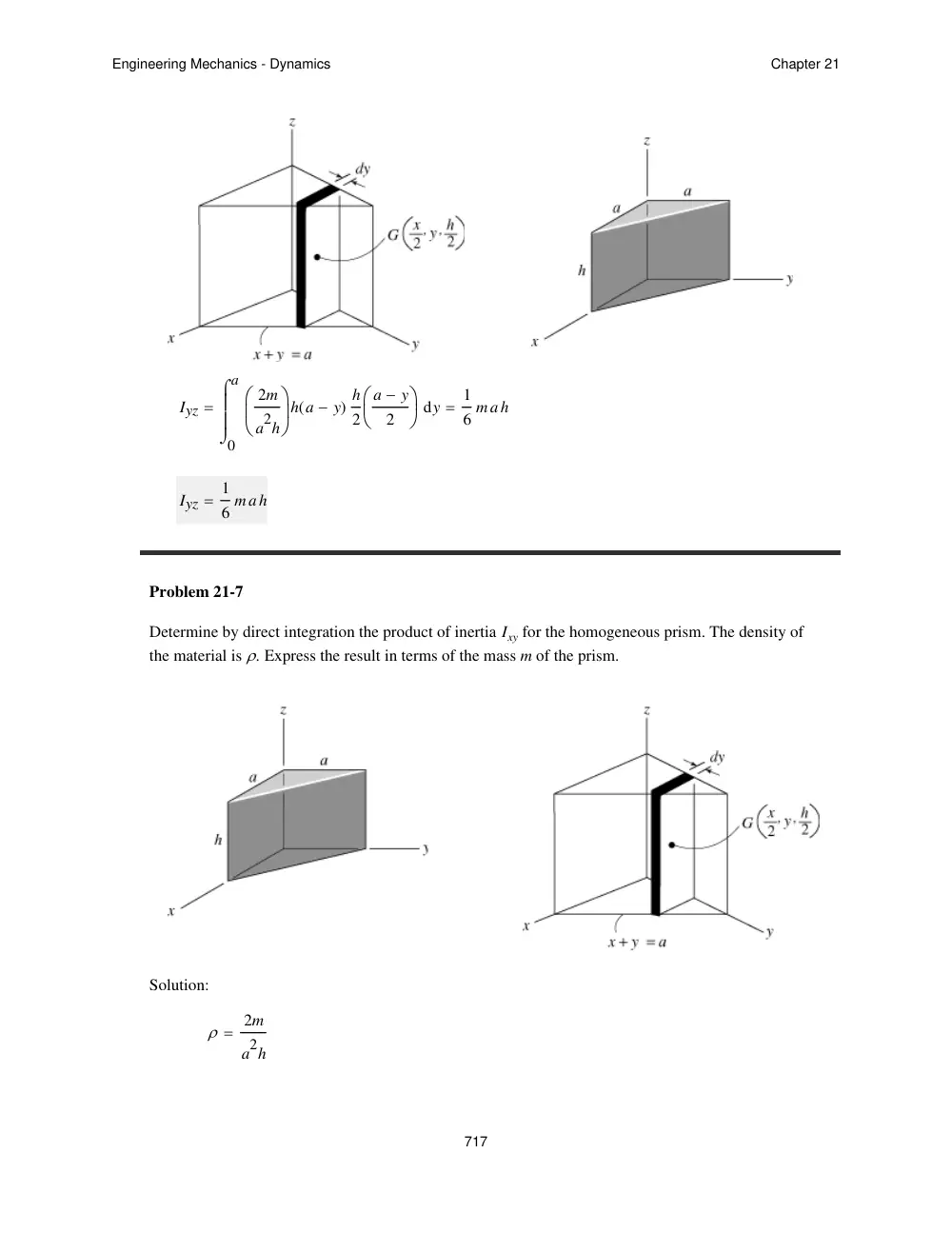
Problem 21-6
Determine by direct integration the product of inertia Iyz for the homogeneous prism. The density of
the material is ρ. Express the result in terms of the mass m of the prism.
Solution:
ρ
2m
a2h
=
716
Engineering Mechanics - Dynamics
Chapter 21
Iyz
0
a
y
2m
a2h
⎛⎜
⎝
⎞⎟
⎠
h a
− y
(
) h
2
a
− y
2
⎛⎜⎝
⎞⎟⎠
⌠
⎮
⎮
⌡
d
=
1
6 mah
=
Iyz
1
6 mah
=
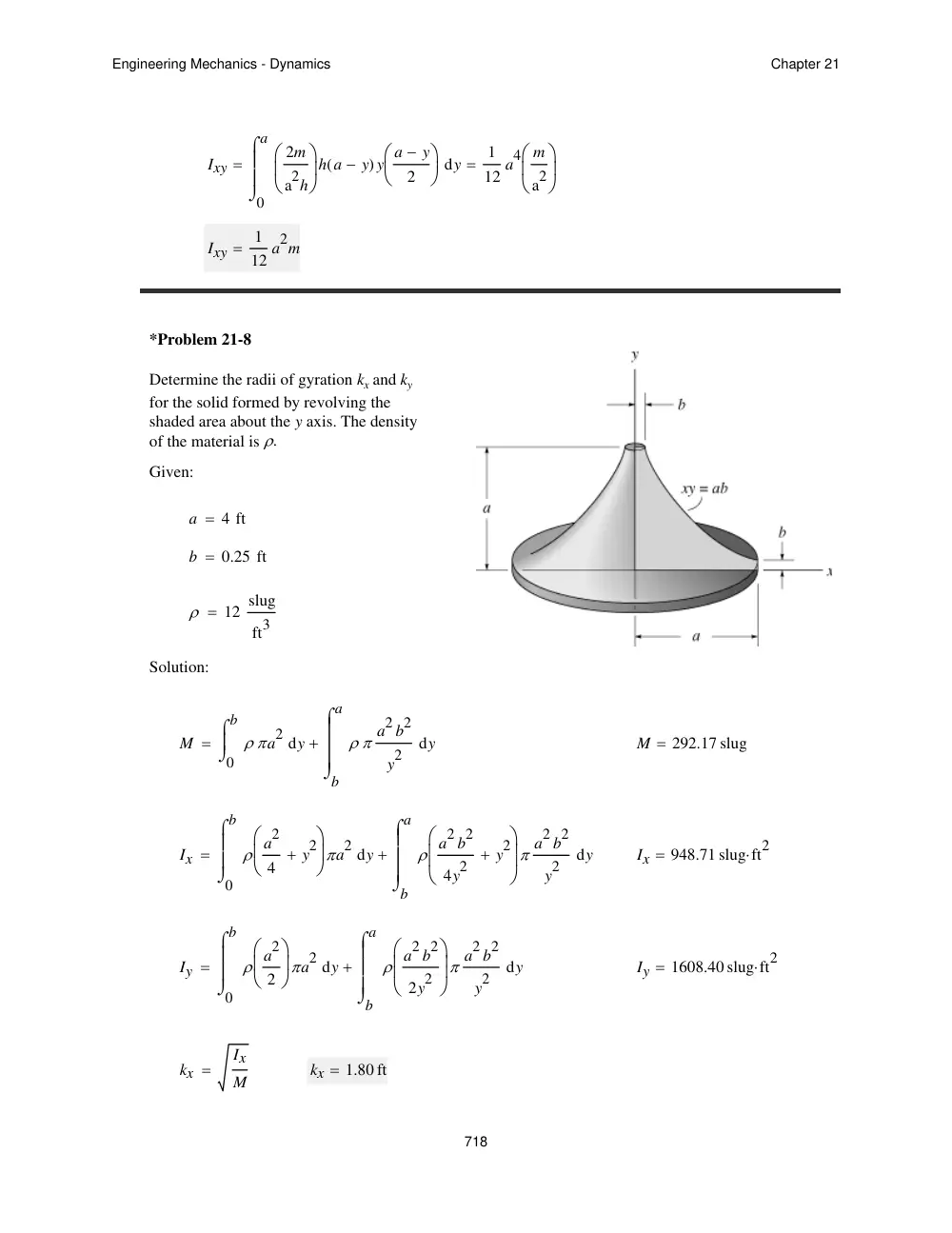
Problem 21-7
Determine by direct integration the product of inertia Ixy for the homogeneous prism. The density of
the material is ρ. Express the result in terms of the mass m of the prism.
Solution:
ρ
2m
a2h
=
717
Engineering Mechanics - Dynamics
Chapter 21
Ixy
0
a
y
2m
a2h
⎛⎜
⎝
⎞⎟
⎠
h a
− y
(
) y a
− y
2
⎛⎜⎝
⎞⎟⎠
⌠
⎮
⎮
⌡
d
=
1
12 a4 m
a2
⎛⎜
⎝
⎞⎟
⎠
=
Ixy
1
12 a2m
=
*Problem 21-8
Determine the radii of gyration kx and ky
for the solid formed by revolving the
shaded area about the y axis. The density
of the material is ρ.
Given:
a
4 ft
=
b
0.25 ft
=
ρ
12 slug
ft3
=
Solution:
M
0
b
y
ρ πa2
⌠
⎮⌡
d
b
a
y
ρ π a2 b2
y2
⌠⎮
⎮
⎮⌡
d
+
=
M
292.17 slug
=
Ix
0
b
y
ρ a2
4
+ y2
⎛⎜
⎝
⎞⎟
⎠
πa2
⌠
⎮
⎮
⌡
d
b
a
y
ρ a2 b2
4y2
+ y2
⎛⎜
⎜⎝
⎞⎟
⎟⎠
π a2 b2
y2
⌠⎮
⎮
⎮⌡
d
+
=
Ix
948.71 slug ft2
⋅
=
Iy
0
b
y
ρ a2
2
⎛⎜
⎝
⎞⎟
⎠
πa2
⌠
⎮
⎮
⌡
d
b
a
y
ρ a2 b2
2y2
⎛⎜
⎜⎝
⎞⎟
⎟⎠
π a2 b2
y2
⌠⎮
⎮
⎮⌡
d
+
=
Iy
1608.40 slug ft2
⋅
=
kx
Ix
M
=
kx
1.80 ft
=
718
Engineering Mechanics - Dynamics
Chapter 21
ky
Iy
M
=
ky
2.35 ft
=
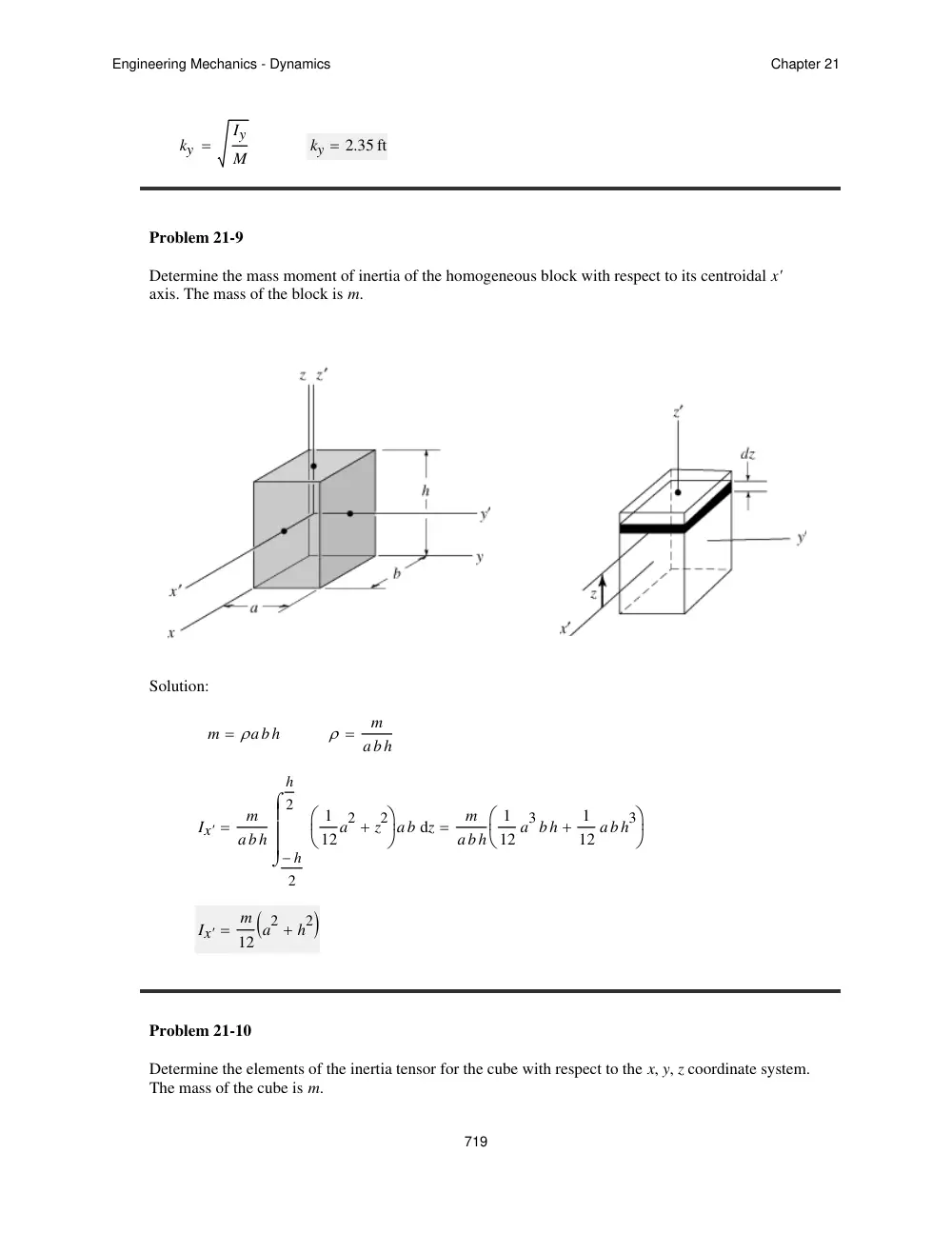
Problem 21-9
Determine the mass moment of inertia of the homogeneous block with respect to its centroidal x'
axis. The mass of the block is m.
Solution:
m
= ρabh
ρ
m
abh
=
Ix'
m
abh
h
−
2
h
2
z
1
12a2
+ z2
⎛⎜⎝
⎞⎟⎠
ab
⌠⎮
⎮
⎮⌡
d
=
m
abh
1
12 a3 bh
1
+ 12 abh3
⎛⎜⎝
⎞⎟⎠
=
Ix'
m
12 a2
+ h2
(
)
=
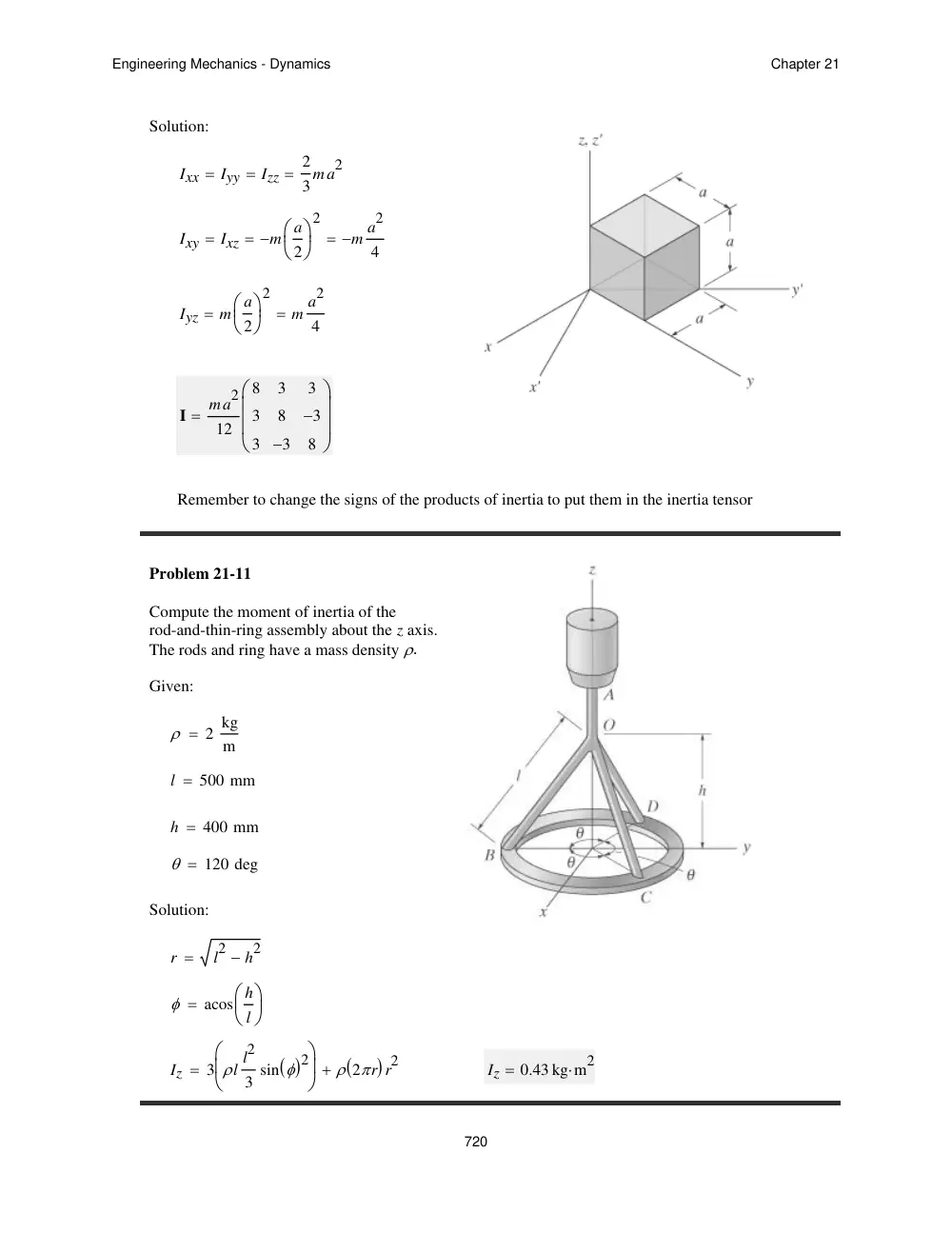
Problem 21-10
Determine the elements of the inertia tensor for the cube with respect to the x, y, z coordinate system.
The mass of the cube is m.
719
Engineering Mechanics - Dynamics
Chapter 21
Solution:
Ixx
= Iyy
= Izz
2
3ma2
=
Ixy
= Ixz
−m
a
2
⎛⎜⎝
⎞⎟⎠
2
=
−m
a2
4
=
Iyz
m a
2
⎛⎜⎝
⎞⎟⎠
2
=
m a2
4
=
I
ma2
12
8
3
3
3
8
3
−
3
3
−
8
⎛
⎜
⎜
⎝
⎞
⎟
⎟
⎠
=
Remember to change the signs of the products of inertia to put them in the inertia tensor
Problem 21-11
Compute the moment of inertia of the
rod-and-thin-ring assembly about the z axis.
The rods and ring have a mass density ρ.
Given:
ρ
2 kg
m
=
l
500 mm
=
h
400 mm
=
θ
120 deg
=
Solution:
r
l2
− h2
=
φ
acos h
l
⎛⎜⎝
⎞⎟⎠
=
Iz
3 ρl l2
3 sin φ( )2
⎛⎜
⎝
⎞⎟
⎠
ρ 2πr
(
) r2
+
=
Iz
0.43 kg m2
⋅
=
720
Engineering Mechanics - Dynamics
Chapter 21
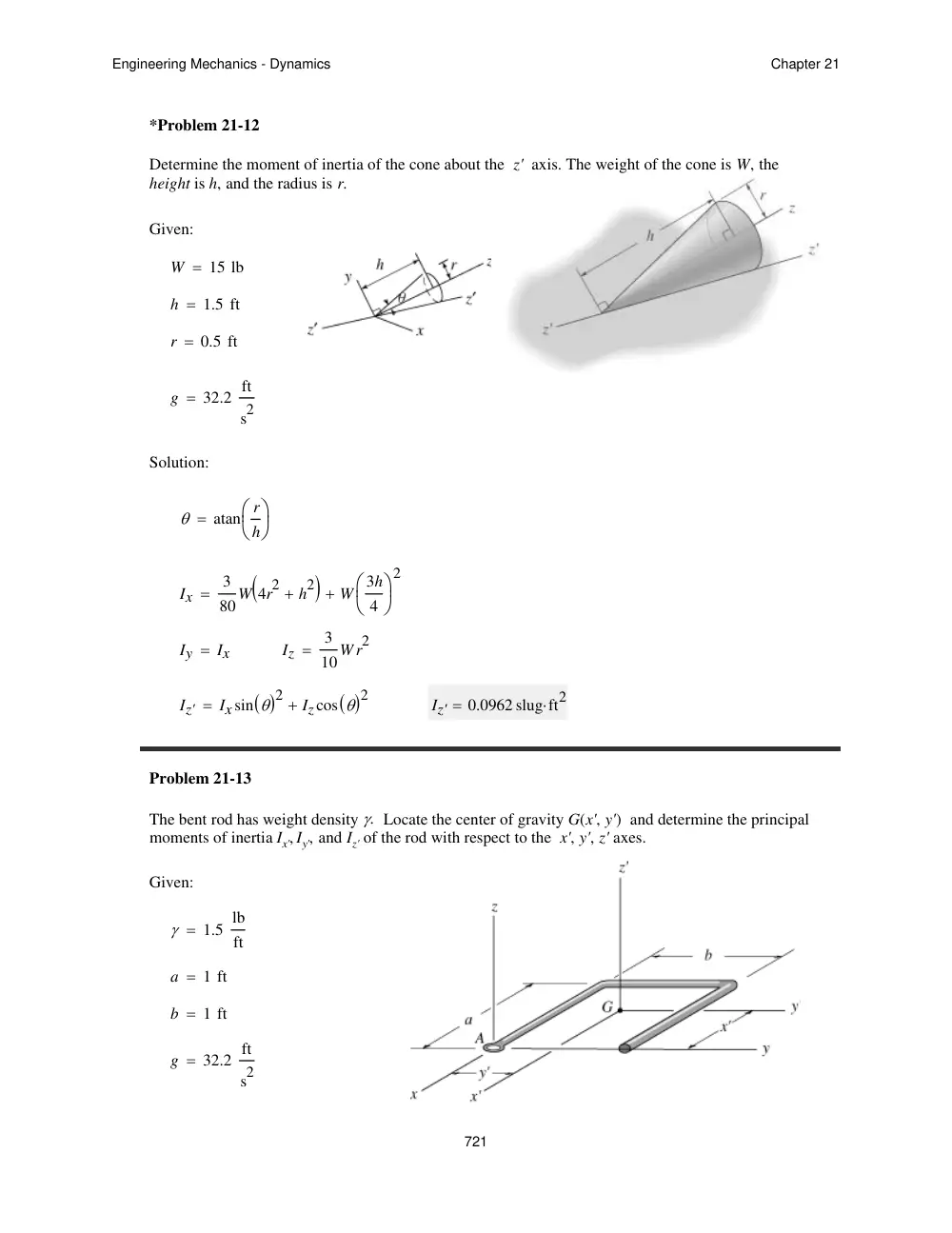
*Problem 21-12
Determine the moment of inertia of the cone about the z' axis. The weight of the cone is W, the
height is h, and the radius is r.
Given:
W
15 lb
=
h
1.5 ft
=
r
0.5 ft
=
g
32.2 ft
s2
=
Solution:
θ
atan r
h
⎛⎜⎝
⎞⎟⎠
=
Ix
3
80W 4r2
+ h2
(
)
W
3h
4
⎛⎜⎝
⎞⎟⎠
2
+
=
Iy
= Ix
Iz
3
10W r2
=
Iz'
Ix sin θ( )2
+ Izcos θ( )2
=
Iz'
0.0962 slug ft2
⋅
=
Problem 21-13
The bent rod has weight density γ. Locate the center of gravity G(x', y') and determine the principal
moments of inertia Ix', Iy', and Iz' of the rod with respect to the x', y', z' axes.
Given:
γ
1.5 lb
ft
=
a
1 ft
=
b
1 ft
=
g
32.2 ft
s2
=
721
Engineering Mechanics - Dynamics
Chapter 21
Solution:
x'
2a a
2
ba
+
2a
+ b
=
x'
0.667 ft
=
y'
ab
b b
2
+
2a
+ b
=
y'
0.50 ft
=
Ix'
γa y'2
γa b
− y'
(
)2
+
1
+ 12γbb2
γb b
2
− y'
⎛⎜⎝
⎞⎟⎠
2
+
=
Ix'
0.0272 slug ft2
⋅
=
Iy'
2
12γaa2
2γa a
2
− x'
⎛⎜⎝
⎞⎟⎠
2
+
γb a
− x'
(
)2
+
=
Iy'
0.0155 slug ft2
⋅
=
Iz'
Ix'
+ Iy'
=
Iz'
0.0427 slug ft2
⋅
=
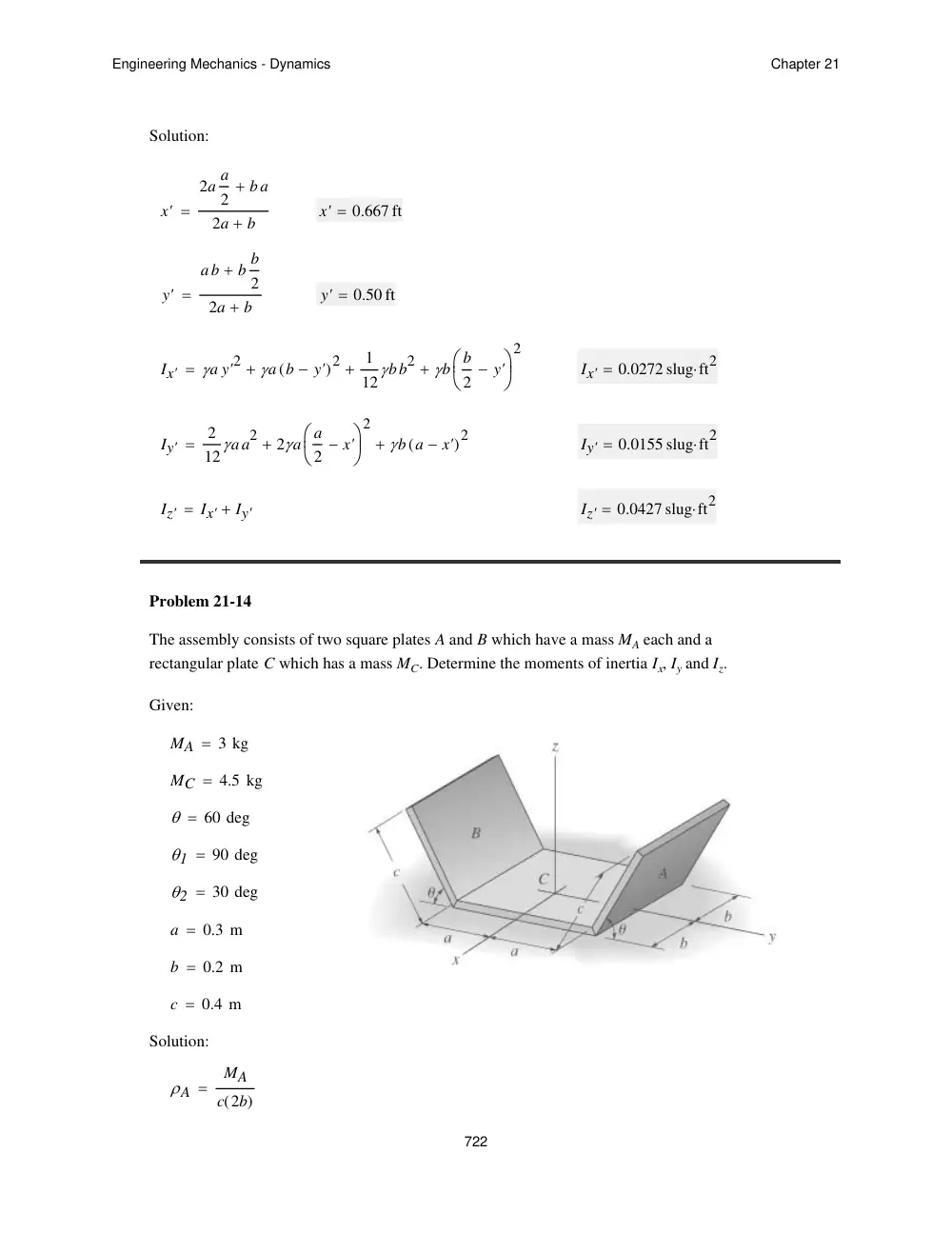
Problem 21-14
The assembly consists of two square plates A and B which have a mass MA each and a
rectangular plate C which has a mass MC. Determine the moments of inertia Ix, Iy and Iz.
Given:
MA
3 kg
=
MC
4.5 kg
=
θ
60 deg
=
θ1
90 deg
=
θ2
30 deg
=
a
0.3 m
=
b
0.2 m
=
c
0.4 m
=
Solution:
ρA
MA
c 2b
(
)
=
722
Engineering Mechanics - Dynamics
Chapter 21
Ix
1
12MC 2a
(
)2
2
0
c
ξ
ρA 2b
(
)
a
( + ξ cos θ( )
)2
(ξ sin θ( )
)2
+
⎡⎣
⎤⎦
⌠
⎮
⌡
d
+
=
Iy
1
12MC 2b
(
)2
2
b
−
b
x
0
c
ξ
ρA x2
+ ξ2 sin θ( )2
(
)
⌠
⎮
⌡
d
⌠
⎮
⌡
d
+
=
Iz
1
12MC
(2b
)2
(2a
)2
+
⎡⎣
⎤⎦
2
b
−
b
x
0
c
ξ
ρA x2
a
( + ξ cos θ( )
)2
+
⎡⎣
⎤⎦
⌠
⎮
⌡
d
⌠
⎮
⌡
d
+
=
Ix
1.36 kg m2
⋅
=
Iy
0.380 kg m2
⋅
=
Iz
1.25 kg m2
⋅
=
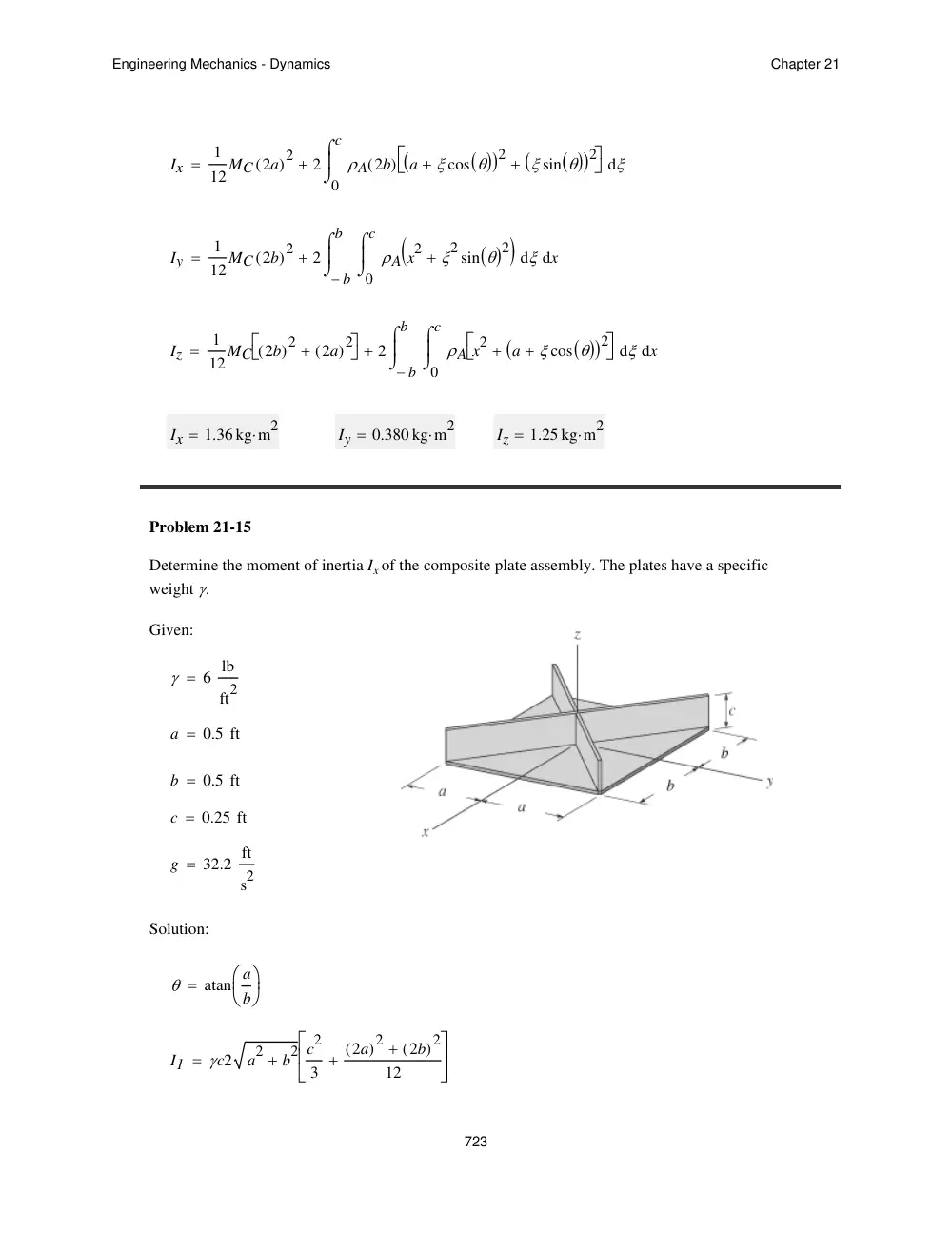
Problem 21-15
Determine the moment of inertia Ix of the composite plate assembly. The plates have a specific
weight γ.
Given:
γ
6 lb
ft2
=
a
0.5 ft
=
b
0.5 ft
=
c
0.25 ft
=
g
32.2 ft
s2
=
Solution:
θ
atan a
b
⎛⎜⎝
⎞⎟⎠
=
I1
γc2
a2
+ b2
c2
3
(2a
)2
(2b
)2
+
12
+
⎡⎢
⎣
⎤⎥
⎦
=
723
Engineering Mechanics - Dynamics
Chapter 21
I2
γc2
a2
+ b2
c2
3
=
Ix
2 I1 sin θ( )2
+ I2 cos θ( )2
(
)
γ 2a
(
) 2b
(
)
(2a
)2
12
+
=
Ix
0.0293 slug ft2
⋅
=
*Problem 21-16
Determine the product of inertia Iyz of the composite plate assembly. The plates have a specific
weight γ.
Solution:
Due to symmetry,
Iyz
0
=
Problem 21-17
Determine the moment of inertia of the composite body about the aa axis. The cylinder has
weight Wc and each hemisphere has weight Wh.
Given:
Wc
20 lb
=
Wh
10 lb
=
b
2 ft
=
c
2 ft
=
g
32.2 ft
s2
=
Solution:
θ
atan c
b
⎛⎜⎝
⎞⎟⎠
=
Iz
2 2
5Wh
c
2
⎛⎜⎝
⎞⎟⎠
2
1
2Wc
c
2
⎛⎜⎝
⎞⎟⎠
2
+
=
Iz
0.56 slug ft2
⋅
=
724
Engineering Mechanics - Dynamics
Chapter 21
Iy
2 83
320Wh
c
2
⎛⎜⎝
⎞⎟⎠
2
2Wh
b
2
3
8
c
2
+
⎛⎜⎝
⎞⎟⎠
2
+
Wc
b2
12
c
2
⎛⎜⎝
⎞⎟⎠
2 1
4
+
⎡⎢
⎣
⎤⎥
⎦
+
=
Iy
1.70 slug ft2
⋅
=
Iaa
Izcos θ( )2
+ Iy sin θ( )2
=
Iaa
1.13 slug ft2
⋅
=
Problem 21-18
Determine the moment of inertia about the z axis of the assembly which consists of the rod
CD of mass MR and disk of mass MD.
Given:
MR
1.5 kg
=
MD
7 kg
=
r
100 mm
=
l
200 mm
=
Solution:
θ
atan r
l
⎛⎜⎝
⎞⎟⎠
=
I1
1
3MRl2
1
+ 4MDr2
+ MDl2
=
I2
I1
=
I3
1
2MDr2
=
Imat
1
0
0
0
cos θ( )
sin θ( )
−
0
sin θ( )
cos θ( )
⎛
⎜
⎜
⎝
⎞
⎟
⎟
⎠
I1
0
0
0
I2
0
0
0
I3
⎛⎜
⎜
⎜⎝
⎞⎟
⎟
⎟⎠
1
0
0
0
cos θ( )
sin θ( )
0
sin θ( )
−
cos θ( )
⎛
⎜
⎜
⎝
⎞
⎟
⎟
⎠
⎡⎢
⎢
⎢⎣
⎤⎥
⎥
⎥⎦
=
Iz
Imat2 2
,
=
Iz
0.0915 kg m2
⋅
=
725
Engineering Mechanics - Dynamics
Chapter 21
Problem 21-19
The assembly consists of a plate A of weight WA, plate B of weight WB, and four rods each of weight
Wr. Determine the moments of inertia of the assembly with respect to the principal x, y, z axes.
Given:
WA
15 lb
=
WB
40 lb
=
Wr
7 lb
=
rA
1 ft
=
rB
4 ft
=
h
4 ft
=
Solution:
L
rB
− rA
(
)2
+ h2
=
L
5.00 ft
=
θ
asin h
L
⎛⎜⎝
⎞⎟⎠
=
θ
53.13 deg
=
Ix
2Wr
L2
3
⎛⎜
⎝
⎞⎟
⎠
sin θ( )2
2 Wr
L2
12
⎛⎜
⎝
⎞⎟
⎠
Wr
h
2
⎛⎜⎝
⎞⎟⎠
2
rA
rB
+
2
⎛⎜⎝
⎞⎟⎠
2
+
⎡
⎢
⎣
⎤
⎥
⎦
+
⎡
⎢
⎣
⎤
⎥
⎦
+
WB
rB
2
4
+
WA
rA
2
4
⎛
⎜
⎝
⎞
⎟
⎠
+ WAh2
+
...
=
Iy
= Ix
by symmetry
Iz
4 Wr
L2
12 cos θ( )2
Wr
rB
rA
+
2
⎛⎜⎝
⎞⎟⎠
2
+
⎡
⎢
⎣
⎤
⎥
⎦
WA
rA
2
2
⎛
⎜
⎝
⎞
⎟
⎠
+
WB
rB
2
2
⎛
⎜
⎝
⎞
⎟
⎠
+
=
Ix
Iy
Iz
⎛⎜
⎜
⎜⎝
⎞⎟
⎟
⎟⎠
20.2
20.2
16.3
⎛
⎜
⎜
⎝
⎞
⎟
⎟
⎠
slug ft2
⋅
=
*Problem 21-20
The thin plate has a weight Wp and each of the four rods has weight Wr. Determine the moment of
726
Engineering Mechanics - Dynamics
Chapter 21
inertia of the assembly about the z axis.
Given:
Wp
5 lb
=
Wr
3 lb
=
h
1.5 ft
=
a
0.5 ft
=
Solution:
L
h2
+ a2
+ a2
=
θ
acos h
L
⎛⎜⎝
⎞⎟⎠
=
Iz
4 1
3WrL2 sin θ( )2
1
12Wp
(2a
)2
(2a
)2
+
⎡⎣
⎤⎦
+
=
Iz
0.0881 slug ft2
⋅
=
Problem 21-21
If a body contains no planes of symmetry, the principal moments of inertia can be determined
mathematically. To show how this is done, consider the rigid body which is spinning with an angular
velocity ω, directed along one of its principal axes of inertia. If the principal moment of inertia about
this axis is I, the angular momentum can be expressed as H = Iω = Iωxi + Iωyj + Iωzk. The
components of H may also be expressed by Eqs. 21-10, where the inertia tensor is assumed to be
known. Equate the i, j, and k components of both expressions for H and consider ωx, ωy, and ωz to be
unknown. The solution of these three equations is obtained provided the determinant of the
coefficients is zero. Show that this determinant, when expanded, yields the cubic equation
I3 -(Ixx+ Iyy + Izz)I2 + (IxxIyy + IyyIzz + IzzIxx- I2
xy - I2
yz-I2
zx)I -(IxxIyyIzz - 2IxyIyzIzx - IxxI2
yz - IyyI2
zx - IzzI2
xy) =
0. The three positive roots of I, obtained from the solution of this equation, represent the principal
moments of inertia Ix, Iy, and Iz.
Solution:
H
= Iω
Iωxi
+ Iωyj
+ Iωzk
=
Equating the i, j, and k components to the scalar
(Eq. 21 - 10) yields
Ixx
− I
(
)ωx
− Ixyωy
− Ixzωz
0
=
−Iyx
ωx
Iyy
− I
(
)ωy
+
− Iyzωz
0
=
727
Engineering Mechanics - Dynamics
Chapter 21
−Izx
ωx
− Izyωy
Izz
− I
(
)ωz
+
0
=
Solution for nontrivial ωx, ωy, and ωz requires
Ixx
− I
(
)
Iyx
−
Izx
−
Ixy
−
Iyy
− I
(
)
Izy
−
Ixz
−
Iyz
−
Izz
− I
(
)
⎡⎢
⎢
⎢⎣
⎤⎥
⎥
⎥⎦
0
=
Expanding the determinant produces the required equation
QED
Problem 21-22
Show that if the angular momentum of a body is determined with respect to an arbitrary point A, then
HA can be expressed by Eq. 21-9. This requires substituting ρA = ρG + ρGA into Eq. 21-6 and
expanding, noting that ∫ρGdm = 0 by definition of the mass center and vG = vA+ ω × ρGA.
Solution:
HA
ρA m
⌠⎮
⎮⌡
d
× vA
m
ρA
ω
( × ρA
)
×
⌠⎮
⎮⌡
d
+
=
HA
m
ρG
+ ρGA
⌠⎮
⎮⌡
d
× vA
m
ρG
+ ρGA
(
)
ω
ρG
+ ρGA
(
)
⎡⎣ ×
⎤⎦
×
⌠⎮
⎮⌡
d
+
=
HA
ρG m
⌠⎮
⎮⌡
d
× vA
ρGA
× m
vA
+
m
ρG
ω
( × ρG
)
×
⌠⎮
⎮⌡
d
+
ρG m
⌠⎮
⎮⌡
d
ω
( × ρGA
)
×
+
ρGA
ω
ρG m
⌠⎮
⎮⌡
d
⎛⎜ ×
⎜⎝
⎞⎟
⎟⎠
×
ρGA
ω
( × ρGA
)m
×
+
+
...
=
728
Engineering Mechanics - Dynamics
Chapter 21
Since
ρG m
⌠⎮
⎮⌡
d
= 0
and
HG
m
ρG
ω
( × ρG
)
×
⌠⎮
⎮⌡
d
=
HA
ρGA
× m
vA
+ HG
ρGA
× ω
(ρGA
)
×
m
+
=
ρGA
× m
vA
ω
× ρGA
+
(
)
+ HG
=
HA
ρG
× m
vG
+ HG
=
Q.E.D
Problem 21-23
The thin plate of mass M is suspended at O using a ball-and-socket joint. It is rotating with a
constant angular velocity ω = ω1k when the corner A strikes the hook at S, which provides a
permanent connection. Determine the angular velocity of the plate immediately after impact.
Given:
M
5 kg
=
ω1
2 rad
s
=
a
300 mm
=
b
400 mm
=
Solution:
Angular Momentum is conserved about the line OA.
OA
0
a
b
−
⎛
⎜
⎜
⎝
⎞
⎟
⎟
⎠
=
oa
OA
OA
=
I2
1
= 3M b2
I3
1
12M 2a
(
)2
=
I1
I2
+ I3
=
Imat
I1
0
0
0
I2
0
0
0
I3
⎛⎜
⎜
⎜⎝
⎞⎟
⎟
⎟⎠
=
Ioa
oaTImat oa
=
Guess
ω2
1 rad
s
=
729
Engineering Mechanics - Dynamics
Chapter 21
Given
Imat
0
0
ω1
⎛⎜
⎜
⎜⎝
⎞⎟
⎟
⎟⎠
oa
Ioaω2
=
ω2
Find ω2
(
)
=
ω2oa
0.00
0.75
−
1.00
⎛
⎜
⎜
⎝
⎞
⎟
⎟
⎠
rad
s
=
*Problem 21-24
Rod AB has weight W and is attached to two smooth collars at its end points by ball-and-socket
joints. If collar A is moving downward at speed vA, determine the kinetic energy of the rod at the
instant shown. Assume that at this instant the angular velocity of the rod is directed perpendicular
to the rod’s axis.
Given:
W
6 lb
=
vA
8 ft
s
=
a
3 ft
=
b
6 ft
=
c
2 ft
=
Solution:
L
a2
+ b2
+ c2
=
Guesses
vB
1 ft
s
=
ωx
1 rad
s
=
ωy
1 rad
s
=
ωz
1 rad
s
=
Given
0
0
vA
−
⎛⎜
⎜
⎜⎝
⎞⎟
⎟
⎟⎠
ωx
ωy
ωz
⎛⎜
⎜
⎜⎝
⎞⎟
⎟
⎟⎠
c
b
a
−
⎛
⎜
⎜
⎝
⎞
⎟
⎟
⎠
×
+
vB
0
0
⎛⎜
⎜
⎜⎝
⎞⎟
⎟
⎟⎠
=
ωx
ωy
ωz
⎛⎜
⎜
⎜⎝
⎞⎟
⎟
⎟⎠
c
b
a
−
⎛
⎜
⎜
⎝
⎞
⎟
⎟
⎠
0 ft
s
=
730
Engineering Mechanics - Dynamics
Chapter 21
vB
ωx
ωy
ωz
⎛⎜
⎜
⎜
⎜
⎜⎝
⎞⎟
⎟
⎟
⎟
⎟⎠
Find vB ωx
,
, ωy
, ωz
(
)
=
ω
ωx
ωy
ωz
⎛⎜
⎜
⎜⎝
⎞⎟
⎟
⎟⎠
=
ω
0.98
1.06
−
1.47
−
⎛
⎜
⎜
⎝
⎞
⎟
⎟
⎠
rad
s
=
vB
12.00 ft
s
=
vG
0
0
vA
−
⎛⎜
⎜
⎜⎝
⎞⎟
⎟
⎟⎠
ω
c
2
b
2
−a
2
⎛⎜
⎜
⎜
⎜
⎜
⎜⎝
⎞⎟
⎟
⎟
⎟
⎟
⎟⎠
×
+
=
T
1
2
W
g
⎛⎜⎝
⎞⎟⎠
(vGvG
)
1
2
W
g
⎛⎜⎝
⎞⎟⎠
L2
12 ω ω
(
)
+
=
T
6.46 lb ft
⋅
=
Problem 21-25
At the instant shown the collar at A on rod AB of weight W has velocity vA. Determine the kinetic
energy of the rod after the collar has descended a distance d. Neglect friction and the thickness of the
rod. Neglect the mass of the collar and the collar is attached to the rod using ball-and-socket joints.
Given:
W
6 lb
=
vA
8 ft
s
=
a
3 ft
=
b
6 ft
=
c
2 ft
=
d
3 ft
=
Solution:
L
a2
+ b2
+ c2
=
Guesses
vB
1 ft
s
=
ωx
1 rad
s
=
ωy
1 rad
s
=
ωz
1 rad
s
=
731
Engineering Mechanics - Dynamics
Chapter 21
Given
0
0
vA
−
⎛⎜
⎜
⎜⎝
⎞⎟
⎟
⎟⎠
ωx
ωy
ωz
⎛⎜
⎜
⎜⎝
⎞⎟
⎟
⎟⎠
c
b
a
−
⎛
⎜
⎜
⎝
⎞
⎟
⎟
⎠
×
+
vB
0
0
⎛⎜
⎜
⎜⎝
⎞⎟
⎟
⎟⎠
=
ωx
ωy
ωz
⎛⎜
⎜
⎜⎝
⎞⎟
⎟
⎟⎠
c
b
a
−
⎛
⎜
⎜
⎝
⎞
⎟
⎟
⎠
0 ft
s
=
vB
ωx
ωy
ωz
⎛⎜
⎜
⎜
⎜
⎜⎝
⎞⎟
⎟
⎟
⎟
⎟⎠
Find vB ωx
,
, ωy
, ωz
(
)
=
ω
ωx
ωy
ωz
⎛⎜
⎜
⎜⎝
⎞⎟
⎟
⎟⎠
=
ω
0.98
1.06
−
1.47
−
⎛
⎜
⎜
⎝
⎞
⎟
⎟
⎠
rad
s
=
vB
12.00 ft
s
=
vG
0
0
vA
−
⎛⎜
⎜
⎜⎝
⎞⎟
⎟
⎟⎠
ω
c
2
b
2
−a
2
⎛⎜
⎜
⎜
⎜
⎜
⎜⎝
⎞⎟
⎟
⎟
⎟
⎟
⎟⎠
×
+
=
T1
1
2
W
g
⎛⎜⎝
⎞⎟⎠
vG vG
⋅
(
)
1
2
W
g
⎛⎜⎝
⎞⎟⎠
L2
12
⎛⎜
⎝
⎞⎟
⎠
ω ω
( ⋅
)
+
=
T1
6.46 lb ft
⋅
=
In position 2 the
center of mass has
fallen a distance d/2
T1
+ 0
T2
W d
2
⎛⎜⎝
⎞⎟⎠
−
=
T2
T1
W d
2
⎛⎜⎝
⎞⎟⎠
+
=
T2
15.5 lb ft
⋅
=
Problem 21-26
The rod AB of mass MAB is attached to the collar of mass MA at A and a link BC of mass MBC using
ball-and-socket joints. If the rod is released from rest in the position shown, determine the angular
velocity of the link after it has rotated 180°.
Given:
MAB
4 kg
=
MA
1 kg
=
732
Engineering Mechanics - Dynamics
Chapter 21
MBC
2 kg
=
a
1.2 m
=
b
0.5 m
=
c
a2
+ b2
=
Solution:
θ
atan b
a
⎛⎜⎝
⎞⎟⎠
=
I
1
3MAB c2 sin θ( )2
1
+ 3MBC b2
=
Guess
ω
1 rad
s
=
Given
MAB
+ MBC
(
)gb
1
2Iω2
=
ω
Find ω
( )
=
ω
10.85 rad
s
=
Problem 21-27
The rod has weight density γ and is suspended from parallel cords at A and B. If the rod has angular
velocity ω about the z axis at the instant shown, determine how high the center of the rod rises at the
instant the rod momentarily stops swinging.
Given:
γ
3 lb
ft
=
ω
2 rad
s
=
a
3 ft
=
g
32.2 ft
s2
=
Solution:
T1
+ V1
T2
+ V2
=
733
Engineering Mechanics - Dynamics
Chapter 21
1
2
1
12
γ 2a
(
)
g
⎡⎢⎣
⎤⎥⎦
(2a
)2 ω2
γ2ah
=
h
1
6 a2 ω2
g
⎛⎜
⎝
⎞⎟
⎠
=
h
2.24 in
=
*Problem 21-28
The assembly consists of a rod AB of mass mAB which is connected to link OA and the collar
at B by ball-and-socket joints. When θ = 0 and y = y1, the system is at rest, the spring is
unstretched, and a couple moment M, is applied to the link at O. Determine the angular
velocity of the link at the instant θ = 90°. Neglect the mass of the link.
Units Used:
kN
103 N
=
Given:
mAB
4 kg
=
M
7 N m
=
a
200 mm
=
y1
600 mm
=
k
2 kN
m
=
Solution:
L
a2
+ a2
y1
2
+
=
I
1
3mAB L2
=
δ
L
− y1
=
Guess
ω
1 rad
s
=
Given
mAB g a
2
M 90 deg
(
)
+
1
2Iω2
1
+ 2kδ2
=
734
Engineering Mechanics - Dynamics
Chapter 21
ω
Find ω
( )
=
ω
6.10 rad
s
=
ωOA
ω L
a
=
ωOA
20.2 rad
s
=
Problem 21-29
The assembly consists of a rod AB of mass mAB which is connected to link OA and the collar
at B by ball-and-socket joints. When θ = 0 and y = y1, the system is at rest, the spring is
unstretched, and a couple moment M = M0(bθ + c), is applied to the link at O. Determine the
angular velocity of the link at the instant θ = 90°. Neglect the mass of the link.
Units Used:
kN
103 N
=
Given:
mAB
4 kg
=
M0
1 N m
=
y1
600 mm
=
a
200 mm
=
b
4
=
c
2
=
k
2 kN
m
=
Solution:
L
a2
+ a2
y1
2
+
=
I
1
3mAB L2
=
δ
L
− y1
=
Guess
ω
1 rad
s
=
Given
mAB g a
2
0
90 deg
θ
M0 bθ
+ c
(
)
⌠
⎮⌡
d
+
1
2Iω2
1
+ 2kδ2
=
ω
Find ω
( )
=
735
Engineering Mechanics - Dynamics
Chapter 21
ω
5.22 rad
s
=
ωOA
ω L
a
=
ωOA
17.3 rad
s
=
Problem 21-30
The circular plate has weight W and diameter d. If it is released from rest and falls horizontally a
distance h onto the hook at S, which provides a permanent connection, determine the velocity of
the mass center of the plate just after the connection with the hook is made.
Given:
W
19 lb
=
d
1.5 ft
=
h
2.5 ft
=
g
32.2 ft
s2
=
Solution:
vG1
2gh
=
vG1
12.69 ft
s
=
W
g
⎛⎜⎝
⎞⎟⎠
vG1
d
2
⎛⎜⎝
⎞⎟⎠
5
4
W
g
⎛⎜⎝
⎞⎟⎠
d
2
⎛⎜⎝
⎞⎟⎠
2
ω2
=
ω2
8vG1
5d
=
ω2
13.53 rad
s
=
vG2
ω2
d
2
=
vG2
10.2 ft
s
=
Problem 21-31
A thin plate, having mass M, is suspended from one
of its corners by a ball-and-socket joint O. If a stone
strikes the plate perpendicular to its surface at an
adjacent corner A with an impulse Is, determine the
instantaneous axis of rotation for the plate and the
impulse created at O.
Given:
M
4 kg
=
a
200 mm
=
736
Engineering Mechanics - Dynamics
Chapter 21
θ
−45
deg
=
Is
60
−
0
0
⎛
⎜
⎜
⎝
⎞
⎟
⎟
⎠
N s⋅
=
Solution:
I1
2
= 3M a2
I2
1
3M a2
=
I3
= I2
I23
M a2
4
=
Cmat
1
0
0
0
cos θ( )
sin θ( )
−
0
sin θ( )
cos θ( )
⎛
⎜
⎜
⎝
⎞
⎟
⎟
⎠
=
Imat
Cmat
I1
0
0
0
I2
I23
−
0
I23
−
I3
⎛⎜
⎜
⎜⎝
⎞⎟
⎟
⎟⎠
Cmat
T
=
Guesses
IOx
IOy
IOz
⎛⎜
⎜
⎜⎝
⎞⎟
⎟
⎟⎠
1
1
1
⎛
⎜
⎜
⎝
⎞
⎟
⎟
⎠
N s
=
vx
vy
vz
⎛⎜
⎜
⎜⎝
⎞⎟
⎟
⎟⎠
1
1
1
⎛
⎜
⎜
⎝
⎞
⎟
⎟
⎠
m
s
=
ωx
ωy
ωz
⎛⎜
⎜
⎜⎝
⎞⎟
⎟
⎟⎠
1
1
1
⎛
⎜
⎜
⎝
⎞
⎟
⎟
⎠
rad
s
=
Given
Is
IOx
IOy
IOz
⎛⎜
⎜
⎜⎝
⎞⎟
⎟
⎟⎠
+
M
vx
vy
vz
⎛⎜
⎜
⎜⎝
⎞⎟
⎟
⎟⎠
=
a
2
0
1
−
1
−
⎛
⎜
⎜
⎝
⎞
⎟
⎟
⎠
× Is
Imat
ωx
ωy
ωz
⎛⎜
⎜
⎜⎝
⎞⎟
⎟
⎟⎠
=
ωx
ωy
ωz
⎛⎜
⎜
⎜⎝
⎞⎟
⎟
⎟⎠
0
0
a
−
2
⎛⎜
⎜
⎜
⎜⎝
⎞⎟
⎟
⎟
⎟⎠
×
vx
vy
vz
⎛⎜
⎜
⎜⎝
⎞⎟
⎟
⎟⎠
=
737
Engineering Mechanics - Dynamics
Chapter 21
IOx
IOy
IOz
ωx
ωy
ωz
vx
vy
vz
⎛⎜
⎜
⎜
⎜
⎜
⎜
⎜
⎜
⎜
⎜
⎜
⎜
⎜⎝
⎞⎟
⎟
⎟
⎟
⎟
⎟
⎟
⎟
⎟
⎟
⎟
⎟
⎟⎠
Find IOx IOy
,
, IOz
, ωx
, ωy
, ωz
, vx
, vy
, vz
(
)
=
Impulse
IOx
IOy
IOz
⎛⎜
⎜
⎜⎝
⎞⎟
⎟
⎟⎠
=
ω
ωx
ωy
ωz
⎛⎜
⎜
⎜⎝
⎞⎟
⎟
⎟⎠
=
axis
ω
ω
=
Impulse
8.57
0.00
0.00
⎛
⎜
⎜
⎝
⎞
⎟
⎟
⎠
N s⋅
=
axis
0.00
0.14
0.99
−
⎛
⎜
⎜
⎝
⎞
⎟
⎟
⎠
=
*Problem 21-32
Rod AB has weight W and is attached to two smooth collars at its ends by ball-and-socket joints.
If collar A is moving downward with speed vA when z = a, determine the speed of A at the instant
z = 0. The spring has unstretched length c. Neglect the mass of the collars. Assume the angular
velocity of rod AB is perpendicular to its axis.
Given:
W
6 lb
=
vA
8 ft
s
=
a
3 ft
=
b
6 ft
=
c
2 ft
=
k
4 lb
ft
=
δ
2 ft
=
738
Engineering Mechanics - Dynamics
Chapter 21
g
32.2 ft
s2
=
Solution:
L
a2
+ b2
+ c2
=
First Position
Guesses
vB1
1 ft
s
=
ωx1
1 rad
s
=
ωy1
1 rad
s
=
ωz1
1 rad
s
=
Given
0
0
vA
−
⎛⎜
⎜
⎜⎝
⎞⎟
⎟
⎟⎠
ωx1
ωy1
ωz1
⎛⎜
⎜
⎜⎝
⎞⎟
⎟
⎟⎠
c
b
a
−
⎛
⎜
⎜
⎝
⎞
⎟
⎟
⎠
×
+
vB1
0
0
⎛⎜
⎜
⎜⎝
⎞⎟
⎟
⎟⎠
=
ωx1
ωy1
ωz1
⎛⎜
⎜
⎜⎝
⎞⎟
⎟
⎟⎠
c
b
a
−
⎛
⎜
⎜
⎝
⎞
⎟
⎟
⎠
0 ft
s
=
ωx1
ωy1
ωz1
vB1
⎛⎜
⎜
⎜
⎜
⎜⎝
⎞⎟
⎟
⎟
⎟
⎟⎠
Find ωx1 ωy1
,
, ωz1
, vB1
(
)
=
ω1
ωx1
ωy1
ωz1
⎛⎜
⎜
⎜⎝
⎞⎟
⎟
⎟⎠
=
ω1
0.98
1.06
−
1.47
−
⎛
⎜
⎜
⎝
⎞
⎟
⎟
⎠
rad
s
=
vG1
0
0
vA
−
⎛⎜
⎜
⎜⎝
⎞⎟
⎟
⎟⎠
ω1
1
2
c
b
a
−
⎛
⎜
⎜
⎝
⎞
⎟
⎟
⎠
⎡
⎢
⎢
⎣
⎤
⎥
⎥
⎦
×
+
=
vG1
6.00
0.00
4.00
−
⎛
⎜
⎜
⎝
⎞
⎟
⎟
⎠
ft
s
=
T1
1
2
W
g vG1 vG1
⋅
(
)
1
2
W
g
L2
12 ω1 ω1
⋅
(
)
+
=
T1
6.46 lb ft
⋅
=
Work - Energy
T1
+ V1
T2
+ V2
=
739
Engineering Mechanics - Dynamics
Chapter 21
T2
T1
W a
2
+
1
2k
L2
− b2
− c
(
)
2
−
=
T2
10.30 lb ft
⋅
=
Second Position
Note that B becomes the instantaneous center
Guesses
vA2
1 ft
s
=
vB2
1 ft
s
=
ωx2
1 rad
s
=
ωy2
1 rad
s
=
ωz2
1 rad
s
=
Given
0
0
vA2
−
⎛⎜
⎜
⎜⎝
⎞⎟
⎟
⎟⎠
ωx2
ωy2
ωz2
⎛⎜
⎜
⎜⎝
⎞⎟
⎟
⎟⎠
L2
b2
−
b
0
⎛⎜
⎜
⎜⎝
⎞⎟
⎟
⎟⎠
×
+
vB2
0
0
⎛⎜
⎜
⎜⎝
⎞⎟
⎟
⎟⎠
=
ωx2
ωy2
ωz2
⎛⎜
⎜
⎜⎝
⎞⎟
⎟
⎟⎠
L2
b2
−
b
0
⎛⎜
⎜
⎜⎝
⎞⎟
⎟
⎟⎠
0 ft
s
=
T2
1
2
W
g
L2
3 ωx2
2
ωy2
2
+
ωz2
2
+
(
)
=
vA2
vB2
ωx2
ωy2
ωz2
⎛⎜
⎜
⎜
⎜
⎜
⎜
⎝
⎞⎟
⎟
⎟
⎟
⎟
⎟
⎠
Find vA2 vB2
,
, ωx2
, ωy2
, ωz2
(
)
=
ωx2
ωy2
ωz2
⎛⎜
⎜
⎜⎝
⎞⎟
⎟
⎟⎠
2.23
1.34
−
0.00
⎛
⎜
⎜
⎝
⎞
⎟
⎟
⎠
rad
s
=
vB2
0.00 ft
s
=
vA2
18.2 ft
s
=
Problem 21-33
The circular disk has weight W and is
mounted on the shaft AB at angle θ with
the horizontal. Determine the angular
velocity of the shaft when t = t1 if a
constant torque M is applied to the shaft.
The shaft is originally spinning with angular
velocity ω1 when the torque is applied.
740
Engineering Mechanics - Dynamics
Chapter 21
Given:
W
15 lb
=
θ
45 deg
=
t1
3 s
=
M
2 lb ft
⋅
=
ω1
8 rad
s
=
r
0.8ft
=
g
32.2 ft
s2
=
Solution:
IAB
W
g
⎛⎜⎝
⎞⎟⎠
r2
4
⎛⎜
⎝
⎞⎟
⎠
cos θ( )2
W
g
⎛⎜⎝
⎞⎟⎠
r2
2
⎛⎜
⎝
⎞⎟
⎠
sin θ( )2
+
=
IAB
0.11 lb ft
⋅
⋅s2
=
α
M
IAB
=
ω2
ω1
+ αt1
=
ω2
61.7 rad
s
=
Problem 21-34
The circular disk has weight W and is mounted on the shaft AB at angle of θ with the horizontal.
Determine the angular velocity of the shaft when t = t1 if a torque M = M0 ebt applied to the shaft. The
shaft is originally spinning at ω1 when the torque is applied.
Given:
W
15 lb
=
θ
45 deg
=
t1
2 s
=
M0
4 lb ft
⋅
=
ω1
8 rad
s
=
r
0.8 ft
=
g
32.2 ft
s2
=
741
Engineering Mechanics - Dynamics
Chapter 21
b
0.1 s 1
−
=
Solution:
IAB
W
g
⎛⎜⎝
⎞⎟⎠
r2
4
⎛⎜
⎝
⎞⎟
⎠
cos θ( )2
W
g
⎛⎜⎝
⎞⎟⎠
r2
2
⎛⎜
⎝
⎞⎟
⎠
sin θ( )2
+
=
IAB
0.11 lb ft
⋅
⋅s2
=
ω2
ω1
1
IAB
0
t1
t
M0 eb t
⌠
⎮⌡
d
⎛⎜
⎜⎝
⎞⎟
⎟⎠
+
=
ω2
87.2 rad
s
=
Problem 21-35
The rectangular plate of mass mp is free to rotate about the y axis because of the bearing supports
at A and B. When the plate is balanced in the vertical plane, a bullet of mass mb is fired into it,
perpendicular to its surface, with a velocity v. Compute the angular velocity of the plate at the
instant it has rotated 180°. If the bullet strikes corner D with the same velocity v, instead of at C,
does the angular velocity remain the same? Why or why not?
Given:
mp
15 kg
=
mb
0.003 kg
=
v
2000 m
s
=
a
150 mm
=
b
150 mm
=
g
9.81 m
s2
=
Solution:
Guesses
ω2
1 rad
s
=
ω3
1 rad
s
=
Given
mb va
1
3mp a2ω2
=
1
2mp
a2
3 ω2
2
mp g a
2
+
1
2mp
a2
3 ω3
2
mp g a
2
−
=
742
Engineering Mechanics - Dynamics
Chapter 21
ω2
ω3
⎛
⎜
⎝
⎞
⎟
⎠
Find ω2 ω3
,
(
)
=
ω2
8.00 rad
s
=
ω3
21.4 rad
s
=
If the bullet strikes at D, the result will be the same.
*Problem 21-36
The rod assembly has a mass density ρ and is rotating with a constant angular velocity ω = ω1k
when the loop end at C encounters a hook at S, which provides a permanent connection.
Determine the angular velocity of the assembly immediately after impact.
Given:
ρ
2.5 kg
m
=
a
0.5 m
=
ω1
2 rad
s
=
h
0.5 m
=
Solution:
OC
0
a
h
−
⎛
⎜
⎜
⎝
⎞
⎟
⎟
⎠
=
oc
OC
OC
=
I1
1
3ρh3
1
12ρ 2a
(
)3
+
+ ρ2ah2
=
I2
1
3ρh3
+ ρ2ah2
=
I3
I1
− I2
=
Imat
I1
0
0
0
I2
0
0
0
I3
⎛⎜
⎜
⎜⎝
⎞⎟
⎟
⎟⎠
=
IOC
ocTImat oc
=
Guess
ω2
1 rad
s
=
743
Engineering Mechanics - Dynamics
Chapter 21
Given
Imat
0
0
ω1
⎛⎜
⎜
⎜⎝
⎞⎟
⎟
⎟⎠
oc
= IOCω2
ω2
Find ω2
(
)
=
ω2
−0.63
rad
s
=
ω2oc
0.00
0.44
−
0.44
⎛
⎜
⎜
⎝
⎞
⎟
⎟
⎠
rad
s
=
Problem 21-37
The plate of weight W is subjected to force F which is always directed perpendicular to the face
of the plate. If the plate is originally at rest, determine its angular velocity after it has rotated one
revolution (360°). The plate is supported by ball-and-socket joints at A and B.
Given:
W
15 lb
=
F
8 lb
=
a
0.4 ft
=
b
1.2 ft
=
g
32.2 ft
s2
=
Solution:
θ
atan a
b
⎛⎜⎝
⎞⎟⎠
=
θ
18.43 deg
=
IAB
W
g
⎛⎜⎝
⎞⎟⎠
a2
12
⎛⎜
⎝
⎞⎟
⎠
cos θ( )2
W
g
⎛⎜⎝
⎞⎟⎠
b2
12
⎛⎜
⎝
⎞⎟
⎠
sin θ( )2
+
=
IAB
0.0112 lb ft
⋅
⋅s2
=
Guess
ω
1 rad
s
=
Given
F acos θ( ) 2π
(
)
1
2IABω2
=
ω
Find ω
( )
=
ω
58.4 rad
s
=
744
Engineering Mechanics - Dynamics
Chapter 21
The space capsule has mass mc and the radii of gyration are kx = kz and ky. If it is traveling with
a velocity vG, compute its angular velocity just after it is struck by a meteoroid having mass mm
and a velocity vm = ( vxi +vyj +vzk ). Assume that the meteoroid embeds itself into the capsule at
point A and that the capsule initially has no angular velocity.
Units Used:
Mg
1000 kg
=
Given:
mc
= 3.5 Mg
mm
0.60 kg
=
kx
= 0.8 m
vx
−200
m
s
=
ky
= 0.5 m
vy
−400
m
s
=
vG
600 m
s
=
vz
200 m
s
=
a
= 1 m
b
= 1 m
c
3 m
=
Solution:
Guesses
ωx
1 rad
s
=
ωy
1 rad
s
=
ωz
1 rad
s
=
Given
a
c
b
−
⎛
⎜
⎜
⎝
⎞
⎟
⎟
⎠
mm
vx
vy
vG
−
vz
⎛⎜
⎜
⎜⎝
⎞⎟
⎟
⎟⎠
⎡⎢
⎢
⎢⎣
⎤⎥
⎥
⎥⎦
×
mc
kx
2
0
0
0
ky
2
0
0
0
kx
2
⎛⎜
⎜
⎜
⎜
⎝
⎞⎟
⎟
⎟
⎟
⎠
ωx
ωy
ωz
⎛⎜
⎜
⎜⎝
⎞⎟
⎟
⎟⎠
=
ωx
ωy
ωz
⎛⎜
⎜
⎜⎝
⎞⎟
⎟
⎟⎠
Find ωx ωy
,
, ωz
(
)
=
ωx
ωy
ωz
⎛⎜
⎜
⎜⎝
⎞⎟
⎟
⎟⎠
0.107
−
0.000
0.107
−
⎛
⎜
⎜
⎝
⎞
⎟
⎟
⎠
rad
s
=
Problem 21-39
Derive the scalar form of the rotational equation of motion along the x axis when Ω ≠ ω and the
moments and products of inertia of the body are not constant with respect to time.
745
Problem 21-38
Engineering Mechanics - Dynamics
Chapter 21
Solution:
In general
M
t
Hxi
+ Hyj
+ Hzk
(
)
d
d
=
M
H'xi
+ H'yj
+ H'zk
(
)
Ω
Hxi
+ Hyj
+ Hzk
(
)
×
+
=
Substitute
Ω
Ωxi
+ Ωyj
+ Ωzk
=
and expanding the cross product yields
M
H'x
− ΩzHy
+ Ωy Hz
(
)i
H'y
− Ωx Hz
+ ΩzHx
(
)j
+
H'z
− Ωy Hx
+ Ωx Hy
(
)k
+
...
=
Substitute Hx, Hy, and Hz using Eq. 21 - 10. For the i component
ΣMx
t
Ixωx
− Ixyωy
− Ixzωz
(
)
Ωz Iyωy
− Iyzωz
− Iyxωx
(
)
−
Ωy Izωz
− Izxωx
− Izyωy
(
)
+
...
⎡⎢⎣
⎤⎥⎦
d
d
=
One can obtain y and z components in a similar manner.
*Problem 21-40
Derive the scalar form of the rotational equation of motion along the x axis when Ω ≠ ω and the
moments and products of inertia of the body are constant with respect to time.
Solution:
In general
M
t
Hxi
+ Hyj
+ Hzk
(
)
d
d
=
M
H'xi
+ H'yj
+ H'zk
(
)
Ω
Hxi
+ Hyj
+ Hzk
(
)
×
+
=
Substitute
Ω
Ωxi
+ Ωyj
+ Ωzk
=
and expanding the cross product yields
M
H'x
− ΩzHy
+ Ωy Hz
(
)i
H'y
− Ωx Hz
+ ΩzHx
(
)j
+
H'z
− Ωy Hx
+ Ωx Hy
(
)k
+
...
=
Substitute Hx, Hy, and Hz using Eq. 21 - 10. For the i component
ΣMx
t
Ixωx
− Ixyωy
− Ixzωz
(
)
Ωz Iyωy
− Iyzωz
− Iyxωx
(
)
−
Ωy Izωz
− Izxωx
− Izyωy
(
)
+
...
⎡⎢⎣
⎤⎥⎦
d
d
=
746
Engineering Mechanics - Dynamics
Chapter 21
For constant inertia, expanding the time derivative of the above equation yields
ΣMx
Ixω'x
− Ixyω'y
− Ixzω'z
(
)
Ωz Iyωy
− Iyzωz
− Iyxωx
(
)
−
Ωy Izωz
− Izxωx
− Izyωy
(
)
+
...
=
One can obtain y and z components in a similar manner.
Problem 21-41
Derive the Euler equations of motion for Ω ≠ ω i.e., Eqs. 21-26.
Solution:
In general
M
t
Hxi
+ Hyj
+ Hzk
(
)
d
d
=
M
H'xi
+ H'yj
+ H'zk
(
)
Ω
Hxi
+ Hyj
+ Hzk
(
)
×
+
=
Substitute
Ω
Ωxi
+ Ωyj
+ Ωzk
=
and expanding the cross product yields
M
H'x
− ΩzHy
+ Ωy Hz
(
)i
H'y
− Ωx Hz
+ ΩzHx
(
)j
+
H'z
− Ωy Hx
+ Ωx Hy
(
)k
+
...
=
Substitute Hx, Hy, and Hz using Eq. 21 - 10. For the i component
ΣMx
t
Ixωx
− Ixyωy
− Ixzωz
(
)
Ωz Iyωy
− Iyzωz
− Iyxωx
(
)
−
Ωy Izωz
− Izxωx
− Izyωy
(
)
+
...
⎡⎢⎣
⎤⎥⎦
d
d
=
Set
Ixy
= Iyz
= Izx
= 0
and require
Ix Iy
,
, Iz
to be constant. This yields
ΣMx
Ixω'x
− IyΩzωy
+ IzΩyωz
=
One can obtain y and z components in a similar manner.
Problem 21-42
The flywheel (disk of mass M) is mounted a distance d off its true center at G. If the shaft is
rotating at constant speed ω, determine the maximum reactions exerted on the journal bearings at A
and B.
747
Engineering Mechanics - Dynamics
Chapter 21
Given:
M
= 40 kg
a
0.75 m
=
d
= 20 mm
b
1.25 m
=
ω
8 rad
s
=
g
9.81 m
s2
=
Solution:
Check both up and down positions
Guesses
Aup
= 1 N
Bup
1 N
=
Given
Aup
+ Bup
− M g
−M
dω2
=
−Aup
a
+ Bupb
0
=
Aup
Bup
⎛
⎜
⎝
⎞
⎟
⎠
Find Aup Bup
,
(
)
=
Aup
Bup
⎛
⎜
⎝
⎞
⎟
⎠
213.25
⎛⎜⎝127.95
⎞⎟⎠
N
=
Guesses
Adown
= 1 N
Bdown
1 N
=
Given
Adown
+ Bdown
− M g
M dω2
=
−Adown
a
+ Bdownb
0
=
Adown
Bdown
⎛
⎜
⎝
⎞
⎟
⎠
Find Adown Bdown
,
(
)
=
Adown
Bdown
⎛
⎜
⎝
⎞
⎟
⎠
277.25
⎛⎜⎝166.35
⎞⎟⎠
N
=
Thus
Amax
max Aup Adown
,
(
)
=
Amax
277 N
=
Bmax
max Bup Bdown
,
(
)
=
Bmax
166 N
=
Problem 21-43
The flywheel (disk of mass M) is mounted a distance d off its true center at G. If the shaft is
rotating at constant speed ω, determine the minimum reactions exerted on the journal bearings at A
and B during the motion.
748
Engineering Mechanics - Dynamics
Chapter 21
Given:
M
= 40 kg
a
0.75 m
=
d
= 20 mm
b
1.25 m
=
ω
8 rad
s
=
g
9.81 m
s2
=
Solution:
Check both up and down positions
Guesses
Aup
= 1 N
Bup
1 N
=
Given
Aup
+ Bup
− M g
−M
dω2
=
−Aup
a
+ Bupb
0
=
Aup
Bup
⎛
⎜
⎝
⎞
⎟
⎠
Find Aup Bup
,
(
)
=
Aup
Bup
⎛
⎜
⎝
⎞
⎟
⎠
213.25
⎛⎜⎝127.95
⎞⎟⎠
N
=
Guesses
Adown
= 1 N
Bdown
1 N
=
Given
Adown
+ Bdown
− M g
M dω2
=
−Adown
a
+ Bdownb
0
=
Adown
Bdown
⎛
⎜
⎝
⎞
⎟
⎠
Find Adown Bdown
,
(
)
=
Adown
Bdown
⎛
⎜
⎝
⎞
⎟
⎠
277.25
⎛⎜⎝166.35
⎞⎟⎠
N
=
Thus
Amin
min Aup Adown
,
(
)
=
Amin
213 N
=
Bmin
min Bup Bdown
,
(
)
=
Bmin
128 N
=
749
Engineering Mechanics - Dynamics
Chapter 21
*Problem 21-44
The bar of weight W rests along the smooth
corners of an open box. At the instant shown,
the box has a velocity v = v1k and an
acceleration a = a1k. Determine the x, y, z
components of force which the corners exert
on the bar.
Given:
W
= 4 lb
a
2 ft
=
v1
5 ft
s
=
b
1 ft
=
c
2 ft
=
a1
2 ft
s2
=
Solution:
Guesses
Ax
= 1 lb
Bx
1 lb
=
Ay
= 1 lb
By
1 lb
=
Bz
1 lb
=
Given
Ax
+ Bx
0
=
Ay
+ By
0
=
Bz
− W
W
g a1
=
1
2
c
−
b
a
−
⎛
⎜
⎜
⎝
⎞
⎟
⎟
⎠
Bx
By
Bz
⎛⎜
⎜
⎜⎝
⎞⎟
⎟
⎟⎠
×
1
2
c
b
−
a
⎛
⎜
⎜
⎝
⎞
⎟
⎟
⎠
Ax
Ay
0
⎛⎜
⎜
⎜⎝
⎞⎟
⎟
⎟⎠
×
+
0
=
Ax
Ay
Bx
By
Bz
⎛⎜
⎜
⎜
⎜
⎜
⎜⎝
⎞⎟
⎟
⎟
⎟
⎟
⎟⎠
Find Ax Ay
,
, Bx
, By
, Bz
(
)
=
Ax
Ay
⎛
⎜
⎝
⎞
⎟
⎠
2.12
−
⎛⎜⎝ 1.06
⎞⎟⎠
lb
=
Bx
By
Bz
⎛⎜
⎜
⎜⎝
⎞⎟
⎟
⎟⎠
2.12
1.06
−
4.25
⎛
⎜
⎜
⎝
⎞
⎟
⎟
⎠
lb
=
750
Engineering Mechanics - Dynamics
Chapter 21
Problem 21-45
The bar of weight W rests along the smooth
corners of an open box. At the instant shown,
the box has a velocity v = v1j and an acceleration
a = a1j. Determine the x, y, z components of
force which the corners exert on the bar.
Given:
W
= 4 lb
a
2 ft
=
v1
3 ft
s
=
b
1 ft
=
c
2 ft
=
a1
−6
ft
s2
=
Solution:
Guesses
Ax
= 1 lb
Bx
1 lb
=
Ay
= 1 lb
By
1 lb
=
Bz
1 lb
=
Given
Ax
+ Bx
0
=
Ay
+ By
W
g a1
=
Bz
− W
0
=
1
2
c
−
b
a
−
⎛
⎜
⎜
⎝
⎞
⎟
⎟
⎠
Bx
By
Bz
⎛⎜
⎜
⎜⎝
⎞⎟
⎟
⎟⎠
×
1
2
c
b
−
a
⎛
⎜
⎜
⎝
⎞
⎟
⎟
⎠
Ax
Ay
0
⎛⎜
⎜
⎜⎝
⎞⎟
⎟
⎟⎠
×
+
0
=
Ax
Ay
Bx
By
Bz
⎛⎜
⎜
⎜
⎜
⎜
⎜⎝
⎞⎟
⎟
⎟
⎟
⎟
⎟⎠
Find Ax Ay
,
, Bx
, By
, Bz
(
)
=
Ax
Ay
⎛
⎜
⎝
⎞
⎟
⎠
2.00
−
⎛⎜⎝ 0.63
⎞⎟⎠
lb
=
Bx
By
Bz
⎛⎜
⎜
⎜⎝
⎞⎟
⎟
⎟⎠
2.00
1.37
−
4.00
⎛
⎜
⎜
⎝
⎞
⎟
⎟
⎠
lb
=
751
Engineering Mechanics - Dynamics
Chapter 21
Problem 21-46
The conical pendulum consists of a bar of mass m and le