
MEN 201 Problems For Chapter 22 with Solutions, Spring 2012
Notre Dame University–Louaize · Engineering Mechanics- Dynamics · 48 pages · with solution

Showing the first 10 of 48 pages. Download the PDF to see all of it.
More MEN 201 files
- Problems For Chapter 14 with Solutions · Spring 2012Chapter · with solutionView
- Problems For Chapter 18 with Solutions · Spring 2012Chapter · with solutionView
- Problems For Chapter 16 with Solutions · Spring 2012Chapter · with solutionView
- Problems For Chapter 19 with Solutions · Spring 2012Chapter · with solutionView
- Problems For Chapter 15 with Solutions · Spring 2012Chapter · with solutionView
- Problems For Chapter 13 with Solutions · Spring 2012Chapter · with solutionView
- Problems For Chapter 12 with Solutions · Spring 2012Chapter · with solutionView
- Problems For Chapter 17 with Solutions · Spring 2012Chapter · with solutionView
Show the text of this chapter
Engineering Mechanics - Dynamics
Chapter 22
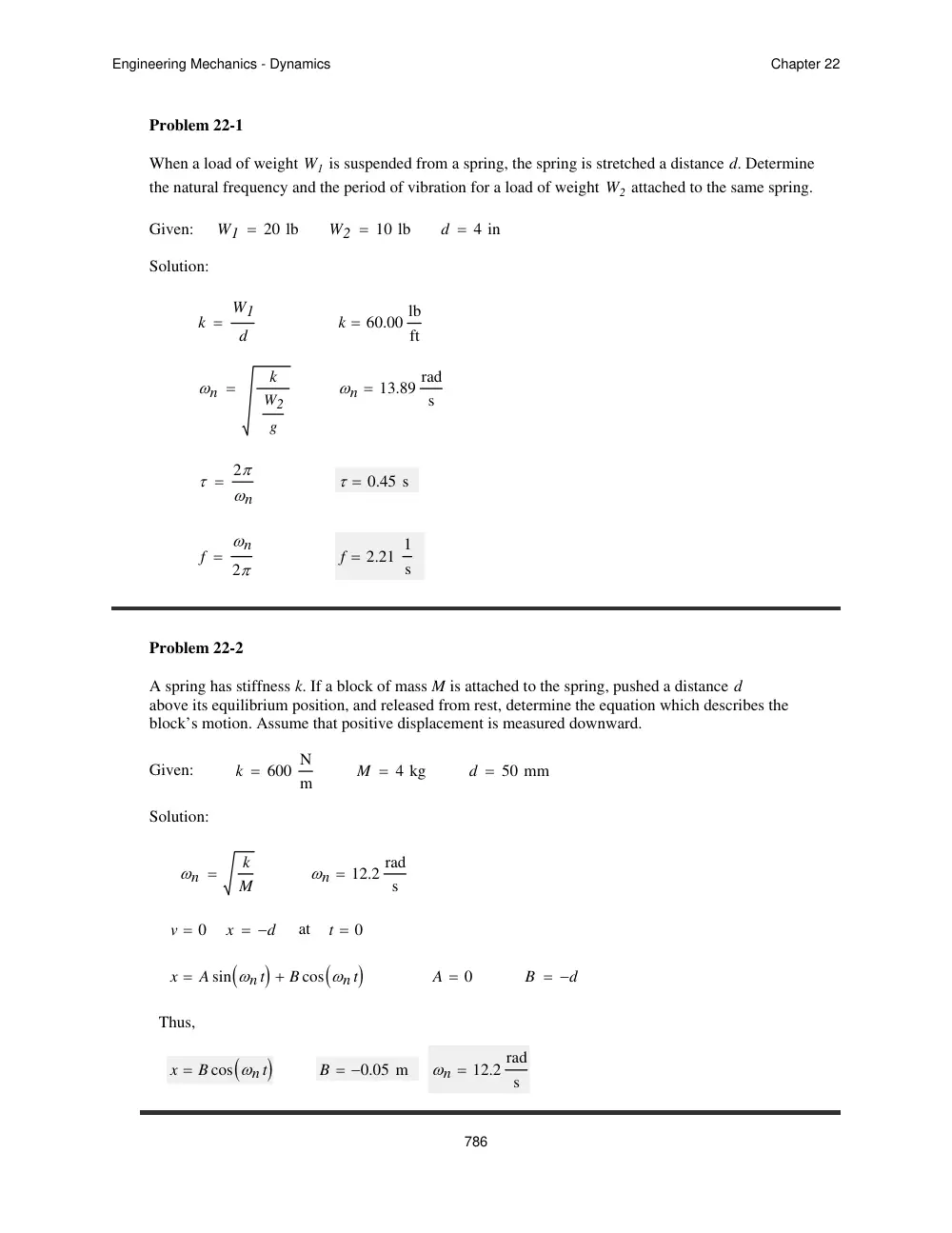
Problem 22-1
When a load of weight W1 is suspended from a spring, the spring is stretched a distance d. Determine
the natural frequency and the period of vibration for a load of weight W2 attached to the same spring.
Given:
W1
= 20 lb
W2
= 10 lb
d
4 in
=
Solution:
k
W1
d
=
k
60.00 lb
ft
=
ωn
k
W2
g
=
ωn
13.89 rad
s
=
τ
2π
ωn
=
τ
0.45 s
=
f
ωn
2π
=
f
2.21 1
s
=
Problem 22-2
A spring has stiffness k. If a block of mass M is attached to the spring, pushed a distance d
above its equilibrium position, and released from rest, determine the equation which describes the
block’s motion. Assume that positive displacement is measured downward.
Given:
k
600 N
m
=
M
= 4 kg
d
50 mm
=
Solution:
ωn
k
M
=
ωn
12.2 rad
s
=
v
= 0
x
= −d
at
t
0
=
x
A sin ωn t
(
)
B cos ωn t
(
)
+
=
A
= 0
B
−d
=
Thus,
x
B cos ωn t
(
)
=
B
−0.05
m
=
ωn
12.2 rad
s
=
786
Engineering Mechanics - Dynamics
Chapter 22
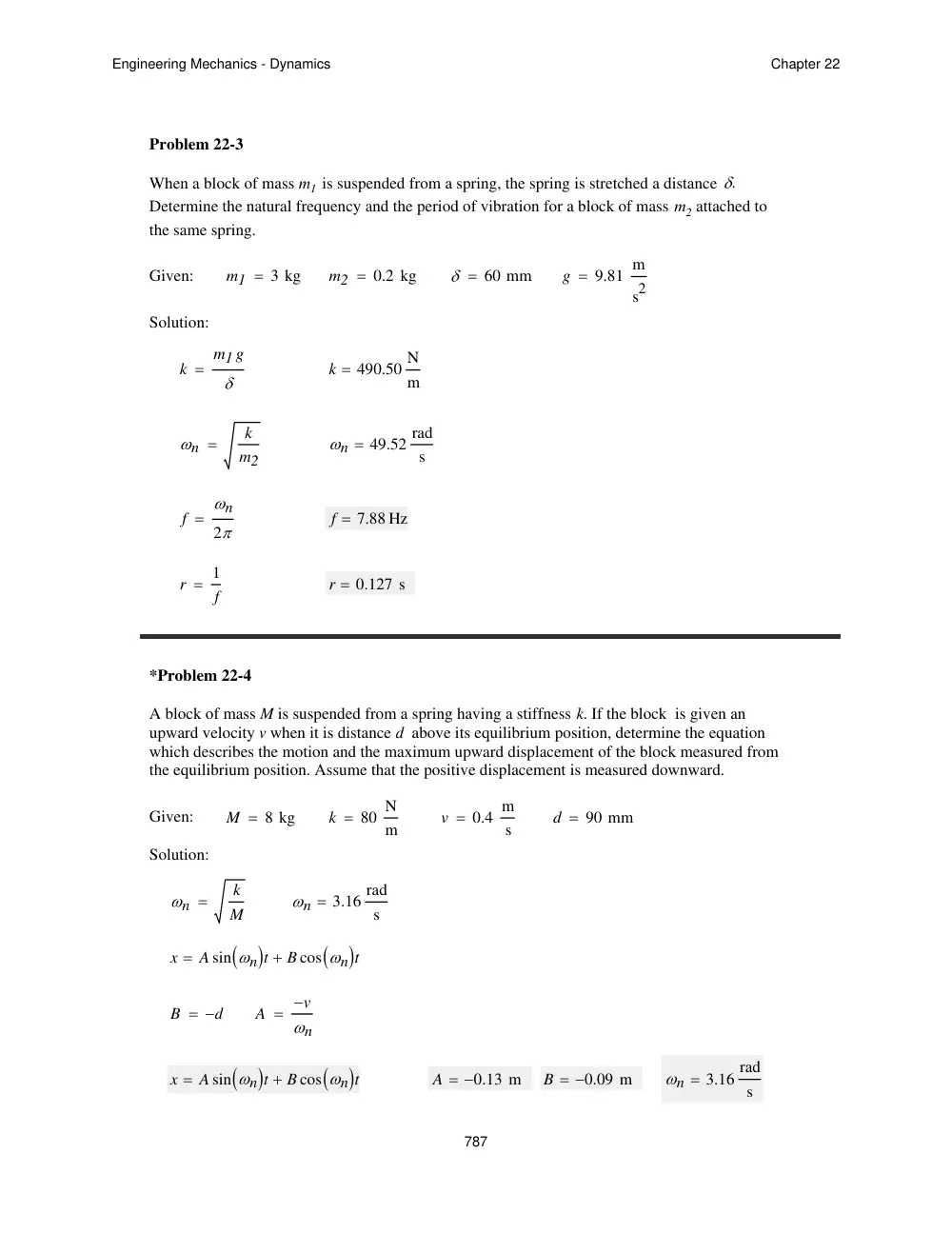
Problem 22-3
When a block of mass m1 is suspended from a spring, the spring is stretched a distance δ.
Determine the natural frequency and the period of vibration for a block of mass m2 attached to
the same spring.
Given:
m1
= 3 kg
m2
= 0.2 kg
δ
= 60 mm
g
9.81 m
s2
=
Solution:
k
m1 g
δ
=
k
490.50 N
m
=
ωn
k
m2
=
ωn
49.52 rad
s
=
f
ωn
2π
=
f
7.88 Hz
=
r
1
= f
r
0.127 s
=
*Problem 22-4
A block of mass M is suspended from a spring having a stiffness k. If the block is given an
upward velocity v when it is distance d above its equilibrium position, determine the equation
which describes the motion and the maximum upward displacement of the block measured from
the equilibrium position. Assume that the positive displacement is measured downward.
Given:
M
= 8 kg
k
80 N
m
=
v
0.4 m
s
=
d
90 mm
=
Solution:
ωn
k
M
=
ωn
3.16 rad
s
=
x
A sin ωn
(
)t
B cos ωn
(
)t
+
=
B
= −d
A
v
−
ωn
=
x
A sin ωn
(
)t
B cos ωn
(
)t
+
=
A
−0.13
m
=
B
−0.09
m
=
ωn
3.16 rad
s
=
787
Engineering Mechanics - Dynamics
Chapter 22
xmax
A2
+ B2
=
xmax
0.16 m
=
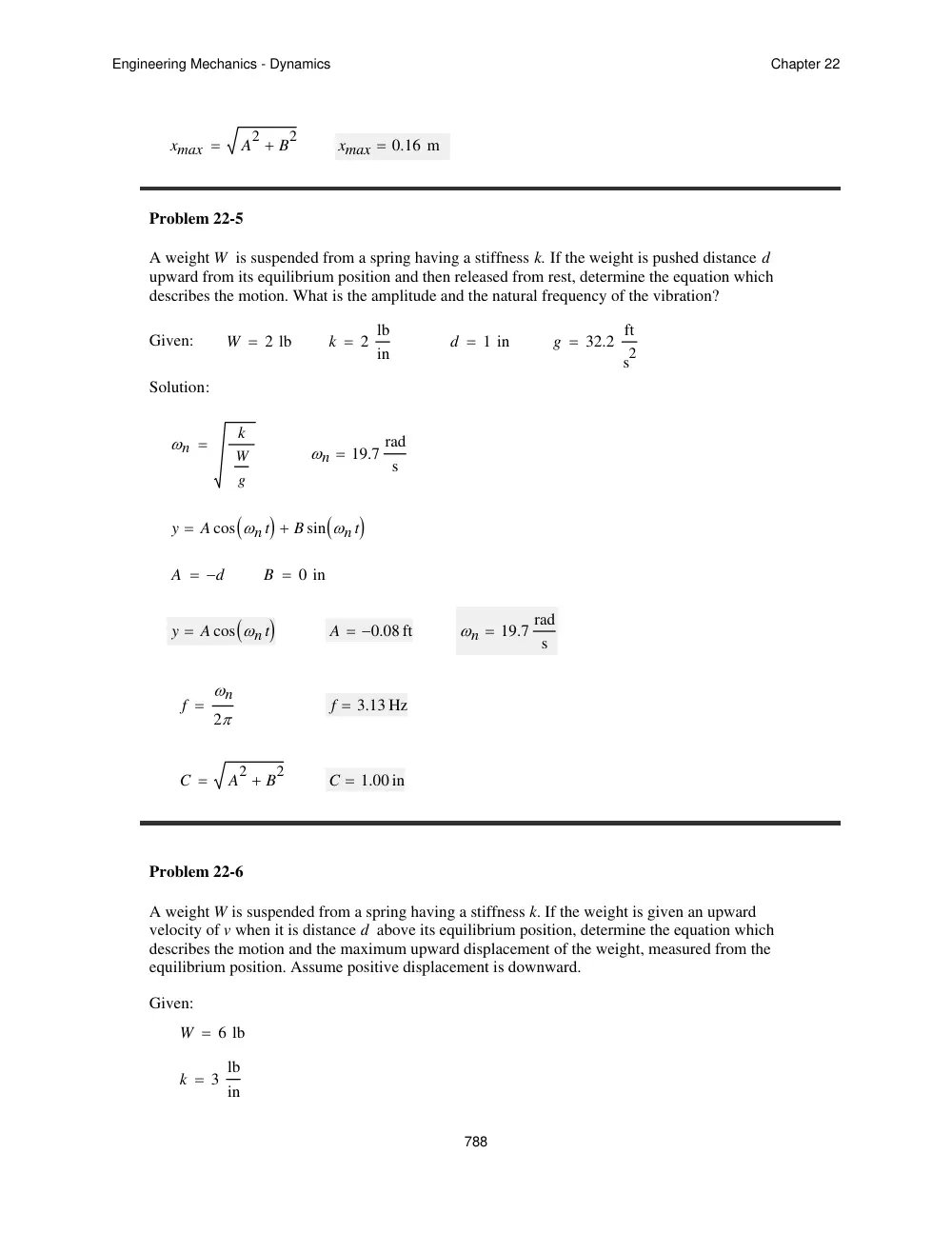
Problem 22-5
A weight W is suspended from a spring having a stiffness k. If the weight is pushed distance d
upward from its equilibrium position and then released from rest, determine the equation which
describes the motion. What is the amplitude and the natural frequency of the vibration?
Given:
W
= 2 lb
k
2 lb
in
=
d
= 1 in
g
32.2 ft
s2
=
Solution:
ωn
k
W
g
=
ωn
19.7 rad
s
=
y
A cos ωn t
(
)
B sin ωn t
(
)
+
=
A
= −d
B
0 in
=
y
A cos ωn t
(
)
=
A
−0.08
ft
=
ωn
19.7 rad
s
=
f
ωn
2π
=
f
3.13 Hz
=
C
A2
+ B2
=
C
1.00 in
=
Problem 22-6
A weight W is suspended from a spring having a stiffness k. If the weight is given an upward
velocity of v when it is distance d above its equilibrium position, determine the equation which
describes the motion and the maximum upward displacement of the weight, measured from the
equilibrium position. Assume positive displacement is downward.
Given:
W
6 lb
=
k
3 lb
in
=
788
Engineering Mechanics - Dynamics
Chapter 22
v
20 ft
s
=
d
2 in
=
g
32.2 ft
s2
=
Solution:
ωn
kg
W
=
ωn
13.90 rad
s
=
y
A cos ωn t
(
)
B sin ωn t
(
)
+
=
A
= −d
B
v
−
ωn
=
y
A cos ωn t
(
)
B sin ωn t
(
)
+
=
A
−0.17
ft
=
B
−1.44
ft
=
ωn
13.90 rad
s
=
C
A2
+ B2
=
C
1.45 ft
=
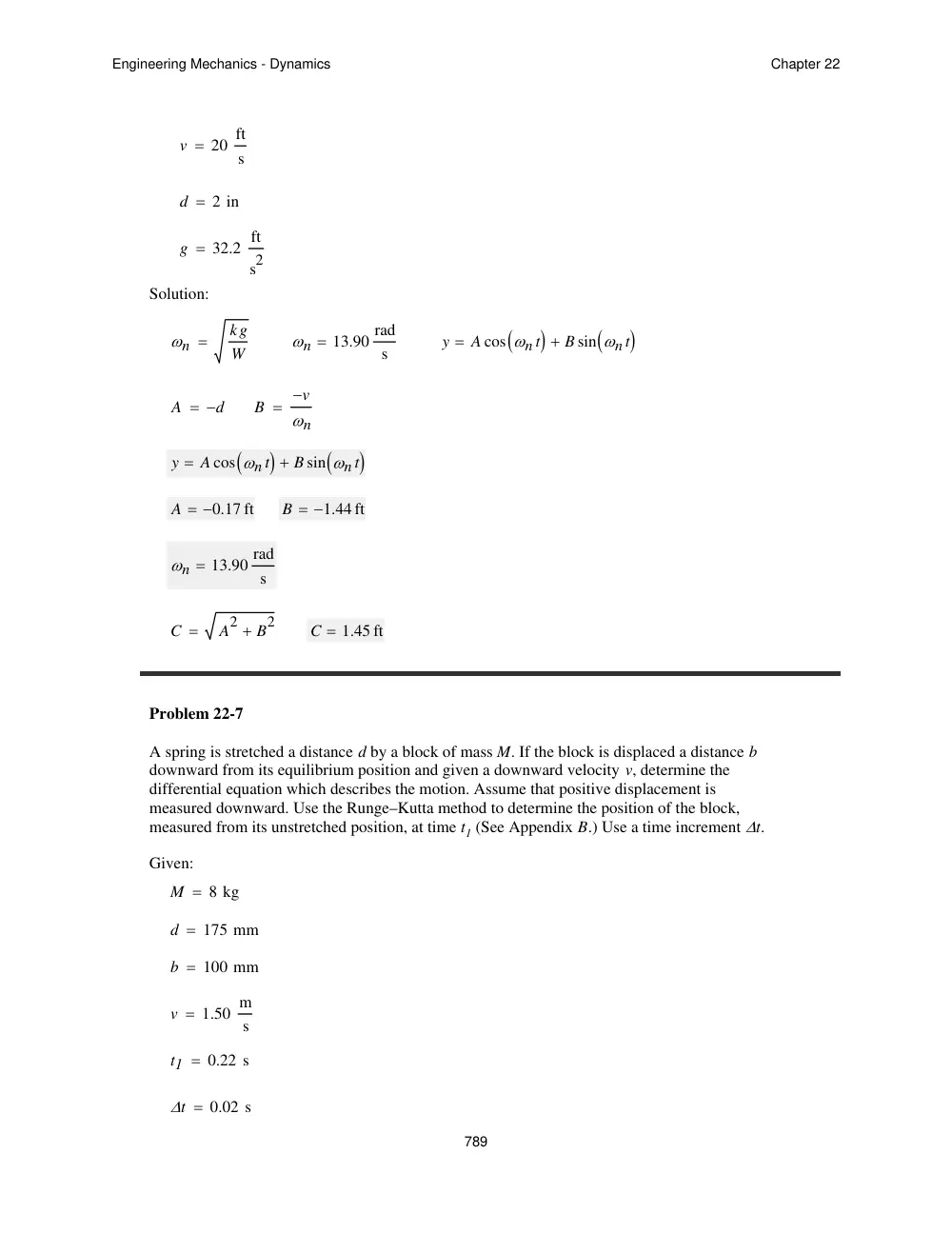
Problem 22-7
A spring is stretched a distance d by a block of mass M. If the block is displaced a distance b
downward from its equilibrium position and given a downward velocity v, determine the
differential equation which describes the motion. Assume that positive displacement is
measured downward. Use the Runge–Kutta method to determine the position of the block,
measured from its unstretched position, at time t1 (See Appendix B.) Use a time increment Δt.
Given:
M
8 kg
=
d
175 mm
=
b
100 mm
=
v
1.50 m
s
=
t1
0.22 s
=
Δt
0.02 s
=
789
Engineering Mechanics - Dynamics
Chapter 22
g
9.81 m
s2
=
Solution:
k
M g
d
=
ωn
k
M
=
y''
ωn
2y
+
= 0
ωn
2
56.1 rad
s2
=
To numerically integrate in Mathcad we have to switch to nondimensional variables
Ωn
ωn
s
rad
=
B
b
= mm
V
v
s
mm
=
T1
t1
s
=
Given
y'' t( )
Ωn
2 y t( )
+
= 0
y 0
( )
= B
y' 0
( )
V
=
y
Odesolve t T1
( ,
)
=
y T1
(
)
= 192
mm
*Problem 22-8
A spring is stretched a distance d by a block of mass M. If the block is displaced a distance b
downward from its equilibrium position and given an upward velocity v, determine the
differential equation which describes the motion. Assume that positive displacement is
measured downward. What is the amplitude of the motion?
Given:
M
8 kg
=
d
175 mm
=
b
60 mm
=
v
4 m
s
=
t1
0.22 s
=
Δt
= 0.02 s
g
9.81 m
s2
=
Solution:
k
M g
d
=
ωn
k
M
=
y''
ωn
2y
+
0
=
790
Engineering Mechanics - Dynamics
Chapter 22
A
= b
B
v
−
ωn
=
y t( )
A cos ωn t
(
)
B sin ωn t
(
)
+
=
A
= 0.06 m
B
−0.53
m
=
ωn
7.49 rad
s
=
C
A2
+ B2
=
C
0.54 m
=
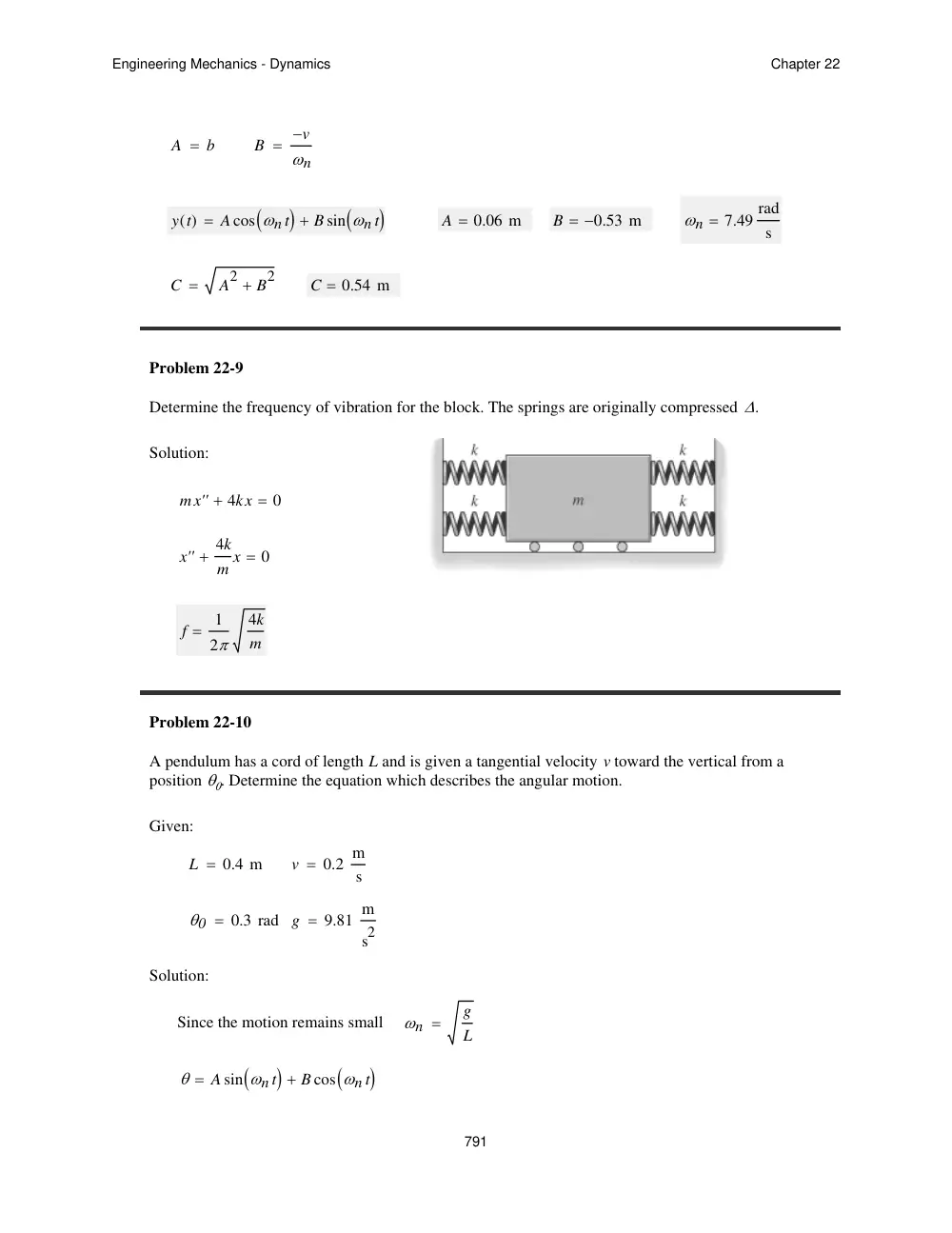
Problem 22-9
Determine the frequency of vibration for the block. The springs are originally compressed Δ.
Solution:
mx''
+ 4kx
0
=
x''
4k
+ m x
0
=
f
1
2π
4k
m
=
Problem 22-10
A pendulum has a cord of length L and is given a tangential velocity v toward the vertical from a
position θ0. Determine the equation which describes the angular motion.
Given:
L
= 0.4 m
v
0.2 m
s
=
θ0
= 0.3 rad
g
9.81 m
s2
=
Solution:
Since the motion remains small
ωn
g
L
=
θ
A sin ωn t
(
)
B cos ωn t
(
)
+
=
791
Engineering Mechanics - Dynamics
Chapter 22
A
v
−
ωn L
=
B
θ0
=
θ
A sin ωn t
(
)
B cos ωn t
(
)
+
=
A
−0.101
rad
=
B
= 0.30 rad
ωn
4.95 rad
s
=
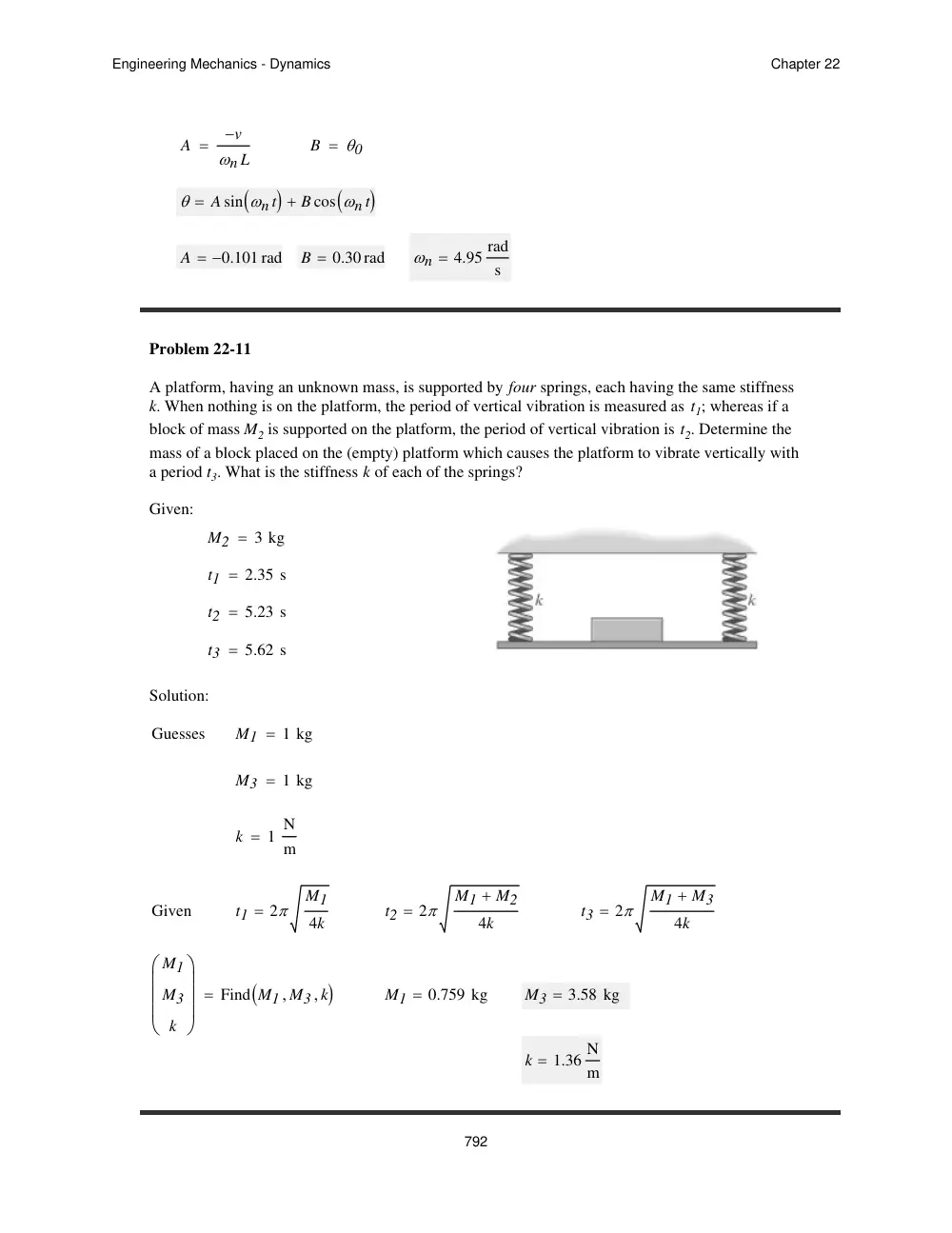
Problem 22-11
A platform, having an unknown mass, is supported by four springs, each having the same stiffness
k. When nothing is on the platform, the period of vertical vibration is measured as t1; whereas if a
block of mass M2 is supported on the platform, the period of vertical vibration is t2. Determine the
mass of a block placed on the (empty) platform which causes the platform to vibrate vertically with
a period t3. What is the stiffness k of each of the springs?
Given:
M2
3 kg
=
t1
2.35 s
=
t2
5.23 s
=
t3
5.62 s
=
Solution:
Guesses
M1
1 kg
=
M3
1 kg
=
k
1 N
m
=
Given
t1
2π
M1
4k
=
t2
2π
M1
M2
+
4k
=
t3
2π
M1
M3
+
4k
=
M1
M3
k
⎛⎜
⎜
⎜⎝
⎞⎟
⎟
⎟⎠
Find M1 M3
,
, k
(
)
=
M1
= 0.759 kg
M3
3.58 kg
=
k
1.36 N
m
=
792
Engineering Mechanics - Dynamics
Chapter 22
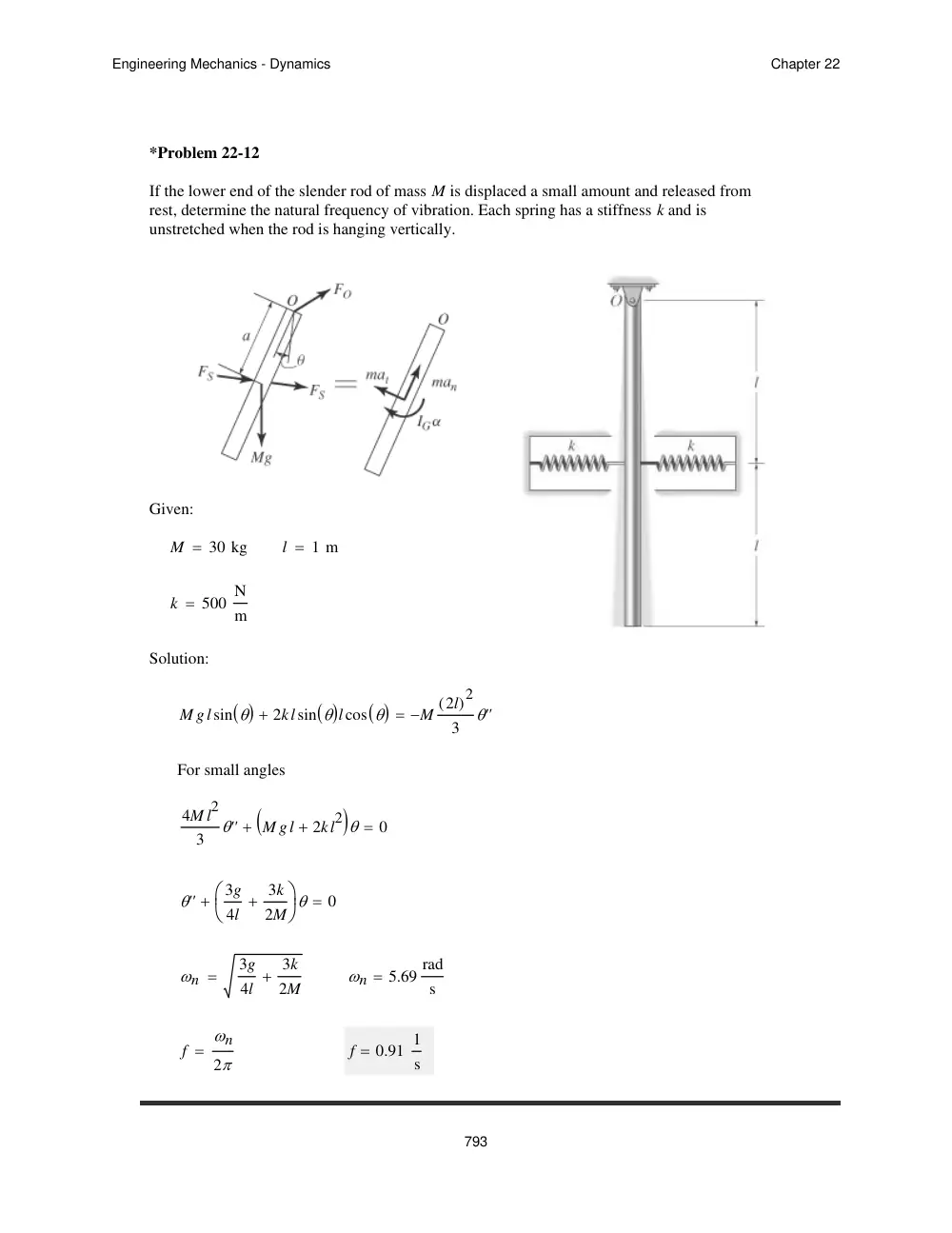
*Problem 22-12
If the lower end of the slender rod of mass M is displaced a small amount and released from
rest, determine the natural frequency of vibration. Each spring has a stiffness k and is
unstretched when the rod is hanging vertically.
Given:
M
= 30 kg
l
1 m
=
k
500 N
m
=
Solution:
M gl sin θ( )
+ 2kl sin θ( )l cos θ( )
−M
(2l
)2
3
θ''
=
For small angles
4M l2
3
θ''
M gl
+ 2kl2
(
)θ
+
0
=
θ''
3g
4l
3k
+ 2M
⎛⎜⎝
⎞⎟⎠
θ
+
0
=
ωn
3g
4l
3k
+ 2M
=
ωn
5.69 rad
s
=
f
ωn
2π
=
f
0.91 1
s
=
793
Engineering Mechanics - Dynamics
Chapter 22
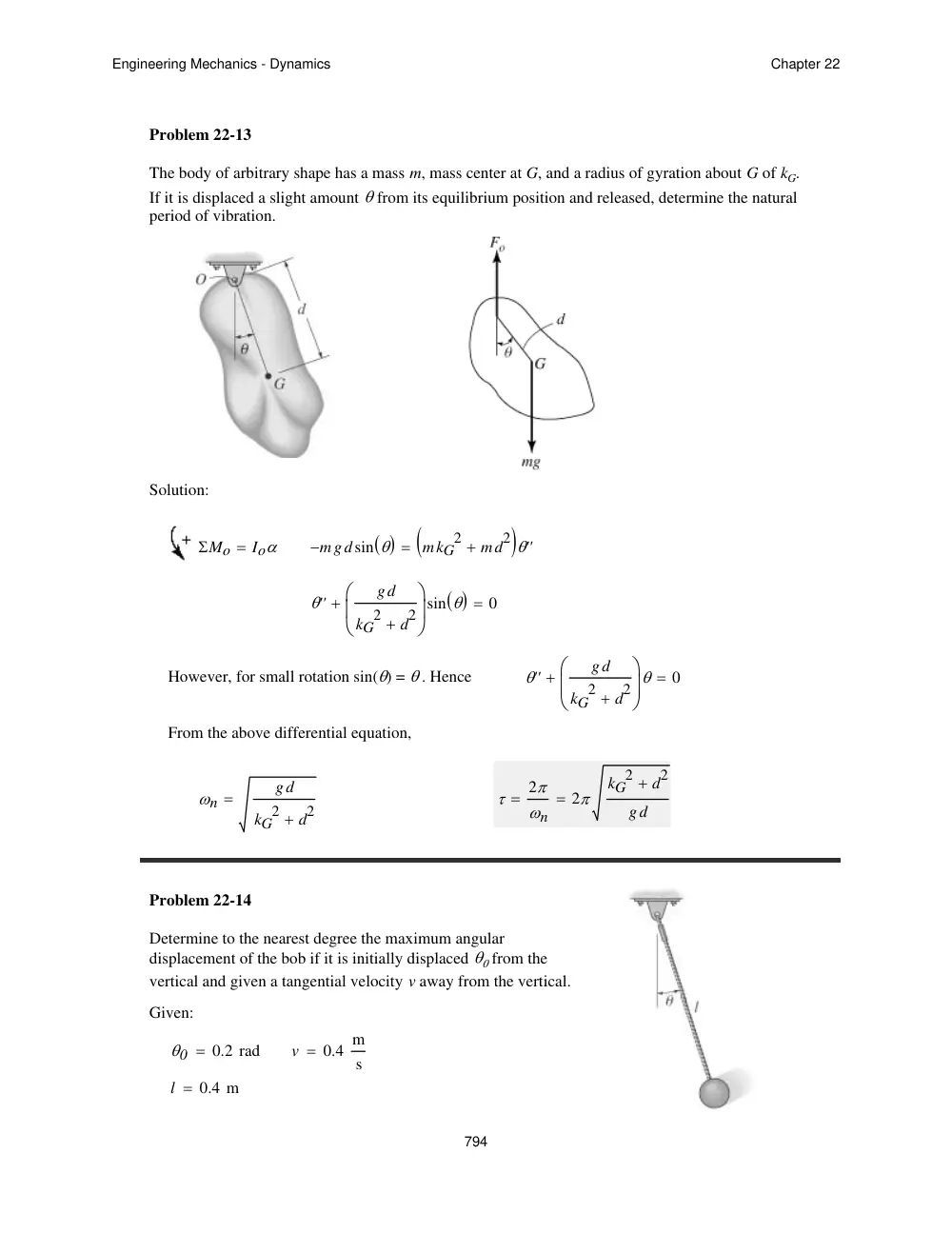
Problem 22-13
The body of arbitrary shape has a mass m, mass center at G, and a radius of gyration about G of kG.
If it is displaced a slight amount θ from its equilibrium position and released, determine the natural
period of vibration.
Solution:
ΣMo
= Ioα
−m
gdsin θ( )
mkG
2
+ md2
(
)θ''
=
θ''
gd
kG
2
d2
+
⎛
⎜
⎝
⎞
⎟
⎠
sin θ( )
+
0
=
However, for small rotation sin(θ) = θ . Hence
θ''
gd
kG
2
d2
+
⎛
⎜
⎝
⎞
⎟
⎠
θ
+
0
=
From the above differential equation,
ωn
gd
kG
2
d2
+
=
τ
2π
ωn
=
2π
kG
2
d2
+
gd
=
Problem 22-14
Determine to the nearest degree the maximum angular
displacement of the bob if it is initially displaced θ0 from the
vertical and given a tangential velocity v away from the vertical.
Given:
θ0
= 0.2 rad
v
0.4 m
s
=
l
0.4 m
=
794
Engineering Mechanics - Dynamics
Chapter 22
Solution:
ωn
g
l
=
A
= θ0
B
v
lωn
=
θ t( )
A cos ωn t
(
)
B sin ωn t
(
)
+
=
C
A2
+ B2
=
C
16deg
=
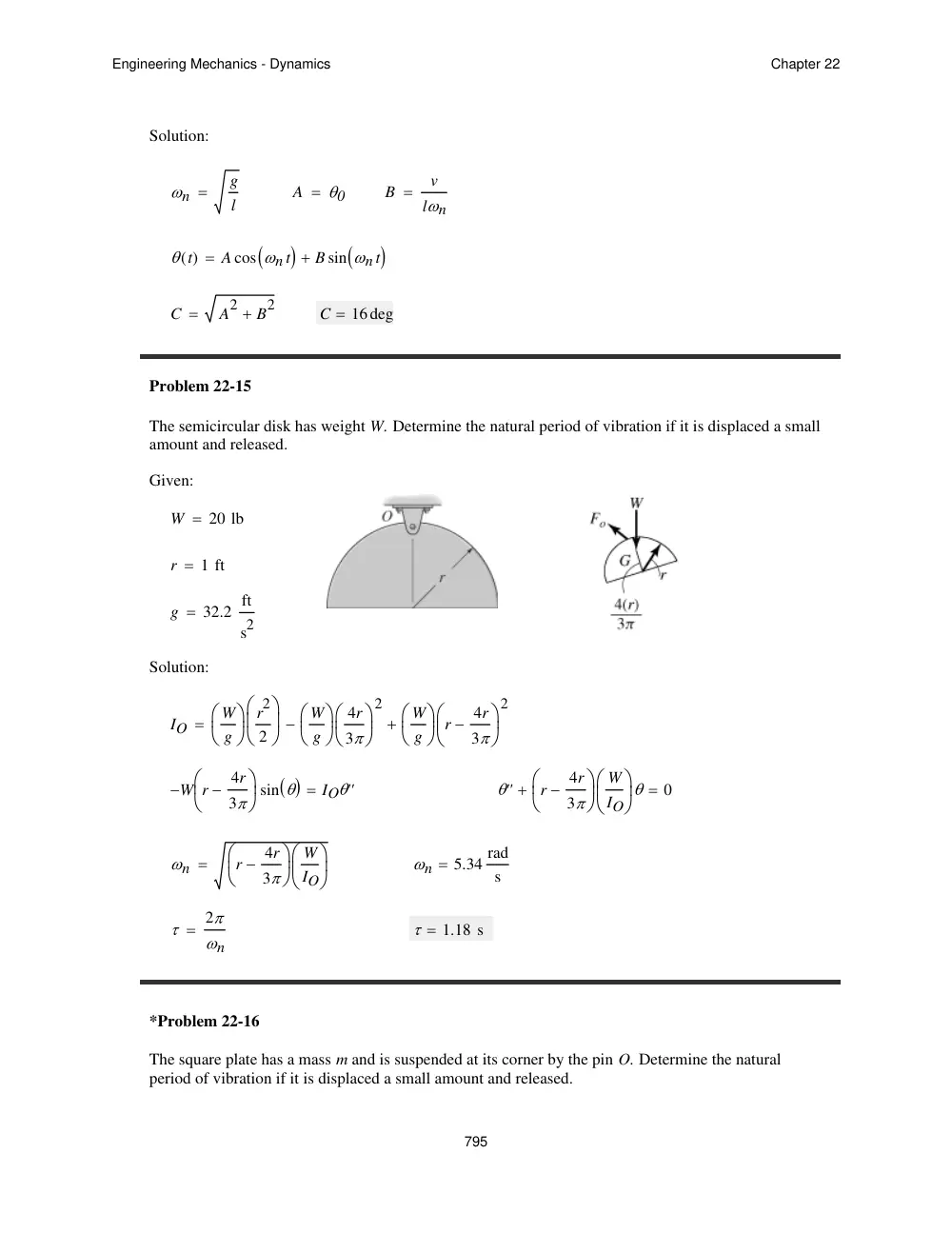
Problem 22-15
The semicircular disk has weight W. Determine the natural period of vibration if it is displaced a small
amount and released.
Given:
W
20 lb
=
r
1 ft
=
g
32.2 ft
s2
=
Solution:
IO
W
g
⎛⎜⎝
⎞⎟⎠
r2
2
⎛⎜
⎝
⎞⎟
⎠
W
g
⎛⎜⎝
⎞⎟⎠
4r
3π
⎛⎜⎝
⎞⎟⎠
2
−
W
g
⎛⎜⎝
⎞⎟⎠
r
4r
3π
−
⎛⎜⎝
⎞⎟⎠
2
+
=
−W
r
4r
3π
−
⎛⎜⎝
⎞⎟⎠
sin θ( )
= IOθ''
θ''
r
4r
3π
−
⎛⎜⎝
⎞⎟⎠
W
IO
⎛⎜⎝
⎞⎟⎠
θ
+
0
=
ωn
r
4r
3π
−
⎛⎜⎝
⎞⎟⎠
W
IO
⎛⎜⎝
⎞⎟⎠
=
ωn
5.34 rad
s
=
τ
2π
ωn
=
τ
1.18 s
=
*Problem 22-16
The square plate has a mass m and is suspended at its corner by the pin O. Determine the natural
period of vibration if it is displaced a small amount and released.
795
Engineering Mechanics - Dynamics
Chapter 22
Solution:
Io
2
= 3ma2
−m
g
2
⎛⎜⎝ 2 a
⎞⎟⎠
θ
2
⎛⎜⎝3ma2
⎞⎟⎠
θ''
=
θ''
3
2g
4a
⎛⎜⎝
⎞⎟⎠
θ
+
= 0
ωn
3
2g
4a
=
τ
2π
ωn
=
2π
4
3
2
a
g
=
b
2π
4
3
2
=
τ
b
a
g
=
b
6.10
=
Problem 22-17
The disk has weight W and rolls without slipping on the horizontal surface as it oscillates about its
equilibrium position. If the disk is displaced by rolling it counterclockwise through angle θ0 ,
determine the equation which describes its oscillatory motion when it is released.
Given:
W
10 lb
=
θ0
0.4 rad
=
r
1 ft
=
k
100 lb
ft
=
g
32.2 ft
s2
=
796
Engineering Mechanics - Dynamics
Chapter 22
Solution:
−k
(2rθ
) 2r
W
g
r2
2
W
+ g r2
⎛⎜
⎝
⎞⎟
⎠
θ''
=
θ''
8kg
+ 3W θ
= 0
ωn
8kg
3W
=
θ
θ0 cos ωn t
(
)
=
θ0
= 0.40 rad
ωn
29.3 rad
s
=
Problem 22-18
The pointer on a metronome supports slider A of weight W, which is positioned at a fixed distance a
from the pivot O of the pointer. When the pointer is displaced, a torsional spring at O exerts a
restoring torque on the pointer having a magnitude M = kθ where θ represents the angle of
displacement from the vertical. Determine the natural period of vibration when the pointer is displaced
a small amount and released. Neglect the mass of the pointer.
Given:
W
0.4 lb
=
k
1.2 lb ft
rad
=
a
0.25 ft
=
g
32.2 ft
s2
=
Solution:
−W
aθ
+ kθ
−W
g
⎛⎜⎝
⎞⎟⎠
a2θ''
=
θ''
g
a
k
aW
− 1
⎛⎜⎝
⎞⎟⎠
θ
+
0
=
ωn
g
a
k
aW
− 1
⎛⎜⎝
⎞⎟⎠
=
ωn
37.64 rad
s
=
τ
2π
ωn
=
τ
0.167 s
=
797
Engineering Mechanics - Dynamics
Chapter 22
Problem 22-19
The block has a mass m and is supported by a rigid bar of negligible mass. If the spring has a
stiffness k, determine the natural period of vibration for the block.
Solution:
k
− bθb
maθ'' a
=
ma2θ''
+ kb2θ
0
=
θ''
kb2
ma2
⎛⎜
⎜⎝
⎞⎟
⎟⎠
θ
+
0
=
ωn
k
m
b
a
⎛⎜⎝
⎞⎟⎠
=
τ
2π a
b
⎛⎜⎝
⎞⎟⎠
m
k
=
*Problem 22-20
The disk, having weight W, is pinned at its center O and supports the block A that has weight WA.
If the belt which passes over the disk is not allowed to slip at its contacting surface, determine the
natural period of vibration of the system.
Given:
W
15 lb
=
WA
3 lb
=
k
80 lb
ft
=
r
0.75 ft
=
g
32.2 ft
s2
=
798
Engineering Mechanics - Dynamics
Chapter 22
Solution:
krθr
−W
g
⎛⎜⎝
⎞⎟⎠
r2
2
⎛⎜
⎝
⎞⎟
⎠
θ''
WA
g
⎛⎜⎝
⎞⎟⎠
rθ'' r
−
=
r2
g
WA
W
+ 2
⎛⎜⎝
⎞⎟⎠
θ''
+ kr2θ
0
=
θ''
kg
WA
W
2
+
θ
+
0
=
ωn
kg
WA
W
2
+
=
ωn
15.66 rad
s
=
τ
2π
ωn
=
τ
0.401 s
=
Problem 22-21
While standing in an elevator, the man holds a
pendulum which consists of cord of length L and a
bob of weight W. If the elevator is descending with
an acceleration a, determine the natural period of
vibration for small amplitudes of swing.
Given:
L
18 in
=
W
0.5 lb
=
a
4 ft
s2
=
g
32.2 ft
s2
=
799
Engineering Mechanics - Dynamics
Chapter 22
Solution:
Since the acceleration of the pendulum is
a'
g
− a
(
)
=
a'
28.2 ft
s2
=
Using the result of Example 22-1, we have
ωn
a'
L
=
ωn
4.34 rad
s
=
τ
2π
ωn
=
τ
1.45 s
=
Problem 22-22
The spool of weight W is attached to two springs. If the spool is displaced a small amount and
released, determine the natural period of vibration. The radius of gyration of the spool is kG. The spool
rolls without slipping.
Given:
W
= 50 lb
ri
1 ft
=
kG
= 1.5 ft
ro
2 ft
=
k1
3 lb
ft
=
g
32.2 ft
s2
=
k2
1 lb
ft
=
Solution:
−k1
ro
+ ri
(
)θ ro
+ ri
(
)
k2 ro
− ri
(
)θ ro
− ri
(
)
−
W
g kG
2
W
g ri
2
+
⎛⎜⎝
⎞⎟⎠
θ''
=
W
g kG
2
W
g ri
2
+
⎛⎜⎝
⎞⎟⎠
θ''
k1 ro
+ ri
(
)2
k2 ro
− ri
(
)2
+
⎡⎣
⎤⎦θ
+
0
=
ωn
g
W kG
2
ri
+ 2
(
)
k1 ro
+ ri
(
)2
k2 ro
− ri
(
)2
+
⎡⎣
⎤⎦
=
ωn
2.36 rad
s
=
800
Engineering Mechanics - Dynamics
Chapter 22
τ
2π
ωn
=
τ
2.67 s
=
Problem 22-23
Determine the natural frequency for small oscillations of the sphere of weight W when the rod
is displaced a slight distance and released. Neglect the size of the sphere and the mass of the
rod. The spring has an unstretched length d.
Given:
W
10 lb
=
k
5 lb
ft
=
d
1 ft
=
Solution:
Geometry
L
d2
+ d2
+ 2ddcos θ( )
=
d
2 1
( + cos θ( )
)
=
2dcos θ
2
⎛⎜⎝
⎞⎟⎠
=
Dynamics
W 2d
(
) sin θ( )
k 2dcos θ
2
⎛⎜⎝
⎞⎟⎠
− d
⎛⎜⎝
⎞⎟⎠
sin θ
2
⎛⎜⎝
⎞⎟⎠
d
−
−W
g
⎛⎜⎝
⎞⎟⎠
(2d
)2θ''
=
Linearize around θ = 0.
4W d2
g
⎛⎜
⎝
⎞⎟
⎠
θ''
W 2d
(
)
kd2
− 2
⎡⎢
⎣
⎤⎥
⎦
θ
+
0
=
θ''
g
2d
kg
− 8W
⎛⎜⎝
⎞⎟⎠
θ
+
= 0
ωn
g
2d
kg
− 8W
=
ωn
3.75 rad
s
=
f
ωn
2π
=
f
0.60 1
s
=
801
Engineering Mechanics - Dynamics
Chapter 22
*Problem 22-24
The bar has length l and mass m. It is
supported at its ends by rollers of negligible
mass. If it is given a small displacement and
released, determine the natural frequency of
vibration.
Solution:
Moment of inertia about point O:
IO
1
12ml2
m
R2
l2
4
−
⎛
⎜
⎝
⎞
⎟
⎠
2
+
=
m R2
1
− 6l2
⎛⎜⎝
⎞⎟⎠
=
mg
R2
l2
4
−
⎛
⎜
⎝
⎞
⎟
⎠
θ
−m
R2
1
− 6l2
⎛⎜⎝
⎞⎟⎠
θ''
=
θ''
3g
4R2
l2
−
6R2
l2
−
θ
+
0
=
From the above differential equation,
p
3g
4R2
l2
−
6R2
l2
−
=
f
p
2π
=
1
2π
3g
4R2
l2
−
6R2
l2
−
=
Problem 22-25
The weight W is fixed to the end of the rod assembly.
If both springs are unstretched when the assembly is
in the position shown, determine the natural period of
vibration for the weight when it is displaced slightly
and released. Neglect the size of the block and the
mass of the rods.
Given:
W
25 lb
=
k
2 lb
in
=
802
Engineering Mechanics - Dynamics
Chapter 22
l
12 in
=
d
6 in
=
Solution:
−W
lθ
− 2kdθd
W
g
⎛⎜⎝
⎞⎟⎠
l2θ''
=
W
g
⎛⎜⎝
⎞⎟⎠
l2θ''
W l
+ 2kd2
(
)θ
+
0
=
θ''
g
l
2kgd2
W l2
+
⎛⎜
⎜⎝
⎞⎟
⎟⎠
θ
+
0
=
ωn
g
l
2kgd2
W l2
+
=
T
2π
ωn
=
T
0.91 s
=
Problem 22-26
The body of arbitrary shape has a mass m, mass center at G, and a radius of gyration about G of kG.
If it is displaced a slight amount θ from its equilibrium position and released, determine the natural
period of vibration. Solve using energy methods
Solution:
T
+ V
1
2 mkG
2
+ md2
(
) θ'2
mgd 1
( − cos θ( )
)
+
=
m kG
2
+ d2
(
)θ'θ''
mgd sin θ( )
(
)θ'
+
0
=
803
Engineering Mechanics - Dynamics
Chapter 22
sin θ( )
≈ θ
θ''
gd
kG
2
d2
+
⎛
⎜
⎝
⎞
⎟
⎠
θ
+
0
=
τ
2π
ωn
=
τ
2π
kG
2
d2
+
gd
=
Problem 22-27
The semicircular disk has weight W. Determine the natural period of vibration if it is displaced a small
amount and released. Solve using energy methods.
Given:
W
20 lb
=
r
1 ft
=
g
32.2 ft
s2
=
Solution:
IO
W
g
⎛⎜⎝
⎞⎟⎠
r2
2
⎛⎜
⎝
⎞⎟
⎠
W
g
⎛⎜⎝
⎞⎟⎠
4r
3π
⎛⎜⎝
⎞⎟⎠
2
−
W
g
⎛⎜⎝
⎞⎟⎠
r
4r
3π
−
⎛⎜⎝
⎞⎟⎠
2
+
=
T
+ V
1
2IOθ'2
W r
4r
3π
−
⎛⎜⎝
⎞⎟⎠
cos θ( )
−
=
IOθ''
W r
4r
3π
−
⎛⎜⎝
⎞⎟⎠
θ
+
= 0
θ''
W
IO
r
4r
3π
−
⎛⎜⎝
⎞⎟⎠
θ
+
0
=
ωn
W
IO
r
4r
3π
−
⎛⎜⎝
⎞⎟⎠
=
ωn
5.34 rad
s
=
τ
2π
ωn
=
τ
1.18 s
=
804
Engineering Mechanics - Dynamics
Chapter 22
*Problem 22-28
The square plate has a mass m and is suspended at its
corner by the pin O. Determine the natural period of
vibration if it is displaced a small amount and released.
Solve using energy methods.
Solution:
T
+ V
1
2
1
12m a2
+ a2
(
)
m
a
2
⎛⎜⎝
⎞⎟⎠
2
+
⎡
⎢
⎣
⎤
⎥
⎦
θ'2
mg
a
2
⎛⎜⎝
⎞⎟⎠
1
( − cos θ( )
)
+
=
2
3ma2θ'θ''
mg
a
2
⎛⎜⎝
⎞⎟⎠
(sin θ( )
)θ'
+
0
=
θ''
3
2g
4a
⎛⎜⎝
⎞⎟⎠
θ
+
0
=
ωn
3
2g
4a
=
τ
2π
ωn
=
2π
4
3
2
a
g
=
b
2π
4
3
2
=
τ
b
a
g
=
b
6.10
=
Problem 22-29
The disk, having weight W, is pinned at its center O and supports the block A that has weight WA.
If the belt which passes over the disk is not allowed to slip at its contacting surface, determine the
natural period of vibration of the system.
Given:
W
15 lb
=
WA
3 lb
=
805
Engineering Mechanics - Dynamics
Chapter 22
k
80 lb
ft
=
r
0.75 ft
=
g
32.2 ft
s2
=
Solution:
T
+ V
1
2
W
g
⎛⎜⎝
⎞⎟⎠
r2
2
⎛⎜
⎝
⎞⎟
⎠
θ'2
1
2
WA
g
⎛⎜⎝
⎞⎟⎠
r2 θ'2
+
1
2k rθ
(
)2
+
=
W
g
r2
2
WA
+ g r2
⎛⎜
⎝
⎞⎟
⎠
θ''
+ kr2θ
0
=
θ''
kg
WA
W
2
+
θ
+
= 0
ωn
kg
WA
W
2
+
=
ωn
15.66 rad
s
=
τ
2π
ωn
=
τ
0.401 s
=
Problem 22-30
The uniform rod of mass m is supported by a pin at A and a spring at B. If the end B is given a
small downward displacement and released, determine the natural period of vibration.
Solution:
T
+ V
1
2m l2
3
⎛⎜
⎝
⎞⎟
⎠
θ'2
1
2k lθ
( )2
+
=
m l2
3 θ''
+ kl2θ
= 0
θ''
3k
+ m θ
0
=
ωn
3k
m
=
806
Engineering Mechanics - Dynamics
Chapter 22
τ
2π
ωn
=
τ
2π
m
3k
=
Problem 22-31
Determine the differential equation of motion of the block of mass M when it is displaced slightly
and released. The surface is smooth and the springs are originally unstretched.
Given:
M
3 kg
=
k
500 N
m
=
Solution:
T
+ V
1
2M x'2
2 1
2kx2
+
=
M x''
+ 2kx
= 0
x''
2k
M
⎛⎜⎝
⎞⎟⎠
x
+
0
=
b
2k
= M
x''
+ bx
= 0
b
333 rad
s2
=
*Problem 22-32
Determine the natural period of vibration of the
semicircular disk of weight W.
Given:
W
= 10 lb
r
0.5 ft
=
Solution:
T
+ V
1
2
W
g
⎛⎜⎝
⎞⎟⎠
r2
2
⎛⎜
⎝
⎞⎟
⎠
W
g
⎛⎜⎝
⎞⎟⎠
4r
3π
⎛⎜⎝
⎞⎟⎠
2
−
W
g
⎛⎜⎝
⎞⎟⎠
r
4r
3π
−
⎛⎜⎝
⎞⎟⎠
2
+
⎡⎢
⎣
⎤⎥
⎦
θ'2
W
4r
3π
⎛⎜⎝
⎞⎟⎠
1
− cos θ( )
(
−
=
1
2
W
g
⎛⎜⎝
⎞⎟⎠
r2 3
2
8
3π
−
⎛⎜⎝
⎞⎟⎠
θ'2
W
4r
3π
⎛⎜⎝
⎞⎟⎠
1
( − cos θ( )
)
−
0
=
807
Engineering Mechanics - Dynamics
Chapter 22
W
g
⎛⎜⎝
⎞⎟⎠
r2 3
2
8
3π
−
⎛⎜⎝
⎞⎟⎠
θ''
W
4r
3π
⎛⎜⎝
⎞⎟⎠
θ
+
0
=
θ''
4g
3rπ 3
2
8
3π
−
⎛⎜⎝
⎞⎟⎠
θ
+
= 0
ωn
4g
3rπ 3
2
8
3π
−
⎛⎜⎝
⎞⎟⎠
=
τ
2π
ωn
=
τ
0.970 s
=
Problem 22-33
The disk of mass M is pin-connected at its midpoint. Determine the natural period of vibration
of the disk if the springs have sufficient tension in them to prevent the cord from slipping on
the disk as it oscillates. Hint: Assume that the initial stretch in each spring is δ0. This term will
cancel out after taking the time derivative of the energy equation.
Given:
M
7 kg
=
k
600 N
m
=
r
100 mm
=
Solution:
T
+ V
1
2M r2
2
⎛⎜
⎝
⎞⎟
⎠
θ'2
1
2k rθ
+ δ0
(
)2
+
1
2k rθ
− δ0
(
)2
+
=
M r2
2
⎛⎜
⎝
⎞⎟
⎠
θ''
+ 2kr2θ
= 0
θ''
4k
M
⎛⎜⎝
⎞⎟⎠
θ
+
0
=
τ
2π
M
4k
=
τ
0.339 s
=
Problem 22-34
The sphere of weight W is attached to a rod of negligible mass and rests in the horizontal
position. Determine the natural frequency of vibration. Neglect the size of the sphere.
808
Engineering Mechanics - Dynamics
Chapter 22
Given:
W
= 5 lb
a
1 ft
=
b
= 0.5 ft
k
10 lb
ft
=
Solution:
T
+ V
1
2
W
g
⎛⎜⎝
⎞⎟⎠
a
+ b
(
)2 θ'2
1
2k aθ
(
)2
+
=
W
g
⎛⎜⎝
⎞⎟⎠
a
+ b
(
)2θ''
+ ka2θ
0
=
θ''
ka2g
W a
+ b
(
)2
⎡⎢
⎢⎣
⎤⎥
⎥⎦
θ
+
= 0
ωn
ka2g
W a
+ b
(
)2
=
f
ωn
2π
=
f
0.85 1
s
=
Problem 22-35
The bar has a mass M and is suspended from
two springs such that when it is in
equilibrium, the springs make an angle θ with
the horizontal as shown. Determine the natural
period of vibration if the bar is pulled down a
short distance and released. Each spring has a
stiffness k.
Given:
M
8 kg
=
θ
45 deg
=
k
40 N
m
=
Solution:
Let 2b be the distance between B and C.
T
+ V
1
2M y'2
1
2 2k
(
) δ2
+
=
809
Engineering Mechanics - Dynamics
Chapter 22
where
δ
btan θ( )
+ y
(
)2
+ b2
(btan θ( )
)2
+ b2
−
=
= sin θ( ) y
for small y
thus
1
2M y'2
+ ksin θ( )2 y2
= 0
M y''
+ 2ksin θ( )2y
0
=
y''
2ksin θ( )2
M
⎛⎜
⎝
⎞⎟
⎠
y
+
0
=
ωn
2ksin θ( )2
M
=
τ
2π
ωn
=
τ
2.81 s
=
*Problem 22-36
Determine the natural period of vibration of the sphere of mass M. Neglect the mass of the rod
and the size of the sphere.
Given:
M
= 3 kg
a
300 mm
=
b
= 300 mm
k
500 N
m
=
Solution:
T
+ V
1
2M bθ'
(
)2
1
2k aθ
(
)2
+
=
M b2θ''
+ ka2θ
= 0
θ''
ka2
M b2 θ
+
0
=
τ
2π
M b2
ka2
=
τ
0.487 s
=
810
Engineering Mechanics - Dynamics
Chapter 22
Problem 22-37
The slender rod has a weight W. If it is supported in the horizontal plane by a ball-and-socket
joint at A and a cable at B, determine the natural frequency of vibration when the end B is
given a small horizontal displacement and then released.
Given:
W
4 lb
ft
=
d
1.5 ft
=
l
0.75 ft
=
Solution:
dθ
= lφ
φ
dθ
l
=
T
+ V
1
2
W
g
⎛⎜⎝
⎞⎟⎠
d2
3
⎛⎜
⎝
⎞⎟
⎠
θ'2
W
2 l 1
cos dθ
l
⎛⎜⎝
⎞⎟⎠
⎛⎜⎝ −
⎞⎟⎠
+
=
W d2
3g
⎛⎜
⎝
⎞⎟
⎠
θ''
W
2
⎛⎜⎝
⎞⎟⎠
l sin dθ
l
⎛⎜⎝
⎞⎟⎠
d
l
+
0
=
W d2
3g
⎛⎜
⎝
⎞⎟
⎠
θ''
W d2
2l
⎛⎜
⎝
⎞⎟
⎠
θ
+
0
=
θ''
3g
+ 2l θ
0
=
f
1
2π
3g
2l
=
f
1.28 1
s
=
Problem 22-38
Determine the natural frequency of vibration of the disk of weight W. Assume the disk does not
slip on the inclined surface.
Given:
W
20 lb
=
811
Engineering Mechanics - Dynamics
Chapter 22
k
10 lb
in
=
θ
30 deg
=
r
1 ft
=
g
32.2 ft
s2
=
Solution:
T
+ V
1
2
W
g
⎛⎜⎝
⎞⎟⎠
3r2
2
⎛⎜
⎝
⎞⎟
⎠
θ'2
1
2k rθ
(
)2
+
=
W
g
⎛⎜⎝
⎞⎟⎠
3r2
2
⎛⎜
⎝
⎞⎟
⎠
θ''
+ kr2θ
0
=
θ''
2kg
+ 3W θ
= 0
f
1
2π
2kg
3W
=
f
1.81 1
s
=
Problem 22-39
If the disk has mass M, determine the natural frequency of vibration. The springs are originally
unstretched.
Given:
M
8 kg
=
k
400 N
m
=
r
100 mm
=
Solution:
T
+ V
1
2
M r2
2
⎛⎜
⎝
⎞⎟
⎠
θ'2
2 1
2k rθ
(
)2
+
=
812
Engineering Mechanics - Dynamics
Chapter 22
M r2
2
⎛⎜
⎝
⎞⎟
⎠
θ''
+ 2kr2θ
0
=
θ''
4k
+ M θ
= 0
f
1
2π
4k
M
=
f
2.25 1
s
=
*Problem 22-40
Determine the differential equation of motion of the spool of mass M. Assume that it does not
slip at the surface of contact as it oscillates. The radius of gyration of the spool about its center
of mass is kG.
Given:
M
3 kg
=
kG
125 mm
=
ri
100 mm
=
ro
200 mm
=
k
400 N
m
=
Solution:
T
+ V
1
2M kG
2
ri
+ 2
(
) θ'2
1
2k
ro
+ ri
(
)θ
⎡⎣
⎤⎦
2
+
=
M kG
2
ri
+ 2
(
)θ''
k ro
+ ri
(
)2θ
+
0
=
ωn
k ro
+ ri
(
)2
M kG
2
ri
+ 2
(
)
=
θ''
ωn
2θ
+
0
=
where
ωn
2
468 rad
s2
=
813
Engineering Mechanics - Dynamics
Chapter 22
Problem 22-41
Use a block-and-spring model like that shown in Fig. 22-14a but suspended from a vertical
position and subjected to a periodic support displacement of δ = δ0 cosωt, determine the
equation of motion for the system, and obtain its general solution. Define the displacement y
measured from the static equilibrium position of the block when t = 0.
Solution:
For Static Equilibrium
mg
kδst
=
Equation of Motion is then
k δ
+ δst
− y
(
)
− mg
m y''
=
m y''
+ k y
kδ0 cos ωt
(
)
=
y''
k
+ m y
k
mδ0 cos ωt
(
)
=
The solution consists of a homogeneous part and a
particular part
y t( )
A cos
k
⎛⎜⎝ m t
⎞⎟⎠
B sin
k
⎛⎜⎝ m t
⎞⎟⎠
+
δ0
1
mω2
k
−
cos ωt
(
)
+
=
The constants A and B are determined from the initial conditions.
Problem 22-42
The block of weight W is attached to a spring having stiffness k. A force F = F0cosω t is applied
to the block. Determine the maximum speed of the block after frictional forces cause the free
vibrations to dampen out.
Given:
W
20 lb
=
k
20 lb
ft
=
F0
6 lb
=
814
Engineering Mechanics - Dynamics
Chapter 22
ω
2 rad
s
=
g
32.2 ft
s2
=
Solution:
ωn
kg
W
=
C
F0 g
W
kg
W
ω2
−
=
x
Ccos ωt
(
)
=
v
−C
ω sin ωt
(
)
=
vmax
= Cω
vmax
0.685 ft
s
=
Problem 22-43
A weight W is attached to a spring having a stiffness k. The weight is drawn downward a distance
d and released from rest. If the support moves with a vertical displacement δ = δ0 sinωt, determine
the equation which describes the position of the weight as a function of time.
Given:
W
= 4 lb
δ0
0.5 in
=
k
10 lb
ft
=
ω
4 rad
s
=
d
4 in
=
Solution:
For Static Equilibrium
W
kδst
=
Equation of Motion is then
k y
+ δst
− δ
(
)
− W
−W
g
⎛⎜⎝
⎞⎟⎠
y''
=
W
g
⎛⎜⎝
⎞⎟⎠
y''
+ k y
kδ0 sin ωt
(
)
=
815
Engineering Mechanics - Dynamics
Chapter 22
y''
kg
W
⎛⎜⎝
⎞⎟⎠
y
+
kg
W
⎛⎜⎝
⎞⎟⎠
δ0 sin ωt
(
)
=
The solution consists of a homogeneous part and a
particular part
y t( )
A cos
kg
W t
⎛⎜⎝
⎞⎟⎠
B sin
kg
W t
⎛⎜⎝
⎞⎟⎠
+
δ0
1
Wω2
kg
−
sin ωt
(
)
+
=
The constants A and B are determined from the initial conditions.
A
= d
B
−δ0
ω
1
Wω2
⎛⎜ − kg
⎝
⎞⎟
⎠
kg
W
=
C
δ0
1
Wω2
kg
−
=
p
kg
W
=
y
A cos pt
(
)
B sin pt
(
)
+
Csin ωt
(
)
+
=
where
A
= 0.33 ft
B
−0.0232
ft
=
C
= 0.05 ft
p
8.97 rad
s
=
ω
4.00 rad
s
=
*Problem 22-44
If the block is subjected to the impressed force F = F0 cos(ω t), show that
the differential equation of motion is y'' + ( k / m )y = ( F0 / m )cos(ω t),
where y is measured from the equilibrium position of the block. What is the
general solution of this equation ?
816
Engineering Mechanics - Dynamics
Chapter 22
Solution:
W
kδst
=
F0 cos ωt
(
)
+ mg
k δst
+ y
(
)
−
m y''
=
y''
k
m
⎛⎜⎝
⎞⎟⎠
y
+
F0
m cos ωt
(
)
=
Q.E.D.
y
A sin
k
⎛⎜⎝ m t
⎞⎟⎠
B cos
k
⎛⎜⎝ m t
⎞⎟⎠
+
Fo
k
mω2
−
⎛
⎜
⎝
⎞
⎟
⎠
cos ωt
(
)
+
=
Problem 22-45
The light elastic rod supports the sphere of mass M. When a vertical force P is applied to
the sphere, the rod deflects a distance d. If the wall oscillates with harmonic frequency f
and has amplitude A, determine the amplitude of vibration for the sphere.
Given:
M
4 kg
=
P
18 N
=
δ
14 mm
=
f
2 Hz
=
A
15 mm
=
Solution:
k
P
δ
=
ω
= 2π f
ωn
k
M
=
xpmax
A
1
ω
ωn
⎛⎜⎝
⎞⎟⎠
2
−
=
xpmax
29.5 mm
=
817
Engineering Mechanics - Dynamics
Chapter 22
Problem 22-46
Use a block-and-spring model like that shown in Fig. 22-14a but suspended from a vertical
position and subjected to a periodic support displacement of δ = δ0 sinωt, determine the
equation of motion for the system, and obtain its general solution. Define the displacement y
measured from the static equilibrium position of the block when t = 0.
Solution:
For Static Equilibrium
mg
kδst
=
Equation of Motion is then
k δ
+ δst
− y
(
)
− mg
m y''
=
m y''
+ k y
kδ0 sin ωt
(
)
=
y''
k
+ m y
k
mδ0 sin ωt
(
)
=
The solution consists of a homogeneous part and a
particular part
y t( )
A sin
k
⎛⎜⎝ m t
⎞⎟⎠
B cos
k
⎛⎜⎝ m t
⎞⎟⎠
+
δ0
1
mω2
k
−
sin ωt
(
)
+
=
The constants A and B are determined from the initial conditions.
Problem 22-47
A block of mass M is suspended from a spring having a stiffness k. If the block is acted upon
by a vertical force F = F0 sinωt, determine the equation which describes the motion of the block
when it is pulled down a distance d from the equilibrium position and released from rest at t = 0.
Assume that positive displacement is downward.
Given:
M
5 kg
=
k
300 N
m
=
F0
7 N
=
818
Engineering Mechanics - Dynamics
Chapter 22
ω
8 rad
s
=
d
100 mm
=
Solution:
ωn
k
M
=
C
F0
M ωn
2
− ω2
(
)
=
y
A sin ωn t
(
)
B cos ωn t
(
)
+
Csin ωt
(
)
+
=
y'
Aωn cos ωn t
(
)
Bωn sin ωn t
(
)
−
Cω cos ωt
(
)
+
=
y
= d
when
t
= 0
B
d
=
y
= y'
= 0
when
t
= 0
A
−C
ω
ωn
=
y
A sin ωn t
(
)
B cos ωn t
(
)
+
Csin ωt
(
)
+
=
A
B
C
⎛
⎜
⎜
⎝
⎞
⎟
⎟
⎠
361
100
350
−
⎛
⎜
⎜
⎝
⎞
⎟
⎟
⎠
mm
=
ωn
ω
⎛⎜
⎝
⎞⎟
⎠
7.75
⎛⎜⎝8.00
⎞⎟⎠
rad
s
=
*Problem 22-48
The circular disk of mass M is attached to three springs, each spring having a stiffness k.
If the disk is immersed in a fluid and given a downward velocity v at the equilibrium
position, determine the equation which describes the motion. Assume that positive
displacement is measured downward, and that fluid resistance acting on the disk furnishes
a damping force having a magnitude F = cv.
Given:
M
= 4 kg
c
60 kg
s
=
k
180 N
m
=
θ
120 deg
=
v
0.3 m
s
=
819
Engineering Mechanics - Dynamics
Chapter 22
Solution:
M y''
+ c y'
+ 3k y
= 0
y''
c
+ M y'
3k
+ M y
0
=
ωn
3k
M
=
ζ
c
2Mωn
=
Since ζ
= 0.65
< 1 the system is underdamped
b
= ζ ωn
ωd
1
− ζ2
ωn
=
y t( )
e b
−
t A cos ωd t
(
)
B sin ωd t
(
)
+
(
)
=
Now find A and B from initial conditions.
Guesses
A
= 1 m
B
1 m
=
Given
0
= A
v
−A
b
+ Bωd
=
A
⎛⎜⎝B
⎞⎟⎠
Find A B
,
(
)
=
y t( )
e b
−
t A cos ωd t
(
)
B sin ωd t
(
)
+
(
)
=
where
b
7.50 rad
s
=
ωd
8.87 rad
s
=
A
= 0.0 mm
B
33.8 mm
=
Problem 22-49
The instrument is centered uniformly on a platform P, which in turn is supported by four springs,
each spring having stiffness k. If the floor is subjected to a vibration f, having a vertical
displacement amplitude δ0 , determine the vertical displacement amplitude of the platform and
instrument. The instrument and the platform have a total weight W.
Given:
k
130 lb
ft
=
δ0
0.17 ft
=
f
= 7 Hz
W
18 lb
=
Solution:
ωn
4kg
W
=
ωn
30.50 rad
s
=
820
Engineering Mechanics - Dynamics
Chapter 22
ω
= 2π f
ω
43.98 rad
s
=
Using Eq. 22-22, the amplitude is
xpmax
δ0
1
ω
ωn
⎛⎜⎝
⎞⎟⎠
2
−
=
xpmax
1.89 in
=
Problem 22-50
A trailer of mass M is pulled with a constant speed over the surface of a bumpy road, which
may be approximated by a cosine curve having an amplitude a and wave length 2d. If the
two springs s which support the trailer each have a stiffness k, determine the speed v which
will cause the greatest vibration (resonance) of the trailer. Neglect the weight of the wheels.
Given:
M
450 kg
=
k
800 N
m
=
d
2 m
=
a
50 mm
=
Solution:
p
2k
M
=
τ
2π
p
=
τ
3.33 s
=
For maximum vibration of the trailer, resonance must occur,
ω
p
=
Thus the trailer must travel so that
vR
2d
τ
=
vR
1.20 m
s
=
Problem 22-51
The trailer of mass M is pulled with a constant speed over the surface of a bumpy road, which
may be approximated by a cosine curve having an amplitude a and wave length 2d. If the two
springs s which support the trailer each have a stiffness k, determine the amplitude of vibration
of the trailer if the speed is v.
821
Engineering Mechanics - Dynamics
Chapter 22
Given:
M
= 450 kg
d
2 m
=
k
800 N
m
=
v
15 km
hr
=
a
50 mm
=
Solution:
p
2k
M
=
τ
2d
v
=
ω
2π
τ
=
xmax
a
1
ω
p
⎛⎜⎝
⎞⎟⎠
2
−
=
xmax
4.53 mm
=
*Problem 22-52
The electric motor turns an eccentric flywheel which is equivalent to an unbalanced weight Wb
located distance d from the axis of rotation. If the static deflection of the beam is δ because of the
weight of the motor, determine the angular velocity of the flywheel at which resonance will occur.
The motor has weight Wm. Neglect the mass of the beam.
Given:
Wb
= 0.25 lb
Wm
150 lb
=
d
= 10 in
g
32.2 ft
s2
=
δ
1 in
=
Solution:
k
Wm
δ
=
k
1800 lb
ft
=
ωn
kg
Wm
=
ωn
19.66 rad
s
=
Resonance occurs when
ω
= ωn
ω
19.7 rad
s
=
822
Engineering Mechanics - Dynamics
Chapter 22
Problem 22-53
The electric motor turns an eccentric flywheel which is equivalent to an unbalanced weight Wb
located distance d from the axis of rotation. The static deflection of the beam is δ because of the
weight of the motor. The motor has weight Wm. Neglect the mass of the beam. What will be the
amplitude of steady-state vibration of the motor if the angular velocity of the flywheel is ω ?
Given:
Wb
= 0.25 lb
Wm
150 lb
=
d
= 10 in
g
32.2 ft
s2
=
δ
= 1 in
ω
20 rad
s
=
Solution:
k
Wm
δ
=
k
1800 lb
ft
=
ωn
kg
Wm
=
ωn
19.66 rad
s
=
F0
Wb
g dω2
=
F0
2.59 lb
=
From Eq. 22-21, the amplitude of the steady state motion is
C
F0
k
1
ω
ωn
⎛⎜⎝
⎞⎟⎠
2
−
⎡⎢
⎢
⎢
⎢⎣
⎤⎥
⎥
⎥
⎥⎦
=
C
0.490 in
=
Problem 22-54
The electric motor turns an eccentric flywheel which is equivalent to an unbalanced weight Wb
located distance d from the axis of rotation. The static deflection of the beam is δ because of the
weight of the motor. The motor has weight Wm. Neglect the mass of the beam. Determine the
angular velocity of the flywheel which will produce an amplitude of vibration C.
Given:
Wb
0.25 lb
=
823
Engineering Mechanics - Dynamics
Chapter 22
Wm
150 lb
=
d
10 in
=
δ
1 in
=
C
0.25 in
=
g
32.2 ft
s2
=
Solution:
k
Wm
δ
=
k
1800 lb
ft
=
ωn
k
Wm
g
=
ωn
19.657 rad
s
=