
CIVE 580 Midterm, Fall 2010
American University of Beirut · Construction Management · 8 pages
More CIVE 580 files
Show the text of this exam
1 out of 8
The American University of Beirut
Faculty of Engineering and Architecture
CIVE 580/ENMG 502 – Construction Management
Term Exam: 2 hours
Name:
ID #:
Write your name and ID number on both the cover page and answer (last) page.
Please note that, for Q1 through Q8, the last page is the only page to be graded.
Therefore, answers of all types shall be copied to that page.
Questions to the proctors are strictly forbidden.
Use back side of exam sheet as scratch paper
Sharing of calculators is not allowed
No student will be allowed to hand in his/her completed exam before 60 minutes of the
allotted two hours have elapsed.
Students wishing to leave the exam room for any reason whatsoever after the 60
minutes have elapsed shall hand in his/her exam before s/he may do so.
2 out of 8
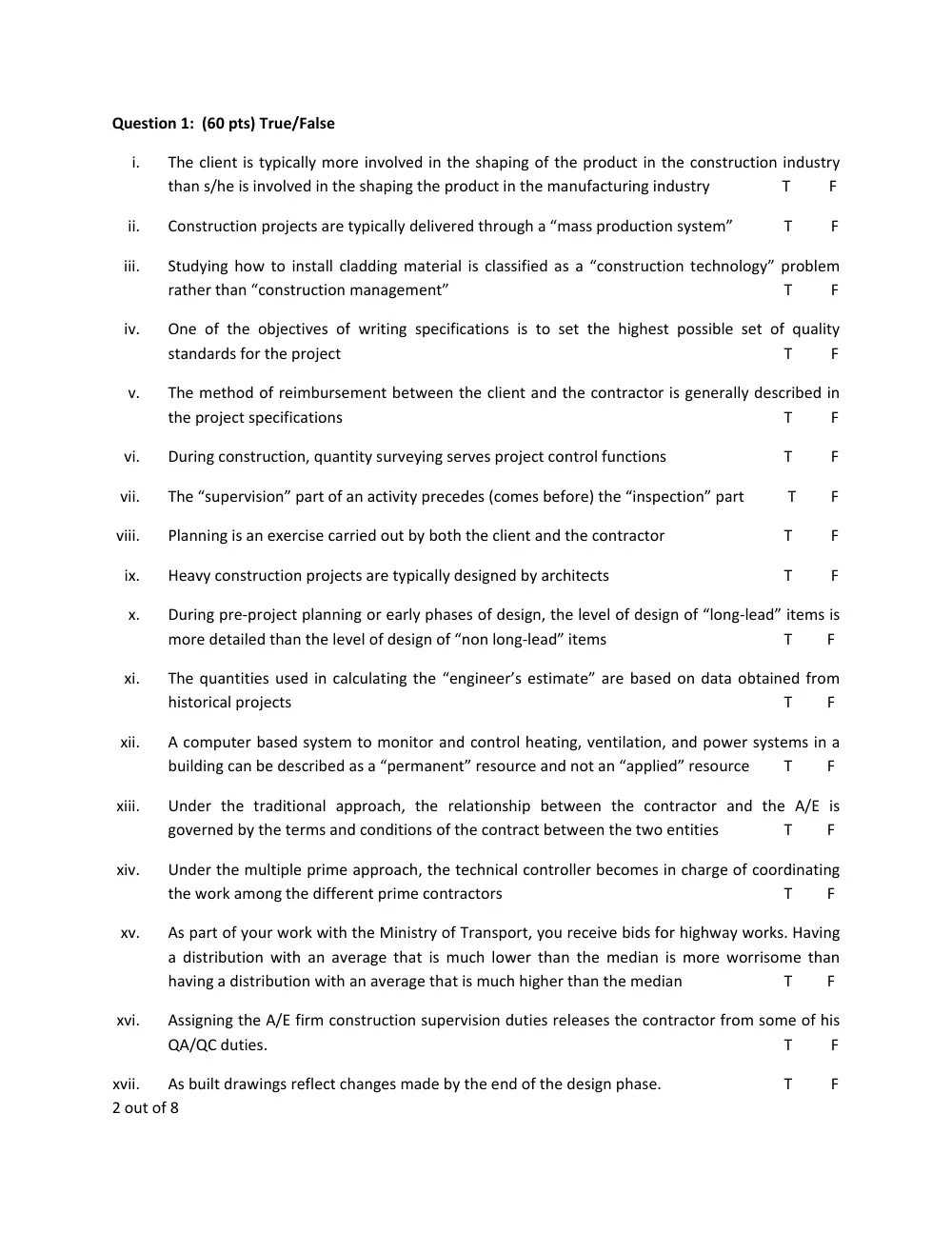
Question 1: (60 pts) True/False
i.
The client is typically more involved in the shaping of the product in the construction industry
than s/he is involved in the shaping the product in the manufacturing industry
T F
ii.
Construction projects are typically delivered through a “mass production system”
T F
iii.
Studying how to install cladding material is classified as a “construction technology” problem
rather than “construction management”
T F
iv.
One of the objectives of writing specifications is to set the highest possible set of quality
standards for the project
T F
v.
The method of reimbursement between the client and the contractor is generally described in
the project specifications
T F
vi.
During construction, quantity surveying serves project control functions
T F
vii.
The “supervision” part of an activity precedes (comes before) the “inspection” part
T F
viii.
Planning is an exercise carried out by both the client and the contractor
T F
ix.
Heavy construction projects are typically designed by architects
T F
x.
During pre‐project planning or early phases of design, the level of design of “long‐lead” items is
more detailed than the level of design of “non long‐lead” items
T F
xi.
The quantities used in calculating the “engineer’s estimate” are based on data obtained from
historical projects
T F
xii.
A computer based system to monitor and control heating, ventilation, and power systems in a
building can be described as a “permanent” resource and not an “applied” resource
T F
xiii.
Under the traditional approach, the relationship between the contractor and the A/E is
governed by the terms and conditions of the contract between the two entities
T F
xiv.
Under the multiple prime approach, the technical controller becomes in charge of coordinating
the work among the different prime contractors
T F
xv.
As part of your work with the Ministry of Transport, you receive bids for highway works. Having
a distribution with an average that is much lower than the median is more worrisome than
having a distribution with an average that is much higher than the median
T F
xvi.
Assigning the A/E firm construction supervision duties releases the contractor from some of his
QA/QC duties.
T F
xvii.
As built drawings reflect changes made by the end of the design phase.
T F
3 out of 8
xviii.
The main objective of “retainage” is to reduce the profit made by the contractor
T F
xix.
At “substantial completion”, retainage is returned to the contractor provided the facility is
functioning with no problems
T F
xx.
QA/QC is not of concern to the public owner under the build‐operate‐transfer (BOT) delivery
approach
T F
xxi.
The owner may appoint a Construction Manager (CM) to coordinate and administrate the
subcontracts under a DB contract
T F
xxii.
The strengths of the banking sector in a certain country are of interest to both the project owner
and the general contractor
T F
xxiii.
The project manager (PM) can be entrusted by the owner to review and interpret the value
engineering proposals presented by the A/E design firm during the design process, but not by
the successful contractor during construction
T F
xxiv.
The outcome of the PPP phase may be a “No Go” decision
T F
xxv.
The professional construction management (CM) approach does not pose any difficulty in
defining the defects liability periods for the various trade packages
T F
xxvi.
Under the D‐B approach, it is reasonable for the Client/Owner to need the assistance of an A/E
consultant to help prepare his/her Requirements
T F
xxvii.
The provisional acceptance of accomplished works by the A/E is not a prerequisite for releasing
the certification of payment to the general contractor during construction
T F
xxviii.
Having the Engineer, who is acting on the behalf of the client during construction, issue a
Taking‐Over Certificate (showing that all items on the snag‐list have been addressed) is a
prerequisite to the start of occupancy of the built facility by the end‐users
T F
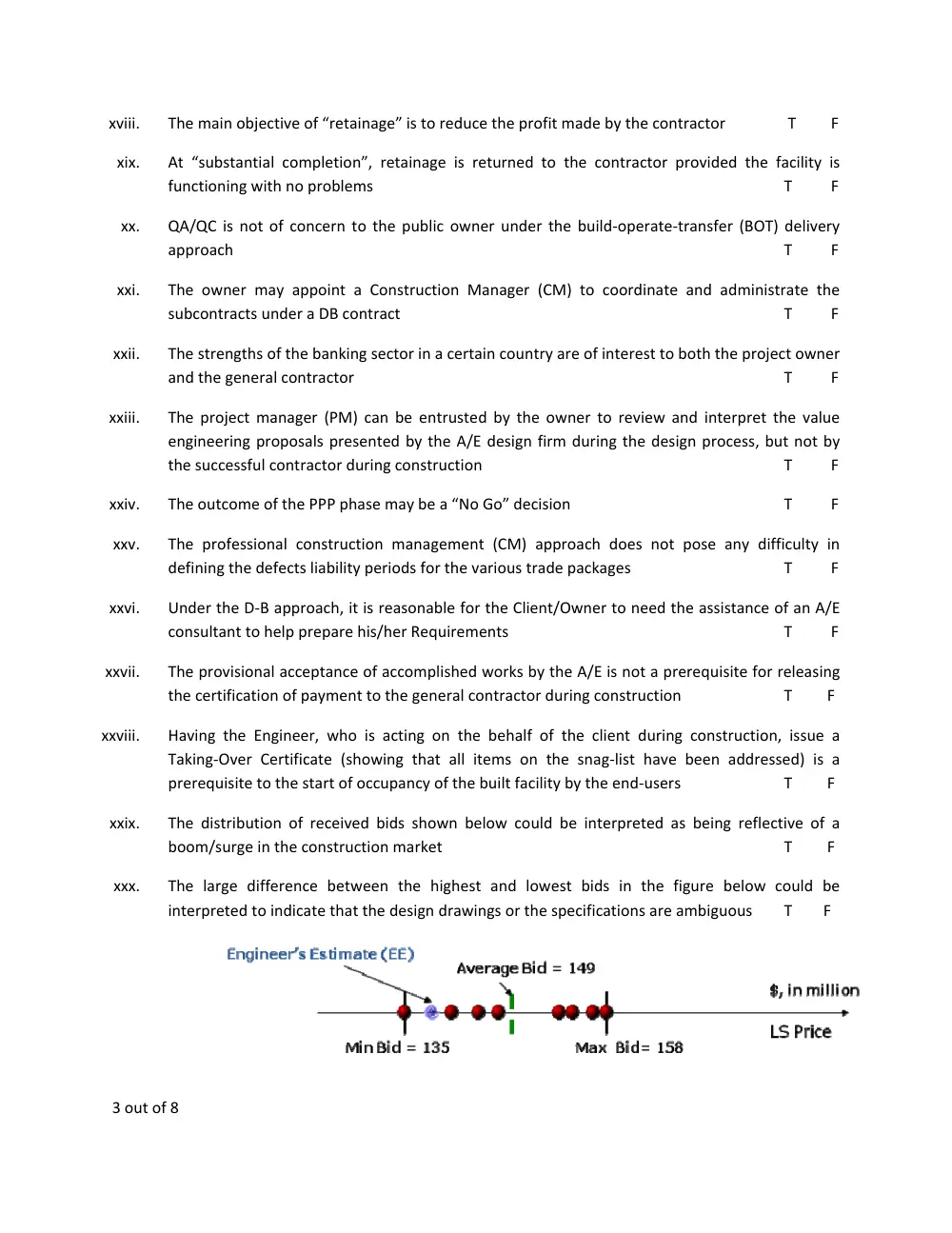
xxix.
The distribution of received bids shown below could be interpreted as being reflective of a
boom/surge in the construction market
T F
xxx.
The large difference between the highest and lowest bids in the figure below could be
interpreted to indicate that the design drawings or the specifications are ambiguous
T F
4 out of 8
Questions 2 through 7: Select the most accurate answer
Question 2: (3 pts) Your rich Mexican uncle is returning to Lebanon and is considering investing some of
his cash in a construction project. Believe it or not, you found an empty lot for him in Jounieh and you
are helping him consider the following options: build a beach resort or a shopping center. Which one of
the following parties is best positioned to provide further advice?
a. Cost consultant
b. Development management company
c. Technical controller
d. Financial auditing firm
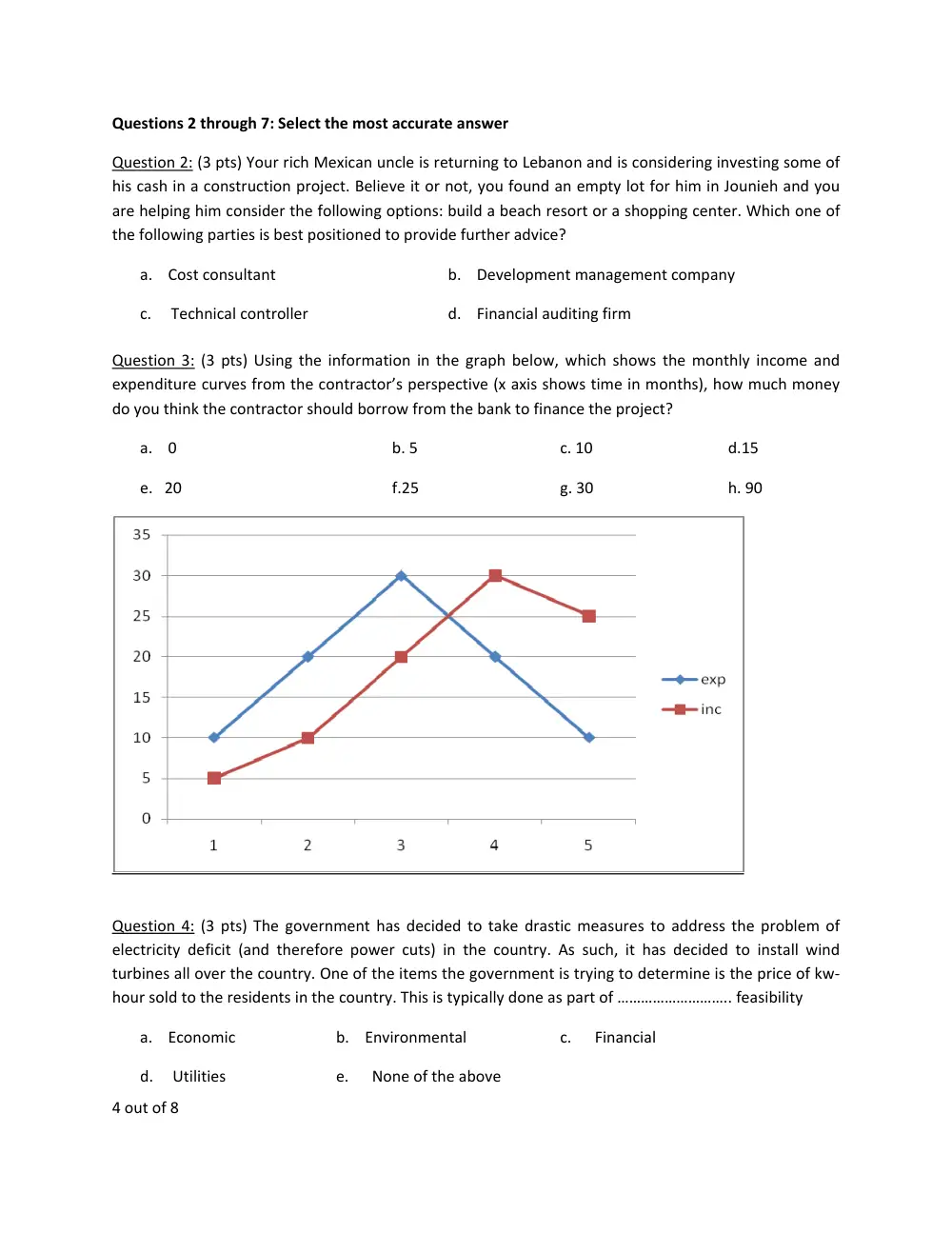
Question 3: (3 pts) Using the information in the graph below, which shows the monthly income and
expenditure curves from the contractor’s perspective (x axis shows time in months), how much money
do you think the contractor should borrow from the bank to finance the project?
a. 0
b. 5
c. 10
d.15
e. 20
f.25
g. 30
h. 90
Question 4: (3 pts) The government has decided to take drastic measures to address the problem of
electricity deficit (and therefore power cuts) in the country. As such, it has decided to install wind
turbines all over the country. One of the items the government is trying to determine is the price of kw‐
hour sold to the residents in the country. This is typically done as part of ……………………….. feasibility
a. Economic
b. Environmental
c. Financial
d. Utilities
e. None of the above
5 out of 8
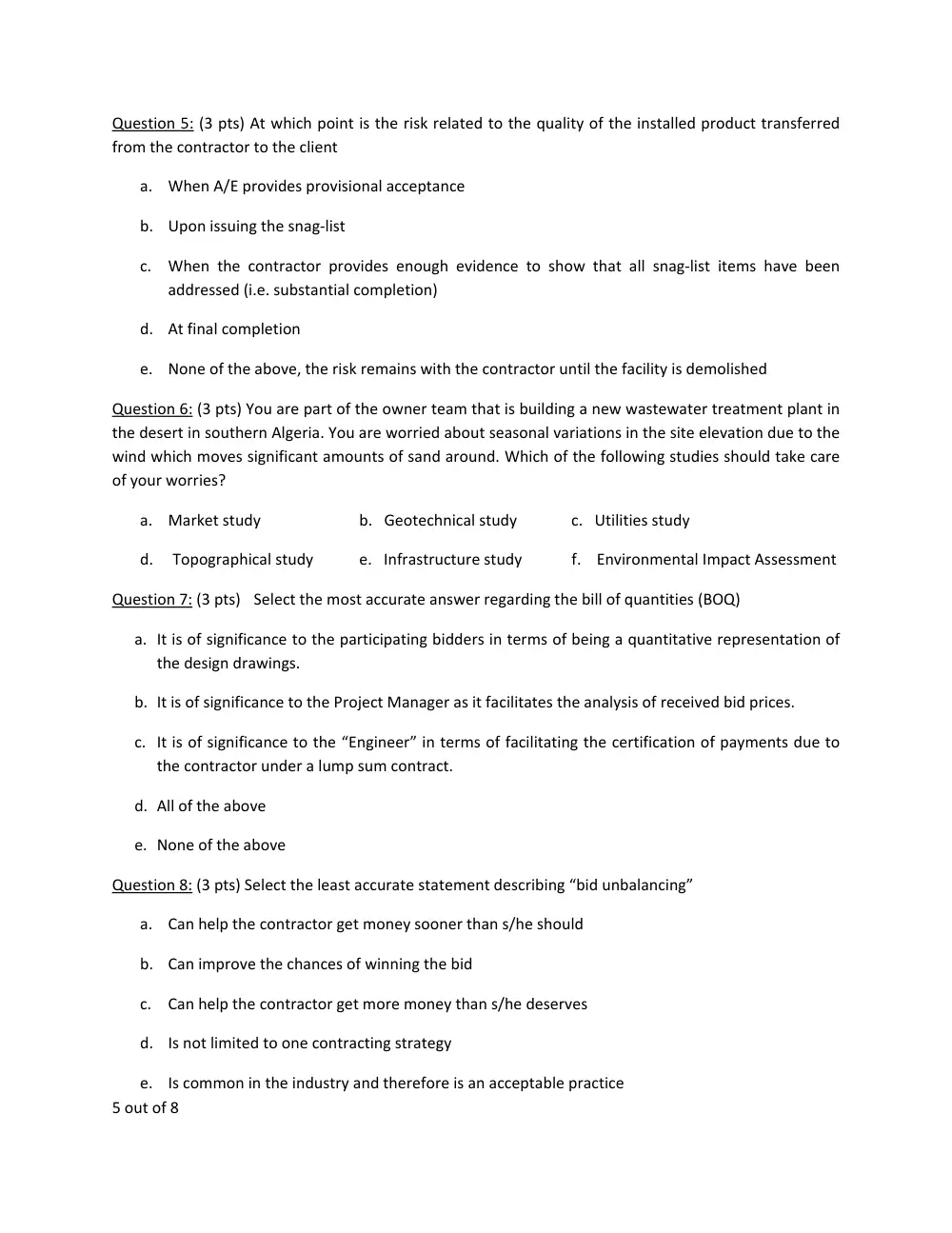
Question 5: (3 pts) At which point is the risk related to the quality of the installed product transferred
from the contractor to the client
a. When A/E provides provisional acceptance
b. Upon issuing the snag‐list
c. When the contractor provides enough evidence to show that all snag‐list items have been
addressed (i.e. substantial completion)
d. At final completion
e. None of the above, the risk remains with the contractor until the facility is demolished
Question 6: (3 pts) You are part of the owner team that is building a new wastewater treatment plant in
the desert in southern Algeria. You are worried about seasonal variations in the site elevation due to the
wind which moves significant amounts of sand around. Which of the following studies should take care
of your worries?
a. Market study
b. Geotechnical study c. Utilities study
d. Topographical study
e. Infrastructure study
f. Environmental Impact Assessment
Question 7: (3 pts) Select the most accurate answer regarding the bill of quantities (BOQ)
a. It is of significance to the participating bidders in terms of being a quantitative representation of
the design drawings.
b. It is of significance to the Project Manager as it facilitates the analysis of received bid prices.
c. It is of significance to the “Engineer” in terms of facilitating the certification of payments due to
the contractor under a lump sum contract.
d. All of the above
e. None of the above
Question 8: (3 pts) Select the least accurate statement describing “bid unbalancing”
a. Can help the contractor get money sooner than s/he should
b. Can improve the chances of winning the bid
c. Can help the contractor get more money than s/he deserves
d. Is not limited to one contracting strategy
e. Is common in the industry and therefore is an acceptable practice
6 out of 8
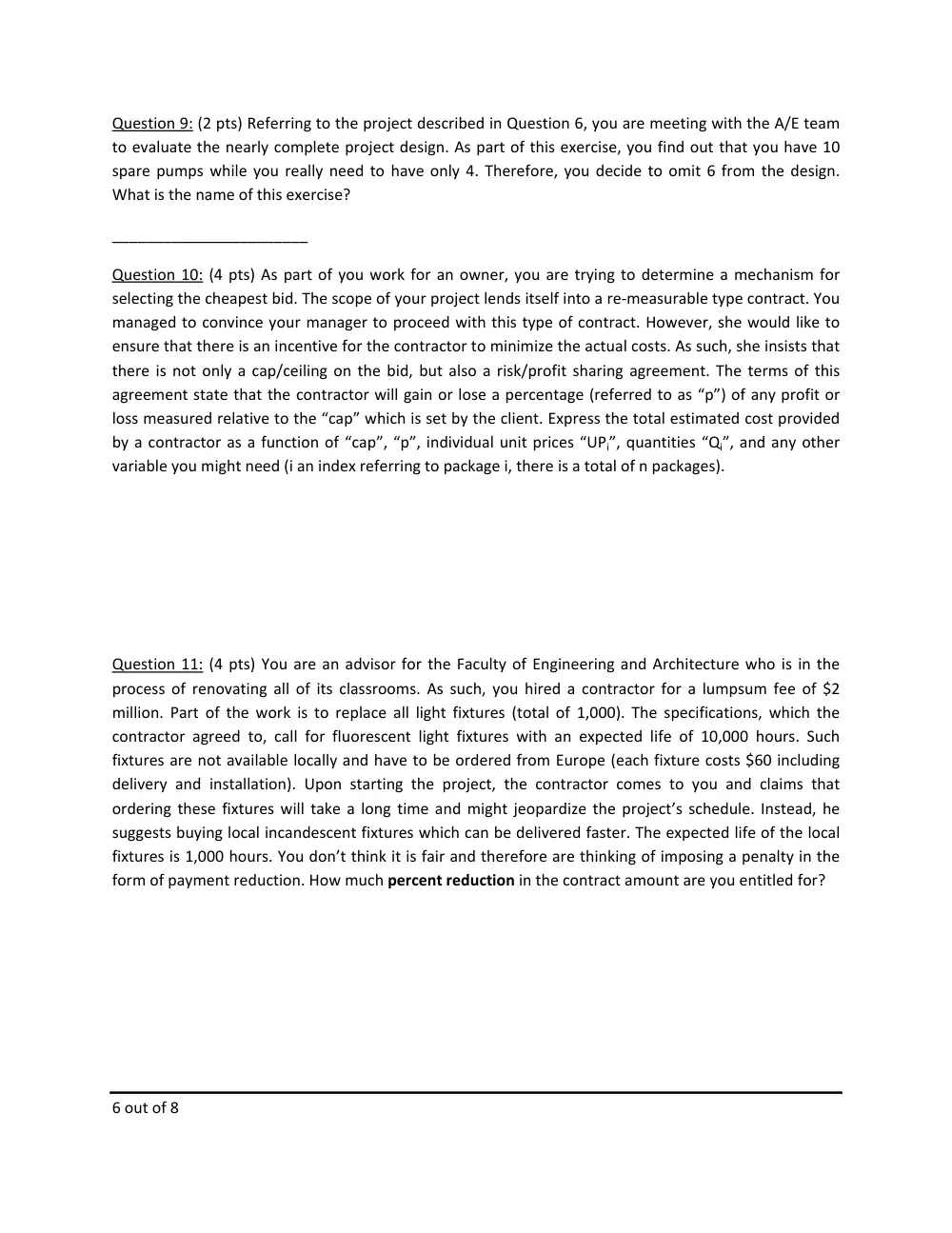
Question 9: (2 pts) Referring to the project described in Question 6, you are meeting with the A/E team
to evaluate the nearly complete project design. As part of this exercise, you find out that you have 10
spare pumps while you really need to have only 4. Therefore, you decide to omit 6 from the design.
What is the name of this exercise?
_______________________
Question 10: (4 pts) As part of you work for an owner, you are trying to determine a mechanism for
selecting the cheapest bid. The scope of your project lends itself into a re‐measurable type contract. You
managed to convince your manager to proceed with this type of contract. However, she would like to
ensure that there is an incentive for the contractor to minimize the actual costs. As such, she insists that
there is not only a cap/ceiling on the bid, but also a risk/profit sharing agreement. The terms of this
agreement state that the contractor will gain or lose a percentage (referred to as “p”) of any profit or
loss measured relative to the “cap” which is set by the client. Express the total estimated cost provided
by a contractor as a function of “cap”, “p”, individual unit prices “UPi”, quantities “Qi”, and any other
variable you might need (i an index referring to package i, there is a total of n packages).
Question 11: (4 pts) You are an advisor for the Faculty of Engineering and Architecture who is in the
process of renovating all of its classrooms. As such, you hired a contractor for a lumpsum fee of $2
million. Part of the work is to replace all light fixtures (total of 1,000). The specifications, which the
contractor agreed to, call for fluorescent light fixtures with an expected life of 10,000 hours. Such
fixtures are not available locally and have to be ordered from Europe (each fixture costs $60 including
delivery and installation). Upon starting the project, the contractor comes to you and claims that
ordering these fixtures will take a long time and might jeopardize the project’s schedule. Instead, he
suggests buying local incandescent fixtures which can be delivered faster. The expected life of the local
fixtures is 1,000 hours. You don’t think it is fair and therefore are thinking of imposing a penalty in the
form of payment reduction. How much percent reduction in the contract amount are you entitled for?
7 out of 8
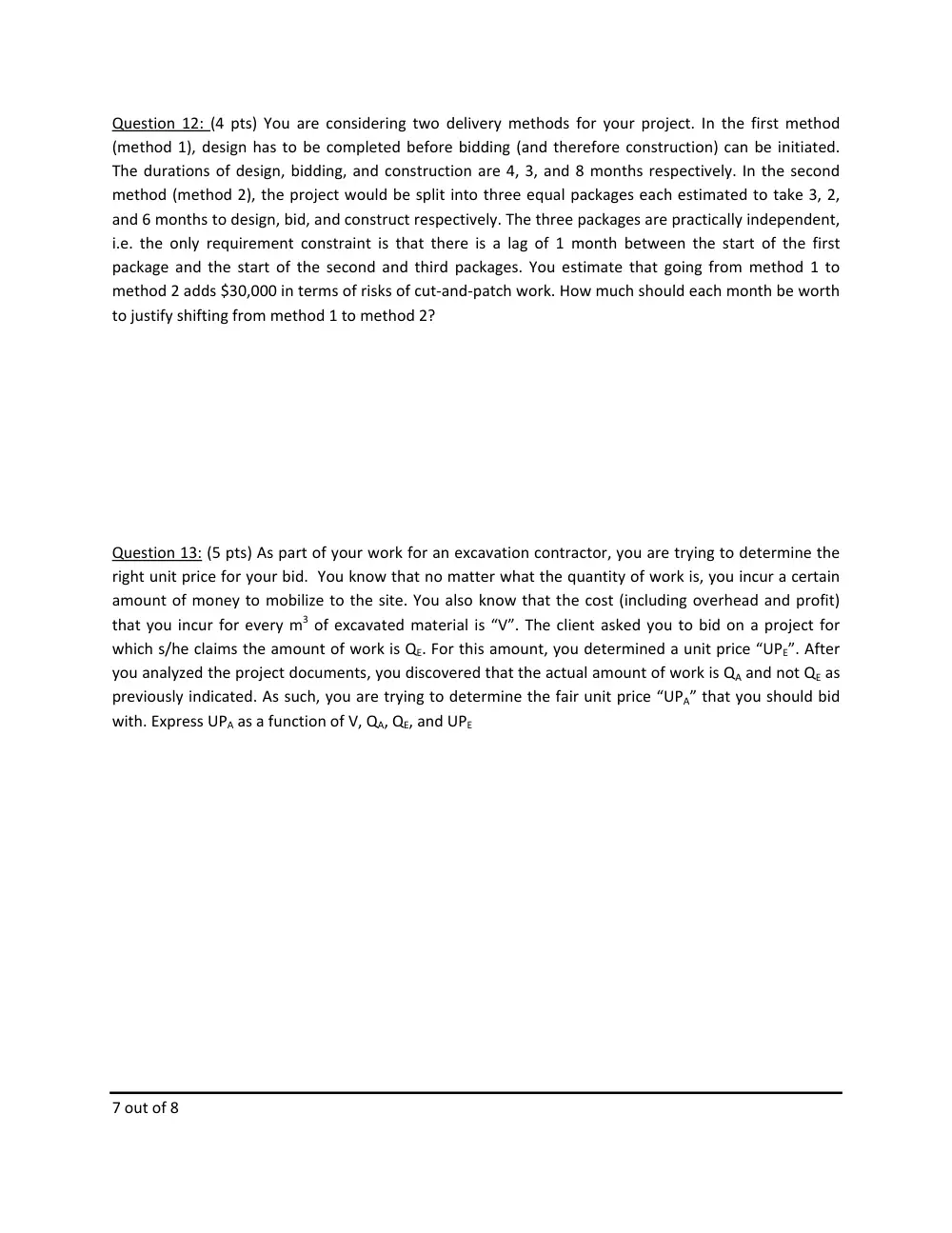
Question 12: (4 pts) You are considering two delivery methods for your project. In the first method
(method 1), design has to be completed before bidding (and therefore construction) can be initiated.
The durations of design, bidding, and construction are 4, 3, and 8 months respectively. In the second
method (method 2), the project would be split into three equal packages each estimated to take 3, 2,
and 6 months to design, bid, and construct respectively. The three packages are practically independent,
i.e. the only requirement constraint is that there is a lag of 1 month between the start of the first
package and the start of the second and third packages. You estimate that going from method 1 to
method 2 adds $30,000 in terms of risks of cut‐and‐patch work. How much should each month be worth
to justify shifting from method 1 to method 2?
Question 13: (5 pts) As part of your work for an excavation contractor, you are trying to determine the
right unit price for your bid. You know that no matter what the quantity of work is, you incur a certain
amount of money to mobilize to the site. You also know that the cost (including overhead and profit)
that you incur for every m3 of excavated material is “V”. The client asked you to bid on a project for
which s/he claims the amount of work is QE. For this amount, you determined a unit price “UPE”. After
you analyzed the project documents, you discovered that the actual amount of work is QA and not QE as
previously indicated. As such, you are trying to determine the fair unit price “UPA” that you should bid
with. Express UPA as a function of V, QA, QE, and UPE
8 out of 8
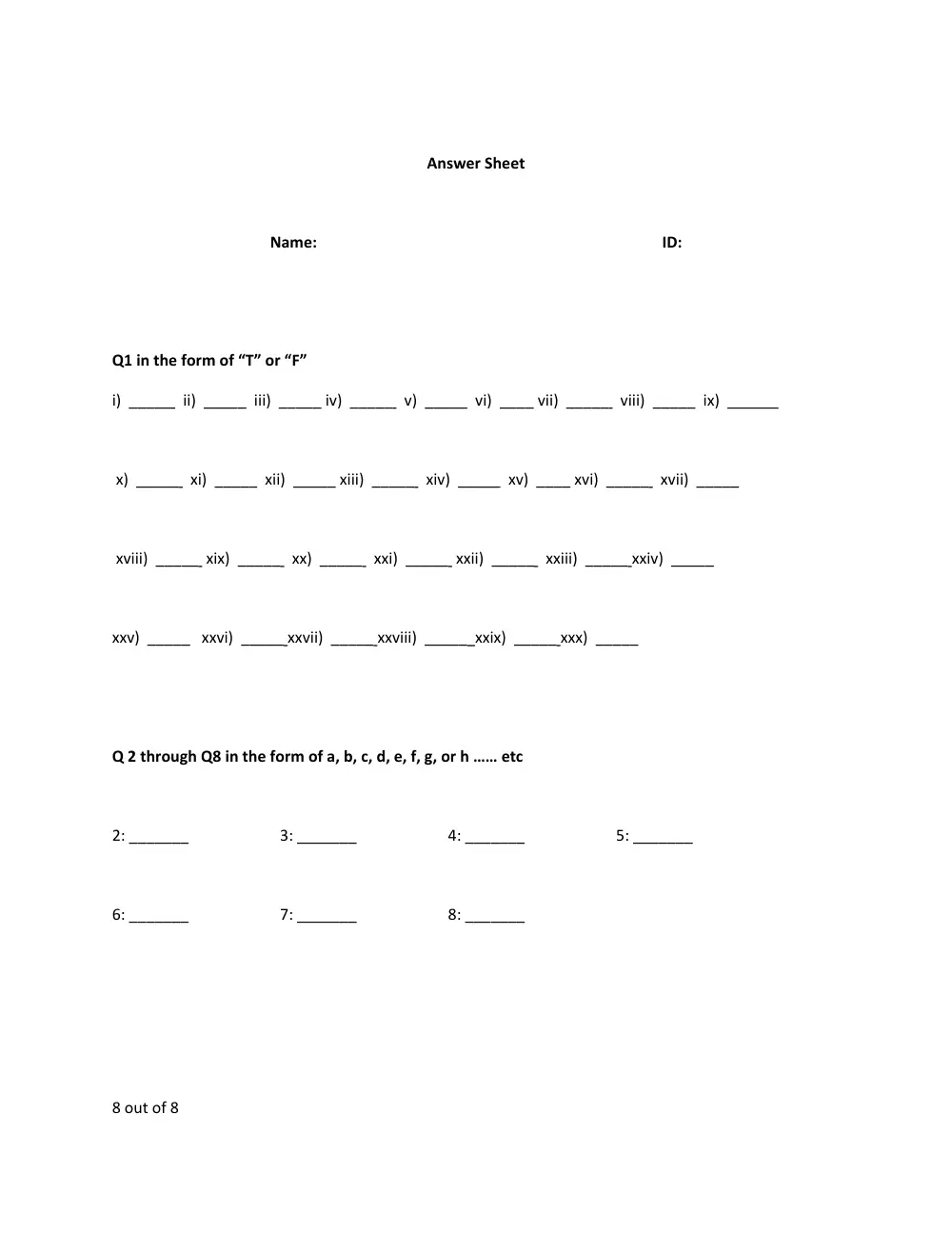
Answer Sheet
Name:
ID:
Q1 in the form of “T” or “F”
i) _____ ii) _____ iii) _____ iv) _____ v) _____ vi) ____ vii) _____ viii) _____ ix) ______
x) _____ xi) _____ xii) _____ xiii) _____ xiv) _____ xv) ____ xvi) _____ xvii) _____
xviii) _____ xix) _____ xx) _____ xxi) _____ xxii) _____ xxiii) _____ xxiv) _____
xxv) _____ xxvi) _____ xxvii) _____ xxviii) _____ xxix) _____ xxx) _____
Q 2 through Q8 in the form of a, b, c, d, e, f, g, or h …… etc
2: _______
3: _______
4: _______
5: _______
6: _______
7: _______
8: _______