
CIVE 580 Midterm, Fall 2012
American University of Beirut · Construction Management · 7 pages
More CIVE 580 files
Show the text of this exam
1 out of 7
The American University of Beirut, Faculty of Engineering and Architecture
CIVE 580/ENMG 502 – Construction Management
Term Exam: 2 hours
Name:
ID #:
� Write your name and ID number on both the cover page and answer (last) page.
� Please note that, for Q1 through Q15, the last page is the only page to be graded. Therefore,
answers of all types shall be copied to that page.
� Questions to the proctors are strictly forbidden.
� Use back side of exam sheet as scratch paper
� Use of calculators is not allowed
� No student will be allowed to hand in his/her completed exam before 60 minutes of the allotted
two hours have elapsed.
� Students wishing to leave the exam room for any reason whatsoever after the 60 minutes have
elapsed shall hand in his/her exam before s/he may do so.
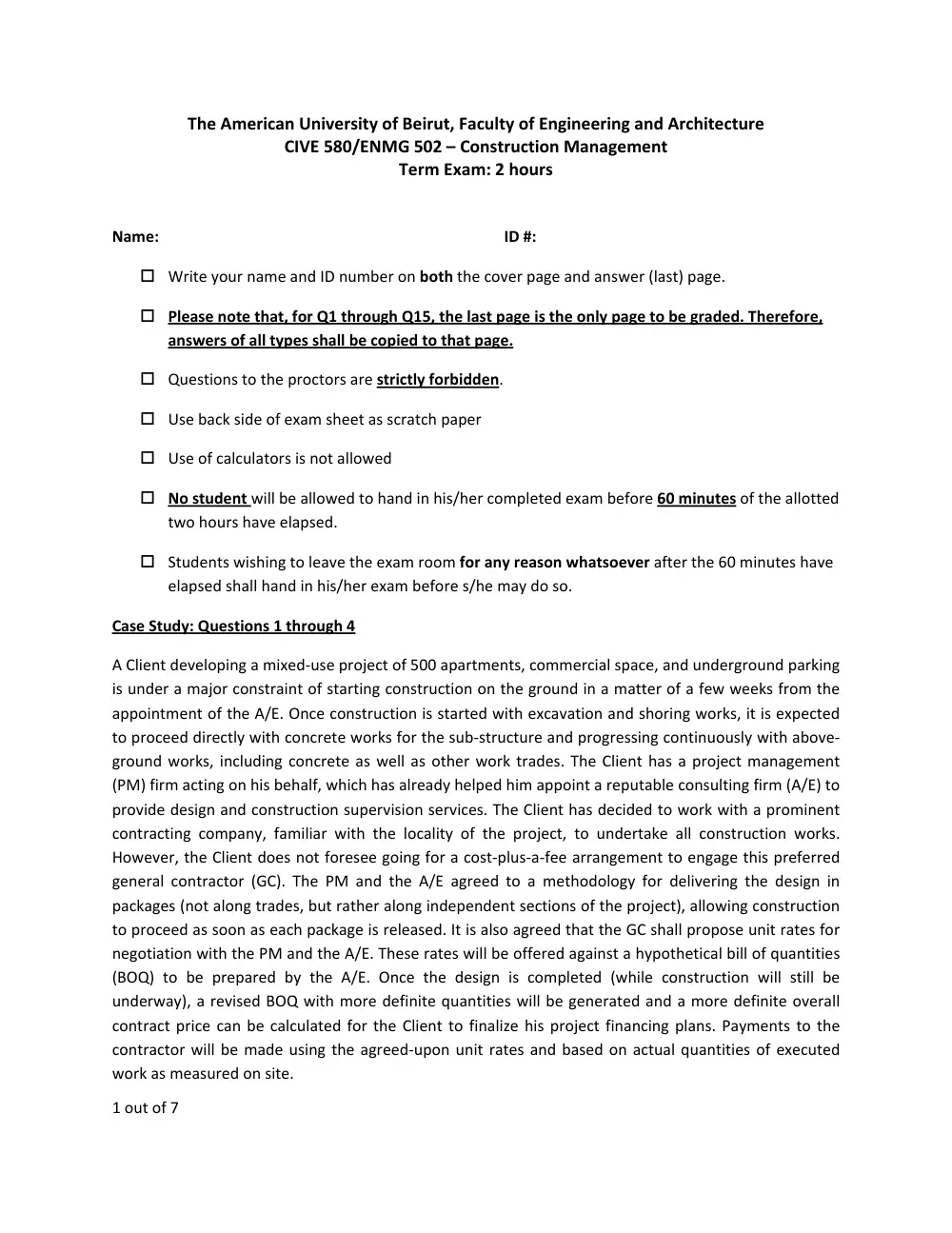
Case Study: Questions 1 through 4
A Client developing a mixed‐use project of 500 apartments, commercial space, and underground parking
is under a major constraint of starting construction on the ground in a matter of a few weeks from the
appointment of the A/E. Once construction is started with excavation and shoring works, it is expected
to proceed directly with concrete works for the sub‐structure and progressing continuously with above‐
ground works, including concrete as well as other work trades. The Client has a project management
(PM) firm acting on his behalf, which has already helped him appoint a reputable consulting firm (A/E) to
provide design and construction supervision services. The Client has decided to work with a prominent
contracting company, familiar with the locality of the project, to undertake all construction works.
However, the Client does not foresee going for a cost‐plus‐a‐fee arrangement to engage this preferred
general contractor (GC). The PM and the A/E agreed to a methodology for delivering the design in
packages (not along trades, but rather along independent sections of the project), allowing construction
to proceed as soon as each package is released. It is also agreed that the GC shall propose unit rates for
negotiation with the PM and the A/E. These rates will be offered against a hypothetical bill of quantities
(BOQ) to be prepared by the A/E. Once the design is completed (while construction will still be
underway), a revised BOQ with more definite quantities will be generated and a more definite overall
contract price can be calculated for the Client to finalize his project financing plans. Payments to the
contractor will be made using the agreed‐upon unit rates and based on actual quantities of executed
work as measured on site.
2 out of 7
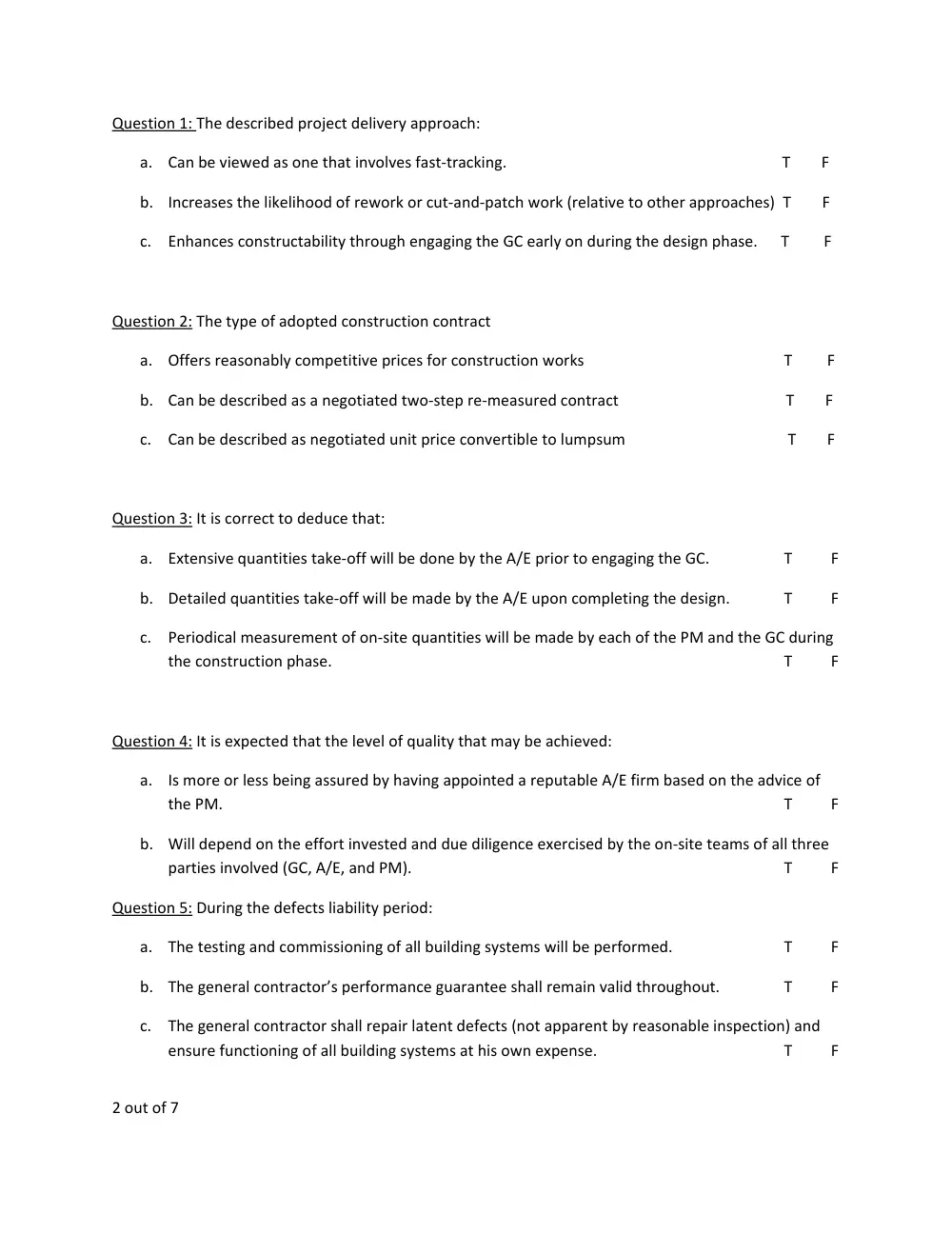
Question 1: The described project delivery approach:
a. Can be viewed as one that involves fast‐tracking.
T F
b. Increases the likelihood of rework or cut‐and‐patch work (relative to other approaches) T F
c. Enhances constructability through engaging the GC early on during the design phase. T F
Question 2: The type of adopted construction contract
a. Offers reasonably competitive prices for construction works
T F
b. Can be described as a negotiated two‐step re‐measured contract
T F
c. Can be described as negotiated unit price convertible to lumpsum
T F
Question 3: It is correct to deduce that:
a. Extensive quantities take‐off will be done by the A/E prior to engaging the GC.
T F
b. Detailed quantities take‐off will be made by the A/E upon completing the design.
T F
c. Periodical measurement of on‐site quantities will be made by each of the PM and the GC during
the construction phase.
T F
Question 4: It is expected that the level of quality that may be achieved:
a. Is more or less being assured by having appointed a reputable A/E firm based on the advice of
the PM.
T F
b. Will depend on the effort invested and due diligence exercised by the on‐site teams of all three
parties involved (GC, A/E, and PM).
T F
Question 5: During the defects liability period:
a. The testing and commissioning of all building systems will be performed.
T F
b. The general contractor’s performance guarantee shall remain valid throughout.
T F
c. The general contractor shall repair latent defects (not apparent by reasonable inspection) and
ensure functioning of all building systems at his own expense.
T F
3 out of 7
Question 6: It is correct to say that:
a. The fourth project parameter of safety is meant to emphasize the need to ensure a safe
environment for the construction workforce.
T F
b. The fourth project parameter of safety is meant to emphasize the need to ensure a safe
environment for the construction site and its immediate surroundings.
T F
c. The fourth project parameter of safety is meant to emphasize the need to ensure a safe
environment for all groups involved in construction supervision.
T F
Question 7: It is correct to say that under the DB approach:
a. The Client is guaranteed the most economical fixed price for the project.
T F
b. It is generally harder to implement constructability than under the D‐B‐B approach. T F
c. The A/E enjoys a relatively higher leverage compared to that enjoyed by the A/E under the
professional CM approach.
T F
Question 8: It is correct to say that:
a. Planning is a function exercised by the GC with the aim of translating the design into a physical
object.
T F
b. Planning is a phase in the project’s life where justification for the project is studied. T F
c. Scheduling includes calendar‐based sequencing of tasks/activities and a further analysis of time‐
related calculations.
T F
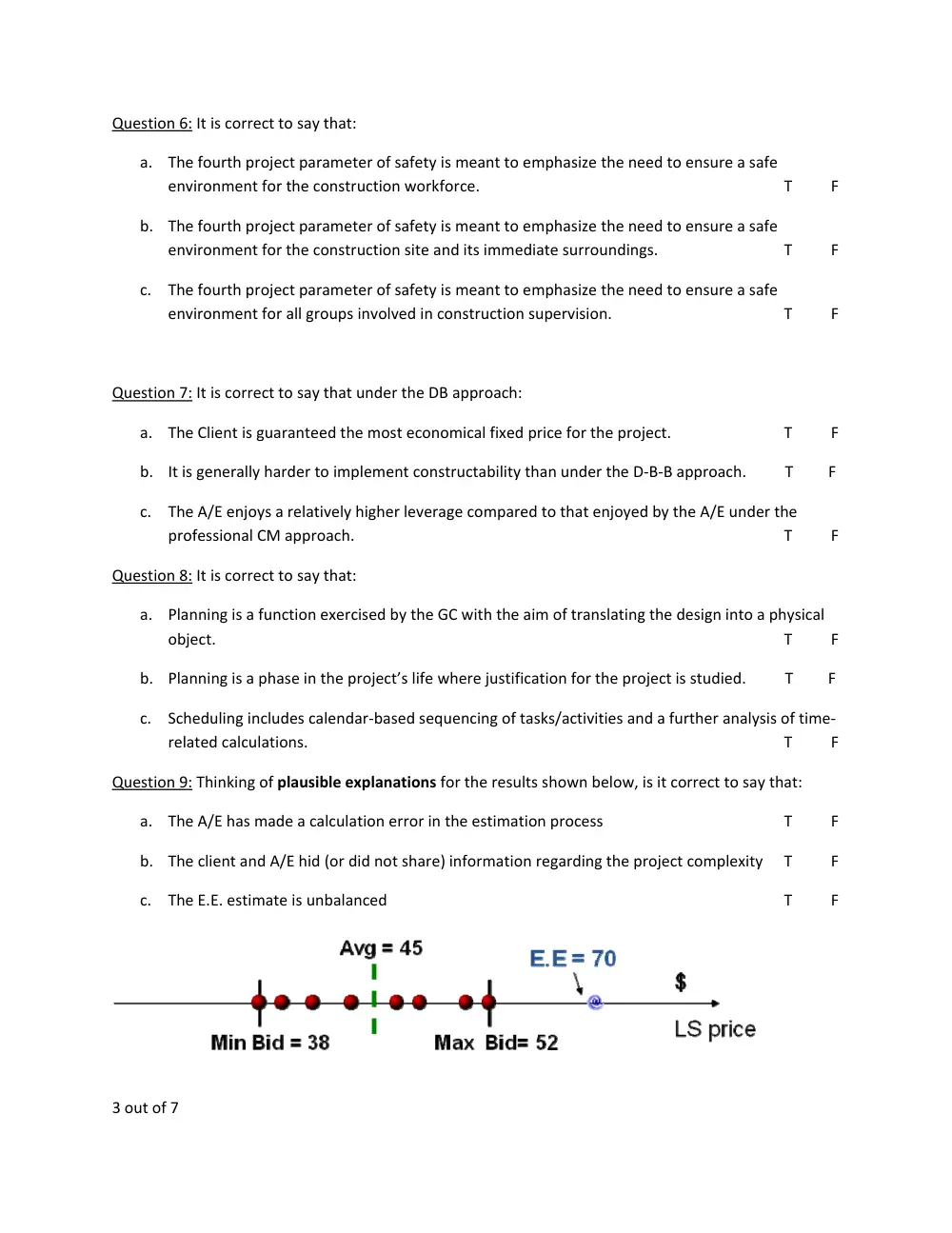
Question 9: Thinking of plausible explanations for the results shown below, is it correct to say that:
a. The A/E has made a calculation error in the estimation process
T F
b. The client and A/E hid (or did not share) information regarding the project complexity
T F
c. The E.E. estimate is unbalanced
T F
4 out of 7
Question 10: It is correct to say that
a. A bond is an assessment of the strength of the professional relationship between the owner
and the contractor organizations.
T F
b. Bonding capacity of a contracting firm is an indication of its strength and reputation T F
Question 11:
Your company is planning to build a 20‐storey building in a high‐end neighborhood. Your cost estimate is
20% higher than management’s expectation; and therefore, your manager asked you to use “value
engineering”. She asked you to investigate several options. Which one of the following suggestions do
you consider as a value engineering proposition:
a. Remove two floors
d. Increase the selling price for each apartment
b. Remove four floors
e. All of the above
c. Reduce the size of each apartment
f. None of the above
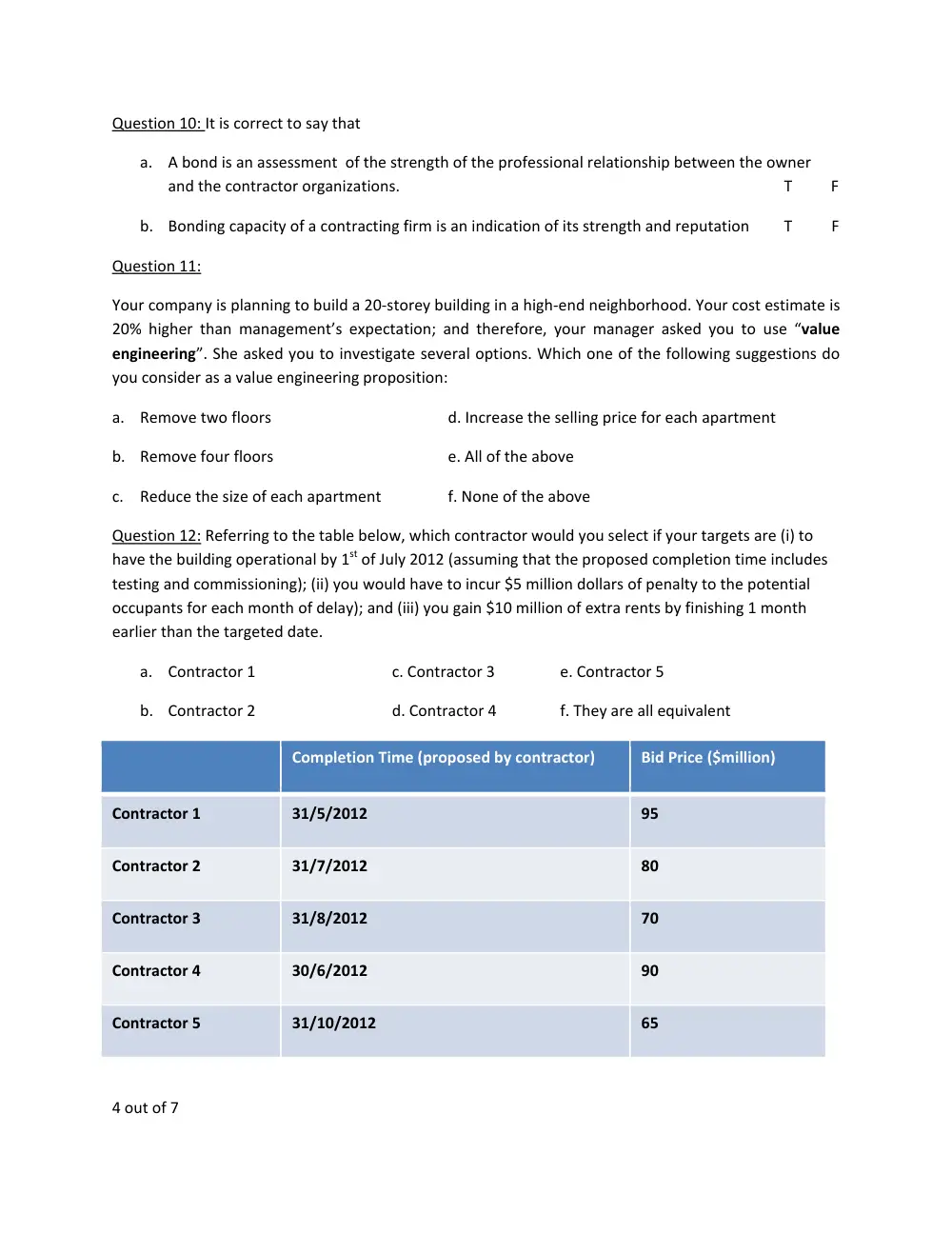
Question 12: Referring to the table below, which contractor would you select if your targets are (i) to
have the building operational by 1st of July 2012 (assuming that the proposed completion time includes
testing and commissioning); (ii) you would have to incur $5 million dollars of penalty to the potential
occupants for each month of delay); and (iii) you gain $10 million of extra rents by finishing 1 month
earlier than the targeted date.
a. Contractor 1
c. Contractor 3
e. Contractor 5
b. Contractor 2
d. Contractor 4
f. They are all equivalent
Completion Time (proposed by contractor)
Bid Price ($million)
Contractor 1
31/5/2012
95
Contractor 2
31/7/2012
80
Contractor 3
31/8/2012
70
Contractor 4
30/6/2012
90
Contractor 5
31/10/2012
65
5 out of 7
Question 13: Using the graph below, which shows the cash flow from the contractor’s perspective, how
much money do you think the contractor should borrow from the bank to finance the project?
a. 0
c. 200
e. 700
g. 1600
b. 100
d. 500
f. 1000
h. 2000
Question 14: How much retainage was there on the same project described in question 13?
a. 0
c. 200
e. 400
g. 700
b. 100
d. 300
f. 500
h. 2000
Question 15: By law, you are required to have a minimum of 5 bids before selecting a successful bidder
to execute the project. Your initial contracting market studies indicate tight conditions (i.e. there are
many ongoing jobs in your location and not enough contractors). As such what do you recommend
a. Pre‐qualification
b. Post‐qualification
c. Both pre‐qualification and post‐qualification
d. This issue has nothing to do with pre‐qualification or post‐qualification
6 out of 7
Question 16: By reviewing the bidding documents for the project below, you determined that the
quantity of “excavation” was over‐estimated, i.e. you expect the actual quantity to be 400 m3. You want
to use this information to make sure that you get the job. How much lower can your bid be relative to
another contractor who did not notice the over‐estimation error and therefore uses the unit prices
shown in the table? [Hint: you want to earn the same amount of money your competitor would earn at
the end of the project should he be selected, so you adjust the unit prices accordingly by raising the
price for concrete to $24/m3……..]
Difference between your bid and competitor: __________________
Estimated Quantity
Unit Price ($/unit)
Excavation (m3)
1,000
10
Concrete (m3)
500
20
Question 17: You are building a new hospital in Beirut Central District, close to the Saifi Village. In
addition to the owner, designer, and contractor; list four key project stakeholders that should be
consulted in the early phases of project planning:
a. ___________________.
b. ___________________.
c. ___________________.
d. ___________________.
Question 18: For the same project described in question 17, list three important constraints, particular
to this location, which you believe can have an effect on the construction process:
a. __________________.
b. __________________.
c. __________________.
Question 19: What do you call the contracting strategy depicted below: __________________________
7 out of 7
Question 20: The design firm you work with is in the process of initiating the renovation its headquarters
(i.e. main building). As a result, the company has moved to a temporary facility, which you are supposed
to vacate by the end of 2010. Luckily, the renovation of your headquarters is scheduled to finish by the
end of 2010. Still, you are worried about the contractor not meeting this target date and therefore you
are considering using liquidated damages. Devise (briefly) a simple mechanism for setting fair liquidated
damages.
_____________________________________________________________________________________
Answer Sheet
Q1 through Q10 in the form of “T” or “F”
1: a) _____ b) _____ c) _____
2: a) _____ b) _____ c) _____
3: a) _____ b) _____ c) _____
4: a) _____ b) _____
5: a) _____ b) _____ c) _____
6: a) _____ b) _____ c) _____
7: a) _____ b) _____ c) _____
8: a) _____ b) _____ c) _____
9: a) _____ b) _____ c) _____
10: a) _____ b) _____
Q 11 through Q15 in the form of a, b, c, d, e, f, g, or h …… etc
11: _______
12: _______
13: _______
14: _______
15: _______