
CMPS 251 Homework Assignment 2, Fall 2015
American University of Beirut · Numerical Computing · 3 pages

More CMPS 251 files
- Homework Assignment 4 · Fall 2015HomeworkView
- Homework Assignment 4 Solution · Fall 2015Homework · with solutionView
- Homework Assignment 3 Solution · Fall 2015Homework · with solutionView
- Homework Assignment 5 · Fall 2015HomeworkView
- Homework Assignment 3 · Fall 2015HomeworkView
- Homework Assignment 1 · Fall 2015HomeworkView
- Homework Assignment 1 Solution · Fall 2015Homework · with solutionView
- Homework Assignment 2 Solution · Fall 2015Homework · with solutionView
Show the text of this homework
CMPS 251-Numerical Computing
Assignment 2
Due Thursday, October 1, 2015
Reading Material:
- Cheney & Kincaid: Sections 1.3 and 1.4
Notes: You are encouraged in work individually on the assignment. Piazza can be used to ask
questions (without requesting a solution !!).
Problem 1
Decimal to Binary
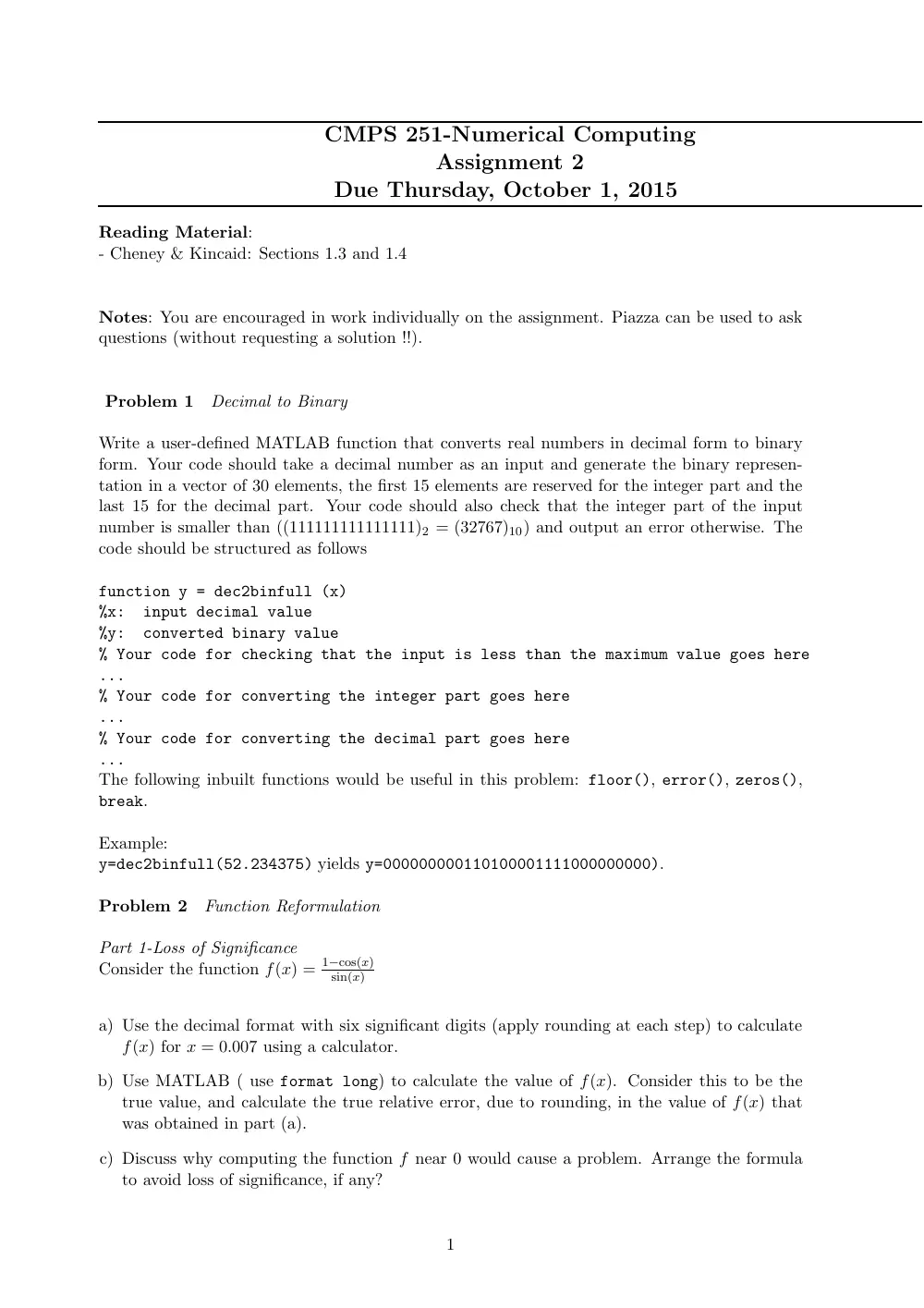
Write a user-defined MATLAB function that converts real numbers in decimal form to binary
form. Your code should take a decimal number as an input and generate the binary represen-
tation in a vector of 30 elements, the first 15 elements are reserved for the integer part and the
last 15 for the decimal part. Your code should also check that the integer part of the input
number is smaller than ((111111111111111)2 = (32767)10) and output an error otherwise. The
code should be structured as follows
function y = dec2binfull (x)
%x:
input decimal value
%y:
converted binary value
% Your code for checking that the input is less than the maximum value goes here
...
% Your code for converting the integer part goes here
...
% Your code for converting the decimal part goes here
...
The following inbuilt functions would be useful in this problem: floor(), error(), zeros(),
break.
Example:
y=dec2binfull(52.234375) yields y=000000000110100001111000000000).
Problem 2
Function Reformulation
Part 1-Loss of Significance
Consider the function f(x) = 1−cos(x)
sin(x)
a) Use the decimal format with six significant digits (apply rounding at each step) to calculate
f(x) for x = 0.007 using a calculator.
b) Use MATLAB ( use format long) to calculate the value of f(x). Consider this to be the
true value, and calculate the true relative error, due to rounding, in the value of f(x) that
was obtained in part (a).
c) Discuss why computing the function f near 0 would cause a problem. Arrange the formula
to avoid loss of significance, if any?
1
Part 2-Overflow
For very large values of x and y, the following function would cause an overflow
f(x) =
�
x2 + y2
Reformulate this function to avoid any overflow.
Problem 3
New Rounding Scheme!!!!
A CMPS 251 student enjoyed the derivation of the rounding and chopping errors in a gen-
eral floating point representation. He decided to come up with a rounding scheme and calculate
the resulting rounding error. He defined the following rounding scheme.
Consider a real number x represented in base β system as follows
x = (.d1d2d3 . . . dtdt+1 . . .) · βe =
� ∞
�
i=1
diβ−i
�
· βe,
d1 ̸= 0
The “FunkyRound” scheme is given as
fl(x) =
⎧
⎪
⎪
⎨
⎪
⎪
⎩
(.d1d2 . . . [dt + 1]) · βe =
��t
i=1 diβ−i + β−t�
· βe
if dt+1 < β/2
(.d1d2 . . . dt) · βe =
��t
i=1 diβ−i�
· βe
if dt+1 > β/2
(.d1d2 . . . dt−10) · βe =
��t−1
i=1 diβ−i�
· βe
if dt+1 = β/2
Derive the “FunkyRound” maximum rounding error, Comment?
Problem 4
Floating-Point Numbers
Part 1
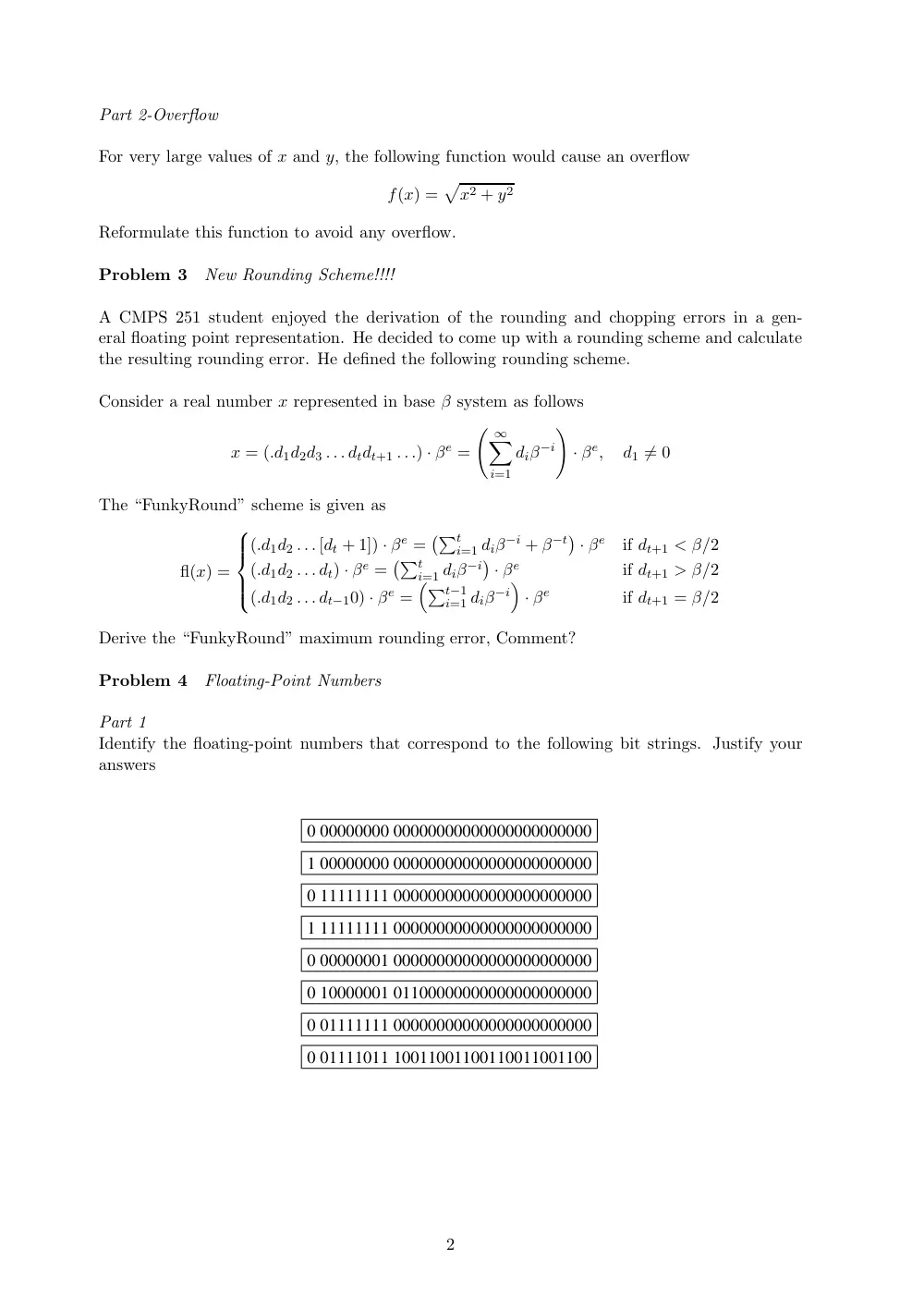
Identify the floating-point numbers that correspond to the following bit strings. Justify your
answers
0 00000000 00000000000000000000000
1 00000000 00000000000000000000000
0 11111111 00000000000000000000000
1 11111111 00000000000000000000000
0 00000001 00000000000000000000000
0 10000001 01100000000000000000000
0 01111111 00000000000000000000000
0 01111011 10011001100110011001100
2
Part 2
Determine the numbers that have the following machine representations. Show all the steps
1)[C705A700]16
2)[45607000]16
3)[494F96A0]16
Part 3
Determine the single precision machine representation of the following numbers. Show all the
steps. Calculate the relative error between the given number and its machine representation if
it cannot be represented exactly in single precision format.
1)64.37109375
2)0.234375
3)-9876.54321
Problem 5
Floating-Point Operations
Let a = 0.23371258 × 10⁻⁴, b = 0.33678429 × 10², c = −0.33677811 × 10². Assuming an 8-
decimal-digit computer, determine the sum s = a + b + c either as (1) fl(s) = fl(fl(a + b) + c) (2)
fl(s) = fl(a + fl(b + c)) Explain the discrepancy between the two answers.
For arbitrary machine numbers a, b, c on a computer with machine precision ϵ = 2−24, find a
criterion on a, b, c for the result of (2) to be more accurate than the result of (1). Hint: compare
bounds on the relative errors, neglecting higher-order terms in δ and assuming a + b + c ̸= 0
3