
CMPS 251 Homework Assignment 4 Solution, Fall 2015
American University of Beirut · Numerical Computing · 4 pages · with solution
More CMPS 251 files
- Homework Assignment 3 Solution · Fall 2015Homework · with solutionView
- Homework Assignment 4 · Fall 2015HomeworkView
- Homework Assignment 3 · Fall 2015HomeworkView
- Homework Assignment 5 · Fall 2015HomeworkView
- Homework Assignment 2 Solution · Fall 2015Homework · with solutionView
- Homework Assignment 1 · Fall 2015HomeworkView
- Homework Assignment 1 Solution · Fall 2015Homework · with solutionView
- Homework Assignment 2 · Fall 2015HomeworkView
Show the text of this homework
CMPS 251
Assignment 4‐Solution
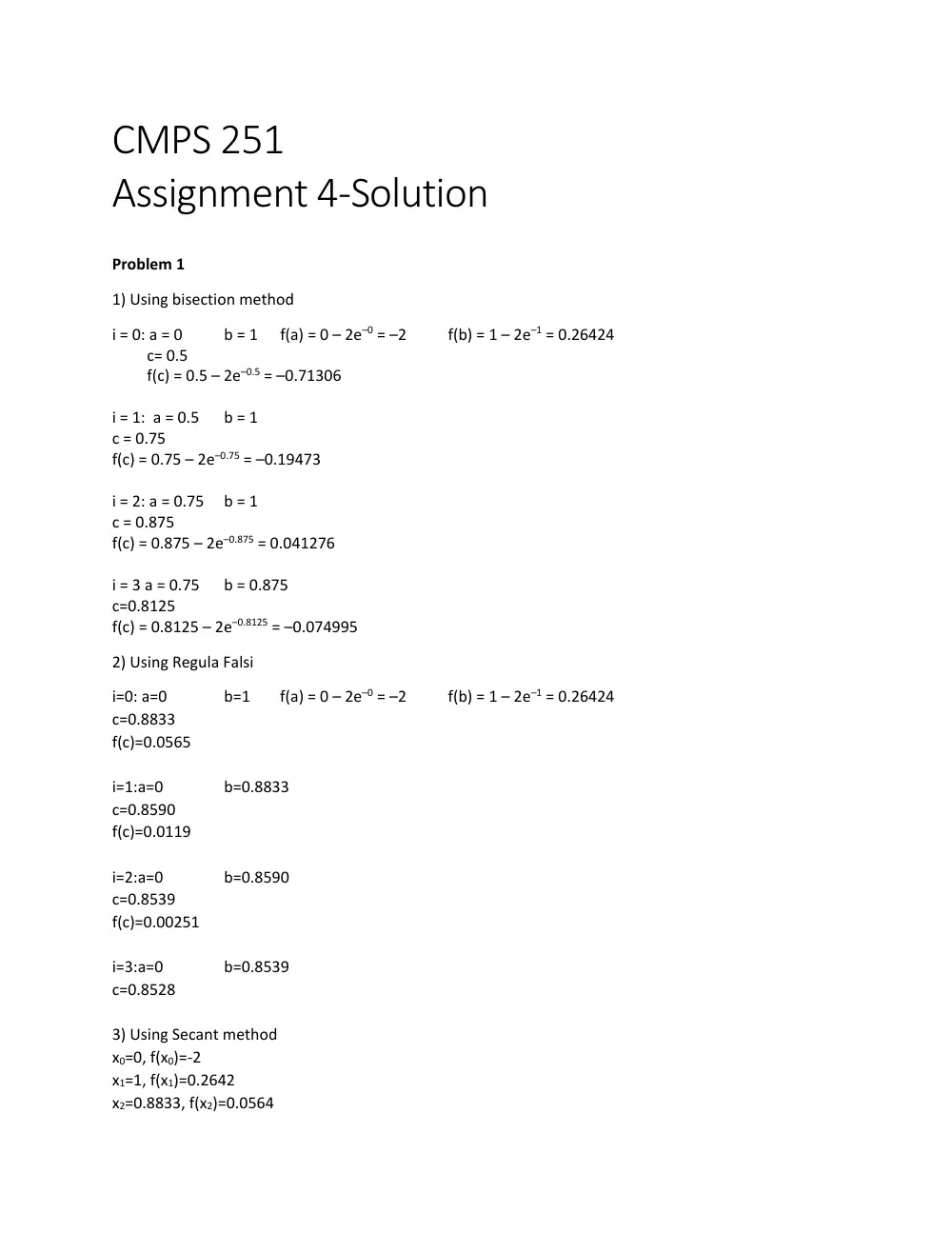
Problem 1
1) Using bisection method
i = 0: a = 0
b = 1 f(a) = 0 – 2e–0 = –2
f(b) = 1 – 2e–1 = 0.26424
c= 0.5
f(c) = 0.5 – 2e–0.5 = –0.71306
i = 1: a = 0.5
b = 1
c = 0.75
f(c) = 0.75 – 2e–0.75 = –0.19473
i = 2: a = 0.75 b = 1
c = 0.875
f(c) = 0.875 – 2e–0.875 = 0.041276
i = 3 a = 0.75
b = 0.875
c=0.8125
f(c) = 0.8125 – 2e–0.8125 = –0.074995
2) Using Regula Falsi
i=0: a=0
b=1
f(a) = 0 – 2e–0 = –2
f(b) = 1 – 2e–1 = 0.26424
c=0.8833
f(c)=0.0565
i=1:a=0
b=0.8833
c=0.8590
f(c)=0.0119
i=2:a=0
b=0.8590
c=0.8539
f(c)=0.00251
i=3:a=0
b=0.8539
c=0.8528
3) Using Secant method
x0=0, f(x0)=‐2
x1=1, f(x1)=0.2642
x2=0.8833, f(x2)=0.0564
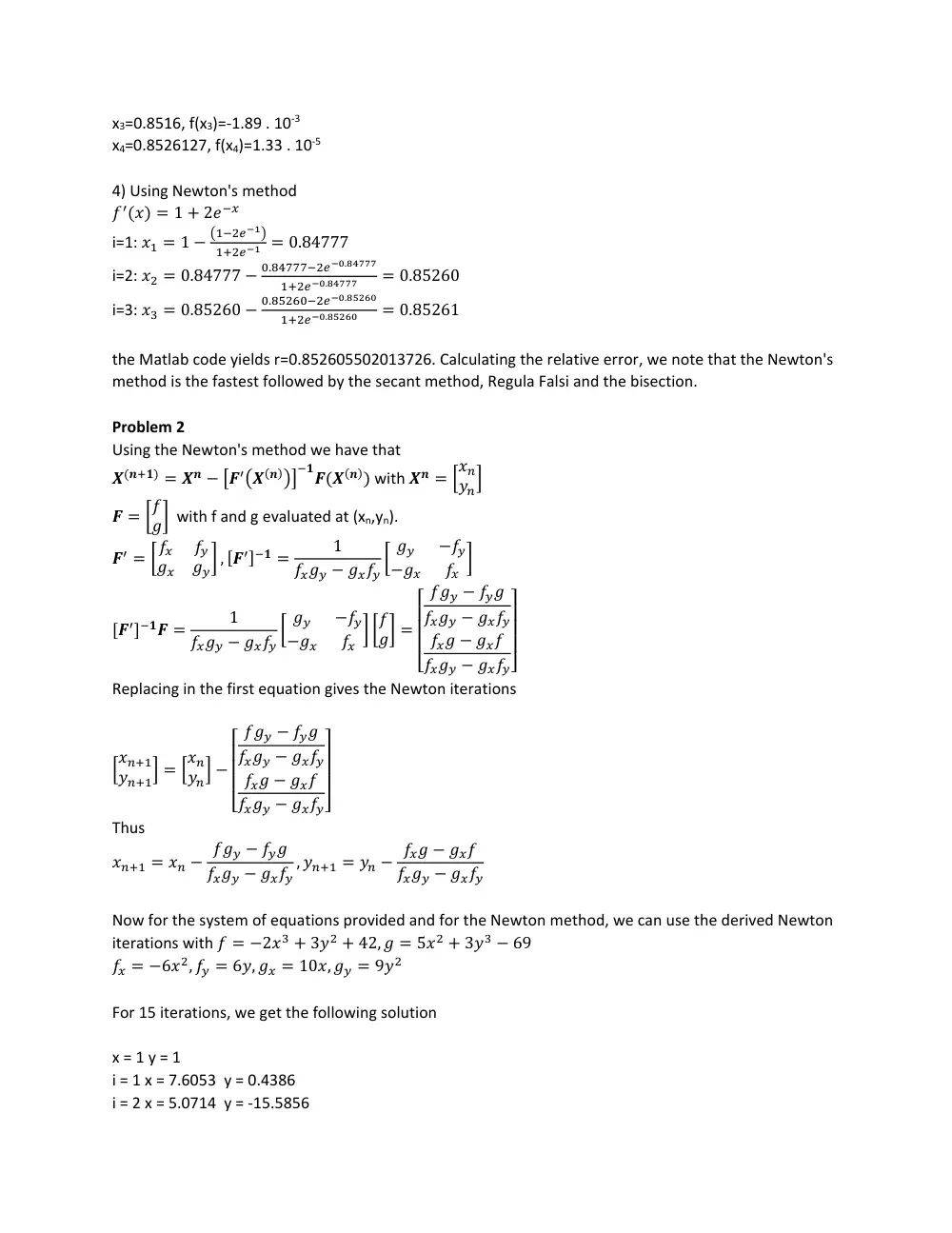
x3=0.8516, f(x3)=‐1.89 . 10‐3
x4=0.8526127, f(x4)=1.33 . 10‐5
4) Using Newton's method
����� � 1 � 2���
i=1: �� � 1 �
��������
������ � 0.84777
i=2: �� � 0.84777 �
�.����������.�����
������.�����
� 0.85260
i=3: �� � 0.85260 �
�.����������.�����
������.�����
� 0.85261
the Matlab code yields r=0.852605502013726. Calculating the relative error, we note that the Newton's
method is the fastest followed by the secant method, Regula Falsi and the bisection.
Problem 2
Using the Newton's method we have that
������ � �� � ����������
��������� with �� � ���
���
� � ��
�� with f and g evaluated at (xn,yn).
�� � ���
��
��
��� , ������ �
1
���� � ����
� ��
���
���
��
�
������� �
1
���� � ����
� ��
���
���
��
� ��
�� �
�
�
�
�
� ��� � ���
���� � ����
��� � ���
���� � �����
�
�
�
�
Replacing in the first equation gives the Newton iterations
�����
����� � ���
��� �
�
�
�
�
� ��� � ���
���� � ����
��� � ���
���� � �����
�
�
�
�
Thus
���� � �� � ��� � ���
���� � ����
, ���� � �� � ��� � ���
���� � ����
Now for the system of equations provided and for the Newton method, we can use the derived Newton
iterations with � � �2�� � 3�� � 42, � � 5�� � 3�� � 69
�� � �6��, �� � 6�, �� � 10�, �� � 9��
For 15 iterations, we get the following solution
x = 1 y = 1
i = 1 x = 7.6053 y = 0.4386
i = 2 x = 5.0714 y = ‐15.5856
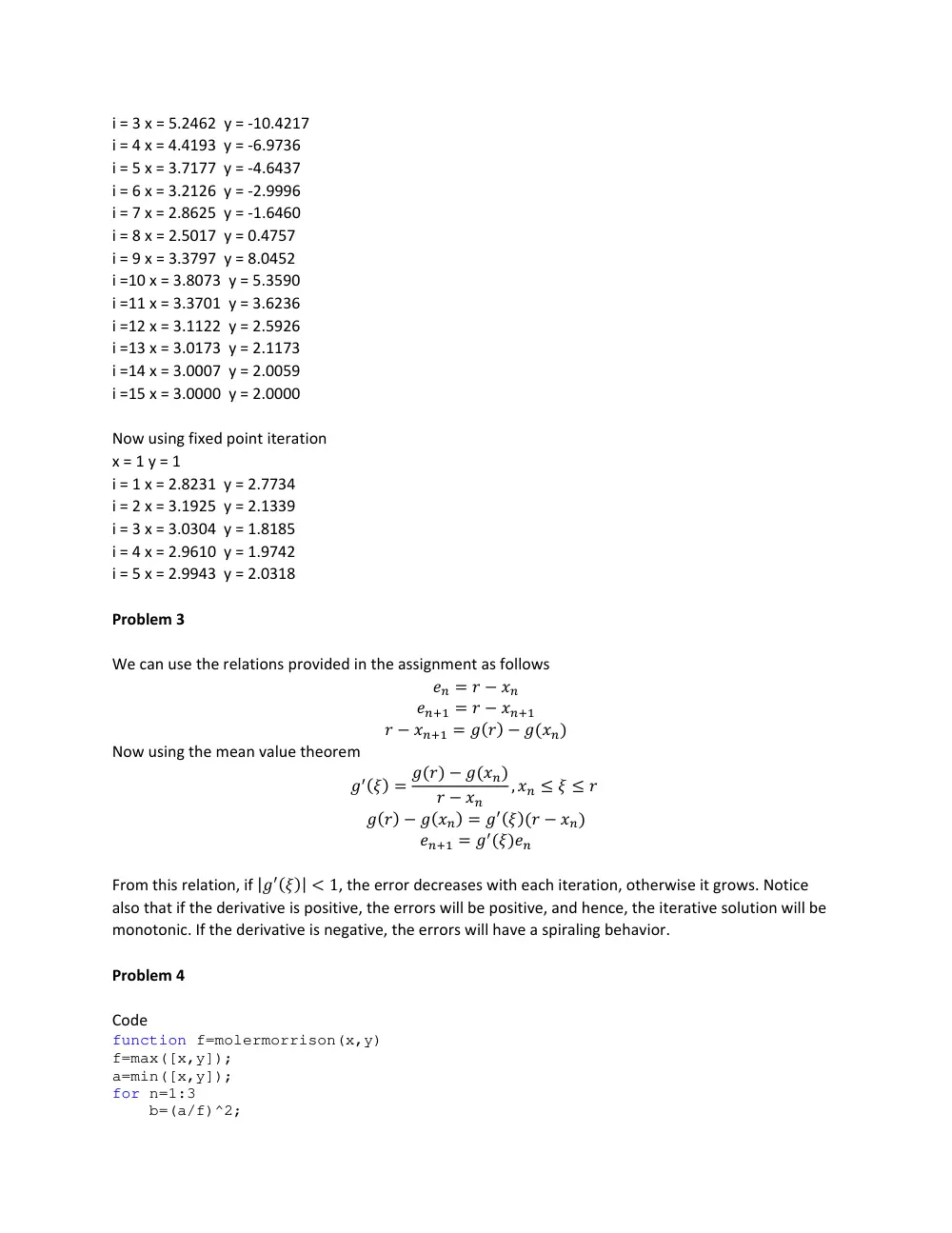
i = 3 x = 5.2462 y = ‐10.4217
i = 4 x = 4.4193 y = ‐6.9736
i = 5 x = 3.7177 y = ‐4.6437
i = 6 x = 3.2126 y = ‐2.9996
i = 7 x = 2.8625 y = ‐1.6460
i = 8 x = 2.5017 y = 0.4757
i = 9 x = 3.3797 y = 8.0452
i =10 x = 3.8073 y = 5.3590
i =11 x = 3.3701 y = 3.6236
i =12 x = 3.1122 y = 2.5926
i =13 x = 3.0173 y = 2.1173
i =14 x = 3.0007 y = 2.0059
i =15 x = 3.0000 y = 2.0000
Now using fixed point iteration
x = 1 y = 1
i = 1 x = 2.8231 y = 2.7734
i = 2 x = 3.1925 y = 2.1339
i = 3 x = 3.0304 y = 1.8185
i = 4 x = 2.9610 y = 1.9742
i = 5 x = 2.9943 y = 2.0318
Problem 3
We can use the relations provided in the assignment as follows
�� � � � ��
���� � � � ����
� � ���� � ���� � �����
Now using the mean value theorem
����� � ���� � �����
� � ��
, �� � � � �
���� � ����� � ������� � ���
���� � �������
From this relation, if |�����| � 1, the error decreases with each iteration, otherwise it grows. Notice
also that if the derivative is positive, the errors will be positive, and hence, the iterative solution will be
monotonic. If the derivative is negative, the errors will have a spiraling behavior.
Problem 4
Code
function f=molermorrison(x,y)
f=max([x,y]);
a=min([x,y]);
for n=1:3
b=(a/f)^2;
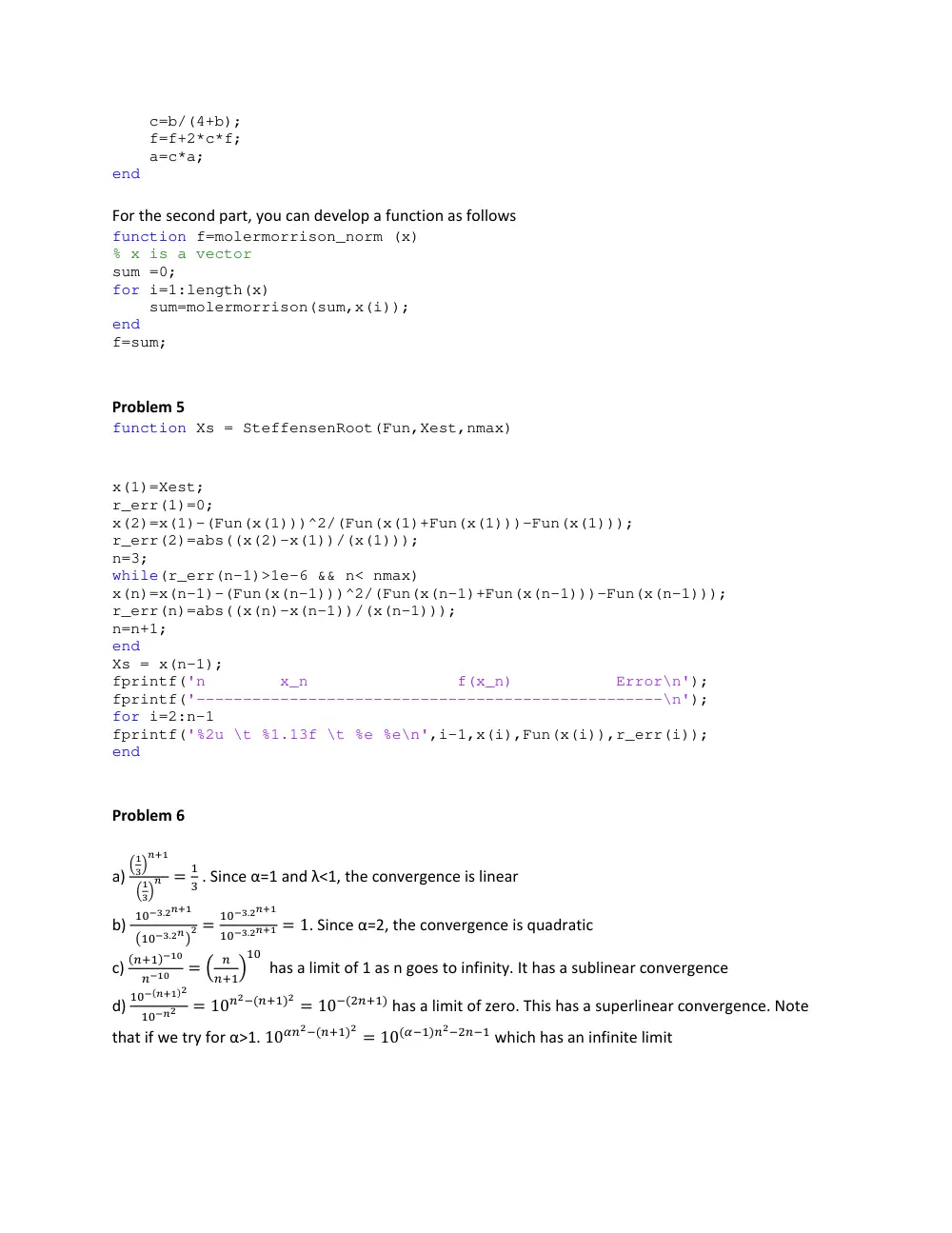
c=b/(4+b);
f=f+2*c*f;
a=c*a;
end
For the second part, you can develop a function as follows
function f=molermorrison_norm (x)
% x is a vector
sum =0;
for i=1:length(x)
sum=molermorrison(sum,x(i));
end
f=sum;
Problem 5
function Xs = SteffensenRoot(Fun,Xest,nmax)
x(1)=Xest;
r_err(1)=0;
x(2)=x(1)-(Fun(x(1)))^2/(Fun(x(1)+Fun(x(1)))-Fun(x(1)));
r_err(2)=abs((x(2)-x(1))/(x(1)));
n=3;
while(r_err(n-1)>1e-6 && n< nmax)
x(n)=x(n-1)-(Fun(x(n-1)))^2/(Fun(x(n-1)+Fun(x(n-1)))-Fun(x(n-1)));
r_err(n)=abs((x(n)-x(n-1))/(x(n-1)));
n=n+1;
end
Xs = x(n-1);
fprintf('n x_n f(x_n) Error\n');
fprintf('--------------------------------------------------\n');
for i=2:n-1
fprintf('%2u \t %1.13f \t %e %e\n',i-1,x(i),Fun(x(i)),r_err(i));
end
Problem 6
a)
��
��
���
��
��
� �
�
� . Since α=1 and λ<1, the convergence is linear
b)
����.����
�����.���
� �
����.����
����.���� � 1. Since α=2, the convergence is quadratic
c)
��������
����
� �
�
����
��
has a limit of 1 as n goes to infinity. It has a sublinear convergence
d)
���������
�����
� 10��������� � 10������� has a limit of zero. This has a superlinear convergence. Note
that if we try for α>1. 10���������� � 10������������ which has an infinite limit