
CMPS 251 Homework Assignment 2 Solution, Fall 2015
American University of Beirut · Numerical Computing · 6 pages · with solution

More CMPS 251 files
- Homework Assignment 4 · Fall 2015HomeworkView
- Homework Assignment 4 Solution · Fall 2015Homework · with solutionView
- Homework Assignment 3 Solution · Fall 2015Homework · with solutionView
- Homework Assignment 5 · Fall 2015HomeworkView
- Homework Assignment 3 · Fall 2015HomeworkView
- Homework Assignment 1 · Fall 2015HomeworkView
- Homework Assignment 1 Solution · Fall 2015Homework · with solutionView
- Homework Assignment 2 · Fall 2015HomeworkView
Show the text of this homework
CMPS 251
Assignment 2-Solution
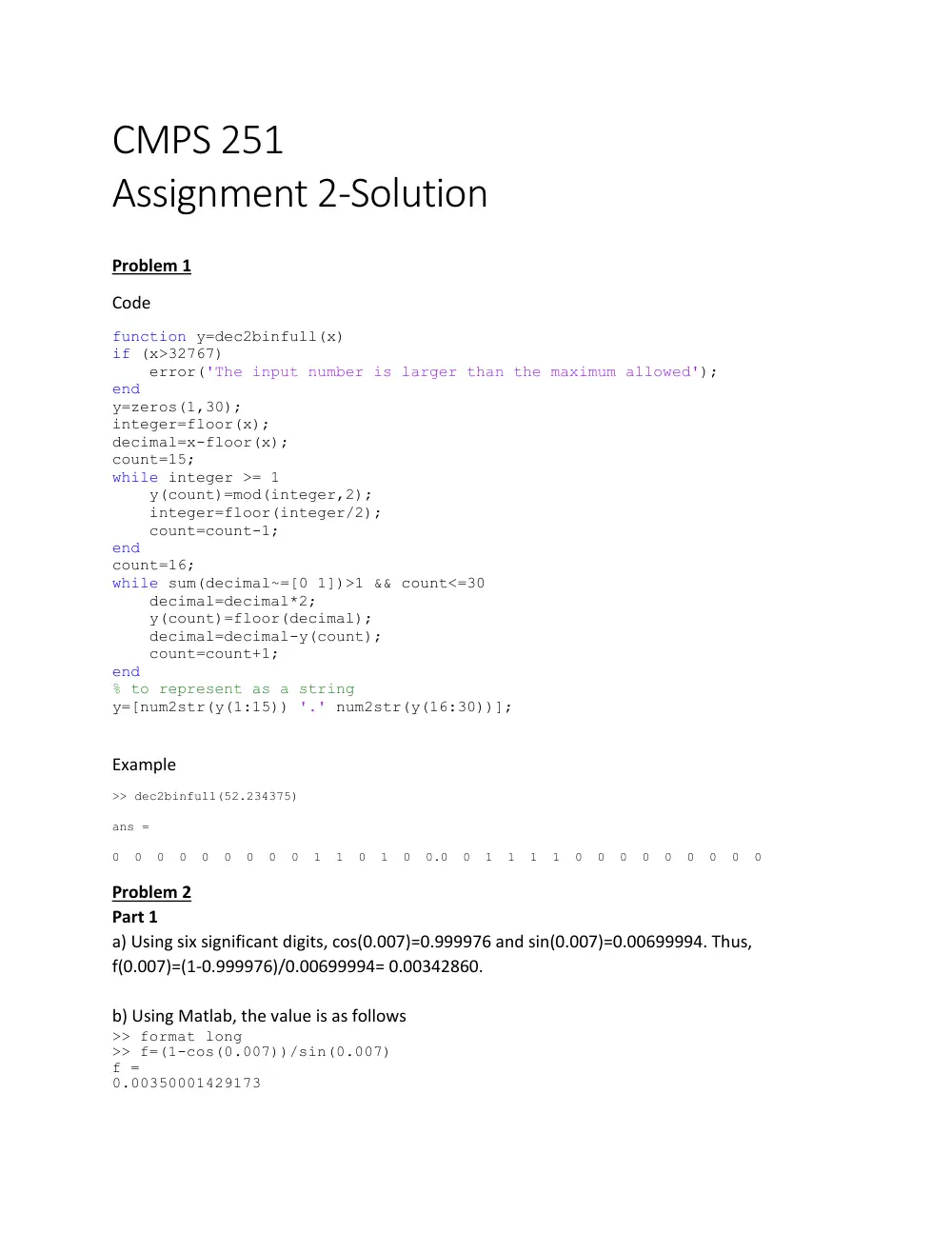
Problem 1
Code
function y=dec2binfull(x)
if (x>32767)
error('The input number is larger than the maximum allowed');
end
y=zeros(1,30);
integer=floor(x);
decimal=x-floor(x);
count=15;
while integer >= 1
y(count)=mod(integer,2);
integer=floor(integer/2);
count=count-1;
end
count=16;
while sum(decimal~=[0 1])>1 && count<=30
decimal=decimal*2;
y(count)=floor(decimal);
decimal=decimal-y(count);
count=count+1;
end
% to represent as a string
y=[num2str(y(1:15)) '.' num2str(y(16:30))];
Example
>> dec2binfull(52.234375)
ans =
0 0 0 0 0 0 0 0 0 1 1 0 1 0 0.0 0 1 1 1 1 0 0 0 0 0 0 0 0 0
Problem 2
Part 1
a) Using six significant digits, cos(0.007)=0.999976 and sin(0.007)=0.00699994. Thus,
f(0.007)=(1-0.999976)/0.00699994= 0.00342860.
b) Using Matlab, the value is as follows
>> format long
>> f=(1-cos(0.007))/sin(0.007)
f =
0.00350001429173
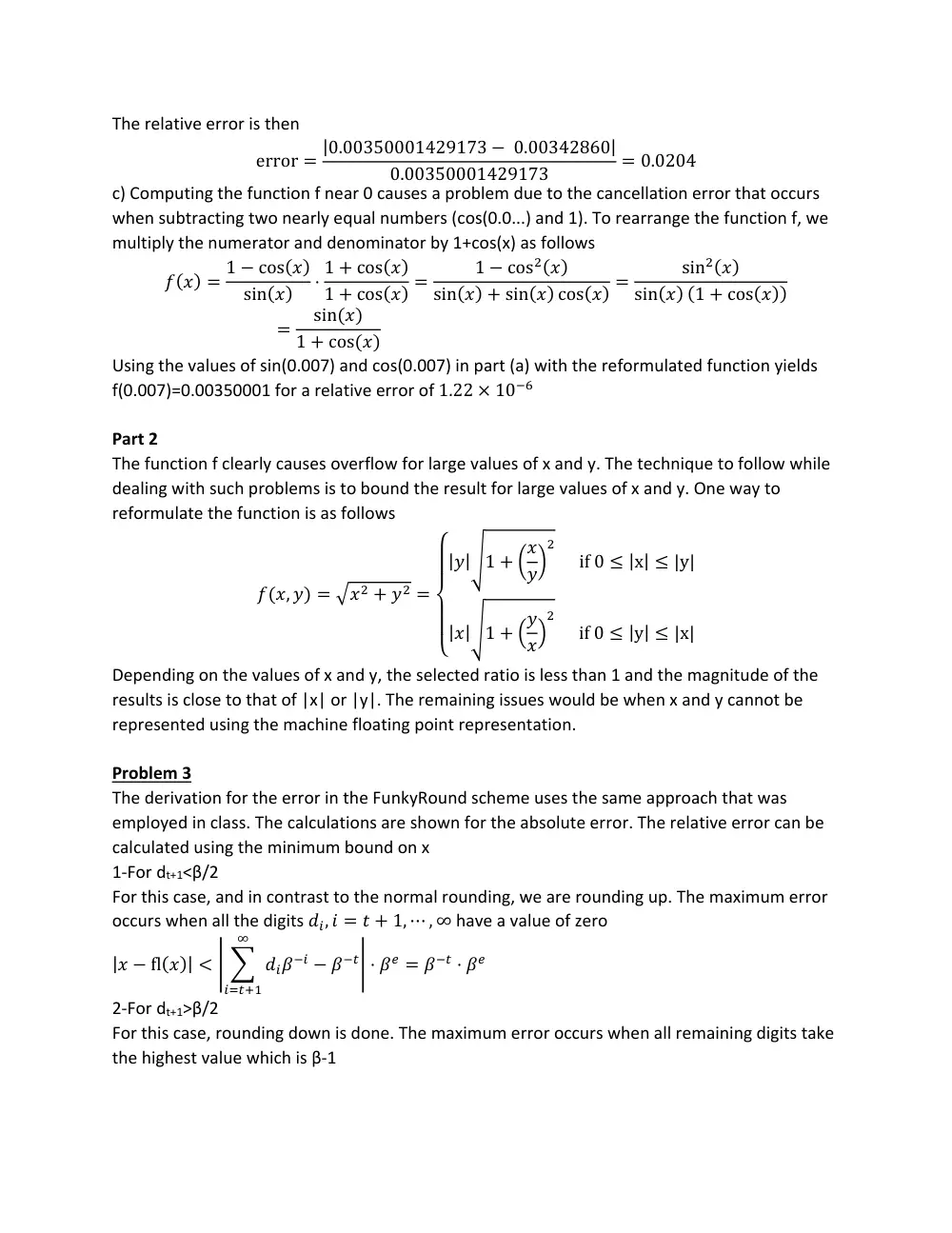
The relative error is then
error = |0.00350001429173 − 0.00342860|
0.00350001429173
= 0.0204
c) Computing the function f near 0 causes a problem due to the cancellation error that occurs
when subtracting two nearly equal numbers (cos(0.0...) and 1). To rearrange the function f, we
multiply the numerator and denominator by 1+cos(x) as follows
𝑓(𝑥) = 1 − cos(𝑥)
sin(𝑥)
⋅ 1 + cos(𝑥)
1 + cos(𝑥) =
1 − cos2(𝑥)
sin(𝑥) + sin(𝑥) cos(𝑥) =
sin2(𝑥)
sin(𝑥) (1 + cos(𝑥))
=
sin (𝑥)
1 + cos (𝑥)
Using the values of sin(0.007) and cos(0.007) in part (a) with the reformulated function yields
f(0.007)=0.00350001 for a relative error of 1.22 × 10⁻⁶
Part 2
The function f clearly causes overflow for large values of x and y. The technique to follow while
dealing with such problems is to bound the result for large values of x and y. One way to
reformulate the function is as follows
𝑓(𝑥, 𝑦) = √𝑥2 + 𝑦2 =
{
|𝑦|√1 + (𝑥
𝑦)
2
if 0 ≤ |x| ≤ |y|
|𝑥|√1 + (𝑦
𝑥)
2
if 0 ≤ |y| ≤ |x|
Depending on the values of x and y, the selected ratio is less than 1 and the magnitude of the
results is close to that of |x| or |y|. The remaining issues would be when x and y cannot be
represented using the machine floating point representation.
Problem 3
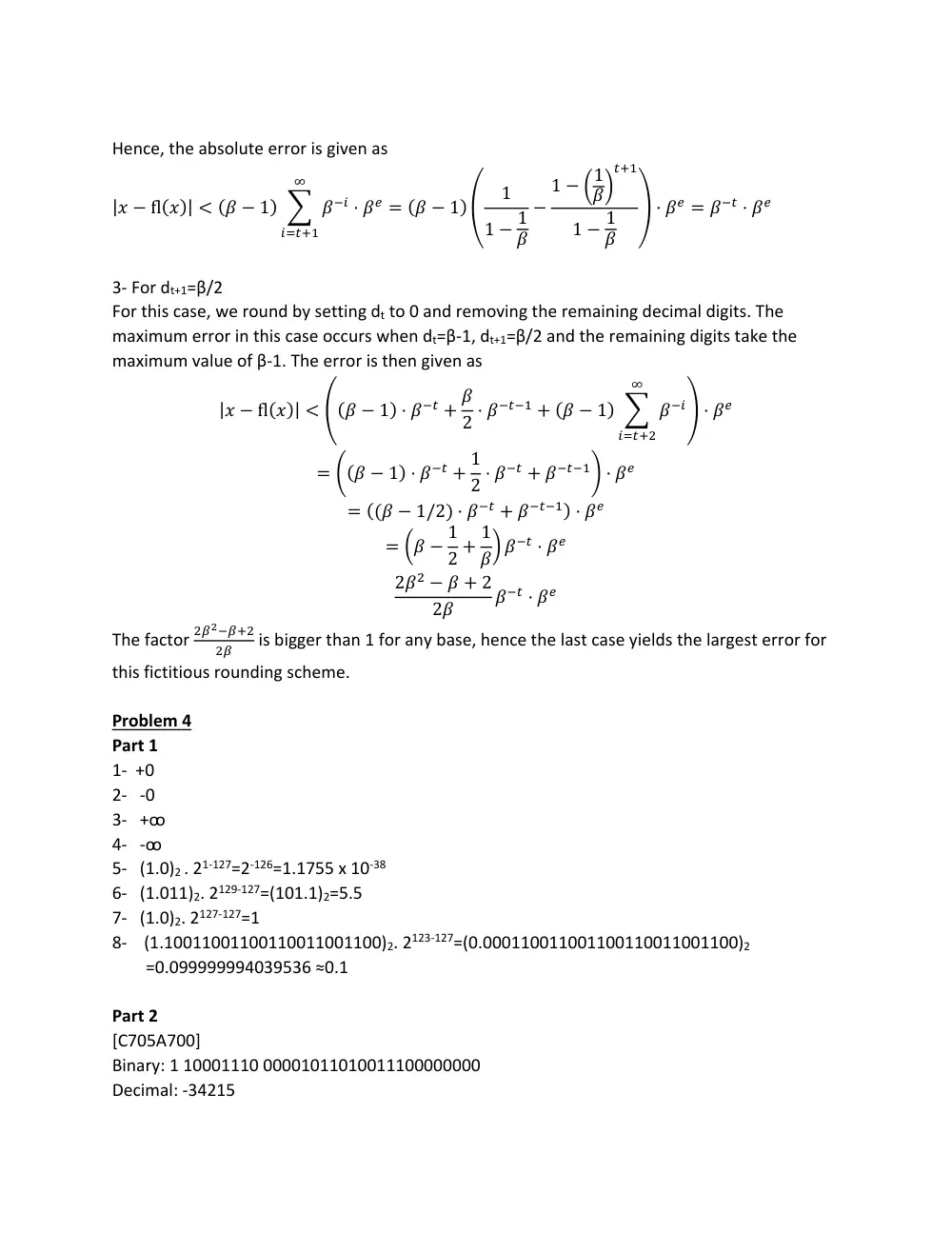
The derivation for the error in the FunkyRound scheme uses the same approach that was
employed in class. The calculations are shown for the absolute error. The relative error can be
calculated using the minimum bound on x
1-For dt+1<β/2
For this case, and in contrast to the normal rounding, we are rounding up. The maximum error
occurs when all the digits 𝑑𝑖, 𝑖 = 𝑡 + 1, ⋯ , ∞ have a value of zero
|𝑥 − fl(𝑥)| < | ∑ 𝑑𝑖𝛽−𝑖
∞
𝑖=𝑡+1
− 𝛽−𝑡| ⋅ 𝛽𝑒 = 𝛽−𝑡 ⋅ 𝛽𝑒
2-For dt+1>β/2
For this case, rounding down is done. The maximum error occurs when all remaining digits take
the highest value which is β-1
Hence, the absolute error is given as
|𝑥 − fl(𝑥)| < (𝛽 − 1) ∑ 𝛽−𝑖
∞
𝑖=𝑡+1
⋅ 𝛽𝑒 = (𝛽 − 1) (
1
1 − 1
𝛽
−
1 − (1
𝛽)
𝑡+1
1 − 1
𝛽
) ⋅ 𝛽𝑒 = 𝛽−𝑡 ⋅ 𝛽𝑒
3- For dt+1=β/2
For this case, we round by setting dt to 0 and removing the remaining decimal digits. The
maximum error in this case occurs when dt=β-1, dt+1=β/2 and the remaining digits take the
maximum value of β-1. The error is then given as
|𝑥 − fl(𝑥)| < ((𝛽 − 1) ⋅ 𝛽−𝑡 + 𝛽
2 ⋅ 𝛽−𝑡−1 + (𝛽 − 1) ∑ 𝛽−𝑖
∞
𝑖=𝑡+2
) ⋅ 𝛽𝑒
= ((𝛽 − 1) ⋅ 𝛽−𝑡 + 1
2 ⋅ 𝛽−𝑡 + 𝛽−𝑡−1) ⋅ 𝛽𝑒
= ((𝛽 − 1/2) ⋅ 𝛽−𝑡 + 𝛽−𝑡−1) ⋅ 𝛽𝑒
= (𝛽 − 1
2 + 1
𝛽) 𝛽−𝑡 ⋅ 𝛽𝑒
2𝛽2 − 𝛽 + 2
2𝛽
𝛽−𝑡 ⋅ 𝛽𝑒
The factor
2𝛽2−𝛽+2
2𝛽
is bigger than 1 for any base, hence the last case yields the largest error for
this fictitious rounding scheme.
Problem 4
Part 1
1- +0
2- -0
3- +ꝏ
4- -ꝏ
5- (1.0)2 . 21-127=2-126=1.1755 x 10-38
6- (1.011)2. 2129-127=(101.1)2=5.5
7- (1.0)2. 2127-127=1
8- (1.10011001100110011001100)2. 2123-127=(0.000110011001100110011001100)2
=0.099999994039536 ≈0.1
Part 2
[C705A700]
Binary: 1 10001110 00001011010011100000000
Decimal: -34215
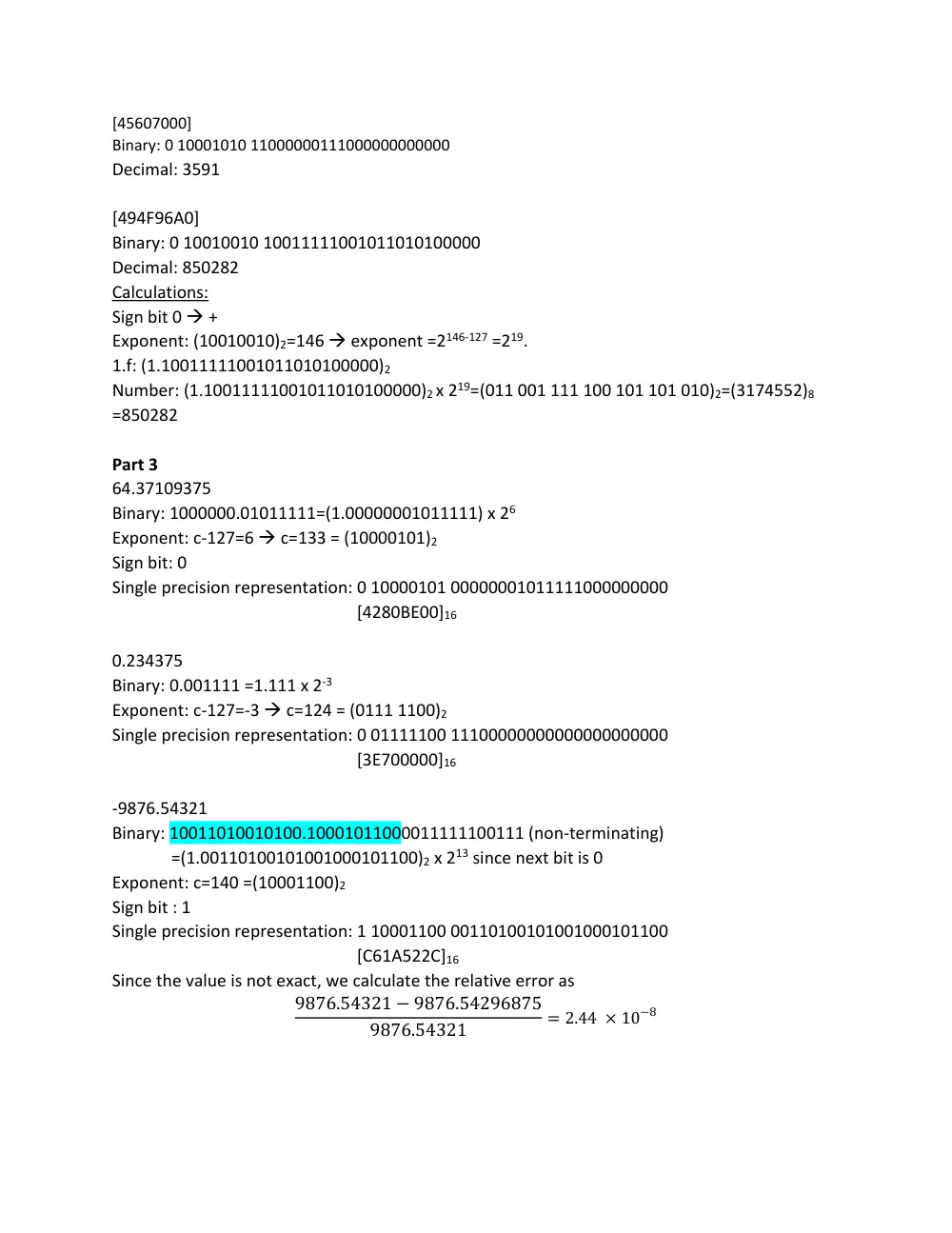
[45607000]
Binary: 0 10001010 11000000111000000000000
Decimal: 3591
[494F96A0]
Binary: 0 10010010 10011111001011010100000
Decimal: 850282
Calculations:
Sign bit 0 +
Exponent: (10010010)2=146 exponent =2146-127 =219.
1.f: (1.10011111001011010100000)2
Number: (1.10011111001011010100000)2 x 219=(011 001 111 100 101 101 010)2=(3174552)8
=850282
Part 3
64.37109375
Binary: 1000000.01011111=(1.00000001011111) x 26
Exponent: c-127=6 c=133 = (10000101)2
Sign bit: 0
Single precision representation: 0 10000101 00000001011111000000000
[4280BE00]16
0.234375
Binary: 0.001111 =1.111 x 2-3
Exponent: c-127=-3 c=124 = (0111 1100)2
Single precision representation: 0 01111100 11100000000000000000000
[3E700000]16
-9876.54321
Binary: 10011010010100.10001011000011111100111 (non-terminating)
=(1.00110100101001000101100)2 x 213 since next bit is 0
Exponent: c=140 =(10001100)2
Sign bit : 1
Single precision representation: 1 10001100 00110100101001000101100
[C61A522C]16
Since the value is not exact, we calculate the relative error as
9876.54321 − 9876.54296875
9876.54321
= 2.44 × 10⁻⁸
Problem 5
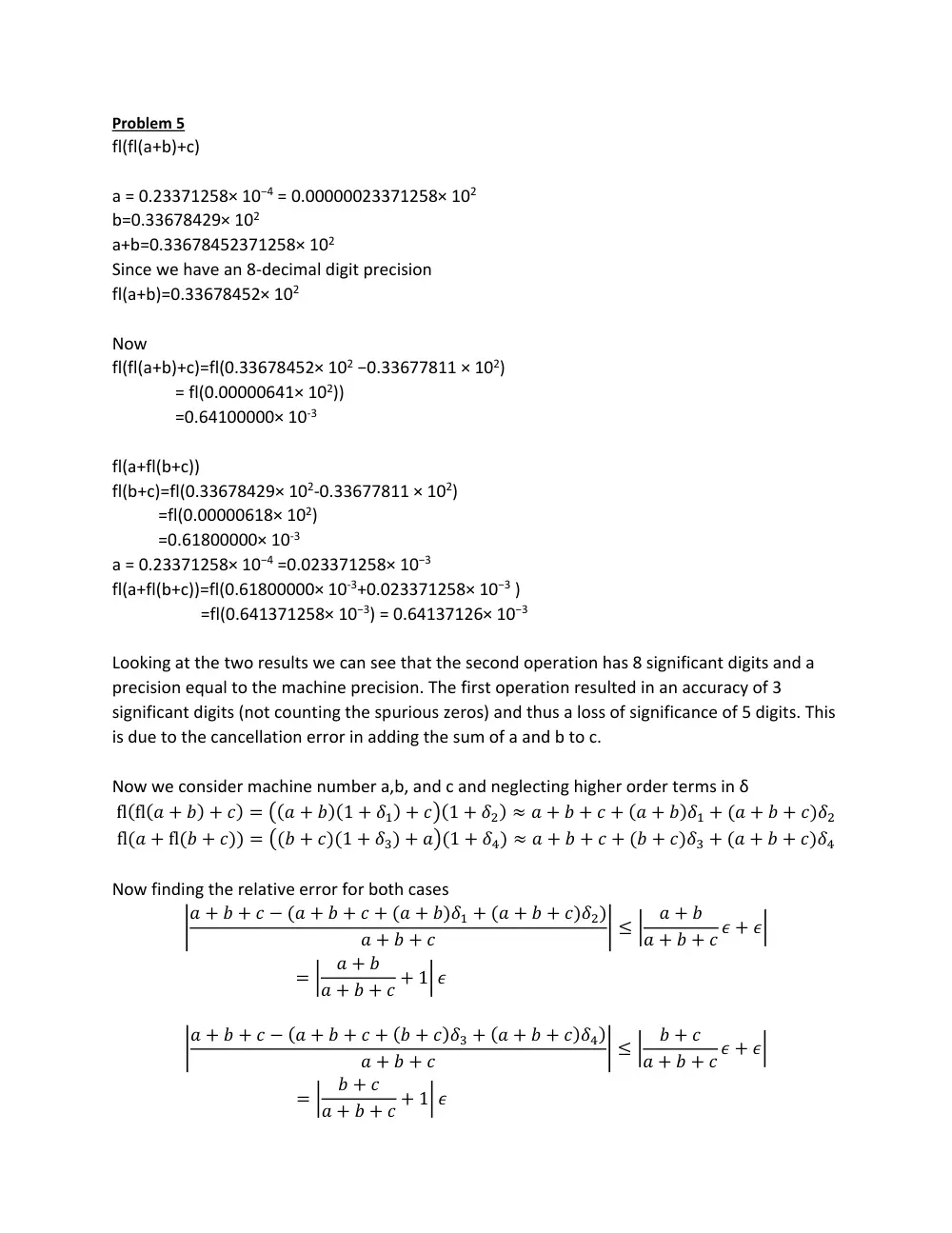
fl(fl(a+b)+c)
a = 0.23371258× 10−4 = 0.00000023371258× 10²
b=0.33678429× 10²
a+b=0.33678452371258× 10²
Since we have an 8-decimal digit precision
fl(a+b)=0.33678452× 10²
Now
fl(fl(a+b)+c)=fl(0.33678452× 10² −0.33677811 × 10²)
= fl(0.00000641× 10²))
=0.64100000× 10⁻³
fl(a+fl(b+c))
fl(b+c)=fl(0.33678429× 10²-0.33677811 × 10²)
=fl(0.00000618× 10²)
=0.61800000× 10⁻³
a = 0.23371258× 10−4 =0.023371258× 10⁻³
fl(a+fl(b+c))=fl(0.61800000× 10⁻³+0.023371258× 10⁻³ )
=fl(0.641371258× 10⁻³) = 0.64137126× 10⁻³
Looking at the two results we can see that the second operation has 8 significant digits and a
precision equal to the machine precision. The first operation resulted in an accuracy of 3
significant digits (not counting the spurious zeros) and thus a loss of significance of 5 digits. This
is due to the cancellation error in adding the sum of a and b to c.
Now we consider machine number a,b, and c and neglecting higher order terms in δ
fl(fl(𝑎 + 𝑏) + 𝑐) = ((𝑎 + 𝑏)(1 + 𝛿1) + 𝑐)(1 + 𝛿2) ≈ 𝑎 + 𝑏 + 𝑐 + (𝑎 + 𝑏)𝛿1 + (𝑎 + 𝑏 + 𝑐)𝛿2
fl(𝑎 + fl(𝑏 + 𝑐)) = ((𝑏 + 𝑐)(1 + 𝛿3) + 𝑎)(1 + 𝛿4) ≈ 𝑎 + 𝑏 + 𝑐 + (𝑏 + 𝑐)𝛿3 + (𝑎 + 𝑏 + 𝑐)𝛿4
Now finding the relative error for both cases
|𝑎 + 𝑏 + 𝑐 − (𝑎 + 𝑏 + 𝑐 + (𝑎 + 𝑏)𝛿1 + (𝑎 + 𝑏 + 𝑐)𝛿2)
𝑎 + 𝑏 + 𝑐
| ≤ |
𝑎 + 𝑏
𝑎 + 𝑏 + 𝑐 𝜖 + 𝜖|
= |
𝑎 + 𝑏
𝑎 + 𝑏 + 𝑐 + 1| 𝜖
|𝑎 + 𝑏 + 𝑐 − (𝑎 + 𝑏 + 𝑐 + (𝑏 + 𝑐)𝛿3 + (𝑎 + 𝑏 + 𝑐)𝛿4)
𝑎 + 𝑏 + 𝑐
| ≤ |
𝑏 + 𝑐
𝑎 + 𝑏 + 𝑐 𝜖 + 𝜖|
= |
𝑏 + 𝑐
𝑎 + 𝑏 + 𝑐 + 1| 𝜖
Finally, we can note that when |𝑏 + 𝑐| < |𝑎 + 𝑏|, the second operation is better than the first
one.