
CMPS 251 Homework Assignment 5 Solution, Fall 2015
American University of Beirut · Numerical Computing · 6 pages · with solution


More CMPS 251 files
- Homework Assignment 3 Solution · Fall 2015Homework · with solutionView
- Homework Assignment 4 · Fall 2015HomeworkView
- Homework Assignment 3 · Fall 2015HomeworkView
- Homework Assignment 4 Solution · Fall 2015Homework · with solutionView
- Homework Assignment 2 Solution · Fall 2015Homework · with solutionView
- Homework Assignment 1 · Fall 2015HomeworkView
- Homework Assignment 1 Solution · Fall 2015Homework · with solutionView
- Homework Assignment 2 · Fall 2015HomeworkView
Show the text of this homework
CMPS 251
Assignment 5-Solution
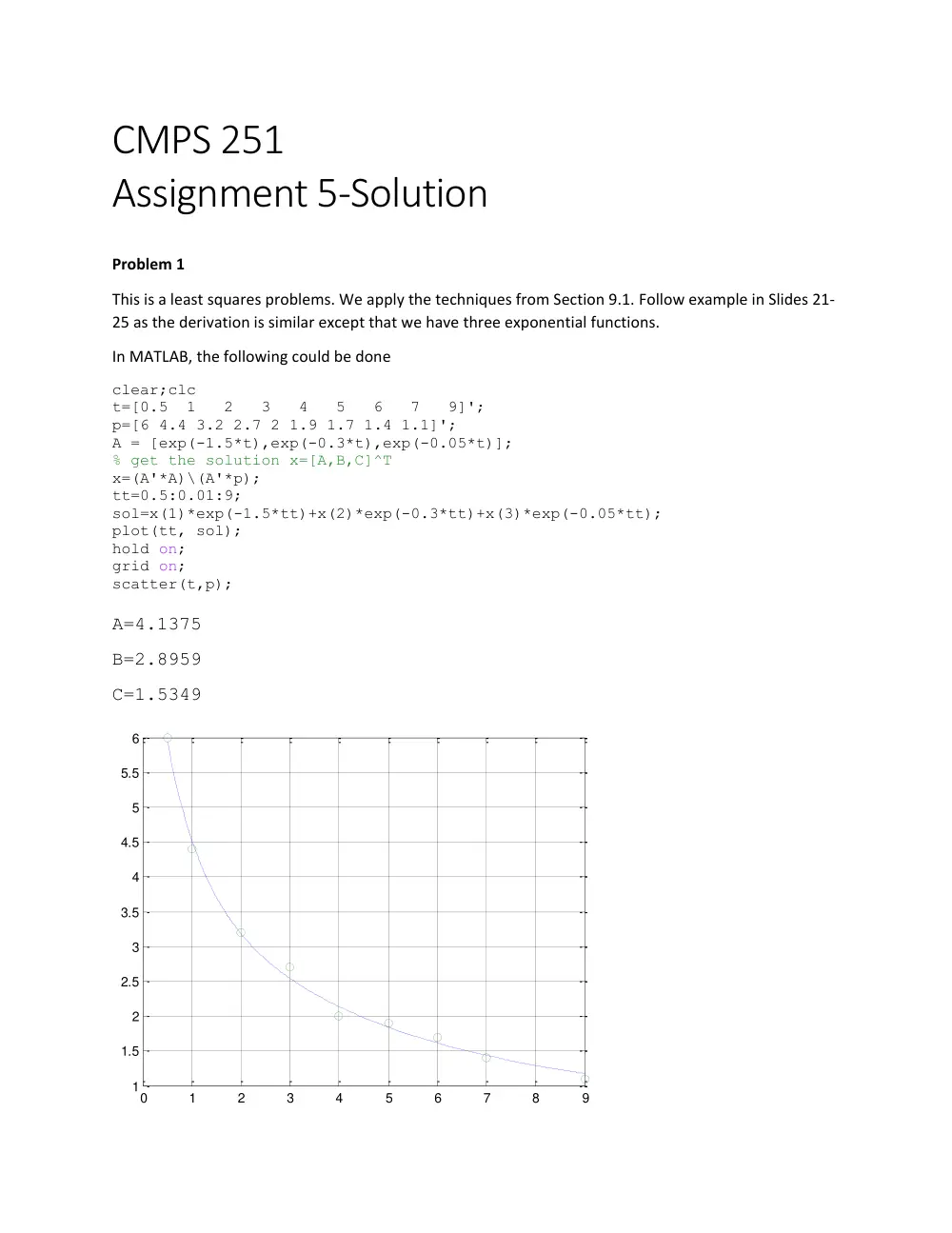
Problem 1
This is a least squares problems. We apply the techniques from Section 9.1. Follow example in Slides 21-
25 as the derivation is similar except that we have three exponential functions.
In MATLAB, the following could be done
clear;clc
t=[0.5 1 2 3 4 5 6 7 9]';
p=[6 4.4 3.2 2.7 2 1.9 1.7 1.4 1.1]';
A = [exp(-1.5*t),exp(-0.3*t),exp(-0.05*t)];
% get the solution x=[A,B,C]^T
x=(A'*A)\(A'*p);
tt=0.5:0.01:9;
sol=x(1)*exp(-1.5*tt)+x(2)*exp(-0.3*tt)+x(3)*exp(-0.05*tt);
plot(tt, sol);
hold on;
grid on;
scatter(t,p);
A=4.1375
B=2.8959
C=1.5349
0
1
2
3
4
5
6
7
8
9
1
1.5
2
2.5
3
3.5
4
4.5
5
5.5
6
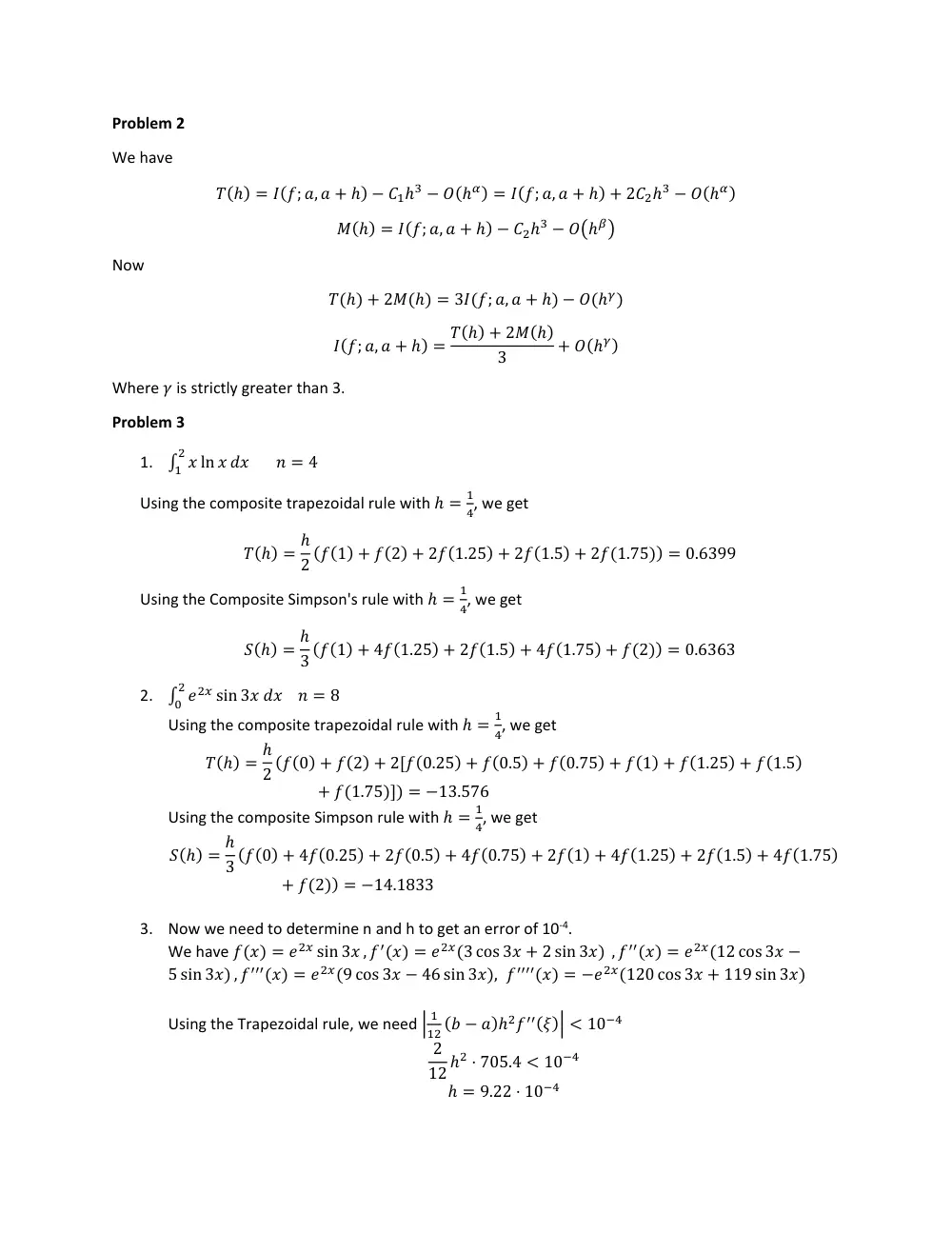
Problem 2
We have
𝑇(ℎ) = 𝐼(𝑓; 𝑎, 𝑎 + ℎ) − 𝐶1ℎ3 − 𝑂(ℎ𝛼) = 𝐼(𝑓; 𝑎, 𝑎 + ℎ) + 2𝐶2ℎ3 − 𝑂(ℎ𝛼)
𝑀(ℎ) = 𝐼(𝑓; 𝑎, 𝑎 + ℎ) − 𝐶2ℎ3 − 𝑂(ℎ𝛽)
Now
𝑇(ℎ) + 2𝑀(ℎ) = 3𝐼(𝑓; 𝑎, 𝑎 + ℎ) − 𝑂(ℎ𝛾)
𝐼(𝑓; 𝑎, 𝑎 + ℎ) = 𝑇(ℎ) + 2𝑀(ℎ)
3
+ 𝑂(ℎ𝛾)
Where 𝛾 is strictly greater than 3.
Problem 3
1. ∫ 𝑥 ln 𝑥 𝑑𝑥 𝑛 = 4
2
1
Using the composite trapezoidal rule with ℎ =
1
4, we get
𝑇(ℎ) = ℎ
2 (𝑓(1) + 𝑓(2) + 2𝑓(1.25) + 2𝑓(1.5) + 2𝑓(1.75)) = 0.6399
Using the Composite Simpson's rule with ℎ =
1
4, we get
𝑆(ℎ) = ℎ
3 (𝑓(1) + 4𝑓(1.25) + 2𝑓(1.5) + 4𝑓(1.75) + 𝑓(2)) = 0.6363
2. ∫ 𝑒2𝑥 sin 3𝑥 𝑑𝑥 𝑛 = 8
2
0
Using the composite trapezoidal rule with ℎ =
1
4, we get
𝑇(ℎ) = ℎ
2 (𝑓(0) + 𝑓(2) + 2[𝑓(0.25) + 𝑓(0.5) + 𝑓(0.75) + 𝑓(1) + 𝑓(1.25) + 𝑓(1.5)
+ 𝑓(1.75)]) = −13.576
Using the composite Simpson rule with ℎ =
1
4, we get
𝑆(ℎ) = ℎ
3 (𝑓(0) + 4𝑓(0.25) + 2𝑓(0.5) + 4𝑓(0.75) + 2𝑓(1) + 4𝑓(1.25) + 2𝑓(1.5) + 4𝑓(1.75)
+ 𝑓(2)) = −14.1833
3. Now we need to determine n and h to get an error of 10-4.
We have 𝑓(𝑥) = 𝑒2𝑥 sin 3𝑥 , 𝑓′(𝑥) = 𝑒2𝑥(3 cos 3𝑥 + 2 sin 3𝑥) , 𝑓′′(𝑥) = 𝑒2𝑥(12 cos 3𝑥 −
5 sin 3𝑥) , 𝑓′′′(𝑥) = 𝑒2𝑥(9 cos 3𝑥 − 46 sin 3𝑥), 𝑓′′′′(𝑥) = −𝑒2𝑥(120 cos 3𝑥 + 119 sin 3𝑥)
Using the Trapezoidal rule, we need |
1
12 (𝑏 − 𝑎)ℎ2𝑓′′(𝜉)| < 10−4
2
12 ℎ2 ⋅ 705.4 < 10−4
ℎ = 9.22 ⋅ 10−4
𝑛 > 2168
Using the Simpson's Rule we need |
1
180 (𝑏 − 𝑎)ℎ4𝑓′′′′(𝜉)| < 10−4
1
180 ⋅ 2ℎ4 ⋅ 2845 < 10−4
ℎ < 0.0422
𝑛 > 47
4. ∫
∫
𝑥𝑦2𝑑𝑦𝑑𝑥
1.4
1.2
2.5
2.1
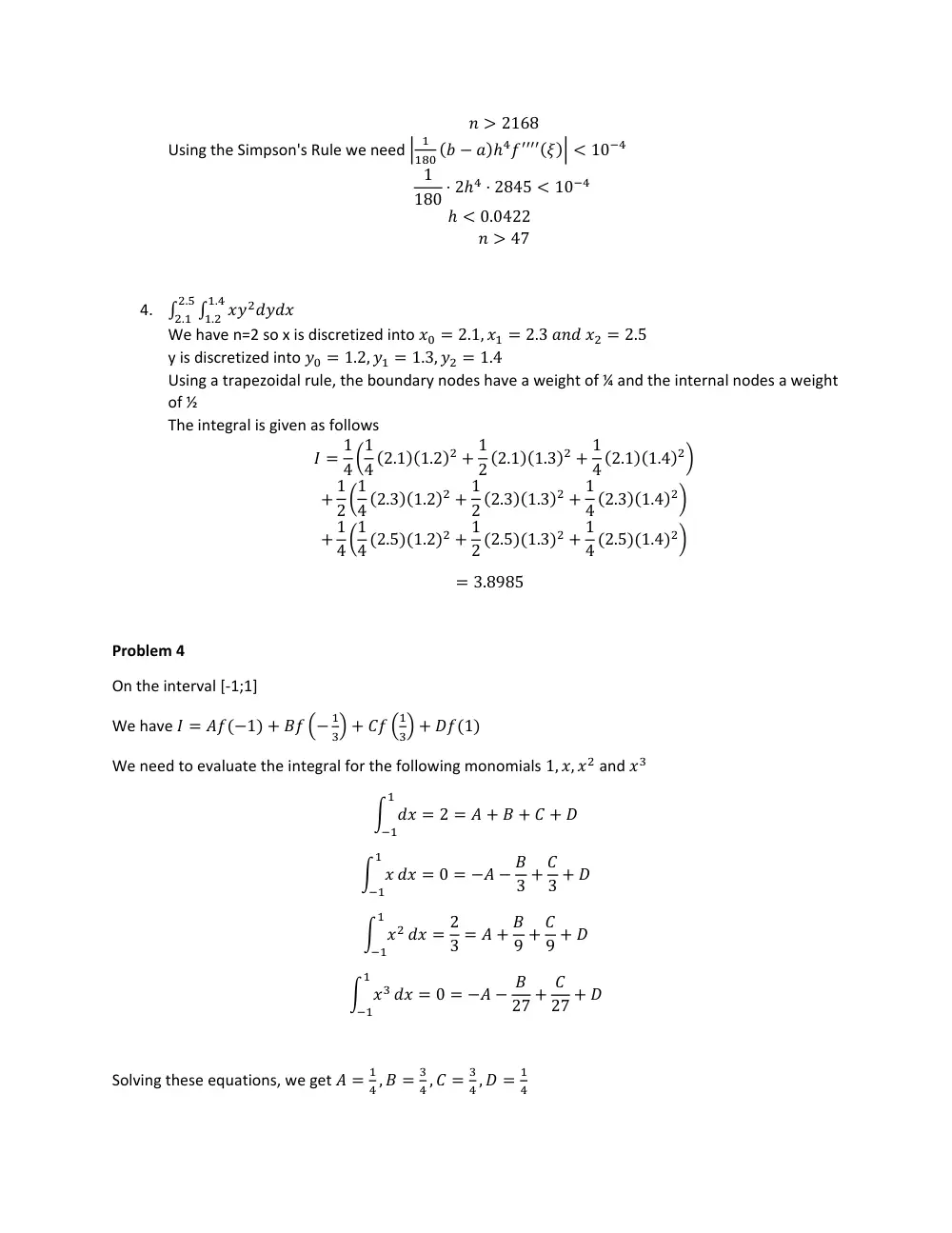
We have n=2 so x is discretized into 𝑥0 = 2.1, 𝑥1 = 2.3 𝑎𝑛𝑑 𝑥2 = 2.5
y is discretized into 𝑦0 = 1.2, 𝑦1 = 1.3, 𝑦2 = 1.4
Using a trapezoidal rule, the boundary nodes have a weight of ¼ and the internal nodes a weight
of ½
The integral is given as follows
𝐼 = 1
4 (1
4 (2.1)(1.2)2 + 1
2 (2.1)(1.3)2 + 1
4 (2.1)(1.4)2)
+ 1
2 (1
4 (2.3)(1.2)2 + 1
2 (2.3)(1.3)2 + 1
4 (2.3)(1.4)2)
+ 1
4 (1
4 (2.5)(1.2)2 + 1
2 (2.5)(1.3)2 + 1
4 (2.5)(1.4)2)
= 3.8985
Problem 4
On the interval [-1;1]
We have 𝐼 = 𝐴𝑓(−1) + 𝐵𝑓 (−
1
3) + 𝐶𝑓 (
1
3) + 𝐷𝑓(1)
We need to evaluate the integral for the following monomials 1, 𝑥, 𝑥2 and 𝑥3
∫ 𝑑𝑥 = 2 = 𝐴 + 𝐵 + 𝐶 + 𝐷
1
−1
∫ 𝑥
1
−1
𝑑𝑥 = 0 = −𝐴 − 𝐵
3 + 𝐶
3 + 𝐷
∫ 𝑥2
1
−1
𝑑𝑥 = 2
3 = 𝐴 + 𝐵
9 + 𝐶
9 + 𝐷
∫ 𝑥3
1
−1
𝑑𝑥 = 0 = −𝐴 − 𝐵
27 + 𝐶
27 + 𝐷
Solving these equations, we get 𝐴 =
1
4 , 𝐵 =
3
4 , 𝐶 =
3
4 , 𝐷 =
1
4
Now using the linear mapping with a weight of
3ℎ
2
we get 𝐼 =
3ℎ
8 (𝑓(𝑎) + 3𝑓(𝑎 + ℎ) + 3𝑓(𝑎 + 2ℎ) + 𝑓(𝑎 + 3ℎ))
Now we need to calculate the error
𝐿𝑒𝑡 𝐹(𝑥) = ∫ 𝑓(𝑡)𝑑𝑡
𝑥
𝑎
𝐹(𝑎) = 0
𝐹(𝑎 + 3ℎ) = 𝐹(𝑎) + 3ℎ𝐹′(𝑎) + 9ℎ2
2 𝐹′′(𝑎) + 27ℎ3
6
𝐹′′′(𝑎) + 81ℎ4
24 𝐹′′′′(𝑎) + 243ℎ5
120 𝐹(5)(𝑎) + ⋯
= 3ℎ𝑓 + 9ℎ2
2 𝑓′ + 27ℎ3
6
𝑓′′ + 81ℎ4
24 𝑓′′′ + 243ℎ5
120 𝑓′′′′ + ⋯
3ℎ
8 (𝑓(𝑎) + 3𝑓(𝑎 + ℎ) + 3𝑓(𝑎 + 2ℎ) + 𝑓(𝑎 + 3ℎ))
= 3ℎ
8 (8𝑓 + 12ℎ𝑓′ + ℎ2
2 (3 + 3.22 + 32)𝑓′′ + ℎ3
6 (3 + 3.23 + 33)𝑓′′′
+ ℎ4
24 (3 + 3.24 + 34)) 𝑓′′′′ + ⋯
= 3ℎ𝑓 + 9ℎ2
2 𝑓′ + 27ℎ3
6
𝑓′′ + 81ℎ4
24 𝑓′′′ + 33ℎ5
16 𝑓′′′′ + ⋯
Subtracting the two entities leaves us with a truncation error of
243ℎ5
120 𝑓′′′′ −
33ℎ5
16 𝑓′′′′ = −
3
80 ℎ5𝑓′′′′(𝜉)
Problem 5
function R=Romberg(f,a,b,n)
h=b-a;
R(1,1)=h/2*(f(a)+f(b));
for i=2:n+1
h=h/2;
sum=0;
for k=1:2:2^(i-1)-1
sum=sum+f(a+k*h);
end
R(i,1)=0.5*R(i-1,1)+sum*h;
for j=2:i
R(i,j)=R(i,j-1)+(R(i,j-1)-R(i-1,j-1))/(4^(j-1)-1);
end
end
function f=testRom(x)
f=4./(1+x.^2);
R=Romberg(@testRom,0,1,5)
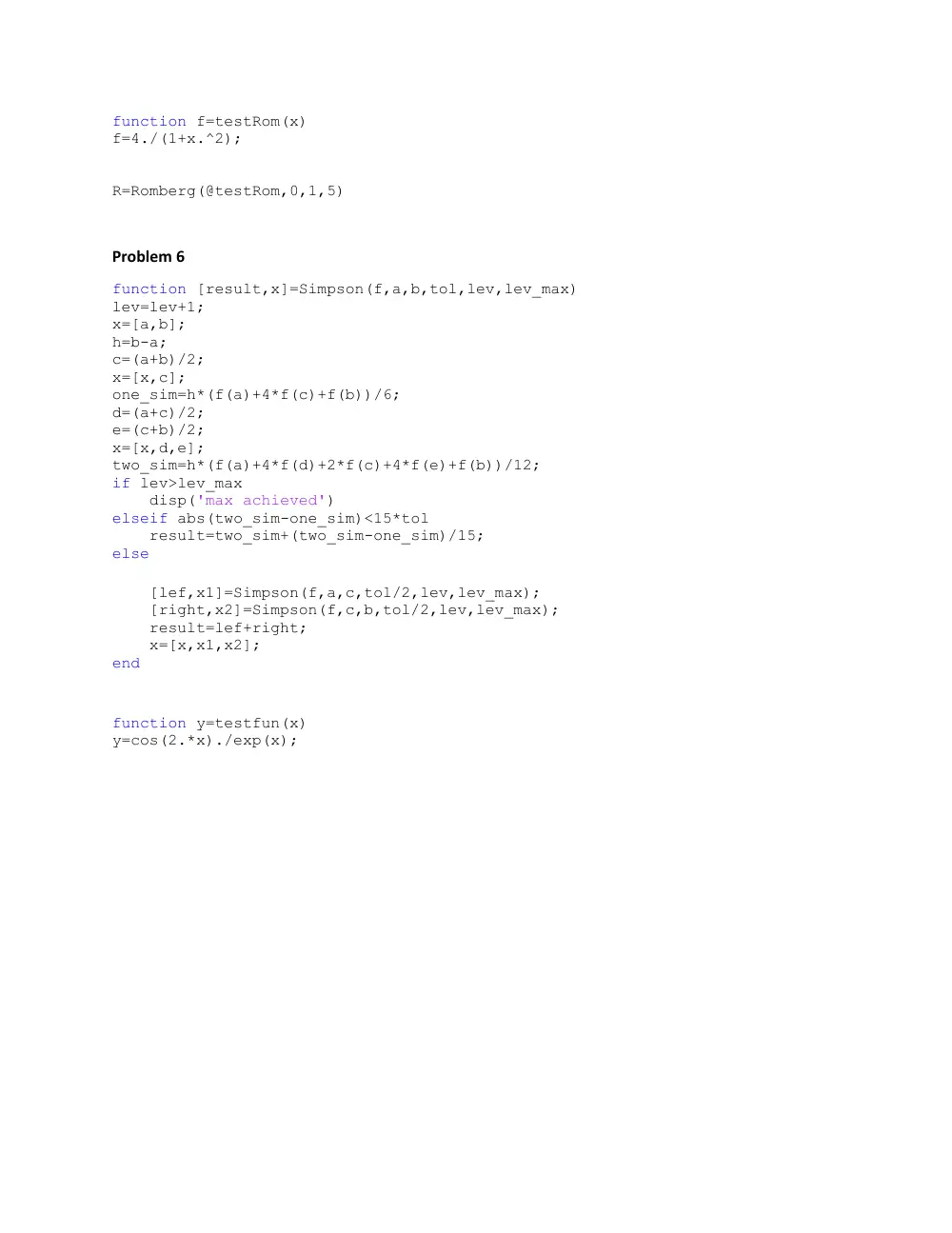
Problem 6
function [result,x]=Simpson(f,a,b,tol,lev,lev_max)
lev=lev+1;
x=[a,b];
h=b-a;
c=(a+b)/2;
x=[x,c];
one_sim=h*(f(a)+4*f(c)+f(b))/6;
d=(a+c)/2;
e=(c+b)/2;
x=[x,d,e];
two_sim=h*(f(a)+4*f(d)+2*f(c)+4*f(e)+f(b))/12;
if lev>lev_max
disp('max achieved')
elseif abs(two_sim-one_sim)<15*tol
result=two_sim+(two_sim-one_sim)/15;
else
[lef,x1]=Simpson(f,a,c,tol/2,lev,lev_max);
[right,x2]=Simpson(f,c,b,tol/2,lev,lev_max);
result=lef+right;
x=[x,x1,x2];
end
function y=testfun(x)
y=cos(2.*x)./exp(x);
0
0.5
1
1.5
2
2.5
3
3.5
4
-0.4
-0.2
0
0.2
0.4
0.6
0.8
1