
CMPS 251 Homework Assignment 6 Solution, Fall 2015
American University of Beirut · Numerical Computing · 5 pages · with solution
More CMPS 251 files
- Homework Assignment 3 Solution · Fall 2015Homework · with solutionView
- Homework Assignment 4 · Fall 2015HomeworkView
- Homework Assignment 3 · Fall 2015HomeworkView
- Homework Assignment 4 Solution · Fall 2015Homework · with solutionView
- Homework Assignment 2 Solution · Fall 2015Homework · with solutionView
- Homework Assignment 1 · Fall 2015HomeworkView
- Homework Assignment 1 Solution · Fall 2015Homework · with solutionView
- Homework Assignment 2 · Fall 2015HomeworkView
Show the text of this homework
CMPS 251
Assignment 6-Solution
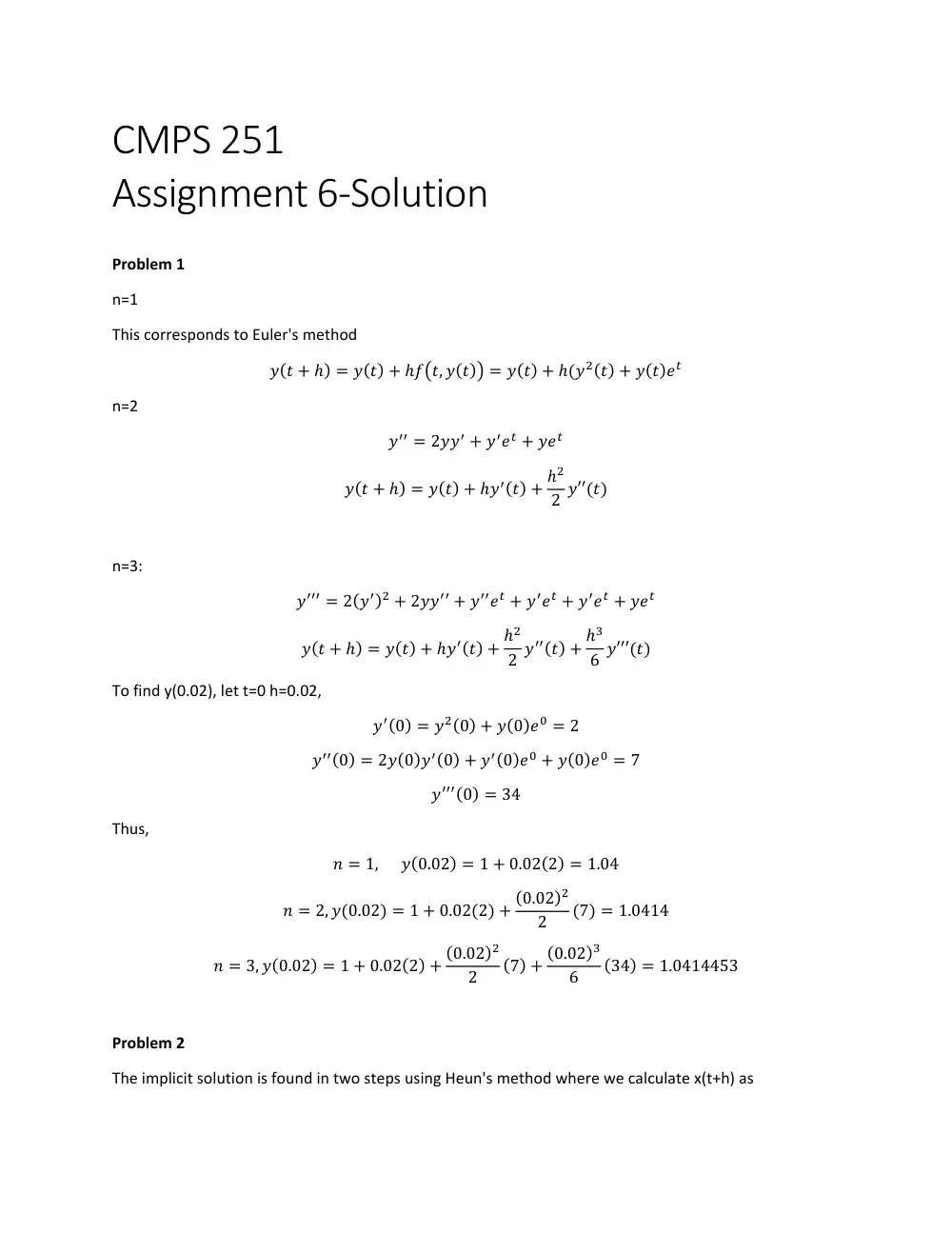
Problem 1
n=1
This corresponds to Euler's method
𝑦(𝑡 + ℎ) = 𝑦(𝑡) + ℎ𝑓(𝑡, 𝑦(𝑡)) = 𝑦(𝑡) + ℎ(𝑦2(𝑡) + 𝑦(𝑡)𝑒𝑡
n=2
𝑦′′ = 2𝑦𝑦′ + 𝑦′𝑒𝑡 + 𝑦𝑒𝑡
𝑦(𝑡 + ℎ) = 𝑦(𝑡) + ℎ𝑦′(𝑡) + ℎ2
2 𝑦′′(𝑡)
n=3:
𝑦′′′ = 2(𝑦′)2 + 2𝑦𝑦′′ + 𝑦′′𝑒𝑡 + 𝑦′𝑒𝑡 + 𝑦′𝑒𝑡 + 𝑦𝑒𝑡
𝑦(𝑡 + ℎ) = 𝑦(𝑡) + ℎ𝑦′(𝑡) + ℎ2
2 𝑦′′(𝑡) + ℎ3
6 𝑦′′′(𝑡)
To find y(0.02), let t=0 h=0.02,
𝑦′(0) = 𝑦2(0) + 𝑦(0)𝑒0 = 2
𝑦′′(0) = 2𝑦(0)𝑦′(0) + 𝑦′(0)𝑒0 + 𝑦(0)𝑒0 = 7
𝑦′′′(0) = 34
Thus,
𝑛 = 1, 𝑦(0.02) = 1 + 0.02(2) = 1.04
𝑛 = 2, 𝑦(0.02) = 1 + 0.02(2) +
(0.02)2
2
(7) = 1.0414
𝑛 = 3, 𝑦(0.02) = 1 + 0.02(2) +
(0.02)2
2
(7) +
(0.02)3
6
(34) = 1.0414453
Problem 2
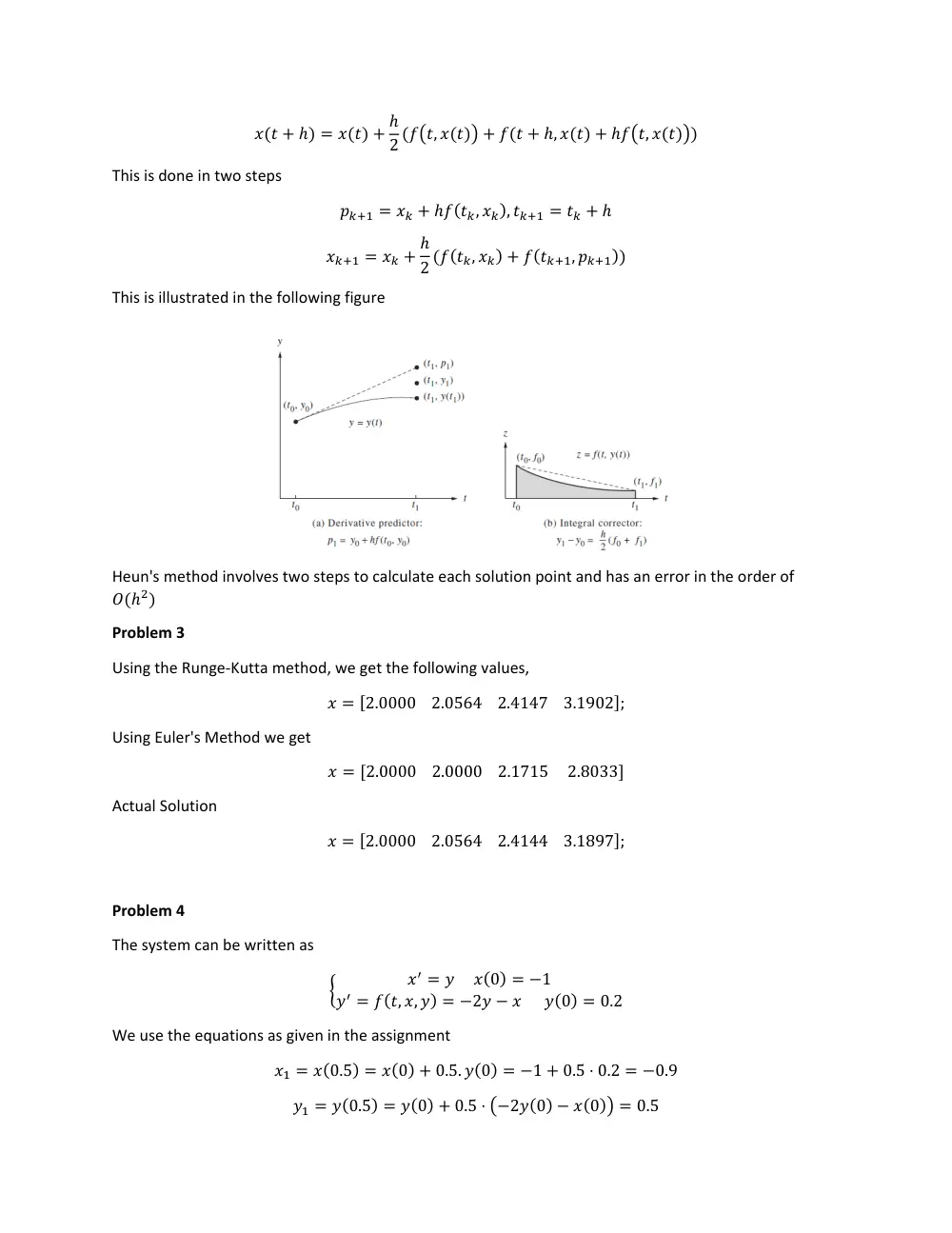
The implicit solution is found in two steps using Heun's method where we calculate x(t+h) as
𝑥(𝑡 + ℎ) = 𝑥(𝑡) + ℎ
2 (𝑓(𝑡, 𝑥(𝑡)) + 𝑓(𝑡 + ℎ, 𝑥(𝑡) + ℎ𝑓(𝑡, 𝑥(𝑡)))
This is done in two steps
𝑝𝑘+1 = 𝑥𝑘 + ℎ𝑓(𝑡𝑘, 𝑥𝑘), 𝑡𝑘+1 = 𝑡𝑘 + ℎ
𝑥𝑘+1 = 𝑥𝑘 + ℎ
2 (𝑓(𝑡𝑘, 𝑥𝑘) + 𝑓(𝑡𝑘+1, 𝑝𝑘+1))
This is illustrated in the following figure
Heun's method involves two steps to calculate each solution point and has an error in the order of
𝑂(ℎ2)
Problem 3
Using the Runge-Kutta method, we get the following values,
𝑥 = [2.0000 2.0564 2.4147 3.1902];
Using Euler's Method we get
𝑥 = [2.0000 2.0000 2.1715 2.8033]
Actual Solution
𝑥 = [2.0000 2.0564 2.4144 3.1897];
Problem 4
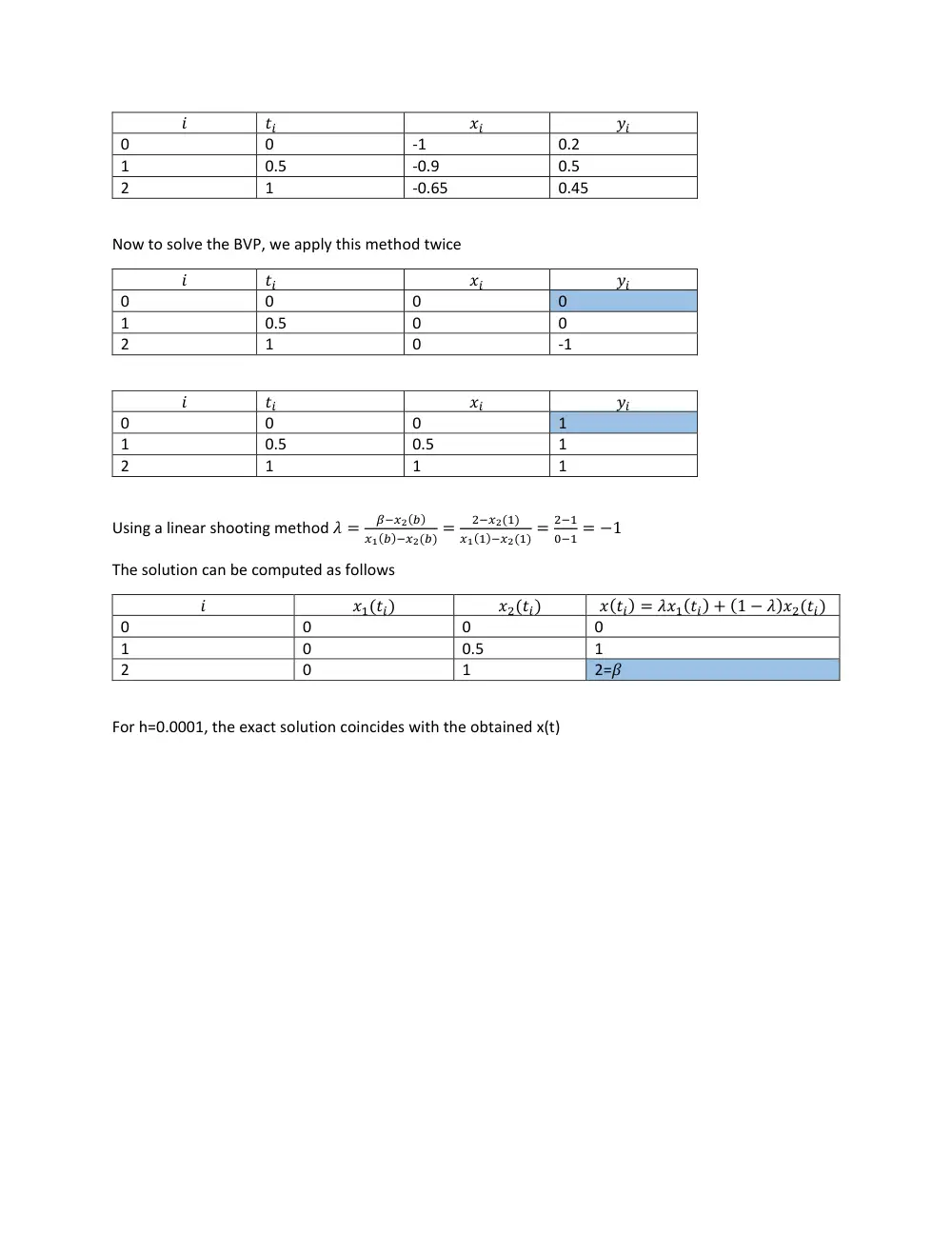
The system can be written as
{
𝑥′ = 𝑦 𝑥(0) = −1
𝑦′ = 𝑓(𝑡, 𝑥, 𝑦) = −2𝑦 − 𝑥 𝑦(0) = 0.2
We use the equations as given in the assignment
𝑥1 = 𝑥(0.5) = 𝑥(0) + 0.5. 𝑦(0) = −1 + 0.5 ⋅ 0.2 = −0.9
𝑦1 = 𝑦(0.5) = 𝑦(0) + 0.5 ⋅ (−2𝑦(0) − 𝑥(0)) = 0.5
𝑖
𝑡𝑖
𝑥𝑖
𝑦𝑖
0
0
-1
0.2
1
0.5
-0.9
0.5
2
1
-0.65
0.45
Now to solve the BVP, we apply this method twice
𝑖
𝑡𝑖
𝑥𝑖
𝑦𝑖
0
0
0
0
1
0.5
0
0
2
1
0
-1
𝑖
𝑡𝑖
𝑥𝑖
𝑦𝑖
0
0
0
1
1
0.5
0.5
1
2
1
1
1
Using a linear shooting method 𝜆 =
𝛽−𝑥2(𝑏)
𝑥1(𝑏)−𝑥2(𝑏) =
2−𝑥2(1)
𝑥1(1)−𝑥2(1) =
2−1
0−1 = −1
The solution can be computed as follows
𝑖
𝑥1(𝑡𝑖)
𝑥2(𝑡𝑖)
𝑥(𝑡𝑖) = 𝜆𝑥1(𝑡𝑖) + (1 − 𝜆)𝑥2(𝑡𝑖)
0
0
0
0
1
0
0.5
1
2
0
1
2=𝛽
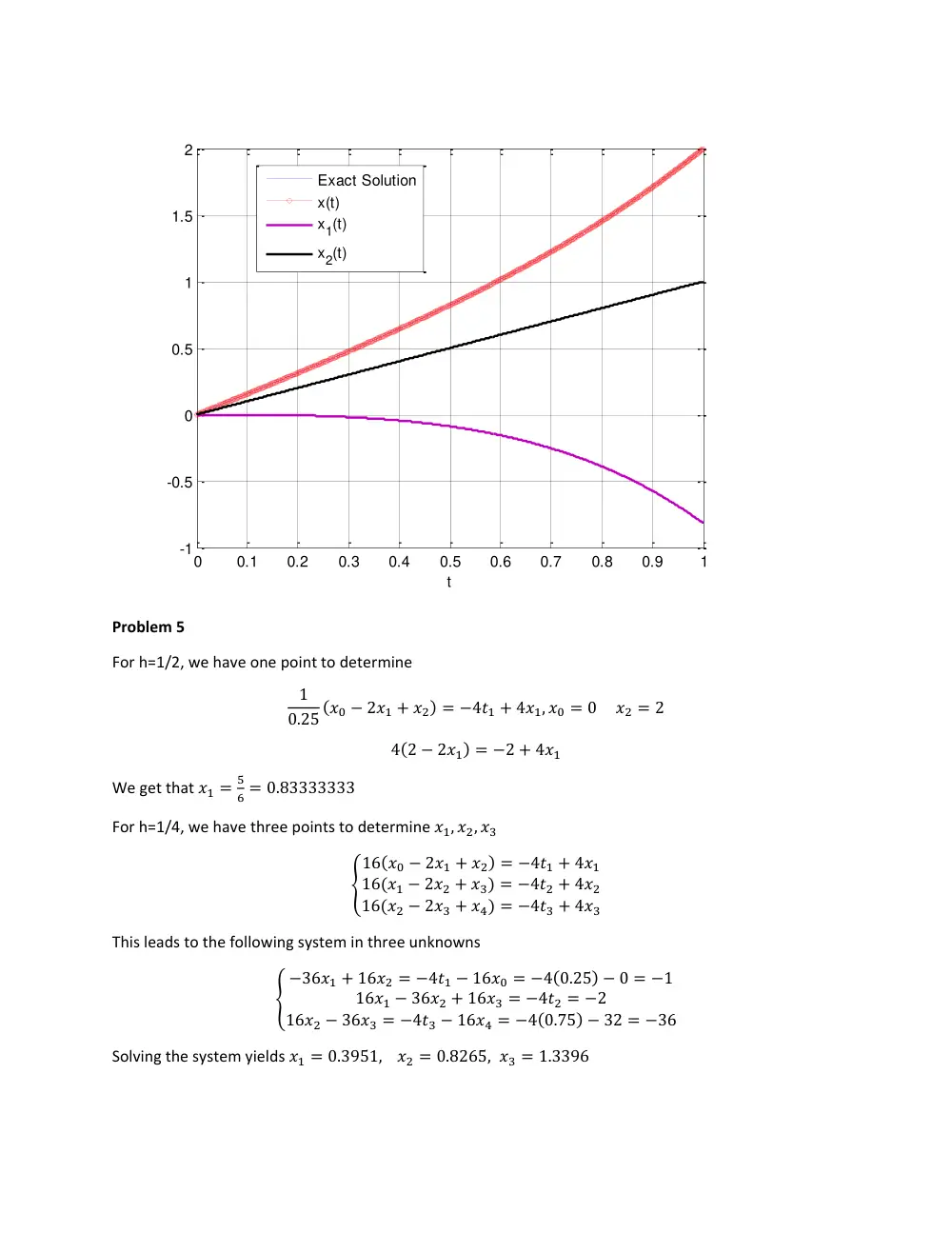
For h=0.0001, the exact solution coincides with the obtained x(t)
Problem 5
For h=1/2, we have one point to determine
1
0.25 (𝑥0 − 2𝑥1 + 𝑥2) = −4𝑡1 + 4𝑥1, 𝑥0 = 0 𝑥2 = 2
4(2 − 2𝑥1) = −2 + 4𝑥1
We get that 𝑥1 =
5
6 = 0.83333333
For h=1/4, we have three points to determine 𝑥1, 𝑥2, 𝑥3
{
16(𝑥0 − 2𝑥1 + 𝑥2) = −4𝑡1 + 4𝑥1
16(𝑥1 − 2𝑥2 + 𝑥3) = −4𝑡2 + 4𝑥2
16(𝑥2 − 2𝑥3 + 𝑥4) = −4𝑡3 + 4𝑥3
This leads to the following system in three unknowns
{
−36𝑥1 + 16𝑥2 = −4𝑡1 − 16𝑥0 = −4(0.25) − 0 = −1
16𝑥1 − 36𝑥2 + 16𝑥3 = −4𝑡2 = −2
16𝑥2 − 36𝑥3 = −4𝑡3 − 16𝑥4 = −4(0.75) − 32 = −36
Solving the system yields 𝑥1 = 0.3951, 𝑥2 = 0.8265, 𝑥3 = 1.3396
0
0.1
0.2
0.3
0.4
0.5
0.6
0.7
0.8
0.9
1
-1
-0.5
0
0.5
1
1.5
2
t
Exact Solution
x(t)
x1(t)
x2(t)
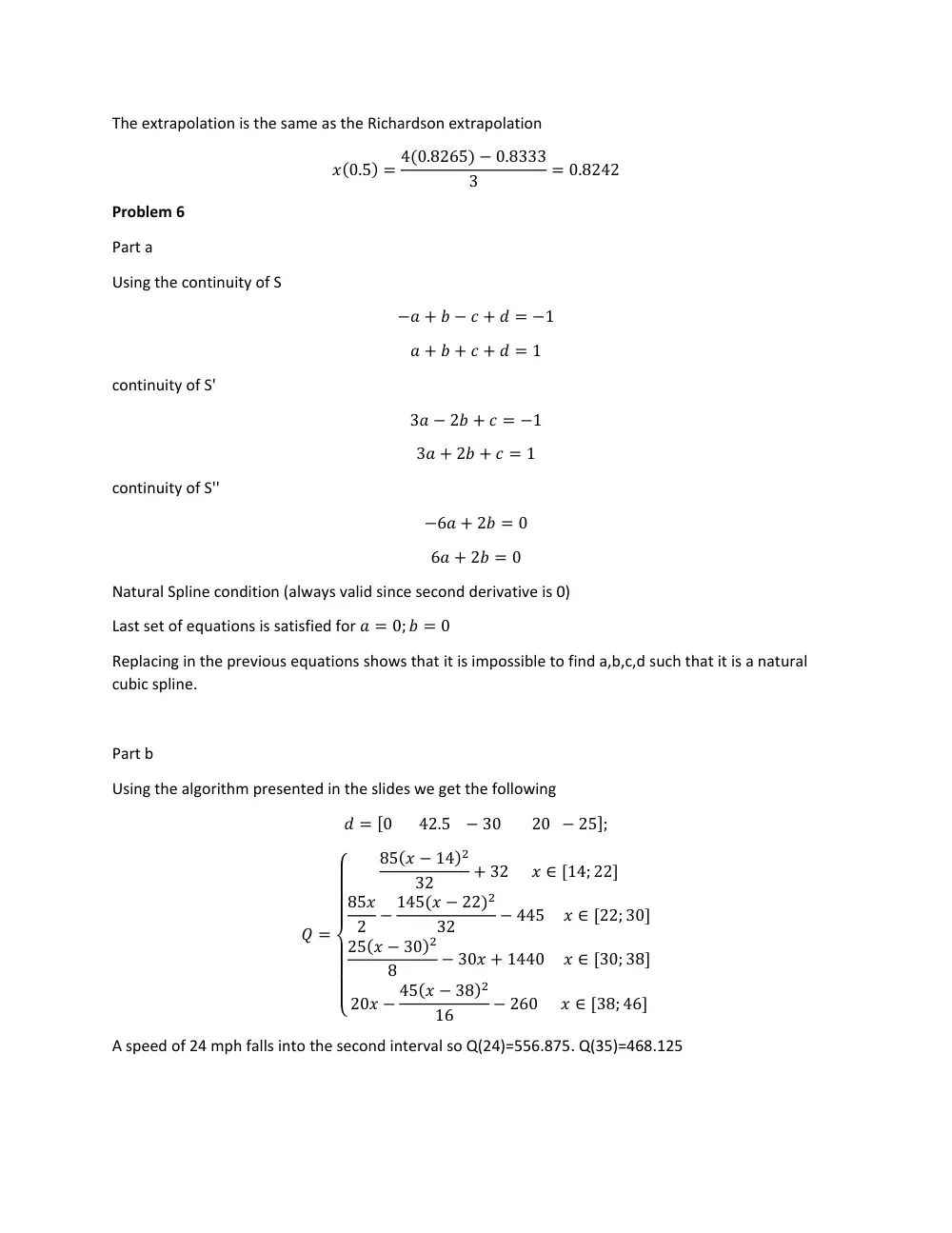
The extrapolation is the same as the Richardson extrapolation
𝑥(0.5) = 4(0.8265) − 0.8333
3
= 0.8242
Problem 6
Part a
Using the continuity of S
−𝑎 + 𝑏 − 𝑐 + 𝑑 = −1
𝑎 + 𝑏 + 𝑐 + 𝑑 = 1
continuity of S'
3𝑎 − 2𝑏 + 𝑐 = −1
3𝑎 + 2𝑏 + 𝑐 = 1
continuity of S''
−6𝑎 + 2𝑏 = 0
6𝑎 + 2𝑏 = 0
Natural Spline condition (always valid since second derivative is 0)
Last set of equations is satisfied for 𝑎 = 0; 𝑏 = 0
Replacing in the previous equations shows that it is impossible to find a,b,c,d such that it is a natural
cubic spline.
Part b
Using the algorithm presented in the slides we get the following
𝑑 = [0 42.5 − 30 20 − 25];
𝑄 =
{
85(𝑥 − 14)2
32
+ 32 𝑥 ∈ [14; 22]
85𝑥
2 − 145(𝑥 − 22)2
32
− 445 𝑥 ∈ [22; 30]
25(𝑥 − 30)2
8
− 30𝑥 + 1440 𝑥 ∈ [30; 38]
20𝑥 − 45(𝑥 − 38)2
16
− 260 𝑥 ∈ [38; 46]
A speed of 24 mph falls into the second interval so Q(24)=556.875. Q(35)=468.125