
EECE 320 Lecture 19, Fall 2011
American University of Beirut · Digital Systems Design · 8 pages · Prof. Ali Chehab
More EECE 320 files
Show the text of this lab
EECE 320 L19: Combinational Logic design Practices 1
Chehab, AUB, 2003
EECE 320
Digital Systems Design
Lecture 19:
Sequential Logic Design
Principles
Ali Chehab
EECE 320 L19: Combinational Logic design Practices 2
Chehab, AUB, 2003
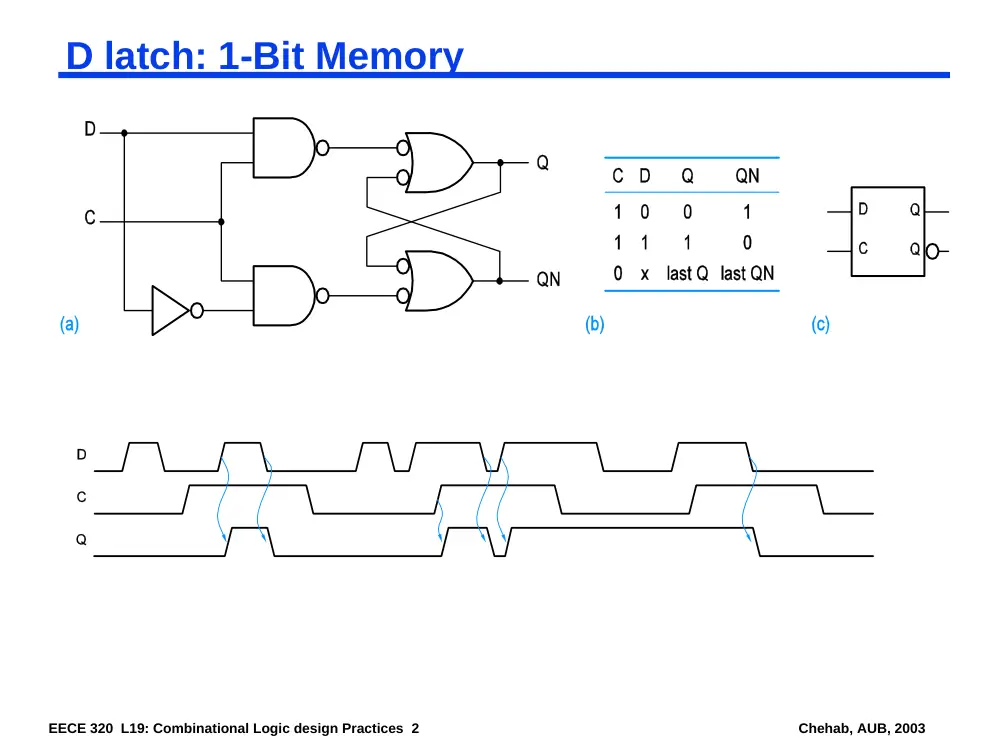
D latch: 1-Bit Memory
EECE 320 L19: Combinational Logic design Practices 3
Chehab, AUB, 2003
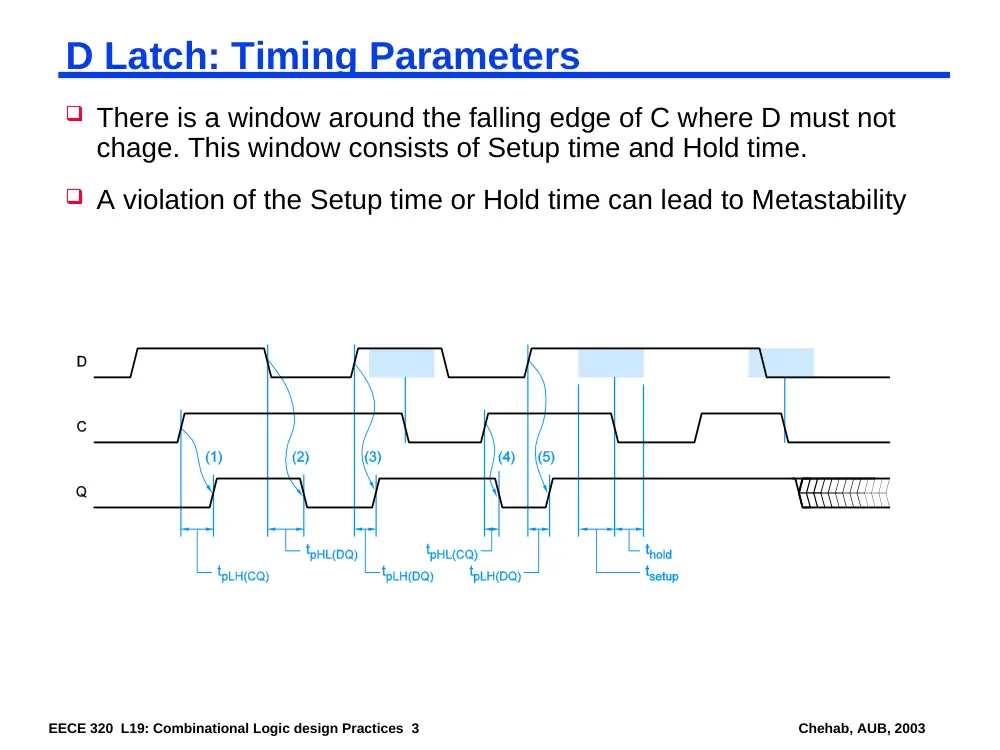
D Latch: Timing Parameters
There is a window around the falling edge of C where D must not
chage. This window consists of Setup time and Hold time.
A violation of the Setup time or Hold time can lead to Metastability
EECE 320 L19: Combinational Logic design Practices 4
Chehab, AUB, 2003
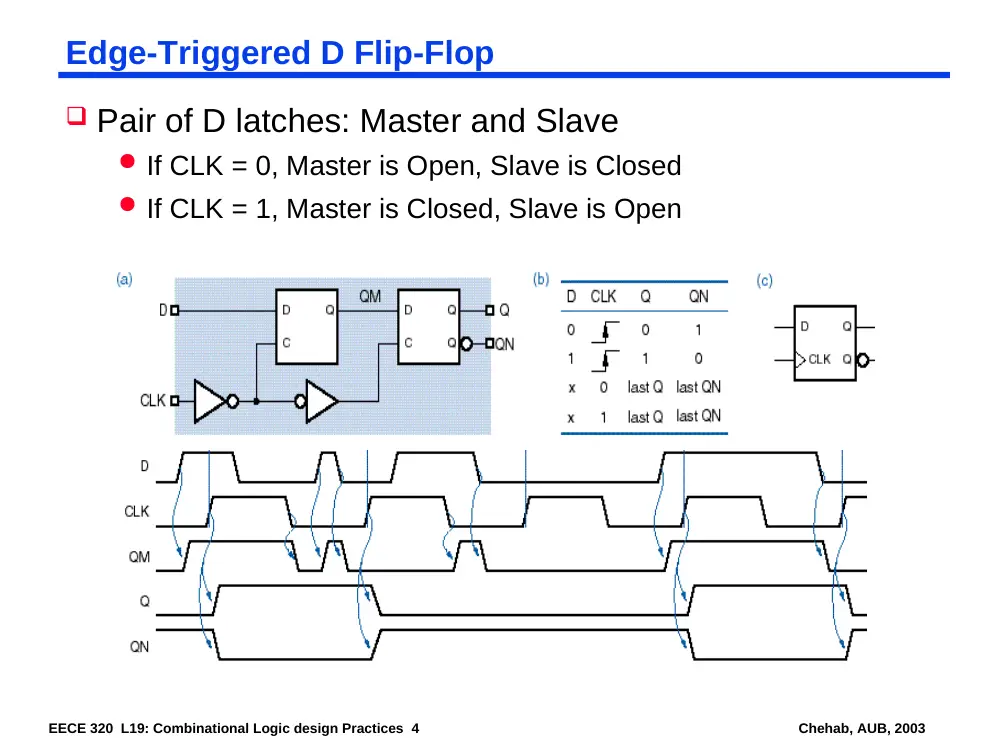
Edge-Triggered D Flip-Flop
Pair of D latches: Master and Slave
If CLK = 0, Master is Open, Slave is Closed
If CLK = 1, Master is Closed, Slave is Open
EECE 320 L19: Combinational Logic design Practices 5
Chehab, AUB, 2003
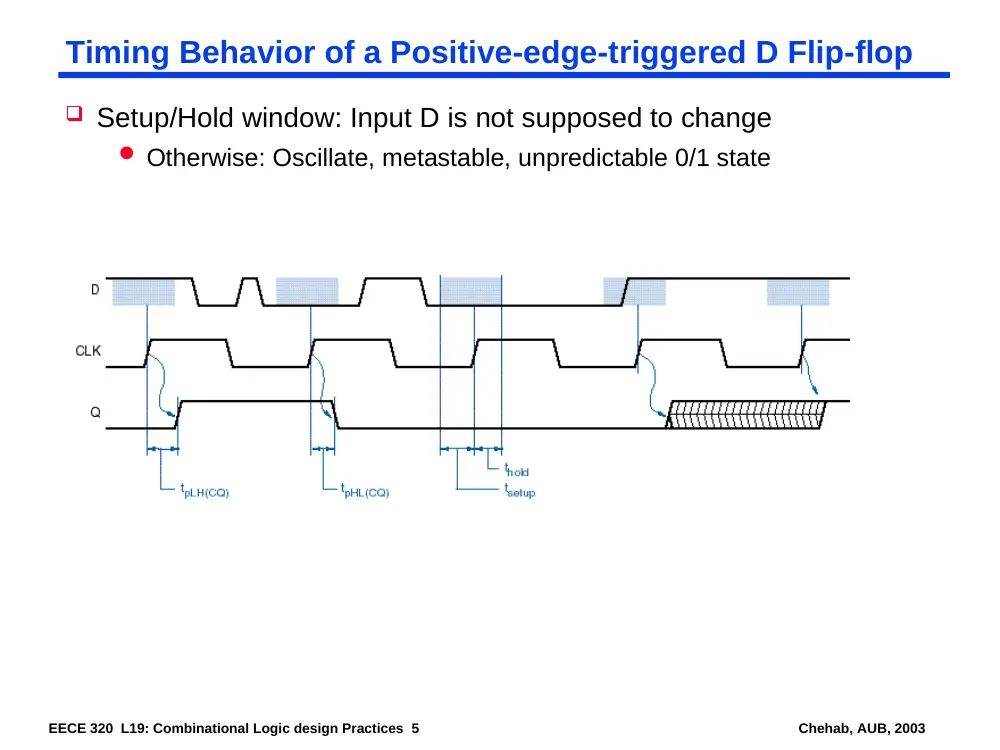
Timing Behavior of a Positive-edge-triggered D Flip-flop
Setup/Hold window: Input D is not supposed to change
Otherwise: Oscillate, metastable, unpredictable 0/1 state
EECE 320 L19: Combinational Logic design Practices 6
Chehab, AUB, 2003
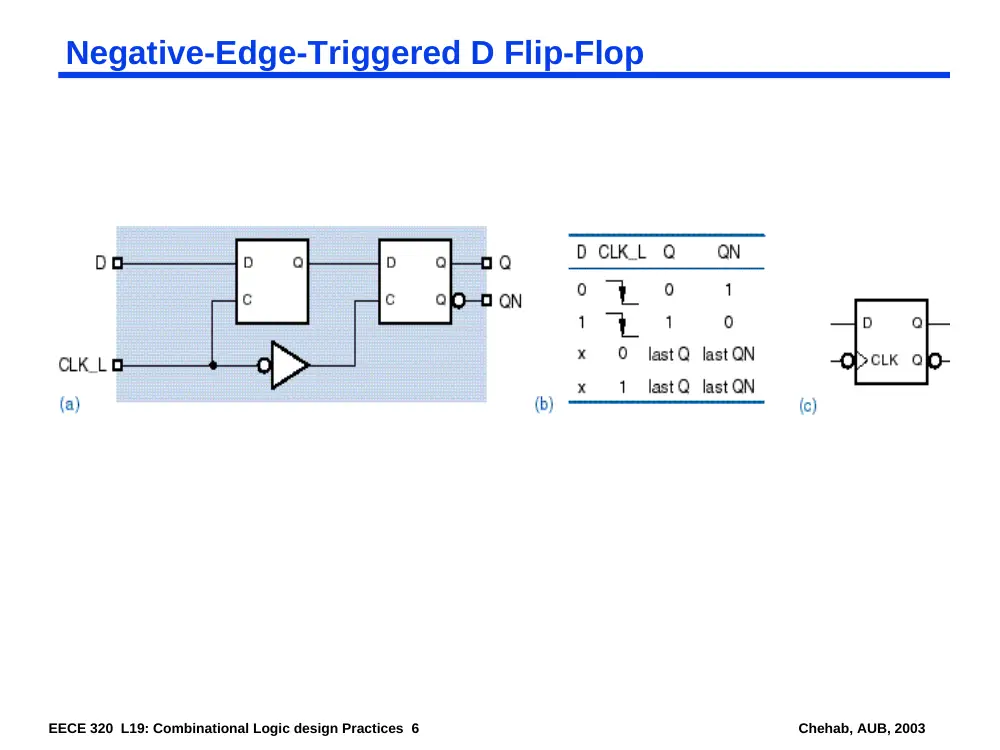
Negative-Edge-Triggered D Flip-Flop
EECE 320 L19: Combinational Logic design Practices 7
Chehab, AUB, 2003
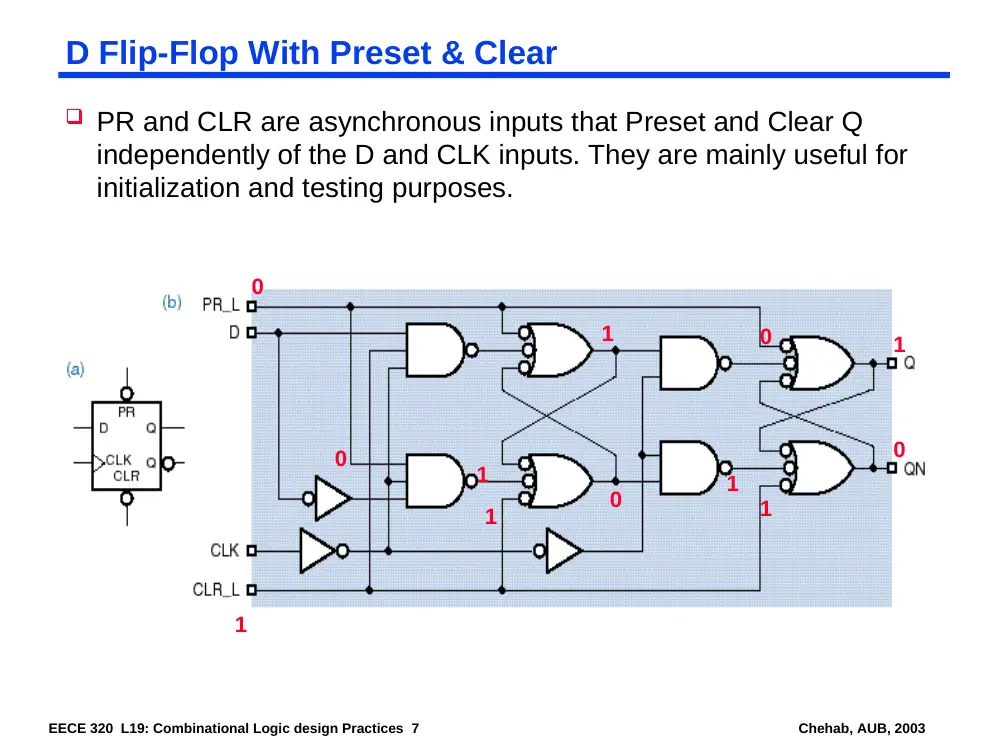
D Flip-Flop With Preset & Clear
PR and CLR are asynchronous inputs that Preset and Clear Q
independently of the D and CLK inputs. They are mainly useful for
initialization and testing purposes.
0
1
0
1
0
1
1
1
0
1
1
0
EECE 320 L19: Combinational Logic design Practices 8
Chehab, AUB, 2003
Next Lecture and Reminders
Next lecture
Reminders