
EECE 320 Lecture 2, Fall 2011
American University of Beirut · Digital Systems Design · 21 pages · Prof. Ali Chehab



Showing the first 10 of 21 pages. Download the PDF to see all of it.
More EECE 320 files
Show the text of this lab
EECE 320 L2: Number Systems and Codes 1
Chehab, AUB, 2003
EECE 320
Digital Systems Design
Lecture 2:
Number Systems and
Codes
Ali Chehab
EECE 320 L2: Number Systems and Codes 2
Chehab, AUB, 2003
Number Systems and Codes
A digital designer must establish a correspondence
between binary digits and real-life numbers, events and
conditions
EECE 320 L2: Number Systems and Codes 3
Chehab, AUB, 2003
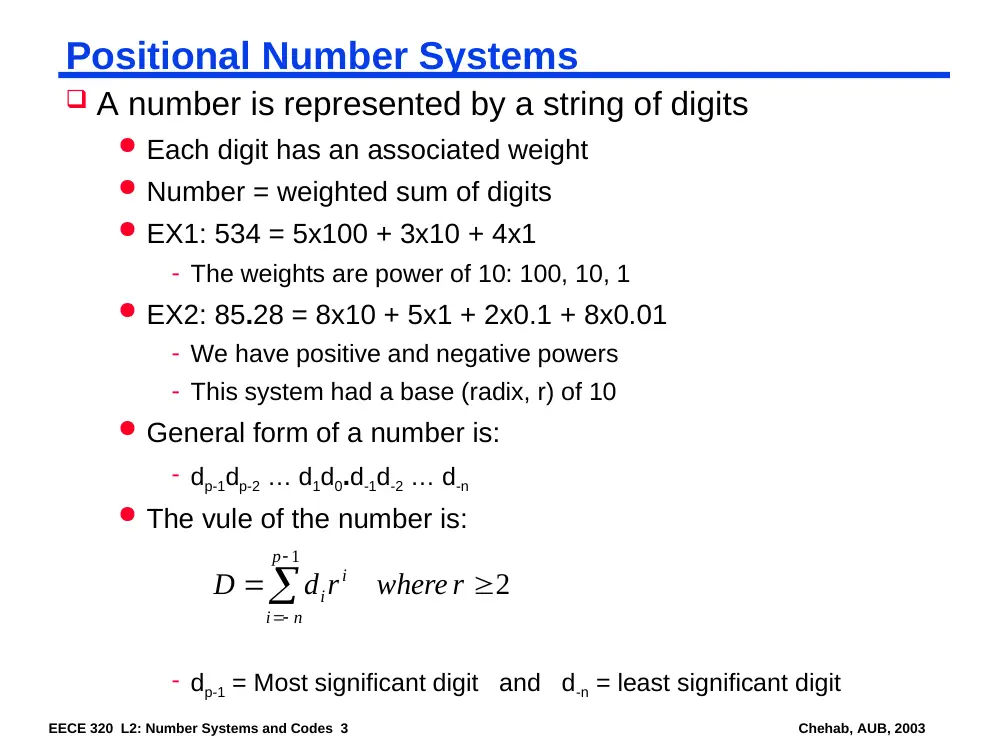
Positional Number Systems
A number is represented by a string of digits
Each digit has an associated weight
Number = weighted sum of digits
EX1: 534 = 5x100 + 3x10 + 4x1
- The weights are power of 10: 100, 10, 1
EX2: 85.28 = 8x10 + 5x1 + 2x0.1 + 8x0.01
- We have positive and negative powers
- This system had a base (radix, r) of 10
General form of a number is:
- dp-1dp-2 … d1d0.d-1d-2 … d-n
The vule of the number is:
- dp-1 = Most significant digit and d-n = least significant digit
1
2
p
n
i
i
i
where r
d r
D
EECE 320 L2: Number Systems and Codes 4
Chehab, AUB, 2003
Positional Number Systems
Binary: radix = 2
Used to represent numbers in a digital system
Reliable since only 2 values need to be distinguished
EX: 110.01 = 1x4 + 1x2 + 0x1 + 0x0.5 + 1x0.25 = 6.2510
In general the value is given by:
Octal and Hexadecimal represent a shorthand notation
for the binary system
•
Octal (Base 8): { 0, 1, 2, 3, 4, 5, 6, 7 }
– Example: 576 = 6*80 + 7*81 + 5*82 = 38210
•
Hexadecimal (Base 16): { 0, …, 9, A, B, C, D, E, F }
– Example: A2F = F*160 + 2*161 + A*162
= 15*160 + 2*161 + 10*162 = 260710
1
2
p
n
i
i
ib
B
EECE 320 L2: Number Systems and Codes 5
Chehab, AUB, 2003
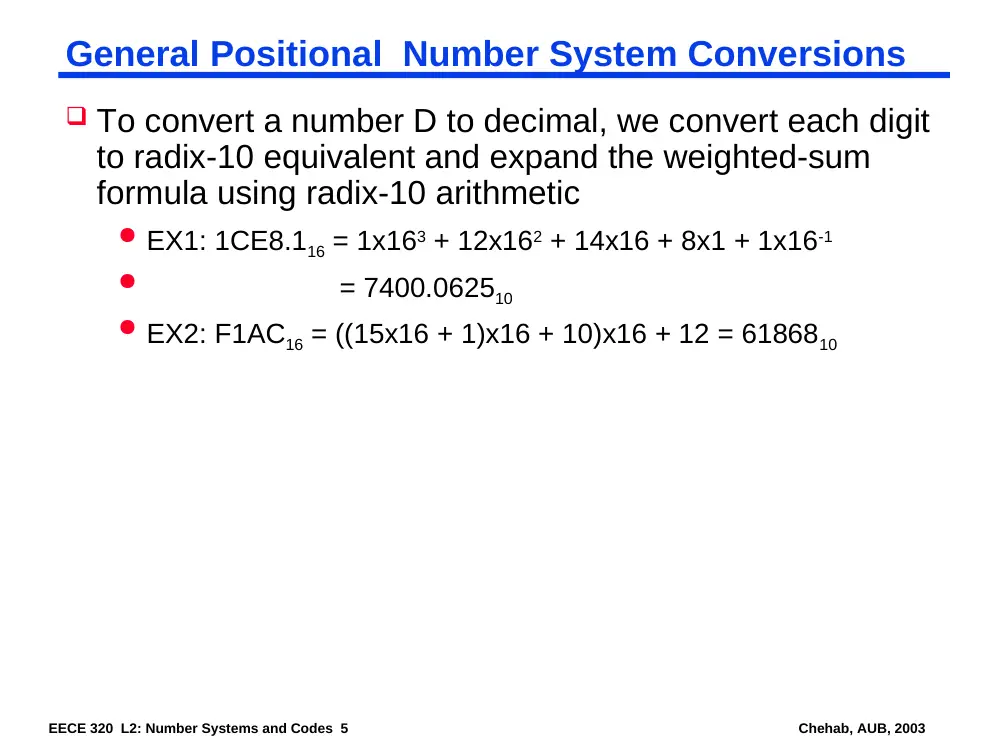
General Positional Number System Conversions
To convert a number D to decimal, we convert each digit
to radix-10 equivalent and expand the weighted-sum
formula using radix-10 arithmetic
EX1: 1CE8.116 = 1x163 + 12x162 + 14x16 + 8x1 + 1x16-1
= 7400.062510
EX2: F1AC16 = ((15x16 + 1)x16 + 10)x16 + 12 = 6186810
EECE 320 L2: Number Systems and Codes 6
Chehab, AUB, 2003
General Positional Number System Conversions
Decimal to Binary: It is done by successive divisions until
a zero quotient is obtained. The remainders taken in
reverse order constitute the binary representation
Example: Convert 46 Decimal into Binary
46 / 2 = 23 and Remainder = 0
23 / 2 = 11 and Remainder = 1
11 / 2 = 5 and Remainder = 1
5 / 2 = 2 and Remainder = 1
2 / 2 = 1 and Remainder = 0
1 / 2 = 0 and Remainder = 1
Result: 4610 = 1011102
EECE 320 L2: Number Systems and Codes 7
Chehab, AUB, 2003
General Positional Number System Conversions
Decimal fraction to binary: It is done by successive
multiplications taking out each time the integer part of the
result.
Example: convert 0.3125 to binary
0.3125 x 2 = 0.625 0
0.625 x 2 = 1.25 1
0.25 x 2 = 0.5 0
0.5 x 2 = 1 1
0.312510 = 01012
EECE 320 L2: Number Systems and Codes 8
Chehab, AUB, 2003
General Positional Number System Conversions
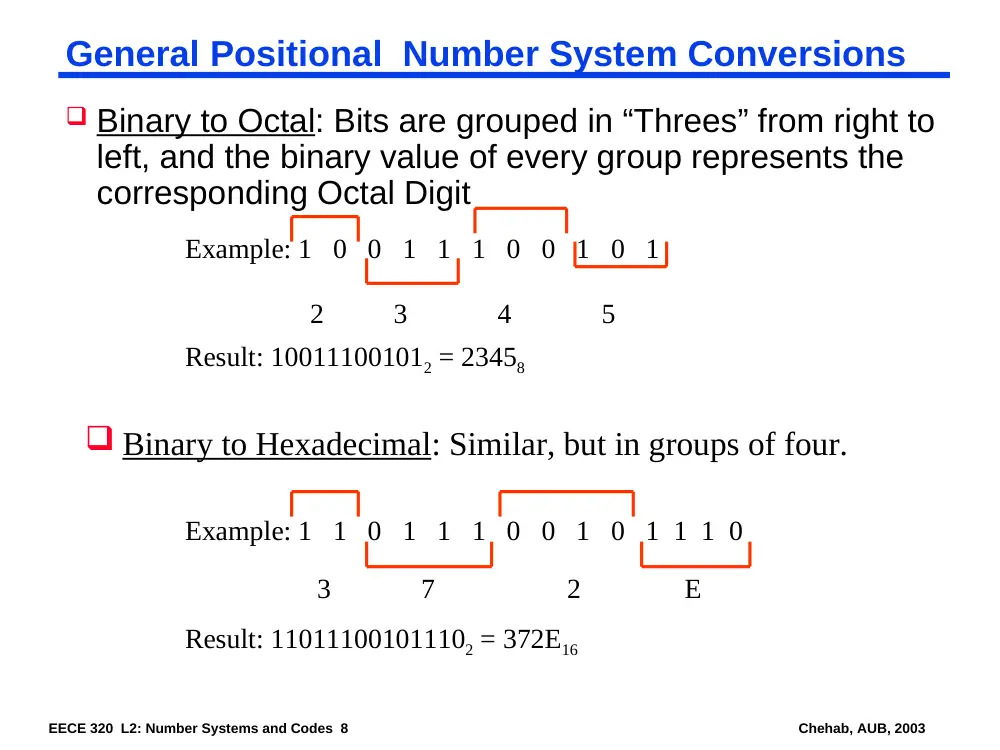
Binary to Octal: Bits are grouped in “Threes” from right to
left, and the binary value of every group represents the
corresponding Octal Digit
Example: 1 0 0 1 1 1 0 0 1 0 1
2 3 4 5
Result: 100111001012 = 23458
Example: 1 1 0 1 1 1 0 0 1 0 1 1 1 0
3 7 2 E
Result: 110111001011102 = 372E16
Binary to Hexadecimal: Similar, but in groups of four.
EECE 320 L2: Number Systems and Codes 9
Chehab, AUB, 2003
Addition and Subtraction of Binary Numbers
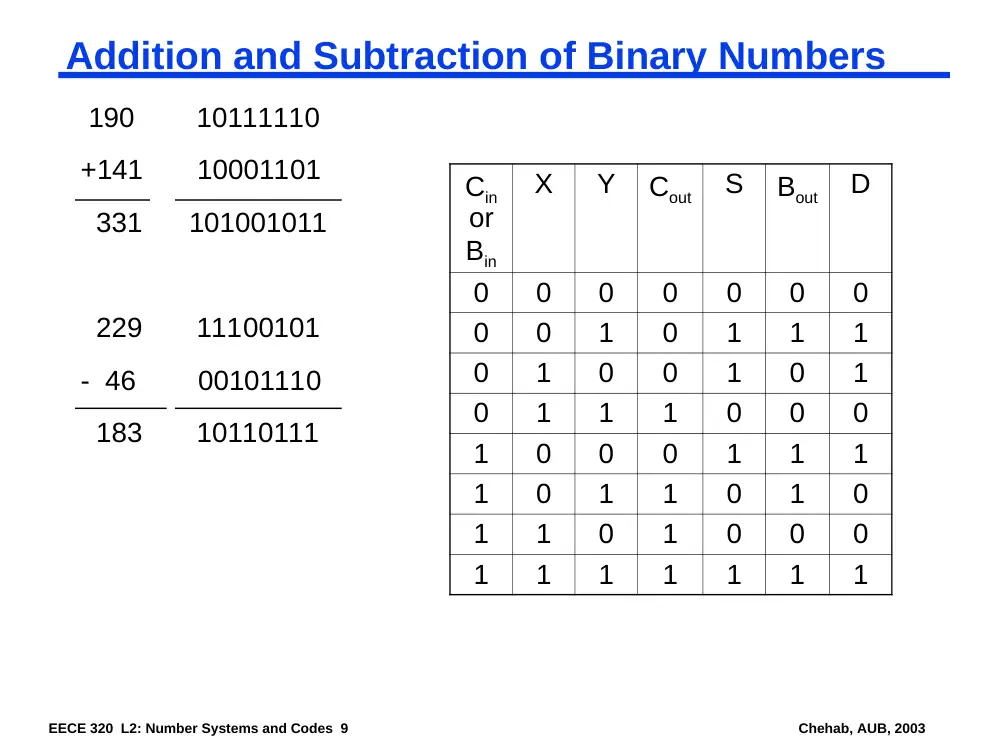
190 10111110
+141 10001101
331 101001011
229 11100101
- 46 00101110
183 10110111
Cin
or
Bin
X
Y
Cout
S
Bout
D
0
0
0
0
0
0
0
0
0
1
0
1
1
1
0
1
0
0
1
0
1
0
1
1
1
0
0
0
1
0
0
0
1
1
1
1
0
1
1
0
1
0
1
1
0
1
0
0
0
1
1
1
1
1
1
1
EECE 320 L2: Number Systems and Codes 10
Chehab, AUB, 2003
Representation of Negative Numbers
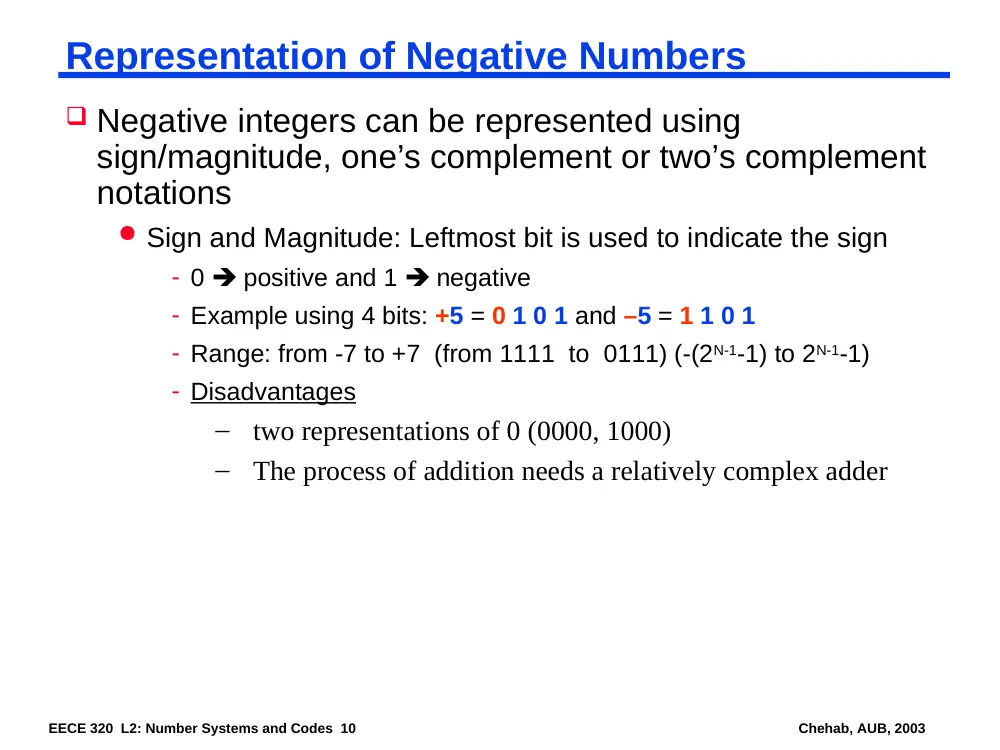
Negative integers can be represented using
sign/magnitude, one’s complement or two’s complement
notations
Sign and Magnitude: Leftmost bit is used to indicate the sign
- 0 positive and 1 negative
- Example using 4 bits: +5 = 0 1 0 1 and –5 = 1 1 0 1
- Range: from -7 to +7 (from 1111 to 0111) (-(2N-1-1) to 2N-1-1)
- Disadvantages
–
two representations of 0 (0000, 1000)
–
The process of addition needs a relatively complex adder
EECE 320 L2: Number Systems and Codes 11
Chehab, AUB, 2003
Complements
Complements are used in digital systems to negate a number and to
simplify the subtraction operation.
Two types of complements for any base-r system:
Radix complement: called r’s complement
Diminished radix complement: called (r-1)’s complement
In base ten: 10’s complement, 9’s complement
In base 2: 2’s complement, 1’s complement
Diminished radix: Given a number N in base r having n digits, the
(r-1)’s complement is defined as follows:
EECE 320 L2: Number Systems and Codes 12
Chehab, AUB, 2003
Complements
EX: r=10, what is 10n?
It is a single ‘1’ followed by n 0s. EX: 104 = 1,0000(ten)
EX: r=10, what is 10n - 1?
It is n 9s. 104 -1 = 9999
EX: What is 9’s complement of 546700?
EX: r=2, what is 24? 10000
EX: r=2, what is 24-1? 1111
1’s complement: subtract each digit from 1. But 1-0=1, 1-1=0 => to
get 1’s complement of a number, flip all its digits.
EECE 320 L2: Number Systems and Codes 13
Chehab, AUB, 2003
Complements
Radix complement: Given a number N in base r having n digits, the r
’s complement is defined as follows:
Since
r’s complement is obtained by taking (r-1)’s complement and adding 1.
EX: 2’s complement of 101100 is
010011 + 1 = 010100
EX: 10’s complement of 012398 is
987601 + 1 = 987602
EECE 320 L2: Number Systems and Codes 14
Chehab, AUB, 2003
Complements
Short cuts:
10’s complement: leave all least significant 0s unchanged,
subtract first nonzero least significant digit from 10, and subtract
all higher significant digits from 9.
2’s complement: leave all least significant 0s unchanged, leave
the first 1 unchanged, flip all other higher significant digits.
What is the r’s complement of the r’s complement of a
number?
EECE 320 L2: Number Systems and Codes 15
Chehab, AUB, 2003
Representation of Negative Numbers
Two’s Complement: A negative # is represented by complementing
each bit of the corresponding positive # and adding 1.
MSB has a weight of -2N-1 instead of 2N-1
A negative number has MSB = 1
Example using 8 bits: +9 = 0 0 0 0 1 0 0 1
-9 = 1 1 1 1 0 1 1 1
Range is from –128 to +127 (10000000 to 01111111)
For N bits, the range is: -(2N-1) to +(2N-1-1)
Overflow and underflow occur when result is outside the range
1 representation of 0. Using 4 bits: 0000
Addition can be easily carried out: A carry will be ignored.
- Example: to add –1 and –2 using 4 bits: 1 1 1 1
1 1 1 0
----------
Ignored 1 1 1 0 1 = -3
EECE 320 L2: Number Systems and Codes 16
Chehab, AUB, 2003
Representation of Negative Numbers
+7
+6
+5
+4
+3
+2
+1
+0
-0
-1
-2
-3
-4
-5
-6
-7
-8
EECE 320 L2: Number Systems and Codes 17
Chehab, AUB, 2003
2’s Complement Addition: Overflow
An overflow is said to occur if the result of the addition exceeds the
range.
Addition of 2 numbers with different signs cannot produce an
overflow
Examples
-3 1101 +5 0101
+ -6 1010 + +6 0110
---- -------- ----- -------
-9 1 0111 = +7 +11 1011 = -5
A simple rule to detect overflow is to check if the sign of the result is
different from the sign of the addends.
EECE 320 L2: Number Systems and Codes 18
Chehab, AUB, 2003
Subtraction Rules
Most subtraction circuits for 2’s complement numbers do not perform
subtraction. Instead, we take the two’s complement of the
subtrahend and add the 2 numbers: A – B = A + (-B)
We can complement bit by bit the subtrahend, added to the minuend
and add a carry of 1
Examples
1 Cin 1 Cin
+4 0100 0100 +3 0011 0011
- +3 - 0011 + 1100 - +4 - 0100 + 1011
---- -------- ------ ----- ------- ------
+1 1 0001 -1 1111
We can use the same rules of addition to detect overflow
We can subtract -8 as long as the result does not overflow
(-3) – (-8) = (1101) – (1000) = (1101) + (0111) + 1 = 1 0101 = +5
EECE 320 L2: Number Systems and Codes 19
Chehab, AUB, 2003
Binary Codes for decimal Numbers
Some digital devices process decimal numbers
The interface of a digital system may read or display decimal #s
A decimal number is represented by a string of at least 4 bits
EECE 320 L2: Number Systems and Codes 20
Chehab, AUB, 2003
Binary Codes for decimal Numbers
Gray Code
Only 1 bit changes between each pair of consecutive codewords
It is a reflective code
- For a 1 bit code 0 and 1
- For (N+1)-bit code, the first 2N are the same of N-bit code with a leading
zero
- The last 2N codewords are the reverse of N-bit code with a leading 1
EECE 320 L2: Number Systems and Codes 21
Chehab, AUB, 2003
Next Lecture and Reminders
Next lecture
Reminders