
EECE 320 Lecture 3, Fall 2011
American University of Beirut · Digital Systems Design · 12 pages · Prof. Ali Chehab



Showing the first 10 of 12 pages. Download the PDF to see all of it.
More EECE 320 files
Show the text of this lab
EECE 320 L3: Combinational Logic design Principles 1
Chehab, AUB, 2003
EECE 320
Digital Systems Design
Lecture 3:
Combinational Logic Design
Principles
Ali Chehab
EECE 320 L3: Combinational Logic design Principles 2
Chehab, AUB, 2003
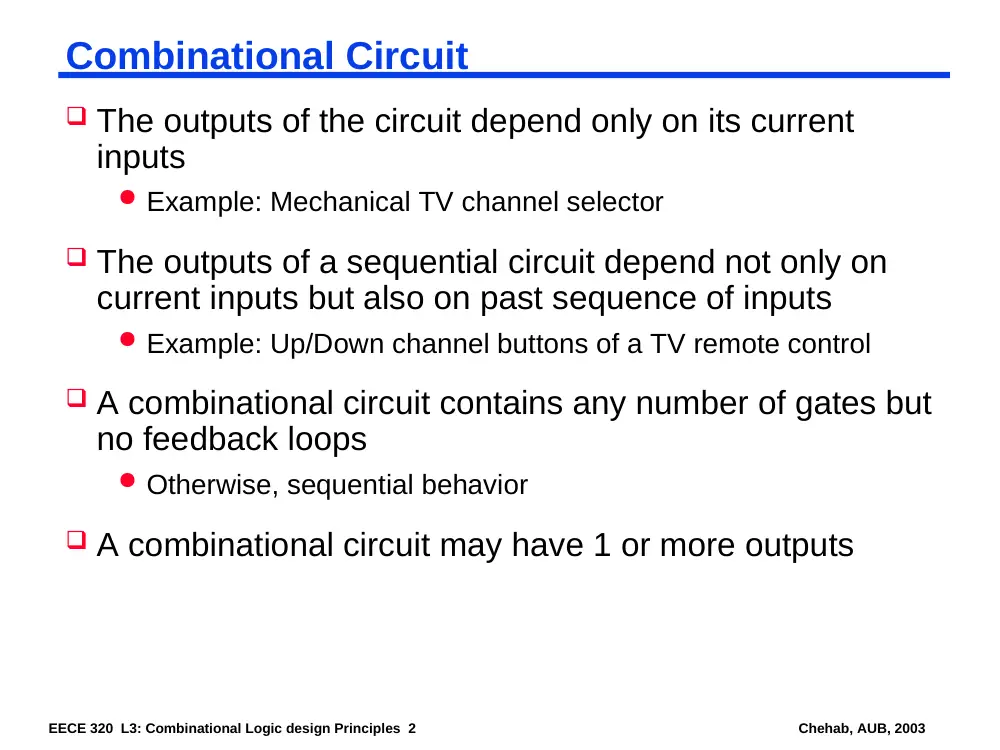
Combinational Circuit
The outputs of the circuit depend only on its current
inputs
Example: Mechanical TV channel selector
The outputs of a sequential circuit depend not only on
current inputs but also on past sequence of inputs
Example: Up/Down channel buttons of a TV remote control
A combinational circuit contains any number of gates but
no feedback loops
Otherwise, sequential behavior
A combinational circuit may have 1 or more outputs
EECE 320 L3: Combinational Logic design Principles 3
Chehab, AUB, 2003
Switching Algebra (Boolean)
Axioms (definitions that are assumed to be true)
A variable X can take 1 of 2 values
(A1) X = 0 if X 1
(A1’) X = 1 if X 0
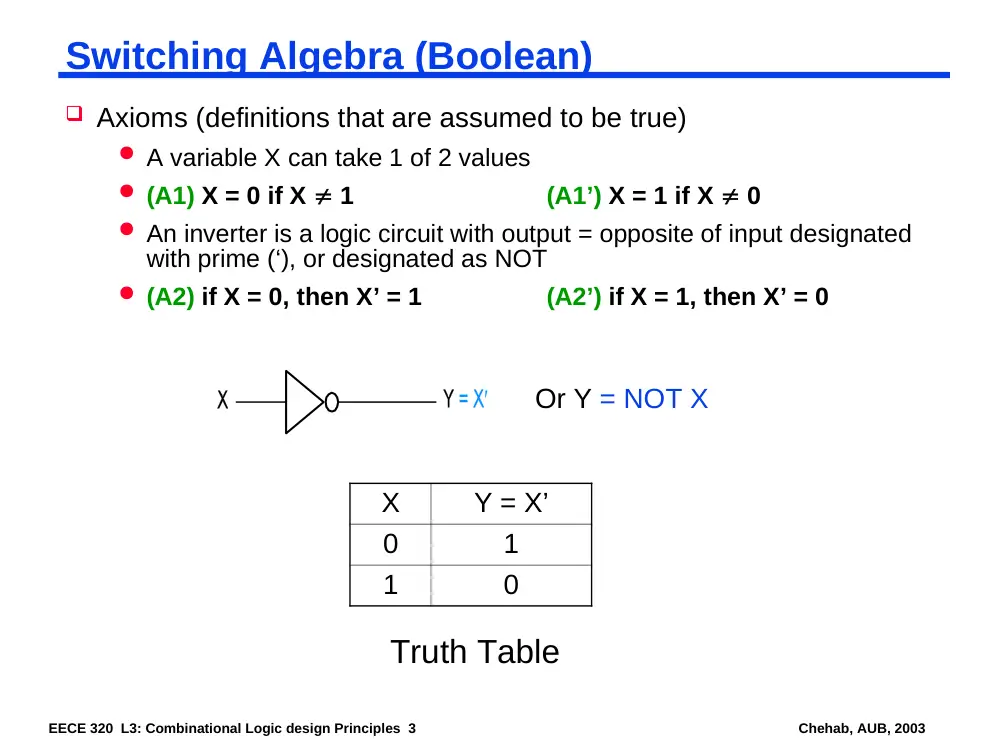
An inverter is a logic circuit with output = opposite of input designated
with prime (‘), or designated as NOT
(A2) if X = 0, then X’ = 1
(A2’) if X = 1, then X’ = 0
X
Y = X’
0
1
1
0
Truth Table
Or Y = NOT X
EECE 320 L3: Combinational Logic design Principles 4
Chehab, AUB, 2003
Switching Algebra (Boolean)
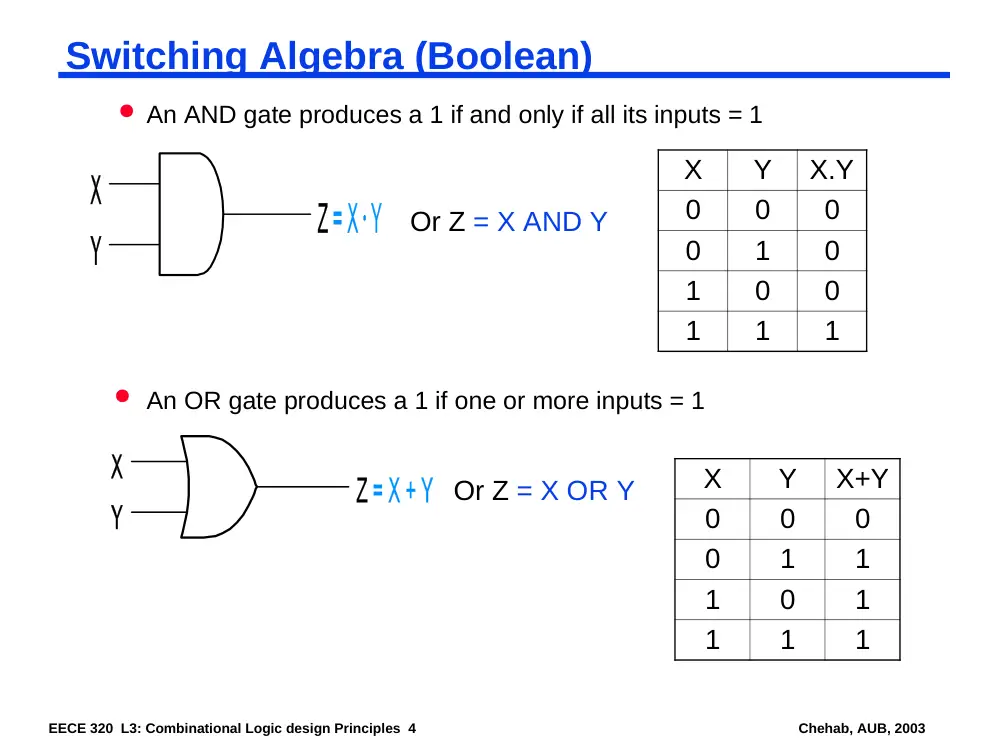
An AND gate produces a 1 if and only if all its inputs = 1
Or Z = X AND Y
X
Y
X.Y
0
0
0
0
1
0
1
0
0
1
1
1
An OR gate produces a 1 if one or more inputs = 1
Or Z = X OR Y
X
Y
X+Y
0
0
0
0
1
1
1
0
1
1
1
1
EECE 320 L3: Combinational Logic design Principles 5
Chehab, AUB, 2003
Switching Algebra (Boolean)
A NAND gate produces a 0 if and only if all its inputs = 1
X
Y
(X.Y)’
0
0
1
0
1
1
1
0
1
1
1
0
A NOR gate produces a 0 if one or more inputs = 1
X
Y
(X+Y)’
0
0
1
0
1
0
1
0
0
1
1
0
Z = X NAND Y
Z = X NOR Y
EECE 320 L3: Combinational Logic design Principles 6
Chehab, AUB, 2003
Switching Algebra (Boolean)
(A3) 0.0 = 0
(A3’) 1 + 1 = 1
(A4) 1.1 = 1
(A4’) 0 + 0 = 0
(A5) 0.1 = 1.0 = 0
(A5’) 1 + 0 = 0 + 1 = 1
All other facts of switching algebra can be proven using
(A1) -(A5) and (A1’) – (A5’)
EECE 320 L3: Combinational Logic design Principles 7
Chehab, AUB, 2003
Switching Algebra (Boolean)
Single Variable Theorems
(T1) X + 0 = X
(T1’) X . 1 = X
(Identities)
(T2) X + 1 = 1
(T2’) X . 0 = 0
(Null elements)
(T3) X + X = X
(T3’) X . X = X
(Idempotency)
(T4) (X’)’ = X
(Involution)
(T5) X + X’ = 1
(T5’) X . X’ = 0 (Complements)
We can prove them by perfect induction Prove them
to be true for X=0 and for X=1
EX: (T1)
If X = 0 0 + 0 = 0 = X
If X = 1 1 + 0 = 1 = X
EECE 320 L3: Combinational Logic design Principles 8
Chehab, AUB, 2003
Switching Algebra (Boolean)
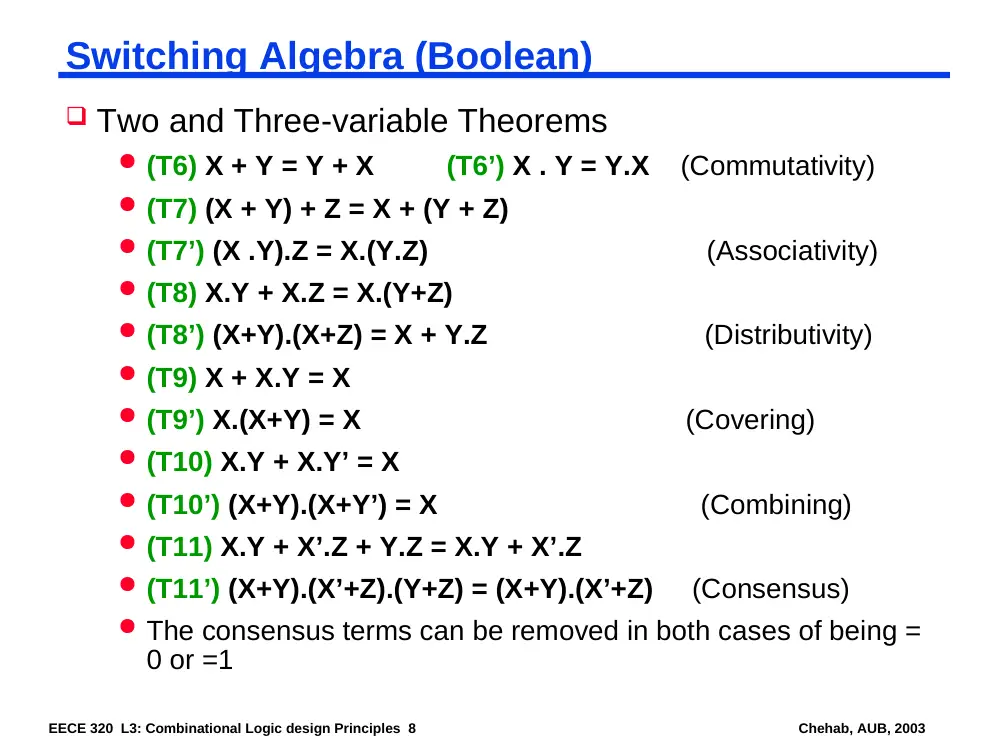
Two and Three-variable Theorems
(T6) X + Y = Y + X
(T6’) X . Y = Y.X (Commutativity)
(T7) (X + Y) + Z = X + (Y + Z)
(T7’) (X .Y).Z = X.(Y.Z) (Associativity)
(T8) X.Y + X.Z = X.(Y+Z)
(T8’) (X+Y).(X+Z) = X + Y.Z (Distributivity)
(T9) X + X.Y = X
(T9’) X.(X+Y) = X
(Covering)
(T10) X.Y + X.Y’ = X
(T10’) (X+Y).(X+Y’) = X (Combining)
(T11) X.Y + X’.Z + Y.Z = X.Y + X’.Z
(T11’) (X+Y).(X’+Z).(Y+Z) = (X+Y).(X’+Z) (Consensus)
The consensus terms can be removed in both cases of being =
0 or =1
EECE 320 L3: Combinational Logic design Principles 9
Chehab, AUB, 2003
Switching Algebra (Boolean)
N-variable Theorems
Can be proven by finite induction
- True for N=2
- If true for i, prove for i+1
(T12) X+X+ … +X = X
(T12’) X.X. … .X = X (Generalized Idempotency)
(T13) (X1.X2. … .XN)’ = X1’+X2’+ … +XN’
(T13’) (X1+X2+ … +XN)’ = X1’.X2’. … .XN’ (De Morgan)
EECE 320 L3: Combinational Logic design Principles 10
Chehab, AUB, 2003
Switching Algebra (Boolean)
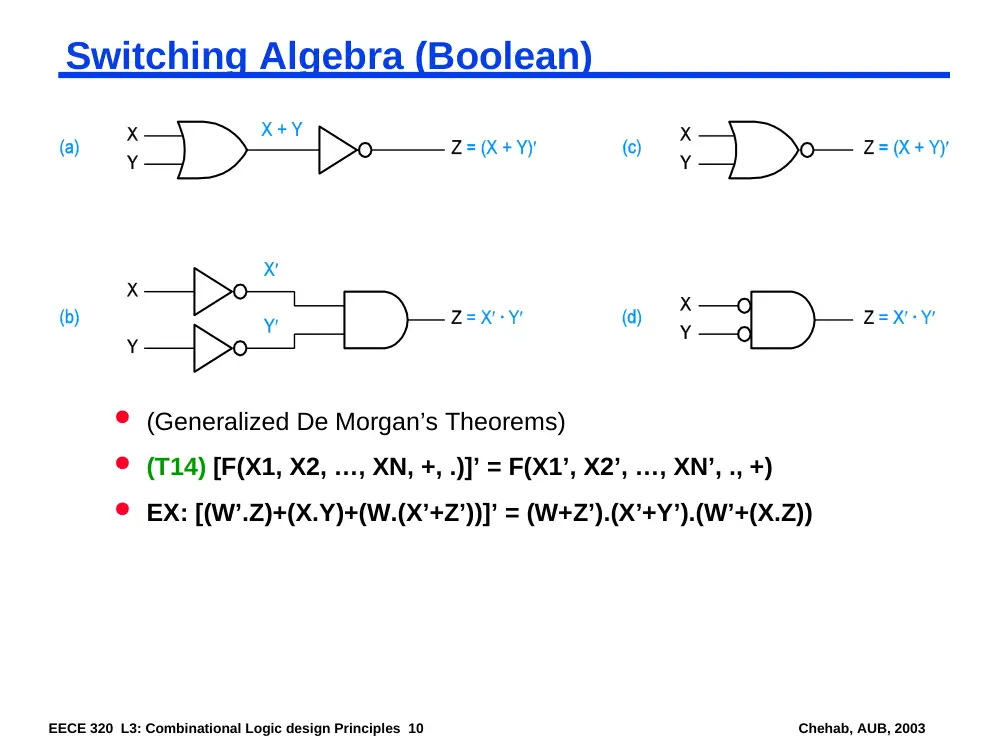
(Generalized De Morgan’s Theorems)
(T14) [F(X1, X2, …, XN, +, .)]’ = F(X1’, X2’, …, XN’, ., +)
EX: [(W’.Z)+(X.Y)+(W.(X’+Z’))]’ = (W+Z’).(X’+Y’).(W’+(X.Z))
EECE 320 L3: Combinational Logic design Principles 11
Chehab, AUB, 2003
Switching Algebra (Boolean)
(Shanon Expansions Theorems)
(T15) F(X1, X2, …, XN) = X1. F(1, X2, …, XN) + X1’. F(0, X2, …, XN)
(T15’) F(X1, X2, …, XN) = [X1+F(0, X2, …, XN)].[X1’+F(1, X2, …, XN)]
Shanon is useful when trying to do implementations with muxes
Example: F(X,Y,Z) = XYZ’ + Y.(X+Z)+X’Y’Z’
F(1,Y,Z) = YZ’+Y=Y, F(0,Y,Z) = YZ+Y’Z’
=> F(X,Y,Z) = XY + X’(YZ+Y’Z’)
F(1,X2,..,XN)
F(0,X2,..,XN)
X1 (select)
F(X1,X2,..,XN)
EECE 320 L3: Combinational Logic design Principles 12
Chehab, AUB, 2003
Next Lecture and Reminders
Next lecture
Reminders