
EECE 320 Lecture 4, Fall 2011
American University of Beirut · Digital Systems Design · 15 pages · Prof. Ali Chehab


Showing the first 10 of 15 pages. Download the PDF to see all of it.
More EECE 320 files
Show the text of this lab
EECE 320 L4: Combinational Logic design Principles 1
Chehab, AUB, 2003
EECE 320
Digital Systems Design
Lecture 4:
Combinational Logic Design
Principles
Ali Chehab
EECE 320 L4: Combinational Logic design Principles 2
Chehab, AUB, 2003
Duality Principle
Any theorem or identity in switching algebra remains true
if the following is done:
(0 and 1) are swapped
(. and +) are swapped
The dual of a logic expression is the same expression
with (. and +) swapped
FD(X1, X2, …, XN, +, ., ‘) = F(X1, X2, …, XN, ., +, ‘)
De Morgan’s Theorem
[F(X1, X2, …, XN)]’ = FD(X1’, X2’, …, XN‘)
EECE 320 L4: Combinational Logic design Principles 3
Chehab, AUB, 2003
Standard Representation of Logic Functions
Truth Table
For an N-variable logic function, the truth table has 2N rows, and 1
output column.
Practical for small values of N
EX: 3-variable function
EECE 320 L4: Combinational Logic design Principles 4
Chehab, AUB, 2003
Standard Representation of Logic Functions
Definitions
Literal: variable or its complement. EX: X, Y, Z’
Product Term: Z’, X.Y, X.Y.Z’
Sum-of-products expression: Z’ + X.Y + X.Y.Z’
Sum term: Z’, (X+Y+W)
Product-of-sum expression: Z’.(X+Y).(X+Y+W’)
Normal Term: Product or sum where no variable appears more
than once. EX: X.Y’.Z, X+Y+W
Non-normal Term: X.Y.Y.Z, X.X’.Z
N-variable Minterm: Normal product with n literals. There are 2N
minterms. EX: N=3 X.Y.Z, X’.Y.Z
N-variable Maxterm: Normal sum with n literals. There are 2N
maxterms. EX: N=4 X+Y+Z+W, X’+Y+Z’+W
A minterm (maxterm) is a product (sum) that is 1 (0) in exactly 1
row of the truth table
EECE 320 L4: Combinational Logic design Principles 5
Chehab, AUB, 2003
Standard Representation of Logic Functions
Minterm i corresponds to row i.
Canonical sum of a logic function is a sum of the minterms where output
= 1 (On-set).
- EX: F = X,Y,Z(3,5,6,7) = X’Y.Z + X.Y’.Z + X.Y.Z’ + X.Y.Z
Canonical product is the product of maxterms where output = 0 (Off-set)
- EX: F = X,Y,Z(0,1,2,4) = (X+Y+Z)(X+Y+Z’)(X+Y’+Z).(X’+Y+Z)
F
0
0
0
1
0
1
1
1
EECE 320 L4: Combinational Logic design Principles 6
Chehab, AUB, 2003
Standard Representation of Logic Functions
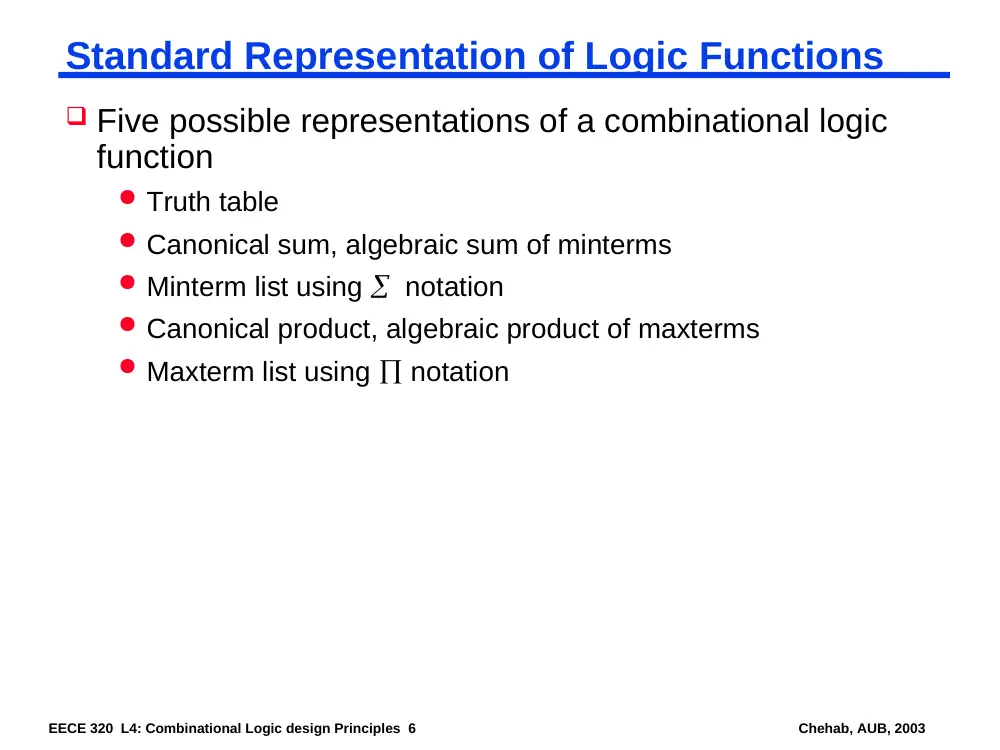
Five possible representations of a combinational logic
function
Truth table
Canonical sum, algebraic sum of minterms
Minterm list using notation
Canonical product, algebraic product of maxterms
Maxterm list using notation
EECE 320 L4: Combinational Logic design Principles 7
Chehab, AUB, 2003
Standard Representation of Logic Functions
A
B
C
F
0
0
0
0
0
0
1
1
0
1
0
0
0
1
1
0
1
0
0
1
1
0
1
1
1
1
0
1
1
1
1
1
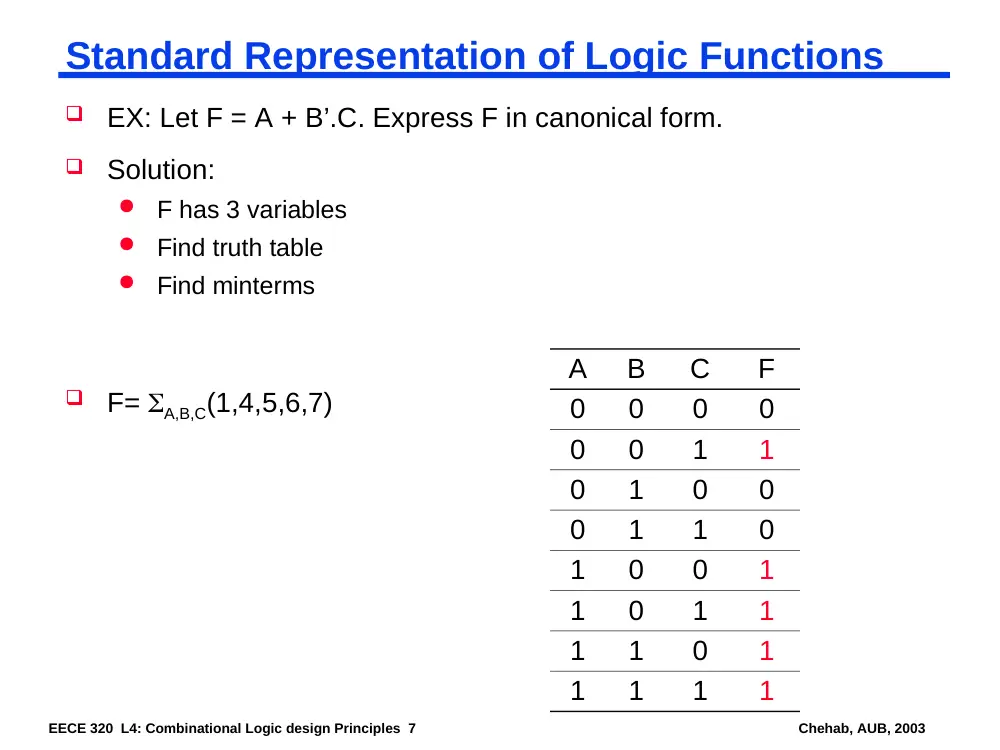
EX: Let F = A + B’.C. Express F in canonical form.
Solution:
F has 3 variables
Find truth table
Find minterms
F= A,B,C(1,4,5,6,7)
EECE 320 L4: Combinational Logic design Principles 8
Chehab, AUB, 2003
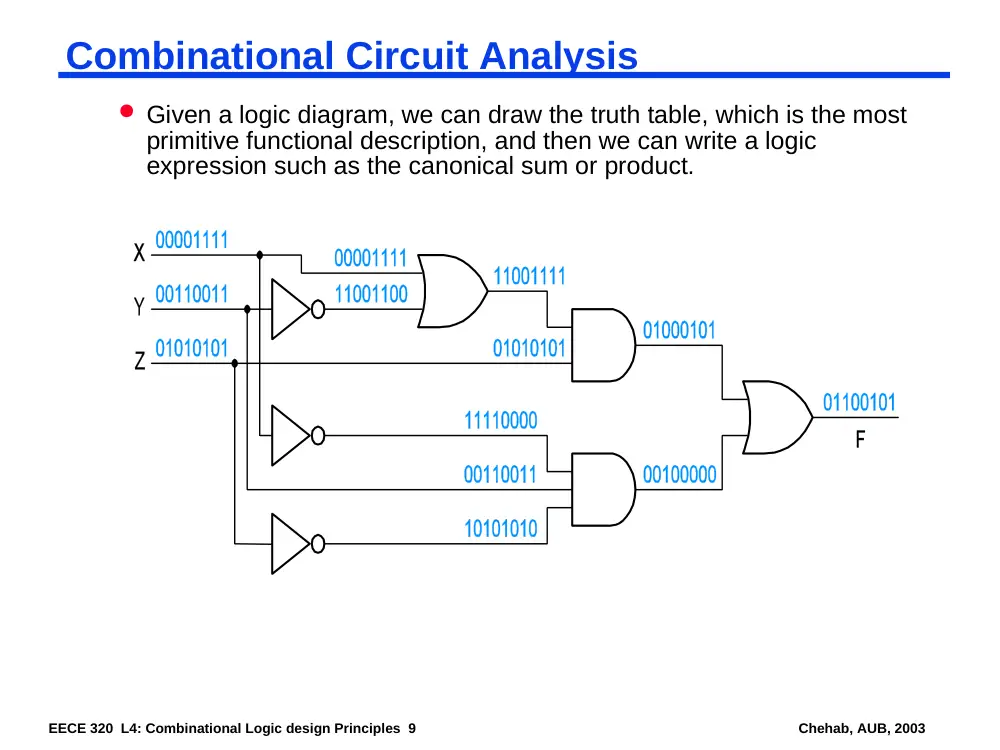
Combinational Circuit Analysis
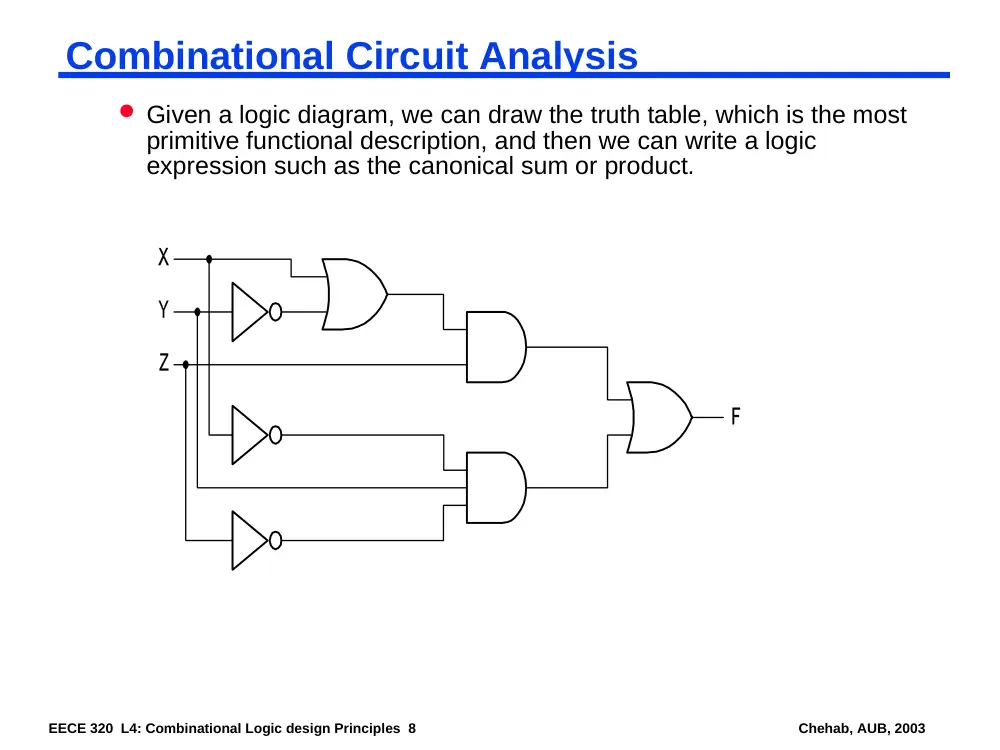
Given a logic diagram, we can draw the truth table, which is the most
primitive functional description, and then we can write a logic
expression such as the canonical sum or product.
EECE 320 L4: Combinational Logic design Principles 9
Chehab, AUB, 2003
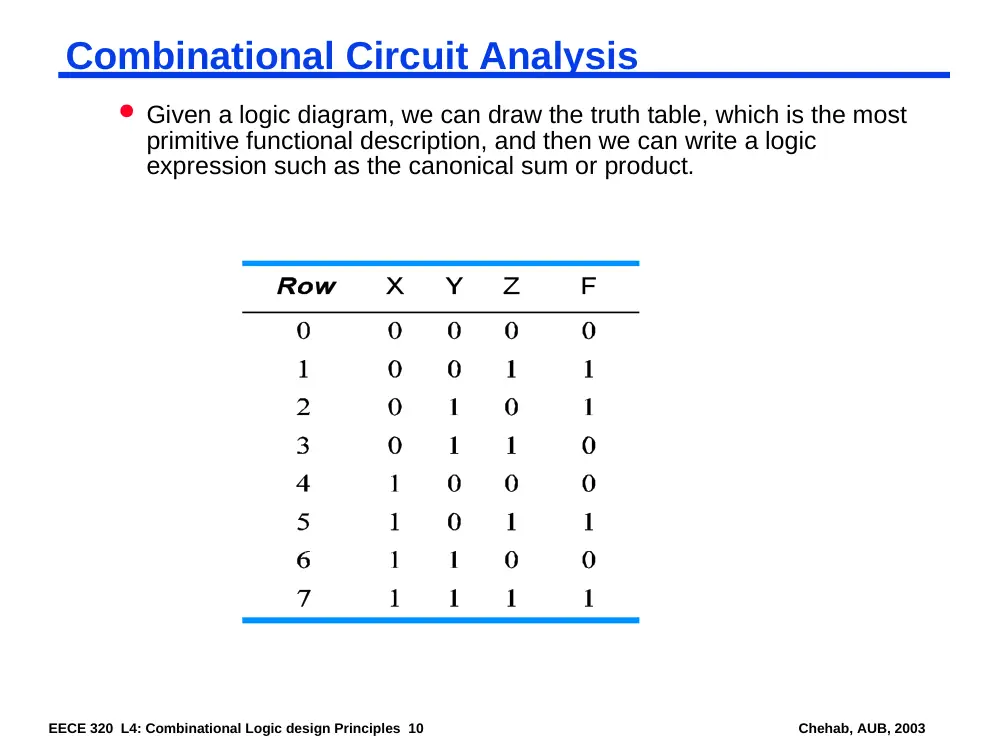
Combinational Circuit Analysis
Given a logic diagram, we can draw the truth table, which is the most
primitive functional description, and then we can write a logic
expression such as the canonical sum or product.
EECE 320 L4: Combinational Logic design Principles 10
Chehab, AUB, 2003
Combinational Circuit Analysis
Given a logic diagram, we can draw the truth table, which is the most
primitive functional description, and then we can write a logic
expression such as the canonical sum or product.
EECE 320 L4: Combinational Logic design Principles 11
Chehab, AUB, 2003
Combinational Circuit Analysis
The second approach is to build a parenthesized logic expression of
the circuit’s function. We start from the inputs and work our way to the
output.
EECE 320 L4: Combinational Logic design Principles 12
Chehab, AUB, 2003
Combinational Circuit Analysis
The second approach is to build a parenthesized logic expression of
the circuit’s function. We start from the inputs and work our way to the
output.
EECE 320 L4: Combinational Logic design Principles 13
Chehab, AUB, 2003
Combinational Circuit Analysis
If we multiply out the expression of F, we obtain a new expression
that translates to a new implementation.
F = ((X+Y’).Z) + X’.Y.Z’ F = X.Z + Y’.Z + X’.Y.Z’
Sum-of-product expression that can be implemented as a two-level
AND-OR circuit
EECE 320 L4: Combinational Logic design Principles 14
Chehab, AUB, 2003
Combinational Circuit Analysis
If we add out the expression of F, we obtain a new expression that
translates to a new implementation.
F = ((X+Y’).Z) + X’.Y.Z’
F = (X+Y’+X’).(X+Y’+Y).(X+Y’+Z’).(Z+X’).(Z+Y).(Z+Z’)
F = (X+Y’+Z’).(Z+X’).(Z+Y)
Product-of sum expression that can be implemented as a two-level OR-
AND circuit
EECE 320 L4: Combinational Logic design Principles 15
Chehab, AUB, 2003
Next Lecture and Reminders
Next lecture
Reminders